Month: May 2010

Can’t blog now, writing essays…

I will no doubt be caught up in moments of procrastination in the next two days… but it’s study week, and before I study for my exams I need to finish an essay.

I am intending to include the words milieu, and hegemony, in every essay I write this year. From this point on. Just because I like them.

Got any more words to throw into the pile?

Coffee is fuel for the brain

Yet another study has come out linking coffee consumption with a life both healthy and wise…

Regular consumption of caffeine over the long-term has been linked to lower incidences of Parkinson’s and Alzheimer’s disease in humans and lesser memory dysfunction and neurodegeration in animals, write neuroscientists Alexandre de Mendonça of the University of Lisbon and Rodrigo A. Cunha of the University of Coimbra, both in Portugal, in this month’s issue of the Journal of Alzheimer’s Research.

The beneficial effects only appeared when caffeine was consumed in moderate amounts (the equivalent of up to 4 cups of coffee a day for humans) regularly over a long period of time, Cunha told Livescience.

Rather than improve memory, “caffeine prevents any deterioration of memory caused by insults you might be prone to,” Cunha said.

It’s not talking about things someone may have said about your mum there – but rather things that effect your brain.

Read about it here, or order some coffee from the St. Eutychus Roastery here.

How to take a kick to the groin

Ouch. Complete with super slow mo replays, and biomechanical analysis. Apparently “no pain, no brain” is a factual reality.

Is this the best chase scene ever?

At the very least, it is possibly the most convoluted chase scene ever… It’s like the director found this list of possible elements for movie chase scenes and hit select all.

The best bit is that the guy doesn’t look at the explosions (which don’t come until right at the end). He’s so cool.

Power play: electricity generating soccer ball

Three Harvard students have come up with “sOccket” – a soccer ball with an internal generator that in a typical game will generate enough power to provide light for a house for a day.

“The ball uses inductive coil technology–similar to flashlights that power up when shaken. Each 15 minutes of play with the ball generates enough power to light up an LED lamp for 3 hours, so a soccer game could easily provide light for a day.”

A short history of everything

Have I posted this before? I can’t remember…

If every logo looked the same…

I actually wouldn’t mind a world where every logo had to be produced using Helvetica. A vision put to the test here.


The many faces of Space Invaders

It’s important to be on the look out for aliens. At least that’s what Hollywood has taught me. Space Invaders can come disguised in many ways. Here are some to be aware of.

Via Walyou.

Hitchens v Hitchens (again)

Peter Hitchens and Christopher Hitchens both have books hitting the shelves at the same time. I’ve posted on their famous disagreement before… Peter is a Christian journalist, his older brother Christopher is an atheist journalist. It’s almost providential really. That the perfect foil for one of new atheism’s most vocal advocates comes from the same genetic pool and has the same predisposition for communication.

Anyway, Hitchens’ (the younger) new book is reviewed in a piece from the Centre of Public Christianity, published in the Sydney Morning Herald. Here’s what Peter Hitchens has to say about the dangers of the rise of atheism.

“His experiences living and reporting from Russia and eastern Europe profoundly shaped his view of the world. Having lived in Moscow at the close of the Soviet era, and having witnessed other atheistic regimes in full flight, he refuses to accept his brother’s evasion of what he sees as an organic link between atheism and the most notorious modernist experiments of the 20th century.

It is this experience that appears to shape his concerns for society. He believes Christianity is under attack today because it remains the most coherent and potent obstacle to frightening and ruthless idealism: “The concepts of sin, of conscience, of eternal life, and of divine justice under an unalterable law are the ultimate defence against the utopian’s belief that ends justify means and that morality is relative. These concepts are safeguards against the worship of human power.”

Five Youth Ministry Stereotypes

To be avoided like the plague, the Bieber Plague.

This has been around for a while.

Speech bubbles for noisy pubs

Yeah. This is a good idea. You’ll make heaps more friends at the pub if you can listen to everything they say because you’re wearing one of these speech bubbles…

You know what we need chief. A ball of silence.

Via here.

iHallelujah

Just what your iPhone ordered. A hallelujah button. So that you can break out in non-spontaneous praise.

Lost in Translation

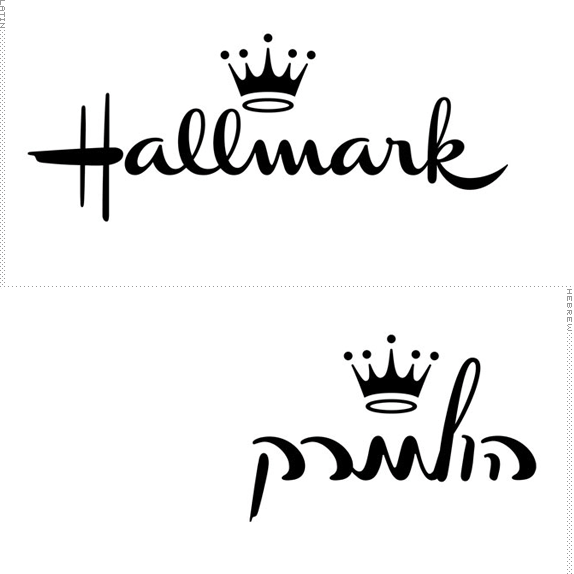
Hebrew versions of some “popular” logos. Most are indecipherable.

One among millions: Blogging infographics

It’s surprising how many of these apply

The St. Eutychus Guide to First Year Greek – Part Ten

Nouns of the Third Declension

Greek nouns, like the verbs, have a stem, a connecting vowel and an ending. The ending indicates case (and declension).

Third declension nouns have no stem vowel. They just whack the ending onto the noun’s root. The stem is easies to identify by removing the “ος” from the genitive. Third declension genitives receive an ος in every singular genitive and an ων in every plural genitive (regardless of gender).

Nominatives mostly either have just an ς or nothing, datives always end in ι (singular) or σι(ν) (plural), and accusative plurals always end in ς (either ας or ες).

Third declension nouns are categorised on the basis of whether the stem ends with a consonant or a vowel. Consonantal stems are split into categories based on the last phoneme of the stem.

The gender of third declension nouns is not readily apparent – in order to spot them in the wild we need to learn the nominative and genitive singular versions, and the article, as always, will be our greatest ally in figuring out what the noun is doing.

Because there is no stem vowel the dative plural σι(ν) often comes across letters that σ hates. So:

  • ξ, κ, γ, χ + σι(ν) = ψι(ν)
  • ψ, π, β, φ + σι(ν)  = ξι(ν)
  • ζ, τ, δ, θ + σι(ν)  = σι(ν)

If the stem ends in αντ, εντ, or  οντ in the dative case the ντ drops out and the leftover vowel lengthens.

eg: αντ + σι(ν) = ασι(ν)

εντ + σι(ν) = εισι(ν)

Adjectives, pronouns and numerals of the First and Third Declension

πας (meaning all) has a sibilant stem, so it follows δοξα, the stem of the third declension is παντ (from παντος).

πας has four uses:

  1. In the predicate it means “all”
  2. In the attributive it means “whole”
  3. With a noun without an article it means “every”
  4. When it stands by itself it’s substantive.

πας can have many different meanings (sometimes full or pure).

εις, ουδεις, and μηδεις

εις (“heis” not eis (which is into)) is the nominative masculine form of one. μια is the feminine nominative, while εν (“hen”, not en (which is in)) is the neuter.

The declension of εις, ουδεις, and μηνδεις is as follows

  • N: εις
  • G: ενος
  • D: ενι
  • A: ενα
  • N: μια
  • G: μιας
  • D: μιᾳ
  • A: μιαν
  • N: εν
  • G: ενος
  • D: ενι
  • A: εν

εκαστος εισ means “each one” and occurs commonly.

Greek double negatives don’t cancel each other out. So ουδεις and μηνδεις (no-one, no-thing) can reinforce a negative .

ουδεις is used in the indicative mood. μηνδεις in the others.

πολυς, μεγας and αληθης

  • πολυς = much, many
  • μεγας = great
  • αληθης = true, and is declined using third declension end.

Comparison of Adjectives

Adjectives in Greek have three degrees – positive (normal) (beautiful, hard, good), comparitive (harder, more beautiful, better), and superlative (hardest, most beautiful, best).

Comparative adjectives take the forms: -τερος, -τατα, -τατον

Superlative adjectives take the forms: -τατος, -τατη, -τατον

So:

δικαιος (positive), δικαιοτερος (comparitive), δικαιοτατος (superlative)

There are a bunch of irregular comparatives:

  • αγαθος (good) -> κρεισσων (better)
  • κακοσ (bad) -> χειρων (worse)
  • μεγας (great) -> μειζων (greater)
  • πολυς (much) -> πλειων (more)

Adjectives may be used to express a comparison. This happens in two ways:

  1. By placing the noun (or pronoun) to be compared in the genitive. This is called the genitive of comparison.
  2. By using the particle η (than) and nouns in the same case.

The comparative form is often used with a superlative function “but the greatest of these” or the elative sense “very great”…