Archives For biblical theology

If you haven’t been following along on the interwebs, a hornets nest has been kicked and then ignited with the release of three Zondervan e-books about women and preaching, and whether or not they should do it.

I’ve read one of these, Hearing Her Voice, by John Dickson, the following review should come with the same caveats I included when I reviewed Promoting the Gospel: the best kept secret of Christian mission - I think John Dickson is excellent, I love his published body of work, and have found him helpful at just about every step of the way on my journey from Christian kid to theological student.

In this book we get more of Dickson’s very solid hermeneutical model applied to a pretty tricky question, and particularly applied to a verse that creates quite a few difficulties for the modern church. Seriously, he is, I think, the model of what being a careful interpreter of Scripture looks like, there’s a great para in the book that outlines his approach to using history as a tool for exegesis, and I commend it to you.

I was going to include quotes from the book – but this post is already almost 6,000 words long.

The question at the heart of this book – well, there are two questions, I think – and perhaps three – is what is “teaching?” Is preaching teaching? And if not, can women preach in church?

What’s not up for grabs for Dickson is the real strength of his work – he’s big on the authority of Scripture, big on consistently reading and exegeting it with the original readers and meaning in mind, and big on the principle that while male and female are equal in God’s sight, we are different.

I feel like I should throw in a few disclaimers at the start so you know where I’m coming from…

  • I’m aware of the dangers of being a “privileged” and unoppressed class speaking out on this issue – a white, anglo-saxon, male, protestant voice in this debate needs to be pretty mindful of his cultural background and relative freedom to make proclamations that appear to come at a cost to others.
  • I love the concept of a priesthood of all believers – it goes without saying that this includes men and women – I think it’s biblical, I think we’re all called to be on mission together, and equipped by God to serve as part of the body of believers as we serve and love one another and try to reach people together.
  • I think there are lots of women who are gifted preachers, teachers, and evangelists. I don’t see any gender specific traits that make being able to show someone else that Jesus is the Christ a particularly male act. This isn’t an “innate” issue, or a “masculinity” issue, men are not innately more competent in this area than women.
  • I’m also a complementarian – I think our different genders are a good and necessary part of what it means to be human.
  • I agree that there are lots of roles open to women that we’ve essentially closed because we’re scared of transgressing in this area – including prophecy, exhortation, partnering as “gospel workers,” etc.
  • I think the gender stuff at the fall is pretty interesting, and is certainly something Paul has in mind in this verse. While this is pretty absent in Dickson’s book, it is something Mike Bird, who wrote a second book in the series, spends some time considering – but I haven’t read that yet.
  • I’m wary about tossing out 2,000 years of church tradition, particularly the interpretive traditions from people who took the Bible seriously – though I’m also aware that all interpreters are fallible, and texts, and interpretations of those texts are the product of different cultures.
  • I’ll also presuppose that how we do church – including who preaches – is part of our ethos, so that the decision about who preaches is, in part, a decision we make about our presentation of the gospel.

What is a sermon? Teaching? Exhortation? Preaching?

I have some reservations about how Dickson approaches the Greek language (and how others do too) – but this is probably because they are experts at Greek and I am not. I think word studies have some merit, but I think assume too much about the deliberation that goes into the use of particular words, rather than paying heed to the vibe of a paragraph, or whole letter. I think words often have a broad semantic range that overlaps with other words, and you kind of use those ranges together to create new concepts – Dickson thinks this happens with “teaching” and “authority” in the verse in question… So I don’t really like arguments based on word studies – and most of my response won’t really engage with the question of whether or not “teaching” or in the Greek, didaskein, is a technical word for a particular act, or a general word for the passing on of knowledge – this is where the debate is being fought out on the interwebs by Lionel Windsor, and Dickson himself (in a great model of how you can disagree with people without calling their character into question…

Like I say – I’m not an expert on Greek, and don’t pretend to be, and I’m fairly sure that words can also be used technically to mean very narrow things – but I do think literary context guides interpretation… and I think one of the concerns of Paul’s letter to Timothy is to help Timothy, and the church, think rightly about questions of pastoral leadership – including the establishment of a role that seems to be for men and includes carrying the responsibility of preaching and teaching, within the church.

I don’t think Dickson necessarily disagrees with this approach to language – though his treatment of “teaching” here is very similar to his treatment of “evangelism” in Promoting the Gospel. He allows for general  use of words, while suggesting we need to pay heed to the technical meanings that may have been in operation in the first century.

He spends significant time making the case that “teaching” isn’t directly transferrable to what we do in the pulpit of a modern church each Sunday – and his argument seems to have some merit. I don’t think preaching is the teaching, in the technical sense, that Dickson identifies. So I’m almost happy to cede his whole argument, on one level – if the Sunday sermon is exhortation, as he suggests, or prophecy as the Puritans suggest, and not teaching (as Lionel Windsor suggests it is) – then I think he’s right – women should be able to exhort, prophecy, and do all the things that Paul specifically or implicitly allows, and even all the things he doesn’t forbid.

Anyway – here’s the passage in question, with a bit of context. From 1 Timothy 2…

For there is one God, and there is one mediator between God and men, the man Christ Jesus, who gave himself as a ransom for all, which is the testimony given at the proper time. For this I was appointed a preacher and an apostle (I am telling the truth, I am not lying), a teacher of the Gentiles in faith and truth.

I desire then that in every place the men should pray, lifting holy hands without anger or quarreling; likewise also that women should adorn themselves in respectable apparel, with modesty and self-control, not with braided hair and gold or pearls or costly attire, 10 but with what is proper for women who profess godliness—with good works. 11 Let a woman learn quietly with all submissiveness. 12 I do not permit a woman to teach or to exercise authority over a man; rather, she is to remain quiet. 13 For Adam was formed first, then Eve; 14 and Adam was not deceived, but the woman was deceived and became a transgressor. 15 Yet she will be saved through childbearing—if they continue in faith and love and holiness, with self-control.

In 1 Timothy 3, when he’s establishing the qualifications of a deacon, and an overseer he gives a set of ethos heavy principles, like being “above reproach” – which presumably has something to do with not undermining his leadership of others, and “be well thought of by outsiders, so that he may not fall into disgrace, into a snare of the devil.” It is assumed in these verses that the person in question is a man – building off his argument in chapter 2.

In 1 Timothy 5 it appears he assumes these elders will be the people doing the “preaching and teaching”…

17 Let the elders who rule well be considered worthy of double honor, especially those who labor in preaching and teaching. 18 For the Scripture says, “You shall not muzzle an ox when it treads out the grain,” and, “The laborer deserves his wages.”

Then, in 2 Timothy 4, he kind of spells out what Timothy is called to do, under the umbrella of “preaching”…

4 I charge you in the presence of God and of Christ Jesus, who is to judge the living and the dead, and by his appearing and his kingdom: preach the word; be ready in season and out of season; reprove, rebuke, and exhort, with complete patience and teachingFor the time is coming when people will not endure sound teaching, but having itching ears they will accumulate for themselves teachers to suit their own passions, and will turn away from listening to the truth and wander off into myths. As for you, always be sober-minded, endure suffering, do the work of an evangelist, fulfill your ministry.

Ultimately, I’m not convinced by the way Dickson groups “teaching” and “authority” into one command, rather than two separate but related commands based on the same Old Testament/created order principle… and I think there’s another reason, an ethos reason, when it comes to how we persuade people about the message of the gospel that means we should think carefully about how we use, or emphasise, gender and authority in church gatherings… which I’ll get to below. Somewhere. I think what is done from the pulpit is an act of authority – and listening is an act of submission.

Where I think Windsor is right to go (but slightly wrong in where he lands – I think), and where I think Dickson is wrong – is on what the sermon actually is. In sum, Windsor thinks it’s teaching, and Dickson sells teaching short, Dickson thinks the sermon is exhortation, or something analogous to that – and thus thinks women can give sermons.

What Preaching is not…

I’d argue, with Dickson, that preaching is not teaching, we’ve hastily drawn an analogous line from the Bible’s use of teaching to our modern equivalent, and that’s come at a cost.

  • Preaching is not simply teaching – though it may involve the transmission of information from someone with knowledge to someone without.
  • Preaching is not strictly exhortation though it may encourage.
  • Preaching is not simply prophecy, though it may speak God’s word to people at a particular time… though in a sense a good sermon is all of these things. 

This is one of the areas I think Dickson’s argument breaks down – you don’t have to look much past Paul to find someone who exercises more than one of the “offices” of word ministry that Dickson seems to suggest are in operation… Paul also suggests all of these things are part of Timothy’s job as a preacher (2 Tim 4).

It’s quite possible that there’ll be an overlap of different styles of speaking in any particular speech, much as there was in just about any form of first century oratory. Where Cicero, in Brutus, bags out some orators for being too specialised in one area, because the idea was that public speakers could adopt a wide range of styles, from the boring didactic history lecture, to the witty declamation of an opponent on the election trail.

What a sermon (preaching) is…

Preaching is preaching. It has a New Testament equivalent – and an Old Testament equivalent. It has a Greek word – kerusso – which had a pre-existing technical meaning, and a meaning that developed through Christian usage, and it appears to be something like being a herald and proclaiming good news, with authority.

I’d argue that if one:

then our sermons are not “teaching” in the sense identified by Dickson – but “preaching”… in the sense that the word is used throughout the New Testament.

Our sermons should point people to Jesus and the kingdom of God, attempt to persuade people to accept the message, and declare that, Jesus is Lord – This essentially does nothing for the gender question but move the goalposts, so the question is not “can women teach?” but “can women preach?” – so Dickson’s insights, while useful, are potentially irrelevant to the question.

I would say that I think preaching is an act of authority – but the ultimate authority rests in the same person it rests in when Jesus is challenged about the authority behind his preaching – God and his Christ. When we preach faithfully we are simply pointing to the authority of Jesus. The way authority is exercised over the church is ultimately in the preaching of the word (and the faithful passing on of the apostolic traditions) as they relate to Jesus, not the appointment of humans who have particular gifts in particular areas.

Here’s where I want to make the case that this isn’t a new way of thinking about what preaching is – first from the Reformers, and then, after a little ethos excursus from the New Testament (though the order should be reversed – the NT stuff is pretty long).

Preaching in the Reformed world

Both Luther and Calvin (Institutes, 4.1.5) put a pretty high value on preaching , if preaching involved the gospel – so much that preaching was more important than the sacraments in terms of constituting Christ’s presence in the gathering of the body – this was a big deal in a time where people were killed over what they thought happened at communion.

Calvin says:

“We see that God, who might perfect his people in a moment, chooses not to bring them to manhood in any other way than by the education of the Church. We see the mode of doing it expressed; the preaching of celestial doctrine is committed to pastors. We see that all without exception are brought into the same order, that they may with meek and docile spirit allow themselves to be governed by teachers appointed for this purpose… Hence it follows, that all who reject the spiritual food of the soul divinely offered to them by the hands of the Church, deserve to perish of hunger and famine. God inspires us with faith, but it is by the instrumentality of his gospel, as Paul reminds us, “Faith cometh by hearing” (Rom. 10:17). God reserves to himself the power of maintaining it, but it is by the preaching of the gospel, as Paul also declares, that he brings it forth and unfolds it.”

Both (Luther Large Catechism (PDF, p 72), Calvin Institutes 4.1.1, 4)  saw the church as the “mother” of believers – responsible, ordinarily and under God, for giving birth to new believers and nurturing the faith of existing believers – and it did this, for both groups, in the same way – by preaching the gospel of Jesus. Not legalism. Not morals. Not ethics. Not just words of encouragement. But the gospel.

The gospel will have necessary implications for our morality and ethics – and it will necessarily be encouraging as we consider that the creator of the universe sent his son to earth to buy us, for a relationship, to make us his children. But our sermons that do all these things do these things because they first declare the truths of the gospel, and these things are part of the persuasive case the gospel makes for those who hear it.

The preaching of the gospel is one of the “marks of the church” for Reformed people.

The Westminster Confession of Faith essentially follows both Calvin and Luther on this point – it says the church is responsible for the “gathering and perfecting of saints” (WCF VII, XXV), and that the preaching of the word is one of the two marks of the church (along with the administration of the sacraments).

“And particular Churches, which are members thereof [the universal, visible, church], are more or less pure, according as the doctrine of the gospel is taught and embraced, ordinances administered, and public worship performed more or less purely in them.”

In XV the Confession says ministers are to preach: “Repentance unto life is an evangelical grace, the doctrine whereof is to be preached by every minister of the gospel, as well as that of faith in Christ,” and in XXI it says faithful preaching is part of worship. This preaching is conducted by these “ministers of the gospel”…

I like this quote from Calvin that Justin Taylor shared last week:

“This is what we should in short seek in the whole of Scripture: truly to know Jesus Christ, and the infinite riches that are comprised in him and are offered to us by him from God the Father. If one were to sift thoroughly the Law and the Prophets, he would not find a single word which would not draw and bring us to him. . . . Therefore, rightly does Saint Paul say in another passage that he would know nothing except Jesus Christ, and him crucified.”

Biblical, expository, sermons will point people to Jesus Christ in a way that declares his kingdom has come at the cross. It is preaching, not teaching.

An argument from “authority” – an ethos consideration

I think a case can be made that Paul’s prohibition on women exercising authority in the 1 Timothy 2 passage refers to what is going on in the gathering, and works a bit with the similar prohibition in 1 Corinthians, to establish a principle, rooted in creation and the fall, for what happens when the church meets and the gospel is preached… as an authoritative act.

But even if that case is weak – I wonder if there’s an ethos driven, cross-shaped, argument for women letting men preach, if sermons are preaching, and preaching is an act of persuasion where both pathos and ethos are as relevant as what we say… even if they are more gifted than their male counterparts, which is surely often the case.

A willingness to submit is part of the testimony of the gospel of the cross – as is a willingness to sacrificially not use our gifts for the sake of others… I’d argue Paul is essentially doing this in Corinth when he avoids using his full rhetorical prowess, that he demonstrates in Acts, in order to “know nothing but Christ and him crucified” as he teaches them, knowing what he does about their culture and context – and the sinful desires they have to place value in their abilities or flashy man made idols. I reckon its possible that gender equality is a bit of an idol in our culture – I’m not arguing that it’s a bad thing, idols are good things turned into ultimate things… but I wonder if a refusal to give in to cultural pressure on the gender front, voluntarily, might be a hugely important part of our testimony.

This is where a little bit of trepidation kicks in on my part – because I recognise that I’m a guy telling gifted women they can’t do what they’re gifted to do.

But, I think it’s possible that If we believe that:

  • genders are different, but that people are equal in value,
  • that the gospel does away with inequalities that people might establish on the basis of differences (Gal 3:28),
  • that submission isn’t a statement of inequality, this is where some smart egalitarians like Miroslav Volf depart, but it must be true because if we believe that the Trinity is made up of three parties who are equally God, we need to be able to say that Jesus can submit to the father without calling this equality into question (in academic terms this is a question of whether you can have functional subordination alongside ontological equality, I think the answer has to be yes, if the submission is voluntary, an act of love, offered without coercion),

then we should be able to sacrificially let men do the preaching… even if there are women out there who are better equipped to do the job… because this is part of our testimony, and our act of testifying – to the sacrifice of Jesus, for his church – just as it is in marriage (Ephesians 5).

The act of preaching is an act of authority – but this authority isn’t establishing an inequality – and if it does create such an inequality, then questions have to be asked about whether or not the guy is doing his job – just like in a marriage. Because a cruciform preacher who humbly uses the gifts God has given to build up the church and point people to Jesus through the persuasive preaching of the gospel won’t, if logos, pathos, and ethos stack up, be in a position to create any inequality except the inequality created by considering everybody else better than yourself…

Our value to God isn’t caught up in our ability to serve him – with the gifts that he has given us, nor is our testimony – I would argue our testimony is caught up in our ability to live cross-shaped lives where we imitate Jesus, who despite having all authority and abilities in his grasp, and being equipped to do otherwise gave himself up for us, as an example, here’s Philippians 2:

2 So if there is any encouragement in Christ, any comfort from love, anyparticipation in the Spirit, any affection and sympathy, complete my joy by being of the same mind, having the same love, being in full accord and of one mind. Do nothing from selfish ambition or conceit, but in humility count others more significant than yourselvesLet each of you look not only to his own interests, but also to the interests of othersHave this mind among yourselves, which is yours in Christ Jesus, who, though he was in the form of God, did not count equality with God a thing to be grasped, but emptied himself, by taking the form of a servant, being born in the likeness of men.And being found in human form, he humbled himself by becoming obedient to the point of death, even death on a cross. Therefore God has highly exalted him and bestowed on him the name that is above every name, 10 so that at the name of Jesus every knee should bow, in heaven and on earth and under the earth, 11 and every tongue confess that Jesus Christ is Lord, to the glory of God the Father.

Perhaps the way we testify to our unity, our like mindedness, and avoid promoting our gifts, interests, and selves, is to be prepared to not do things we could do, as part of our testimony to Jesus, and to the creator who sent him, and made men and women different.

Communicating why we’re doing this, and valuing, affirming, and giving avenues for gifted women to be effective members of the body and servants of the mission of God is obviously pretty tricky – and one of the great strengths of Dickson’s work is that it’s motivated by exactly this concern.

Continue Reading…

I’m doing some stuff on the church for one of my subjects this semester (well, for three of them, but this one in particular is called Church, Sacraments, and Ministry). Here’s a cool bit of Biblical Theology that I’d kind of thought about before but I’ve just had to articulate it…

These passages work really nicely together to account for the global significance of the gospel…

In Genesis 11 you get the story of Babel, some entrepreneurial peeps try to build a big tower to be like God. Because they all speak the same language.

11 Now the whole world had one language and a common speech. As people moved eastward,they found a plain in Shinar and settled there.

They said to each other, “Come, let’s make bricks and bake them thoroughly.” They used brick instead of stone, and tar for mortar. Then they said, “Come, let us build ourselves a city, with a tower that reaches to the heavens, so that we may make a name for ourselves; otherwise we will be scattered over the face of the whole earth.”

But the Lord came down to see the city and the tower the people were building. The Lordsaid, “If as one people speaking the same language they have begun to do this, then nothing they plan to do will be impossible for them. Come, let us go down and confuse their language so they will not understand each other.”

So the Lord scattered them from there over all the earth, and they stopped building the city.That is why it was called Babel —because there the Lord confused the language of the whole world. From there the Lord scattered them over the face of the whole earth.

It’s a nice little theological account for why there are different nations – which sits just before God calls Abraham (then Abram) to start his own people – and they’re meant to bless these other nations (Gen 12:1-3).

Skip ahead a few thousand years (well, you could incorporate the nations coming in to see Solomon. I probably would). And you get the great Commission… Especially these bits in Matthew 28:

18 Then Jesus came to them and said, “All authority in heaven and on earth has been given to me. 19 Therefore go and make disciples of all nations, baptizing them in the name of the Father and of the Son and of the Holy Spirit, 20 and teaching them to obey everything I have commanded you. And surely I am with you always, to the very end of the age.”

It’s global. But it’s global because the Babel type distinction (which has become a “Jew/Gentile” distinction) has been broken down by Jesus.

Paul says it this way in Galatians 3:

28 There is neither Jew nor Gentile, neither slave nor free, nor is there male and female, for you are all one in Christ Jesus.

Here’s some cool stuff though… Babel starts getting reversed at Pentecost in Acts 2 (I know it’s probably obvious, sometimes the obvious can be exciting though)…

2 When the day of Pentecost came, they were all together in one place. Suddenly a sound like the blowing of a violent wind came from heaven and filled the whole house where they were sitting. They saw what seemed to be tongues of fire that separated and came to rest on each of them. All of them were filled with the Holy Spirit and began to speak in other tongues[a] as the Spirit enabled them.

Now there were staying in Jerusalem God-fearing Jews from every nation under heaven.When they heard this sound, a crowd came together in bewilderment, because each one heard their own language being spoken. Utterly amazed, they asked: “Aren’t all these who are speaking Galileans? Then how is it that each of us hears them in our native language?Parthians, Medes and Elamites; residents of Mesopotamia, Judea and Cappadocia, Pontusand Asia, 10 Phrygia and Pamphylia, Egypt and the parts of Libya near Cyrene; visitors from Rome 11 (both Jews and converts to Judaism); Cretans and Arabs—we hear them declaring the wonders of God in our own tongues!” 12 Amazed and perplexed, they asked one another, “What does this mean?”

That, in itself, is a pretty nice piece of Biblical Theology. But what I really love is when you throw in a picture of what heaven will look like, which seems to riff on this little thread that develops through the Bible – where people get together and sing with one voice…

After this I looked, and there before me was a great multitude that no one could count, from every nation, tribe, people and language, standing before the throne and before the Lamb. They were wearing white robes and were holding palm branches in their hands. 10 And they cried out in a loud voice:

“Salvation belongs to our God,
who sits on the throne,
and to the Lamb.”

Cool. Hey. Babel gets reversed so that people can sing stuff about Jesus.


Parenting is fun. We love it. Getting advice about parenting, well, that’s a mixed bag. Some is helpful. Some is odd. Most is well intentioned. Some is revenge for the years of pain I’ve inflicted on other people’s kids.

Anyway.

Here’s my number one piece of parenting advice. Buy your child this kid’s Bible. The Jesus Storybook Bible: Every Story Whispers His Name. For less than $12, excluding postage, you pretty much can’t go wrong. It’s brilliant. We’re on the third lap. It is well written, it is theologically astute. You’ll probably learn something about how to make Biblical concepts clear enough for kids.
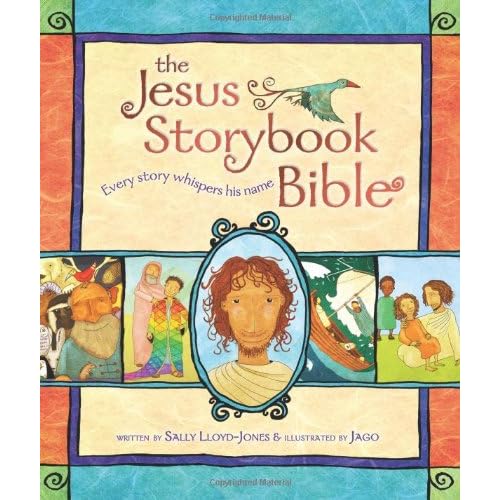
It’s a sensational example of why a Christ centred Biblical Theology brings the whole Bible together.

I am looking forward to Soph being old enough for me to complement it with pictures from the Brick Bible. I have the Old Testament already. And you can find the kids talks I did once with pictures from the online version of Judges in my Bible Stories for Boys tag.

Brueggemann and Goldingay’s approaches to wisdom identified a worthwhile second peg in Biblical Theology theology that is often ignored in favour of focusing on salvation or redemptive history, bringing the issue of creation – what we are created to be/how we are created to live – into the mix. This approach puts the wisdom literature largely into the category of how we should live as people in God’s creation – but I’d suggest that the wisdom literature has a role to play in redemptive history. Because, as I’ve posted previously, I think the wisdom literature was part of an international wisdom dialogue, and that it put forward wisdom grounded in YHWH as true wisdom. Israel had a covenantal obligation (see Gen 12) to bless the nations. I think Solomon’s wisdom, as described in 1 Kings 4-10, is where we see that blessing most fulfilled in the Old Testament, and the linking of the wisdom corpus to Solomon’s reign provides a handy interpretive key with regards to its purpose. This doesn’t do away with the two poled creation/redemption approach. It’s not an either/or thing. To suggest that the Wisdom Literature only had one function or purpose and only has one way of being integrated with understanding the big picture is to create an unjustifiably false dichotomy.

Two of the problems that have caused the wisdom literature to be seen, as Brueggemann calls it, as the embarrassing step-child of the Old Testament, are its similarities to other Ancient Near Eastern wisdom, and the apparent presentation, in Proverbs, of a retributive “you reap what you sow” theology. Some scholars have suggested that Proverbs is so different in outlook to Job and Ecclesiastes that they can only be considered to have arisen in protest to this retributive idea. It’s very possible that this protest question is going to come up in the exam for the B Th people… so I’ll post my essay answer to that question again shortly.

I think that rather than being a problem for figuring out the Wisdom Literature, its similarities with other writings from the time and place are part of the answer. To touch on my current “big idea” – we’re used to the idea that part of the Genesis account is written directly to address other ANE creation accounts (the Gilgamesh Epic and Enuma Elish), and as I mentioned in my post on the Old Testament law and women last week, the laws in Leviticus are very similar to laws governing the same legal issues in contemporary cultures (just nicer, and designed to help Israel be “set apart” from their neighbours). So why do we get to the wisdom literature and go “oh no, it’s similar to the other nations” and then see this as a problem. Perhaps the Biblical wisdom literature seeks to address the influence of wisdom literature from other cultures on the people of Israel. Perhaps, in the light of the account of Solomon’s rule, it also seeks to participate in an international wisdom dialogue, and maybe it’s even presenting a philosophical apologetic for subscribing to Israel’s religious system to her neighbours… Norman Whybray, Bruce Waltke, and Christopher Wright have suggested there was an international wisdom conversation going on around the time the wisdom literature was emerging in Israel, Proverbs contains, by its own admission, wisdom from foreign kings, collected by Solomon (and others), and the account of Solomon’s reign in 1 Kings includes him giving his better wisdom to surrounding nations (as fulfillment of Genesis 12 – which is the intention of the 1 Kings narrative (Goldsworthy).

Most scholars are quick to dismiss the idea that Israel stole wisdom from other countries willy-nilly as it sought to develop its own social identity, but few explain the presence or influence of foreign wisdom in the Bible. Other than to suggest that all wisdom is developed out of observations of the same world. All agree that Hebrew wisdom deliberately creates a monotheistic distinction from conventional ANE thought. This deliberate distinction, not the similarities, should provide the most fruit for understanding the relationship between similar works.

Wright suggests Israel’s wisdom thinkers and writers took part in an international dialogue “with an openness to discern the wisdom of God in cultures other than their own,” and that such comparisons lead to the conclusion that there was “a lot of contact between Israel’s wisdom thinkers and writers and those of surrounding nations.”

Tying the wisdom literature to Solomon’s reign – the guy who built the temple, and reached the nations – seems to be a pretty good way to bring it alongside redemptive history, as primary documents from the time when Israel was at its peak… and its not doing an injustice to the text – because Proverbs and Ecclesiastes both present themselves as linked to Solomon, and most scholars acknowledge that the wisdom movement flourished under his reign.

Wright (2006) suggests “any wisdom that is associated with Solomon must be connected with the Solomonic tradition that God should bless the nations in their interaction with Israel.”

Here’s where I think that leads (from my essay):

Solomon participates in an international wisdom dialogue with foreign leaders, judges justly, and blesses the ANE world in fulfillment of the Abrahamic promise (Genesis 12:3), in the manner envisaged by the Psalm 72. His international focus is evident in his prayer dedicating the temple contains an international injunction (1 Kings 8:41-43). It is also feasible to assume that the description of Solomon’s collection of wisdom crossed national boundaries.

The aspects of his reign that I would suggest have bearing on our interpretation of biblical wisdom are as follows:

1. An interaction with the ideas of the nations and their rulers and wisdom, and thus with the religious beliefs of the nations (1 Kings 4:29-34, 1 Kings 10:23-24)
2. A theological focus, and corrective of international wisdom, based on the “fear of the Lord” (1 Kings 8:43).
3. A desire to see the nations come before Yahweh, recognising his rightful position as creator of the world and the basis of wisdom and righteousness (1 Kings 8:41-43, 59-61, 1 Kings 10:9, Psalm 72).

The reference to Solomon’s wisdom “surpassing that of Egypt and the wisdom of all the men of the east “ (1 Kings 4:30) invites us to compare Israel’s wisdom with the nations, and it is therefore feasible to expect similar interactions between wisdom literature linked to Solomon and the wisdom literature of the ANE.

The biggest difference between the Biblical wisdom literature and that of the surrounding nations is the centrality (at least in the final form of the texts, but I’d argue also in their fundamental purpose) of the concept of the “fear of the Lord” – it’s an important theme in Job and Ecclesiastes, as well as in Proverbs. And it’s indelibly linked to salvation history.

The “fear of Yahweh” is a touch point of Jewish orthodoxy synonymous with faithful obedience (Deuteronomy 4:10; 5:29; 6:2, 13, 24; 10:12, 20).

The phrase occurs throughout Proverbs (Proverbs 1:7, 2:5, 9:10, 10:27, 14:27, 15:16, 15:33, 16:6, 19:23; 22:4; 23:17, 31:30, and an injunction to “fear the Lord” occurs in Proverbs 1:29; 3:7; 8:13; and 24:21), it occurs almost exclusively in the passages tied to Solomon (Chapters 1-24), and does not appear in those collected under Hezekiah.

The passages linked most strongly to other ANE wisdom writings fall in passages attributed to Solomon. Those passages are either directly proceeded by, or followed by, a reference to fearing Yahweh (Proverbs 22:4, Proverbs 24:21, and Proverbs 23:17).

The phrase is also used to contrast with the teaching of wise (Proverbs 13:14) and the fear of Yahweh (Proverbs 14:27), with both considered as the “fountain of life.”

Retributive theology was a big concept throughout the Ancient Near East. And you can read Proverbs as advocating such a position, if you remove any notion of God (and some scholars go so far as to suggest that the Fear of the Lord is an addition by a pious sage wanting Proverbs to be more Godly – Von Rad is one of them). But Waltke suggests that any Proverbs that lend themselves to this interpretation should be considered in the broader scheme of the book, and are likely to be eschatological.

The idea that Job and Ecclesiastes stand in conflict with Proverbs is popular modern wisdom scholarship, and some have tried to identify retributive theology in the ethics of the prophets, suggesting it played an important role in Jewish theology. Any concept of retributive theology legitimately found in the Old Testament is carefully grounded in the will of Yahweh, and is usually the fruit of a promise. I would suggest this view actually describes the purposes of the wisdom authors in addressing ANE conceptions of reality.

Here’s the bonus bit – from a comment from my dad in response to one of yesterday’s posts:

“Can I suggest that there’s lots of Deuteronomic content in Proverbs, particularly relating to the blessings of living under covenant in the land? It’s often observed that Proverbs is overly idealised, and ‘over promises.’ But I’d suggest, no moreso than the blessings of Deuteronomy would lead you to expect. In fact, if you allow for an allegorical reading of the “son” material as referring to Israel, who is not to prostitute himself to other gods, Proverbs is (arguably) just saying that ‘all the Deuteronomic blessings will be yours if you remain faithful.’ Conversely, there are clear exile warnings in the early chapters of Proverbs, which also fit it neatly into the Deuteronomic schema. From there, it’s a simple step to building it into the metanarrative of a Biblical Theology. (Theory Part B – It’s all integrated by Hosea, who was one of Hezekiah’s men, as specified in Proverbs as those who ‘gathered and Solomon’s teaching.’) Hence, there are heaps of proverbial statements in Hosea, and echoes of Hosea’s “Israel as son” theology in Proverbs.)”

So there’s another response to the idea of protest that seems plausible, and also ties the wisdom literature to redemptive history… Here’s what I reckon is going on, from the conclusion of my essay:

“I propose that the wisdom literature adopted and critiqued the wisdom conventions of surrounding nations in the same way that Israel’s historians adopted and critiqued stories of creation and the flood from the ANE and contrasted them with an account grounded in the actions of Yahweh. A true understanding of wisdom, like a true understanding of history, is grounded in understanding Yahweh’s involvement in the world, not in its ANE equivalents. If the wisdom literature is an apologetic for Yahweh as the author of life, in a deliberate comparison with other ANE gods, and if this apologetic occurs in the context of an international wisdom conversation, then it was both didactic for the people of Yahweh, and a declaration to the nations. “

Following up on yesterday’s summary of approaches to integrating wisdom and Biblical Theology, Wilson discusses integrating Wisdom Literature with Biblical Theology following Bruegemann and Goldingay.

Brueggemann proposes a dialectic approach to Biblical theology – using the poles of creation and redemption. Goldingay develops this idea, suggesting that while Salvation History is a prominent strand in Biblical revelation we can focus on it at the expense of baby and bathwater, neglecting stuff like how God interacts with nature, how he interacts in day to day life, and wisdom. He makes four statements that summarise the relationship between the two poles.

1. The world God redeems is the world of God’s creation.
2. The world that God created is a world that needed to be redeemed.
3. Humans are redeemed to live again their life created before God.
4. The redeemed humanity still looks for a final act of redemption, or new creation.

Four good points. And the question “what does this passage contribute to our understanding of God’s creation and our place in it as his people” is a useful one to ask in exegesis, perhaps not quite as useful as “how does this passage demonstrate God’s plans to redeem the world through Jesus, and how do you fit in that” – but splitting them is creating a bit of an unhelpful dichotomy. They’re the same coin.

Here’s Wilson:

“The first two [points] establish the connection between creation and salvation history (or covenant), and ensure that both voices are heard. God’s pusposes are wider than the covenant people. Yet they are also focused on Israel, and effected through them.”

I like the idea that ancient wisdom movements are analogous to the later philosophies that Augustine and others before him (like Justin Martyr) suggested God’s people should pillage like gold from Egypt – truth is truth wherever it is found. How’s that for integrating different disciplines from college (actually, I like that idea a lot, and I’ll post something on it post exams – I’m working up a pretty big idea that needs to be blogged in order for me to stop dwelling on it – that’s how I roll).

“The last [point] enables us to see the incompleteness and forward looking nature of the Old Testament. The expressions of future hope that we find mainly in the prophetic and apocalyptic materials are rightly seen as part of the Old Testament core. When we read these together we appreciate some of the flow of Old Testament theology. We see the movement from creation, through God’s redeeming acts in different generations, to the future hopes variously described as redemption or new creation. This is the big picture, the broad canvas of the Old Testament.

But there’s also a smaller picture, which Goldingay recognises in point three (but which I reckon is part of the bigger picture too, because Christians living that created life before God is part of bringing people into the grander narrative)…

Wilson on Goldingay’s third point:

“Here he again recognises that both creation and redemption have a part to play – people are redeemed to live their created life before God. Daily living is not just the concern of the wisdom materials. The Torah has extensive legislation that affects everyday life. The prophets call Israel back to right living within the covenant. Yet, the Wisdom themes have a great input here, particularly in the area of attitudes and the formation of character.

Kidner’s commentary on Proverbs says that wisdom focuses on “details of character small enough to escape the mesh of the law and the broadsides of the prophets.”

Wilson likes this twin pole idea championed by Brueggemann and followed by Goldingay. But he raises two concerns with regards to the Wisdom literature..

1. This point three needs clarification – wisdom isn’t framed as a response to God’s redemptive acts but rather to creation itself [though as Goldsworthy points out the "Fear of the Lord" suggests that wisdom might be based in the knowledge of God's position as redeemer]. Scobie is the guy who suggests that wisdom is a response to the world and the human experience. Wilson says “perhaps what is needed is a broadening of our understanding of the human response so that it includes responding to God’s redemptive acts (the law and the prophets) and to God’s order in creation (especially in the wisdom materials).

2. The connection between creation and redemption needs to be explored further – which is more fundamental? He breaks it down to the questions:

“Is the focus in the salvation-history materials on “what requirements should be imposed on the covenant community?” While that of wisdom is rather “what values should I adopt or strive for?”

A nice summary of the functions of wisdom and the law that Robyn and I worked up yesterday is that the law provides the ethical low base for how God’s people are to live, while wisdom and the laws regarding loving God, and loving your neighbour, are the high bar. It’s the way God’s people are meant to live. Ideally.

Coming up next – I’ll try to summarise the approach I landed on in my essay (which provides a function for the wisdom literature that focuses on a purpose for the wisdom literature that fits under this model, and a method of integrating the different books that doesn’t put them in opposition to one another), and I’ll, as a bonus, put forward my dad’s solution. Which I also haven’t read anywhere else.

When it comes to the question of a Biblical Theology of the Old Testament (an idea that underpins it and holds it all together) the wisdom literature is a bit of an elephant in the room. Most Old Testament theologies focus on themes like “covenant” or “promise” and tie the Old Testament to the new by dealing with the unfolding of the story of God’s dealing with his people and his creation, finding some form of fulfillment in Jesus. It’s a noble, and useful aim. Provided you don’t lump for one, at the expense of all the other themes that are also there, and also valid. Why can’t all our Old Testament theologies be friends?

Eichrodt pioneered the “covenant,” and Dumbrell picked that idea up and ran with it. Von Rad (the most awesome name in theology) preferred to focus his sights on “salvation history,” Kaiser proposed “promise,” which doesn’t seem that much different from “covenant” because it isn’t. He sees wisdom as “life under the promise” – but Scobie (who has a few bobs each way on a unifying idea in his “The Ways of Our God“) suggests this connection between wisdom and the rest of the Bible is tenuous…

A useful piece from the Reformed Theological Review by Lindsay Wilson called “The Place of Wisdom in Old Testament Theology” summarises the situation nicely. Here’s an overview of the article.

Kaiser put forward two questions that need to be answered in order for a big idea to be considered valid:

1. Was this idea and purpose in the minds of the Old Testament writers?
2. Can this view be embraced by the whole Old Testament without artificially overloading this point, or ignoring large blocks of material?

Since the 20th century and Von Rad and Eichrodt’s work, scholars have decided that no single idea can describe the Old Testament adequately.

Goldingay suggests there are three ways to approach to the diversity of the Old Testament.

1. Diverse theologies can be explained by various historical contexts (e.g the idea of what it means to be the “people of God” changes based on Israel’s political circumstances).
2. One strand of theology should be used to evaluate and critique the others (Deuteronomic or Deutero-Isaiah should be the dominant view, others should be compared and contrasted).
3. The strands should be brought together, Goldingay calls this a “unifying or contsructing approach” – in a manner that does justice to the theological diversity.

Goldingay describes the different approaches like this:

“One suggests that different viewpoints are appropriate to different contexts, another that they reflect different levels of insight, and a third that they are all expressions of one underlying theology.” – Goldingay, Theological Diversity and the Authority of the Old Testament, 1987

Wilson analyses these approaches…

The first approach helps to explain some of the diversity of the Old Testament – clearly Adam in Eden requires different commands and hopes to Abraham, and Abraham to David, and David to those in exile.

The second is the most open to objection – it can involve people reading the Old Testament through a lens of their own creation, not something borne out by the Old Testament itself (eg the “history of religions” approach that tries to describe the emergence of Jewish monotheism from ANE polytheism).

The third is both promising and vexing – one must decide what to include in the mix to form a key cluster of ideas held in complex unity.

Wilson now considers how the wisdom literature might be approached in relation to Biblical Theology.

Solomonic Enlightenment
Von Rad championedthe idea that there was a period under Solomon and David that allowed the unfettered development of the wisdom movement. Brueggemann agrees. Because Israel had arrived at its peak – the wise in Israel could turn from questions of faith to questions of how to live.

Brueggemann suggests the “salvation history” approach concentrates on traps man might fall into and God’s subsequent actions to deliver him.

“Scripture has been integrated primarily around the theme of redemption which tends to suggest the gracious, powerful role of God and the despair and helplessness of man… As a result the countertheme of creation has been generally neglected.”

Suggestions for how wisdom fits commonly turn to the idea that it’s about “the order in and goodness of creation,” this works with the idea that different social situations produce different theological approaches, and a different theological focus.

Wilson outlines two approaches for finding integration between wisdom literature and the rest of the Old Testament… finding salvation history elements in the wisdom books, and finding wisdom elements in non-wisdom books. A similar approach to that discussed in Goldsworthy’s Gospel and Kingdom.

Finding Salvation-History in the Wisdom Literature

He suggests the “Fear of the Lord” is one such link (as identified by Goldsworthy) but then suggests that the wisdom literature is more diverse than just “the fear of the Lord”…

“While Goldsworthy concedes that wisdom is a complement to, not a sub-set of, salvation history, he comes close to reading wisdom down to life under the covenant. Thus he concludes that “wisdom is a theology of the redeemed man living in the world under God’s rule”.”

Wilson says the second problem here is that such an approach “fails to show how the wisdom literature and salvation history elements are integrated… it establishes a point of contact, but says little about the interplay between the two strands.”

Finding Wisdom in the Rest of the OT

A bunch of scholars have suggested a “wisdom school” might have been influential in the writing or shaping of other texts. This is hotly disputed. James Crenshaw has suggested the methodology used in some of these studies is a bit rubbish. Wilson examines a couple of case studies that Crenshaw has critiqued, and while he agrees with Crenshaw that the stories (Esther and the Joseph Narrative) are not “wisdom” exclusively, he disagrees because he says wisdom may form part of the picture.

Wilson says:

“In the light of what we have seen so far, we are able to draw at least two conclusions. Firstly, Wisdom material and influence is a significant part of the Old Testament corpus. Any proposed analysis of Old Testament theology must do justice to Wisdom themes. Secondly, we must be wary of those who see wisdom as alien to the normative theology in the Old Testament.”

Wisdom is woven into the fabric of the Old Testament. We’ll see where Wilson takes his piece in the next post.

Wisdom literature gives some advice on guidance and decision making. Goldsworthy argues that wisdom literature can be related to Israel’s covenant faith. And that it points to the coming of Christ. Goldsworthy advocates a presuppositional approach to wisdom about the world. To be truly wise, first one must presuppose God. And because we presume God, we assume the Bible is the basis for true wisdom, then we also need to realise that the Old Testament finds its fulfillment in Jesus, so any consideration of the function of an Old Testament book must begin Christologically.

Wisdom is not intelligence, it belongs to all who believe the gospel. It’s not so much an intellectual approach to life, as it is a way of living life. It differs us from the animals.

We must begin [studying wisdom in the Bible] with Christ because it is through him that we become Christians and are motivated to study the Old Testament as Christian Scripture.

He suggests the question to ask of the Old Testament Wisdom is how it comes to help us understand Christ. And then we need to ask how the Wisdom Literature is fulfilled in Christ.

In Luke 11:31 Jesus makes an explicit comparison between himself and Solomon:

31 The Queen of the South will rise at the judgment with the people of this generation and condemn them, for she came from the ends of the earth to listen to Solomon’s wisdom; and now something greater than Solomon is here.”

Paul’s argument in 1 Corinthians 1 and 2 is another point of contrast – the Old Testament wisdom was very similar to the wisdom of the world, the gospel of Christ crucifed on the other hand, is folly to the wisdom of the world.

Worldly wisdom has a place. We use it every day.  When we approach questions of how to live our lives, we often turn to worldly wisdom without a thought about where it fits with God’s wisdom (appropriately) – we don’t ask if the correct approach to repairing a computer comes from God (nor should we take actions in those areas that contradict Godly wisdom – but you get the point).

“If Christians showed as much talent and shrewdness in the pursuit of the world for Christ as unbelievers show in the pursuit of riches, who could gauge what effect that would have?”

“Every culture collects the wisdom of its people, much of which will be found in the form of concise proverbial sayings.”

The wisdom literature from Babylon and Egypt has close similarities to the Biblical works.”

“At this point we can at least recognise that there is some common ground shared by the wisdom of pagans and that of God’s people”…

Stephen (Acts 7:22) suggests Moses was educated in Egypt’s wisdom.

By the time Moses went to school in Egypt there was already a long history of wisdom.

On Ma’at

“Ma’at represented an order that was to be seen particularly in the stability of the Egyptian state… There is no real parallel in Hebrew wisdom to Ma’at other than similarities to the idea of order. These similarities between Hebrew and Egyptian wisdom suggest that the common factor is the quest for the understanding of the order of the universe. Hebrew wisdom was distinct in that it was shaped by the Israelite experience of covenant and redemption.”

Goldsworthy suggests Biblical accounts of Solomon, and the non-Israelite bits in Proverbs suggest a connection between Israelite and ANE wisdom.

“The evidence available to us of the intellectual achievements of the people in the old civilizations of the Middle East shows us that wisdom was sought after and written down very early in recorded history. There is little doubt that wisdom sayings of some kind would have been part of the emerging culture of Israel’s ancestors.”

“Wisdom’s apparent lack  of concern for Israel’s history, covenant and law is one of its distinctive features. Perhaps we can work back from the wisdom books to look for clues to the origins of wisdom in Israel. The wisdom literature itself is lacking in the kind of historical references which would give such clues. The books of Proverbs and Ecclesiastes contain only the briefest indications of the traditional patronage of Solomon.1

Four kinds of evidence which contribute to our understanding of wisdom in Israel:

First – the scattered wisdom sayings found in various parts of the narrative literature of the Old Testament (some of these are clues to a pre-literary stage which probably existed before there were any schools of wisdom or written wisdom) – for example sayings about mighty hunters (Genesis 10), and “it became a saying” in 1 Samuel 10. In this case the word “saying” is the Hebrew word later used for Proverb.

Second – the wisdom books themselves.

Third – knowledge of the wisdom literature form the ANE – “the forms and functions of this wisdom suggest parallels to Israelite wisdom, but the differences are more obvious.”

Fourth – the possible wisdom influences on other books of the Old Testament, the idea that other books were compiled by wisdom schools, written by wise men, or influenced by wisdom thoughts.

“If we could be sure of the identification of wisdom influences [on the Old Testament], they would provide some valuable evidence of the place of wisdom in the main stream of Israelite thought. We would see how the wisdom ideas, which in the main wisdom books appear in almost complete isolation from expressions of the covenant faith, have been brought into organic relationship with that covenant faith.”

1 We’ll get to Solomon later, and Goldsworthy’s view (also, see the previous post).

1870s – Wellhausen’s Documentary Hypothesis (Source Criticism): Identifies JEDP – the four voices alleged in the Pentateuch. Breaking the texts into parts based on their use of names for God, theological focus (on ritual, or law), and on literary style. This followed about 100 years of source criticism.

Here’s what the breakdown of the text looks like (from Wikipedia):

1890s – Vos takes up a position as a professor of Biblical Theology in Princeton in a move designed to combat the emergence of text criticism as the dominant interpretive paradigm. Princeton was apparently looking for someone familiar with the German school and committed to a framework of Biblical Theology, Vos, having studied under the German school was perfect.

1940s – Noth and Von Rad (following Gunkel) introduced the idea of common oral sources (form criticism) for significant moments in Israel’s history. Noth also pioneered “the Deuteronomistic History,” the idea that Joshua to Kings represented a cohesive sociological-historical account of Israel for post exilic (7th century BC) use, at the same time both he and Von Rad saw Joshua as part of the same unit as the Pentateuch, arguing for a hextateuch (to me it seems like only a small step from Joshua to Judges which would make a septicheuch).

1941 – Cassuto, a Jewish Rabbi who wrote in Italian, offered a substantive criticism of the Documentary hypothesis that was not translated into English until 1961. He proposed that the Pentateuch was a single text, written by one author in the tenth century BC. His dating was a subsidiary to his criticism of the Documentary Hypothesis. He demonstrated that textual criticism – the notion of examining inconsistencies in the text to identify separate voices – was essentially cultural imperialism reading modern mores into ancient writings – and that the style of writing presented in the text was entirely consistent with Hebrew literary structure.

1976 – Schmid (another German) almost singlehandly removes the notion of the Jahwist voice (J), and some see him as having done away with all but the Deuteronomist.

1977 – Rendtorff went a step further than Schmid, he did away with both J and E, suggesting a Deuteronomic School was the most likely final editor of the OT, though allowing for a later “priestly” redactor.

My thoughts

Given my bias for Biblical Theology (ie a unified view of the text and an emphasis on inspiration), I’m glad the Documentary Hypothesis is on its way out the academic door. But I think it has provided useful insights (provided it sits under the umbrella of divine inspiration).

So here’s what I think.

The Pentateuch was probably around in some sort of oral/written form pretty early on, which was discovered (and possibly edited into a more cohesive form) under Josiah (there’s reference to a book of law being found in the temple under his reign so it must have existed before then), though compiled in its final form, and attached to the “deuteronomistic history” post exile as Israel struggled to come to terms with its identity. I think the Old Testament as a whole is a subjective retelling of Israel’s history so sociological and literary approaches to the text are useful, historical criticism is useful only insofar as it assumes the accounts will be flavoured in favour of Israel and genre is taken into account.

So, in summary, if I was answering a question like “how is Biblical Theology useful for understanding the Old Testament?” I would make the following points (probably with reference to Goldsworthy, Scobie, Dumbrell and Demster):

1. It grounds us in the notion that the Bible is a unified text not a hodgepodge of disparate parts strung together because no other documents existed.

2. It puts other forms of literary criticism in their place as subsets of this view (here I would reference Von Rad, Brueggemann, Barr, the documentary hypothesis and anything else that would demonstrate I knew what was at stake in terms of viewing the Bible as a loose collection of texts).

3. It helps us chart the development of God’s redemptive plans for creation from go to woe. Starting with creation and the fall, through the creation of his people with covenant obligations, the development of kingship, and ultimately culminating with the new creation and Jesus as king.

4. It reminds us that themes carry on, and develop through the Biblical text that are helpful for guiding our exegesis and our preaching.

None of the ideas put forward as unifying concepts for the Bible are entirely satisfying on their own, they all miss something of the complexity of the text (any simplification or summary will inherently do that), but they all play a role in shaping our interpretation. Pointing out linking themes is useful. Provided you don’t want to turn it into the only thread that holds the Bible together.

Just to add another Biblical Theology into the mix, Demster’s work is part of Don Carson’s “New Studies in Biblical Theology” series.

Like everybody else in the Biblical Theology world he starts with a bit of background on the discipline. He says “of the sixty biblical theologies written in the last hundred years there are almost as many theologies as there are theologians.”

Demster, in a vaguely Hegelian movement, critiques the application of both postmodernism and modernism to Biblical text. This is a cool quote:

“Theologians sailing in the waters of contemporary western culture have to avoid two opposite errors: they have to navigate between the Scylla of modernism and the Charybis of postmodernism. The error of modernism is objectivism, that is the idea that individual subjects can attain the entire value-free truth when examining an object – they can see it as it really is; while the error of postmodernism is subjectivism, the idea that because observers are never value-free or objective, they see the object according to their subjective perspective – they see it not as it is, but as they are (and therefore never really see it). A truly Judeo-Christian epistemology will navigate between these extremes…”

That’s a nice elegant critique with a reference to old school Greek mythology right there…

Barr championed the notion that the books of the Bible must be read separately because they were written separately, and stored as such until a later collation. He says notions of unity are “read into the text” rather than “read out of it.” The same could be said of the Lord of the Rings.

Demster provides a good quote for anybody tackling a question about the ordering or importance of keeping particular books in the Pentateuch:

“The larger literary context of the Tanakh has significant hermeneutical implications. For example, it begins with Genesis rather than Exodus, signifying that Israel’s national history is subordinated to that of world history.”

And one for anybody writing on Judges (this afternoon’s readings) – “The monotonous refrain at the end of Judges that there was no king in Israel. Everyone did what was right in his own eyes” (Judges 21:25) supplies the appropriate context for interpreting the rise of kingship in the subsequent book of Samuel.”

Demster affirms the cohesive literary value of the whole Old Testament, under its primary role as “scripture.” T.S Eliot said “the Bible has had a literary influence upon English literature not because it has been considered as literature, but because it has been considered the report of the word of God.”

Here’s another cool Eliot quote about primarily enjoying the Bible as ‘literature’:

“While I acknowledge the legitimacy of this enjoyment, I am more acutely aware of its abuse. The persons who enjoy these writings solely because of their literary merits are essentially parasites.”

He uses the analogy of approaching the Bible with a wide angled lens (Biblical theology) as well as a zoom lens (textual criticism). It’s only really worth interpreting with the latter if you understand it in perspective.

Demster, in his summary of the story from Adam to David (conveniently the period covered by our exam) says:

“This story is about the reclamation of a lost human dominion over the world through a Davidic dynasty. In short it is about the coming of the kingdom of God, and it is unfinished.”

His understanding of the Kingdom is essentially the same as Goldsworthy’s, though curiously (given that it was written in 2003) does not reference or interact with his work at all.

Then he brings out the hourglass structure – God’s people starting as humanity, narrowing to Israel, narrowing to Judah, narrowing to Benjamin, and then narrowing to David, before expanding. And he sees this as a typology of Jesus, the new David.

Scobie’s “The Ways of Our God” is a significant tome introducing a slightly altered framework of Biblical Theology – God’s Way, God’s Servant, God’s People, and God’s Order…

It opens with a history of Biblical Theology that alone is worth the price of admission – he charts scholarly thought from Augustine (and earlier) through to the reformation, and finally the last 500 years (or thereabouts).

Consensus, at least in the “German School” of textual criticism which sees the Bible as a patchwork document of odd bits and pieces thrown together at the last minute and missing lots of valuable pieces that have been lost forever, is that Biblical Theology is impossible, not only is a unifying idea for the whole Bible impossible in their minds, but to suggest such an idea is possible for either the New Testament or Old Testament is lunacy. Scholars can be dumb. There. I said it. This is one of my most significant epiphanies. Academia is “the emperors new clothes” come to life… let me give you a tangential rant…

Hegel was the ultimate hater of conflict. He’s a compromiser. And proud of it. Hegel believed that in any conflict there were two sides just waiting to be synchronised. This may be a strawman version of his actual position, but it’s a strawman many people have since dressed up and carried around Oz looking for a brain to give him. Hegel’s dialectic works a bit like this:

Someone comes up with an idea (it doesn’t really matter if it’s a good idea or a bad idea). This is the “thesis”…

Someone voices a disagreement with the thesis (it doesn’t really matter if it’s a good disagreement or a bad disagreement). This is the “antithesis”…

We have conflict. Now, suddenly, it’s a good idea to bring those two positions together. In balance. Rather than rejecting either faulty thesis. And that gives us our understanding, until another idea comes along.

There doesn’t, in my mind at least, seem to be any sense of quality control. And so, to continue the Wizard of Oz metaphor, we end up down a yellow brick road wondering why we’re no longer in Kansas, but rather in a mythical land created by our imaginations.

This is pretty much what happens with scholarship. This digression is now over. Lets get back to Scobie’s history of Biblical Theology. Textual criticism (be it sociological, historical, structural, or form) started by doing away with any notion of authorial intent (how very postmodern). As a writer I find that pretty insulting. What’s the point of writing something if you’re just going to interpret it with zero regard to why I’ve written it? I don’t write for writing’s sake. I write to communicate something. The convenience for textual and form critics is that redactors (later editors) play a big part in their understanding of the writing of scripture – which means that anything that disagrees with their presuppositioned conclusion (yes, it is an oxymoron) can just be attributed to an editor and cast off as the scholar burrows into the “true meaning” of the text. Which is whatever they want it to mean. Dumb. Don’t get me started.

Scobie, in discussing the presuppositions that are inherent in any textual criticism makes the following point:

“The underlying assumptions of many practitioners of historical criticism have frequently been positivistic and rationalistic. While claiming to be neutral and objective, many scholars have in fact ignored the most central assertions of the Biblical texts themselves, those relating to the presence and activity of God.”

To paraphrase, Scobie is saying these guys may as well be atheists. That’s how they approach the text.

Brueggemann is more interested in sociological criticism – understanding how texts functioned in terms of shaping the identity of the reader, how they were intended to function in that manner, and how the identity of the writer shaped the writing. This is much more useful, so long as it is approached from a position of acknowledging that God plays some part in shaping the identity of his people via the pen (or quill, or chisel) of the writer.

Scobie concludes his piece on the textual critics by acknowledging that such criticism has a place in establishing the “world behind the text” but he suggests this must play a subsidiary role to the theological function of the texts. And particularly the Biblical theological function of the text. Scobie argues that textual criticism should be focused at the level of the canon as a united work, rather than in parts.

Brueggemann, and others, also want to treat the Bible as literature, paying attention to genre and the art of the text. Which is, I think, my default interpretive position (with the assumption that that will reveal the theological truth). The problem with some of the language used surrounding this literary approach – rhetoric, literary, etc – is that it creates a dichotomy between literature and truth. Not all literature is fiction. Not all fiction is untrue. Fiction – through fables, analogies, allegories, and extended metaphors (all pretty much the same thing) – can be used to express truth. History can be recorded with literary flair.

Scobie shares a good quote from Longman:

“While the Old Testament prose narrative consists of selective, structured, emphasised and interpreted stories… a literary analysis of a historical book is not inconsistent with a high view of the historicity of the text.”

He follows his history of scholarly thought with a short history of the Biblical canon before arriving at the bit that is of interest – a reflection on frameworks or themes identified in popular Biblical Theologies.

He mentions covenantal theology as “foundational” and tracks its development under Eichrodt. Who took the covenant as a heading and proposed:

  1. God and Nation
  2. God and World
  3. God and Men

As three sub-themes of the Old Testament.

Kaiser goes with one idea – “The Promise”…

Von Rad (who has an awesome name) said of the Old Testament, in response “there is no focal-point such as there as in the new.”

He acknowledges the sovereignty of God as a key theme identified by Goldsworthy, and “redemptive history” as a product of German thinking (notably Von Rad).

Scobie says that while the debate has failed to identify one major unifying theme it has recognised multiple important themes that run through the whole Bible.

He comments on a work by Dumbrell that loosely identifies Revelation 21-22 as positing five themes, which Scobie synergises into his own four themed approach which he bases on a proclamation/consumation model of interaction between Old and New Testaments.

His themes and their explanations follow:

God’s Order

Essentially a rebrand of Goldsworthy’s “God’s Rule” – encompasses God’s role and relationship with his creation. It is fulfilled in Christ who brings the dawn of the age, promised in the Old Testament. He brings five sub-themes under this heading.

  1. The Living God
  2. The Lord of Creation
  3. The Lord of History
  4. The Adversaries
  5. The Spirit

God’s Servant

This is obviously fulfilled in Jesus, but the role is played by other characters in the Old Testament  – from Israel holistically to kings, prophets and priests… This is essentially a rebrand of part of Goldsworthy’s “God’s People”. But it also tracks the development of messianic themes and other prophecies in the Old Testament that are fulfilled in Jesus.

God’s People

The part of Goldsworthy’s “God’s People” that wasn’t expressed by those specifically acting as God’s agents (above), falls under this category. This captures the ideas of covenant, the theme of God relating to people, and doctrines like election and the church. He also brings Goldsworthy’s “God’s Place” under this heading, arguing that God’s people were always, and are always, intented to be in God’s promised land – from Eden to the New Creation.

God’s Way

Here Scobie departs from previous frameworks to include things like the law, righteousness, ethics (particularly Old Testament ethics – following Childs (1992) who argued that “the Old Testament portrayal of ethical behaviour is inseparable from its theological content.” These ethics are ultimately consummated in the ethics of Jesus and the injunctions of the Epistles.

As a good (ahem) Presbyterian it would be remiss of me to talk about Biblical Theology and not mention covenantal theology… Famous advocates of Covenantal theology include Ligon Duncan, Bill Dumbrell and apparently Spurgeon… who said:

“The doctrine of the Covenant lies at the root of all true theology. It has been said that he who well understands the distinction between the Covenant of Works and the Covenant of Grace is a master of divinity. I am persuaded that most of the mistakes which men make concerning the doctrines of Scriptures are based upon fundamental errors with regard to the covenants of law and the covenants of grace. May God grant us now the power to instruct and you the grace to receive instruction on this vital subject.”

Duncan’s work on Covenant Theology is a pretty good primer.

Here are some of his points:

The Covenants give order to creation and redemption. They delineate the Bible’s various historical periods. Many of us are familiar with Scofield’s arrangements of dispensations. That is an entirely artificial arrangement from the standpoint of the Scriptures themselves. But all you have to do is turn to say, Psalm 89 or to the book of Hebrews, and know that the Bible itself talks about the epics of Scripture in terms of covenants. So this isn’t something that men had to think up on their own. The Bible itself talks about God’s history of redemption in covenantal epics. And of course, the covenants have even given us the titles of the Old and the New Testaments.

The covenants unify the Scriptures. The very heart of the covenant is the Immanuel principle, “I will be your God and you will be My people.” This is the very heart of the Scriptures. We could stop today and do a survey of that and you would see that theme of God being our God and of us being His people runs from Genesis to Revelation, as the very essence of God’s design for us. And that principle is a covenantal principal. It pervades and unifies the history of salvation recorded in the Bible. The book of Hebrews, at the very end, in chapter 13, speaks of this everlasting covenant.

He talks about the importance of Covenantal theology in the light of Biblical Theology – seeing the theme of covenant as an important thread running through the whole Bible. Which segues nicely into Bill Dumbrell’s work…

Bill Dumbrell

Where Goldsworthy emphasises God’s kingdom as the unifying theme of the Bible, Dumbrell emphasises God’s covenant – the mechanism by which he relates to his people, or, to synchronise the two, the mechanism that his rule is conducted. The Westminster Confession recognises two covenants – the pre-fall “covenant of works” and the post fall “covenant of grace” – or so it was explained to me. I tend to disagree with this position, I think the Bible speaks of the pre-Jesus Abrahamic/Noahic/Mosaic promises as an old covenant, and Jesus as the harbinger of a new covenant. This covenant is foreshadowed in the Old Testament – like in Deuteronomy 30 (with the promise of an internal writing of the law/new covenant sign ie the Holy Spirit).

Identifying “covenant” as a theme is pretty useful for exegesis. One question to ask, among many, when exegeting a passage is “what role does God’s covenant relationship play here?” Placing a passage within the covenantal framework and asking what the expectations of the people under the agreement are will almost always bring clarity (and is probably useful for application too).

It is particularly useful in understanding the Old Testament though, especially with regards to Israel’s failures to meet their obligations and the spiraling consequences. At every turn in the Old Testament we’re confronted with disasters only mitigated by God’s gracious flexibility with regards to Israel’s obligations. In the conquest narratives Israel fails to take the land, which leads to constant conflict with the remnants of the other nations (and eventually their expulsion from the land), in Judges the Israelites constantly turn their backs on God, which eventually leads to civil war, in 1 and 2 Samuel Israel demand a king like the other nations, who becomes a king like the other nations (which isn’t a good thing), David, the ideal king, commits adultery which leads to the implosion of the Royal family, including fractricide, and a filial coup d’état, then Solomon, at the pinnacle of covenant fulfillment, also meets every negative criteria established for bad kings in Deuteronomy 17. His many wives lead him astray, and it’s downhill from there. Israel fail their covenantal obligations throughout – and God shows them mercy.

One of the most famous architects of Biblical Theology is Australian. Graeme Goldsworthy. His Gospel and Kingdom is one of the seminal works on Biblical theology – its premise is that “God’s Kingdom” is a lens through which the Bible can be cohesively understood – he defines God’s kingdom as “God’s people, living in God’s place, under God’s Rule”… So, in say the Garden of Eden we see God’s people (Adam and Eve), living in God’s place (Eden), in direct relationship with God, and then, moving forward a few books, in Judges we see God’s people (Israel), living in God’s place (the promised land), under God’s rule (the judges) – this idea develops throughout the Old Testament, biblically culminating in Jesus, and ultimately culminating in the new creation. This “redemptive history” approach frames every passage as it relates to the ultimate end of the Bible, books are not ends in themselves, but part of the means to that ultimate end.

His book “According to Plan” charts the development of this picture through the Bible. For our OT exam we’re focusing on the Old Testament up to the end of 2 Samuel, so here are his divisions of our text under his headings (followed by a summary):

Creation by Word Genesis 1 and 2
The Fall Genesis 3
First Revelation of Redemption Genesis 4–11
Abraham Our Father Genesis 12–50
Exodus: Our Pattern of Redemption Exodus 1–15
New Life: Gift and Task Exodus 16–40; Leviticus
The Temptation in the Wilderness Numbers; Deuteronomy
Into the Good Land Joshua; Judges; Ruth
God’s Rule in God’s Land 1 and 2 Samuel; 1 Kings 1–10; 1 Chronicles; 2 Chronicles 1–9

I think the strength of basing approaches to Biblical texts in a framework of Biblical Theology is that it is, by my reckoning, what Jesus would do (and indeed what he did), and it’s certainly what the apostles did – they were able to explain, beginning with Moses, how Jesus was the fulfillment of the Biblical narrative (cf Matthew 5:17-20). It’s not rocket science. So a good framework, or understanding of the unfolding nature of revelation, helps us read the Old Testament without getting bogged down in mechanics. To continue Vos’ body analogy – we can enjoy the fruits of anatomical research without knowing the science – we can sit in our arm chairs and appreciate athletic endeavour without analysing every aspect of the physiological make up of the athlete and his trappings, and any study of the mechanics should be undertaken with the goal of improving on field performance.

For the benefit of other Old Testament students out there – below is Goldsworthy’s summary of the key points in his structure (via here).

Creation by Word
Genesis 1 and 2
In the beginning God created everything that exists. He made Adam and Eve and placed them in the garden of Eden. God spoke to them and gave them certain tasks in the world. For food he allowed them the fruit of all the trees in the garden except one. He warned them that they would die if they ate of that one tree.

The Fall
Genesis 3
The snake persuaded Eve to disobey God and to eat the forbidden fruit. She gave some to Adam and he ate also. Then God spoke to them in judgment, and sent them out of the garden into a world that came under the same judgment.

First Revelation of Redemption
Genesis 4–11
Outside Eden, Cain and Abel were born to Adam and eve. Cain murdered Abel and Eve bore another son, Seth. Eventually the human race became so wicked that God determined to destroy every living thing with a flood. Noah and his family were saved by building a great boat at God’s command. The human race began again with Noah and his three sons with their families. Sometime after the flood a still unified human race attempted a godless act to assert its power in the building of a high tower. God thwarted these plans by scattering the people and confusing their language.

Abraham Our Father
Genesis 12–50
Sometime in the early second millennium BC God called Abraham out of Mesopotamia to Canaan. He promised to give this land to Abraham’s descendants and to bless them as his people. Abraham went, and many years later he had a son, Isaac. Isaac in rum had two sons, Esau and Jacob. The promises of God were established with Jacob and his descendants. He had twelve sons, and in time they all went to live in Egypt because of famine in Canaan.

Exodus: Our Pattern of Redemption
Exodus 1–15
In time the descendants of Jacob living in Egypt multiplied to become a very large number of people. The Egyptians no longer regarded them with friendliness and made them slaves. God appointed Moses to be the one who would lead Israel out of Egypt to the promised land of Canaan. When the moment came for Moses to demand the freedom of his people, the Pharaoh refused to let them go. Though Moses worked ten miracle–plagues which brought hardship, destruction, and death to the Egyptians. Finally, Pharaoh let Israel go, but then pursued them and trapped them at the Red Sea (or Sea of Reeds). The God opened a way in the sea for Israel to cross on dry land, but closed the water over the Egyptian army, destroying it.

New Life: Gift and Task
Exodus 16–40; Leviticus
After their release from Egypt, Moses led the Israelites to Mount Sinai. There God gave them his law which they were commanded to keep. At one point Moses held a covenant renewal ceremony in which the covenant arrangement was sealed in blood. However, while Moses was away on the mountain, the people persuaded Aaron to fashion a golden calf. Thus they showed their inclination to forsake the covenant and to engage in idolatry. God also commanded the building of the tabernacle and gave all the rules of sacrificial worship by which Israel might approach him.

The Temptation in the Wilderness
Numbers; Deuteronomy
After giving the law to the Israelites at Sinai, God directed them to go in and take possession of the promised land. Fearing the inhabitants of Canaan, they refused to do so, thus showing lack of confidence in the promises of God. The whole adult generation that had come out of Egypt, with the exception of Joshua and Caleb, was condemned to wander and die in the desert. Israel was forbidden to dispossess its kinsfolk, the nation of Edom, Moab, and Ammon, but was given victory over other nations that opposed it. Finally, forty years after leaving Egypt, Israel arrived in the Moabite territory on the east side of the Jordan. Here Moses prepared the people for their possession of Canaan, and commissioned Joshua as their new leader.

Into the Good Land
Joshua; Judges; Ruth
Under Joshua’s leadership the Israelites crossed the Jordan and began the task of driving out the inhabitants of Canaan. After the conquest the land was divided between the tribes, each being allotted its own region. Only the tribe of Levi was without an inheritance of land because of its special priestly relationship to God. There remained pockets of Canaanites in the land and, from time to time, these threatened Israel’s hold on their new possession. From the one–man leaderships of Moses and Joshua, the nation moved into a period of relative instability during which judges exercised some measure of control over the affairs of the people.

God’s Rule in God’s Land
1 and 2 Samuel; 1 Kings 1–10; 1 Chronicles; 2 Chronicles 1–9
Samuel became judge and prophet in all Israel at a time when the Philistines threatened the freedom of the nation. An earlier movement for kingship was received and the demand put to a reluctant Samuel. The first king, Saul, had a promising start to his reign but eventually showed himself unsuitable as the ruler of the covenant people. While Saul still reigned, David was anointed to succeed him. Because of Saul’s jealousy David became an outcast, but when Saul died in battle David returned and became king (about 1000 BC). Due to his success Israel became a powerful and stable nation. He established a central sanctuary at Jerusalem, and created a professional bureaucracy and permanent army. David’s son Solomon succeeded him (about 961 BC) and the prosperity of Israel continued. The building of the temple at Jerusalem was one of Solomon’s most notable achievements.


I promised my wife I’d do some reading up on Biblical Theology for the both of us… This is a long post. Feel free to just skip it.

What is Biblical Theology

Biblical Theology is a framework, or the attempt to create a framework, that sees the Bible not as a set of disparate texts brought together by chance and the say so of a council of clergy centuries later – but rather as a consistent piece of revelation. One work that outlines God’s interaction with his creation from beginning to end. It is different to systematic theology, which seeks to bring pieces of the Bible together in order to approach particular topics, but good systematic theology stems from solid Biblical theology.

Geerhardus Vos, apart from having a cool name, described Biblical Theology as the art of drawing a straight line through Biblical texts, where Systematic Theology draws a circle.

He also, when taking the chair as Princeton’s inaugural professor of Biblical Theology, made the following statements about the value of Biblical Theology.

First, he defined the anti-supernatural readers (textual critics) that he says Biblical Theology counters:

“Revelation [by their definition] consists in this, that the divine Spirit, by an unconscious process, stirs the depths of man’s heart so as to cause the springing up therein afterward of certain religious thoughts and feelings, which are as truly human as they are a revelation of God, and are, therefore, only relatively true… The people of Israel are held to have possessed a creative religious genius, just as the Greek nation was endowed with a creative genius in the sphere of art…Writers of this class deal as freely with the facts and teachings of the Bible as the most extreme anti-supernaturalists. But with their evolutionistic treatment of the phenomena they combine the hypothesis of this mystical influence of the Spirit, which they are pleased to call revelation. It is needless to say that revelation of this kind must remain forever inaccessible to objective proof or verification. Whatever can pretend to be scientific in this theory lacks all rapport with the idea of the Supernatural, and whatever there lingers in it of diluted Supernaturalism lacks all scientific character.”

I especially like the last bit.

Then he uses this analogy of the intricacy of the human body (with a hat tip to the argument from design) to describe why Biblical Theology opens up exciting new possibilities for understanding the Bible:

“In the Bible there is an organization finer, more complicated, more exquisite than even the texture of muscles and nerves and brain in the human body; that its various parts are interwoven and correlated in the most subtle manner, each sensitive to the impressions received from all the others, perfect in itself, and yet dependent upon the rest, while in them and through them all throbs as a unifying principle the Spirit of God’s living truth. If anything, then, this is adapted to convince the student that what the Bible places before him is not the chance product of the several human minds that have been engaged in its composition, but the workmanship of none other than God Himself.”

Recognising the unity of the Bible is not a priori a reason to dismiss analysing its individual parts (provided you recognise that they have a larger role to play), there is, to stretch the analogy, value in studying the anatomy and physiology of the human hand (or the eye – if you want to follow the traditional path of the argument from design). The Biblical body is both the sum of its parts, and greater than the sum…

Vos saw Biblical Theology as the antidote to what he perceived (writing in the late 19th century about ten years after Wellhausen had proposed the “Documentary Hypothesis” – that there were four separate writers, or schools of writers, responsible for the Pentateuch)…

“Biblical Theology is suited to furnish a most effective antidote to the destructive critical views now prevailing. These modern theories, however much may be asserted to the contrary, disorganize the Scriptures. Their chief danger lies, not in affirmations concerning matters of minor importance, concerning errors in historical details, but in the most radical claims upsetting the inner organization of the whole body of truth. We have seen that the course of revelation is most closely identified with the history described in the Bible. Of this history of the Bible, this framework on which the whole structure of revelation rests, the newest criticism asserts that it is falsified and unhistorical for the greater part. All the historical writings of the Old Testament in their present state are tendency-writings. Even where they embody older and more reliable documents, the Deuteronomic and Levitical paste, applied to them in and after the exile, has obliterated the historic reality. Now, if it were known among believing Christians to what an extent these theories disorganize the Bible, their chief spell would be broken; and many would repudiate with horror what they now tolerate or view with indifference.”

Cons – Problems with Biblical Theology

The effect of holding to no consistent theological framework or understanding led Carl Trueman to make the following observation about the state of modern “theological” studies in universities:

With no coherent epistemological or ontological basis to hold itself together, the university discipline has long ago collapsed into an incoherent mish-mash of courses of the `Theology and ….’ variety, where you insert your own particular concern or interest, be it women, ecology, politics, vegetarianism, or Tom and Jerry cartoons. Hey, it’s a postmodern world, cartoons are as worthy of time and energy as starving children, and the unifying factor in our disciplines, if there is one, must be found in our own little universes, not in the God of revelation.

Ouch. I guess I’ll be shelving plans to write “Theology and Coffee”…

Trueman offers a valuable critique of Biblical Theology – a corrective from a self styled theological revolutionary (from his first paragraph)… in his sights is the redemptive history movement championed on the global stage by Australian’s like Graeme Goldsworthy through Moore College. He thinks, in the circles that he moves in, this framework has become the “establishment” and because he self identifies as a “Marxist” when it comes to challenging establishments he wrote the following critique:

“First, there is the problem of mediocrity. It is one thing for a master of biblical theology to preach it week after week; quite another for a less talented follower so to do. We all know the old joke about the Christian fundamentalist who, when asked what was grey, furry, and lived in a tree, responded that `It sure sounds like a squirrel, but I know the answer to every question is `Jesus’’.

One of the problems I have with a relentless diet of biblical theological sermons from less talented (i.e., most of us) preachers is their boring mediocrity: contrived contortions of passages which are engaged in to produce the answer `Jesus’ every week. It doesn’t matter what the text is; the sermon is always the same.

Second, the triumph of the biblical theological method in theology and preaching has come at the very high price of a neglect of the theological tradition. The church spent nearly seventeen hundred years engaging in careful doctrinal reflection; formulating a technical language allowing her theologians to express themselves with precision and clarity; writing creeds and confessions to allow believers over the face of the earth to express herself with one voice; and wrestling long and hard with those aspects of God which must be true if the biblical record was to be at all coherent or make any sense whatsoever.”

His closing statement (in an online debate that Goldsworthy subsequently responded to)…

My fear is that the biblical theology movement, while striving to place the Word back at the centre of the church’s life, is inadequate in and by itself for the theological task of defending and articulating the faith. Reflection upon the wider church tradition is needed, creeds, confessions and all, because this is the best way to understand how and where the discipline of biblical theology and redemptive history can be of use to the wider picture without it usurping and excluding other, equally necessary and important theological disciplines.

A paragraph from Goldsworthy’s response to Trueman is useful when assessing the importance of Biblical Theology when reading the Old Testament:

Biblical theology is necessary to prevent this de-historicising of the gospel by anchoring the person and work of Christ into the continuum of redemptive history that provides the “story-line” of the whole Bible. The only thing that can rescue systematics from such abstractions is biblical theology. In fact, systematic theology is plainly impossible without biblical theology. Biblical theology is the only means of preventing every biblical text having equal significance for Christians (eg. we need it to sort out what to do which the ritual laws of the Pentateuch). It prevents us from short-circuiting texts so that we isolate them from their theological context and then moralize on their application to believers.

On elegant analogies

Nathan Campbell —  March 16, 2010

While I’m in the mood for trying to express myself by the power of analogy I thought I’d share – for those not reading the comments on yesterday’s post – I thought I’d share this “gem” with you.

I’m still trying to come up with a way to affirm the good in all the good frameworks for Biblical Theology – and I’m loving Dr Leigh’s “expectation and fulfillment” (coming soon to a publication near you) idea.

I think any simplification causes the object in focus to suffer, because it can’t possibly not – simplifications involve cutting out of bits that don’t fit the “big idea”, though like some sculpture said “when I sculpt a statue of a horse I take a block of wood and cut away all the bits that aren’t horse” (rough paraphrase)… this got me thinking a bit. Simplifications are good for clarity. They help us see the main game. They help us appreciate the value. It’s a bit like diamonds. Uncut diamonds are worth a lot – because they have such potential. There are all sorts of directions you can go with the diamond thing as an analogy for Biblical Theology – each system is like a jeweler’s lens – they help us to appreciate something about the value of the diamond. And they help us to get rid of rubbish ideas about the meaning of passages (eg moral teachings from the OT that ignore Christ). But here’s where I went in the comments last night (with some modifications). I think it’s more helpful to think of each (good) system of Biblical theology as a facet of a precious jewel…

I like to think of the Bible as a really big diamond – one that is so big we can’t look at it all at once. You can look at one facet of the diamond and through it see all the others, this can distort each other facet if you forget that you can flip the diamond around and look at it from a different angle. Some people stand too close, or lack depth perception, and will only see one facet of the diamond ignoring all the others. Some will want to break the diamond up into lots of pieces, thus devaluing it.

The best way to appreciate the diamond is to step back and see that there are many facets at work and that each of them contributes to the diamond’s beauty in a slightly different way. Light hits each and refracts differently. If I wanted to be trite I would say “when you shine a light into any facet of the diamond and focus that light on a smooth surface it makes a cross – no matter which facet you point the diamond through…” But I’m not trite, so I won’t.