I haven’t stopped writing about technology and how it impacts modern life (and faith in modern life). Since last posting here I’ve written a couple of pieces for the Centre for Public Christianity.
The first was about machine generated pornography; it’s published on CPX’s website. In this piece I considered the way AI image producers chop up lots of bits of different images and mash them up into one ‘new’ image and pondering the ethical implications of doing that to images of humans produced by a degrading and increasingly violent and idolatrous industry. My take is that these platforms might be ‘more ethical’ in that you could draw on the existing pool of human misery and ‘body parts’ out there waiting to be recombobulated for human consumption; but they are potentially even more damaging and dehumanising to our imaginations and empathy and our sense of what it means to be human (plus those people whose body parts are mashed up in future image generation are unlikely to be paid).
Porn reflects back the cruelty of a culture that tosses its mentally ill out on the street, warehouses more than 2 million people in prisons, denies health care to tens of millions of the poor, champions gun ownership over gun control, and trumpets an obnoxious and superpatriotic nationalism and rapacious corporate capitalism. The violence, cruelty, and degradation of porn are expressions of a society that has lost the capacity for empathy… In porn the woman is stripped of her human attributes and made to beg for abuse. She has no identity as a distinct human being. Her only worth is as a toy, a pleasure doll.
I’m not sure the machine is a way out of these death works, but a next step into them.
“It is the disease of corporate and imperial power. It extinguishes the sacred and the human to worship power, control, force, and pain. It replaces empathy, eros, and compassion with the illusion that we are gods. Porn is the glittering façade, like the casinos and resorts in Las Vegas, like the rest of the fantasy that is America, of a culture seduced by death.”
I’m not sure the machine is a way out of these death works, but a next step into them.
I didn’t say as much as I might’ve liked about deepfakes, but AI generated deep fake pornography broke as a significant tech story a short time after this was published.
My follow up piece was one that took a philosophical thought experiment around the machine — a Paperclip Maximiser — a machine programmed, simply (and without limits) to make paperclips. The machine in this thought experiment eventually turns ever piece of matter in the universe into paperclips. It’s meant to remind us of the importance of human-established limits. I suggested poker machines are ‘profit maximising’ machines, and, with NSW Premier Dom Perottet’s “religious gut” becoming a bit of an election issue around gambling reform, I argued that religious guts are a good place to turn to find human limits for consuming machines. This piece ran at Eureka St.
I drew on the work of Natasha Dow Schüll, whose book Addiction By Design digs into the programmed intelligence of modern pokie machines; the way they now adapt to a user in order to become more addictive so that user will, in industry terms, “play to extinction.”
For pieces like this to be published in public facing media outlets that aren’t explicitly Christian you’ve got to thread a bit of a needle; so during the process we dropped off a thread in this piece about how the Old Testament prophets; who inform the religious gut of Jesus, and his followers, positioned idols as man-made death machines, just with less moving parts and bells and whistles; and how critiques of a Babylonian empire built on total domination and turning everything into Babylon, through the power of their military and religious machinery might help us think about profit maximising empires that create human misery in their wake.
I have some plans in the pipeline for a couple more pieces exploring the ‘machine’.
If you haven’t read my last post, which unpacked a church in a box created by OpenAI’s ChatGPT tool, then, this latest one isn’t going to make a whole lot of sense.
I’m not the only church leader type playing around with this new technology, or demonstrating how it can be used in the life of a church — some people I know are using ChatGPT as a research and writing assistant to streamline some of the more menial and ‘paint by numbers’ aspects of church life. You can, for example, pump out a generic welcome announcement with a conversation starter like this:
Welcome to our church service this week! We are so glad that you have joined us in worship today. After the service, we invite you to stick around for a cup of coffee and some lunch. Not only is this a great opportunity to catch up with friends and meet new people, but it also helps us to build a strong sense of community within our church.
We especially want to extend a warm welcome to any newcomers who are visiting us for the first time. We understand that visiting a new church can be intimidating, but we want to assure you that you will be received with open arms and that we are here to support you in any way we can. If you have any questions or would like to know more about our church, please feel free to speak to one of our members after the service or visit our website. We hope you enjoy the service and look forward to getting to know you better.
And, those mini-sermons that worship leaders (or ‘song leaders’ in Sydney Anglican inspired churches) give before a song — well, ChatGPT’s got your piety covered as well, here’s an intro to the song Shout to the Lord.
“It’s time to lift our voices high And sing out to the Lord With all our hearts and all our might We have come here to worship And give our King the praise He deserves So, put your hands together, And let’s sing out loud The song of victory, the song of salvation The song that reminds us of the power of our God It’s time to Shout to the Lord! This song is a powerful reminder of the love and grace of our Lord and savior, let’s sing it with all our hearts and give him all the glory, honour and praise he deserves. Let’s sing it together, Shout to the Lord!”
You know you’ve heard that song intro before. And that’s kinda the point.
Now, the other thing I was thinking, was “who better to predict the future of the church than the technology so many church folks (and tech futurist types) are seeing as part of the future?”
So I asked ChatGPT to predict (and even suggest) ways that churches could incorporate emerging technologies like machine learning, virtual reality, and interactive glass surfaces into their rhythms and spaces. And here’s what the machine suggests.
Some examples of emerging technologies that could potentially be used in a church setting in the future include:
Artificial intelligence: This could be used to create personalized recommendations for biblical studies or spiritual growth, or to provide answers to frequently asked questions.
Virtual and augmented reality: These technologies could be used to create immersive experiences for worship, Bible study, or other events. For example, a church could use virtual reality to take members on a virtual tour of biblical sites, or to create a simulated gathering space for virtual services.
Blockchain: This technology could be used to securely track donations, manage membership records, or facilitate online transactions.
3D printing: This could be used to create physical copies of biblical artifacts or other objects for use in worship or educational settings.
Here are a few ideas for integrating traditional rituals, spiritual disciplines, and practices with new and emerging technologies:
create personalized devotional materials, such as daily emails or notifications with Bible verses or prayers that are tailored to an individual’s specific needs or interests.
create personalized spiritual growth plans or tracks, which could include resources such as Bible readings, prayers, and other spiritual practices that are tailored to an individual’s specific goals and needs.
Using virtual or augmented reality to create immersive experiences for sacraments, such as baptism or communion. For example, a church could create a virtual reality experience that allows members to participate in a simulated baptism ceremony.
facilitate online retreats or spiritual retreats that incorporate both virtual and in-person elements. This could allow members to participate in retreats from the comfort of their own homes, while still being able to connect with others and engage in spiritual practices.
create interactive prayer or meditation spaces, such as virtual prayer walls or chat rooms where members can share their prayers and connect with others in real-time.
create virtual reality experiences that allow members to visit and learn about historical or biblical sites, such as the Holy Land or ancient churches.
Using virtual or augmented reality to create immersive worship experiences, such as virtual reality simulations of ancient worship practices or events from the Bible.
facilitate online or virtual services, such as by live-streaming services or offering virtual worship experiences that can be accessed remotely.
create interactive resources for worship, such as online quizzes or assessments that help individuals reflect on the themes of a service or identify areas for spiritual growth.
facilitate online prayer or meditation groups, such as through social media or messaging apps, which could allow individuals to connect with others and share their prayers in real-time.
Lots of these aren’t rocket science — there’re plenty of suggestions here that churches have embraced already, even before the pandemic — and some (blockchain anyone) that I can’t see churches embracing any time soon — but, having worked in a church that sent a media team to sites from the New Testament, it seems a small jump from that to creating VR experiences. Some of the more far-fetched stuff isn’t, when you’ve been part of a church community with a million dollar budget and a need to ‘produce’ content or measurable outputs to justify that giving. I’ll write more about this vision of the church in a future post, but for now, let’s consider what happens if we embrace the machine — and machine-like predictability in the way we speak about, and experience, church.
Predictably predictable… like a machine
ChatGPT is super brilliant, but it’s also — as a function of its technology — exceptionally derivative. One way to sum up what this technology does is to think of it as a prediction model that, given any given word in a sentence, will try — based on all the words its scanned and all the relationships it has mapped out between words — to match the next word in a sentence with the most predictable sausage.
Sausage obviously isn’t the word that naturally goes there — that’s just something I’ve put in so you know a bot hasn’t written this post. See, ChatGPT describes the way it works this way:
Me: Finish this sentence: ChatGPT’s language prediction model works by…
GPT: using a neural network architecture called a transformer, which is trained on a large dataset of text, to generate responses based on the input it receives. The model uses patterns and relationships it has learned from the training data to make predictions about what words or phrases are likely to come next in a given context. Additionally, the model has been fine-tuned to understand the specific language and conventions of the domain it is being used in, such as conversation, literature, or code.
ChatGPT is a prediction machine, it has built a pretty comprehensive pattern of how words are used in order to guess (rather than understand) the best relationship between certain words in a given category or genre. This means that rather than being a magic wand, that is totally generating new and beautiful art — what Tolkien called “sub-creation,” the magic of elves, this tool ends up being more like a tool someone in Mordor might come up with. It’s derivative, and built from extracting value from existing material. In On Fairy Stories, Tolkien writes about the human capacity to create new worlds with words — once we can imagine a green sun, or mix any unpredictable adjective with a predictable noun — all GPT does, even if you ask for something unpredictable, even if you try to play the game the way I do, trying to come up with novel uses for the platform — like a kids book about a ninja duck with nun-chucks named Quacker-Whacker, whose brother Waddle-Twaddle reads Kafka and helps him break a cycle of violence with a cat named Scratch, propped up by an oppressive bureaucratic system of swans, all the model does is built on predictions based on past behaviours. The real capacity for creativity with ChatGPT lies in the creativity of the human managing the inputs, mashing up predictable outcomes in unpredictable ways, rather than in the machine.
Tolkien believed our ability to sub-create was a function of being made in the image of a God who makes; ChatGPT is a machine that at best replicates images made by images of God, and at worst, amplifies the parts of our creativity and our expression that have become commonplace enough to be predictable. In a letter he writes to a potential publisher in 1951, Tolkien makes a distinction between ‘magic’, in his stories — which was meant to evoke ‘the machine’ in our minds — the sort of will to power on display in Mordor — and the artful, generative, creativity of the elves and Gandalf. He defines this will to power as a desire to “make the will more effective,” and so much of the hype I’ve heard (and felt) about machine learning technologies is around the area of improved efficacy. For Tolkien, the elves use of magic is different to the way fallen (and mortal) humans pursue power; the elves are there to demonstrate something different. He says some things, of the elves, that I think are profound when we apply them to this new technology:
Their ‘magic’ is Art, delivered from many of its human limitations: more effortless, more quick, more complete (product, and vision in unflawed correspondence). And its object is Art not Power, sub-creation not domination and tyrannous re-forming of Creation. The ‘Elves’ are ‘immortal’, at least as far as this world goes: and hence are concerned rather with the griefs and burdens of deathlessness in time and change, than with death. The Enemy in successive forms is always ‘naturally’ concerned with sheer Domination, and so the Lord of magic and machines; but the problem : that this frightful evil can and does arise from an apparently good root, the desire to benefit the world and others.”
Nobody is making machine learning technologies — and pursuing efficiencies through this technology — with a profound desire to cause harm. It’ll be interesting to see what harm is unleashed in the name of benefiting others, and who exactly the “others” are… who can forget Google’s “don’t be evil” mission statement back before the days of surveillance capitalism, and SEO witchcraft, and algorithmic power being wielded in pursuit of profits; tech commentator Cory Doctorow wrote a fascinating article this week about a dynamic he calls enshitification that’s embedded in the rise and fall cycle of big tech products that’s worth reflecting on here, a shift from ‘user focus’ to ‘delivering for shareholders’ that every platform goes through).
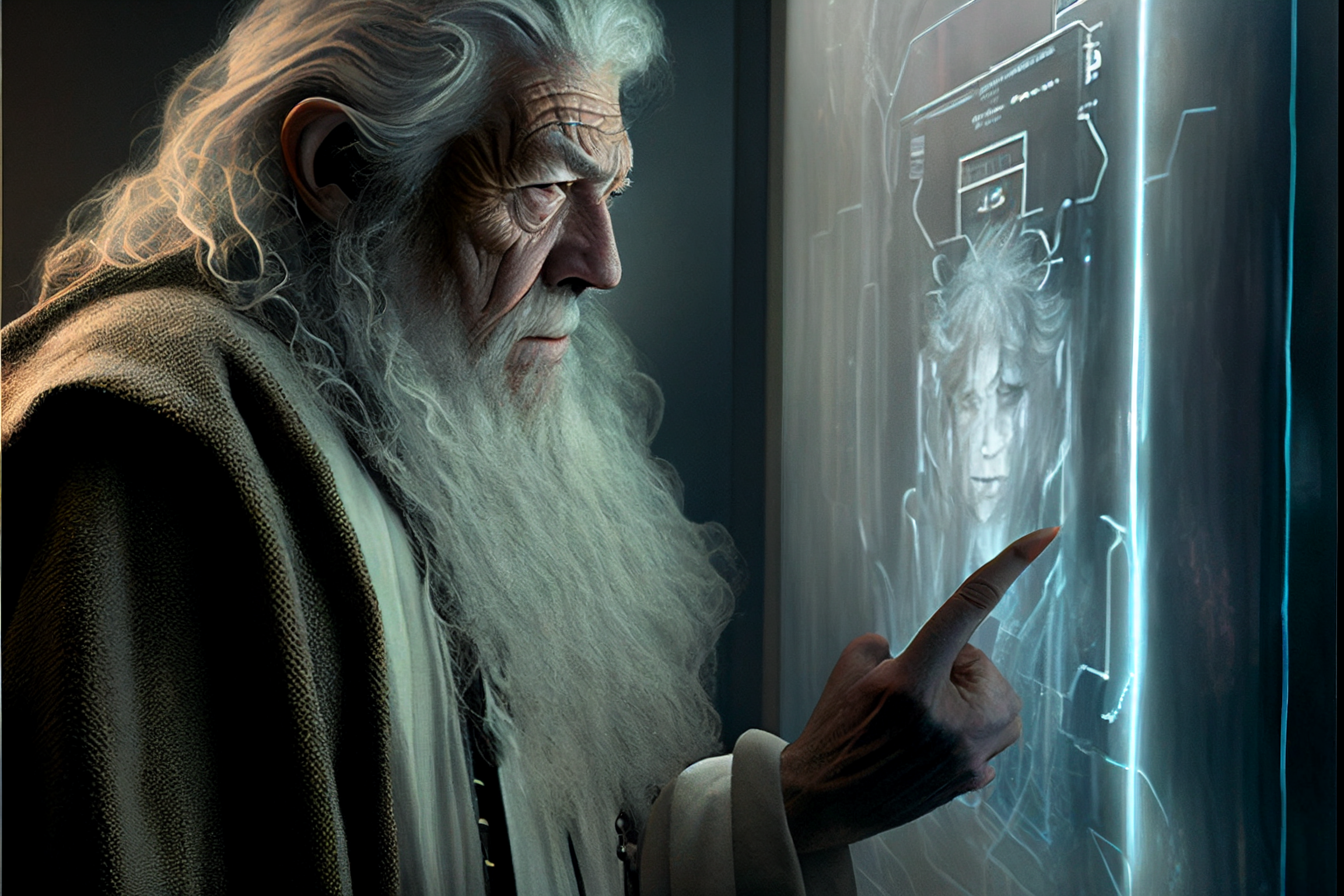
It’s also interesting that Tolkien sees the elves being able to produce ‘art’ rather than mechanical-dominion-magic because they’re both unfallen and immortal — not caught up in trying to grab as much as they can in the little time they have in order to hold suffering at bay. It does raise the question of whether fallen, mortal, humans can create art — or if we’re doomed to make disenchanting dominion-machines of destruction. Because Tolkien would love this so much (by which I mean, he’d hate absolutely everything about it, the image accompanying this post is Ian McKellen as Gandalf interacting with an enchanted touch screen).
I wonder if Nick Cave’s essay about ChatGPT’s songwriting capacity gives us a path towards art-creation built from human limits. Nick Cave described a song ChatGPT wrote “in the style of Nick Cave” as “the fire of hell in his eyes” — this extended quote from Cave suggests that maybe our capacity for enchantment is born from facing our limits; and our mortality (and our suffering) rather than trying to deny them by grasping and destroying, or embracing something mechanical.
Songs arise out of suffering, by which I mean they are predicated upon the complex, internal human struggle of creation and, well, as far as I know, algorithms don’t feel. Data doesn’t suffer. ChatGPT has no inner being, it has been nowhere, it has endured nothing, it has not had the audacity to reach beyond its limitations, and hence it doesn’t have the capacity for a shared transcendent experience, as it has no limitations from which to transcend. ChatGPT’s melancholy role is that it is destined to imitate and can never have an authentic human experience, no matter how devalued and inconsequential the human experience may in time become.
What makes a great song great is not its close resemblance to a recognizable work. Writing a good song is not mimicry, or replication, or pastiche, it is the opposite. It is an act of self-murder that destroys all one has strived to produce in the past. It is those dangerous, heart-stopping departures that catapult the artist beyond the limits of what he or she recognises as their known self. This is part of the authentic creative struggle that precedes the invention of a unique lyric of actual value; it is the breathless confrontation with one’s vulnerability, one’s perilousness, one’s smallness, pitted against a sense of sudden shocking discovery; it is the redemptive artistic act that stirs the heart of the listener, where the listener recognizes in the inner workings of the song their own blood, their own struggle, their own suffering. This is what we humble humans can offer, that AI can only mimic, the transcendent journey of the artist that forever grapples with his or her own shortcomings. This is where human genius resides, deeply embedded within, yet reaching beyond, those limitations.
Just note that last bit — we humans can offer the “transcendent journey of the artist that forever grapples with his or her own shortcomings,” while the machine can only mimic. Machines have no body; no experience of suffering — or of longing — no vision of the transcendent, they are creations within what the philosopher Charles Taylor calls “the immanent frame” — and so they are disenchantment engines. They don’t throw us towards the transcendent, but ground us in predictions about the immanent. It’s interesting, I think, that the paradox at the heart of the Gospel — the transcendent and immortal God who becomes human in order to suffer and die — plays in this magical and enchanting tension in ways both Cave and Tolkien find compelling.
I think it’s fair to say that mechanical ‘church in a box’ techniques that employ machine-like magic — technological artificers — are disenchanting, rather than magical in either an Elvish way or a ‘stare suffering in the face’ way. I’m not sure either the Elves, or Nick Cave, would write about a “vibrant church community” the way our church promotion machine seems to want us to, or the myriad other cliches we employ chasing some sort of magical spell or silver bullet that will grow our churches as someone reads our websites.
A magic mirror held up to our ‘vibrant’ communities
Here’s my thesis about a prediction engine that produces text that has that machine-like feel, that feels quite similar to the sort of text that humans writing to predictable cultural scripts might produce… we’ve already embraced the machine. Long before ChatGPT.
ChatGPT serves as a mirror; its predictive capacity reveals our machine like predictability. Its soullessness, its lack of originality and enchantment is matched by our own.
That Radiance Church could be so profoundly unboxed by ChatGPT in ways that feel plausible says something about the church marketing machine that produces pablum and calls it ‘copy’. Here’s a little exercise. Google the name of your city or town, the word church, and the word vibrant. How many results come up?
Did you catch the description ChatGPT adopted of the church growth consultant it imitated for me in producing Radiance Church — ““My focus is on practical and effective strategies for building and growing a church community that is well equipped to thrive in a modern world. I will emphasize the importance of technology and innovation in building a vibrant and relevant church community that is able to connect with people in the community,” or in the vision statement “To be a vibrant and growing community of believers…” or in the description of the sort of hero image that should be used as a hero image online “a beautiful, vibrant, and dynamic image that captures the essence of the church’s mission and vision,” or the description of Radiance Church it developed for the home page: “Welcome to Radiance Church! We are a vibrant and growing community of believers, passionate about sharing the love and hope of Jesus Christ with all people. Our mission is to glorify God by shining the light of Jesus Christ in our hearts and sharing it with the world through worship, fellowship, and service.“
What does vibrant even mean to someone who has never been to church? For churchy types it’s maybe code for “we have some people under the age of 80” (some of the most vibrant Christians I know are aged 80+ though). It’s such a predictable cliche — it’s so predictable a machine can predict and reproduce it. Some predictability is ok though — right — some of what ChatGPT does offer is the ability to drum out predictable stuff that we’d just be reproducing week on week anyway (or generating content that follows particular established forms, including code). But cliches can also be dead and disenchanting and robotic where we could be working for something more human; imbued with the “human genius,” displayed in “the transcendent journey of the artist” grappling with suffering and existence in a body, shot through with aches and longings for something other than what is, and what has been, utterly predictable.
The word cliche comes from the world of typeset printing — from the printing press — its French, the English word with the same meaning is “stereotype” — it described a word or phrase so commonly used by printers that instead of the word being formed letter by letter it’d be stuck together on a metal plate; the same would happen for mass produced documents where you’d make an entire mould to reproduce a whole page on demand. ChatGPT is a cliche producer — it predicts what it has been fed — and so Radiance Church is not ‘the apocalypse’ in the way we might think, we’re not staring into the fire of hell in some distant (or not as distant as we’d like) future; Radiance Church is an apocalypse because it reveals something about how the machine-Church already exists. And how it already disenchants.
ChatGPT’s Radiance Church in a box holds a bit of a mirror up to how we present ourselves — and the sort of repeated grunt-work we’ve brought into the life of the modern church that doesn’t offer the enchantment of embodied liturgies directing us towards heaven — the ‘stay with us for coffee’ benediction, and the ‘welcome to our vibrant community’ call to worship, or the pietistic and cliched one size fits all song intros (and perhaps sermons).
And I guess the question isn’t “is it a magic mirror,” so much as “are we Snow White, or the wicked witch?” Are we actually beautiful and without guile, or relying on deceitful enchantments to prop up our areas of lack?
Could a person reading your church’s website tell it was written by a human? Does it function as art, or part of the machine? And what about our communities — and our approach to life together?
Have we so embraced technology, and technique, and repetition of cliches that we’ve become machine-like and disenchanting — like robots writing Nick Cave songs — or are we using our creative capacity to generate art — or an art-like approach to our language and imagery — that is true and beautiful, that is grounded in our suffering, our mortality, and our desire for transcendence (and that desire being answered in Jesus) so that we present our life together built on the Gospel as something that speaks to these experiences, and our longings for something other than just “vibrant community”.
This weekend I’m presenting a talk at the Conference on Science and Christianity (COSAC) for the Institute for the Study of Christianity in an Age of Science and Technology (ISCAST). The conference theme is “A Hopeful Future: Christians, Creation, and the AI World.” Because of Covid-19, the conference is being held virtually, and it’s not too late to register.
My presentation takes the work of Marshall McLuhan and Neil Postman (media ecologists), and Charles Taylor, to suggest that technology is not neutral because it becomes part of the ecology that forms us as humans, and comes with inbuilt mythologies about the good life, and true human ends, including a sort of technological eschatology where a hope that people genuinely believe is good is the hope that we might become part of the machine. Technologist David Porush coined a term for the ‘good coding’ that would allow technology to mirror and interface and capture the human consciousness — “eudoxia” — or ‘good words’ — I’m playing that against Tolkien’s “eucatastrophe” — or ‘good catastrophe’ — the injection of hope from above when all seems hopeless that he sees as the quality of good human stories, because the satisfaction they bring is aligned with the true hope that comes from the Eucatastrophe at the heart of God’s interaction with creation; the incarnation, resurrection, and future return of Jesus. The “desire for dragons” he speaks of won’t necessarily be answered by Jurassic Park, and the use of technology to clone and resurrect dinosaurs (or by ‘augmented reality’ video games that bring the Jurassic world to life).
That’s not to give the game away too much, but as I was putting together this presentation (and you’ll find some of the building blocks in things I wrote about Telstra’s Magic of Technology advertisement, and Amazon Prime’s show Upload), I was struck again by the imagery of Ethiopia’s Church Forests. They’re such a stark picture of a non-technological response to a world where technology is used to dominate the physical landscape in order to deliver our vision for the good life. This essay from Fred Bahnson was part of drawing my attention to them (along with the video essay from National Geographic).
Screenshot from the fascinating documentary/essay project from Fred Bahnson and Jeremy Seifert, from Emergence Magazine
The documentary opens with the line:
“In Ethiopian Orthodox teaching, a church, to be a church, should be enveloped by a forest. It should resemble the garden of Eden.”
These forests have protected Ethiopian biodiversity from being eradicated by agricultural dominion, Bahnson’s essay, which touches on the research of Dr. Alemayehu Wassie, who studies the forests as his vocation notes:
“Until roughly a hundred years ago, Ethiopia’s northern highlands were one continuous forest, but over time that forest has been continually bisected, eaten up by agriculture and the pressures of a growing population. Now the entire region has become a dry hinterland taken over almost entirely by farm fields. From the air it looks similar to Haiti. Less than three percent of primary forest remains. And nearly all of that three percent, Alemayehu discovered, was only found in forests protected by the church.”
There’s something quite ‘new Edeny‘ about these forests; and while Ethiopian Orthodox Spirituality doesn’t always resonate with my theological framework; a significant part of how I approach theology is rooted in my disenchanted, western, view of the world. Part of technology’s formative effect is ‘disenchantment’ — the idea that technology isn’t just like magic, but is magic in its truest form, because other belief in magic just expresses desires we haven’t yet found technological solutions for.
“Fred Bahnson, who wrote the essay that became the documentary on the Ethiopian church forests, thinks of them as arks, or “tiny green vessels sailing over a barren sea of brown”. Deploying the metaphor globally to image our contested and fragile future, he writes, “We will need many more arks like them … tens of thousands of arks: cultural, biological, spiritual.” … These kinds of initiatives take work. They require nurture. And a strong foundation. The church forests emanate from a belief in the sacred — sacred space worth protecting, and sacred life and the value of every person. The centre enables the whole. The solid protective walls are permeable, in that an open gate welcomes all who want to enter to find refuge and abundant life. They offer a bright sign of hope in northern Ethiopia, and perhaps a symbol of what is possible in our own search for sanctuary and refreshment.”
I draw on both the Church Forest and J.R.R Tolkien in my presentation, struck, again, by not just the ‘Eucastrophe’ bit of On Fairy Stories, but the way it unpacks Tolkien’s whole project — in a world increasingly shaped by dominion through technology, with imaginations fuelled by science fiction, he turned to the purity of the fairy story as a critique of that sort of vision of man; calling for us, instead, to be ‘co-creators’ — who participate in generative imitation of God both in our stories, and in the lives promoted by stories that echo the truths of the Gospel. In a letter unpacking his approach in Lord Of The Rings, Tolkien lays his motivations bare (brazen for a guy who accused his friend C.S Lewis of too much allegory).
“I intend all use of external plans or devices (apparatus) instead of the development of inherent inner powers or talents – or even the use of these talents with the corrupted motive of dominating: bulldozing the real world, or coercing other wills. The Machine is our more obvious modern form though more closely related to Magic than is usually recognised.
The Elves are there (in my tales) to demonstrate the difference. Their “magic” is Art, delivered from many of its human limitations: more effortless, more quick, more complete (product, and vision in unflawed correspondence). And its object is Art not Power, sub-creation not domination and tyrannous re-forming of Creation.”
I’d not noticed how much this is true; the good wizards in Middle Earth have a deep affinity with nature, while Saruman and Sauron both employ magic to enslave and destroy — both the natural environment, and the lives of those around them. The Lord of the Rings, then, functions as a critique of finding hope in magic or technology, rather than the eucatastrophe, and the animating belief that all sad things will one day come untrue.
The story that animates us — whether the pursuit of the ‘good words’ that will unite us with our technology, or the good intervention that will save us from the jaws of our machines and the destruction of beastly dominion — sin, and death, and Satan — will shape the way we live now. If the Gospel is true, and the world is a sacred place made to reveal the divine nature and character of God in concert with the Gospel message, coordinated under the rule of the resurrected and resurrecting King Jesus who will return to “make all things new” — in a new Eden — then planting forests that protect biodiversity, and position the church community within the natural world in a way that is more like the elves and less like the orcs, might be ways that we live in anticipation and hope.
I also came across, in the last few weeks, this article, ‘When the Gardener Returns: An ecological perspective on Adam’s Dominion,’ by Old Testament scholar Doug Green (who’s also part of our church family, and whose work I drew on quite a bit in articulating a ‘political theology’ that plays off two threads at work in the world, those taking up the call to bear God’s image as it is revealed in Jesus, and those falling into beastliness, this isn’t to say that I’ve understood him, or represented him in such a way that he is responsible for my representation of this thinking…).
Taking up the resurrection appearance of Jesus in the garden in John’s Gospel, and Mary’s meeting ‘The Gardener’ — the new Adam, the man “destined to bring all of creation into order, harmony, and abundance,” Doug says:
“While the day of the final curse-lifting renewal still lies out in our future (Rom 8:19-22), in Christ’s resurrection the age to come has broken into this present age, and the Gardener has already taken up his royal vocation of subduing the earth on God’s behalf. Accordingly, the reborn Gardener of Genesis 2 calls his subjects — the renewed humanity of Genesis 1 — to live as true humans, by living from the first definition, found in Genesis 1-2, of what it means to be human, but especially by living toward the gospel’s vision of what humanity will be in the age to come. With our “ethical eyes” looking back to our origin and forward to our destiny, we are called to live as ambassadors of the New Creation, who give the watching world a foretaste of what life in that kingdom will be like. Surely this should be good news for creation as Christians seek to live the royal, second-Adam life, as God’s gardeners. Yes, Christians may work the earth for human benefit, but we must do so in a protective and caring way that previews and anticipates the great day of renewal when Jesus, the Gardner-King, will finally deliver the natural realm from its bondage to decay and at last transform the whole world into a new and better Eden.”
Ethiopian church forests are a little picture of the possibility of this sort of approach to church; they’re the products of generations of faithful cultivation, and we should probably start now.
Upload dropped on Amazon Prime this week. It’s like The Good Place, only there’s no twist. Really, it’s not that like The Good Place at all, except that it deals with life after death in a universe where God is mostly absent. Belief in a spiritual afterlife is a quaint hope held by some “Ludds” (from Luddites) pitted against the very real virtual hope peddled in Upload‘s universe — our universe, just in 2033.
There’s some interesting dynamics right up front with this program being on Amazon Prime; Amazon’s end game might look very much like the in show company, called Horizon. Amazon’s smile logo can be found on packaging within the show, but their push into cloud computing, digital media, and Jeff Bezos’ ‘end game’ (not to mention his exorbitant personal wealth — no seriously, click that, spend a few minutes scrolling it, and then come back) make them prime candidates for attempting to produce something like this for reals. It won’t be Elon Musk who does it; probably; he believes we’re already in this future; already characters in a computer program indistinguishable from reality. You can trust Amazon to find ways to keep making money from your consumption after you die.
In Upload, Horizon is the company responsible for the richest afterlife experience (an afterlife experience for the rich, where you have to keep paying for room service and minibar items by swiping left for your virtual pleasures. Horizon’s prime afterlife location is called Lakeview. Residents pay big bucks to have their consciousness digitised and uploaded; stored on servers, so that their lives can continue not in the clouds with harps (like some poor Ludds believe), but in ‘the cloud.’
As far as reviews go, we watched the whole first season over two nights. It’s a fascinating (but not Good Place esque) dig into some philosophical questions about what it means to be human; leaning into Descartes’ “I think therefore I am” to suggest that so long as a person’s mind is still active, no matter what happens to their body, the person still is; and later probing whether a soul exists as a thing apart from a mind. We’re in a sort of new gnostic territory most of the time, except that scientists are also working on synthetic bodies that can host a download of the individual’s upload. There’s a hint of the unnaturalness of life without a body, but even the Luddite hope of heaven is the hope of a disembodied soul in the sky when you die (where salvation, and immortality, is not secured so much by wealth, but simply by death).
The show’s main upload, Nathan Brown, is hanging out for the availability of a download because he knows, deep down in his soul, that to exist as a person, a human, is to have a body. He’s also died in a freak self-drive car accident (or was it), and lost some vital memories in the upload that also make him less than him. Uploaded beings are served by ‘angels’ — employees of the ultimate surveillance capitalism firm, who are voice activated. Unlike Siri and Alexa, these are real humans sitting at computers waiting for voice commands from now-digital beings. And so we meet Nora, Nathan’s angel.
The show also has some fun pictures of technology in the not so distant future; including consent cameras for kicking off sexual encounters largely curated via Nitely, a future version of Tinder. The show handles sex and bodies in a fascinating way; the boundaries between the digital afterlife and the real world are almost totally porous, any avatar can cross over and connect in virtual reality, which means your loved one is never truly gone — even if they stop aging (so long as you don’t pay for age up updates). Sex is excarnated, rather than incarnating — though for those on the meaty side of reality, feelings are reproduced by a frankly kinda creepy VR suit. When Charles Taylor observed that the ‘disenchanted’ world we now live in is an ‘excarnated’ world — he was describing a world that pushes us out of being enfleshed in bodies, and into ‘being’ in our heads. Where sex may once have been ‘enchanting’ — sacramental almost — as a good gift from God, in the disenchanted, excarnate, world it is simply transactional.
At one point in A Secular Age, Taylor notes that the more intimately connected we are with a person the less worried we are about cross contamination — we’ll share a spoon with those we kiss — he suggests sex is the ultimate expression of such intimacy, that “love making itself is a mixing of fluids with abandon” — it’s a bit gross; but as we become excarnate, culturally, our approach to intimacy gets a bit blurry, when our bodies don’t matter anymore, we’ll mix fluids with anybody. And yet, the VR ‘sex suit’ proves too much for Nathan’s girlfriend, stuck in embodied life, because she sees them being cleaned in the hire shop — and hears all about the fluids they have to wash out — the suits are also used for people hugging dead grandparents; so there’s a cocktail of snot, vomit, sweat, and other things. Gross. Bodies are gross. And yet, sex-as-intimacy, for two embodied people, can also be sacramental; Nathan’s girlfriend, Ingrid, is prepared to overcome the ick factor because she “misses their intimacy.” Touch matters. Bodies are essential to that, and while our approach to sex (think pornography, hookup apps, consent video cameras, VR suits etc) can ‘excarnate’ — we can push ourselves away from our bodies and into our brains, sex, like other embodied pleasures, has the capacity to re-incarnate us. To remind us of the goodness of our bodies, and even of something enchanted or transcendent; something meaningful. Taylor calls this ‘haunting’ we sometimes experience in the real world — the reminder of something beyond us a ‘frisson’ (sometimes called “skin orgasms“) — that’s the little thrill you get sometimes that makes your neck hairs stand up and your skin get goosebumps. That power of touch — even in the afterlife — gets explored too.
The fundamental question in season 1 of Upload is can a human be a human without a body; what are we? While the eschatological hope served up by Amazon Horizon is frictionless consumption in a digital eternity controlled by a corporation that exists to serve your every whim with a voice command (“Alexa…” I mean “Angel…”), the question Upload asks is just how satisfying such a future can be; and whether a download into an eternal body might not be a more desirable, human, outcome.
Those in the digital world have lost all the limitations of embodiment; there is no longer any mourning, nor crying, nor pain… it’s a world made new. Digitally.
Except, you can pay to be sick — because after a stack of time in the digital afterlife, your yearning for a bodily existence leaves you wanting the feeling of pain or sickness, just to feel alive. So, you can pay to have a headcold…
_______
Zach: “Having a cold is no fun”
Nathan: “Why are you paying extra for this, isn’t it like a dollar a minute”
Zach: “When you’ve been here a little longer you’ll see that having no fun can be kinda fun. My nose is actually stuffed up. Just like real life.”
_______
The conversation pauses here because a new afterlife experience pops up; it’s pay to play, remember.
Trust Amazon Horizon to figure out a way to monetise a sneeze.
One of the more depressing sub-plots (and there are a couple, if you push too hard), is the story of Luke. Luke is a war veteran whose body was broken in conflict; he lost his legs, and rather than suffer life in the body, with no legs, he chooses to ‘upload’ early, and spends his digital life chasing experiences from the other parts of his body he gave up (mostly sex and food). Life without a body isn’t all its cracked up to be in Lakeview. But he’s also just a bloke desperately looking for connection. The show wants love to be enough for him, and for him to find compensation for the other bits, but it also leaves open the idea that life without a body just won’t be enough.
There’s a great dialogue between Nathan, and Dave, the Luddite father of his angel (it’s complicated) about the nature of the person, the soul, the afterlife, and hope.
_______
Dave: “You see Nathan, when you died, your soul went to real heaven, so whatever simulation I’m talking to now has no soul. It’s an abomination.”
Nathan: “Ok, or, there is no soul. And there never was, and in a sense both of our consciousnesses are simulations. Mine on a silicon computer and yours on a computer made of meat. Your brain.”
_______
Dave’s hope is a tangible future where he might hold his wife in his arms again; an embodied resurrection even, but Nathan, like many good moderns, can’t conceive of heaven as anything more than disembodied consciousness; eternal life for the soul, but not for the body. Like in the finale of the Good Place, the message from episode 1, to the end of episode 10, is that heaven is other people; the chance to spend eternity (or as much time as possible) with the people you love. God isn’t in the picture — even in Dave’s heaven — heaven is other people. For Horizon/Amazon — that’s an opportunity to make some money…
There’s an open source alternative to Horizon weaving its way through the storyline of Upload; the good guys who want heaven to be ad free. That might be the truly ‘good place’ — and Nathan hopes to be able to bring some of that open source goodness to Horizon; to hack away some of the overreach of his corporate overlords. Whether or not a ‘good’ digital afterlife is possible, Upload reminds us that we really want bodies for most of the stuff we love; which fits with the Christian understanding of the person. We are not souls in a meatsack — that’s gnosticism or Platonism — we are people who have bodies. The Christian hope is a resurrected body; a body made imperishable because God’s Spirit works not just with our soul, but on our body, to make us heavenly and immortal (1 Corinthians 15).
And while the show is billed as ‘science fiction,’ there are actually people out there seriously contemplating what such a digital afterlife could or should look like. Let me remind you again, Elon Musk thinks this is it; that the digital afterlife, where we exist not as people with flesh and blood, but as 0s and 1s in someone else’s program (with Covid-19 a really weird glitch in the software; a virus even). This was also, taken in a more dystopian direction, the plot for The Matrix.
There’s a question about what a good digital afterlife might look like, if the tech was available. We humans love the idea of being in control of our own end game; being able to work towards an eschatology (a view of the ‘end times’) where we, collectively (or corporately) are gods who can select our afterlife of choice and then consume our way to bliss. That fits the secular narrative pretty neatly. Amazon is a master of that narrative; a master of frictionless consumption and seemingly limitless consumer choice; which makes its involvement with the production of this program quite bizarre to unpack. Is being sucked into Amazon’s mainframe a good death? A good afterlife?
In Greek, the letters ‘eu’ at the start of a word work as a prefix for ‘good’ — so ‘euthanasia’ is a “good death.” In 1993, tech-philosopher David Porush published a journal article titled ‘Voyage to Eudoxia.’ It was an article exploring a potential escape to cyberspace; a good cyberspace. He suggested an obsession with cyberspace emerged earlier than he was writing (almost 30 years ago), after space exploration became a little passe. The next big tech things would be computers. Games were just starting to become ‘immersive’ (though nothing like they are now). He wrote then:
“Eventually, in the far-flung future perhaps, we may all emigrate, at least part time, to this new and gleaming electronic suburb, there to revel in an excess of sensory stimulation that today’s cinema or MTV can only hint at.”
He called this future place ‘Eudoxia,’ after Eudoxos of Knidos, and an invisible city in the work of an author he liked, Italo Calvino who wrote Cybernetic fiction. Porush used the term ‘cybernetic’ to describe a future “Cybernetic Age” where technology might enable us to capture (and maybe understand) the mind and how it works. Porush described a genre of science fiction exploring this potential as “cybernetic (or even better, “anti-cybernetic”)” — Upload joins a long line of stories, like William Gibson’s Neuromancer, exploring the potential that technology might free us from our bodies. Calvino, and Porush use the word ‘Eudoxia’ to describe the ability to write and create virtual worlds, or cities, built on ‘good discourse.’
“We now have a word for a magic technology that will create a complete sensorium or virtual reality on a cybernetic platform; cyberspace, an accessible, self-referential, genre-destroying hyperspace, a soaring sensorium that will imitate, model, and link to its mirror image, the human brain.”
Porush believed such a future technology, or place, Eudoxia, would render the story — TV or fairy tale — impoverished.
Lakeview, the ‘heaven’ in Upload, is a picture of a Eudoxia. And it turns out, people still want their bodies. That the mind itself is not enough; and that the sort of ‘transcendence’ Porush dreamed of, where we push out of our bodies and into our brains, is actually disenchanting rather than magical.
In a follow up piece, Hacking the Brainstem, published in 1994, Porush argued that (even then) our “centuries-long romance with technology” where we used technology to, for example, achieve intimacy with others, “has already cyberspatialised us,” preparing the way for us to experience ‘sensuous information bodilessly’ — he breathlessly hoped that cyberspace would help us transcend our bodies. He said in the sort of science fiction that anticipated cyberspace — this cybernetic fiction — “Cyberspace already transcends the physical “meat” body by creating a simulated “meta” body in the brain and communicating with it directly via electrical implants.” He said:
“Eudoxia is presently enacted in video games and cybernetic fiction, which will find their ultimate material marriage in the computer’s cyberspace.”
Whether or not this future can, or will, happen is immaterial. It’s clearly a future that we like to imagine happening; an escape from the meat of our bodies into the meta. Life forever; freed from pain and suffering, beyond death.
That a company like Amazon is going to be best placed to deliver such a future is a scary thought Upload presents us with; but its story, like other anti-cybernetic stories, should cause us to pause and ask if this is the best good place we can imagine.
Porush describes the promise of cyberspace peddled in such stories in this reasonably long passage, it’s worth it though…
______
The imminence of the cyborg is not a matter of speculation, it is a matter of reporting the news, a matter of postmodern sociology and introspection. We are already experiencing the reflux from a time twenty seconds into the future when our own media technologies will physically transcribe themselves onto our bodies, re-creating the human in their own images, forcing our evolution into the posthuman through a combination of mechanistic and genetic manipulations… yberspace will renovate human relations; it will unite art and technology; it will represent an altogether new and radical domain for improved social, psychic, and perceptual transactions. Bypassing the infirmities of the body, cyberspace will free the cripple and liberate the paralytic. Enabling multimedia and sensory access to the entire wealth of world data, cyberspace will deliver a universal education. Through its anonymity, cyberspace will invite the construction of a more ethical code and create norms for human interaction that strip distinctions of gender, class, race, and power. Cyberspace will provide a playspace for the imagination to roam free, liberating the mind from its inevitably neurotic relationship to the body. Cyberspace therefore has untold psychotherapeutic possibilities. Yet cyberspace will incapacitate destructive urges and consequences by removing our bodies. Cyberspace will create the means for a pure and perfect democracy and universal suffrage in which everyone can vote immediately on any issue. Cyberspace will present the possibilities for “virtual communities.” Cyberspace will reconstruct the nature of the relationship between labor and time and labor and space and will reconstruct authoritarian technics as they are manifested in the workplace —although one wonders who is going to empty the garbage and build the roads after we have all emigrated to this new virtual suburb. While cyberspace will undoubtedly present new opportunities for criminality, rape and physical assault will become impossible. Cyberspace will present a new opportunity for our manifest destiny, a new frontier. Cyberspace will make war obsolete by turning it into a Desert Storm videogame. Cyberspace will create a totalized hypertextual platform that will cure what ails American higher education. We will become immortal there. It will enable us to combine work and play in a new way. Even the music will be better there. Cyberspace will be the new, clean, virtual Eden to which we will all emigrate when this physical world becomes an unlivable ecodisaster. In cyberspace we will finally perfect the academic’s dream of sex: we will be able to indulge lust without the involving of our bodies (perhaps I should have said “the dream of sex that’s academic”). The New World, World Without End, amen.”
______
Cyberspace in Porush’ vision, is the cyberspace on offer in Upload. A world built by Horizon Amazon.
In Hacking the Brainstem, Porush makes a pretty interesting point about ‘utopian visions’ served up in our stories; eschatologies, even. He suggests we create utopias, culturally, by ‘modelling our view of human nature rationally and then inventing a technology to control or direct that model’ — by ‘technology’ he says he means “systems that seek and project perfect control” — so when a human is placed in the system the system encourages the “best part and controls the worst part of human nature” while the human maintains the system by their participation. This is particularly interesting when one considers Upload’s utopian vision; a digital world where the technology pictures the ideal human life as one of unfettered consumption in the pursuit of goodness and pleasure, surrounded by those people you love (such that you might consume them too).
The world we live in is one where corporations want that to be our utopian vision; because it’s what keeps them profitable.
The corporate world wants to keep us disenchanted and placing our hope in a technological future — a eudoxia — because if we put our hope in some transcendent otherworld, heaven — clouds outside the cloud — then they lose us now. We no longer want to play in their system.
There’s a reason there’s no God in Upload — that the priest for hire at the funeral parlour offers up factoids about Nathan that he’s gleaned from wikipedia, and no comfort beyond his digital avatar being there on the big screen behind him. God upsets the apple cart of these apple vendors.
Like in The Good Place, the ‘eudoxia’ of Upload — Lakeview — is in need of a good eucatastrophe. A “good catastrophe” — the term coined by Tolkien for the fantastic moment in a fairy story where the failure of our attempts to build our own utopian visions; craft our own ending to the story, our own ‘afterlife’ is met by an interruption; a good catastrophe. Tolkien’s ‘best catastrophe’ — the one that means I’d be banking on fantasy novels outlasting cybernetic fiction — is the enchanting story; the story that reminds us that reality is not all there is; that the physical world points to a supernatural world; that sex in bodies is, like other experiences in our bodies, meant to throw us towards something ‘enchanted’ rather than excarnated, and to remind us that our bodies are fundamental to our personhood. Tolkien’s best version of the good catastrophe is, of course, the version where the story of Jesus is true; where the heavenly future he offers is not disembodied life in the cloud(s), but an embodied life in a re-created and renovated world; this world; not a digital world; not a world fuelled by consumption and the pursuit of pleasure through choice where you have to keep paying a corporation; but a transformed world centred on the love of God for his people, and the love of his people for God and for one another. This is our hope. The real new eden — not the digital one.
“Look! God’s dwelling place is now among the people, and he will dwell with them. They will be his people, and God himself will be with them and be their God.‘He will wipe every tear from their eyes. There will be no more death’ or mourning or crying or pain, for the old order of things has passed away.”
He who was seated on the throne said, “I am making everything new!”
Revelation 21:4-5
Who needs a Lakeview when you can have a river view anyway…
Then the angel showed me the river of the water of life, as clear as crystal, flowing from the throne of God and of the Lamb down the middle of the great street of the city. On each side of the river stood the tree of life, bearing twelve crops of fruit, yielding its fruit every month. And the leaves of the tree are for the healing of the nations.No longer will there be any curse.
“I desired dragons with a profound desire. Of course, I in my timid body did not wish to have them in the neighbourhood, intruding into my relatively safe world, in which it was, for instance, possible to read stories in peace of mind, free from fear. But the world that contained even the imagination of Fàfnir was richer and more beautiful, at whatever cost of peril.”
Tolkien, On Fairy Stories
I’ve decided I want to be a dinosaur.
The more I watch technology be uncritically embraced — not simply by the church in Covid-19 lockdown, or even by society at large, but by myself, the more I wonder what we’re inviting into our lives in the name of progress.
I fitted multiple rooms in our house with Google Homes, and that wasn’t enough. We have Alexa devices in the kids room to read them bedtime stories. I spend hours staring at backlit black glass. I’ve been blogging for longer than I’ve been married, and on Facebook for almost as long. I registered domain names for my kids when they were born. I’m not quite a digital native, but I’m very close… I love technology. And yet. I’m convinced there’s a dark side to technology — that we become what we behold, that technology is not neutral. Marshall McLuhan once said:
“Our conventional response to all media, namely that it is how they are used that counts, is the numb stance of the technological idiot.”
McLuhan, Understanding Media
Neil Postman, a student of McLuhan’s, suggested that unless we can see the impact technology has had on society and culture in the past, we shouldn’t be allowed to set rules for adopting new technologies — or to assess their potential.
“A sophisticated perspective on technological change includes one’s being skeptical of Utopian and Messianic visions drawn by those who have no sense of history or of the precarious balances on which culture depends. In fact, if it were up to me, I would forbid anyone from talking about the new information technologies unless the person can demonstrate that he or she knows something about the social and psychic effects of the alphabet, the mechanical clock, the printing press, and telegraphy. In other words, knows something about the costs of great technologies.”
Neil Postman, ‘Five Things We Need To Know About Technological Change.’
I wonder how many churches who have jumped to livestreaming broadcast media style services (rather than social media services, or gatherings) have thought about the impact the clock had on the human psyche, or the printing press (let alone the alphabet). I wonder how many people have paused before Zooming off into livestream meetings. And how many of us, then, are surprised by the developing phenomenon of ‘Zoom fatigue’ and the interesting reminders it provides, as we assess that phenomenon, that we’re actually creatures created to live in time and space, not be broken up into pixels like Mike Teavee from Charlie and the Chocolate Factory and beamed across space to be put together in tiny pieces on someone else’s screen? Curt Thompson has a great piece on how to push ourselves back into our bodies for those struggling with this phenomenon.
I’ve seen lots of conversations from church leaders about technology; what to buy, how to solve issues, how to engage those checking out your service with technological follow up… questions about technique, that all assume we’re doing what we should be doing by jumping to technology to extend us from one space to another, without asking what happens as communications technology annihilates space and time the way C.S Lewis described the car ‘annihilating space’ — and bemoaned its impact on village (and church) life as suddenly we were empowered by the choice not to go to our local church, but to find other options, including the option of not going to church at all. How much more is this true of our incredible capacity to drop in on a seemingly infinite number of churches from around the world through their digital platforms; never having to physically visit in order to consume church. And look. We don’t have much choice at the moment; technology has to be part of our solution if we want to love our neighbours and obey our government.
I read one piece that suggested churches have, or are now needing to, reinvent themselves; where once we were ‘event organisations’ suddenly we’re ‘media organisations’ — what happened to community organisations, or relationship networks, or any other descriptor that might provide a different approach to how we be the church in this time; this pivot expresses the way that we uncritically participate in what Jacques Ellul described as the technological society, where we solve problems by finding the best technique using the technological tools at our disposal; because thats’ what we think we ‘ought’ to do.
Maybe one of the things that makes me want to be a dinosaur is that I spend a significant amount of time playing the augmented reality game Jurassic World Alive, think Pokemon Go but with dinosaurs. Dinosaurs are great.
The thing about every Jurassic Park movie ever is that it explores a particular question about our relationship with technology. Sure. Dinosaurs are awesome. But just because we can do something with technology, doesn’t mean we ought, no matter how awesome we might think the results are or could be, there are always unforeseen circumstances that come from unleashing the raptors, or in the case of Jurassic Park, the T-Rex.
There’s an old fallacy — the naturalistic fallacy — that says you can’t infer an ought from an is, just because something is the way it is, doesn’t mean it ought to be that way. Think about, perhaps, a human propensity to dishonesty or violence — just because those come naturally, doesn’t mean we ought to enshrine them as virtues or the basis of our society. The technological fallacy we’re too quick to fall for in our desire to see all progress as good progress is that because we can do something with technology, we ought to. I think we’re seeing an outwork of this technology in the way the Aussie church is responding to Covid-19 with some ‘technological advances’ — just because you can bring TV style production to your church service, or make your kids church a TV show that can be watched from the lounge room at any time, doesn’t mean you ought. Just because you can create algorithms that generate a more accurate understanding of a person’s desires and behaviours than a person’s spouse has of them (and this was in 2015) doesn’t mean you ought, just because you can deploy meme generating tweet bots to skew elections or opinions in favour of your perspective, even if you believe that perspective is good and true, doesn’t mean you ought. A Philosopher of Technology, Robin K. Hill, has dubbed our propensity to take an ‘ought’ from a ‘can’ as the Artificialistic Fallacy. It’s not necessary that any use of tech is the result of the fallacy; but any assumption that technology will necessarily solve our current situation or make things better, is a fallacy. I wonder if we’re better off, as the church, now because we have technological solutions that weren’t around during the Spanish Flu, our countless other crises and pandemics, than the church living through those times were; or than the New Testament church that got by in various forms of danger or isolation with a few letters from the Apostles (letters themselves being a technology that their own writers acknowledged were limitations — like John saying he’d rather be face to face in two of his letters, and Paul expressing the same idea frequently).
We have a problem with technology and technique as moderns. We accept it, and its extensions of our personhood, almost uncritically — or we don’t engage our critical faculties until it is too late, and the technology has already been incorporated into our ecosystem. Like dinosaurs escaping their enclosures in a dinosaur zoo. Loose, hungry, and destructive.
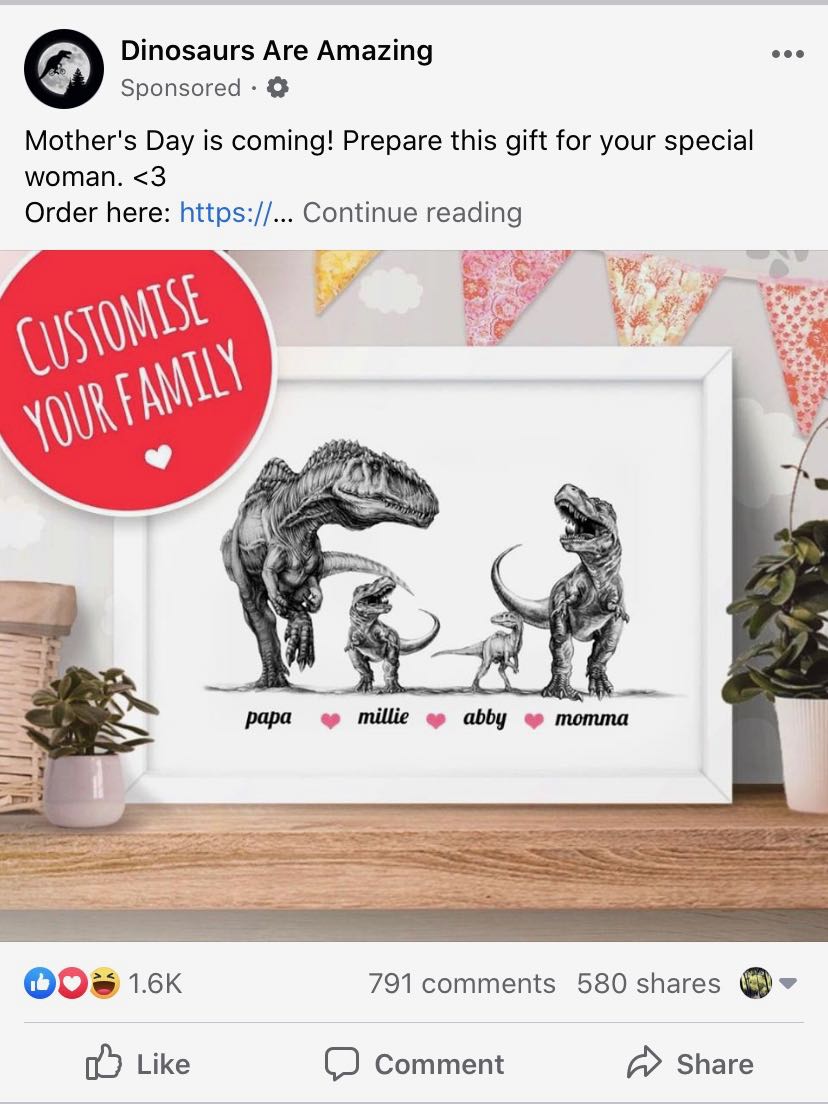
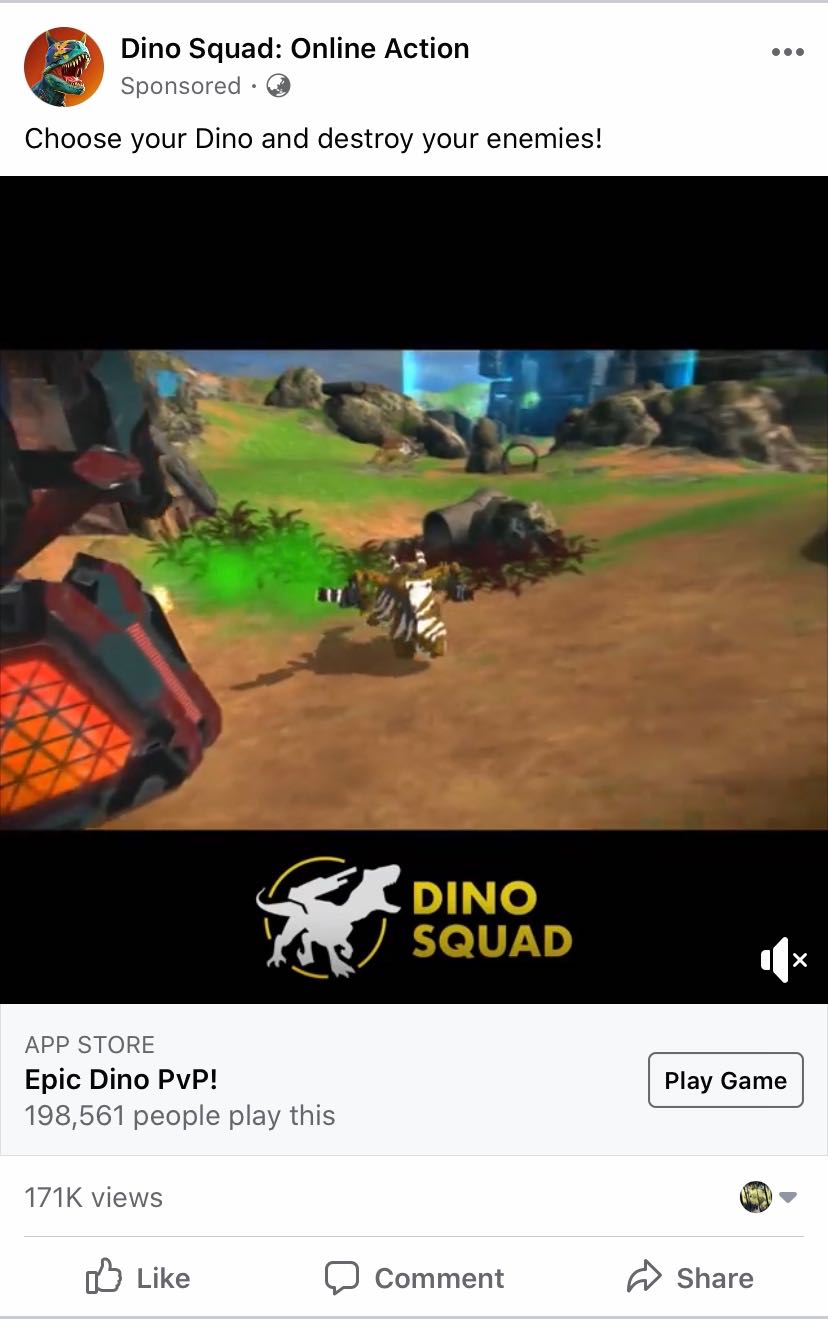
Here’s a fun fact. I wrote some of this post and left it open in a tab in my browser. I have not typed the phrase dinosaurs are awesome anywhere but in this tab. This morning when I opened Facebook I had some new ads in my feed.
I’m not sure a framed picture of our family as dinosaurs is going to cut it for Mother’s Day, but it’s creepy that Facebook’s algorithm either knows me well enough to coincidentally decide that this is something I’m into, or that my as yet unpublished text in a browser has given them more data to mine in order to sell me a solution. This is what has been called ‘surveillance capitalism’ — the sort of economic world we buy into through our uncritical participation in technology; our falling for the fallacy that just because we can (and companies can), we should (and they should).
Much as I love technology, and much as its introduction into our ecosystem is hard to keep safe, and much as uncaging the beast causes massive changes to our safety and day to day lives; I do want to be a dinosaur. Maybe this is part of Tolkien’s “desire for dragons” — maybe I want to live in a world of enchantment, a purer world where technology isn’t linked up with the Babylonian impulse to dominate the natural world, and other people, to secure prosperity for me (or the companies that are part of the fabric of this technology shaped society). Maybe I want to live in a world where it’s easier to sense the presence of God because the way our idolatry has seeped into the construction of our society makes it harder; it’s not that there was an age free from systemic corruption because of sin (see Babel, and then Babylon, and then Rome)… it’s just that it’s hardest to see that in our own age, because idols blind us; and technology plays part of that role in our lives now.
I want to try to reclaim some of what life was like before technology impacted the way we live and relate; and I’m certainly cautious about what sort of devastating impact unleashing the technology dinosaurs into the mix (and the very mixed metaphors) of Covid-19 and family life, and church life, and my own life. Much as I might seek escape into the world of augmented dinosaur battles on Jurassic World Alive, exploring a map littered with digital beasties to capture — I’m in real danger of being conformed in the image of a digital beasty myself.
C.S Lewis, in his inaugural speech at Cambridge, De Descriptione Temporum, suggested that technology — specifically the introduction of the machine — was the major contributing factor in a move from an enchanted to a disenchanted world; the thing that pushed the de-Christianisation of the west faster than any other phenomena. He says our belief in progress — specifically the good of technological advance and our ability to do new things by taking new technology and chucking old stuff, basically forms what Charles Taylor would later describe as our “social imaginary” — the building blocks of our imagination, especially how we understand life in the universe and so how to approach living in the universe. This image of ‘the good’ being ‘technological progress’ means that we often uncritically adopt new technologies and turf old ones. Lewis says this is bigger for our belief in progress, even, than Darwin’s theory of evolution… this is what he calls our ‘new archetypal image’ of how life works.
“It is the image of old machines being superseded by new and better ones. For in the world of machines the new most often really is better and the primitive really is the clumsy. And this image, potent in all our minds, reigns almost without rival in the minds of the uneducated. For to them, after their marriage and the births of their children, the very milestones of life are technical advances. From the old push-bike to the motor-bike and thence to the little car; from gramophone to radio and from radio to television; from the range to the stove; these are the very stages of their pilgrimage.”
C.S Lewis, De Descriptione Temporum
He ended his speech with a note of apology to his students; knowing, even then, that he was speaking to those in post-machine world as a non-native. The man didn’t even use a typewriter because of the impact he thought its machine like rhythms would have on his writing. He said people in a tech-obsessed world should listen to him like they’d listen to a freak — because his critique — from a different world to theirs — might help them look with fresh perspective on their relationship with technology. His approach to medieval literature and the idea that there was an image of the universe in the medieval world closer to the truth than the image we replaced it with when we discarded enchantment (the subject of his academic work The Discarded Image) allowed him, he believed, to see the dangers of the present age differently, even if it meant his students might have to view him as a dinosaur. He was prepared to embrace being a dinosaur.
I claim that, even if the defence of my conviction is weak, the fact of my conviction is a historical datum to which you should give full weight. That way, where I fail as a critic, I may yet be useful as a specimen. I would even dare to go further. Speaking not only for myself but for all other Old Western men whom you may meet, I would say, use your specimens while you can. There are not going to be many more dinosaurs.
— C.S Lewis, De Descriptione Temporum
Interestingly, his intro essay to Athanasius On The Incarnation encouraged people to read old books — not just books from our time — because their concerns would reveal some of the folly of our concerns and practices. There’s a way to become a dinosaur that doesn’t involve virtual reality, but digging in to old books from the past. In Surprised By Joy he talks about the sort of chronological snobbery that helps us jump from the naturalistic fallacy to the artificialistic fallacy via our changed imaginations; we think technology is good and necessary and that we ought do what it allows us simply because we think we’re much more sensible than those who came before us; we’re more highly evolved and have made progress in all areas. Lewis calls this ‘Chronological snobbery.’ Avoiding that might require being a dinosaur, or at least walking with them…
Maybe we need more human dinosaurs before we unleash the technological dinosaurs on our ecosystems anew. Charles Taylor saw ‘excarnation’ working alongside ‘disenchantment’ as the causes of secularity in the modern west. He said this was produced, historically (via the Reformation and its emphasis on the brain/knowledge rather than embodied practice) by “the steady disembodying of spiritual life.” How much faster is that happening via technology? Alan Jacobs, in this fantastic piece Fantasy and the Buffered Self, talks about technology as ‘Janus faced’ — he says our economic and cultural structures are produced by a ‘technocracy’ (the sort of structures present in telco and techno companies and their advertising right now), and this technocracy, through its various institutions, “speaks dark words of disenchantment with one mouth, and the bright promise of re-enchantment with the other.” Technology offers itself as the man made solution, from within a disenchanted frame — a world without God — and we buy it because it lets us be gods, even while it becomes a new god for us; an idol.
Whether we buy the pessimism about the potential danger of letting the T-Rex of Tech loose in in our church ecosystems, or we think we can put the tyrant back in his cage once this pandemic passes, we need to be aware that our jumping in to swim with the tide of technology puts us in a stream that has an ‘end point,’ and connects us with artefacts (technology) that aren’t neutral because they carry their own myth, their own anthropology, and their own eschatology. I’ve been struck, for example, by how much television advertising in night time pandemic viewing has pivoted to telcos and tech companies showing the ‘magic’ of technology; the way technology has transcended space and time to bring us together and keep us creating in this moment.
Amazon Prime is now advertising the show Upload, an alternative Good Place, that looks like it has humanity escaping to the cloud; not the heavenly one with angels, but the digital one. Becoming one with the machine (and hey, Elon Musk reckons we’re already there. That we are digital figments existing in some strange computer game). There’s a whole cultural apparatus pushing us to the idea that the future is digital; the eternal future even. Like the gnostics of old, they see technology freeing us from the meatflesh existence of our bodies (think cyberpunk fiction like Gibson’s Neuromancer). The idea that we might be saved from our bodies and from death and decay by becoming one with the machine is one legitimately explored and advocated by technologists; and celebrated in our advertising (like Telstra’s ‘magic of technology’ ad).
This all follows a trajectory identified by Lewis way back in his first speech in his role at Cambridge, and by Jacques Ellul in the same year, 1954, with his publication of The Technological Society. Ellul was both pessimistic and prophetic about the impacts of technology, and the belief in technique as the path to the good, on our humanity (in the same way McLuhan was later).
“Technique has penetrated the deepest recesses of the human being. The machine tends not only to create a new human environment, but also to modify man’s very essence. The milieu in which he lives is no longer his. He must adapt himself, as though the world were new, to a universe for which he was not created. He was made to go six kilometers an hour, and he goes a thousand. He was made to eat when he was hungry and to sleep when he was sleepy; instead, he obeys a clock. He was made to have contact with living things, and he lives in a world of stone. He was created with a certain essential unity, and he is fragmented by all the forces of the modern world.”
— Jacques Ellul, The Technological Society, 1954
It’s really hard to step back from the impact technology has on us — to unwind its impact on the deepest recesses of our humanity. To undo the ecological impact technology has on us where, in the words of another of McLuhan’s students, “we shape our tools and thereafter they shape us.” The egg can’t be totally unscrambled. And the making of technology is a deeply human task — part of our call to ‘cultivate’ the earth as God’s image bearing people who can imagine and create artefacts; but just because we can doesn’t mean we ought and sometimes we need human, biological, dinosaurs to step back and point out the impact artificial dinosaurs are having on the world we live in; lest we be eaten while on the toilet, or participating in the life of the church.
My hunch is that one of the ways back is less time in man made worlds that rely on technology, and that we interact with using technologies and techniques honed for us by the technocracy, and more time rediscovering the enchanted world we live in; the view those ‘dinosaurs’ from pre-modern times had, and part of that might be walking through the same forests, or looking at the same stars, that they did, or engaging art and stories that throw us into fantasy worlds away from ‘augmented reality’ — the stuff Jacobs advocates in the piece linked above, or Tolkien in On Fairy Stories, the thinking that helped Lewis produce Narnia.
I wish clever technology could do that for me more (and perhaps it can if the tools we create are extensions of our life as creatures created by a creator and we receive them with thanksgiving as gifts from God (1 Timothy 4), the technocracy works to blind us to that ‘enchanted’ dimension of technology; and technology as idol often pulls us away from, rather than towards God… Augmented reality dinosaurs, where my fantasy world, created by clever programmers (who want me to spend money), is mediated to me by a screen, in a way that makes me beastly, don’t do for my imagination or “desire for dragons” what imagining the trees in the bushland up the road from me as living, breathing things that speak to the goodness of my creator does… and yet, that’s what trees are for (Romans 1:20).
“He does not despise real woods because he has read of enchanted woods; the reading makes all real woods a little enchanted.” — C.S Lewis
At the same time, I’ve been watching churches in Australia (mine included) embracing the technological solution of livestreaming services to help people stay away and not miss out. Technology can be great; but long time readers will know that I’ve often argued (following Marshall McLuhan and Neil Postman) that technology isn’t neutral. Technology is ecological; the technologies we introduce to the ecosystems of our lives and relationships change our lives and relationships — sometimes in ways we don’t notice. I think livestreaming is a good temporary solution — to aid people in making the decision to self-isolate from churches now, but I don’t think it is a good long term solution — either beyond the pandemic, or in an extended shutdown through the Aussie flu season.
So here’s two further thoughts on church during the pandemic.
Shut large (and even medium) gatherings earlier than the government tells you to to flatten the curve, and keep Christians healthy for acts of service in the community.
Don’t live stream a service the whole way through a long shutdown because of a theological commitment to church being a gathering of people (not an event where people come together to consume the teachings of a priest).
Here’s a good place to start figuring out how to live in a world affected by pandemic conditions.
Dear friends, I urge you, as foreigners and exiles, to abstain from sinful desires, which wage war against your soul. Live such good lives among the pagans that, though they accuse you of doing wrong, they may see your good deeds and glorify God on the day he visits us. Submit yourselves for the Lord’s sake to every human authority: whether to the emperor, as the supreme authority, or to governors, who are sent by him to punish those who do wrong and to commend those who do right.
1 Peter 2:12-14
Peter, up front, reminds us that our patterns of life aren’t those from the world — they aren’t sinful desires — but a world lived as people removed from the ways of the world because we are no longer exiled from God. As God’s people we’re meant to live observable good lives; lives that mark us out as different to our neighbours (otherwise, what’s the difference that makes them ‘such good lives’ not just normal ones). And we’re to submit to human authorities (there are versions of that submission that will look more like martyrdom at their hands than obedience).
I read this morning that the government is considering reducing the number of people gathered in static events from 500 to 100. This will be a threshold moment for lots of Aussie churches — but we shouldn’t be waiting. Waiting would be a normal good life, not a remarkably good life. Waiting would also embrace a particular pattern of life that is motivating the decisions being made about shut downs.
Flattening the curve requires early action — and while it’s been great seeing lots of churches taking action around live streaming and making hygiene a priority on Sundays, there are still quite a few churches committed to soldiering on through the virus. This assumes that the best way for us to soldier on, as the church, through the crisis, is to hold Sunday gatherings that bring an entire church community together. Rather than proactively loving our neighbours by staying away from each other and minimising disease.
The government has a particular view of human flourishing that will form the basis of its decision making about social distancing measures. It is not solely interested in the medical health of people. It is interested in economic flourising. Decisions to delay social distancing measures are constantly being weighed up against economic imperatives (decisions about who should be treated in publicly funded hospitals are weighed up against the same measures, ultimately, and perhaps especially in the sort of crisis Italy finds itself in). Approaching the issue in economic terms — with the health crisis assessed based on its financial impact (see Trump, Donald, ‘Response to the Corona Virus’ in future encyclopaedias) will have us asking questions and making calculations like the one asked in The Australian newspaper today:
It’s unedifying but governments do put monetary values on human life, implicitly. That’s why we don’t have double the number of ambulances or hospitals — because the additional people that would be saved aren’t deemed worth the diversion of resources from other things. State and federal governments spend about one sixth of GDP keeping us healthy and safe. A 2014 Australian government document put the “statistical value” of a life at $4.2m, and the value of a year of life at $182,000. “The value of statistical life is most appropriately measured by estimating how much society is willing to pay to reduce the risk of death,” it stated.
If 1000 more people died but we avoid a 1930s-style depression, would it be worth it? It’s a hypothetical question because governments can’t know how effective their health measures are in advance. There’s no neat menu of policy options and trade-offs.
Hospitals have a particular measure of human flourishing too (medical health), my last post touched on the idea that Christians kickstarted hospitals by caring for vulnerable people other medical professionals wouldn’t touch for both medical and economic reasons (these non-Christian doctors in the Roman Empire would only try to heal those who might survive, pay, and benefit their careers).
These aren’t the questions we ask in framing our response. Our questions are something more like: “what is the most loving thing we might do that show we love the Lord our God with all our hearts, and love our neighbours as we love ourselves”?
Our metric as churches is not predominantly economic or medical/physical flourishing — though because we believe people are embodied creatures, our vision of human flourishing includes the economic and the physical. Our vision extends to the mental and spiritual wellbeing, and sees worldly wealth and the value of human lives in different terms to a state that ultimately will make all pandemic decisions based on utility; based on limiting harm but defining that harm as a balance between the economic and the physical. We believe lives have value because people are made in the image of God, with a created vocation to represent his life, nature, and character in the world he made. We don’t assess flourishing in purely material terms; and especially not with economic ones on top of our hierarchy. In an age of radical individualism, and a nation built on individual freedoms, Christians also have good reason to believe that community, and relationships, are part of human flourishing. I’d suggest our hierarchy should put the Spiritual first, the physical next, and while the economic is important, it’s certainly not the priority for our gatherings (like it might be for schools and workplaces), and then I’d put our responsibility to others above self-interest in a decision making matrix (ala Philippians 2).
We have a very different economics built on our very different picture of flourishing (do not store up for yourselves treasures on earth, but treasures in heaven… if your neighbour asks for your cloak, give them your shirt as well… that sort of thing… you know, the teachings of Jesus). Our ultimate picture of the flourishing life is one connected to God, by his Spirit, through Jesus, participating in the renewal of all things — seeking, as Crouch said, ‘shalom’ — life in God’s peace; his kingdom; in relationship with him.
We also have a different ethical framework to the ethical framework government applies. Christian ethics are not utilitarian but are virtuous, that we are called to make the right decisions based on the right thing to do — based on questions of virtue and character rather than predominantly about results on some bottom line or other; that we act as people shaped by love of God, and love for neighbour.
We should do the loving thing; not the least disruptive thing. So, we are to love sacrificially, and not find our value in our own physical or economic health, but instead are to trust God to provide, and have faith the the hope of the Gospel is real. While governments (rightly) have a role to play in determining shutdown parameters that will effect the economy, the education system, and the health system (and all of those inter-relate, and all of them are impacted by government decision making), our parameters for deciding what to do about how we operate as churches are very different, and we should act quicker because our priorities are different.
Now, I can see a case to be made, from a Christian framework that is a little more gnostic than I’m suggesting — where the health of the soul trumps all other forms of flourishing, that might suggest we keep doing Sunday church services come hell, or come highwater, trusting that God will work through the proclamation of his word. But I don’t think this rightly values the embodied nature of human life — our own wellbeing, or that of our neighbours. Not looking after your own health would be a way of ‘loving your neighbour as you love yourself’ — that is to say, a not very wise or sustainable way. And it would also be not a great witness to the very physical nature of the kingdom of God; the one that culminates in a physical new creation where we have physical resurrection bodies, brought about by the physical incarnation of Jesus into a human body; that same Jesus who cared for the physical needs of those he met and healed as a picture of their spiritual needs (the same loving kindness that motivated the beginning of public hospitals in the western world).
If flattening the curve is the best way to love our neighbours (wisely balancing economic, physical, and spiritual health) then we should model not putting the economy first and take steps to stay ahead of the curve. We should do the right thing not out of economic imperatives, but a fuller sense of human flourishing. This is why I think churches should stop holding big, Sunday, gatherings before the government directs us to, but that we should ensure that people are still having their spiritual well being, and need for community, met. If our priority is living and proclaiming the Gospel — and the priorities of the kingdom — in the midst of a crisis, I don’t think our most effective way to achieve that is to hold big gatherings that appear to be unloving (see the discussion around Hillsong’s conference on Twitter, for example). We have an opportunity to display the values of the kingdom in how we participate in the world during this crisis; with lives marked by sacrificial love for others and different priorities, and words soaked in the hope of the Gospel. While I’d hope these are markers of our gatherings on Sundays at “church” every week, they don’t exclusively have to happen there.
Live streaming a service is a great interim measure to flatten the curve and transition towards a social distancing period, but I don’t think it’s a very good medium term solution (because it is a terrible long term replacement for church). Live streaming is probably, I’d say, better than continuing to meet, either disregarding government directives or waiting until the last minute and taking no initiative in flattening the curve.
“Church” by its nature is the gathered people of God — a church is an expression of the body of Jesus; there’s an embodied, incarnational, nature of church that is fundamental to existing as that gathered community in the world. Gathering is important. Gathering to encourage and equip one another, and, in my Presbyterian context, for the ministry of word and sacrament, to take place is important. Andy Crouch’s excellent piece made the point that gathering for corporate worship is fundamental to a Christian view of human flourishing. I think he’s right. But (despite my Presbyterian heritage, and the Westminster Confession’s position on worship), I don’t think ‘corporate worship’ is located in the Sunday service, but in us Christians together (you plural) offering ourselves as a living sacrifice. We can do that in all sorts of expressions of a gathering. So I find myself with the theological convictions that the body of Christ is expressed in physical gatherings, where people are using their spiritual gifts to sacrificially love and serve one another (and together serve outsiders) as an expression of God’s presence in us by his Spirit, and that we meet ‘in Jesus name’ through the ministry of the word and sacrament (the proclamation of the Gospel, and our participation in it). You can’t really do most of this digitally. It’d be a really bad idea for us to establish this as an option that becomes either a norm, or a desirable/more convenient alternative. Call me an idealist, but I believe a crisis is exactly the time to turn to theological principles, and even push further towards them, rather than to find convenient solutions that don’t integrate with those principles. ‘Digital church’ isn’t actually a thing; and most churches have alternative structures that are closer to the nature of church than anything where teaching from someone outside a gathering is mediated by a screen.
If this shutdown period goes beyond Easter, I’ll be suggesting that we cease live streaming a centralised service with a talk from me (or another professional preacher) at that point, and that as more extreme social distancing measures kick in (the President of the U.S.A today asked people to limit meetings in the states to 10 people), we turn our energies and efforts to the small churches we already have in our midst (in most communities); that we change the dynamic of at least some gatherings of our small groups so that they actually function as small churches. If we’re going to establish a new normal through this period, let’s establish one that might see people growing in equipping one another for works of service (Ephesians 4), rather than one of people being fed content via screens.
If we are limited (or self-limiting) to gatherings of ten people, then I will be encouraging our small groups to function as churches who meet together to do what we would normally do on a Sunday in their small groups, but who also look beyond their own needs to serve others their community is connected to. In our system, this would mean that I would visit groups on a rotating basis to share the Lord’s Supper (probably a few times in a longish shut down), or that we get the appropriate permissions for others to conduct those sacraments.
It would mean growth groups take responsibility for the preaching of the word, and for figuring out what format that takes. There are plenty of church traditions where this is the norm, but one way that I would see us continuing as a larger church, who might come back together, is that I’d be encouraging our leaders to be teaching through the same material, and I’d meet with them during the week to help them prepare a church service. I’d rather reinforce that church is about the gathered people of God, equipping one another through works of service and through the ministry of the word and sacrament in the flesh than creating (or reinforcing) a consumer mentality that sees content from a professional preacher as the thing we come to receive when we attend church. Growth Groups might then invite members who are stuck in isolation or sick to stream in, virtually, to their smaller community, using the technology we’ve established in our preparations.
Livestreaming, for us, will take the edge off missing out on church while we are still meeting on Sundays, but it’s not going to be our solution beyond that point. I suspect this Sunday, or the next, will be our last services held or live streamed with a skeleton crew for some time, and that’s what I’m working towards. And I think on the whole, that’ll be a good thing.
Illustration by Kim Dong-kyu Based on: Wanderer Above the Sea of Fog, by Caspar David Friedrich (1818). From: Technology Nearly Killed Me, Andrew Sullivan, New York Mag, Sep 2016
“Any sufficiently advanced technology is indistinguishable from magic” — Arthur C. Clarke
There’s a new Telstra ad that I love because it is beautiful, but that I feel overpromises on what technology can (and does) deliver; in fact, I think it misleads, and invites us to put our hope in the wrong places. But it is a beautiful ad that taps into some deep human desires.
https://www.youtube.com/watch?v=6zGytq7ckS8
“See? We live in a magical world. We never have to wake up from our dreams. Our restless minds now free to wonder at the wonder of technology; at the magic we’ve created. Possibilities are like stars now infinite constellations fuelled by pure imagination; leading to one destination – to you, to thrive.” — Telstra
The world doesn’t feel as magical as it used to. That’s part of the central thesis of award winning philosopher Charles Taylor’s A Secular Age. Telstra’s marketing gurus seem to have tapped into the haunting sense of loss we have because of the evacuation of magic, or something ‘transcendent’ from our view of the world by suggesting technology itself is the way back; like somehow the answer to our longing for something more than the material is more material, just cleverer, just with the illusion of magic (because part of the evacuation of magic from the world is the belief that anything that looks magical is actually an illusion, which is why we call magicians illusionists now).
It used to be that life was magical; that every thing had some sort of spiritual significance, whether there were gods everywhere behind every event, like a poor harvest or a pregnancy, or in monotheistic cultures everything existed in some way within the life and will of the infinite God; Christians in particular believe that the material world, what Taylor calls the ‘immanent’ world, is somehow given life and significance (or more ultimate meaning) by its connection to the creator, and by Jesus, the creator’s creating and sustaining ‘word’ (transcendent) made flesh (immanent). Colossians 1 has a good example of this view of the world:
“For in [Jesus] all things were created: things in heaven and on earth, visible and invisible, whether thrones or powers or rulers or authorities; all things have been created through him and for him.He is before all things, and in him all things hold together.” — Colossians 1:16-17
C.S Lewis didn’t just write fairy tales for kids and a bunch of Christian reflections on life; he also published academic work on literature, including a book called The Discarded Image which looked at how older generations viewed the world this way; as enchanted, and how that fuelled their creativity, their art, their literature, and so better answered the longings of the human heart for some sort of enchantment, he argued (in 1964) that we’ve lost something as moderns who have kicked the sense of the transcendent out of our world and settled just for the stuff we can see and taste and touch as ‘reality’ and our source of meaning; C.S Lewis would be a little suspicious of Telstra’s advertising I suspect. Even the best technology — the most luxurious things we can fill our house with — he said were a certain sort of ugly, precisely because of this lack of symbolism, or significance, pointing to anything beyond itself (and so we have modern, and post-modern, art, often wallowing in this milieu, and so soulless and empty).
“Luxury and material splendour in the modern world need be connected with nothing but money and are also, more often than not, very ugly. But what a medieval man saw in royal or feudal courts and imagined as being outstripped in ‘ faerie’ and far outstripped in Heaven, was not so. The architecture, arms, crowns, clothes, horses, and music were nearly all beautiful. They were all symbolical or significant-of sanctity, authority, valour, noble lineage or, at the very worst, of power. They were associated, as modern luxury is not, with graciousness and courtesy. They could therefore be ingenuously admired without degradation for the admirer.” — C.S Lewis, The Discarded Image
James K.A. Smith wrote an accessible commentary on Taylor’s massive tome called How (Not) To Be Secular, here are two key ideas from his work:
“It is a mainstay of secularization theory that modernity “disenchants” the world — evacuates it of spirits and various ghosts in the machine. Diseases are not demonic, mental illness is no longer possession, the body is no longer ensouled. Generally disenchantment is taken to simply be a matter of naturalization: the magical “spiritual” world is dissolved and we are left with the machinations of matter…There is a kind of blurring of boundaries so that it is not only personal agents that have causal power. Things can do stuff.”
“Taylor names and identifies what some of our best novelists, poets, and artists attest to: that our age is haunted. On the one hand, we live under a brass heaven, ensconced in immanence. We live in the twilight of both gods and idols. But their ghosts have refused to depart, and every once in a while we might be surprised to find ourselves tempted by belief, by intimations of transcendence. Even what Taylor calls the “immanent frame” is haunted.” — James K.A Smith, How (Not) to be Secular
The implications of these quotes are interesting when read against Telstra’s ad; a campaign designed to reconnect us with the magic we long for, via machines.
The first is interesting because it explains why we look to technology — machines — to enchant our lives; if matter is all that matters, if everything (the universe) is basically one big machine of cause and effect, filled with little machines (us), who make machines (technology) then we’re now likely to rely on technology to give us any sense of what we’ve lost because they’re the closest we get to matter with a soul; other than us, and we get to program the soul into them so they serve us. The second point explains why we want them to serve us by delivering the experience of ‘magic’; because that’s precisely what we’ve lost, and what we long for, and what we’re haunted by. We want matter to matter more than it does; we want a transcendent reality that stretches beyond us; this might be, as the writer of Ecclesiastes puts it, because God has set eternity on the hearts of humanity, but it might just be that we wish magic was real.
If Taylor is right then I don’t think machines; perhaps especially smartphones and screens; will deliver the answer our haunted selves are looking for, they might actually make the haunting worse; especially if all the science looking at what technology use does to our brains and relationships is true; and on this you should definitely read the Andrew Sullivan piece, Technology Almost Killed Me where that picture at the top of this post comes from; Sullivan is one of the world’s most famous bloggers, he went a year without tech, precisely because he felt he was losing himself into a totally ‘immanent’ way of life, and he wanted some transcendence; he found that silence, not distracting technological bombardment, was where something ‘magical’ could truly be found… he looks at how our western world has progressively killed the silence which used to enchant us, and in doing so have ensure our haunted longings for something more, for the infinite reality that silence throws us towards, are not truly satiated.
“The smartphone revolution of the past decade can be seen in some ways simply as the final twist of this ratchet, in which those few remaining redoubts of quiet — the tiny cracks of inactivity in our lives — are being methodically filled with more stimulus and noise.
And yet our need for quiet has never fully gone away, because our practical achievements, however spectacular, never quite fulfill us. They are always giving way to new wants and needs, always requiring updating or repairing, always falling short. The mania of our online lives reveals this: We keep swiping and swiping because we are never fully satisfied. The late British philosopher Michael Oakeshott starkly called this truth “the deadliness of doing.” There seems no end to this paradox of practical life, and no way out, just an infinite succession of efforts, all doomed ultimately to fail.
Except, of course, there is the option of a spiritual reconciliation to this futility, an attempt to transcend the unending cycle of impermanent human achievement. There is a recognition that beyond mere doing, there is also being; that at the end of life, there is also the great silence of death with which we must eventually make our peace. From the moment I entered a church in my childhood, I understood that this place was different becauseit was so quiet. The Mass itself was full of silences — those liturgical pauses that would never do in a theater, those minutes of quiet after communion when we were encouraged to get lost in prayer, those liturgical spaces that seemed to insist that we are in no hurry here. And this silence demarcated what we once understood as the sacred, marking a space beyond the secular world of noise and business and shopping.”
The inability for technology to really scratch the haunting itch of the loss of the transcendent, that it doesn’t truly ‘enchant’ our world or make our lives feel magical, has fuelled technologist David Rose, who’s committed to creating enchanting technology because he thinks most technology doesn’t live up to the Arthur C. Clarke quote, he wrote a book called Enchanted Objects trying to articulate a vision for the sort of technology that might do this, it’s a compelling read, particularly (I think) for this analysis on the problem with the ideas that screens can deliver the enchantment Telstra promises.
“I HAVE A recurring nightmare. It is years into the future. All the wonderful everyday objects we once treasured have disappeared, gobbled up by an unstoppable interface: a slim slab of black glass. Books, calculators, clocks, compasses, maps, musical instruments, pencils, and paintbrushes, all are gone. The artifacts, tools, toys, and appliances we love and rely on today have converged into this slice of shiny glass, its face filled with tiny, inscrutable icons that now define and control our lives. In my nightmare the landscape beyond the slab is barren. Desks are decluttered and paperless. Pens are nowhere to be found. We no longer carry wallets or keys or wear watches. Heirloom objects have been digitized and then atomized. Framed photos, sports trophies, lovely cameras with leather straps, creased maps, spinning globes and compasses, even binoculars and books—the signifiers of our past and triggers of our memory—have been consumed by the cold glass interface and blinking search field. Future life looks like a Dwell magazine photo shoot. Rectilinear spaces, devoid of people. No furniture. No objects. Just hard, intersecting planes—Corbusier’s Utopia. The lack of objects has had an icy effect on us. Human relationships, too, have become more transactional, sharply punctuated, thin and curt. Less nostalgic. Fewer objects exist to trigger storytelling—no old photo albums or clumsy watercolors made while traveling someplace in the Caribbean. Marc Andreessen, the inventor of the Netscape browser, said, “Software is eating the world.” Smartphones are the pixelated plates where software dines. Often when I awake from this nightmare, I think of my grandfather Otto and know the future doesn’t have to be dominated by the slab. Grandfather was a meticulous architect and woodworker. His basement workshop had many more tools than a typical iPad has apps…”
… Today’s gadgets are the antithesis of Grandfather Otto’s sharp chisel or Frodo’s knowing sword. The smartphone is a confusing and feature-crammed techno-version of the Swiss Army knife, impressive only because it is so compact. It is awkward to use, impolite, interruptive, and doesn’t offer a good interface for much of anything. The smartphone is a jealous companion, turning us into blue-faced zombies, as we incessantly stare into its screen every waking minute of the day. It took some time for me to understand why the smartphone, while convenient and useful for some tasks, is a dead end as the human-computer interface. The reason, once I saw it, is blindingly obvious: it has little respect for humanity. What enchants the objects of fantasy and folklore, by contrast, is their ability to fulfill human drives with emotional engagement and élan. Frodo does not value Sting simply because it has a good grip and a sharp edge; he values it for safety and protection, perhaps the most primal drive. Dick Tracy was not a guy prone to wasting time and money on expensive personal accessories such as wristwatches, but he valued his two-way wrist communicator because it granted him a degree of telepathy—with it, he could instantly connect with others and do his work better. Stopping crime. Saving lives.
— David Rose, Enchanted Objects
He looked to our ‘enchanted’ stories; stories that have the sort of view of the world that Lewis (and his friend Tolkien) looked back to from the past and created in the more recent past… but it’s possible he missed the heart of what these writers (and J.K Rowling) were doing.
What’s the secret to creating technology that is attuned to the needs and wants of humans? The answer can be found in the popular stories and characters we absorb in childhood and that run through our cultural bloodstream: Greek myths, romantic folktales, comic book heroes, Tolkien’s wizards and elves, Harry Potter’s entourage, Disney’s sorcerers, James Bond, and Dr. Evil. They all employ enchanted tools and objects that help them fulfill fundamental human drives.
He does understand that technology will only work if it speaks to fundamental human desires; he’s not going to these stories as books containing “fanciful, ephemeral wishes, but rather persistent, essential human ones,” which he lists as omniscience, telepathy, safekeeping, immortality, teleportation, and expression. Basically, to use Taylor’s terminology, we’re in want of something that will pull us from the immanent into transcendence. Rose does just enough to kill Telstra’s claims that connectivity via a piece of glass can give us what our haunted hearts desire, and the technology he writes about as alternatives, like a magic cabinet that has a built in screen with a skype connection to a matching cabinet, which glows when the person at the other end of the line is nearby and allows instant and convenient conversation; well, that’s pretty great and does fan some of the flames of my heart (and could one day make my wallet lighter). The problem will always be that immanent objects — the product of coding and engineering — will only ever leave us trapped in the immanent world, the ‘brass heaven,’ haunted by a sense that there might be something more to life and relationships than that which can be encoded in bits and bytes made up of 1s and 0s. The problem will always be that eternity is written on our hearts; if only, like the writer of Ecclesiastes, we knew where to look to scratch that itch. This writer, who after his journey through life trying to sort the immanent out from the transcendent, concluded:
“So I reflected on all this and concluded that the righteous and the wise and what they do are in God’s hands, but no one knows whether love or hate awaits them.All share a common destiny—the righteous and the wicked, the good and the bad, the clean and the unclean, those who offer sacrifices and those who do not.” — Ecclesiastes 9:1-2
He doesn’t take this to the negative sort of place you might expect…
“You who are young, be happy while you are young, and let your heart give you joy in the days of your youth. Follow the ways of your heart and whatever your eyes see, but know that for all these things God will bring you into judgment. So then, banish anxiety from your heart and cast off the troubles of your body, for youth and vigor are meaningless.
Remember your Creator in the days of your youth,
— Ecclesiastes 11:9-12:1
Then he says:
“Remember him—before the silver cord is severed, and the golden bowl is broken; before the pitcher is shattered at the spring, and the wheel broken at the well, and the dust returns to the ground it came from, and the spirit returns to God who gave it.”
— Ecclesiastes 12:6-7
This is what we’re to do in our ‘immanent’ existence; the fleeting ‘breath’ that this writer reflects on time and time again that is unfortunately often translated as ‘meaningless’… we’re meant to reach out towards the God who gave us breath, knowing that as he puts it at the start of his summing up in Ecclesiastes 9: “the righteous and the wise and what they do are in God’s hands“… now… If only we knew where to look to see God’s hands. If only there were some way to scratch where we itch… if only there were some way to bridge between the immanent and the transcendent; to satisfy those deep desires that the writer of Ecclesiastes, Telstra and David Rose are searching for — the ability to see the world as meaningful beyond the material, to give us existence beyond ‘breathiness’ so that we become immortal.
Oh that’s right. According to two thousand years of Christians, and the book we live by… We do.
Paul says some more good stuff about Jesus in Colossians 1; about the implications of that time we see the hands of God; hands nailed to ugly planks of wood by barbaric spikes, these hands Paul says hold the cosmos together became very ‘immanent’ and are the ultimate enchanted objects that deliver on our wildest imaginings. Paul says:
“And he is the head of the body, the church; he is the beginning and the firstborn from among the dead, so that in everything he might have the supremacy. For God was pleased to have all his fullness dwell in him,and through him to reconcile to himself all things, whether things on earth or things in heaven, by making peace through his blood, shed on the cross.” — Colossians 1:18-20
That’s more magical than an iThing (as nice as they are) don’t let Telstra, or anyone, sell you short. You can enjoy the sort of life you so deeply desire and are haunted by. You can enjoy life that is more than just immanent, more than just heading towards the dust of the grave, you can enjoy life that’s more than a little bit magical.
There’s a robot for that. In the day an age of every intangible calculation being performed by an iPhone app, it seems fitting that there are also robots for almost all tangible activities. I for one welcome our technological overlords.
Douglas Coupland coined the named Generation X and wrote some books that I like. He’s put forward forty five theses on the future. That are interesting and thought provoking. Here are some of my favourites.
8) Try to live near a subway entrance
In a world of crazy-expensive oil, it’s the only real estate that will hold its value, if not increase.
9) The suburbs are doomed, especially thoseE.T. , California-style suburbs
This is a no-brainer, but the former homes will make amazing hangouts for gangs, weirdoes and people performing illegal activities. The pretend gates at the entranceways to gated communities will become real, and the charred stubs of previous white-collar homes will serve only to make the still-standing structures creepier and more exotic.
17) You may well burn out on the effort of being an individual
You’ve become a notch in the Internet’s belt. Don’t try to delude yourself that you’re a romantic lone individual. To the new order, you’re just a node. There is no escape.
21) We will still be annoyed by people who pun, but we will be able to show them mercy because punning will be revealed to be some sort of connectopathic glitch: The punner, like someone with Tourette’s, has no medical ability not to pun.
33) People who shun new technologies will be viewed as passive-aggressive control freaks trying to rope people into their world, much like vegetarian teenage girls in the early 1980s
1980: “We can’t go to that restaurant. Karen’s vegetarian and it doesn’t have anything for her.”
2010: “What restaurant are we going to? I don’t know. Karen was supposed to tell me, but she doesn’t have a cell, so I can’t ask her. I’m sick of her crazy control-freak behaviour. Let’s go someplace else and not tell her where.”
35) Stupid people will be in charge, only to be replaced by ever-stupider people. You will live in a world without kings, only princes in whom our faith is shattered
This new Saeco, the Xelsis Digital ID SLX 8870 MS, is a triumph of integrating disparate pieces of technology in a novel, but mostly pointless, way. It takes almost all the effort out of making coffee – which, for a Super Auto machine, is taking things to a whole new height.
This machine has a fingerprint scanner. It saves user profiles, and at the swipe of a finger will produce your “usual”…
Speech to text recognition software is one of personal computing’s final frontiers. The dream of sitting in a room and talking to your computer (and having it understand, compute, and respond accordingly) is, apparently, unlikely to ever become an actual reality. The problems are manifold – the biggest problems being that words are aurally ambiguous and we instinctively translate them based on context and expression, and that certain words have an array of meanings.
In 2001 recognition accuracy topped out at 80%, far short of HAL-like levels of comprehension. Adding data or computing power made no difference. Researchers at Carnegie Mellon University checked again in 2006 and found the situation unchanged. With human discrimination as high as 98%, the unclosed gap left little basis for conversation. But sticking to a few topics, like numbers, helped. Saying “one” into the phone works about as well as pressing a button, approaching 100% accuracy. But loosen the vocabulary constraint and recognition begins to drift, turning to vertigo in the wide-open vastness of linguistic space…
Many spoken words sound the same. Saying “recognize speech” makes a sound that can be indistinguishable from “wreck a nice beach.” Other laughers include “wreck an eyes peach” and “recondite speech.” But with a little knowledge of word meaning and grammar, it seems like a computer ought to be able to puzzle it out. Ironically, however, much of the progress in speech recognition came from a conscious rejection of the deeper dimensions of language. As an IBM researcher famously put it: “Every time I fire a linguist my system improves.” But pink-slipping all the linguistics PhDs only gets you 80% accuracy, at best…
Researchers have also tried to endow computers with knowledge of word meanings. Words are defined by other words, to state the seemingly obvious. And definitions, of course, live in a dictionary. In the early 1990s, Microsoft Research developed a system called MindNet which “read” the dictionary and traced out a network from each word out to every mention of it in the definitions of other words.
Words have multiple definitions until they are used in a sentence which narrows the possibilities. MindNet deduced the intended definition of a word by combing through the networks of the other words in the sentence, looking for overlap. Consider the sentence, “The driver struck the ball.” To figure out the intended meaning of “driver,” MindNet followed the network to the definition for “golf” which includes the word “ball.” So driver means a kind of golf club. Or does it? Maybe the sentence means a car crashed into a group of people at a party.
To guess meanings more accurately, MindNet expanded the data on which it based its statistics much as speech recognizers did. The program ingested encyclopedias and other online texts, carefully assigning probabilistic weights based on what it learned. But that wasn’t enough. MindNet’s goal of “resolving semantic ambiguities in text,” remains unattained. The project, the first undertaken by Microsoft Research after it was founded in 1991, was shelved in 2005.
Not all technology belongs in the hands of consumers. And selling these to the general public for a relatively low price just sounds like a bad idea. But hey. Lasers. No, let me say that again right. LASERS. Lasers that burn stuff. Yeah. That’s right. And they’re shaped like lightsabers.
Standard warnings about not letting children near them obviously apply…
The Artic emits a 445nm cool blue, ultra high power 1W beam which appears up to 4000% brighter than the Sonar’s 405nm violet beam. This direct blue laser diode is the result of the evolution of laser technology. Less than one year ago, this laser would have cost thousands of dollars to build. Don’t let the Arctic name fool you, this laser possesses the most burning capabilities of any portable laser in existence. That’s why it’s also the most dangerous laser ever created.
In recognizing and mastering the power of direct blue diodes, the Wicked Lasers’ Arctic shall become the standard by which all other blue lasers are judged.
Warning: Extremely dangerous is an understatement to the power of 1W of laser power. It will blind permanently and instantly and set fire quickly to skin and other body parts, use with extreme caution and only when using the included eye protection. Customers will be required to completely read and agree to our Class IV Laser Hazard Acknowledgment Form.
I’ve never been so proud to be an Australian. Our army is employing Segway robot soldiers. At this stage the Segway robots are only being used for training exercises as target practice:
“Australia based Marathon Robotics have taken Segways and turned them into human-shaped autonomous robots capable of moving around streets and buildings just like people in a crowd! The Marathon bots can act like insurgents, hostages, or civilians, letting armed soldiers practice before being exposed to the real thing. The Australian Department of Defense already has a training camp using the robots, and the US Marine Corps will be establishing one this year. You’ve got to see these robots in action in the video below – this puts all other shooting ranges to shame!”
If you’re a paranoid parent – and what parent isn’t a little bit paranoid – and you want to know your child’s secrets, the type they’d only tell their talking teddy bear, you need one of these.
Sure, it might look a bit creepy, but it’ll ask your children questions and then email you the audio of their response.
Product specs:
Your child’s closest confidante serves as your eyes and ears
Cuddly bear talks to your child, encouraging them to share their secrets
Says over 20 phrases, including:
“I love you. Do you love me?”
“You’re my best friend and I think you’re special.”
“Best friends always share their secrets.”
“Sometimes I feel sad. Does anything make you feel sad?”
“Sometimes I get angry. What makes you angry?”
“Sometimes I’m scared. What scares you?”
“Do you have a secret, best friend? You can tell me anything.”
Trigger phrases turn on the audio & video recording, which continues until child stops talking
The confession files are then emailed to the parent (WiFi network required)
Integrates seamlessly with Twitter, Facebook and Gmail.
Retractable USB cord allows child to “charge” the bear (and secretly transfer files to parent’s computer)