Archives For Tony Abbott

Did you catch that really uncomfortable interview with Tony Abbott and Leigh Sales last week? The really embarrassing thing, as far as I could tell, wasn’t that he flip flopped on whether or not he’d read the BHP statement about why they’re shelving a massive mining project (I think economics is complex enough that he’s probably right)… no. The embarrassing thing was when the conversation moved to “boat people”… here’s the transcript of that part in full

“LEIGH SALES: Why have you referred repeatedly to illegal asylum boats coming to Australia? Do you accept that that’s illegal and that seeking asylum by any means is legal?

TONY ABBOTT: Most of the people who are coming to Australia by boat have passed through several countries on the way and if they simply wanted asylum they could have claimed that in any of the countries through which they’d passed.

LEIGH SALES: But I don’t believe that it’s actually illegal to pass through countries on your way to somewhere where you want to have asylum.

TONY ABBOTT: You try turning up in America without documents, without a visa, without a passport; you’ll be treated as very, very much illegal, Leigh. The other point I make, from recollection at least, is that the very term that the Government has officially used to describe these vessels is “suspected illegal entry vessel”.

LEIGH SALES: Do you – I’m asking you though, not about the Government. I’m asking: do you accept that it’s legal to come to Australia to seek asylum by any means – boat, plane – that it is actually legal to seek asylum?

TONY ABBOTT: I think that people should come to Australia through the front door, not through the back door. If people want a migration outcome, they should go through the migration channels.

LEIGH SALES: That’s an answer to the question if I asked you: how do you think people should seek asylum?, it’s not an answer to the question: is it legal to seek asylum?

TONY ABBOTT: And Leigh, it’s the answer I’m giving you because these people aren’t so much seeking asylum, they’re seeking permanent residency. If they were happy with temporary protection visas, then they might be able to argue better that they were asylum seekers, but obviously the people who are coming to Australia by boat, they want permanent residency; that’s what they want and this government has given the people smugglers a business model by putting permanent residency on the table. And even though the Government has adopted just one of the Howard Government’s successful policies, it won’t adopt temporary protection visas or the willingness to turn boats around where it’s safe to do so.”

That’s just awful. But there’s no backlash, because there’s no political mileage. No votes are going to change hands here because the Labor Party is every bit as culpable on that front (though they are going to increase the refugee intake).

Season 2 of Go Back To Where You Came From kicks off tonight. The first season was pretty powerful stuff. For all their agitation surrounding gay marriage, which probably annoys a lot of Christians, GetUp is doing some good work on the asylum seeker front. They’ve produced this infographic to coincide with the show. And there’s a petition you can sign ahead of this week’s vote on the new refugee legislation, they’ve also got a form where you can email your member of parliament with a personalised message. If you’re a Christian you might also like to email Jim Wallace at the Australian Christian Lobby (their emails are typically firstname.lastname@acl.org.au), and tell him you’d like the ACL to spend more effort speaking out for those who aren’t providing their organisation with financial support – and maybe ask them to do less than just “welcoming” whatever the government does like they do in this Media Release, and this one).

This shouldn’t be an issue where a response falls along right/left lines. You can read my last two posts on boat people – the first, in response to Tony Abbott’s claim that boat people are “unChristian”, the second, a follow up to that.

UPDATE: Somebody questioned the legitimacy of this infographic in the Facebook comments below. So I did some digging and found what appears to be the source of this data. The following is from pages 17 and 18 of this DIAC report: Submission to the Joint Select Committee on Australia’s Immigration Detention Network September 2011 Department of Immigration and Citizenship (http://www.immi.gov.au/media/publications/pdf/2011/diac-jscaidn-submission-sept11.pdf).

“From 1989 to 30 June 1995 a further 41 boats carrying 1893 people arrived in Australia, most of whom came from Cambodia, the People’s Republic of China (PRC) and Vietnam…No Cambodian IMAs arrived after the United Nations Transitional Authority in Cambodia (UNTAC) mission was established in 1991. The flow of Vietnamese IMAs effectively stopped in 1995–96, with none arriving in the next three financial years. The last major arrival of IMAs from PRC was in 2000, with 25 arrivals. ”

“The profile and origins of IMAs coming to Australia began to change in 1999. Previously, most IMAs had come from Cambodia, PRC and Vietnam. As the tide of IMAs from east Asia and south-east Asia receded, a new movement of IMAs—predominantly from Afghanistan, Iran, Iraq and Sri Lanka—emerged. In total, 12,272 people arrived in this period. ”

“Boats began arriving again in October 2008. Over the course of 2009–10 the number of asylum seekers increased significantly. As with the preceding wave, the majority of IMAs came from Afghanistan, Iran, Iraq and Sri Lanka. Notably, however, the number of Iranians to arrive since January 2011 has increased significantly.”

UPDATE 2: You can watch episode 1 of season 2 of Go Back To Where You Came From online.


Credit: Boat People Infographic from Crikey providing numerical perspective on the current situation (I’m not suggesting that people’s anxiety on the issue is fully captured by this picture.)

Wow. Tony Abbott. Here’s a pearler of a quote from a radio interview yesterday, where admittedly, Abbott was responding to a gibe about his asylum seeker policies being “unChristian”…

“Look I don’t think it is a very Christian thing to come in by the back door rather than the front door.”

Now. Before we get into the myriad problems with this statement coming from a politician in a heated policy debate, I want to be a little sympathetic to what he’s trying to say… it’s a tragedy that genuine asylum seekers waiting in camps around the world obeying due process are missing out because some people engage in dangerous and expensive people smuggling. In an ideal world there’d be no need for people to seek refuge, but in our fallen world where bad stuff happens this sort of displacement is nothing new – it’s been happening since at least Exodus.

Whoops. I started on the theological problems already.

Every aspect of Abbott’s statement is problematic. He would have been better off copping the gibe on the chin or talking about the people trying to obey due process without even mentioning the people jumping on boats.

UPDATE: Here’s the fuller context of Abbott’s quote, lest you feel I’m misrepresenting the interview…

“And I’m all in favour of Australia having a healthy and compassionate refugee and humanitarian intake program.

“I think that’s a good thing. But I think the people we accept should be coming the right way and not the wrong way.

“If you pay a people-smuggler, if you jump the queue, if you take yourself and your family on a leaky boat, that’s doing the wrong thing, not the right thing, and we shouldn’t encourage it.”

This makes a complex ethical question into an absolute question of morality – I’m not sure you can argue that genuine asylum seekers have done the wrong thing by seeking asylum, and 97% of people who seek asylum in Australia, after arriving by boat, are found to be genuine refugees… (END UPDATE).

But ignoring the elephant in the room, that most boat people are coming from countries that aren’t exactly known for fostering significant Christian populations (though some refugees are Christians fleeing persecution) – and thus the idea that the boat people should be Christian is perhaps patently ridiculous… let’s consider for a moment that God’s people, since the very beginning, and Jesus himself, have essentially been refugees. Here are some more useful facts about boat people (PDF from the Australian Government).

Abraham left his father’s land and sought asylum in various foreign kingdoms as he headed off to the promised land.

Joseph was a refugee to Egypt.

Moses led Israel out of Egypt as asylum seeing refugees. Israel was called to care for asylum seekers/the aliens in their midst, as God does, as a result of Israel’s experience as refugees. So Deuteronomy 10:

“18 He [God] defends the cause of the fatherless and the widow, and loves the foreigner residing among you, giving them food and clothing. 19 And you are to love those who are foreigners, for you yourselves were foreigners in Egypt.”

Their failure to care for the foreigner is listed as part of the reason they’re booted out and forced into exile again in Ezekiel 22…

“‘See how each of the princes of Israel who are in you uses his power to shed blood. In you they have treated father and mother with contempt; in you they have oppressed the foreigner and mistreated the fatherless and the widow.”

Now, I know Australia isn’t the promised land, and isn’t meaningfully able to be spoken of as a Christian nation, but if the leader of the opposition brings Christianity into the debate, then it should at least be represented fairly… It’s not unChristian to seek asylum – it is the most Christian thing in the world as we’ve had to seek refuge for ourselves in Jesus. It’s arguable, though I don’t think we should really make anything of this, that Jesus’ family sought asylum when Herod was out to get them in Matthew 2.

13 When they had gone, an angel of the Lord appeared to Joseph in a dream. “Get up,” he said, “take the child and his mother and escape to Egypt. Stay there until I tell you, for Herod is going to search for the child to kill him.”

And I think a fair case can be made that Jesus replaces the cities of refuge that OT people were to flee to (Joshua 20), and that turning to Jesus, as all Christians have, is the ultimate expression of seeking asylum. It’s certainly the ultimate expression of seeking citizenship somewhere better where we’re not truly entitled to on our own merit (especially for Gentiles). So this big quote from Ephesians 2…

12 remember that at that time you were separate from Christ, excluded from citizenship in Israel and foreigners to the covenants of the promise, without hope and without God in the world. 13 But now in Christ Jesus you who once were far away have been brought near by the blood of Christ.

14 For he himself is our peace, who has made the two groups one and has destroyed the barrier, the dividing wall of hostility, 15 by setting aside in his flesh the law with its commands and regulations. His purpose was to create in himself one new humanity out of the two, thus making peace, 16 and in one body to reconcile both of them to God through the cross, by which he put to death their hostility. 17 He came and preached peace to you who were far away and peace to those who were near. 18 For through him we both have access to the Father by one Spirit.

19 Consequently, you are no longer foreigners and strangers, but fellow citizens with God’s people and also members of his household, 20 built on the foundation of the apostles and prophets, with Christ Jesus himself as the chief cornerstone.


Now the comparison isn’t exact, and the issues here are referring to something different because Australia isn’t the kingdom of God – but there are two principles here that make it hard to justify the claim that urgently seeking asylum without regard to due process is unchristian. Firstly, Christians are asylum seekers, and secondly, the idea, for Christians, that our earthly citizenship of an earthly nation is something to be protected at the expense of being united with other people in Christ doesn’t really stand up to scrutiny. Christians in the early church framed their understanding of citizenship, a particularly significant concept when it came to the Roman Empire, around being aliens in the empire – sojourners, who loved other outsiders accordingly – loving foreigners wasn’t exclusive to Israel when they occupied the physical kingdom of Israel with some power. We seem to have lost that vibe a little bit as Christianity became a dominant socio-political force – but now we’re starting to be part of a post-Christian society we need to start being informed by this as a category again, and caring for our fellow aliens.

If we’re taking a “Christian” approach to the chance to show love to the poor and oppressed people who don’t know Jesus then we’re going to want to welcome and love them. That’d be my thinking anyway…

The onus isn’t really on the asylum seekers to act as Christians when they’re approaching a country – unless they’re claiming to be Christians, in which case the decision to jump the queue is something they’ll have to wrestle with personally – the onus is on the country receiving them, if they claim in any sense to be Christian (which Abbott does), to be receiving the refugees in a Christian way. This is where Abbott went really wrong. The question was legitimate. Because caring for refugees, or any oppressed people, or any people, is a definite outworking of following Jesus.

Interestingly, Jesus echoes the Deuteronomic principle that people who are trying to be like God should be caring for the oppressed, he framed his understanding of his mission this way (quoting Isaiah):

16 He went to Nazareth, where he had been brought up, and on the Sabbath day he went into the synagogue, as was his custom. He stood up to read, 17 and the scroll of the prophet Isaiah was handed to him. Unrolling it, he found the place where it is written:

18 “The Spirit of the Lord is on me, 
    because he has anointed me
    to proclaim good news to the poor.
He has sent me to proclaim freedom for the prisoners
    and recovery of sight for the blind,
to set the oppressed free,
19     to proclaim the year of the Lord’s favor.”

20 Then he rolled up the scroll, gave it back to the attendant and sat down. The eyes of everyone in the synagogue were fastened on him. 21 He began by saying to them, “Today this scripture is fulfilled in your hearing.”
So. You might be thinking. It’s all well and good for Jesus to say this and apply it to his own ministry, if he is this refuge for the oppressed – but it doesn’t follow that it is “Christian” to love refugees.

You would be wrong.

Jesus rebukes the Pharisees in Luke 11 on the basis that they care for their religiosity but not for the poor.

39 Then the Lord said to him, “Now then, you Pharisees clean the outside of the cup and dish, but inside you are full of greed and wickedness. 40 You foolish people! Did not the one who made the outside make the inside also? 41 But now as for what is inside you—be generous to the poor, and everything will be clean for you.42 “Woe to you Pharisees, because you give God a tenth of your mint, rue and all other kinds of garden herbs, but you neglect justice and the love of God. You should have practiced the latter without leaving the former undone.”

Then, when he’s talking about how people who want to follow him should approach social conventions and the hosting of status building banquets, he makes it clear that his concern is on provision for the poor (Luke 14)…

12 Then Jesus said to his host, “When you give a luncheon or dinner, do not invite your friends, your brothers or sisters, your relatives, or your rich neighbors; if you do, they may invite you back and so you will be repaid. 13 But when you give a banquet, invite the poor, the crippled, the lame, the blind, 14 and you will be blessed. Although they cannot repay you, you will be repaid at the resurrection of the righteous.”

Then, when he’s talking about how his followers, Christians, will be distinguished from people not following him (unchristians?), he makes it clear that this is one of the markers of a Christian, someone whose thinking has been truly transformed by the Spirit as they follow Jesus.

34 “Then the King will say to those on his right, ‘Come, you who are blessed by my Father; take your inheritance, the kingdom prepared for you since the creation of the world. 35 For I was hungry and you gave me something to eat, I was thirsty and you gave me something to drink, I was a stranger and you invited me in, 36 I needed clothes and you clothed me, I was sick and you looked after me, I was in prison and you came to visit me.’37 “Then the righteous will answer him, ‘Lord, when did we see you hungry and feed you, or thirsty and give you something to drink? 38 When did we see you a stranger and invite you in, or needing clothes and clothe you? 39 When did we see you sick or in prison and go to visit you?’40 “The King will reply, ‘Truly I tell you, whatever you did for one of the least of these brothers and sisters of mine, you did for me.’”

James follows suit.

27 Religion that God our Father accepts as pure and faultless is this: to look after orphans and widows in their distress and to keep oneself from being polluted by the world.”

It’s pretty hard to maintain anything that looks like the policies of either of Australia’s major parties on “boat people” if you’re trying to take a Christian approach – the justification for taking a Christian approach is obviously quesitonable for the same reason that introducing any policy into a secular democracy for solely theological reasons is questionable. But we have every right to speak in the democratic process, and you’d hope such contributions would be framed by our theological reality, more than by political expediency, you’d hope we’d be the most compassionate voice out there, and call for something more than what our major parties are happy to settle for… and yet, when given the opportunity to make a statement following Abbott’s theological faux pas, here’s what Lyle Shelton from the ACL says:

“It is unfortunate that the term ‘Christian’ has been co-opted in the debate… I don’t want to say what is Christian and what is not, but it is important that our policies give people languishing in camps a fair go. We have to stop the people smugglers’ business model. We have to stop people perishing at sea.”


Could this organisation stoop any lower in its bid to represent as broad a church as possible? How bout defining Christian as “somebody who follows Jesus and holds to something representing the historic confessions of the church”? It’s not that hard. And this sort of waftiness is precisely why the ACL can’t claim to speak for anybody in particular. It’s also an issue that needs the  voice of Christians to offer some compassionate clarity.

It’s unfortunate Christianity has been misrepresented in the debate, but it’s more unfortunate we had to be co-opted, and haven’t been on the front line from the beginning (which notable exceptions have been – like Melbourne’s Crossway Church, which offered to care for unaccompanied minors who were at risk of being deported).

People who follow Jesus are refugees. People who follow Jesus are to love the oppressed, including refugees. This has to be the basis of a “Christian” response to the tragedy that leads people to flee their countries, and the tragedy that many of those people are turning to criminals and jumping on dangerous boats.

Not from the people who brought you the Kim Jong Il tumblog with essentially the same name… but it is still awesome. Tony Abbott Looking At Things.

Tony Abbott, for international readers, is Australia’s opposition leader, and a walking photo opp.

Tea Party Jesus

Nathan Campbell —  April 11, 2010

Have you heard of the Tea Party Movement? If you’re into American politics (probably thanks to the West Wing) you probably have some idea what’s going on over there. I haven’t blogged much about politics for a while, and don’t really intend to now. There’s no election on. But there’s this odd moving of the deck chairs in American politics because the so called “religious right” is such a strong voting bloc. The Tea Party Movement doesn’t really seem to know what it is yet – or what it will do come election time – but they’ve been cosying up to the likes of Focus on the Family in order to lock up God’s vote. Because apparently God cares if you like health care or not…

Anyway, atheists understanably don’t like this, and if there’s one thing they’re good at, it’s pointing out hypocrisy in the lives of believers.

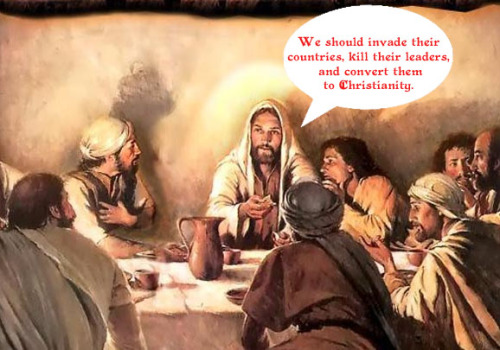
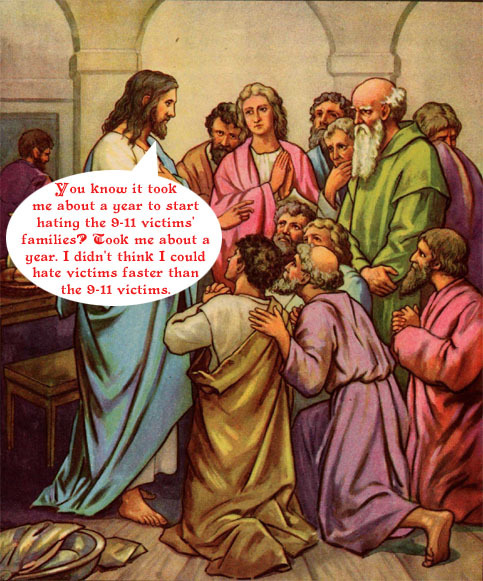
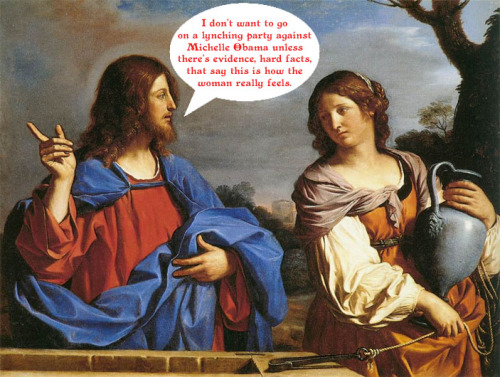
So, I give you, Tea Party Jesus – a site that brings quotes from Tea Party Members (usually prominent) together with pictures of Jesus to remind us why it’s a bad idea not to bring Jesus into the political realm as though he’s endorsing your position… Here’s a quote from right wing pundit Ann Coulter.

And one from Glenn Beck

And Bill O’Reilly

And lest you think I’m just picking out right wing shock jocks – here’s one from James Dobson (I kind of see where he’s going with this one, I just think he takes it a step too far).

If you’re going to claim to speak for Jesus you want to make sure that what you’re saying is consistent with what he said and how he lived. There are plenty of things that many of us, as Christians, say that would look equally preposterous – but we’re not there asking you to vote for me, or with me, on the basis that God would.

This is something all those of a political persuasion should learn. (I’m looking at you Tony Abbott – seriously, who could argue that Jesus would not show compassion and love to desperate boat people on the basis that he drove money lenders from the temple).

“Jesus knew that there was a place for everything and it’s not necessarily everyone’s place to come to Australia.”

There are myriad ways that this statement does not work. What about the biblical injunctions to care for the poor? The widows? The orphans? Andrew has a good post about a better response to asylum seekers here.

Here’s a better statement.

“Jesus knew that there was a place for everything and it’s not necessarily everyone’s place to come to Australia.”

For those playing at home – here’s how Jesus spells out how we’re to care for those crying out for help in Matthew 25…

31“When the Son of Man comes in his glory, and all the angels with him, he will sit on his throne in heavenly glory. 32All the nations will be gathered before him, and he will separate the people one from another as a shepherd separates the sheep from the goats. 33He will put the sheep on his right and the goats on his left.

34“Then the King will say to those on his right, ‘Come, you who are blessed by my Father; take your inheritance, the kingdom prepared for you since the creation of the world. 35For I was hungry and you gave me something to eat, I was thirsty and you gave me something to drink, I was a stranger and you invited me in, 36I needed clothes and you clothed me, I was sick and you looked after me, I was in prison and you came to visit me.’

37“Then the righteous will answer him, ‘Lord, when did we see you hungry and feed you, or thirsty and give you something to drink? 38When did we see you a stranger and invite you in, or needing clothes and clothe you? 39When did we see you sick or in prison and go to visit you?’

40“The King will reply, ‘I tell you the truth, whatever you did for one of the least of these brothers of mine, you did for me.’

41“Then he will say to those on his left, ‘Depart from me, you who are cursed, into the eternal fire prepared for the devil and his angels. 42For I was hungry and you gave me nothing to eat, I was thirsty and you gave me nothing to drink, 43I was a stranger and you did not invite me in, I needed clothes and you did not clothe me, I was sick and in prison and you did not look after me.’

44“They also will answer, ‘Lord, when did we see you hungry or thirsty or a stranger or needing clothes or sick or in prison, and did not help you?’

45“He will reply, ‘I tell you the truth, whatever you did not do for one of the least of these, you did not do for me.’

46“Then they will go away to eternal punishment, but the righteous to eternal life.”

Apparently political leadership is all about unity. Unity is much easier when there’s a common cause involved – particularly a cause of value, or one that people can unite to believe in.

Tony Abbott doesn’t really get it. In a manifesto on his political leadership he suggests being in opposition successfully is about being in opposition.

Mr Abbott said he would work to bring the party together because it’s easier to manage a party when they oppose rather than negotiate with the government.

“The best way to unite a political party is to really go after your opponents, which is what I intend to do,” he told the Nine Network today.”

I disagree. I think the electorate does too.

Successful “opposition” doesn’t depend on disagreeing with everything the Government puts forward.

K-Rudd started getting traction with the electorate when he positioned himself as the “alternative Prime Minister” and his party as the “alternative government”… I got so sick of hearing those words before the last Federal election was announced – but mostly because I didn’t like K-Rudd and I could see a correlation between those words and his boost in the polls.

Real leadership means offering policies and informed, decisive alternatives. Not just saying “they’re wrong” as loud as you can.

Peter Costello has a column in today’s SMH detailing his problems with Turnbull’s approach to leadership.

He acknowledged some strengths of his methodology. But diagnosed the problem with Turnbull’s leadership as an inability to cultivate much needed unity.

“To promote unity, Turnbull needed to give all the shades of party opinion a say in proceedings, and to promote colleagues on merit regardless of whether they voted for or against him.”

“A political leader cannot take his base for granted. He must give voice and confidence to the party membership. Australian politics is detribalising. Rusted-on supporters are fewer than ever. To keep those supporters, a party must nourish and respect them.”

Costello seems to think Turnbull was unable to cultivate unity because he was a grasping power monger climbing above his station. He’s particularly scathing on Turnbull’s public statements about Liberal Party colleagues.

I have never seen a Liberal leader attack senior colleagues in the way Turnbull did on the weekend. Turnbull’s attacks have been sharper and inflicted more damage on his colleagues than Kevin Rudd ever did.

If I was running the Labor Party’s campaign in the seemingly inevitable double dissolution election I would be rubbing my hands at the prospect of ads just featuring quotes from Liberal Party members about other Liberal Party members.

Foetal position

Nathan Campbell —  March 11, 2009

Ben just sent me a link to this ABC story where Tony Abbott attacked Kevin Rudd for allowing changes to Australia’s aid policy and aid money being used to fund abortions.

The comments thread is telling. These discussions always bring out the rabid atheists who want to accuse Christianity of “holding back society”… I do like it when they put together a coherent argument.

Like this:

“Lets not forget that the bible tells the story of how god drowned every living person except Jonah and his family because he was annoyed with them. So to say the bible condemns murder is a very selective interpretation.”

Sadly comments are closed. So I couldn’t point out that Jonah was the guy eaten by a whale and people were saved at the end of the Jonah story because they repented. Anyway. There’s a lot of stupid Christians in the debate too. But Coloru seems to be a pretty rabid atheist, he says:

“Wakeup! If you cant find god in your own heart and mind then it doesnt exist. The bible isnt going to help.*”

*lack of apostrophes his own.

This again highlights the atheist’s fundamental misunderstanding of the place of the bible in Christian faith. It’s central – not an afterthought. It’s the way we find God. And hands up Christians who can find God in their own heart and mind…

Happy Budget Day

Nathan Campbell —  May 10, 2006

I hope you all had great fun watching the Federal Budget last night. Didn’t Peter Costello look dapper in his Sunday (or Tuesday) best – he was wearing a particularly spiffy stripey tie. He’s way too trendy to be a real Prime Ministerial candidate. I think Tony Abbott with his unfashionable satellite dish ears, and slightly elf like chin, is a much more realistic candidate. If you throw the “here’s my adopted-out non-son” nonsense into the mix he’s got the whole public sympathy thing happening too. Clearly that’s how John Howard got elected. Everyone felt sorry for the little man. I had a budget party by myself last night. How sad is that. I also installed a new hard drive in my computer and almost killed it. So I’m a nerd and a geek.

Today’s theory is that economists are the strangest people in the world – I base this theory on my two economist friends – Ben and Joe. Some of you will know both Ben and Joe, others will know one or the other, some of you will know neither. Suffice to say (that’s a grammatically incorrect figure of speech if ever I’ve seen one – there really should be an it’s before the Suffice, but that’s not how it works*)- they’re both weird. Anyway, I got a post budget email from Ben asking me what my opinion is on the government’s subsidy of childcare places – he’s not sure non-parents should be carrying the can for those who choose to reproduce. Here’s my response – copied directly from the email:

“On childcare – the reality is children are the future of our country, and a valuable resource that should be invested in. I think there are two ways to look at it – the government could provide financial assistance for parents who choose to stay at home and look after their children (meaning that childcare wouldn’t need to be such an issue) – essentially they do this with family allowance – but it could be a greater counter childcare incentive.
On the socio-economic side of things – it stands to reason that genetically some people will have more intelligent children than others – it worries me that “smart” people are increasingly choosing not to breed – and dumb people aren’t caring for and nurturing their children like smart people would – I think this will be a problem. On an interesting side note – there’s an economist who has tied decreasing crime stats in the US with the introduction of abortion – he’s that popular economist guy who writes those books. ”

Ben’s response used an analogy of a soccer coach who only invests in youth being narrow minded and not particularly likely to experience short term success.

Here’s my counter response:

“There’s no point spending lots of money on encouraging today’s generation to make as much money as possible if they’re going to die out – except that they’ll leave no heirs and the government will get the money. That’s an interesting form of investment – but the people the money will benefit in the long term will be children from broken homes, who have been educated through a crappy state system because they can’t afford private education and who have parents who haven’t been able to bring them up properly because they’re working to be able to buy their plasma screen TVs and luxury items.

By the same token – the parents with good jobs who work to put their kids through child care and pay for their plasma televisions will decide that economically it makes more sense not to have kids to begin with so they can buy bigger TVs and both work to make their lives more comfortable.

Inherent human selfishness will be the death of our society – the more self sufficient individuals society creates the smaller society becomes – those individuals become their own society and then die off. It’s a poor economic model – which is why children are our future – and it’s why Costello called for people to take one for the team and breed.

A good coach finds the right mixture of youth and experience (Chelsea – Robben and co, Crespo) a bad coach buys a bunch of guys who are in, or passing their prime (Real Madrid – Zidane, Figo etc) or invests only in youth and loses all their experience (I’d put Ferguson in that category at the moment, releasing experience in Beckham, Keane, et al and bringing in Christiano Ronaldo and Wayne Rooney).”

That’s the sort of thing I talk about with my strange friends. It’s pseudo-intellectual I guess, and very self serving (some rude people might say it’s a load of wank – but I’m not rude).

Now that I earn an income I say yay for tax cuts… and I’ll leave you with this asterixed point to check out.

*Sidenote on the English language – Micallef does this sketch as an arts critic filling in for a sports journo in a post match interview with a footballer who says “it all goes well for the finals” when of course the sports star should have said “it augers well” or “all bodes well” – his point was remade by the SMH a couple of weeks ago in an article highlighting the highjacking of language by our culture of stupidity. Read it here.