 It might seem like a fudge to call being interesting a virtue – and this second virtue was originally an authentic and interesting voice with an interesting message. But, in this brave new media world, it is. I changed the title because this virtue is something like the ancient oratorical Holy Grail. Eloquence.
Attention spans are short.
Time spent reading is an increasingly popular web metric (see also, Upworthy making this switch, and note: there’s now something of an estimate, based on length, of reading time at the top of each post on this site). Being boring kills.
And this is a series about what it is that defines the writers I admire. And those writers are, without fail, interesting. Or eloquent.
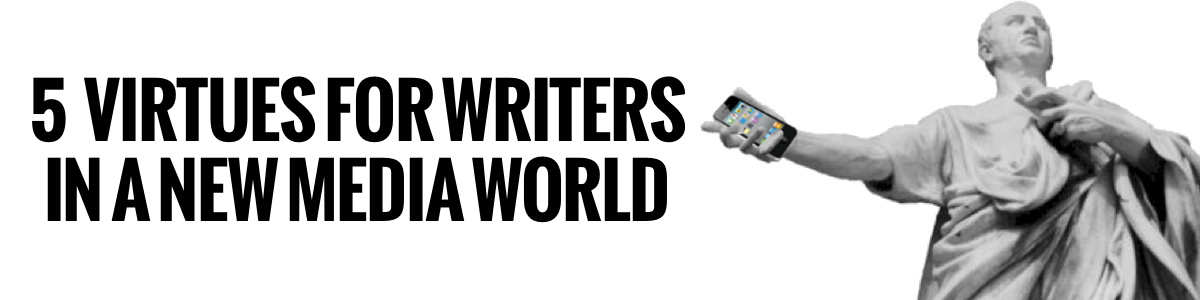
Who else would I turn to to prove my point on this front if not Cicero.
“He, then, is truly eloquent… who in the Forum, and in public debates, can so speak, as to prove, delight, and force the passions. To prove, is a matter of necessity:—to delight, is indispensably requisite to engage the attention:—and to force the passions, is the surest means of victory; for this contributes more effectually than both the others to get a cause decided to our wishes.”
Marcus Tullius Cicero went as close as anybody to declaring eloquence a virtue in De Oratore he says:
“Eloquence is so potent a force that it embraces the origin and operation and developments of all things, all the virtues and duties, all the natural principles governing the morals and minds and life of mankind, and also determines their customs and laws and rights, and controls the government of the state, and expresses everything that concerns whatever topic in a graceful and flowing style.”
What I think is interesting about this quote is that the new media world is ‘governed’ by something like eloquence. The agenda in this world isn’t set by big budget, multi-national, media conglomerates, but by individuals whose content is dispersed through social networks. Individuals curate content, functioning as editors. Sure, new media platforms like Facebook influence what spreads and what doesn’t through its opaque newsfeed algorithm, but how long the online community will stand idly by and let that happen is an interesting question (on opaque algorithms and their dangers, read this), and even with the all-powerful algorithm serving up stories to maximise eyeball time on the platform, the content is still largely generated (or curated) by the little guy (Facebook’s Director of Product says its algorithm ensures it’s the content users like that users see – rather than quality content, or biased/agenda-driven content like you might expect from the mass media). Content in this new media world is democratised. For more on this check out Tom Standage’s conclusion in the superb Writing on the Wall (review here), or his TEDx talk.
Eloquence sits beside virtue for Cicero as must have elements of the ideal person/statesman (his ideal person was pretty much himself – so he probably doesn’t embody my cardinal virtue for writers in a new media world. Humility). If it excites you, you can read most of a chapter on how Cicero’s views of the ideal orator, and the relationship between virtue and eloquence, were developed by Augustine on Google Books. In Brutus he calls eloquence the “marrow and quintessence of persuasion.” For Cicero, the ideal person was an orator-philosopher-statesman, and the only speaking or writing worth bothering with was persuasive.
Persuasive writing or speaking transforms. It moves. It excites. It stirs the emotions. It does what good writing should. Persuasive writing must be interesting – or it won’t persuade, and, as a reader, I want to read stuff that challenges, changes, or deepens my thinking – so persuasive writing is, I think, the mark of good writing. For Cicero, good oratory (and for us, good writing) is judged on its fruits. Its impact. While the good orator or writer is judged on their eloquence and virtuous character.
“When a Citizen hears an able Orator, he readily credits what is said;—he imagines every thing to be true, he believes and relishes the force of it; and, in short, the persuasive language of the Speaker wins his absolute, his hearty assent. You, who are possessed of a critical knowledge of the art, what more will you require? The listening multitude is charmed and captivated by the force of his Eloquence, and feels a pleasure which is not to be resisted. What here can you find to censure? The whole audience is either flushed with joy, or overwhelmed with grief;—it smiles, or weeps,—it loves, or hates,—it scorns or envies,—and, in short, is alternately seized with the various emotions of pity, shame, remorse, resentment, wonder, hope, and fear, according as it is influenced by the language, the sentiments, and the action of the speaker.” – Cicero, Brutus
Good writing does this. Good writers seek to do this for stuff they truly believe in and care about. They don’t create these emotions if they don’t first feel them, they don’t persuade people to think things they don’t think themselves. Perhaps to demonstrate Cicero’s ongoing relevance, but also to engage with new media realities, I’ll also feature a heavy smattering of insights from Jonah Peretti, one of the founders of the Huffington Post, and the founder of Buzzfeed. If anyone understands how to write for the new media world it’s Peretti. He gave this great (and incredibly long) interview on Medium that I’ll be quoting. You can read the whole thing – but according to Medium’s time calculator, it’ll take you 91 minutes.
I’ll break down my own vision of this virtue as it pertains to the new media world into three key (overlapping) elements authenticity, presentation. All of these qualities are important – but excellent, or virtuous, writing in this new media world requires all three, or at least two out of three (and I’d argue that for writing to be virtuous the content always needs to be excellent – it can either be packaged well without an authentic/credible author, or have an authentic/credible author and be packaged in an incredibly boring way).
An authentic voice
“I have been so much transported, not by the force of my genius, but by the real fervor of my heart, that I was unable to restrain myself: —and, indeed, no language will inflame the mind of the hearer, unless the Speaker himself first catches the ardor, and glows with the importance of his subject.” – Cicero, The Orator
Orators weren’t famed for authenticity – in fact, there was a whole stream of oratory – Sophistry – that was all about the triumph of style over substance, that lauded one’s ability to speak passionately about anything, even while not caring about that thing. I like Cicero because (outside some of his speeches as a defence lawyer) he was big on authenticity. Cicero literally embodied the values of the Republic in the face of the Empire, even to the point of martyrdom. These were something like his parting words – they come from the Philippics, a series of speeches that saw him executed.
“I defended the republic as a young man; I will not desert it as an old one. I despised the swords of Catiline; I will not fear yours. Indeed I would gladly offer my body, if by my death the liberty of the state can be immediately recovered, so that finally the suffering of the Roman People may bring to birth what it has long since labored to produce.” Cicero, Orationes Philippicae
These weren’t empty words. He died for his convictions. After he was executed his tongue and hands (that spoke, and penned) these words were nailed to the forum for all to see. He knew it was coming when he published the Philippics. Part of eloquence is embodying your message, beyond your words, and speaking from the heart. One of my other favourite orators, the apostle Paul, also embodied his message with authenticity, as demonstrated by the scars he carried with his message about the crucified Jesus.
“May I never boast except in the cross of our Lord Jesus Christ, through which the world has been crucified to me, and I to the world. Neither circumcision nor uncircumcision means anything; what counts is the new creation… From now on, let no one cause me trouble, for I bear on my body the marks of Jesus.” – Paul, Galatians 6:14-17 “We always carry around in our body the death of Jesus, so that the life of Jesus may also be revealed in our body. ” – Paul, 2 Corinthians 4:10
Authenticity is so important in this new media world, and is one of the determining factors in what gets read and shared online (cat videos not withstanding). And it’s certainly the determining factor in what, or who, I choose to read. BuzzFeed might have a reputation for promoting the trite and the trivial, but for Jonah Peretti, and for BuzzFeed, the need for authenticity is part of the editorial process – and this feeds into the site’s voice.
We also have our no-haters orientation. We tend to be enthusiastic and we tend to avoid snarky articles about mediocre things. It’s not like there’s some hard rule. In general, we tend to avoid a post that is designed to make the author feel smart and superior and the reader to vicariously feel smart and superior because a Hollywood film is mediocre or because something in culture is mediocre.
Interviewer: Honest enthusiasm is a sort of default stance at BuzzFeed.
Peretti: If there’s something that is worth someone’s time that is interesting and is worthy of being excited about, we should cover that. If there’s an egregious miscarriage of justice or corruption or fraud or something that needs to be investigated, those are both strong things. In the middle, there’s a lot of things that are kind of a waste of time. Mediocre things that you can write cynical comments about. – Jonah Peretti, BuzzFeed.
Writers in the democratised new media world don’t have the credibility that comes built in to writing for a mass-media platform, they build credibility on the basis of who they are – their expertise, what and how they think, and how they express themselves. I want to read people who say interesting stuff about interesting things, but I especially want them to be interested in those things (preferably with skin in the game), not professionally detached (like a journalist). It’s almost like in this new media world subjectivity is more interesting than objectivity, and we build our own objective view of ‘the facts’ (whatever they are) by choosing to hear from multiple perspectives.
An interesting voice (with an interesting message)
“It is of little consequence to discover what is proper to be said, unless you are able to express it in a free and agreeable manner: and even that will be insufficient, if not recommended by the voice, the look, and the gesture. ” – Cicero, Brutus
“Our style must be pure, and correct;—we must speak with clearness and perspicuity.” – Cicero, The Orator
Other beauties of composition which he will not fail to pursue;—such as brevity where the subject requires it;—a lively and pathetic description of important occurrences;—a passionate exaggeration of remarkable circumstances;—an earnestness of expression which implies more than is said;—a well-timed variety of humour;—and a happy imitation of different characters and dispositions. Assisted and adorned by such figures as these, which are very numerous, the force of Eloquence will appear in its brightest lustre. – Cicero, The Orator
It’s possible to be interesting when you’re talking about boring stuff – provided you talk about that stuff in an interesting way, or from an interesting angle. Some of the best stuff in the new media world, I think, involves putting the spotlight on stuff we take for granted. One of my favourite books is a biography of salt. I’m currently reading a biography of paper . I love all those videos on craftsmen making bespoke stuff like scissors and shoes.
The way to achieve this is to present that stuff with eloquence, such that the presentation makes the content sing.
Cicero basically defined eloquence in terms of knowing what to say, where to say it, and saying it well. In Brutus, Cicero speaks of Caesar. His frienemy (who ends up being exclusively his enemy). Cicero was trying to win Caesar over by painting his oratory in such glowing terms (a little bit of an authenticity fail on Cicero’s part), but his depiction of praiseworthy oratory is worth pondering.
“He [Caesar] is absolutely master of his trade, and, neglecting every other profession, has applied himself solely to this; and, for that purpose, has persevered in the rigorous task of composing a daily Essay in writing. His words are well chosen; his language is full and copious; and every thing he says receives an additional ornament from the graceful tone of his voice, and the dignity of his action. In short, he is so compleat an Orator, that there is no quality I know of, in which I can think him deficient.” – Cicero, Brutus
Cicero is pretty big on the idea that practice makes perfect when it comes to speaking and writing. He mentions Cicero’s essay writing to this end, but he also says stuff like:
A good voice, indeed, though a desirable accomplishment, is not in our power to acquire:—but to exercise, and improve it, is certainly in the power of every person. – Cicero, The Orator
He thinks the ability to speak (and he’s talking about the vocalisation of words) comes from nature (or the gods), but there are ways to improve (this is where a ‘voice’ analogy between writing and speaking fails because he’d also suggest anybody can become a writer, if not a speaker). Cicero has a second character in Brutus note that Caesar dedicated his own writing on oratory to Cicero, with this axiomatic definition of eloquence: “an accurate choice of words is the foundation of Eloquence.” Cicero compares eloquence to carefully displaying art in a gallery – where the framing matters, the lighting matters, the height you place the painting on the wall matters… eloquence is about featuring your content like a gallery curator features the star work in an exhibition.
“Accordingly, to the purest elegance of expression, he [Caesar] has added all the various ornaments of Elocution; so that he seems to exhibit the finest painting in the most advantageous point of view… Besides, his manner of speaking, both as to his voice and gesture, is splendid and noble, without the least appearance of artifice or affectation: and there is a dignity in his very presence, which bespeaks a great and elevated mind.” – Cicero, Brutus
This eloquence includes the choice of words, the structure of sentences, the flow and structure of the piece – and in this set of virtues the impact of humility on these matters discussed in the previous post (charity and clarity) come first. You can always make choices in these areas to look or sound impressive. But there are always choices to make on behalf of your audience, rather than for yourself. For Cicero the audience was king when it came to deciding if something was eloquent.
“The taste of the Audience, then, has always governed and directed the Eloquence of the Speaker: for all who wish to be applauded, consult the character, and the inclinations of those who hear them, and carefully form and accommodate themselves to their particular humours and dispositions.” – Cicero, The Orator
Different people like different stuff – and that’s fine. Different forums require different styles – and that’s fine. But the eloquent person writes to the audience they have selected.
“Different men have different opinions;”—nor is it easy to determine which is best. Thus also in painting, some are pleased with a rough, a wild, and a dark and cloudy style; while others prefer that which is clear, and lively, and well covered with light. How then shall we strike out a general rule or model, when there are several manners, and each of them has a certain perfection of its own?” – Cicero, The Orator
“We are not to speak upon every occasion, or before every audience, or against every opponent, or in defence of every client, and to every Judge, in the same invariable manner. He, therefore, is the man of genuine Eloquence, who can adapt his language to what is most suitable to each. By doing this, he will be sure to say every thing as it ought to be said. He will neither speak drily upon copious subjects, nor without dignity and spirit upon things of importance; but his language will always be proportioned, and equal to his subject.” – Cicero, Brutus
He, then, is an Orator indeed! who can speak upon trivial subjects with simplicity and art, upon weighty ones with energy and pathos, and upon those of middling import with calmness and moderation. – Cicero, The Orator
Cicero calls the ability to select a style that is apt to your audience and purpose ‘decorum’ – and this is basically one of his virtues for the orator. The key to good writing is to tailor how you present your content to the audience you write to. This means making sure your ‘voice’ matches your platform (or medium), and your content. Conversations about writing for the online world invariably end up talking about length (in my experience, though perhaps this is because I like to write such unwieldly posts). There’s no real ‘golden rule’ for packaging when it comes to length, or even style – except that it should achieve what the writer sets out to achieve. Length can work for, or against, eloquence. This is true according to both Cicero and Peretti…
“For as language is ever soft and yielding, and so amazingly pliable that you may bend and form it at your pleasure; so different natures and dispositions have given rise to different kinds of Elocution. Some, for instance, who place the chief merit of it in it’s rapidity, are mightily pleased with a torrent of words, and a volubility of expression. Others again are better pleased with regular, and measured intervals, and frequent stops, and pauses. What can be more opposite? and yet both have their proper excellence.” – Cicero, The Orator
“We see with our longform stories that, in some cases, the sheer length and rigor of a piece will make the piece have a bigger impact. Just the fact that it’s 6,000 words or 12,000 words.” – Buzzfeed’s Jonah Peretti
Peretti does suggest that it’s possible for things to be too long. Even if they’re well written. The key is delivering value to the reader in proportion to the length and the time spent reading.
Saying things in an interesting way isn’t just about packaging or length. Cicero is also big on two features of eloquent writing – the use of metaphors and the use of humour – and these, too, must be appropriate to the context.
We have slightly touched upon the ornaments of language, both in single words, and in words as they stand connected with each other;—in which our Orator will so indulge himself, that not a single expression may escape him, but what is either elegant or weighty. But he will most abound in the metaphor; which, by an aptness of similitude, conveys and transports the mind from object to object, and hurries it backwards and forwards through a pleasing variety of images;—a motion which, in its own nature, (as being full of life and action) can never fail to be highly delightful. – Cicero, The Orator
When it comes to getting laughs, Cicero makes a distinction between witty repartee and ‘humour.’ Humour is used to make narratives “lively and entertaining,” witty repartee is used to ridicule, or to respond to ridicule. He has some rules which are timeless tips for using humour, so I think apply to the new media world, and especially to the written word, where humour is so hard to pull off.
“The powers of ridicule are not to be employed too often, lest we sink into scurrility;—nor in loose and indecent language, lest we degenerate into wantonness and buffoonery; —nor with the least degree of petulance and abuse, lest we appear audacious and ill-bred;—nor levelled against the unfortunate, lest we incur the censure of inhumanity;—nor against atrocious crimes, lest we raise a laugh where we ought to excite abhorrence;—nor, in the last place, should they be used unseasonably, or when the characters either of the Speaker, or the Hearer, and the circumstances of time and place forbid it;—otherwise we should grossly fail in that decorum of which we have already said so much. We should likewise avoid all affected witticisms, which appear not to be thrown out occasionally, but to be dragged from the closet; for such are generally cold and insipid. It is also improper to jest upon our friends, or upon persons of quality, or to give any strokes of wit which may appear ill-natured, or malicious.” Cicero, The Orator
If a virtuous modern writer is defined by humility, I think it’s reasonable to expect most humour from this sort of writer should be victimless or self-deprecating. The democratisation of this new media world is a throw back to the time of Cicero. Everyone who creates or shares content online is an orator. Everyone has a platform. And it’s the audience that determines if something is eloquent or not. Cicero suggests eloquence takes the taste of the audience into account. One of the downsides of this democratisation is that every voice is, in some sense, given equal weight (note: this isn’t quite true, big platforms still exist, mass media outlets have a presence online, but it’s true when bits of writing are exported from their original context into other platforms – except when algorithms give greater weight to bigger platforms, which some do). This means that there’s a lot of noise to wade through. Cicero has some advice for the kind of voice that will cut through that chatter…
“A crowded audience, and a clamorous Forum, require an Orator who is lively, animated, full of action, and able to exert his voice to the highest pitch.” – Cicero, Brutus
Figuring out how to do that in writing is, I think, the key to packaging stuff for world we live in. It’s what thrusts sites like Upworthy and BuzzFeed into Facebook newsfeeds and the twittersphere. But packaging alone is not enough. If I’ve presented Cicero’s views on eloquence accurately – that it’s about using the right words in the right place in the right way, as defined by your audience, then it’s interesting to see how closely Peretti’s modern views mesh with his ancient advice.
“We want the stuff we do to reach the maximum audience it should reach, no less and no more. If we make a wonky political scoop, we want every political wonk to read it. If we make “Which state should you actually live in,” we want everyone who lives in a city to read it. ” “When we have something that’s a hit, usually our response is not, “Let’s do more of those.” Our response is, “Let’s figure why this is a hit and make variations of this.” This was successful because it was tied to someone’s identity, it was successful because it had cats in it, or it was successful because it had humor, or it was successful because it tapped into nostalgia. If you’re making entertainment content, which is a big part of what we do, you look at that hit and you say, “Why was that successful? Can I do it again? Can I make something else that people really love and want to share?” And you try to vary it, even though you know doing something derivative would work. Long term, you want to have a deeper understanding of how to make great things.” – BuzzFeed’s Jonah Peretti
When you think about the media industry, it’s also, “How do you reach people and how do you get people to understand?” If you write something and nobody understands it, it’s easy to be, like, “Oh those are all the dumb people.” Sometimes writing something that’s very sophisticated and difficult and technical for a particular audience is totally fine, but you should be able to communicate in simple language… The thing is, there are dangers in this, because you can also explain something in a way that makes people feel like they understand it when they actually don’t… You can figure out a way to frame something and explain it so that it feels like it confirms what people already believe, including incorrect things they believe. – BuzzFeed’s Jonah Peretti
Peretti notes that to be eloquent (according to our definition) in the new media world requires thinking about what’s new in our media platforms and how that has to shape our approach (and our content).
“Early-stage digital publishers have stayed too close to print. They look like print. Their basic unit is the same kind of article structure. Some of them might be shorter or longer, but the front page is programmed almost like a newspaper. The formats of the articles are more like a newspaper. And it’s like, “Oh, let’s add a little video,” but when they add video it’s like they are trying to be TV, but it’s not quite as good as regular TV. The way to break through and to make something that can actually scale into something big is just to say, “What would this be if the readers and the publishers were not focused on making something similar to print?” If they said, instead, “What should this be if mobile is the most important thing; if things can be more visual; if things can be more shareable; if length can be anywhere from 140 characters to 12,000 words? In that kind of world, where things can be interactive, like quizzes—in that kind of a world, what should a media company be?… In a grand sense it needs to move away from mimicking print to doing what is natural for the web.”
The new media world has to shift our understanding of eloquent writing. Because the audience is shifting.
It’s not paranoid to think that the audience watching broadcast television is old. And it’s not paranoid to think people, particularly young people, are spending a lot of time on their phones and a lot of time on the Internet. It’s accurate to say that media consumption is changing in a pretty dramatic way and that if your marketing stays the same you essentially will be marketing to people who are consuming media the way people consumed media ten years ago instead of the way they’re consuming today. – BuzzFeed’s Jonah Peretti
(An interesting voice) with an interesting message
It’s hard to split the voice from the message when it comes to eloquence. What I think is virtuous when it comes to the “interestingness” of the content is delivering on what is promised in the packaging, and delivering value to the reader. Part of this is in the realm of a ‘content strategy’ or editorial policy, that’s a decision the modern writer makes based on who their audience is, and, because authenticity is important – who they are and what they’re passionate about. Content is king. Really. Content is where the value of a piece of writing lies. A reader may perceive writing as more valuable based on who it comes from, or how it’s served up, but good writing is inherently valuable to the reader (even if that value only lies in the reaction it prompts, and even if that reaction is only to entertain or excite the emotions), and good content is what should hold a reader’s attention. The virtuous and eloquent writer only holds the reader’s attention for as long as they want it to be held, they don’t employ ruses to entrap the reader. The virtuous writer makes it clear what is being offered, and delivers. It’s interesting how much debate about the relationship between content and packaging revolves around the headline. You can dress up your content with all the BuzzFeed or Upworthy tips and tricks, sensationalist headlines and listicles (here’s a neat article from Anil Dash, one of the prophets of the new media world about clickbait headlines that I quite like, and here’s an article about how headlines don’t actually matter because people who share stuff with their networks typically make up their own headline/description of the article). Peretti says BuzzFeed has made a conscious effort to have headlines that match up with, and describe, the content.
“You could show a picture of like an older guy at the beach and be like, “Guess whose body this is?” Then you click and it’s like, “Oh it’s Giorgio Armani” or whatever, and you could get a tremendous clickthrough rate on headlines that didn’t tell you what the story is about. The problem with that is that if you’re just getting clicks that would have gone to another headline on your front page, it’s sending people the content that might not be as good, because they’re clicking because they want to know what’s there. They’re not clicking because they’re interested in what’s there… You end up with lots of people who don’t actually want to see Giorgio Armani in a Speedo on the beach clicking that and then feeling like, “Oh god, why did I do that?” Like, “That was a waste of time.” The main problem for us is that when you think from the perspective of the reader, if headlines are all devoid of information and you have to click them to find out what they are about, all the social streams out there would become much less useful and much less valuable. When you think from that perspective it’s like, “Whoa, let’s just make headlines that describe what’s in the article and that’s better for the consumer and it’s better for the ecosystem as a whole. Then let’s make articles that people really want to click because they’re interested in them, not because they’re wondering what it’s about.”
Peretti talks a fair bit about appropriate metrics for this new media world, he doesn’t think time is the best measure, because people can do stuff to keep people’s attention for longer than they need to.
“The challenge there is that, like you said, if you create a long, meandering, boring story that’s just good enough to keep people reading, they might spend more time on that story than the short, condensed one that just tells you what you need to know. If you use time on that one, it will tell you to do the wrong thing… One of the reasons reality TV became so dominant was because people looked at time as being the metric. And the reason that reality TV works well for time is that the classic reality TV formula, in the beginning, was the tribal council and somebody getting eliminated. So you could have 50 percent of the show being boring filler and you’re kind of wanting to change the channel but you’re like, “Oh, but I wonder if my favorite person’s going to get eliminated.” So you have to watch to the end to see the elimination. In a way, that was a way of gaming time. You could look at that and say, “Oh, they spent an hour watching this show, including the commercials. That means it must be a really high quality show.” But it also might just mean that they figured out a hook that incentivizes you to watch to the end and then did a lot of mediocre content in the middle.”
It’s clear from the length of this piece that it’s in danger of being far from eloquent (but I haven’t claimed to be virtuous), so I’ll stop now.
 which is something of an extended treatment of these aforementioned ideas from David Foster Wallace, combined with a connection to the work of Marshall McLuhan (who coined the term “the medium is the message” – amongst other things).