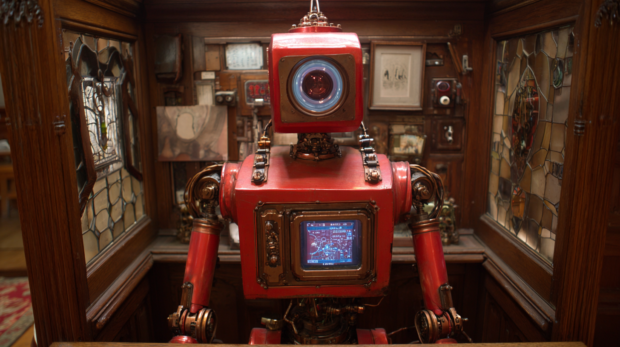
I’ve been trying to get the next instalment of my interactions with Paul Kingsnorth’s Against the Machine finished and posted, but, like Alice, I find myself down several rabbit holes and with a document 10,000 words long. So. I’m serialising this next bit.
The machine church, as I’ve been describing it —runs like a well-oiled machine; or tries to — and works best when people fit into the machine like cogs who keep things turning over; or fuel; whose energy (and money) is used to keep the cogs turning.
But growing a church beyond ‘human scale’ — and a ‘local scale’ much like growing a city — requires machines; and this creates an interesting phenomenon where one’s participation in the church is mediated by forms of machinery in ways that are significant and serve to form our experiences and communities — but also go largely unnoticed. Machines and technology reshape the architecture of our homes, public spaces, and cities — and we don’t always notice, and for some of us the revolution happened before we were born. Charles Taylor talks about how our beliefs are a function of our ‘social imaginaries’ — the things we take for granted as part of our everyday life, including architecture. I’m suggesting here that machine church is mediated to us in ways that are a function of a ‘social imaginary’ provided for us by technologies we have embedded into modern life by virtue of ‘the machine’ and that have shaped church life in ‘machine ways’ without us noticing.
In my last post I began to describe the transition that happened while I was on staff at a machine church from aspiring megachurch to multisite church with ambitions for 200 campuses. This is, ultimately, a well-worn machine move from automobile to screen, or mechanical to digital that mirrors the kind of (r)evolution that Kingsnorth describes in his book, and that other thinkers — like Marshall McLuhan — anticipated.
The modern church is — regardless of shape, size, or philosophy — a product of mobilisation and specifically auto-mobilisation aided by the very real machine that drives us (or that we drive) to the location we gather. It’s significant that the ‘auto’ in automobile is the Greek word for ‘self’. The modern church in the western world will either be shaped ‘by the machine’ that shapes the West, or in resistance to “the machine,” and will have to navigate how it employs or relies on technology that ‘mediates’ our message along a spectrum of acceptance to resistance or refusal. Sometimes we will do multiple things at once, but at least knowing we’re doing them seems important.
Unless your church is either limited to one household, or people who gather travelling by foot, it is a product of extending our limits using a machine. It feels impossible to reverse this — and while I love the romantic idea of the ‘walkable city’ and the ‘walkable church’ (and don’t understand the way they’ve become polarised and loathed by the modern right, except that the modern right loves individualism and engines), they are (as we will unpack in subsequent posts) economically almost impossible to produce without significant disruption and expense.
Utopian ideals might pull us incrementally towards more human ends though (or destroy us, like most Utopian visions), but my goal is to at least ask questions and invite recognition of where we are being de-formed and how we might be re-formed or transformed by non-machine forces.
The machine church is not just ‘out there’ in some other church — this is true of the church I lead, and it just is a thing, and it has an impact — and there are many other physical and environmental factors geared up against human scale church that I’ll unpack subsequent to this post that mean there’s not a simple answer to de-couple from the machine and create an alternative — but unless we name what is happening, the massage of the machine continues unchecked. Marshall McLuhan, the ‘media ecologist’ who coined the phrase ‘the medium is the message’ also wrote ‘the medium is the massage’ — we don’t always notice how we are being pressed and manipulated by the forms and mediums and technologies we introduce into our ecosystems.
I want to zero in on two machines that shape the machine church experience — that are vital to it — the car and the screen — and suggest that if these technologies dictate how our communities are shaped and operate, this will form us in certain ways — and that while both technologies seek to collapse limits — especially time and space — they have, and will continue to, transform the habitat in which we form our habits, and the shape our relationships to place and people in ways that might reinforce, or harden, parts of our humanity that the Gospel seeks to soften and change.
My basic argument, that I’ll unpack across a few posts, goes like this:
- We live in, and our life and churches are shaped by what Charles Taylor described as the “age of mobilisation”.
- The age of mobilisation is a product of machines (like rail, cars and screens) and “the machine” (like an animating principle), which changes our ‘social imaginary’
- The megachurch is, historically, demonstrably a product of the automobile, and the ‘age of mobilisation’ as it involves consumer choice, and conceptually a product of ‘the machine’.
- The multisite church (and it’s ‘sister’ the ‘digital campus’) is a product of digital image technology, and a “machine church” heir to the megachurch designed to push past the limits imposed by physical ‘car’ space.
- Machine churches — whether mega, multisite, or ‘would be if we could be,’ feel the pull of machine technology to expand reach beyond limits, and ultimately become part of the machine paradigm — and come under its spell — as a result.
- Machine churches operate like cities not towns, villages, gardens, or families — they uproot and disrupt rather than establishing connection between people and place, creating a tendency towards what I will call the ‘westfieldification of church’.
- In the age of ‘surveillance capitalism’ and the production line, machine churches move towards a sort of ‘globalised’ standardisation and form consumers who become resources for the machine to harvest.
- Machine churches compete with each other (and all other churches) for consumers by ‘product differentiation’ — including available carparking space and digital output made for the ‘attention economy,’ and compete with the machine world for the attention of ‘not-yet-customers’ towards this end.
- Machine churches turn humans — both staff and volunteers — into ‘mechanical turks’ who serve and are ‘discipled’ through participation in the machine; whose ‘maturity’ is assessed on the basis of conformity and contribution.
- There are ‘economic factors’ of modern life caused by the machine that fragment and destroy organic, human scale life and community, and sometimes life in a machine world requires machinery, or radical restructuring. So, for example, housing prices and urban sprawl uproot families and communities geographically and maintaining relationship requires technological mediation (driving or calling).
Hopefully now that I’ve decided to chunk these up, they’ll come out a little faster. Happy to start engaging with the listed ideas above though if you want to enter the conversation earlier.
Comments
Hi Nathan,
Thank you for this. The way you’ve been elucidating these ideas has been resonating deeply with me. I suspect that the “would be if we could be” catagory is far more pervasive and ubiquitous than we want to admit. I’m looking forward to to reading more, I’m thankful for the chance to read them on your blog when this could easily be a book or even a Phd thesis (maybe it should still be these things).
My heart has been broken by what feels like an insidious pull that takes shepherds and turns them into factory farms.
Bless you mate