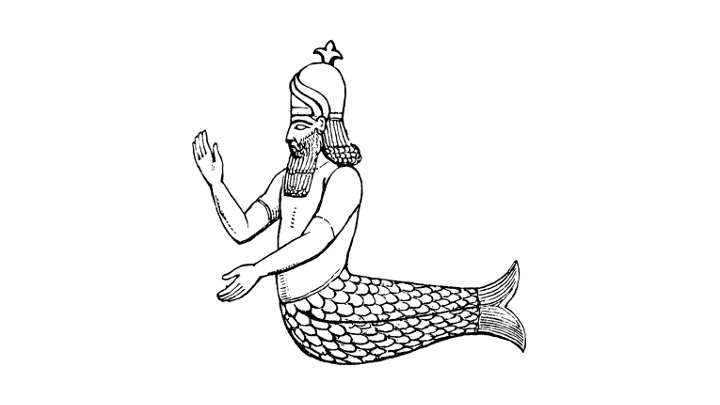
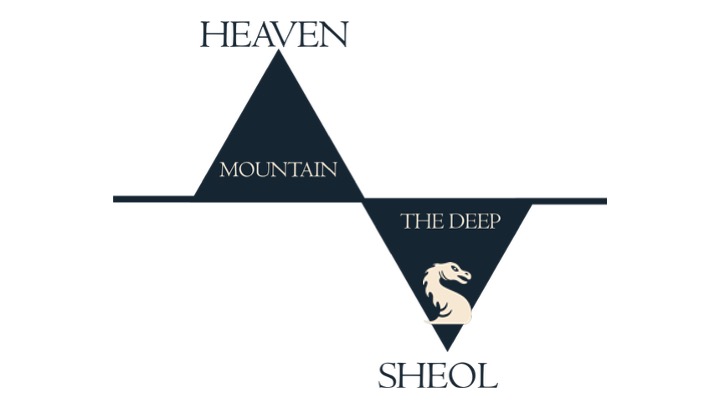
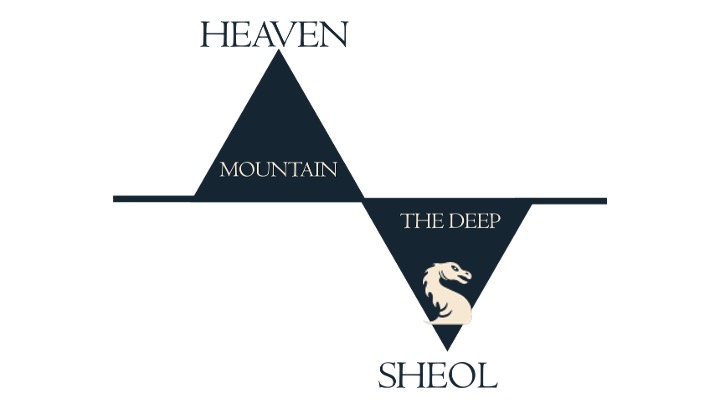
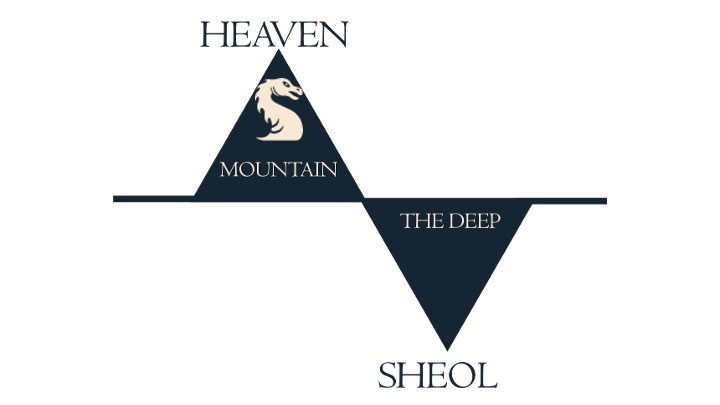
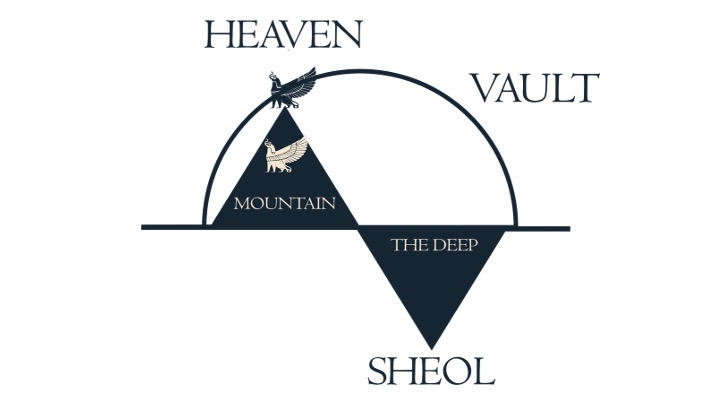
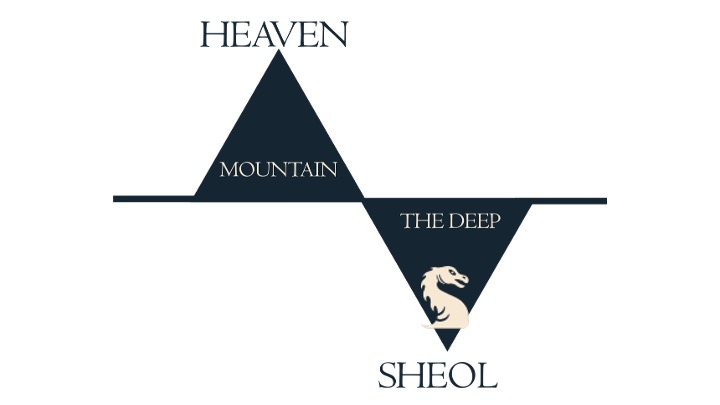
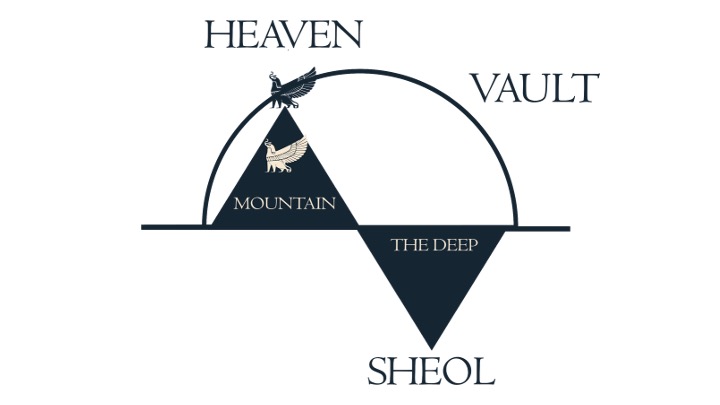
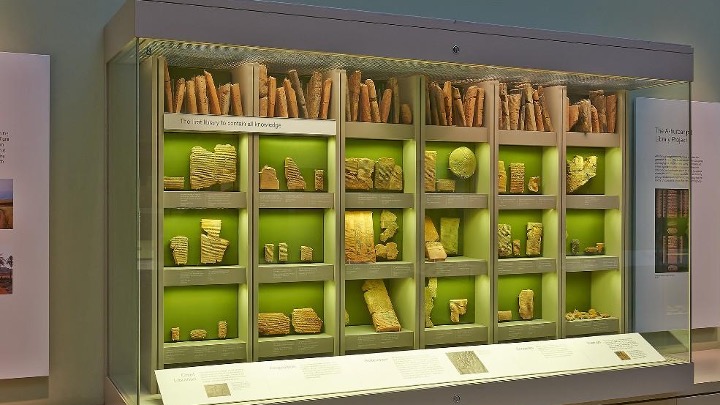
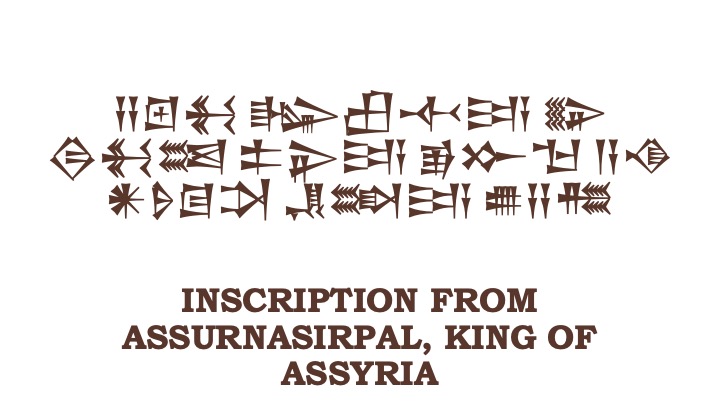
Babylon’s creation story the Enuma Elish is the story of how the powerful warrior God Marduk took up weapons against his mother Tiamat, a giant cosmic creature of the deep waters — but not the waters that bring life (the Apsu) — she’s often identified as a serpent or dragon, and many of her monstrous offspring are also dragons or serpents. Tiamat becomes a bit of a violent tyrant, so Marduk, her son, goes to war with her and chops her in two; and from her body parts he forms the heavens and the earth.
There are snakes, sea monsters, and serpents all through the story of the Bible. People in my congregation are concocting drinking games for the number of times I bring them up in sermons, but I bring them up for a reason. There’s a reason, for example, that Jesus calls the religious leaders of his day who end up conspiring with the Babylon of his day (see Revelation) to crucify him a “brood of vipers” — snake children, and where he also just straight up says “your father is the devil” who lies and murders by his nature.
There are sea monsters — tannin in Hebrew — sanitised out of our translation of Genesis 1 (the great creatures of the deep); and foreign powers like Egypt and Babylon are described as serpenty (nacash in Hebrew) sea monsters (tannin) who are “leviathan” as God describes their violent dominion and his promise to rescue people from their oppressive coils.
Violence and lies are the tools the serpenty empire use to create and legitimise violent and dishonest empires that believe we create through destruction; including the destruction of human bodies made to bear the divine image. Babylon’s practice was not simply to sacrifice children but also to make young men from conquered royal families into eunuchs (Daniel, the prophet, is given to the chief of the eunuchs so it is likely he was dismembered as a picture of Babylonian power — as the prophets promised in both Isaiah 39:7 and 2 Kings 20:18). Eunuchs represented many other things in a royal court and functioned in particular ways, but when Babylon’s creation myth is pitted against the creation story of the Bible and God’s divine image being represented in humans “male and female he created them”; the visibility of this contrast is part of the picture behind Isaiah’s words. Babylon’s story legitimised Babylon’s violent empire; and kings — like Nebuchadnezzar (the living image of God in Babylonian cultic practice) who ruled like Marduk (and propagated his story to draw the links more closely).
The pentecostal theologian Walter Wink traced this story through to the way the modern world approaches power and violence and called it “The Myth of Redemptive Violence“. Here are a couple of paragraphs from his essay, which engages with the Enuma Elish (the Babylonian creation story).
“The belief that violence ”saves” is so successful because it doesn’t seem to be mythic in the least. Violence simply appears to be the nature of things. It’s what works. It seems inevitable, the last and, often, the first resort in conflicts. If a god is what you turn to
when all else fails, violence certainly functions as a god. What people overlook, then, is the religious character of violence. It demands from its devotees an absolute obedience unto-death. This Myth of Redemptive Violence is the real myth of the modern world. It, and not Judaism or Christianity or Islam, is the dominant religion in our society today.”
He looks at our cartoons (Popeye) — but, you know, Reacher or the Marvel movies, or whatever, and maps them onto the Babylonian vision of the world.
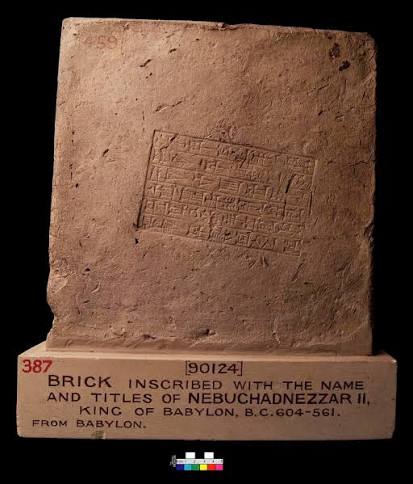
The Biblical story is radically different to Babylon’s; creation does not come through violence but as a generous act of generative love. Where Marduk kills his mum and makes the heavens from her ribs, God puts the earthling (Adam’s name means earth) to sleep (a kind of death) and forms life in a way that does not destroy but generates more life — as the two become one again to ‘be fruitful and multiply’. In Genesis’ account of the creation of Babylon — the tower of Babel story — a king (Nimrod, introduced a chapter earlier) leads a people to build a great tower to the heavens to “make a name for themselves” using bricks. Nebuchadnezzar famously inscribed every brick in his building projects (built by enslaved workers from the conquered nations) with his name, and the Enuma Elish tells the story of the construction of the city of Babylon as a ‘tower’; a gateway between heaven and earth so the gods could enslave their (too noisy) human workers who worked for their pleasure. Pretty self-serving story if you’re the walking image of God who likes to destroy your enemies and build big things for your name… Marduk is also pictured, often with a pet snakey-dragon. It’s not a coincidence that the Old Testament describes empires like his as snakey or beastly (or that Revelation does the same when looking at Rome’s beastly human kingdom that serves the dragon, Satan.
After his retelling of the Babylonian account of power, violence and creativity and redemption coming through destruction, Wink says:
The implications are clear: human beings are created from the blood of a murdered god. Our very origin is violence. Killing is in our genes. Humanity is not the originator of evil, but merely finds evil already present and perpetuates it. Our origins are divine, to be sure, since we are made from a god, but from the blood of an assassinated god. We are the outcome of deicide.
All of this is to say — a few years ago now (Feb 2021) I wrote a piece for Eternity News urging Christians in particular to avoid violent rhetoric in how we talk about politics; because, violence begets violence —and the sort of script we bring to the public square represents the kind of kingdom we belong to; the creation story that shapes us.
The story was pulled because I (with receipts) named names and was threatened with defamation, and because my contribution contributed to the very polarisation I was calling out. After some reflection at the time, I did republish it here.
The people I named were people from the so-called “Christian right” who want a muscular, militant Christianity and use “culture war” language and even laugh about the idea of political violence being “not yet” necessary. A few years later some “Christian” domestic terrorists shot some police officers here in Queensland.
The table turned a bit when this same violent language was used to justify the shooting of a politically conservative Christian voice on a university campus; suddenly many of those voices were against the violent rhetoric of “the left” – whoever “they are” if “they” are my political opponent “they” are the problem.
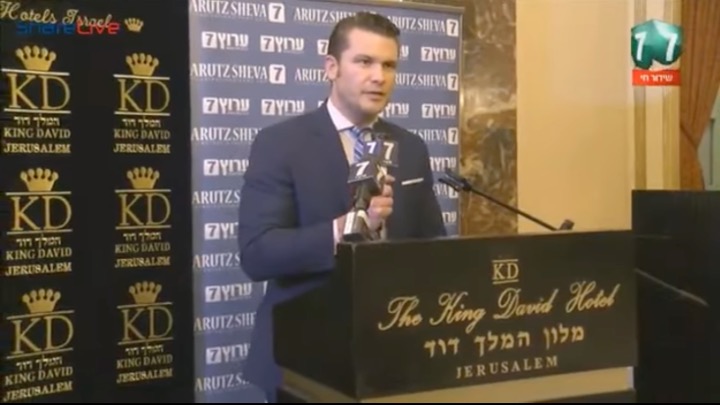
I don’t think I was wrong to ‘target’ the right, so to speak, and not talk about the left — I am more concerned (because I am concerned about the witness of the Gospel) with the fusion of the Gospel with the political right as I see it in Christian Nationalism and especially the U.S “Secretary for War” posting instagram reels of himself praying the Lord’s Prayer to vision of the army dropping bombs on its enemy, or quoting Isaiah to claim the U.S army is sent by God “here I am send me” — and by Trump claiming to do more for Christians than anyone ever — I am more concerned about this than I am about the godless political left and the destruction it wreaks simply because that is not destruction worked in Jesus’ name (carrying God’s name in vain), but a picture of something else. Also, I do think the modern western left is inevitably motivated by Christian values around the dignity and worth of various people and groups (whether that’s women, queer people, racial minorities etc), and that this lens gets applied to lots of conflicts and power struggles in helpful ways (and unhelpful ways), just as I think conservatives are often trying to conserve good and true things.
I have seen, this week — at least one of the figures I named in that piece (who I then sat down with for breakfast) — blaming Helen Haines — the victim of this week’s politically motivated terror attack on the political positions this leader took around Covid vaccines and abortion; justifying “violence” (or at least explaining it).
He wrote:
“Sadly Helen Haines may lose her life if not her legs.. It’s also sad that she backed the rules that locked you out while your grandmother died alone. She treated medical autonomy as optional and supported abortion on demand plus voluntary assisted dying.
Then a man deliberately drove a car at her. Now she is in intensive care and the political class suddenly remembered that violence is bad, while still defending the ideas that treated some lives as optional.”
He was so enamored by this line of reasoning that after two sentences (in the same post) about the perpetrator, he returned to his attack on Haines.
“Helen Haines publicly supported Victoria’s abortion laws, some of the worst in the world. She backed assisted suicide for the elderly and the sick. During COVID she pushed the vaccine rollout against peoples will, treated dissent as a threat, and accepted a system that kept families from the dying. For years that class of politicians told ordinary Australians their rights were optional: you could not see your dying parent, your body was not fully yours, unborn lives could be discarded, and the frail could be offered an early exit.”
And then evokes the spectre of the scary “they”… before suggesting that Haines belongs in the same place as the man who attempted to kill her with his car.
“They normalised the idea that some lives and some freedoms do not matter when the ends suit them. Then they act shocked when an unstable man applies a version of the same logic to a politician.
Disclaimer: The attacker is fully responsible for his crime. Nothing justifies running someone down. But the years of state coercion and disposable lives created the climate in which this kind of madness becomes more thinkable.”
Condemn the violence. Jail the perpetrator. AND get rid of the policies that taught people certain rights and certain people were optional. Helen should not be in hospital. No. At worst, jail.”
One must question what this sort of rhetoric — the overwhelming emphasis on Haine’s political positions (which do not otherwise seem to be on the table in terms of the motivation for the attack) rather than on her attacker — is designed to do; it creates an enemy, it legitimise a kind of force used against a political enemy (prison is a kind of violence at one level). This is bad people doing bad things to bad people, in a way that tacitly justifies bad things happening to the bad person — just not that bad thing, and preferably at the hands of the state (and preferably a state where we Christians take back control). While it seeks to uphold the value of the life of the unborn and the elderly, it does so by buying into a kind of Babylonian vision of one’s political enemy.
His tune changed a day later when it turned out the perpetrator held “leftist” political positions on Gaza and the climate. Whatever the story is, this kind of political actor uses it to sow division and enmity.
“Helen Haines was mowed down by a left-wing anti-Israel activist. Albanese’s response? Blame the right and everyone who has ever criticised him. Australia has suffered two horrifying terror-related attacks in the past year. Neither had anything to do with the right.”
This conveniently ignores both Desi Freeman and the Wieambilla shootings — terror-related attacks only count when “the other” is doing the violence. This is also not to say that the attack on Haines was not politically motivated (though I’d say most attacks are also perpetrated by deeply unwell individuals and blaming an ideaology is pretty politically convenient, especially when the vast majority of people on the left, or right — or Christians or Muslims — do not commit violent acts of terror).
He writes:
“The accused is Brendan Nugent. Years of environmental activism. Then he took a dark turn after 7 October 2023 into intense anti-Israel, pro-Palestine posting. Calls to “turn down the temperature.” Warnings about political discourse. Fingers pointed at the right.
Meanwhile the same people who spent years demonising ordinary Australians for opposing mass immigration, gender ideology, or open borders stay silent when the violence comes from the left or from Islamism.”
There are aspects of the way these sentences are written that sound like this is AI slop confected to create outrage; but this particular author has been prodigious in his output prior to the AI revolution.
It’s “not us”… it’s “them…” the woman you put here with me; but never me. Their violence and oppression. Never mine.
Now. I think it’s true that “the left” also blame “the right”.
And, part of what prompted me to stick my head back up above the fray on this one is I just read two of my online lefty friends suggesting the conservative church views its ultimate test of strength being around excluding queer people, to which another friend said the conservative church is “all about having power and influence” through politicking, not the Spirit, “principally” focused on controlling people’s genitals based on primitive readings of a small number of passages. I don’t think that fairly represents the motives of those who would conserve a teaching the church has held for centuries in the light of modern pressures (the serpent works by saying “did God really say” afterall), and yet I am sympathetic to the desire to question our use of power and our exclusionary practices that go beyond what God says (he did not say “don’t touch”), and in the next post served up to me by my Babylonian outrage algorithm built by the slave masters of the extractive surveillance capitalist machine that wants to harvest my attention was a conservative friend and colleague calling for Christian nationalism as another conservative Christian friend pinged the Attorney General for being all about toning down the rhetoric now when leftist political voices happily justify violence and celebrated the death of Charlie Kirk.
Friends. Our moral compasses have been “enshittified” to the point we cannot, it seems, recognise the way the game we are playing has been framed so that we can’t help but serve the serpent.
Probably me included. Probably even this post with its implicit “hey, I was right all those years ago” bid for your attention.
Part of the problem here is that the polarisation itself serves the serpent. We actually ‘are’ our brother’s keeper — especially within the church, but then we exist to be a blessing to the nations as we invite people to life at God’s table as his redeemed and restored image bearing children through his image-bearing son who brings heaven and earth together on God’s terms.
Adam and Eve actually did have a responsibility to one another in a generative partnership of fruitful multiplication through their oneness — and their conflict and blame game is a sign that has been twisted by the serpent and his lies (just as Eve’s misrepresentation of God’s instructions before she was introduced into the story is a picture of a failure on behalf of Adam — perhaps he had given her a well-meaning and protective extra rule to ‘conserve’ something that ended up being destructive).
Neither the political right or the political left in Australia have the monopoly or moral high ground here; in fact, I would contend that both sides of the political machine in Australia are deeply influenced by our Christian heritage and story about the dignity of humans — and when they contend for the good (or even for things we might see as bad) their motives are in part a function of the image of God in them (common grace) and this legacy, but both sides are also corrupted by the values of Babylon and its gods; the powers and principalities; the way of the serpent; in modern form. And this manifests in violence, the destruction of humans in the name of ‘progress’ and in lies.
And we play our part in this game when we don’t see the serpent at work “out there” but also “in here” — in our desire to create an “other” and dominate them (like Cain); or to blame (like Adam) as we seek power and control.
I contend the problem goes deeper; and that modern politics, is at heart as much Babylonian — even the Christian version — fuelled by the myth of redemptive violence, and, as such, is “snakey” — and that this is inevitably part of a political discourse that buys into and propagates the myth of redemptive violence rather than a generative vision that sees all humans — even ones political opponents; even the eunuch — as made in God’s image and invited to God’s table (Isaiah 56 contains a powerful picture of the inclusion of those physically scarred by the violent empire, and the story of the Eunuch in Acts is a beautiful fulfilment of this picture).
I contend, also, that the serpent loves it when human voices are tricked and divided in ways that produce animosity (think Cain and Abel) so that we turn on one another and seek to blame (think Adam and Eve in the garden). I contend, further, that he delights in pulling us from God’s word and towards violence not only through revisionist twisting of God’s word (that one might be inclined to see amongst “progressives” or “the left” or whatever — and also in the way Trump and Hegseth have created an image of Christianity that looks more at home with Marduk), but also in the ‘conservative’ creation of rules that misrepresent God’s loving generous hospitality (God actually did not say “don’t touch the fruit or you will die” — that was a man made rule that equally misrepresented his character).
The rush by Christian thought leaders — progressive or conservative — to heap blame on the “other side” without reflecting on our own participation in a serpenty, violent, deceptive Babylonian culture demonstrates that we have already lost something of the essence of the kingdom of the serpent-crushing lion who is also the lamb who was slain. We play Babylonian games; we win Babylonian prizes… but the game (and the media and cultural landscape we play it in) is rigged so that seems like the only way to play.
Wink says, of the myth of redemptive violence…
“Its presence everywhere is not the result of a conspiracy of Babylonian priests secretly buying up the mass media with Iraqi oil money, but a function of values endlessly reinforced by the Domination System. By making violence pleasurable, fascinating, and entertaining, the Powers are able to delude people into compliance with a system that is cheating them of their very lives.
Once children have been indoctrinated into the expectations of a dominator society, they may never outgrow the need to locate all evil outside themselves. Even as adults they tend to scapegoat others for all that is wrong in the world. They continue to depend on group identification and the upholding of social norms for a sense of well-being.”
A proper Christian conservatism will seek to conserve the aspects of our politics and culture shaped by the Christian story; not just that each human (born or otherwise) is created with inherent dignity and the vocation to be a representation of the sacred, generative, life giving nature of God, but that forgiveness, redemption and restoration of that created purpose — liberation from Babylon whether for victim (like the eunuchs) or perpetrator (like Namaan the general, or the centurion at the cross) is found as a gift of God through the crucified king who gives us life by his Spirit… They (we) will seek to not erect rules or traditions that give a miserly picture of God or keep people oppressed by the powers of Babylon; or worse — start to act Babylonian (like the Pharisees who were ‘children of the snake) because we actually like money and power.
While, a proper Christian progressivism will be driven by the moral vision of a kingdom where oppression and the dominion of violent political empires is removed and where we don’t live by the Babylonian creation myth or the ‘end’ it creates for humanity, but by the vision at the start and end of the Christian story; a world where heaven and earth are joined together by the living word of God; the lamb who was slain. They will call us to see how we have found ourselves in captivity to Babylon and the way that captivity captures and oppresses as it grants power to those who have it, and uses it against the excluded; but will lose that distinctive voice when they (we) lose site of the God who creates and commands people to be distinct and holy (separated from Babylon), and instead twist his word like the serpent…
A flourishing people of God will recognise that division itself; and a failure to listen to these impulses because we demonise the ‘other’ and turn towards them with fear and loathing that leads to violence actually impacts ‘both sides’ and our ability to flourish as the people of God who are “fruitfully multiplying” and spreading his serpent-free kingdom; shalom; the ‘garden’ where the serpent is kept out…
The blame lies with the serpent; and his insidious serpenty twisting of the lives of individual humans and the empires we build and those who build them.
We don’t fight serpents with the sword, or via “redemptive violence” but by generous, sacrificial, hospitality of the other because we recognise the divine image imprinted on them and want to invite them to follow the shepherd king through the valley of the shadow of death, out of Babylon, and into the house of our heavenly father, forever.
I contend that if your response to a horrible tragedy that reveals just how deeply polarised we are — and how limited our answers seem to be to the crisis (and frankly, we’ve got it pretty good here in Australia thanks to compulsory voting and various other controls) — such that we turn to motherhood statements and blaming the other to score points in a culture war — then maybe we should be looking to alternative visions for how to play the game; and the one who calls us to love our neighbour, and our enemies, and then shows us what that looks like in the face of a violent empire not by taking up the sword and building a kingdom from their dismembered bodies; but by taking up his cross and giving his body to give life to the world absorbing that violence; a gift his people are meant to remember as we feast on him at his table; and that this is how the serpent is defeated and we are called to be witnesses (martyrs) to this king with our own testimony — our words and our lives of love for the other.
We are shaped by the life-creating death of a God; but it’s Jesus, not Tiamat.