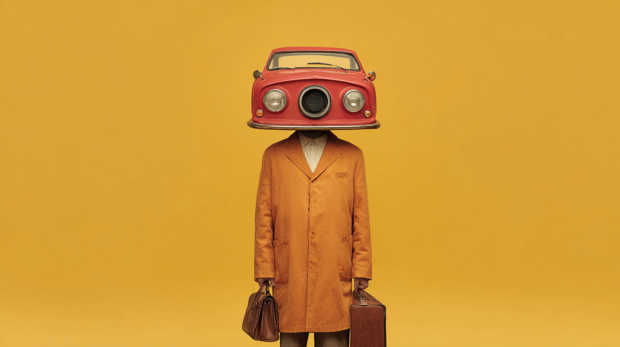
In the last post I explored the way the car shaped the architecture of the modern city. In this post I’m going to interact (mostly) with Charles Taylor and his work exploring the ‘Sources of the Self’ in the modern world and the ‘Secular Age’ (he has two books so-titled.
My thesis here is that just as cars physically reshaped the architecture of the modern city they reshaped our experience of being human — not just by extending our capacity to travel, but by giving us way more choice. Cars emerged alongside an industry geared towards selling us things (aided and abetted by other forms of technology, like the screen, which we’ll get to). Car-based cities, suburban sprawl, and the ability to drive for work and leisure all formed part of what Charles Taylor describes as a “social imaginary” the fabric of life around us that fuels our imagination of what life is.
Cars drove, in some part, what Charles Taylor calls the ‘age of mobilisation’. At this point, before we dig into Taylor, it’s worth observing that the ‘auto’ in ‘automobile’ comes from the Greek word for ‘self’ — cars fuelled ‘mobility’ as they ‘annihilated space’, opening up previously inaccessible places and opportunities and creating a jalopy panoply of choices for how and where to spend one’s time.
The car also created new markets and commercial imperatives — like many new technologies — and were a product of factory production lines and standardisation, which meant marketers had to sell essentially the same product with differentiation, and often this differentiation appealed to insecurities, identity markers, aesthetics, and ‘felt needs.’ And then suppliers of car related products like tyres and fuel would sell their products by creating destinations that tapped into this consumer choice thing — which is, by-the-by, where Michelin star ratings for restaurants come from — they were part of a driving guide put out by the tyre company to encourage driving to restaurants ‘out of town’ as destinations for discerning travellers to boast about to their friends. The local eateries were no longer enough — and sometimes lost business as roads and bypasses created ways to move further from home.
Anyway — as this unfolds I’m going to suggest that the modern machine church shares some of these qualities — around standardisation, marketing-based differentiation to felt needs, the development of ‘Michelin star’ churches that attract people away from local embodied ‘parish’ life through the annihilation of space, and the triumph of self-expression and self-determination that turns us humans into a certain type of automaton responding to these forces and getting behind the wheel of our automobiles. The triumph of the self, indeed.
Charles Taylor wrote about the ‘age of mobilisation’ in his book A Secular Age, which is a massive account of the rise of secularism — by which he means the rise in the possibility that your average citizen in the western world might ‘choose not’ to believe in God, or gods; a relative historical and cultural anomaly.
Taylor suggests it’s not so simple as ‘science disproves God’ or various other go to arguments, but actually, part of what happened was the conditions for belief changed through ‘disenchantment’ (which one might suggest is a product of a mechanical way of thinking built around technology and technique), and through what he calls both the ‘nova’ — an explosion of available choices for what to believe; including many religious options, fuelled by the ‘age of mobilisation’ — which follows increasing urbanisation and career-based choice about where to live that’s a product of the industrial age, the emergence of the modern ‘machine city’ described in the previous post (and the decline of rural, agrarian life).
In short, technologies — the steam engine (train) and rail lines, and combustion engine (car) and highway, meant you were no longer ‘born into a job’ with the family, but could choose to go anywhere to pursue opportunities, and to grow wealth independent of the hierarchical structures or social order that had previously existed (and that had been held to be a God-given order). For Taylor, ‘a social imaginary’ is all the parts of life — including technology, and the architecture of our cities and practices, that make us behave in certain ways, picture life in certain ways, and believe certain things. Taylor says:
“What do I mean by ‘mobilisation’ here? One obvious facet of its meaning is that it designates a process whereby people are persuaded, pushed, dragooned, or bullied into new forms of society, church, association. This generally means that they are induced through the actions of governments, church hierarchies, and/or other élites, not only to adopt new structures, but also to some extent to alter their social imaginaries, and sense of legitimacy, as well as their sense of what is crucially important in their lives…”
Part of the change brought about by ‘mobilisation’ and ‘choice’ was the rise of the individual choice-maker as agent — when you were just ‘born into’ a job and a town, and limited by how or where you could travel, there were less decisions to make because there were less options. Any ‘moral order’ that we build now — any community of belief and practice (like a church) has become a matter of personal choice because, he says:
“It starts from individuals, and doesn’t see these as set a priori within a hierarchical order, outside of which they wouldn’t be fully human agents. Its members are not agents who are essentially embedded in a society which in turn reflects and connects with the cosmos, but rather disembedded individuals who come to associate together…”
Machines allowed us to be more autonomous and more mobile. This was true of cars, and is true again in the digital revolution.
Previous to this age of ‘mobilisation’ the place you were put, you were put by God, and building a society there — and participating in it was seen as “fulfilling the design of God,” living in a place “where God was present,” in his design. Now, we are the designer — the ‘autonomous’ self, and we shape the world, and our options, through the machines we create (that then create us). And the societies or ‘moral orders’ we build — our social imaginaries (including our churches) reinforce these parts of our autonomy — our self-construction through choice. For Taylor the modern social imaginary contrasts with the “embedded” understanding of human life; the givenness of time and place as constraints and limits to enjoy. Where once the western human’s “relation to the whole was mediated” by the relationship between the state, and the church, and their place within this big system; now we “come together” as individuals voluntarily and as an expression of our freedom and equality. Usually driving to such gatherings in cars from homes spread apart in the suburbs. In short, Taylor and Lewis have overlapping — perhaps out-of-date dinosaur-like views. Taylor, for his part, wouldn’t say we should go back to the future — but we should understand how the present is a product of these forces.
Taylor commented on the way this age of mobilisation played out alongside the splintering of the church via the Reformation, and then various post-reformation forces that made ‘parish membership’ not a matter of geography and conviction (I’m a Presbyterian who goes to my local church) but ‘affinity’ — ‘I go to the church that I choose to go to,’ where “belonging to a Methodist church in America, for instance, which was compatible with almost infinite mobility, the primary locus of Catholic life for rural folk [in France] was the parish.” This shift happened as masses of people moved to areas where there were few churches; to life along rail lines or in the suburbs, “folk religion” as Taylor describes it “was tied to the agricultural context, or related to the customs of a particular community.”
We live — and create lives, communities, and churches in this age of mobilisation — which is, like the modern church, a creation of the automobile. We are mobile selves living life where space has been annihilated and individual choices rule. And the screen is fast replacing the automobile — I don’t need tyres to get to a Michelin star restaurant; I can have whatever international cuisine I wished for delivered by a motorbike rider, typically someone who has moved to our country looking for opportunity who I now control with an app on my phone; an app that will track my purchases and adjust prices, and send me special offers based on what will keep me hooked — and probably sell your data to various other businesses profiling you. This is the Michelin dynamic on steroids.
If Taylor is correct, secularism itself — and its accompanying disenchanting tendency towards technology and technique — is a product of mobilisation, which is a product of the automobile.
We are ‘self-mobile’ — and — Christians have good theological reasons to be suspicious of the self; of autonomy — because removing ourselves from a divine order and being placed in time and space to reflect God and cultivate ‘heaven on earth’ space is basically the story of the Fall. This overlapping of the machine as a system, and the self it produces, is one our conversation partner Paul Kingsnorth drew on in his conversion story, ‘The Cross and the Machine,’ which he recounts again in Against the Machine.
He describes his shift from resistance to the annihilation of space — a sort of desire to ‘connect to country’ and to oppose those who would destroy the land, to a realisation that this impulse was what the Christian story described at the heart of our declaration of autonomy — automobility — against God.
“Years of environmental activism followed. Working for NGOs, writing for magazines, chaining myself to things, marching, occupying: Whatever you did, you had to do something, for the state of the Earth was dire. Nobody with eyes to see can deny what humanity has done to the living tissue of the planet, though plenty still try. There were big, systemic reasons for it, I discovered: capitalism, industrialism, maybe civilization itself. Whatever had got us here, it was clear where we were going: into a world in which industrial humanity has ravaged much of the wild earth, tamed the rest, and shaped all nature to its ends. The rebellion against God manifested itself in a rebellion against creation, against all nature, human and wild. We would remake Earth, down to the last nanoparticle, to suit our desires, which we now called “needs.” Our new world would be globalized, uniform, interconnected, digitized, hyper-real, monitored, always-on. We were building a machine to replace God.”
He wrote:
“Early Green thinkers, people like Leopold Kohr or E. F. Schumacher, who were themselves inspired by the likes of Gandhi and Tolstoy, had taught us that the ecological crisis was above all a crisis of limits, or lack of them. Modern economies thrive by encouraging ever-increasing consumption of harmful junk, and our hyper-liberal culture encourages us to satiate any and all of our appetites in our pursuit of happiness. If that pursuit turns out to make us unhappy instead—well, that’s probably just because some limits remain un-busted.”
In short — modern economies are driven by the same zeal that created Michelin star ratings and car advertisements.
And, more Kingsnorth:
“I grew up believing what all modern people are taught: that freedom meant lack of constraint. Orthodoxy taught me that this freedom was no freedom at all, but enslavement to the passions: a neat description of the first thirty years of my life. True freedom, it turns out, is to give up your will and follow God’s. To deny yourself. To let it come. I am terrible at this, but at least now I understand the path.
In the Kingdom of Man, the seas are ribboned with plastic, the forests are burning, the cities bulge with billionaires and tented camps, and still we kneel before the idol of the great god Economy as it grows and grows like a cancer cell. And what if this ancient faith is not an obstacle after all, but a way through? As we see the consequences of eating the forbidden fruit, of choosing power over humility, separation over communion, the stakes become clearer each day. Surrender or rebellion; sacrifice or conquest; death of the self or triumph of the will; the Cross or the machine. We have always been offered the same choice. The gate is strait and the way is narrow and maybe we will always fail to walk it. But is there any other road that leads home?”
Maybe, also, like with Lewis in the previous post — that road is better walked than driven. Who knows.
In the next post we’ll look more at how the modern machine city, and modern machine self, relate to the modern machine church. The machine church — especially the mega church variety obsessed with technique and built in suburbs with large carparks are, historically and philosophically, creations of the car, and increasingly the screen, and we’ll consider more of how this auto-mobilisation pushes against what might be God-given human-scale limits.
Comments
[…] […]
[…] when it dropped into the ‘ecosystem’ of human life, re-wrote the physical landscape, and our experience of being human, and through these changes rewrought church community into something new, in ‘its image and […]