I’m writing an essay at the moment about Luther. This explains the relative paucity of posts this week, and other essays are to blame for the last two weeks’ relative absence.
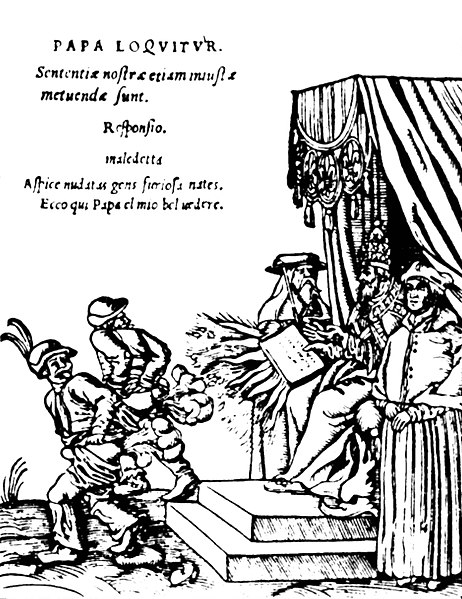
I’m going to look at Luther’s approach to communication throughout his life. And in the process of my research I came across this pamphlet that Luther distributed during the Reformation. In 1545, in his Depiction of the Papacy…
“The Pope speaks: Our sentences are to be feared, even if unjust. Response: Be damned! Behold, o furious race, our bared buttocks. Here, Pope, is my ‘belvedere'”
This website has been around for a couple of months now, and I’m still fairly sure nobody knows if it’s actually a joke or not. I mean. It’s a joke. But I’m not sure if it’s intentionally a joke, or if we’re laughing at it.
PastorFashion.com is celebrity preacher Ed Young’s gift to the world. It features fashion tips to help pastors teach the Bible while being really, really, ridiculously good looking. Or at least well dressed.
The latest post is called “Skinny Jeans and testosterone” and contains this video for your edification.
QTC’s preaching course got high tech this year. The people doing it had to upload a video to YouTube as part of a portfolio. My friend Brian smashed it out of the park with this little sermonette on David and Goliath. It’s laugh out loud funny in a couple of parts, but such a great example of preaching narrative in an engaging way – one of the limitations was a 6 minute time limit, and having spoken to Brian I know the ending would have been a little more fleshed out had he more time. But wow. Brian has skillz.
A little while back somebody on Facebook suggested that I seemed to not like the Australian Christian Lobby but not say why. I thought that was odd, because I thought it was self evident. I don’t like the Australian Christian Lobby because by not talking about Jesus and talking about issues, they are presenting a message that is not the good news of grace, but the bad news of law and morality.
First, the ACL seems to me to be a modernist organisation speaking to a post-modern world. They’ve got no sense of needing to use narrative or stories, rather than proclamation of absolutes, in order to change people’s thinking. This is why it appears that the gay marriage issue is splitting a generation in the US, and in Australia. This is also where I think the ACL ultimately fails on the communication front – their proclamations of right and wrong are too abstracted from real life, they never show the human face of what they’re talking about, but rather engage in high fallutin logical arguments about where society will head if changes are made. People want to know how an issue will change life for them. The pro gay marriage lobby has made the issue all about real couples who are wanting their real love recognised by the government. We haven’t been able to combat that because our arguments are just “this is wrong therefore don’t do it,” or perhaps worse “(the) God (you don’t believe in) says this is wrong.” This is why I’ve argued elsewhere that not only is it important to show how a moral stance relates to the gospel, because that keeps the gospel clear, it’s also important to show how the moral stance comes from a cohesive and legitimate worldview. Otherwise we’re just playing politics like it’s a numbers game, and the numbers are going to change (I’ll get to this below).
Second, the ACL comes from a pseudo ecumenical standpoint, aiming to speak for all Christians. Which is problematic because while Christians might broadly agree about moral issues, they’ll have some pretty fundamental disagreements about the root cause, and how to fix it. So, for example, reformed Christians believe that all people are totally sinful, that sin is natural, and that choosing to follow God requires divine intervention, while Catholics have a much higher anthropology where people are essentially a blank slate, and can naturally choose to follow God. There’s no way we’re going to articulate the gospel the same way when we’re talking about issues – as we saw from George Pell’s appearance on Q&A. If the ACL’s stakeholders can’t actually agree on what the gospel, or the Christian message on moral issues is, then the so-called “Christian” case is never going to be clearly presented.
While most theists, even Muslims, will agree on issues of the sanctity of life, and sexual morality, once you chuck Christian in your name you’d want to start speaking from the points of common ground for all creedal churches, which means sticking to Jesus. The fact that Catholics and protestants, and even types of protestants (so your Liberals, your Arminians who have a slightly more Catholic understanding of human nature, your fundamentalists who want to enshrine Old Testament Laws) disagree so completely on what it means to be a human, and what it means to have a relationship to God, or to live as one of his people (ie a Christian), means anything beyond this common ground is going to become incredibly difficult to articulate in a convincing, cohesive and winsome manner. If the Australian Christian Lobby isn’t speaking about Jesus then they can’t really claim to be speaking for Australian Christians, after that point we’re a very broad church, so broad that even speaking about Jesus doesn’t necessarily represent those who claim the moniker. This the fundamental reason I don’t think an ecumenical approach to social action works – but I can see that in order to mount a convincing political argument in this poll driven iteration of politics, that suggesting you’ve got a big bunch of voters who vote in a block standing behind your statements is politically expedient and a good strategy for lobbying. Which again leads me to my next point…
Thirdly. I don’t think Christians should be lobbying. The role of special interest groups in distorting the political landscape, where better organised and funded activists produce non democratic results, is a blight on the modern system, no matter how well intentioned the lobbyists are. Decisions should be made on what is the right thing to do, on the strength of an argument, whether there is one voice behind it, or a thousand. By participating in lobbying we’re not speaking against a broken system, but using it for our own gains. We’re perpetuating the broken, market driven, approach to democracy, a system the social tide is slowly turning against. And it’s seriously going to come back to bite us – either if “lobbying” becomes vastly unpopular quickly, or if a well organised anti-Christian lobby led by people of my generation as they come into positions of power run a cleansing campaign to finally remove Christianity from public life in Australia.
The idea that Christians should somehow be using political clout, obtained through numbers, to enshrine our worldview, might seem appealing in the short term, but, given the two objections outlined above – namely that there’s a whole generation of people who are watching how the church does politics, and being turned off church, and a whole generation of people listening to what the Christian voice is saying, and not hearing the gospel, we should probably be rethinking how we do political engagement anyway.
I’d argue that employing the language of “lobbying” presents a really harmful message for the non-Christian. We don’t like the tobacco lobby. We don’t like the gun lobby. We don’t like the gay lobby. We don’t like the climate lobby. We don’t like people putting special interests ahead of the common good – which is exactly what “lobbying” implies, it speaks to a strategic organising of people to push their own agenda. It speaks of an unhelpful approach to power and the state which I don’t think is really consistent with the counter-cultural message of the gospel. Particularly for those in my camp, the reformed evangelical types, who think that human nature has been broken by sin, where sin is the natural state of affairs for all people, and the Holy Spirit is required for real change of behaviour, we’re never going to be starting from the same presuppositions as other people in society, and we’ve got to work harder at defending that worldview before legislating from it.
Lobbying isn’t adopting the old Christian maxim of speaking truth to power. It’s trying to speak power to power. It’s playing a numbers game, enforcing the idea that might makes right, that somehow a majority view is what should determine how legislation gets passed. How does this work when the numbers aren’t in our favour? Though the dictionary definitions are almost identical, I wonder why the ACL didn’t choose advocacy as a definition of its work, advocacy at the very least is free of some of the special interest baggage. Especially if our advocacy is framed as protecting the innocent (which we tried with gay marriage after the horse had bolted by arguing about children needing a mother and father – this was a good argument far too late, and on the wrong legislation). Advocacy would free us up to work a bit better with people we disagree with broadly but agree with on specific issues, because it’d be more issue driven than based on arguing for some mythical cross-denominational Christian unity. Scott Stephens, the editor of the ABC’s Religion and Christian Ethics page, gave a really insightful critique of this distinction, as it relates to the gay marriage debate, in a conversation with Steve Austin on mornings last week. I don’t think the answer he puts forward to how Christians should participate in public life is on the money, it’s a little too wishy-washy, and doesn’t start with Jesus, but his diagnosis of the problems in this debate are spot on.
So there, in three nutshells, is why I “don’t like the Australian Christian Lobby” and why, when well meaning members of the ACL (and they are all well meaning, and generally lovely people, who are generally interested in serving God and his kingdom) tell me that I should join the ACL and help them do better, I answer that I’d rather stand apart from them and do my bit to speak truth to the power they’re trying to wield. Basically their policies aren’t good for Australia in the long run, because they’re going to damage the church and the understanding of the gospel for the average Australian, and they’re employing a political methodology that I think is fundamentally antithetical to Christian witness. So [pq]I pretty much think the ACL should change every word in their name to something else.[/pq]
If we are going to do social engagement well, and, as history demonstrates, I think Christians have an incredible role to play in the public sphere, then perhaps we should learn from our successful forbears, who relied on the strength of their argument, building support for change from the ground up, not relying on some powerful numbers play (Wilberforce), and relied on demonstrating a better way rather than simply telling people they were wrong (so the early Christians who cared for abandoned children, and the sick, in a way that made the empire feel guilty), who participated in the process of policy making from within the system rather than holding out the carrot and stick of a voting block (Wilberforce again). Or perhaps we should sacrificially seek out the minority groups who already feel vulnerable, showing that we love them, in a way that opens us up to persecution from the government rather than expects the government to bow to our whims (like, say, Jesus), rather than shouting from our lofty perches in a way that further alienates them from Jesus, who came to make broken people whole, by grace, and only through the Spirit, not by law and holding out the false hope that a moral life, other than the perfectly moral life of Jesus, counts for anything.
This post isn’t meant to be adversarial. And I really haven’t thought all that deeply about the issue (unless you count the time it took me to write this). One of my Facebook friends just asked if I was going to write something about this story about some Christian faith healer types, which was on the front page of Queensland’s Sunday paper, the Sunday Mail, last weekend. And my initial reaction was: “no way,” then I thought: “why not?” It’s not often one gets to use two colons in a sentence, so that’s justification enough. But this is an interesting example of some positive, or not quite negative, media coverage of a group of Christians in the media, so it probably gets as close to fitting the bill in these parts as anything else.
Sooner or later, if you sit in a pretty narrow segment of the Christian world, someone is going to get a guernsey in the media, as a Christian, who spouts some stuff you don’t agree with, stuff that makes you cringe a little… It happened to protestants everywhere when Cardinal George Pell announced that atheists get into heaven. But when you’re a reformed, evangelical, Presbyterian, you’re sitting in a pretty narrow branch of Australian Christian thought. While 740,000 people identified as Presbyterian in the 2001 census, the 2001 National Church Life Survey suggests (based on their own extrapolation of their data) that there are about 35,000 people in Presbyterian churches on any given Sunday (I know the data is ten years old, but it’s probably actually on the optimistic side to suggest that the number hasn’t changed too much since then). That means you’re four times more likely to own a copy of One Direction’s album, Up All Night, in Australia, than have a similar set of beliefs about Christianity to me. Now there are other comparisons I could make between my understanding of Christian theology with other denominations which might make the stats more favourable. But lets face it. Christianity in Australia is a broad church. And being a pentecostal is not something that stops you loving the Lord Jesus.
That’s a rather long preamble which should help me make this point in a way that is hopefully gracious. I’m not a pentecostal, and I believe my pentecostal brothers and sisters get many things wrong. I wouldn’t be picking this fight, and it’s not a fight, were this story not on the front page of the paper, and then on the television. I realise that my views on faith healings are, in the scheme of Australian (not to mention global) Christianity, at the very least a matter of debate, and perhaps more accurately, they’re idiosyncratic. My views, thanks to my rational, Western, sceptical epistemological framework (a fancy way for describing how I think I know stuff), and my “excluded middle” (seriously, click that link – it’s a thought provoking piece from Tamie), doesn’t leave a lot of room for “miracles” as it is, but when coupled with my theological assumptions about what the Holy Spirit actually does, and what purpose miracles serve in the Bible, and how God works through people who are medically trained (lets call this a case of natural revelation meets God’s providence), I approach claims of supernatural healings with about the same level of enthusiasm as my atheist friends. Which means I do one of those involuntary shivers when I read a story headlined “Teen God squad Culture Shifters’ miracle cure claims” in the local paper. The story is relatively tame and contains a bit of “he says/she says” “objectivity”… and this telling quote which really nails the heart of the problem that healing ministries create for the rest of us:
“Flinders University Department of Theology professor Andrew Dutney said youth could be more attracted to flamboyant religious styles than to mainline churches.
“There are issues of course … for example, if a person is drawn to this group with a promise of healing and then they are not healed,” Professor Dutney said.
“There can be situations where people blame the person themselves for not being healed and say: ‘You don’t have enough faith’ and ‘You have some secret sin’ and that can be extremely damaging.'”
These concerns raised in the paper by a learned professor, coupled with the relatively infamous “why won’t God heal amputees” meme, and the problematic prosperity theology that underpins the idea that every illness is a miracle waiting to happen (rather than a sign that the world is broken as a result of sin, and that sufferings are a part of life in this world), leave me a bit concerned when it comes to my “Jesus should be at the centre of our engagement with the world” trope. I don’t doubt that God can heal people, or that he responds to prayer, I just doubt “healing on demand” with a measurement of success metric that would be the envy of any public health department in the world. The more Christians present healing as an expectation now, in this world, the more the distinction between now, and the new creation is blurred, the greater the disjunct becomes between expectation and reality, which makes the amputee question more rhetorically powerful than it ought to be. The real answer to that question is “why should God heal amputees” – and a robust account of the effect of the fall on our experience of the world.
A word on Pentecostals
Pentecostals simultaneously represent the best and worst of Christian culture. In my humble opinion (but lets face it, posting my opinion on a blog and assuming you’re still reading, 800 words on, is indicative of a problematic definition of humble).
This realisation probably struck me most (recently) when I watched a group of hip young things, who I can only assume were Pentecostal because of how amazingly happy and cool they looked, pray together on a Toowoomba street during Easterfest last weekend. I wasn’t at Easterfest. I was at a cafe. The whole contemporary Christian music scene is something I’ve got (I suspect well documented in the archives of this blog) big problems with. These guys were so fired up for Jesus. It was great seeing them hunker down in the middle of a busy street (admittedly a street mostly filled with Christians) to pray for each other. I wish my cloistered, fuddy-duddy reformed friends would do more stuff like that. Genuine, authentic, spontaneous expressions of joy, hope and faith aren’t really something we do well. The action was inspiring. But sadly, the words were inane. I listened to these prayers babbling on with pop-psychology/spiritual babble about the Spirit anointing these people to do such odd and mundane things. I’m not suggesting that God doesn’t have an interest in the mundane, or that we shouldn’t pray about them (again, read Tamie’s excluded middle post), but rather that we shouldn’t hyper-spiritualise them, and we should potentially understand the Spirit’s primary role, in the life of the believer, has less to do with triviality, and more to do with seeing God glorified, and Christ proclaimed, through us.
The great promise of the reformed charismatic movement is the fusing of the joyful enthusiasm of these pentecostal types with a more robust, and dare I say “intellectually sound” (without sounding patronising) understanding of the work of the Spirit, and the purpose of the Christian life. I’ll still probably never be a charismatic, I’m much too narrow minded for that, but at least I’ll be able to sit on the sidelines and sneer less when my Christian brothers open their mouths.
I’ve got to say, I watched 20 minutes of random clips from Culture Shifters, as well as a couple of “healing” videos, and I was much more impressed with the stuff they do in their gatherings than with the healings. These healings could easily be explained, by the skeptical, as preying on the gullibility of the naive and employing some charm and powers of suggestion. I’m not saying that’s what’s happening – just that if I wanted to provide a non-supernatural (or natural) explanation for what’s going on in those videos, that’s where I’d turn. On the other hand, the Culture Shifters’ gatherings seemed focused on, and faithful to the gospel (though I did flick through a couple of testimonies and sermons without listening to the whole lot), and they were if not all about Jesus, they were at least in the ballpark of making Jesus the big deal, which is hard to do in any personal testimony, and encouraging when it comes to the sermons.
On the Spirit and healing and stuff
My biggest problem with this story in particular, and faith healing in general, is (as with Christian engagement with politics) that Jesus gets pushed to the sidelines as an afterthought. Both in the stories themselves, and in the actions. Now. I’m sure the Culture Shifters guys are excited about Jesus and passionate about sharing the gospel. And no doubt the reporter spent ample time hearing about how these guys are living out their faith in king Jesus, who has the power not just to heal the sick, but to forgive sins. But that’s not in this story, nor is it likely to be the take home message for your average Aussie non-Christian. I don’t want to set up binaries (though the world would be much easier if I had that power) – but wouldn’t it be better for all of us if these young, keen, fresh faced and friendly Christians were walking the aisles of our major shopping centres and talking to people about Jesus, rather than doing the Christian equivalent of a parlour trick (they would no doubt say they are doing both). Assuming it gets an equal reception, the gospel has a much better success rate than a healing, with a better long term prognosis. And as much as we’d like to read ourselves into the gospel narratives as Jesus, or even the disciples, we’re really neither. We’re the people who have the benefits of their sacrifice, their ministry, and 2,000 years of ministry from subsequent faithful brothers and sisters. The idea that we’re to run around healing people at the drop of a prayer is pretty hard to justify, and any passage that is even partly suggestive that this might be something we should pray for or attempt is pretty strongly linked to the proclamation of the gospel as the end to which our activities should be directed. This is true both for Jesus’ ministry, that of the disciples, and the version of the great commission in the disputed ending of Mark…
“15 He said to them, “Go into all the world and preach the gospel to all creation. 16 Whoever believes and is baptized will be saved, but whoever does not believe will be condemned. 17 And these signs will accompany those who believe: In my name they will drive out demons; they will speak in new tongues; 18 they will pick up snakes with their hands; and when they drink deadly poison, it will not hurt them at all; they will place their hands on sick people, and they will get well.”
And the question to ask those people is why they aren’t handling snakes or drinking poison. And also, why these verses seem to summarise the events in Acts so perfectly – even up to Paul being bitten by a snake.
So my problem, in summary, is this. The Spirit works to unite us to Christ, to sanctify us through repentance and regeneration, to equip us with gifts for the service of the body, and to strengthen us as we proclaim the gospel. Ultimately the Spirit points people to Jesus – making us more like Jesus, helping us encourage our brothers and sisters to be more like Jesus, and helping other people meet Jesus. Sure. Sometimes that may involve a miraculous healing. But miracles are the exception rather than the norm, and suffering, not prosperity and health, is the norm for Christians. The world is broken, temporary fixes are temporary, and if you want to heal people it probably makes more sense to become a doctor, and do that faithfully and in the service of God. So I think it’s actually unhelpful to the cause of the gospel, not just to the Presbyterian understanding of the gospel, to be making waves for “healing people” if you’re not talking about the real work of healing that Jesus accomplished on the cross and getting media attention and claiming a 90% success rate. Especially when you’re promising an outcome that has no Biblical mandate – sickness and disease are the reality this side of the new creation, and it’s a category error to suggest that our job is to make the new creation happen now. It’s great to want to shift the culture now, to change the world. But that isn’t done just by miraculously healing broken hands, it’s done by introducing broken people to Jesus.
That is all.
UPDATE: The guys behind Culture Shift, or rather, the couple behind Culture Shift, has posted a video responding to the media furore surrounding their healing ministry. I find these two pretty compelling. I want to like them. But I also think this video pretty much sums up in words what I’ve tried to express above. There’s something about the emphasis on transformation being about happiness from about the three minute thirty mark that doesn’t quite mesh up with my understanding of the gospel.
Here’s what Grant, the guy in the video says…
“God’s not just healing people of sickness. He’s healing people of broken hearts. He’s healing people from depression. Really this story is about hundreds of young Australians who had lost hope in life but found the love of God and are now transformed and some of the happiest people on earth.”
Now, I don’t disagree with the sentiment, or with these things, but the work of Jesus isn’t front and centre, nor is the heart of our problem. Sin. And how Jesus deals with that. This could easily be the slogan from a self help program.
I do like that they urge people to go to the doctor and not stop taking their medication. There’s lots to like about these guys and enthusiasm they’re bringing to life and to serving Jesus, but like I said before this update, the gospel is about more than healing sickness, broken hearts, and depression – it’s first and foremost about fixing the brokenness that is a result of our rejection of God.
This timelapse of the Milky Way is just stunning. I hope heaven has a button where you can just watch stuff timelapse style.
I think last time I posted one of these, or maybe the time before, someone quoted the first half of Psalm 19 on my Facebook wall. It’s a sensational bit of inspired poetry to be reflecting on while enjoying this sort of thing.
1 The heavens declare the glory of God;
the skies proclaim the work of his hands.
2 Day after day they pour forth speech;
night after night they reveal knowledge.
3 They have no speech, they use no words;
no sound is heard from them.
4 Yet their voice goes out into all the earth,
their words to the ends of the world.
In the heavens God has pitched a tent for the sun.
5 It is like a bridegroom coming out of his chamber,
like a champion rejoicing to run his course.
6 It rises at one end of the heavens
and makes its circuit to the other;
nothing is deprived of its warmth.
In other news I’m going all sentimental. Parenthood has changed me.
Thanks to Andrew for posting this video on the St. Eutychus Facebook page – I welcome your content suggestions, and that’s a great way to do it.
Fervr.net is a great site, full of great resources. And its up for the chance to win a great award – a Webby. The Internet equivalent of the Oscars. And you can vote for it. And you should. It is a popularity contest.
The idea that God shouldn’t condemn behaviour he has built into humanity isn’t recent, and its flaws are pretty much dealt with in the opening pages of the Bible.
The idea that God shouldn’t judge natural behaviour operates on some shaky assumptions about the goodness of nature, that Catholic theologians have essentially supported. But the real answer to this dilemma comes from understanding just how big the effect of the fall was on human nature.
Here’s Calvin’s answer to the objection from hundreds of years ago. I’m reading the Institutes (again) for an assignment, and I’m wishing I’d read it before I wrote my ethics essay last semester because it’s good stuff.
“If any one thinks it absurd thus to condemn all the desires by which man is naturally affected, seeing they have been implanted by God the author of nature, we answer, that we by no means condemn those appetites which God so implanted in the mind of man at his first creation, that they cannot be eradicated without destroying human nature itself, but only the violent lawless movements which war with the order of God. But as, in consequence of the corruption of nature, all our faculties are so vitiated and corrupted, that a perpetual disorder and excess is apparent in all our actions, and as the appetites cannot be separated from this excess, we maintain that therefore they are vicious; or, to give the substance in fewer words, we hold that all human desires are evil, and we charge them with sin not in as far as they are natural, but because they are inordinate, and inordinate because nothing pure and upright can proceed from a corrupt and polluted nature.”
So Q&A was a bit of a letdown, even for those of us who had low expectations. But one cool thing that’s come from the world’s leading atheist thinkers descending on Melbourne this week is this website. DoubtingDawkins.com from OutreachMedia. Which provides some food for thought for Dawkins fans. Each of the statements is a link. That took me a little while to figure out.
Did you hear the one about the Cardinal and the Evolutionary biologist? Or at least watch Australia’s highest ranking Catholic, George Pell, take on Richard Dawkins on the ABC’s flagship “new media” panel program Q&A, on Monday night in an Easter extravaganza?
You can watch it in full here…
It was a train wreck. Talking too much about where Pell went wrong wouldn’t be conducive to keeping my promise not to debate atheists online, at least atheists I don’t know personally. But Pell was awful. In my humble opinion. The only saving grace of the night was that Dawkins wasn’t much better, and my conversations with non-Christian friends afterwards, both on Facebook and in the real world, confirm that his brand of intolerant fundamentalism is every bit as on the nose as Christianity.
Despite giving up visiting atheist blogs and forums to engage in what I would like to call “winsome trolling” – where you keep a conversation going, but as pleasantly as possible, as “tolerant” as possible, as genuinely inquisitive as possible, and as focused on Jesus as possible – I have some experience arguing with people who adhere closely to Mr Dawkins views, with a more than liberal smattering of those advocated by the late Mr Hitchens, and messers Dennett and Harris. By my calculation I’ve spend hundreds of hours engaged in such debates, either at the keyboard, posting here, speaking to others in person, or ruminating about the conversation I’m currently engaged in while I go about my daily business. I’m a fairly experienced amateur. But I’m an amateur no less. Pell. Arguably. Is a professional. At least that’s why he was presented to us on Monday night. And yet. Almost immediately. He became tangled in several follies of, well, any form of argument/debate, let alone an argument or debate that is televised to a national audience.
In some moments he was sneering, in others pompous, in others snide, in others confused, in others doddery, in others he danced around a question without going near providing an answer, and every five minutes he trotted out a reference to Hitler. In short he was neither convincing or winsome. His theology was jelly-nailed-to-mast stuff. One minute he said he hoped hell existed because Hitler’s evil required it, on the other hand he said he hoped nobody was there, then he said that atheists would end up in heaven if they did good – thus defeating himself. Why would one sign up for a life of self denial if the outcome is unchanged. Pell said himself (and I agree) that an atheist can do good. What he didn’t say was that any “good” act is the result of humanity being created in the image of God, and that none of it has any merit so far as our relationship with God is concerned (the former is consistent with a Catholic understanding of human nature, the latter is pretty much the root cause of the Reformation and non-Catholic Christianity).
I wasn’t expecting to agree with much of what Pell said theologically – but I was hoping that as a guy wearing our colours, and claiming to own Christ, he’d at the very least be loving and winsome, and treat his opponent with respect. Instead, he spend time strawmanning Dawkins, engaging in logical fallacies, playing the man not the argument, misunderstanding the science he was claiming to promote, and generally not talking about Jesus – except after he’d confused everybody by talking about ancient Greek metaphysics (particularly Platonism), while trying to explain what goes on with the wafers when Catholics take communion (transubstantiation).
At one point, when Tony Jones asked him where he’d draw a line on what is “myth” and what is “truth” in the Bible, or rather historical truth, citing the example of God writing the Ten Commandments on stone tablets, Pell flat out denied that the Bible says God wrote the commandments down.
“TONY JONES: So are you talking about a kind of Garden of Eden scenario with an actual Adam and Eve?
GEORGE PELL: Well, Adam and Eve are terms – what do they mean: life and earth. It’s like every man. That’s a beautiful, sophisticated, mythological account. It’s not science but it’s there to tell us two or three things. First of all that God created the world and the universe. Secondly, that the key to the whole of universe, the really significant thing, are humans and, thirdly, it is a very sophisticated mythology to try to explain the evil and suffering in the world.
TONY JONES: But it isn’t a literal truth. You shouldn’t see it in any way as being an historical or literal truth?
GEORGE PELL: It’s certainly not a scientific truth and it’s a religious story told for religious purposes.
TONY JONES: Just quickly, because the Old Testament in particular is full of these kind of stories, I mean is there a point where you distinguish between metaphor and reality? For example, Moses receiving the Ten Commandments inscribed directly by God on a mountain?
GEORGE PELL: I’m not sure that the Old Testament says that God inscribed the Ten Commandments but leaving that aside it’s difficult to know how exactly that worked but Moses was a great man. There was a great encounter with the divine. Actually, with Moses we get the key that enables us to come together with the Greeks with reason because Moses said who will I tell the Egyptians and he tell that my name is “I am who I am”.”
Perhaps he’s not familiar with chapters 31-34 of Exodus…
Exodus 31:18 When the LORD finished speaking to Moses on Mount Sinai, he gave him the two tablets of the covenant law, the tablets of stone inscribed by the finger of God…
32:15 Moses turned and went down the mountain with the two tablets of the covenant law in his hands. They were inscribed on both sides, front and back. 16 The tablets were the work of God; the writing was the writing of God, engraved on the tablets.”
The other thing he kept doing, that really irked me, was presenting the Catholic theological position as the “Christian” position, rather than the position of his own tradition.
MATTHEW THOMPSON: I am an atheist. What do you think will happen when I die and how do you know?
TONY JONES: George Pell, we’ll start with you? You ought to be an authority on this, I imagine?
GEORGE PELL: Well, I know from the Christian point of view, God loves everybody but every genuine motion towards the truth is a motion towards God and when an atheist dies, like everybody else, they will be judged on the extent to which they have moved towards goodness and truth and beauty but in the Christian view, God loves everyone except those who turn his back turn their back on him through evil acts.
Sadly that is not the “Christian” point of view, but a disputed point where Catholics and Protestants disagree.
It was. In short. A train wreck.
Here are some of my favourite tweets from/in response to the night that pretty much sum up what I’m thinking…
A scientific knowledge of the world no sooner dispenses with God than a mechanic’s knowledge of theCommodore explains away Holden.
Jesus got 8 mentions in the program, by name, he was obliquely referred to in a couple of Pell’s quotes. One was from a questioner, one was from Tony Jones, three were from Dawkins.
Here’s the best description of the gospel from the night.
“…the fundamental idea of New Testament Christianity, which is that Jesus is the son of God who is redeeming humanity from original sin, the idea that we are born in sin and the only way we can be redeemed from sin is through the death of Jesus…”
And it’s from Richard Dawkins. Who is dismissing it. Dawkins is clearer on the gospel he’s rejecting than Pell is on the gospel he’s promoting.
Two mentions were in a segment where Pell suggested that the Jews were culturally inferior to the other civilisations of their time.
“TONY JONES: I’m sorry, can I just interrupt? Are you including Jesus in that, who was obviously Jewish and was of that community?
GEORGE PELL: Exactly.
TONY JONES: So intellectually not up to it?
GEORGE PELL: Well, that’s a nice try, Tony. The people, in terms of sophistication, the psalms are remarkable in terms of their buildings and that sort of thing. They don’t compare with the great powers. But Jesus came not as a philosopher to the elite. He came to the poor and the battlers and for some reason he choose a very difficult but actually they are now an intellectually elite because over the centuries they have been pushed out of every other form of work. They’re a – I mean Jesus, I think, is the greatest the son of God but, leaving that aside, the greatest man that ever live so I’ve got a great admiration for the Jews but we don’t need to exaggerate their contribution in their early days.”
Pell finally got on message at the last gasp, in his best answer of the night, answering the last question which essentially suggested a modified Pascal’s Wager, where people should become Christians because life is better for Christians, particularly health wise. Pell thought that was a bad idea.
GEORGE PELL: So am I. It’s a question of truth. Christians don’t present God as, like Santa Claus, something that a myth that’s useful for children and believing in God and being a Christian cuts both ways. More people were killed for their Christian belief in the last century than any other century, probably than all the other centuries combined. They died on principle to be faithful to Jesus so we might get some benefits. You know we mightn’t get ulcers, we might live a bit longer, that might have much more to do with our heredity but we follow Christ because we believe it’s the truth. I think it does bring a peace of mind. It does help us but sometimes it gets us into my life would be much simpler and much easier if I didn’t have to go to bat for a number of Christian principles.
The one thing the transcript doesn’t capture is tone. Pell was snarling. Sarcastic. Snide. He didn’t miss an opportunity to take a cheap shot. Dawkins wasn’t any better. But the tone of this discussion was what really disappointed me. I am overjoyed that we live in a country where the national broadcaster hosts discussions like this, without any fear of repercussions or persecution from the government, or any fear of censorship. But surely Christian spokespeople should be using these opportunities to talk about Jesus, not get cheap laughs and applause from a crowd for mocking their opponents.
So that was Q&A’s Easter special. It made me angry. Why couldn’t someone like Peter Jensen have been invited onto the panel instead. He’s so much more winsome, and able to stay on message about what Christianity is really about (hint – Jesus). Check out the raw footage from this interview he did with SBS.
That’s heaps better than the turkeys who used their Easter media opportunities to slam the banks (though they may deserve it), and even those who try to turn the attention onto the upper middle class (which was social justice champion Father Bob Macguire’s approach). I was pretty thrilled that the ministers asked to comment on the meaning of Good Friday in the Townsville Bulletin all talked about Jesus (with varying degrees of clarity and plain english).
When I choose to tackle some Christians who I think are doing it wrong when it comes to speaking out as Christians in the public sphere people often ask me good questions. They usually start with “did you think about X?” My answer is usually “I was responding to a particular issue, but I have posted about X before.” Other people say nice things about how it would be useful to have all my posts on this issue collected somewhere (thanks mum).
So here’s my attempt to do that. A mega list, though probably not an exhaustive list, of my posts about PR, social issues, and political lobbying.
I’m not one to shy away from criticism. And I enjoy a good conversation where different ideas are presented and debated in the marketplace of ideas.
It’s fair to say that I have, in the past, been quite critical of those lobbying our politicians, from the outside, for the legislation of Christian moral values. Because I think on the whole it’s bad for the mission of the gospel. These groups don’t talk about Jesus enough. They tackle issues that play well with the people who fund them, but ignore the issues I think Jesus would have been concerned about in modern Australia. They confuse people about what the gospel is because they talk about morality, but not forgiveness, and sin but not grace. That’s my case. It’s not that I disagree with their views (or God’s views) on what sin is and isn’t. It’s just that I don’t think running around pretending the sky is falling in, and that the world will end if the word marriage is redefined (polygamy anybody?), is constructive for telling people how to find their identity in Jesus. And I think it’s often unloving to the minorities they choose to single out.
A friend shared the link to my post about “pray away the gay” on her Facebook wall. She has some involvement with the ACL and Family First, and many of her friends are card carrying members of the Christian right. Particularly one Jack Sonnemann, it’s fair to say he disagreed with my post. I sought his permission to post the conversation in the interest of presenting you, dear reader, with a “balanced” approach to the issue. Here it is, uncensored. There are moment when he refers to some comments from other people on the same thread – whose permission I haven’t received.
Feel free to respond to either of us in the comments – I will be supplying Jack with a link to this post. I don’t know if he’ll chime in though, but I will be inviting him to.
A conversation with Jack Sonnemann, Director, Australian Federation for the Family
Jack Sonnemann
I read the st-eutychus link and thought it to be pure unadulterated crap.
Nathan Campbell
Thanks Jack. I’m glad you enjoyed it so much and provided such constructive feedback.
Jack Sonnemann
I am very glad to have my battle scars standing up for Jesus in the public arena. I was just given a GLORIA award by the sodomite community for being one of the 10 most effective men in Australia thwarting the implimentation of the homosexual agenda, given an “Outstanding Achievement Award in Federal Parliament for protecting women and children from sexual exploitation, I have been featured, attacked and defamed in ALL of Australia’s porn publications, sued in the Supreme Court by one of our states Atty Gen, “targeted for destruction” by the professional pornographers, etc. There is a price to pay for our Christianity but I am afraid Sir Weary Dunlop was correct when he said, “The problem with Australia is that we have wimps in the pulpits and cowards in the pews.”
Nathan Campbell
Hi Jack. That’s great. I’m thrilled you’ve got scars and awards. I’m thrilled you’re protecting people. I’m just worried that the gospel of grace easily becomes a gospel of morality when we’re only ever quoted on moral issues in the public sphere and I’d prefer my pulpit to be used telling people the gospel and having them realise they need to reinvent their identity in Christ. Not telling people that they’re abominations or horrible sinners.
Jack Sonnemann
What a shame you do not know the gospel of grace is a moral one. Apparently you take authority over your pulpit. “Sinners in the Hands of an Angry God” by Jonathan Edwards is heresy to you?
Jack Sonnemann
Sorry. We do have a better guide than reason and I have even had God’s Holy Word – just a guess but I think you are a Obama (who calls the Koran holy) sympathiser – printed in Penthouse magazine.
Nathan Campbell
Yes Jack.I’m sure it’s this sort of balanced approach to understanding people you disagree with that won you your sodomites award.I’m sorry, I can’t tell if you’re deliberately interpreting my words in the most twisted way possible. There’s a difference between telling people they need to not be sinners to be right with God (moralism) and telling people they need Jesus because all people are sinful and have turned away from God (the gospel). The problem is that the media don’t really handle nuance all that well when reporting our opposition to immorality, and we often don’t nuance what we say well, so the overwhelming perception of what the gospel is is that people need to be good to be saved.
I don’t really understand any of your second comment about Obama or Penthouse magazine.
Jack Sonnemann
Vikki Nathan just doesn’t get it. No wonder we lead the developed world in violent and sexual assault, no wonder we lead the world in amphetamine and marijuana use, no wonder our children kill themselves more than anywhere else in the world, no wonder abotrion is our most common operation, we allow our daughters to become whores and we sell and display pornography to our children under such “Christian” leadership. Sadly I am reminded of Neh 4 where we are supposed to fight for our wives, daughters, sons and families yet the men turned back in the day of battle. A good definition of insanity is doing the same thing over and over expecting a different result. I, for one, will continue to fight. Eph 5:11
Nathan Campbell
Jack, this has been a fun conversation. I’m thrilled that somehow I am responsible for marijuana use (amongst other things) because I think we should be telling people they need Jesus.Glad to have virtually met you. Do you mind if I reproduce this conversation as a post on my blog? It presents a very different view to my original post, and I’m not afraid of criticism of my ideas. Nathan Campbell
Though I can’t say I feel like you’ve been particularly logical in your treatment of my statements, or particularly fair in your assessment of my character.
Jack Sonnemann
I care not what you think of my comments and you can always post anything I say wherever you like. Just be sure you quote me fully as some just do a half-***ed job.
Nathan Campbell
Hmm. I’ll quote you in full, except I’ll avoid foul language and slightly censor that last comment. And I’ll provide a link here for you to check in case you feel like I’ve misrepresented you.
Jack Sonnemann
Sorry to have hurt your ‘feelings’. I can see how important they are to you.
Nathan Campbell
Hi Jack, I’m pretty thick skinned. I just think the way you’re treating me in this thread, someone you’ve never met who owns the name of Jesus, who is a brother in the Lord, demonstrates one of the inconsistencies with your approach to politics. Given that Jesus says the world will know that we are his disciples by how we love one another…
Nathan Campbell
If this sort of bullying approach to disagreement is the way you approach political discourse I’m going to suggest that your manner is as problematic to me as the content of your message.