These College Humour mashups of kids books and popular science fiction series are pretty grand.


It reminds me of my favourite Strongbad Email…
There are five in total. What would you mash up?
These College Humour mashups of kids books and popular science fiction series are pretty grand.
It reminds me of my favourite Strongbad Email…
There are five in total. What would you mash up?
So, it turns out that having some sort of religious affiliation is likely to mean you’re not really excited about brands.

I have two immediate thoughts when reading this story:
1. Christians are too busy being fanboys about Christian brands (like theological movements, and ministry figures).
2. These people obviously didn’t focus enough on Apple in their research.
“The researchers theorized that both brands and religion contribute to a sense of self-worth and that the two sources of support would be in competition. Their findings confirmed that people who find more solace in religion are less entranced by brand names.”
“In an Internet-based study, 356 participants (68% Christian, 19% nonreligious, 4% Jewish, and the balance Buddhist, Muslim or “other”) were asked to make six choices between brand-name and generic goods, with realistic price differences. The researchers classified the products as either “expressive” (Ralph Lauren sunglasses vs. WalMart’s) or “functional” (Motrin vs. CVS ibuprofen). Subjects then answered 10 questions designed to gauge the importance of faith in their lives.”
The survey seems to suggest that quality is more of a factor for Christians (or people from other religions) than identifying with a brand. I suspect it’s because the more Christian you become the less you need a brand to create or reinforce your identity.
“A subject who attended worship services at least weekly was roughly 20% less likely to select an “expressive” brand than one who did not; there was no difference in the functional category.”
I plan to write something about the whole wikileaks fiasco, though it’ll probably be long and boring.
In the meantime. Be sure to check out what experts are suggesting is the most interesting cable to be leaked by wikileaks. It’s not about K-Rudd. It is a statement guaranteeing the US’s most “special relationship”…
Here’s the header. Read the whole thing. It’s worth it.
Saturday, 12 December 1998, 16:13
S E C R E T SECTION 01 OF 02 LONDON 000368
NOFORN
SIPDIS
DOE FOR GPERSON, CHAYLOCK
EO 12958 DECL: 12/12/2018
TAGS EPET, ENRG, PGOV, RS">RS, NI
SUBJECT: ENGLAND: RELIABILITY AND LONGEVITY OF UK-US RELATIONSHIP CONFIRMED
REF: A. LONDON 365 B. LONDON 366
Classified By: Consul General Robbie Honerkamp for reasons 1.4 (B) and (D )
I like.

From Flickr, via Kottke.org a while back
I also like these (from the same Flick(sta)r… zero-lives.



I caught this Vampire Weekend song on the Jools Holland show while channel surfing the other night.
It was catchy, and I had heard of Vampire Weekend but not heard from Vampire Weekend (at least not memorably) before then. A bit of YouTubing later and I’ve decided I quite like them.
Looking for a novel Christmas present? It doesn’t get any more novel than giving somebody their own brand spanking new mathematical theorem. Named in their honour. That’s the service Theory Mine is offering. For just $15 dollars. For the price of five reasonably priced coffees your loved one could be the talk of the mathematical fraternity, that is, if the computer that discovers new theorems can come up with something amazing.
It’s all very simple.
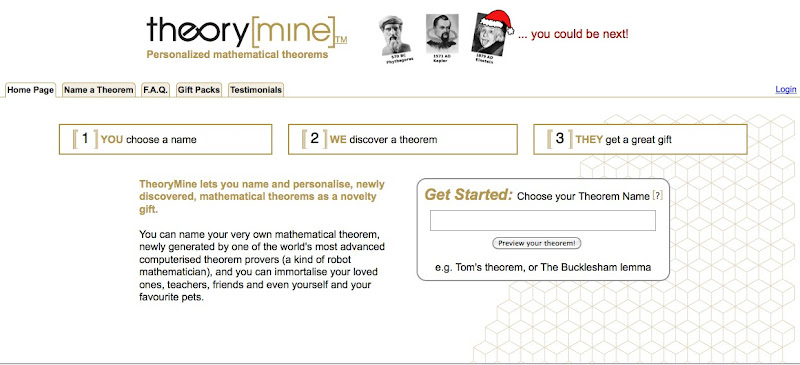
It’s the new thought that counts. Right.
It’s almost a week since Robyn and I went to see Muse. It was a pretty amazing concert. Here are some of the bits of lighting magic I managed to film before my phone went flat. The sound quality is awful. It is, afterall, an iPhone video. And we were sitting a long way away. As I write this I’m watching a Blur: Live at Hyde Park concert on ABC2. And I’m thinking “wouldn’t it be amazing to have musical talent and be in a band so you could perform to tens of thousands of screaming fans”…
These Doctor Who posters are cool.

There are 11 in the set (that’s the first six doctors in the image above).
In an advertising campaign reminiscent of Australia’s Jesus All About Life campaign – a church in the states is running a “Jesus is ____” website asking for people to submit their ideas about who Jesus is. A nice idea. Hijacked by atheists. So if you’re not an atheist, and you don’t think Jesus is a baseballer hitting at 0.216, then head on over and try to even out the numbers. This is the problem with user generated content in the day and age of pharyngulation. Atheists are aware of these campaigns and hit them pretty quickly. For giggles.
I like the campaign.
Here’s their blurb:
“What goes in the blank?
Everyone has an opinion of who Jesus is. That’s why this website exists: as a platform for people to express who Jesus is to them.
Jesus is a lot of things, but the answer is in the Bible. It says that Jesus is the Son of God, who came to earth on a mission to restore mankind to God. By living a perfect life, dying on a cross, and coming back to life, His mission was a success. We can know God because of Jesus.
So maybe the reality of who Jesus is remains too big for the blank.”
And the promo video.
JESUS IS ___. from The City Church on Vimeo.
I like it when comedians and television shows talk about Christianity – because it gives a real insight into what people actually think/are prepared to laugh at when it comes to the gospel.
The BBC show Outnumbered doesn’t see Christianity as a taboo.
This one has been around for a while…
Findo found this story about a minister so keen to defend the honour of Christmas that he’s executing a satanic elf to make the point.

Elves, of course, are servants of Satan. Just like Hitler.
This weekend, Knudsen’s hatred for the creature he says “comes from the devil” manifested itself in the form of a mock execution by hanging of a Christmas elf outside his church.
Around the elf’s neck was a sign reading “we reject Satan and all his works and all his empty promises”, a reference to the Christian baptism rite.
Knudsen said decorating with elves at Christmas was “comparable to decorating with Nazi flags”, and described elves of all sorts as “poltergeists that come from the devil and make children sick”.
What would it look like if Dr Seuss wrote and illustrated Star Wars? Something like this I guess.


More here. Via Twenty Two Words.
Well. I’ll never look at a game of Pacman in quite the same way again.

Its mysteries have been revealed by these two links – firstly the Pacman Dossier – basically a textbook on Pacman, and secondly, this study of the mechanics, and individual personalities, of the Pacman ghosts – which draws on material from the first.
The ghosts have three movement patterns, each individually calibrated. These patterns are determined by what mode they’re in – chase, scatter, or frightened. And these modes switch based on time cycles in each level. The modes determine what a ghost will do as it approaches an intersection.

“The diagram above shows a simplified representation of the maze layout. Decisions are only necessary at all when approaching “intersection” tiles, which are indicated in green on the diagram.
When a decision about which direction to turn is necessary, the choice is made based on which tile adjoining the intersection will put the ghost nearest to its target tile, measured in a straight line. The distance from every possibility to the target tile is measured, and whichever tile is closest to the target will be selected.”
Here’s what happens in Scatter mode:
Each ghost has a pre-defined, fixed target tile while in this mode, located just outside the corners of the maze. When Scatter mode begins, each ghost will head towards their “home” corner using their regular path-finding methods. However, since the actual target tiles are inaccessible and the ghosts cannot stop moving or reverse direction, they are forced to continue past the target, but will turn back towards it as soon as possible. This results in each ghost’s path eventually becoming a fixed loop in their corner. If left in Scatter mode, each ghost would remain in its loop indefinitely. In practice, the duration of Scatter mode is always quite short, so the ghosts often do not have time to even reach their corner or complete a circuit of their loop before reverting back to Chase mode.
Following on from the excellent video about politics, Driscoll just posted this on his blog regarding a Christian approach to culture. It is, in my opinion, a thoroughly Pauline approach, in the next few days I’ll be posting an essay I wrote (at Venn Theology) unpacking Paul’s approach to areas of gospel freedom.
Read Driscoll’s whole post. It’s worth it. He apparently said he liked Jay Z’s music the other day on Facebook, and the crowd went wild.
“What I’ve found over the years is that whenever I speak about something culturally related from a Christian perspective, a debate rages. This has been the case since the earliest days of my ministry. This is because I consider myself a missionary in culture.”
“As a missionary, I do not view culture passively, merely as entertainment. Rather, I engage it actively as a sermon that is preaching a worldview.”
So, as a missionary, I find it a good thing to be aware of what is going on in culture in general as well as in music in particular. Though not a musician myself, I have some five thousand songs on my iTunes account from a wide range of genres and styles. Music is among the most defining and revealing aspects of any culture, and so in addition to enjoying some music, I study lots of music.
“As a missionary, you will need to watch television shows and movies, listen to music, read books, peruse magazines, attend events, join organizations, surf websites, and befriend people that you might not like to better understand people whom Jesus loves. For example, I often read magazines intended for teenage girls, not because I need to take tests to discover if I am compatible with my boyfriend or because I need leg-waxing tips, but because I want to see young women meet Jesus, so I want to understand them and their culture better.”
“The attitude we have for our children is the same we have for our church. This is why we have a pastor leading film and theology discussions. This is why we have a large contingency of Christians who are in the music business but do not wave the flag of Christian music. Rather, their theology informs their songwriting and artistry. Like our children, our goal is not to create a safe Christian subculture as much as to train missionaries to live in culture like Jesus.”
“As we engage culture (watching films and television, listening to music, reading books, shopping at stores, and so on), we must do so as theologians and missionaries filled with wisdom and discernment, seeking to better grasp life in our culture. We do this so we can begin the transforming work of the gospel in our culture by contextualizing the good news of Jesus. Not compromising. Not changing. Contextualizing. Practically, this means doing what Paul says in 1 Corinthians 9:22–23, “I have become all things to all people, that by all means I might save some. I do it all for the sake of the gospel, that I may share with them in its blessings.”
The truth is that every ministry is contextualized, the only difference is to which culture and which year of that culture. Everything from pews to chairs, sound systems, projectors, suits, and a printed Bible in the English language are very recent missiogical contextualizations in light of the two thousand years of Christianity.
“

