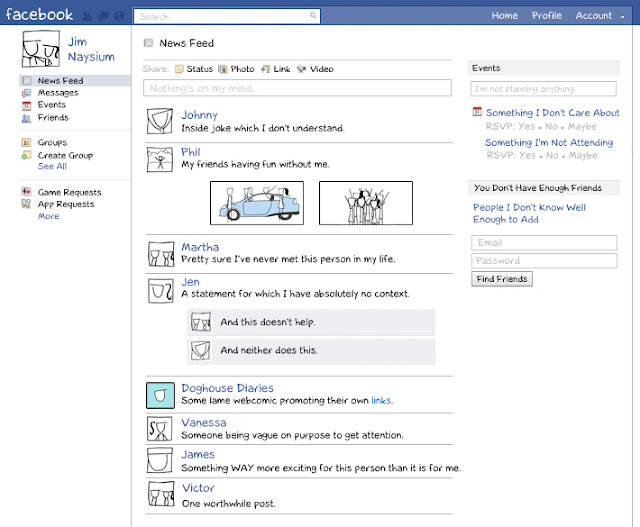
This is a little old. But it’s an interesting comparison. At one point Farmville had more users on Facebook than the entire Twitterverse.

Via Walyou.
This is a little old. But it’s an interesting comparison. At one point Farmville had more users on Facebook than the entire Twitterverse.
Via Walyou.
I figured it was time to put all my blogging talk into action. This one even has ads. I’ve picked a niche (coffee) and I’m out there to see just how much free stuff running a coffee blog can score me (I heard Izaac’s Pixar blog scored him free DVDs).
Plus it’s fun having a purpose when you go to cafes. And it makes all that time spent reading about coffee seem worthwhile.
Here it is. It’s called thebeanstalker.com. Add it to your feed reader. Tell your friends. Tell them to tell their friends. There has been a little bit of original content over there already – but expect to see some of my coffee posts from here posted there, and good stuff from there occasionally posted here.
Dave Miers is raising money so that kids can drink clean water in India. You should help him meet his target of $2,000. He’s got $600 left. For one day only – if you donate money to his fundraising cause and tell me (I’ll check) I’ll send you 250gm of freshly roasted coffee for every donation of $30 or more. I’ll even buy and roast some Indian Coffee for the occasion.
Here’s the direct link to the donation page. Here’s the link to a post on his blog.
I think it’s a good cause, and I’m happy to support it. I do like the poetry of supporting clean water in India by offering to dirty yours.
A long long time ago I posted about milk prices. I suggested they were too high. Or that people should complain about them, rather than about the price of petrol. Milk, is, afterall, completely renewable.

Image Credit: Flickr
Now. I know farmers work hard to earn a living. And I hate that their prices are essentially controlled by our retail duopoly. And I know the margins are pretty low in milk farming because they are being, no pardoning of this pun, milked for every drop.
But I don’t share the dairy lobby’s angst when it comes to the price of milk (see another story where they call price drops “un-Australian”) in Coles and Woolworths (Update: Franklins and Aldi have joined the price war).
The supermarkets are having a price war. So what. This happens all the time in retail. But when it comes to milk, and the price of milk, this is a useful pawn in an economic game. Milk prices are determined by a contractual arrangement. And the contracts are up for renegotiation soon. That’s all these calls to boycott Coles and Woolies milk are. And they’re a little dumb.
Using milk as a loss leader to attract customers (and promising that they’ll wear the costs of dropping the price, rather than the farmers). Now, I am all for lobby groups looking to protect their interests. That’s how capitalism works. So I think it’s great that the dairy guys are out their suggesting Coles and Woolworths won’t wear the cost of a price drop for long. But this argument kind of misses the point of loss leading.
I’m sure the big two would love to have the farmers making no profit on their labours at all – but what they wouldn’t like – is for all the milk farmers to go out of business at once. Leaving them with no supply. Loss leading is essentially a marketing tactic, and I’d hope (perhaps naively) that the cost of dropping the price of milk to $1 a litre, is coming from the marketing side of the supermarket budget, rather than the procurement side. Choosing a staple product like milk to fight with a competitor who in just about every sense offers an identical product is a great move.
Unless there are farmers out there who like selling their milk at below cost (and already the lobby groups seem to be making noise about that being unsustainable) – I’d say the big two will wear the costs for so long as it is making them money to do so. There is no benefit to them if the milk industry dries up. There is benefit to them if they steal market share off one another. They’re targeting each other. Not the farmers. Obviously they want to cut down their overheads as much as possible – but it’s not a particularly sustainable business practice to be running your suppliers out of business in a price war. The whole idea of a loss leader is that they lose money there because nobody just goes to the Supermarket to buy milk, but they might pick one supermarket above the other if their milk is cheaper. It’s marketing. The money to do this probably comes out of a marketing budget.
If they figure out how much they’ll lose selling milk at below cost for a year (say 30c a bottle) and how much profit they’ll make per customer gained, across their whole basket or trolley of goods (say $50) then it’s a pretty simple question to answer… the idea that this will be passed on down the chain is a bit odd – especially since it’s only on their branded lines and the prices of the other, no doubt more popular milk (based on observation at the fridge in the supermarket) have not changed (as far as I know). This is just two companies trying to one up each other to get customers through the door. It’s marketing.
How to fight this battle
Calling giving the average Australian a bargain “un-Australian” is not a winsome PR strategy. It looks like whinging and whining. If the milk lobby really wants to fight against these chains, if they really want to hurt the supermarkets, they should team up with butchers and greengrocers and urge people not to boycott Coles and Woolies milk, but rather to embrace this as a chance to hit them in the hip pocket. If you want to punish them for being “Un-Australian” you should be encouraging people to snap up the cheap milk and buy nothing else from them in protest. The milk industry should embrace this as an opportunity for people to rediscover the joy of drinking milk. Start promoting making milkshakes at home. And then encourage people to get their veggies from a fruit market and their meat from a butcher – and see how long this lasts.
There are very few things in this world that are genuinely laugh out loud funny when you’re reading them in your head. David Thorne’s delightfully nasty bits of revenge, posted online for the world to see, are up there with the best of them.
David went to a ski shop in the US. The service was less than adequate. The gloves he purchased, that he was assured were waterproof, were not. They got wet, and the black ink that provided their ebony colour ran. And it ran all over his jumper. And when he went back to exchange them the staff abused him. So this is what he did:

The store received 5,000 calls enquiring about the free snowboard. And this email exchange ensued.
It was at this point in the exchange that coffee shot through my nostrils:
“I should probably be thankful that your staff were too occupied with having their earlobes stretched by Tonka-truck tyres and wearing pants around their knees to sell me a snowsurfingboard made of sugar or goggles made of bees.”
Or perhaps this point:
“Also, I apologise. While the average male height of 5″9 statistically means anything under is considered short, my question was without diminutive intention. I’m sure there are many advantages to being so small. Target carries an excellent range of boys clothing at competitive prices and a lower centre of gravity should, once helped up onto the ski-lift, allow you to snowboardsurf with greater stability. If I were small, I would buy a cat and ride it.”
There is, as is often the case with Thorne’s work, a language warning attached. It didn’t end all that well. Thorne punctuated the exchange with this:

Don’t fear dirt. Embrace it. Every white shirt I ever owned ended up looking like this anyway, so you may as well make it deliberate. Right?

From Threadless.
Answer: Something like this:
A few days ago I posted this little cartoon to exhort you, my dear readers, to work hard on learning science stuff. So that you could ride cloned prehistoric animals. Because that’s where it’s at. You’ve got two Pterodactyls and a Microsaurus…
Well, anyway, it turns out that in life imitating Jurassic Park, the Wooly Mammoth will be available for your riding pleasure in a matter of years. Maybe.
A guy named Doctor Akira Iritani wants to impregnate an elephant with a baby mammoth.
He intends to use Dr Wakayama’s technique to identify the nuclei of viable mammoth cells before extracting the healthy ones
The nuclei will then be inserted into the egg cells of an African elephant, which will act as the surrogate mother for the mammoth.
From the Telegraph.
I’m not sure that stealing somebody’s money and giving it to the church is going to engender a spirit of generosity. What do you reckon.
GOD’S MUSCLE! from EIT! on Vimeo.
Apparently Peter is a standover man.
You know that song about being to young to march in the infantry, ride in the cavalry or shoot the artillery… here’s what happens if some adults make a film clip for it.
That sort of thing just doesn’t age well. I’m sure it was the coolest thing out back in the 1970s.
Your weekly single serving tumblog is White People Rapping Badly. Pretty self explanatory – and if you can stomach these you should check it out.
“Science has show that for every Eminem, there are approximately 598,467 white people that try to rap but can’t. This is devoted to bringing you the best of the worst.”
Richard Dawkins is not an idiot. But sooner or later the blinkers through which he tries to ram his view of the world are going to become obvious to everybody. That process started a little with this guest post on the ever popular BoingBoing.
Dawkins gets on his soapbox, or behind his pulpit, hoping to preach to a sea of sympathetic listeners. It is the internet, afterall. The playground for the New Atheists.
His target, in this post, was an astronomer named Martin Gaskell. Gaskell recently missed out on an academic position that he was more than qualified for. Essentially because he’s a Christian, who, while not holding a young earth creationist position himself – is sympathetic to those who do.
Here’s what Gaskell says in a pretty fantastic piece of writing on the overlap between astronomy and the Genesis creation account (and varying positions within the scientific fraternity).
“I have a lot of respect for people who hold this view because they are strongly committed to the Bible, but I don’t believe it is the interpretation the Bible requires of itself, and it certainly clashes head-on with science. This viewpoint is something of an “American” view and has been much less common among Christians in Europe.”
Sounds moderate. Right? Some would say positively liberal (having just read Al Mohler’s Atheism Remixed I’d hazard a guess that that’s where Mohler would place him on the spectrum).
So Gaskell sued this college who didn’t give him the job, because the head of the interviewing panel was stupid enough to put the following in writing:
“If Martin were not so superbly qualified, so breathtakingly above the other applicants in background and experience, then our decision would be much simpler. We could easily choose another applicant, and we could content ourselves with the idea that Martin’s religious beliefs played little role in our decision. However, this is not the case. As it is, no objective observer could possibly believe that we excluded Martin on any basis other than religious…”
That’s a smoking gun. Here’s how Dawkins, in this ill-informed diatribe, approaches the Gaskell question:
Step 1. Make allusions to Gaskell’s position on Creation – tying him to the YEC position while admitting that he is not in that camp:
“My own position would be that if a young earth creationist (YEC, the barking mad kind who believe the entire universe began after the domestication of the dog) is “breathtakingly above the other candidates”, then the other candidates must be so bad that we should re-advertise and start afresh.
Martin Gaskell claims, however, that he is not a full-blooded YEC although he has “a lot of respect for people who hold this view because they are strongly committed to the Bible”
Step 2. Compare people who hold a young earth position (which Gaskell does not) to eye doctors who believe babies are delivered by stork, and geologists who believe in a flat earth while promising to teach otherwise.
“Even if a doctor’s belief in the stork theory of reproduction is technically irrelevant to his competence as an eye surgeon, it tells you something about him. It is revealing. It is relevant in a general way to whether we would wish him to treat us or teach us. A patient could reasonably shrink from entrusting her eyes to a doctor whose beliefs (admittedly in the apparently unrelated field of obstetrics) are so cataclysmically disconnected from reality.”
Step 3. Suggest that people with religious beliefs are essentially unfit for any job in academia (though, to be fair, probably in the sciences).
“I don’t care whether his beliefs are based on religion or not, they affect his suitability for the job, and I am going to take them into account.” A law that encourages you to say, “If a candidate’s private beliefs are based on religion I shall ignore them, otherwise I shall take them into account”, is a bad law.”
See, there are a couple of problems here. It’s not uncommon for Dawkins to completely misrepresent Christian beliefs and essentially create strawman pictures of Christianity based on Fox News reports and televangelists. But the other problem is that Dawkins himself links to Gaskell’s own testimony about his own beliefs. A document that contains passages like this:
““Historico-Artistic Viewpoint” – emphasizes that we have to realize that the Genesis was addressed to people 3400 years ago in a form and in descriptive terms they would understand. Moses wouldn’t have got very far if God had quoted from a modern introductory astronomy text to him! (“Say, God, what’s a quark?”). A senior physicist, who had been chairman of a large physics department in the US (and who was, incidentally, not someone with a high view of the Bible), once said to me, “if we put what we now believe to be true about the origin of the universe into poetic language someone would have understood 3000 years ago, we would come up with something very much like Genesis 1 & 2”. The historico-artistic viewpoint would also emphasize that Genesis 1 is in the form of a poem. It has a very definite literary structure. Phrases and patterns of words repeat (e.g., phrases such as “Then God said…and it was so” or “…and God saw that it was good” or “and there were evening and morning…” But we must be careful to note that whether Genesis 1 is poetry or prose has nothing to do with whether it is an actual very literal description of what happened or whether it is allegorical or something. We must not make the distinction prose = fact; poetry = fiction. ”
And this:
“The “scientific” explanations offered by “creationists” are mostly very poor science and I believe this sort of thing actually hinders some (many?) scientists becoming Christians. It is true that there are significant scientific problems in evolutionary theory (a good thing or else many biologists and geologists would be out of a job) and that these problems are bigger than is usually made out in introductory geology/biology courses, but the real problem with humanistic evolution is in the unwarranted atheistic assumptions and extrapolations. It is the latter that “creationists” should really be attacking (many books do, in fact, attack these unwarranted assumptions and extrapolations).
While discussing controversies and interpretations of Genesis I should mention something that has been much debated in recent years but is not an interpretation of Genesis: what is called “Intelligent Design”. This movement, which is often erroneously confused with young-earth creationism, is just exploring the question of what evidence there is in the universe for design by an intelligence. This is really a general, non-religious question (although with obvious religious implications), and there is no opinion on the interpretation of Genesis.”
Now, I’ve got no significant bones to pick with those who hold to a less than literal, or a literal, view of Genesis 1-2:3. I thought that was the worst part of Mohler’s book (Atheism Remixed) – which was actually a pretty good primer on the debate and used arguments from Alister McGrath and Alvin Plantinga (amongst others) to show just how shoddy Dawkins is with regards to his treatment of Christian belief and with regards to philosophy (ie he begs the question of scientific naturalism because he’s bought into evolutionary theory as a unifying theory of everything1). But Dawkins wants anybody who has any religious belief excluded from jobs on that basis. And the beauty of the post on BoingBoing is that its readers call him out. And they are, based on past experience reading the comment threads, a pretty agnostic bunch.
Here are a couple of the comments.
“Oh, just come out and say it, you want to discriminate against a certain class of people even though there is no real objective logical reason to do so. You get an ick factor. Which is eminently stupid. Competence is by definition the ability to get the job done in a satisfactory or better than satisfactory manner. If the person is competent, but somehow throws you off personally because of cultural predilections, that’s frankly a problem and a weakness of your comfort level. Imagine a world where you could hire and fire based on that. I would certainly like to see what you’d have to say when someone refuses to hire an Atheist, because “it tells you something about him.””
And another…
” To not choose the right person for the job, when they have demonstrated in the past that they are fully capable and suitable for it, on the basis of the fact that you don’t like the way they think privately, is pure bigotry.
If he shows evidence that his beliefs are interfering with his work then by all means fire him, but thought is inherently private. Should you equally deny somebody a job in finance because they like to read Marxist literature? What about denying somebody a job as a bartender because they’re teetotal? Where do you draw the line when making that decision for other people?”
One that opens with a quote from Dawkins in the post:
“I suspect that most of my readers would discriminate against both these job candidates…”
If by “my readers” you mean the echo chamber at RichardDawkins.net that you’ve grown accustomed to, certainly.”
My favourite of the lot:
“I think what you are doing here, Richard, is similar to what you do when you criticize religious people in general: you pick prominent but basically ignorant religious people, demonstrate what idiots they are, and then say “well, these guys are prominent, so no doubt the best examples of their lot. Hence, any other example will be even more idiotic, and we therefore need not examine them.”
Here you say “look, we have a competent person who holds religious beliefs someone found objectionable” (for reasons unstated, at least by you). “Isn’t it basically okay that he was discriminated against on the basis of those beliefs, since all people who hold those beliefs are idiots or insane? … The fact is that you appear to know very little about religion (and certainly as a self-proclaimed “atheist” you are entitled to that state of ignorance, at least in regards to religions involving the worship of deities). So it’s hard to see how you’re qualified to even ask this question, because you’re not competent to discriminate accurately between religious people who are idiots or insane, and religious people who are neither.”
It seems that the jig is up. When the masses start picking up the critique of your interlocutors in the sphere of published debate, and they’re doing it in a forum that should cede you home ground advantage, your methods are in a bit of trouble.
1 On this note, I really don’t get how explaining the mechanics of something, explaining the question of how something works, does away with agency. It’s like finding a ball floating in the air towards a target and suggesting that because you understand everything about its motion it must not have been thrown. Or like listening to a piece of music and suggesting that understanding the underpinning musical theory, and the function of the instruments in an orchestra, does away with a composer. It’s philosophically untenable. Just dumb.