What would it look like if Dr Seuss wrote and illustrated Star Wars? Something like this I guess.


More here. Via Twenty Two Words.
What would it look like if Dr Seuss wrote and illustrated Star Wars? Something like this I guess.


More here. Via Twenty Two Words.
Well. I’ll never look at a game of Pacman in quite the same way again.

Its mysteries have been revealed by these two links – firstly the Pacman Dossier – basically a textbook on Pacman, and secondly, this study of the mechanics, and individual personalities, of the Pacman ghosts – which draws on material from the first.
The ghosts have three movement patterns, each individually calibrated. These patterns are determined by what mode they’re in – chase, scatter, or frightened. And these modes switch based on time cycles in each level. The modes determine what a ghost will do as it approaches an intersection.

“The diagram above shows a simplified representation of the maze layout. Decisions are only necessary at all when approaching “intersection” tiles, which are indicated in green on the diagram.
When a decision about which direction to turn is necessary, the choice is made based on which tile adjoining the intersection will put the ghost nearest to its target tile, measured in a straight line. The distance from every possibility to the target tile is measured, and whichever tile is closest to the target will be selected.”
Here’s what happens in Scatter mode:
Each ghost has a pre-defined, fixed target tile while in this mode, located just outside the corners of the maze. When Scatter mode begins, each ghost will head towards their “home” corner using their regular path-finding methods. However, since the actual target tiles are inaccessible and the ghosts cannot stop moving or reverse direction, they are forced to continue past the target, but will turn back towards it as soon as possible. This results in each ghost’s path eventually becoming a fixed loop in their corner. If left in Scatter mode, each ghost would remain in its loop indefinitely. In practice, the duration of Scatter mode is always quite short, so the ghosts often do not have time to even reach their corner or complete a circuit of their loop before reverting back to Chase mode.
Following on from the excellent video about politics, Driscoll just posted this on his blog regarding a Christian approach to culture. It is, in my opinion, a thoroughly Pauline approach, in the next few days I’ll be posting an essay I wrote (at Venn Theology) unpacking Paul’s approach to areas of gospel freedom.
Read Driscoll’s whole post. It’s worth it. He apparently said he liked Jay Z’s music the other day on Facebook, and the crowd went wild.
“What I’ve found over the years is that whenever I speak about something culturally related from a Christian perspective, a debate rages. This has been the case since the earliest days of my ministry. This is because I consider myself a missionary in culture.”
“As a missionary, I do not view culture passively, merely as entertainment. Rather, I engage it actively as a sermon that is preaching a worldview.”
So, as a missionary, I find it a good thing to be aware of what is going on in culture in general as well as in music in particular. Though not a musician myself, I have some five thousand songs on my iTunes account from a wide range of genres and styles. Music is among the most defining and revealing aspects of any culture, and so in addition to enjoying some music, I study lots of music.
“As a missionary, you will need to watch television shows and movies, listen to music, read books, peruse magazines, attend events, join organizations, surf websites, and befriend people that you might not like to better understand people whom Jesus loves. For example, I often read magazines intended for teenage girls, not because I need to take tests to discover if I am compatible with my boyfriend or because I need leg-waxing tips, but because I want to see young women meet Jesus, so I want to understand them and their culture better.”
“The attitude we have for our children is the same we have for our church. This is why we have a pastor leading film and theology discussions. This is why we have a large contingency of Christians who are in the music business but do not wave the flag of Christian music. Rather, their theology informs their songwriting and artistry. Like our children, our goal is not to create a safe Christian subculture as much as to train missionaries to live in culture like Jesus.”
“As we engage culture (watching films and television, listening to music, reading books, shopping at stores, and so on), we must do so as theologians and missionaries filled with wisdom and discernment, seeking to better grasp life in our culture. We do this so we can begin the transforming work of the gospel in our culture by contextualizing the good news of Jesus. Not compromising. Not changing. Contextualizing. Practically, this means doing what Paul says in 1 Corinthians 9:22–23, “I have become all things to all people, that by all means I might save some. I do it all for the sake of the gospel, that I may share with them in its blessings.”
The truth is that every ministry is contextualized, the only difference is to which culture and which year of that culture. Everything from pews to chairs, sound systems, projectors, suits, and a printed Bible in the English language are very recent missiogical contextualizations in light of the two thousand years of Christianity.
“
I’m still trying to figure out exactly what goes here and what goes there.
But in the last few days you might have missed these posts at Venn Theology (my new serious blog)…
1. Reasons you might be really terrible at Powerpoint.
2. Colours and branding and marketing and what they say about you and your product.
3. My lovely wife Robyn is posting her most excellent essay on Daniel in an eight part series. And would love your comments.
4. I’m unpacking my newly developed (or developing) approach to interpreting the Bible by grasping the historical context… ok, it’s not new, but I’m hopefully going to show the benefits of adopting such an approach. Here’s a follow up video with history professor/Biblical scholar/all round good guy Edwin Judge.
Muse were pretty epic last night. They have a beautifully crafted stage presence that makes the songs you don’t like on their albums make a bit of sense. It’s almost as though they write their songs with the arena and not the CD player in mind… wait. That’s exactly what they do. Apparently. According to this interview anyway, which has some relevance (I think) to writing music for churches. Not that I’m an expert on the matter. But I know what songs I like singing and don’t like singing (and I have a yawn test – if I yawn while singing a song it isn’t much fun to sing).
“Q: Speaking of your live show, Muse uses a lot of layers and complicated structures. As you are writing, do you three confer about how the songs will translate live.
A: The end venue, which relates to the last question, it has an impact on the writing, whether you like it or not. You’re always thinking – how is this going to be listened to. Our time is dominated mostly by touring, not by being in the studio. If we were just a studio band, we’d make one kind of album, but because we know we are going on the road, you can’t help but make music that has a relevance being in a large venue.
Using pronouns like “we” and “us”, instead of “I” – you move away from the personal and start moving to singing about more – even the whole venue will feel like it’s about them, or about all of us together in that room. It has an impact. It’s a major difference between the first album to this one, I feel the music we’re making is making a bigger effort to reach out to the people at the back of the venue. You can’t help but wanting to engage the audience.
Q: Do you miss playing small clubs?
A: I like it for different reasons. When you go into a small club, you can totally misjudge the set-list. There’s a certain type of songs which work well in a small venue and others that work well in a big venue. You can get it wrong. There’s a song from the last album called “Take A Bow”, and I imaging on this album it’ll be the track “Eurasia”, that if you played at a really small venue it would actually be crap (laughs). It just wouldn’t work. The pretensions of it, or the over-reachingness of it would be exposed.
Whereas when you go into a stadium environment, it feels perfectly relevant. The boldness of the emotion, the instrumentation of the music fits very well.
Q: So when you are writing, you are writing to the space?
A: I wouldn’t say it’s conscious. I’ve noticed it’s happening unconsciously. It might be the impact of playing in front of large audiences for a long period of time. It makes you think differently about people, it make you think differently about yourself. It’s no longer just a subjective, lonely experience.
“
This kid is going to grow up to be a racist Third Eagle of the Apocalypse. The puppet only gets a say about 3 minutes in.
He’s a junior KKK member. No kidding.
This time tomorrow Robyn and I will be on our way home from a Muse concert. Awesome.
I’m hoping for some of this.
Not this.
Or this.
Paranoid Android is one of my favourite Radiohead songs. Here’s Thom Yorke singing it with an acoustic guitar.
And here are Australian comedy band Tripod singing it a capella.
And here’s an 8 Bit version of the song.
And a bonus, because it was on YouTube and I saw it – here’s another one of my favourite Radiohead songs. Live.
There’s a series of videos on YouTube of “popular” bands being redubbed with badly played instruments. This Creed one made me laugh until I cried.
YouTube’s supply of bad Christian music seems bottomless. I can’t remember if I’ve seen this before. But it made me laugh.
If I were an ice sculptor, a talented ice sculptor, I don’t know how high on the list I’d put “carve a giant autobot” – but having seen this, it’d be up there.
From here.
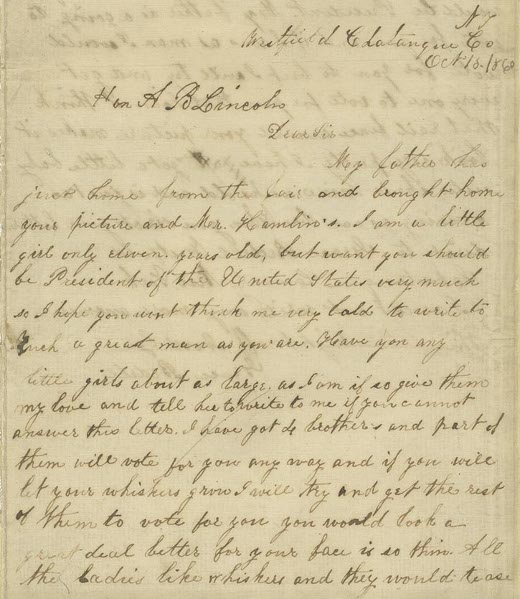
So this morning’s letter was pretty sad. I thought I’d balance it with this one – a letter from a little girl to a then clean faced Abraham Lincoln who was just embarking on his presidential campaign.

“My father has just home from the fair and brought home your picture and Mr. Hamlin’s. I am a little girl only 11 years old, but want you should be President of the United States very much so I hope you wont think me very bold to write to such a great man as you are. Have you any little girls about as large as I am if so give them my love and tell her to write to me if you cannot answer this letter. I have got 4 brothers and part of them will vote for you any way and if you let your whiskers grow I will try and get the rest of them to vote for you you would look a great deal better for your face is so thin. All the ladies like whiskers and they would tease their husbands to vote for you and then you would be President.”
And he replied.

“I regret the necessity of saying I have no daughters— I have three sons— one seventeen, one nine, and one seven years of age— They, with their mother, constitute my whole family—
As to the whiskers, having never worn any, do you not think people would call it a piece of silly affectation if I were to begin it now?”
He grew a beard though. And the rest, as they say, is history.
Again, via Letters of Note.
What would happen if we redistributed nations around the countries of the world based on population? Well. The world map would look something like this.

I’m not actually sure where this came from. But the image is here for you to zoom in and have a look at.
People regularly ask me what coffee stuff they should buy for their loved ones. I like coffee. And I know a fair bit about coffee. But I hate getting coffee presents from people – because usually they’re rubbish (unless you’re very cool people who come to visit from Sydney and bring Campos beans. You know who you are).
So here is a bit of a coffee connoisseur’s guide to Christmas shopping, for a variety of budgets.
Beans
Buy some from me. At the moment I’ve got a sensational Brazilian single origin “Toffee” bean, that’s what it’s called. It’s not sugar coated. Best coffee yet. I think I’m actually going to have to raise my prices in the new year (by about $5), so get them while you can at $20 a kilo.
Buy some from Campos. Their Superior Blend is a knockout, and $40 a kilo.
Buy some from BlackStar. Their Revolutionary Espresso Blend is pretty good, and $35 a kilo.
Buy some from Cup. Cup offers a few single origins and a “seasonal blend.” They sell it in one third kilo bags. $45 per kilo.

Or sign them up for a “Coffee Sub Club” coffee bean subscription with Ministry Grounds. Fantastic range of single origins and a special “Special Reserve” offer.
Cups
Never underestimate the importance of good cups. When my folks were in Italy earlier this year the only souvenir I asked for was a set of good Italian porcelain cups, just garden variety ones, of the right size. For cappuccinos you want a demitasse cup. Half a cup. And smaller for espressos, macchiatos and piccolos.
If you want to get really fancy you can get Bodum’s double walled insulated espresso cups. They’re $20 each. And it sucks when a careless house guest or curtain and blind cleaner knocks one onto the floor and shatters it.
Campos sells sets of six branded cups for $45.
![]()
Hand Grinder
Neil from Ministry Grounds sells these Kyocera Hand Grinders for $88 including shipping and coffee (you can also get a combo with the Aeropress).
Zassenhaus are a German company famous for their handheld coffee grinders. They’re incredibly hard to come by – and vintage ones sell for over $150. There’s one for sale here they’re sold out (amongst a range of other grinding options).

Aeropress
The Aeropress is a powerless coffee maker perfect for camping, some people say the coffee is just as good as from a real machine. But I haven’t tried it, so I can’t comment. I

You can buy one online for $54 from Ministry Grounds They look cheap and plastic because they are. But they’re a coffee geek thing.
Syphon
Syphons look cool, use a gas burner, and make exquisite coffee capturing the subtleties of different beans.
The cheapest I can find them is at Campos online (though I suspect postage adds a bit), they sell them for $125 with burner. The Coffee Guy at Wooloowin has them instore for $165, though they’re different brands so we’re comparing Golden Delicious with Granny Smith here. This is what I’m hoping for as a combined birthday/Christmas present from my wife this year. Hint. Hint.

Ministry Grounds sells the Hario 2 Cup for $140.
MyPressi Twist
The MyPressi is a soda-bulb powered hand held espresso maker. It’s pretty cool. Though at $299 is pretty expensive. You can buy direct from the company for $149 currently (not including postage).
You can grab one online from Toby’s Estate – if you’re in Brisbane the Coffee Guy has them on the shelf.
Grinder sub $200
Sunbeam’s EM0480 Conical Burr grinder is a winner, it’s what I had before I upgraded to a stupidly expensive cafe grinder (a Macap M4 which I am very happy with).
Espresso Machine sub $200
Anything under $100 isn’t going to last long and is likely to make terrible coffee. Ignore anything you read about pump pressure, and if it creates crema by putting a double floor onto the basket in the handle it’s designed to be used with bad supermarket beans that need an external aid to create an imagined sense of body.
I was pretty happy with our Sunbeam Cafe Series machine (the cheapest I’d go, I think), if you’re looking to spend just over the $200 mark the Breville Ikon is a pretty good machine. But the grinder is way more important. The Kyocera/Aeropress combo from Ministry Grounds is the best bet for cheap coffee. Unless you want to get a plunger or one of these pourover filters ($35 from Ministry Grounds) and some filter papers.

Bonus presents for the real snob
Roaster sub $40
A popcorn maker is all you need to get started roasting at home.
Roaster sub $60
Snaffle a second hand breadmaker from a garage sale and get one of Bunning’s Heat Guns (in the paint section) which comes with a lifetime guarantee for something like $25, and you’re on your way to roasting big batches of beans at home.
Roaster sub $500
The Behmor Coffee Roaster I use is great for 500gm batches of coffee, Ministry Grounds no longer sell them, but a quick google will show you that others still do.
Books and DVDs
Coffee Parts have a great range of more expensive coffee machines and grinders – and if they sell it it’s probably pretty good (plus parts are available for it). But they also sell a huge range of other coffee related stuff for amateur baristas and coffee enthusiasts. Including books and DVDs.
Say what you will about Mark Driscoll – but the man is sharpest (I think) when he’s talking about how the church should interact with the surrounding culture. I like this video because we are almost completely in agreement.
Christianity, society and politics from CPX on Vimeo.
He talks about how we can learn from Calvin’s approach to Christianity and Politics, avoiding anachronistically suggesting that any imposition of Christian government is wrong, and suggesting that it’s not appropriate today because you’d need everybody in a country to be Christian in order for that to be appropriate.
“Change often times comes from the bottom up. And I think one of the great myths is that politics changes culture. Politics doesn’t change culture, it represents culture. Politics represents the views of the constituency.”
“My efforts particularly in our city have not been politically active, I’m quite frankly not, I mean, we don’t talk about politicians or issues, much, I mean as I’m teaching through the Bible there might be some corollary between a social issue and a biblical teaching, but for the most part our goal is to love and serve people, to serve the city, to be people who really do love and are committed to our city and want to see the benefit to all people in the city, not just the Christians, and I believe that as more people share that ethic that will help to turn the culture of the city over and that will lead to political change.”
Watch it. It’s good.
This is the sort of post that is eventually going to migrate to Venn Theology (in fact, it’s cross posted there).