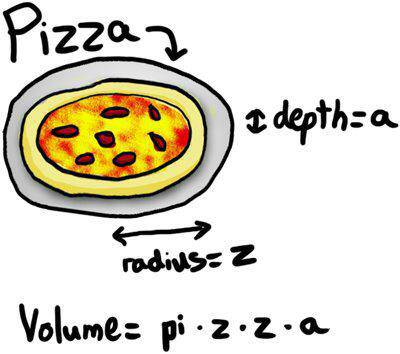
Unequivocal proof that pizza is both delicious and a learning aid.
Via BoingBoing.
There’s a very similar shirt available on ThinkGeek…

Unequivocal proof that pizza is both delicious and a learning aid.
Via BoingBoing.
There’s a very similar shirt available on ThinkGeek…
I love this. From a site featuring 101-word stories called ommatidia.
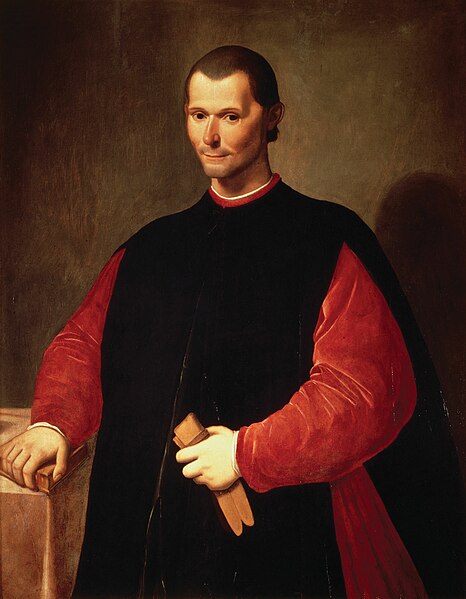
Image Credit: Wikimedia
BOLOGNESE MACHIAVELLI

One of the interesting spin-offs of the great worship debate, both here, and elsewhere, is an argument about the use of words, and what gives words meaning.
There seem to be three approaches to language at play here, three ways of arguing about what language means…
1. The etymological approach – we can know what a word means based on what the word means, how it was developed, its origins, and if not that, at least by its dictionary definition.
2. The “reader decides” approach – a word means what a reader interprets it to mean. This is a bit post-modern. We all bring our own agendas to a text, and we interpret and use words accordingly. In a sense this argument, broadly understood, also incorporates the idea that usage dictates meaning. The way a word is commonly understood is the most legitimate, and in some cases, the only, way to interpret a word.
3. The “author decides” approach – a word is given meaning by the words around it. By the context. The genre. The implied or actual author, the implied reader (ie how the author wants the word to be read by his implied audience). This view sees the author’s intention as paramount in interpretation. A word means what the writer wants it to mean.
As a writer I like option 3. I think Shakespeare would agree. I think Christians with a high doctrine of inspiration of Scripture also have to be at least biased to that approach – while recognising that there are valid insights to be brought to the table by all three approaches. In fact, I think that each of these options, held as an extreme, produces logical fallacies.
The fallacy involved in the first is the “Etymological Fallacy” – it’s where we argue that language doesn’t change. We ignore the process of history and the expansion of definitions of words to include new things, or new concepts.
The fallacy involved in the second, or one of them, is the “illegitimate totality transfer” – a fallacy Don Carson identified where you bring in one meaning of a word and say that it’s the total meaning. This is also a problem that can occur with point 1, though we can also import our own personal preference for the meaning of a word into interpretation.
The third point doesn’t involve a fallacy that I’m familiar with – except that the writer can not reasonably expect the reader to know his/her brain. There must be a name for that fallacy. Anybody? It also seems that expecting a reasonable reader is also an unreasonable read of the world.
Fundamentally each approach above reads the text with an agenda – and the real question is whose agenda does a text serve? I’d say my bias is towards the third – because without a writer we don’t have a text in the first place. The text is the product of a writer’s intent, and it’s fair that we consider it in that framework. But, I think there are particular genres where that is, at best, ambiguous. While the experience of reading Shakespeare, and seeing what he wanted us to see, is rich and captures his artistry – it’s fair to say that his writing contains a fair degree of deliberate ambiguity – where he knows different readers are going to bring different agendas, or knowledge, to a text. It seems to me that the best writing does this. So Shrek, and the Simpsons, are examples from pop-culture where there are layers of meaning imbued in a text by the writer – acknowledging point 3. And puns regularly combine all three interpretive methods. Artistry does that.
Here are a couple of case studies – firstly – I used the words “old people” the other day as a bit of a rhetorical device, in apposition to the “angry young man”… the discussion on the post is informative because I basically failed to acknowledge the existence of points 1 or 2 – which meant what I thought, and intended, as art, wasn’t. But, I would suggest that most “exegetes” of my post failed to pay adequate heed to 3, ignoring both authorial intent, and context (on a blog, with a disclaimer).
Secondly, the worship debate itself – many of the arguments against using the word worship in a modern context commit either one of the two fallacies identified above, and, in my opinion, pay little regard to point three. Word studies are only really useful, in my opinion, for identifying the possible meaning of a word within its context – the meaning of the word is given by the way its used, it’s also a fallacy to say that a writer can’t create new meaning for a word through juxtaposing it with other ideas, or using it in a new context. That’s how language expands. It’s why the etymological fallacy is a fallacy. So with regards to worship – we’ve got the New Testament writers building on Old Testament traditions, and New Testament culture to create a paradigm by which the church could define itself and operate, under God. The original readers of the New Testament had different ideas of what the word “worship” might have meant to the ideas we import into it… the original authors of the New Testament had different ideas about what worship meant to their emperor-worshipping first century counterparts. Insisting on narrow etymological interpretations of a word pays no heed to the idea that the New Testament writers were artists, or creating something new, or good writers who drew pictures. And its weird to toss out words just because their definition has broadened, rather than just qualifying their meaning and trying to define them as the author intended.
Anyway. I’ll stop now.
Some famous atheists and agnostics in these first two (list of names here, and here)…
And some Christian voices for balance…
A pro-wrestler might turn up.
Another Improv Everywhere special – this time it’s a real wedding, and the bride and groom are part of the Improv Everywhere crew.
I’m keen to see this series develop, because this first piece, a look at Carpentry, is pretty cool.
Whatever way you look at it, Brad Thorn has had a pretty incredible career. He also happens to be guy who loves Jesus, and a friend from church.
He’s the most competitive guy I know – especially, and many people won’t know this, at Goldeneye on the N64.
Possibly the coolest ninja themed improv everywhere type thing out there… I’d be happy to be proven wrong on that…
From Improve Toronto. So Canadians do have senses of humour after all.
We’re not there yet – and this is quite a nifty little concept – but I can see this new technology going bad. Innovative camera work at sporting events is one of my pet peeves. I want to see the action from a good angle, not from on the ground behind the in goal, or on some floating camera hovering at odd points in the stadium. And videos coming from within the ball are obviously the next logical progression now that we have a panoramic ball camera containing 36 lenses.
Curiouser and curiouser. Is it just me or is Mark Driscoll on a fast track to laughing stock status. First. He decided he had the gift of discernment.
A special gift that meant we should listen when he slammed video games as stupid, Avatar as Satanic (clips/soundbites from sermons that Mars Hill chose to release as clips/soundbites), and effeminate worship leaders as a scourge on our churches…
Then he started telling us about his semi-pornographic visions – the TV in his head – that helps him see the deep, dark, and sinful leaders of those he counsels (a sermon on the Mars Hill website). I won’t embed the YouTube video because it’s awful (but he again claims the “real gift of discernment”). Lately he’s been getting a bit Westboro Baptist and telling people that God hates them (a clip from a sermon Mars Hill chose to release as a clip/soundbite – but that they later pulled)…
The point of the parenthetic statements is that these are deliberate decisions being made as part of Driscoll’s online branding. As part of Mars Hill’s branding. They’re not being pulled from context by critics, but rather by the organisation themselves.
Somebody is doing an awful job of brand strategy at Mars Hill. From a gospel perspective. Because now the church has decided to send cease and desist letters to other churches named Mars Hill – in this case Mars Hill Sacramento, California – when they’ve all pulled the name from the Bible (Paul’s Areopagus Address – the Areopagus takes its name from Mars Hill). This obviously has nothing to do with Mars Hill’s expansion plans, where they’ve already announced a Mars Hill campus in Orange County, California.
Enforcing one’s copyright rights at the expense of the gospel isn’t likely to win you any friends – especially if you’re the big guy in the playground and you’re going after the littler guy (it goes the other way if a big guy tries to steal a little guy’s identity).
It’s sad. Mars Hill and Mark Driscoll had such potential to be a real asset for the church more broadly, but something about their model is far to tied up in ego and the idea that they’re the ones doing everything right. There’s a lot they do right – but sooner or later that’s not just going to be easy to ignore because of the bad stuff, we’re going to be forced to ignore the good stuff because the rest is so bad.
UPDATE: Mars Hill has attempted to clarify the situation a little bit.
“When cases like this arise in the business world, it’s customary for a law office to send a notice asking the other organization to adjust their branding to differentiate it. This is commonly referred to as a cease and desist letter. On September 27, 2011, our legal counsel sent such a letter to these three Mars Hill churches requesting that they change their logo and name. In hindsight, we realize now that the way we went about raising our concerns, while acceptable in the business world, is not the way we should deal with fellow Christians. On Friday we spoke with the pastor of Mars Hill in Sacramento to apologize for the way we went about this. We had a very productive conversation and look forward to continuing that conversation in the days and weeks ahead.”
UPDATE 2: One of the pastors at one of the other Mars Hills has responded to the response.
Happiness is a well used fry pan. Amongst other things. These look like planets.


They’re from a little artsy project titled “devour” by a guy named Christopher Jonassen. He included this Sartre quote on the page:
“To eat is to appropriate by destruction”. – Jean-Paul Sartre (French existentialist and writer, 1905-1980)”
If you’re thinking about social media and whether or not you should bother engaging with it either in business, or in ministry, then here’s some more evidence that you should. Especially because anybody born from 1978 onwards is a “millennial” or a digital native, as home in the virtual world as they are in the real world.
Click it for a bigger version.

Via Blogbydc
Also worth checking out the Nielsen Social Media Report (PDF – though you may need to fill out a form)
So. For those of you not following along with the discussion on yesterday’s post about worship… here’s an update.
I wrote that post with a healthy dose of irony. I thought. And I was aiming for humour, rather than offence, when adopting the persona of an “angry young man” essentially writing to a bunch of other “angry young people” and calling them old. I was trying to call out those people who were once advocators of change for being a bit stuck in the rut of that advocacy when things have changed. I also thought it was funny that the issue at hand dealt with music – which I thought was universally understood to be a marker of generational change…
And, in order to be noticed, I adopted hyperbole. I ironically wrote a reactive polemic against reactive polemics, calling for nuance. I thought that would be relatively clear.
But it turns out, once again, that the Internet isn’t very good for that sort of stuff. Even though I think that blogging is a medium different to other mediums (ie content is spur of the moment, geared towards the sensational, provocative, not completely thought out and referenced, opinionated, a contribution to discourse, etc), and think the reader has as much responsibility to consider the genre when responding as the writer does to consider the reader when writing… I think this post failed. People responded to the style, rather than the substance. And so, I edited it. You should read the post and join the discussion.
I am sorry that my post was not clear, and I’m sorry that it was possibly an offensive caricature of particular positions (again, ironically, because I would argue that almost all reactionary/polemic based stuff, especially on the internet, relies on caricatures and straw men).
Also, I am sorry if you’re 35 and I called you old, or if my post offended you in myriad other ways. But I guess my one response is – don’t let the offence get in the way of engaging with the issue, or be an excuse for dismissing the substance of the post or its criticism of your position.
How many of these cartoon eyes can you identify?

You can get a poster of this design by Yoni Alter. And there’s an interactive cheat guide here…
This is quite an interesting way to chart the progression of the Biblical narrative. A “sentiment analysis” from OpenBible.
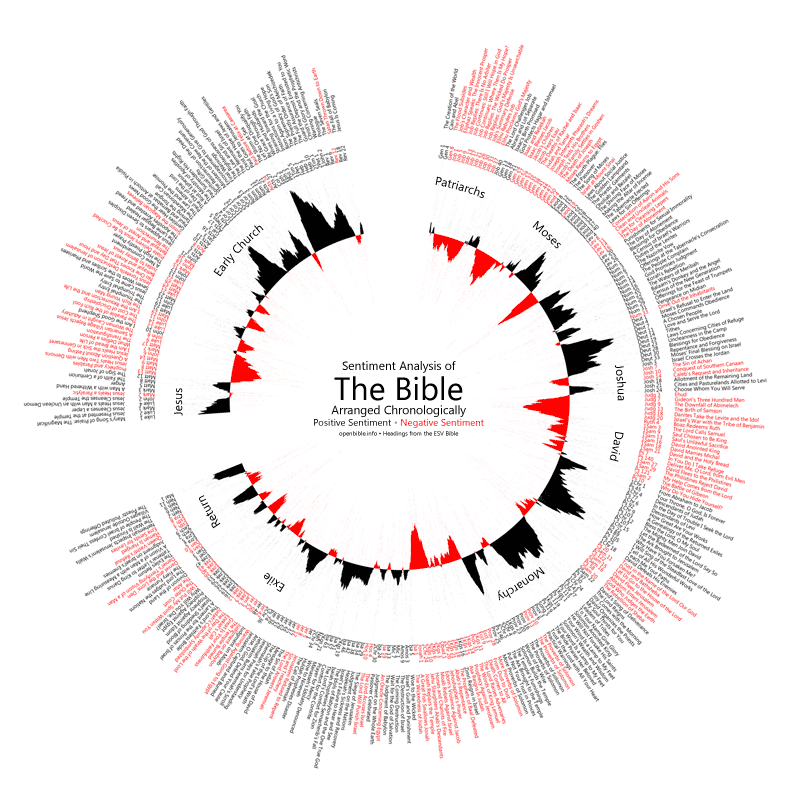
Here’s the methodology applied to produce these graphics.
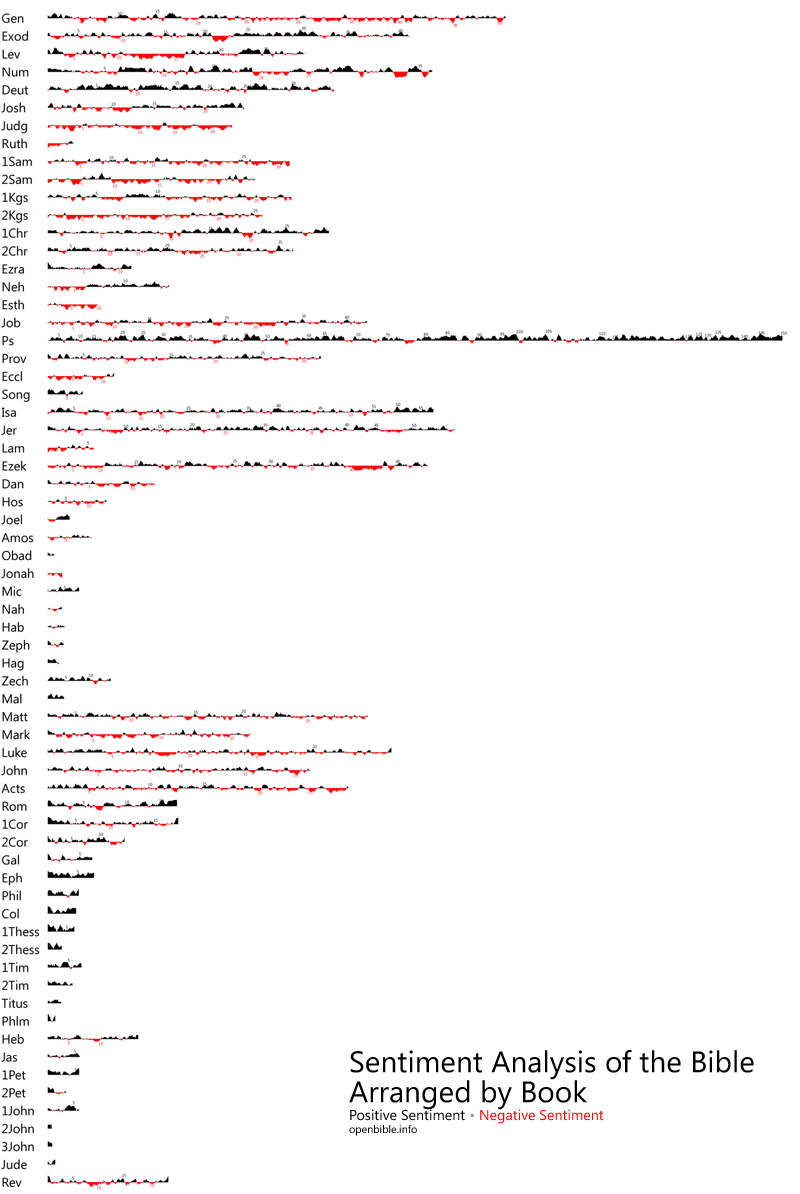
“Sentiment analysis involves algorithmically determining if a piece of text is positive (“I like cheese”) or negative (“I hate cheese”). Think of it as Kurt Vonnegut’s story shapes backed by quantitative data.
I ran the Viralheat Sentiment API over several Bible translations to produce a composite sentiment average for each verse. Strictly speaking, the Viralheat API only returns a probability that the given text is positive or negative, not the intensity of the sentiment. For this purpose, however, probability works as a decent proxy for intensity.”
From a cursory analysis the modelling adds up to most understandings of Biblical theology – except perhaps that exile isn’t as confronting emotionally, or as dire and depressing, as we might have thought – probably because most exilic texts include expressions of hope for delivery.
Here’s the sentiment analysed on a book by book basis.