Tag: Babel

How to Read the Bible — Reading in 4D

This series of posts was first a series of sermons I preached at City South Presbyterian and Coorparoo Presbyterian in mid 2026. You can, if it is your preferred medium, watch the video recording of this sermon here (Vimeo), or listen to the audio recording here (Spotify link).

3D movies were the next big thing… Until 4D.

If you head to a 4D movie, your seat will move, there will be fog and lightning and wind and smells…

We are reading the Bible in 3D… Or 4D today.

This image would be 3D… If you had 3D glasses.

We’re getting straight into our nuts and bolts — looking at how the Bible is not just words on a page; but an immersive experience where we are invited to see, or imaginatively dwell in the world of the text, by acting the story out with our bodies.
Gordon Wenham — one of my favourite Old Testament scholars — suggested we have flattened communication with God, through the Bible, into ‘just words;’ a two-way conversation; reading and praying. This is our 2D model…

“For a long time Christians have imagined that communication between God and man is essentially verbal, merely a matter of words…

God speaks to man through the prophets or through the Bible: man replies in prayer. We view communication with God as a sort of two-way radio.”

But God does not restrict himself to words, he uses ritual such as sacraments: ritual is more like colour TV than radio. Ideas are made visible…

Gordon Wenham

And this is a problem, because, by his words and in his word — God creates a 3D world, and a way of life in for human bodies — including rituals, like the sacraments, which make ideas visible in the spaces, places, and geography they are set in. Engaging the text in 3D requires some imagination; an openness to being pulled into the text, rather than pulling the text on the page apart.

This will require imagination and sensitivity, but I think would be worth the effort…

Gordon Wenham

This is part of jumping from English to Hebrew; from the modern model of reality to the ancient.

Our Western minds love facts; we live in a material world some have described as disenchanted; closed off to the supernatural; but this was not how ancient authors or readers saw.

We are going to read paying attention to how 3D places have spiritual — 4D — significance; to what some call “cosmic geography.”

The events of the Bible happened on the map; not a 2D map, but a landscape with mountains and valleys and water and sky; and the settings matter; they have meaning.

In the beginning God created the heavens and the earth. Now the earth was formless and empty, darkness was over the surface of the deep

Genesis 1:1–2

The very beginning of the Bible presents a map to us; inviting us not just to think about physical space — earth — but the overlap of spiritual space — heaven — with the sky.

The ancient imagination sees the sky in 4D — same with bodies of water; like the deep; which is home to “tannin;” sea monsters. (Genesis 1:21).
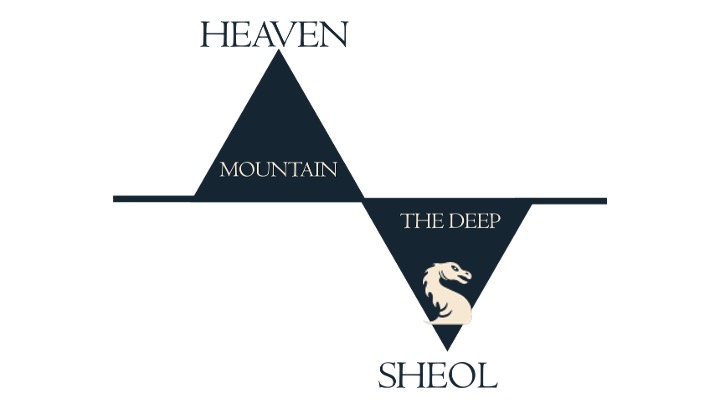
This map of reality sets us up to see moving upwards as moving upwards as moving towards heaven — mountains matter — while moving down into a valley or water is moving towards the realm of death.

Ezekiel tells us the Garden of Eden is on a mountain — Genesis 2 hints at this as it describes rivers of life flowing down into other regions…

And a serpent invades, leading people to grasp the fruit of the tree of knowledge (Genesis 3:6), so they are sent down the mountain, and the way up is guarded by heavenly gatekeepers (Genesis 3:24).
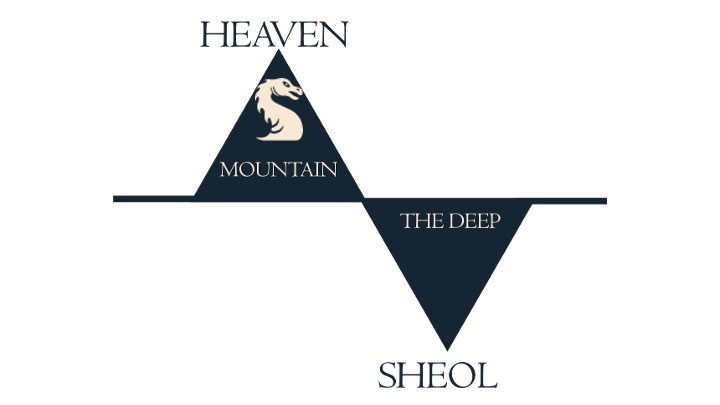
This 4D story of disconnection from heaven is reinforced in the 3D spaces — the tabernacle and temple, that are described in the text, and are at the heart of Israel’s rituals, where they act out being excluded from the Holy of Holies, where God rules from his heavenly throne; pictured in the ark and its cherubim.

When the Bible gives architectural plans for 3D spaces, these teach a story about the cosmos as people follow the plans, building and interacting in those spaces.We do not have the spaces, but we have the plans, and can picture them the way ancient readers would…

Like the first century AD Jewish historian Josephus, who says the floor plan ‘imitates the system of the world,’ so the place behind the curtain is heaven.

Now the room within those pillars was the Most Holy Place: but the rest of the room was the Tabernacle, this was open for the Priests. However this proportion of the measures of the Tabernacle proved to be an imitation of the system of the world. For that third part thereof which was within the four pillars, to which the Priests were not admitted, is, as it were, an Heaven, peculiar to God. But the space of the twenty cubits, is, as it were, sea and land, on which men live: and so this part is peculiar to the Priests only.

Josephus, Antiquities

While the curtain — with its colours, and embroided cherubim and stars — is also a micro-cosmos — an image of spiritual, 4D, reality.

It was a Babylonian curtain… a kind of image of the universe… This curtain had also embroidered upon it all that was mystical in the heavens…

Josephus, The Jewish Wars

The tabernacle travels from Mount Sinai to Mount Zion, where a permanent house — the Temple — is built using the same floorplan.

This 3D space built on the 3D mountaintop place taught God’s people about the 4D reality of heaven and earth; complete with cherubim guarding the barrier between realms.
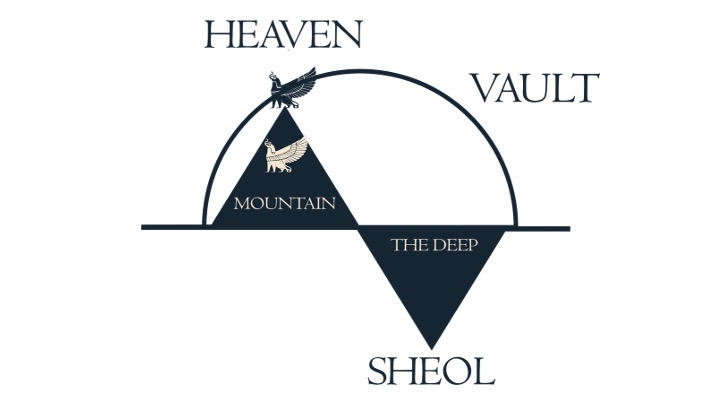
Picture this as we read our story in Genesis 6; where these sons of God ‘saw’ human women were pleasing to the eye, and they took them…

…the sons of God saw that the daughters of man were attractive. And they took as their wives any they chose.
The Nephilim were on the earth in those days, and also afterward, when the sons of God came in to the daughters of man and they bore children to them. These were the mighty men who were of old, the men of renown.

Genesis 6:2, 4

These are the same words as when Eve saw the beautiful fruit and took it; it’s a fall story for heavenly beings; happening in 4D as heaven and earth come together. It creates these beings called Nephilim; these children of gods — ‘heroes of old’ — literally mighty men of name; they are gibborim in Hebrew — that is plural — the same word is used for Nimrod, he is a gibbor — (Genesis 6:4; Genesis 10:8).

He builds Babylon… (Genesis 10:8, 10). And we get the story of the construction of the tower of Babel — Babylon — in chapter 11. This city built on the plain of Shinar (Genesis 11:2), with a tower linking heaven and earth, so the humans ‘make a name’… Gibbors of name.

“Come, let us build ourselves a city, with a tower that reaches to the heavens, so that we may make a name for ourselves; otherwise we will be scattered over the face of the whole earth.”

Genesis 11:4

There are 4D parallels here back to the sons of God’s heavenly fall. Those sons of God come down to earth from heaven, creating these mighty warriors of name — like Nimrod — who leads humans from earth to heaven as they build a man-made mountain to make a name.

But between these stories there is the flood, which was meant to wipe out the Nephilim who are linked to the earth being filled with violence (Genesis 6:11–12); in the flood God opens the vault so the waters of earth and heaven separated re-combine and everything is de-created except Noah and co (Genesis 7:11), who land on a mountain and restart (Genesis 8:4).

So what is with Nimrod the gibbor?

He is maybe part of a giant problem involving Nephilim-like folks after the flood. As Israel are moving from Sinai to Zion — Moses sends spies into the land, who report it’s inhabited by giants; Anakim who are descendants of the Nephilim (Numbers 13:33).

There are more giants; more Anakites aka the Rephaites… (Deuteronomy 2:11). Their king is a giant named Og of Bashan — his bed is 9 cubits — 13 feet — long. (Deuteronomy 3:11). We will look at Goliath in a couple of weeks — but David and his merry men go head-to-head with a bunch of giants, including Goliath’s brother, they are descendants of Rapha, “Rephaim” (2 Samuel 21:16, 19, 22).

This word Rapha has got two separate dictionary entries; one says giant and the other ghost — whether they are linked is debated. I reckon they are — cause when Isaiah uses the word about ghosts, these Rapha are in the realm of the dead — Sheol (Isaiah 14:9). Picture our map.

Isaiah says they are the dead leaders of the world; probably guys like Nimrod and Og the giant — not nepo-babies, but nepho-babies (Isaiah 14:9). Isaiah says Israel has been ruled by these lords, but these children of cosmic rebellion against God are dead; their Rapha do not rise (Isaiah 26:13–14). God wiped them out (Isaiah 26:14). Let me tell you this story.

The rebellious sons of God are the origin story of giant, violent warrior kings of the nations; the kinds who call themselves images of God, who rule the nations who oppose God’s people, and tempt God’s people to worship. But Isaiah says ‘do not worship these giants, they are ghosts in Sheol, which is where they will take you.’

Then Israel is exiled because the gods of these nations become Israel’s gods, their kings become like the nation’s kings (and so the nation’s kings become Israel’s kings); the violent attempts to bring heaven and earth together displayed in Babylon lures Israel in; but their path ends down in the grave, not up in the sky.

Here is where we bring back some more nuts and bolts to see how Deuteronomy 32 gives us a 4D map of this… In the NIV it says the Most High gave the nations their inheritance; dividing mankind (Deuteronomy 32:8), literally the sons of Adam — setting up their boundaries — the scattering he did at Babel… according to the number of the sons of Israel (Deuteronomy 32:8).

When the Most High gave the nations their inheritance, when he divided all the sons of Adam, he set up boundaries for the peoples according to the number of the sons of Israel.
For the Lord’s portion is his people, Jacob his allotted inheritance.

Deuteronomy 32:8–9

But remember textual criticism — from part one — and the Dead Sea Scrolls; and the Greek translation of the Old Testament.

The NIV and other translations say sons of Israel here and the Masoretic Hebrew from the medieval age says “sons of Israel.” But. Earlier Greek translations say either angels of God or sons of God… And Hebrew manuscripts from the Dead Sea Scrolls — the writings used by a Jewish sect located outside Jerusalem — say sons of God…

When the Most High gave the nations their inheritance, when he divided all the sons of Adam, he set up boundaries for the peoples according to the number of the sons of God.
For the Lord’s portion is his people, Jacob his allotted inheritance.

Deuteronomy 32:8–9

The ESV follows this translation. And, if it’s right and the LXX and other manuscripts are right, when God divided up the sons of Adam into nations, he did it according to the number of sons of God; heavenly beings like those in Genesis 6, while keeping Israel — Jacob — for himself.

So, what is the original?

The “sons of God” text thing fits with Psalm 82, where the Most High God — (Deuteronomy 32:8; Psalm 82:6)

God presides in the great assembly; he renders judgment among the “gods”
“I said, ‘You are “gods”; you are all sons of the Most High.’ But you will die like mere mortals; you will fall like every other ruler.”

Psalm 82:1, 6–7

God — literally Elohim — judges an assembly of other gods Elohim — (Psalm 82:1), who are called sons of God, but told they will die like mortals; perhaps becoming ghosts like their giant children.

And it fits with a source; a kind of 4D map, the book of Enoch, that isn’t in our Bibles, but is a source quoted by New Testament writers…

And the angels, the children of the heaven, saw and lusted after them, and said to one another: ‘Come, let us choose us wives from among the children of men and beget us children.’

Enoch 6:2–3

It’s a commentary on Genesis 6 and the sons of God; it uses the Greek word angels.

And again the Lord said to Raphael: ‘Bind Azazel hand and foot, and cast him into the darkness: and make an opening in the desert, which is in Dudael, and cast him therein.

Enoch 10:4–5

They lead humans into violence, and God binds them and casts them into darkness in a grave in the wilderness;

And place upon him rough and jagged rocks, and cover him with darkness, and let him abide there forever, and cover his face that he may not see light

Enoch 10:5–7

Covered forever, until they are hoiked into an abyss of fire, with their followers.

In those days they shall be led off to the abyss of fire: and to the torment and the prison in which they shall be confined forever.

And whosoever shall be condemned and destroyed will from thenceforth be bound together with them to the end of all generations.

Enoch 10:13–15

If that sounds familiar it’s cause Jude and Peter quote Enoch; Jude calls him the seventh after Adam, then quotes this bit… (Jude 1:14). Compare:

“See, the Lord is coming with thousands upon thousands of his holy onesto judge everyone, and to convict all of them of all”

Jude 1:14

“And behold! He cometh with ten thousands of His holy ones. To execute judgement upon all…”

Enoch 1:9

Peter talks about Jesus preaching to dead spirits from the time of Noah (1 Peter 3:18), and God punishing fallen angels… (2 Peter 2:4–5), and Revelation describes a fiery end for rebellious spiritual beings in league with the serpent (Revelation 20:10) — both draw on this picture from Enoch.

Enoch connects the two meanings of Rapha a bit; these spirits of dead rebels become demons — evil spirits — who come up from Sheol to afflict, destroy and attack humans.

And now, the giants, who are produced from the spirits and flesh, shall be called evil spirits upon the earth, and on the earth shall be their dwelling. Evil spirits have proceeded from their bodies…

And the spirits of the giants afflict, oppress, destroy, attack, do battle, and work destruction on the earth, and cause trouble…

Enoch 15:8–9, 11

The book of Enoch describes these sons of God landing on Mount Hermon.

And they were in all two hundred; who descended in the days of Jared on the summit of Mount Hermon…

Enoch 6:6

Rebellion on a mountaintop…

Let’s tie some Old Testament threads together; Og the giant king of Bashan rules Mount Hermon (Joshua 12:4–6); Bashan is the land of ghost giants — Rephaim — and Hermon is the highest mountain in the region (Deuteronomy 3:13).

There’s a Psalm about this mountain of Bashan being jealous of Zion, because God chose it. This Psalm also promises God will bring people out of captivity from Bashan, and the depths of the ocean. The mountain and the deep…

Mount Bashan, majestic mountain, Mount Bashan, rugged mountain, why gaze in envy, you rugged mountain, at the mountain where God chooses to reign, where the Lord himself will dwell forever?
The Lord says, “I will bring them from Bashan; I will bring them from the depths of the sea…”

Psalm 68:15–16, 22

Jewish folks in the first century had this story of Mount Hermon being where the rebel sons of God launched their heaven-meets-earth program — birthing giants, ghosts, demons and violent god-kings of the nations; where those nations were ruled by these powers and principalities after Babel. It would be cool if Mount Hermon showed up in the New Testament…

Hey?

Let’s set the scene for a 4D reading of the transfiguration.

At Caesarea Philipi Jesus asks “Who do people say the Son of Man is?” Peter answers “You are the Messiah” — the Son of God… This son of Adam is the Son of God. Jesus says Peter — you rock — and on this rock I will build my church, and the gates of Hades won’t overcome it (Matthew 16:13, 16, 18)… Hades is the Greek for Sheol; the gates of Hades won’t open up so death overcomes life; they won’t prevent Jesus bringing heaven and earth together in his kingdom.

Josephus says Caesara Philippi got it’s name cause Caesar gave the region to one of Herod’s sons, who built a temple for Caesar at Panium — named after the goat god Pan.

And when Caesar had further bestowed upon him another additional country, he built there also a temple of white marble, hard by the fountains of Jordan: the place is called Panium…

Josephus, Wars 1.404

Caesarea Philippi is at the base of a huge mountain; and features this cave, with a kind of bottomless pit of water, immeasurably deep…

…where is a top of a mountain that is raised to an immense height, and at its side, beneath, or at its bottom, a dark cave opens itself within which there is a horrible precipice, that descends abruptly to a vast depth; it contains a mighty quantity of water, which is immovable and when anybody lets down anything to measure the depth of the earth beneath the water, no length of cord is sufficient to reach it…

Josephus, Wars 1.405

It’s called Pan’s grotto; where people make sacrifices sending stuff through the water to the underworld… Interesting place for Jesus to talk about the gates of Hades… (Matthew 16:18).
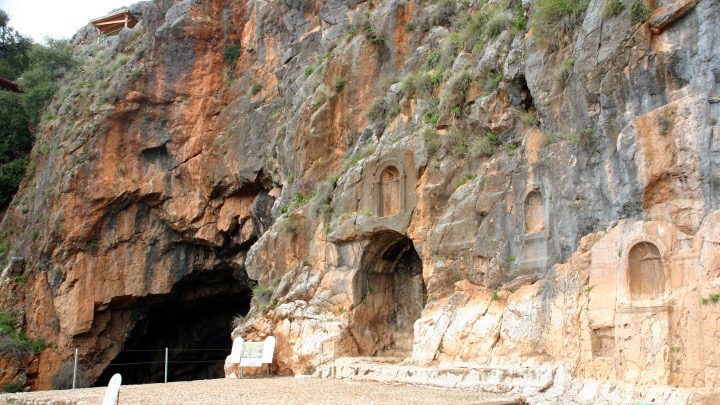
Just plot this water pit on this map as we go…
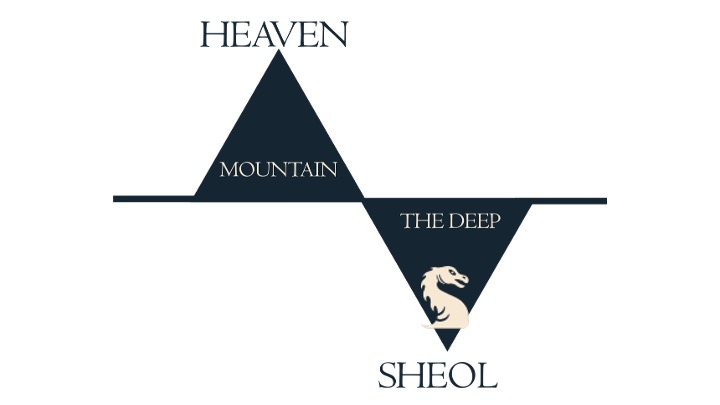
This is where Jesus says the Son of Man will be a human who enters the Father’s glory; with his angels — people will see him entering heaven on God’s terms; it’s a kind of Babel; or a reverse of sons of God coming down.

For the Son of Man is going to come in his Father’s glory with his angels… Truly I tell you, some who are standing here will not taste death before they see the Son of Man coming in his kingdom.

Matthew 16:27–28

Then — Matthew mentions no change in location, just that six days later Jesus takes Peter, James and John up a high mountain (Matthew 17:1) — want to guess what the mountain at Caesarea Philippi is called?

Mount Hermon.

The mountain where serpenty rebellion occurs from heaven, to lead humans away from God… under these powers.

And he was transfigured before them, and his face shone like the sun, and his clothes became white as light.
He was still speaking when, behold, a bright cloud overshadowed them, and a voice from the cloud said, “This is my beloved Son, with whom I am well pleased; listen to him.”

Matthew 17:2, 5

This is where Jesus is transfigured, so the disciples see him in 4D — gloriously uncovered as a heavenly human straight out of Old Testament visions… where God’s voice booms from the clouds of heaven — like at Sinai — imagine the 4D cinema experience… saying “This is my Son.”

Jesus the Son of God and Son of Man who will bring heaven and earth together — restoring the nations under God’s rule is revealed; on this mountain; reclaiming the territory for the Most High.

He comes down the mountain and there is this kid who keeps falling into fire or water — maybe the gates of Hades are beckoning — (Matthew 17:15) And Jesus rebukes this demon — maybe a Rapha-ghost — and restores this boy (Matthew 17:18).

Then — with Hermon in the background he says prayer doesn’t just drive out demons, it moves mountains — specifically “this mountain”: the jealous Mount Bashan, where God will gather people back to himself, and from the deep. Jesus is going to call people back from darkness; from the rule of these nations and the powers behind them. People will no longer be held captive to demons or powers — the stuff associated with Mount Bashan or Mount Hermon…

“Because of your little faith. For truly, I say to you, if you have faith like a grain of mustard seed, you will say to this mountain, ‘Move from here to there,’ and it will move, and nothing will be impossible for you.”

Matthew 17:20

And, again, he foreshadows his death as where this will happen (Matthew 17:22–23).

When Jesus quotes Psalm 22 — ‘my God, my God, why have you forsaken me’ — from the cross; this Psalm pictures Israel’s Messiah being attacked by ‘strong bulls of Bashan’ and lions — beastly pictures of rebellion; trusting God to rescue him from the lions and bulls.

My God, my God, why have you forsaken me?
Many bulls surround me; strong bulls of Bashan encircle me. Roaring lions that tear their prey open their mouths wide against me.
Rescue me from the mouth of the lions; save me from the horns of the wild oxen.

Psalm 22:1, 12–13, 21

And the transfiguration — on the mountain — reveals Jesus as the Son of God — who, through the cross, brings people home to God; anticipating when Jesus will stand on a mountain (Matthew 28:16), and say all authority has been given to me, sending his disciples into all the nations to baptise people into God’s life; gathering us from Bashan and the deep; so the gates of Hades won’t prevail; Sheol has lost its grip. (Psalm 68:22)

“All authority in heaven and on earth has been given to me. Therefore go and make disciples of all nations…”

Matthew 28:18–19

If we put on our 4D glasses we find this thread through the New Testament.

In Athens Paul says God distributed the nations (Acts 17:26), but we are all God’s children and should stop worshipping other gods (Acts 17:29), cause God overlooked this, but now calls all people to repent (Acts 17:30). Reversing that Deuteronomy 32 ‘distribution’ of the nations.

In Ephesians, Paul writes about ‘us’ or ‘we’ the chosen inheritance of God — Israel — adopted as his children… (Ephesians 1:4–5) And then a ‘you’ — the Gentiles — who are rescued from the power of the serpent and included in Christ; given an inheritance; receiving the Holy Spirit; brought into 4D life with God (Ephesians 1:13–14). He says ‘you Gentiles were excluded’ (Ephesians 2:11–12) — now included (Ephesians 2:19).

He even uses the map of reality in the temple floor plan to make the point — once Gentiles were separated by a dividing wall of hostility (Ephesians 2:14); now we are included as bricks in the temple; members of God’s household (Ephesians 2:21–22); adopted as heirs so that in this mystery (Ephesians 3:6). God is making his victory known to the powers and principalities; that divine court room.

His intent was that now, through the church, the manifold wisdom of God should be made known to the rulers and authorities in the heavenly realms,according to his eternal purpose that he accomplished in Christ Jesus our Lord.

Ephesians 3:10–11

Paul even quotes Psalm 68 — the one about Bashan — when he says Jesus is taking people as captive to give us as gifts to each other (Psalm 68:18; Ephesians 4:8–9).

In Revelation, John pictures Jesus in heaven as he saw him on the mountain top.

“His face was like the sun shining in all its brilliance.”

Revelation 1:16

And then sees God’s throne atop a crystal sea (Revelation 4:6); the vault. He sees God destroying the powers who align with the serpent — and the serpent (Revelation 20:10) — and the deep and Hades — Sheol — death itself — before creating a new mountain where heaven and earth meet and the sea — no deep; no barrier, so humans can dwell with God in a new garden city; on a new mountain.

The sea gave up the dead that were in it, and death and Hades gave up the dead that were in them, and each person was judged according to what they had done. Then death and Hades were thrown into the lake of fire.


Then I saw “a new heaven and a new earth,” for the first heaven and the first earth had passed away, and there was no longer any sea.

And he carried me away in the Spirit to a mountain great and high, and showed me the Holy City, Jerusalem, coming down out of heaven from God.

Revelation 20:13–14; 21:1, 10

Turning this…
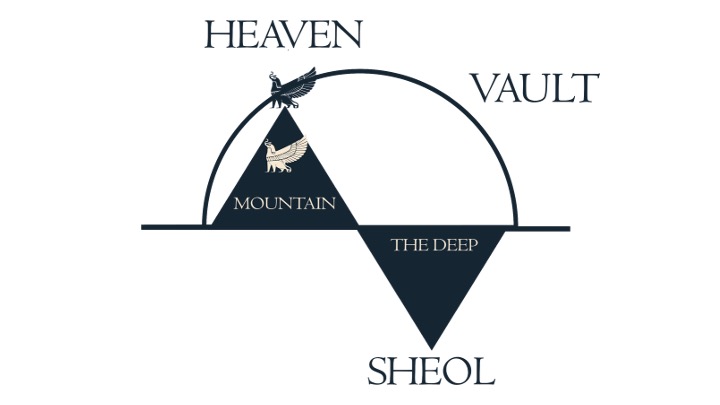
Into this…
When we read in 4D we are tracking this thread.

You might feel like reading in 3D — or 4D — needs special glasses… that this is special knowledge only mystical, professionaly, priestly types can reveal… And that is a real risk. But all of us need guides in a foreign land.

We don’t know Greek or Hebrew so we are guided by translators already.

Maybe we need map translators not just word translators.

But also, this isn’t new.

Jude names Enoch. It’s ‘in the Bible’…

It’s possible that guides from our time — committed to disenchantment — have led us away from this reality; flattening the map; pointing us at words not the world they create; away from the mountains.

We modern readers flatten the Bible into 2D cause we are committed to the idea that comprehension is about getting the right answer; the facts.

Shifting from 2D to 4D shifts us from comprehending and certainty to contemplation. Away from analysis of words to a humble, inquisitive, imaginative curiousity…

Even if some of this wild stuff is speculative; sitting and thinking about the imagery and the vision it creates and not knowing the answers, or admitting we do not know, or we are confused so we reflect and wrestle more takes us into a richer conversation with the God we are too tempted to domesticate and explain.

Even if we have been reading the Bible our whole lives — most of you longer than me — this is a posture that cultivates wisdom, not just knowledge.

We can picture this reorientation as moving away from grasping the fruit of the tree of knowledge using our own power for ourselves, to sitting and examining the beauty of the tree God made, and his word about what it’s for, so that contemplation itself is a gift from God that grows us — and we get to enjoy this sort of contemplation of glorious things for eternity.

This sort of reading involves a different lens; and we might need to act some of it out in our bodies — and we might need guides who will take us from 2D to 4D.

Here are three suggestions.

First, this is how people through church history and outside the west view the world. It’s only disorienting for us moderns who have turned the vault into a closed dome; shutting ourselves off from the heavens. Guides from outside our time and place can help.

Second, I’ve drawn lots of this from an Old Testament scholar named Mike Heiser; his work is disputed; he spent his career writing and podcasting about this stuff; and he might have been wrong about plenty, but he is a good example of taking the Bible seriously, while seeing differently.

Third, C.S. Lewis is less controversial, mostly cause we have domesticated him; turning him into a ‘safe’ Lion… He is not safe, but he is good.

His metaphor for seeing differently is to picture yourself in a dark tool shed; a sunbeam shining through a crack.
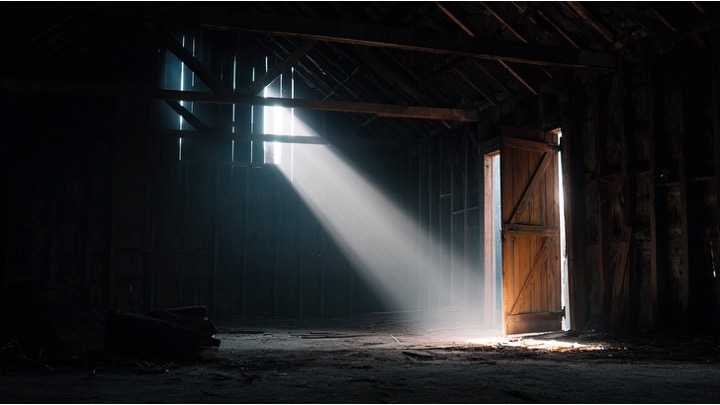
When you look at the beam you can see it lighting up specks of dust, and that it’s “the most striking thing” inside the shed.

Our 2D readings are like this.

Lewis invites us to stand in the beam and look along it; picture looking along the beam out the hole; seeing green leaves on trees, and further — the sun — a bigger reality than the shed. Looking at the beam and looking along the beam are different experiences…

But once we start looking along the beam, it changes how we see the shed; or life on earth, so, like Lewis says elsewhere…

I believe in Christianity as I believe that the sun has risen: not only because I see it, but because by it I see everything else.

C.S. Lewis

If we can — by God’s Spirit — see the world through radiant glory of the transfigured Jesus on the mountain top; as he invites us out of darkness and into his wonderful light — reclaiming us from ground once held by rebellious powers — as the eyes of our hearts are opened and his word helps us see the world this way, it changes everything.

The _____ captivity of the church

Sometimes I think we Christians after Christendom think we’re William Wallace. That we’re in front of a shield wall firing people up for the battle we face… when, actually, we’re already not just prisoners of the enemy, but serving the empire we think we’re standing against. We talk about the world now being ‘Babylon’ and don’t always confront how much Babylon already infects our hearts. Here’s a piece, in part, inspired by Martin Luther’s The Babylonian Captivity Of The Church

“Aye, fight and you may die. Run and you’ll live — at least a while. And, dying in your beds many years from now, would you be willing to trade all the days from this day to that for one chance, just one chance, to come back here and tell our enemies that they may take our lives, but they’ll never take our freedom!” — William Wallace in Braveheart

Freedom.

Religious freedom.

Freedom of speech.

It seems we Christians are a bit obsessed with questions of freedom at the moment. We’re positioning ourselves like an army of Scots ready to fight to maintain our independence from the empire. We’ve got thought leaders who are bracing us for impact, telling us that we’re in the middle of a battle that will decide our future; the battle for our freedom. These freedoms. Hard won freedoms. Freedom from the tyranny of Babylon. Freedom from bending the knee to Caesar and his rainbow sash.

The problem is we talk about religious freedom and how important it is, while we the church are captives in Babylon; and if we think freedom looks like Babylon-lite we’re in big trouble. If we think freedom is simply the ability to maintain a distinct sexual ethic we don’t realise just how much we’ve already been captivated by a world that is an entirely different kingdom to the one we live for if we follow king Jesus. We’re so focused on sex, that we fail to realise that we, mostly, already belong to ‘Babylon’.

We’re captives.

We’re political captives.

We’re economic captives.

We’re captivated by a counter-Gospel. We’re narrative captives, enthralled by Babylon and its shiny promises and explanations about who we are, and what we’re for; blinkered so that we don’t often look beyond our defaults; the status quo of our immediate context and culture.

We’re captivated in our hearts, and our minds, in our desires and in our imaginations.

But still. We picture ourselves as William Wallace, just without the face paint (and so we end up looking a whole lot like Mel Gibson, it’s ok to be a raving lunatic if you’re in character, elsewise, not so much).

We think our freedom is at stake; that it is under attack.

Apparently our real enemies; the ones who will decide our fate, are those who’ve risen up from the margins of the empire who now threaten to take control of everything, or at least to wield disproportionate influence as they capitalise on our collective guilt and shame at how our culture has treated those who are different. We don’t feel guilt, or shame, not in any way that manifests itself in sitting down at the table to make reparations and to reconcile, anyway. We might have changed some of our practices so we don’t do conversion therapy any more or kick out our same sex attracted children (hopefully); we celebrate celibacy for those in our community who are same sex attracted, sure, but we’re not particularly on the front foot explaining to same sex attracted folk outside our community how Jesus is the best possible news for them, and better than any desire for earthly things, including sex, we’re not particularly interested in how life in a contested, pluralist world might be safe for them. It’s not just Christians, or the last vestige of christendom/Old Testament morality that cause bullying, or discrimination, or the world to be unsafe for those who statistically, are not normal. It’s the human heart. It’s the beastly part of the human heart. We’re like chicks, who turn our beaks on the little bird in the clutch who is different, and peck at them until we feel secure, and they are broken beyond recognition.

Well. Now these marginalised folks are at the head of an army; they’ve rounded up the forces of Babylon, both the politicians, and the market forces — corporations — and they’ve brought that army to our shield wall.

“They may take our lives… we might say, but they’ll never take our freedom.” 

We get these bracing call to arms type blog posts on all the big Christian platforms. We get books trying to chart a strategy for the church going forward in a hostile world where our freedom is under threat.

Freedom.

Religious freedom. That’s our shtick; and partly because we so value it for ourselves, it’s one of those things, those common goods, that we want to fight for for everyone else. We tend to see ourselves as the warriors fighting the good fight for freedom on the frontline. William Wallace in a battle raging against the ‘secular’  empire. And by secular this is the sort of hard secularism that sees no place for worship, rather than secularism as ‘no religion is favoured’ pluralistic secularism.

“They may take our lives… we might say, but they’ll never take our freedom.” 

Only we can’t really say that. Or rather, we can’t really say that and mean it. Because our freedom is already gone. We’re already captives. When it comes to Babylon, they’re not at the gate banging on the doors using the new sexual revolution to break down the walls. We’re already captives, and have been for a long time. This stuff on sexual difference is just, perhaps, the last defence to fall before we capitulate, bend the knee to Caesar and kiss the ring. And that we don’t realise we’re already captives makes our resistance pretty pathetic and futile.

We think we’re fighting the good fight here on same sex marriage and safe schools. But the truth is, we’re already captives to Babylon in so many ways that this resistance is pathetic, and unless it leads us to seek freedom in a whole bunch of other areas where ‘Babylon’ has infiltrated, we’re in a bit of trouble.

But the other truth is that Babylon in the Bible isn’t just judgment from God (as we’ll see below); it’s opportunity. It’s an opportunity to reach people outside Israel, and outside the church. Babylon is our mission field, and always has been. And the thing that keeps us focused on the main thing — joining with God in bringing dead people to life through the Gospel — is realising that we’re in Babylon, not Israel, that our neighbours are facing death for rejecting God, and that we’ll be part of God inviting them out of Babylon into a new kind of citizenship.

If we really want to resist Babylon in order to be part of winsomely calling people from death to life, there’s a whole lot of stuff we might need to free ourselves from first. We have to figure out how we’re distinct from Babylon (or should be) in order to reach Babylon with the Gospel (oh, and we need to remember that because we’re not Jews, we’re actually converts from Babylon, Babylonians who’ve decided to follow a different king, that our job isn’t first to identify with Israel and its story, but to appreciate that because of the one faithful exile, Jesus, we are brought home to God and made citizens of something new); we also need to be clear about what ‘Babylon’ means as a metaphor in a Biblical sense (beyond the exile).

There is a sense that God’s people being scattered into Babylon is both vital for his mission to see his image bearers spread over the face of the earth (Genesis 1), and judgment for failing to do the job of being his image bearers in the world; a case of God achieving his purposes through judgment. There’s also a sense in which exile into Babylon is judgment giving people a taste of what it seems they desire — to not live like his people; it’s a purifying thing. This is where his judgment in response to the impulse at Babel — where a bunch of people didn’t scatter, but instead stayed together to build a big, central, tower — probably an ancient ‘ziggurat’ (a staircase into the heavens to make themselves gods) — fits in with his plans for the world. These people rejected his call to go into the world, they built a tower for their own name to make themselves gods ascending to the heavens, and were scattered as a result. It’s this moment, in the Biblical narrative, that creates nations like Babylon, and there’s some pretty interesting historical ties between Babel and Babylon, so that in the first century, the historian, Josephus, says:

“The place wherein they built the tower is now called Babylon, because of the confusion of that language which they readily understood before; for the Hebrews mean by the word Babel, confusion”

The Babylonian captivity of Israel

When Israel was carted off into exile in Babylon the first time around, what got them there, what got them in trouble, was they were already Babylonian at heart before the armies arrived. They were captivated by Babylon before they were captives in Babylon.

They’d already rejected God, and what should have been their distinctives as his people, and they’d turned to idols instead.

They’d signed up with their hearts, and exile was a case of them becoming what they loved. In the book of Ezekiel we get an explanation read by people in Exile about why they’re in exile in the form of the words of the prophet who warned them what was coming.

There’s this scene where a group of Israel’s leaders rock up to Ezekiel to ask him what God says, and it turns out they’re in trouble because they’ve ‘set up idols in their hearts’ — abominations one might say… it turns out they’ve already deserted God. They’re already captives in this sense, even if the physical takeover is not yet complete (though it is for the first readers of Ezekiel)…

 When any of the Israelites set up idols in their hearts and put a wicked stumbling block before their faces and then go to a prophet, I the Lord will answer them myself in keeping with their great idolatry. I will do this to recapture the hearts of the people of Israel, who have all deserted me for their idols.’ — Ezekiel 14:4-5

The heart reality, the ‘Babylonian captivity’, is going to become the real deal though.

“Therefore this is what the Sovereign Lord says: ‘Because you people have brought to mind your guilt by your open rebellion, revealing your sins in all that you do—because you have done this, you will be taken captive.

“‘You profane and wicked prince of Israel, whose day has come, whose time of punishment has reached its climax, this is what the Sovereign Lord says: Take off the turban, remove the crown. It will not be as it was: The lowly will be exalted and the exalted will be brought low. A ruin! A ruin! I will make it a ruin! The crown will not be restored until he to whom it rightfully belongs shall come; to him I will give it.’ — Ezekiel 21:24-27

Exile is a judgment from God on those whose hearts have already gone from him; those who are already captives. The end of this Babylonian exile, according to Ezekiel, is the restoration of the crown to a rightful king of Israel. That’s Jesus. This restoration would also include a restoration of the heart, and a return from exile.

 I will sprinkle clean water on you, and you will be clean; I will cleanse you from all your impurities and from all your idols. I will give you a new heart and put a new spirit in you; I will remove from you your heart of stone and give you a heart of flesh. And I will put my Spirit in you and move you to follow my decrees and be careful to keep my laws. Then you will live in the land I gave your ancestors; you will be my people, and I will be your God.” — Ezekiel 36:25-28

The first Babylonian captivity of the Church

The ‘Babylon’ of Revelation is, first, Rome. It’s the Babylon Israel are still enthralled by; to the extent that when Jesus came, they joined the Romans in executing him. Israel is still in exile, they don’t have new hearts, and they haven’t recognised God’s king. They’re part of this Babylonian kingdom. It’s a picture of a beastly kingdom that has set itself up in total opposition to the kingdom of God. The kingdom we see launched by the death and resurrection of King Jesus. It’s a kingdom whose values are both the opposite of Jesus’ values, and that are so totalising, coherent, and integrated, that once you let just one bit creep into your heart, it’s a trojan horse that lowers your ability to fight the rest. When John starts describing ‘Babylon’ in Revelation he paints this vivid picture of a powerful and beautiful woman who rides a beast, and seductively takes people away from God:

The woman was dressed in purple and scarlet, and was glittering with gold, precious stones and pearls. She held a golden cup in her hand, filled with abominable things and the filth of her adulteries. The name written on her forehead was a mystery:

Babylon the great

the mother of prostitutes

and of the abominations of the earth.

I saw that the woman was drunk with the blood of God’s holy people, the blood of those who bore testimony to Jesus. — Revelation 17:4-6

This isn’t some mystery where we need a decoder ring, or to get in touch with our inner Nostradamus…

“The woman you saw is the great city that rules over the kings of the earth.” — Revelation 17:18

For John, in his day, this is a description of Rome. Rome who loomed large as the totalising persecutor of Christians, but also as a compelling, integrated and coherent picture of civilisation; where order was kept and maintained and the seduction of beauty and power was never far away from the stick of its military. The carrot and stick of Rome were the threat to Christians aiming to maintain their distinction as citizens of heaven who bow the knee to Jesus, not Caesar, so we have a little exchange between governor Pliny and Emperor Trajan where Pliny is trying to figure out what to do with the Christians, and Trajan says “if they are denounced and proved guilty, they are to be punished, with this reservation, that whoever denies that he is a Christian and really proves it — that is, by worshiping our gods — even though he was under suspicion in the past, shall obtain pardon through repentance.” And this lure, which caught Israel, also threatens the church — when John opens Revelation by directly speaking to the churches who first read this apocalyptic (revealing) text; that showed the real lay of the land, he warns the churches ‘not to forsake their first love’, not to be lured by Jezebels and the promises of false worship, not to become ‘lukewarm’ because of their own economic might within the empire… people in the church are in danger of forsaking Jesus and ending up in judgment, in Babylon.Everyone is an exile — you’re just either exiled from God, or from the beastly Babylon. Whatever happens their lives are lived in the physical reality of Babylon. They’re not home. And they’re treated like exiles too, by the world. The church is facing persecution for not bending the knee to Caesar.

Escaping persecution was so simple. You just had to sign up, totally, to the empire. To give in to Rome; to the empire; to Babylon; was to become an abomination; to become “children of the mother of the abominations of the earth.” Now this is pretty strong language, and for a long time the church has got itself in a spot of bother by using versions of the Bible that seem to single out sexual sin as the only sort of ‘abomination’ and abomination as a particularly insidious different type of sin. All sin is fundamentally an abomination to God. Stuff we might give a hall pass to out there in the public square — like greed — but also stuff we’re thoroughly conscripted into and captivated by as Christians — like lust, gluttony, and, umm, greed.

An ‘abomination’ was something put in the place reserved for God — in the Temple, at the altar, but also, fundamentally, in our hearts. An abomination is anything you replace God with. It’s the thing that turns us, as it conscripts us and deforms our behaviours (and so the image we bear in the world), in such a way that we become more like Frankenstein than human. We become vaguely human, in terms of what God’s kingdom looks like. The whole Roman enterprise — though much of it looked beautiful, ordered, and admirable — was built on an abominable rejection of God as God and Jesus as king.

When the Maccabees revolted against the Seleucid Empire (a hellenic kingdom), they were motivated, in part, by that empire fulfilling what they thought were Daniel’s prophecies about the abomination that causes desolation. It was all about God’s temple, and the altar, and the purity of whole-hearted worship that Israel was able to offer to God. So 1 Maccabees describes this abominable moment:

Now on the fifteenth day of [the month] Chislev, in the one hundred forty-fifth year, they erected a desolating sacrilege on the altar of burnt offering. They also built altars in the surrounding towns of Judah — 1 Maccabees 1:54

This sacrilege is later described as an abomination.

… that they had torn down the abomination that he had erected on the altar in Jerusalem; and that they had surrounded the sanctuary with high walls as before, and also Beth-zur, his town. — 1 Maccabees 6:7 

The Romans, when they destroy Jerusalem in 70AD, build a temple to Jupiter on the site of the Temple. And some believe this is what the ultimate abomination Rome is going to carry out looks like. It’s abominable, no doubt.

But I think the ultimate abomination was what Rome — and ‘captive’ Israel — did to God’s ultimate temple. They executed him; utterly rejecting his rule; holding up a mirror to what the beastly kingdom looks like against the face of God’s king. The great irony is that this is where king Jesus is enthroned and his kingdom begins — the kingdom that would ultimately be the undoing of Roman rule and the downfall of the Caesars (if you take the long term view, and of course, the eternal view). We repeat the abomination that causes desolation whenever we put anything but God in the place of supremacy in our hearts — we were made to bear the image of God; to be walking ‘temples’ for whatever it is we worship (the things we love and serve).

The church’s job, according to Revelation, is to bear faithful witness in Babylon as people distinct from Babylon because we bend the knee to a different king — the king described in Revelation 1 who brings the kingdom described in Revelation 21-22, after Babylon is destroyed. In the meantime we’re to be faithful witnesses (see the letters to the churches at the start of Revelation), who call Babylon to repent; who speak truth to power; even to the point of sharing in Babylon’s treatment of our king. Or, as Revelation 11 puts it, when talking about the faithful ‘lampstands’ (which is what the churches are depicted at in the start of the book):

Now when they have finished their testimony, the beast that comes up from the Abyss will attack them, and overpower and kill them. Their bodies will lie in the public square of the great city—which is figuratively called Sodom and Egypt—where also their Lord was crucified. For three and a half days some from every people, tribe, language and nation will gaze on their bodies and refuse them burial. The inhabitants of the earth will gloat over them and will celebrate by sending each other gifts, because these two prophets had tormented those who live on the earth.

But after the three and a half days the breath of life from God entered them,and they stood on their feet, and terror struck those who saw them. Then they heard a loud voice from heaven saying to them, “Come up here.” And they went up to heaven in a cloud, while their enemies looked on. — Revelation 11:7-12

Avoiding ‘Babylonian Captivity’ in the early church

Avoiding Babylonian Captivity after Jesus is a matter of right worship; it’s a matter of being part of the return from exile promised in Ezekiel (and because we’re not Jews, most of us, a return from the exile where we’re humanity was kicked out of Eden). It’s a matter of participation in God’s kingdom, the church, following his king, Jesus, and having him rule our hearts via the Spirit; a removing of the ‘abomination’ of false gods that rule our hearts.

The point is — it’s not sexual sin per say that is the ‘abomination’ (it’s a form of it), it’s idolatry. It’s the participation in worship of things other than God, through undifferentiated participation in kingdoms that are not God’s. It’s captivity. And the thing about Babylon, ‘the mother of abominations’ is that it’s not just sex that captivates us and so makes us captive; it’s not just the ‘sexual revolution’ that aims to restrict our freedom… there’s politics (power), and economics (money), and philosophy/wisdom (education and a vision of the good life) in the mix too.

Early Christians, knowing what was at stake, were more William Wallace like in their ability to avoid this sort of captivity. They refused. They maintained a distinction that included sexual fidelity, and an approach to marriage that was counter cultural in the Roman world, but it included much more than this. Here’s a passage from a second century document called the Letter to Diognetus. It’s about how the Christians avoid being caught up in the trappings of Babylon.

Instead, they inhabit both Greek and barbarian cities, however things have fallen to each of them. And it is while following the customs of the natives in clothing, food, and the rest of ordinary life that they display to us their wonderful and admittedly striking way of life.

They live in their own countries, but they do so as those who are just passing through. As citizens they participate in everything with others, yet they endure everything as if they were foreigners. Every foreign land is like their homeland to them, and every land of their birth is like a land of strangers.

They marry, like everyone else, and they have children, but they do not destroy their offspring.

They share a common table, but not a common bed.

They exist in the flesh, but they do not live by the flesh. They pass their days on earth, but they are citizens of heaven. They obey the prescribed laws, all the while surpassing the laws by their lives.

They love all men and are persecuted by all. They are unknown and condemned. They are put to death and restored to life.

They are poor, yet make many rich. They lack everything, yet they overflow in everything.

They are dishonored, and yet in their very dishonor they are glorified; they are spoken ill of and yet are justified; they are reviled but bless; they are insulted and repay the insult with honor; they do good, yet are punished as evildoers; when punished, they rejoice as if raised from the dead.

The writer of this letter says some other stuff too, including this passage on the stupidity of the idolatry of ‘Babylon’ from earlier in the piece…

“Are they not all deaf? Are they not all blind? Are they not without life? Are they not destitute of feeling? Are they not incapable of motion? Are they not all liable to rot? Are they not all perishable?

You call these things gods! You serve them! You worship them! And you become exactly like them.

It’s for this reason you hate the Christians, because they do not consider these to be gods.”

This is what it looks like to really fight for freedom — to be poor and make many rich, to be lowly, dishonoured, without power, marginalised, but to bless, honour, and do good. To be sexually distinct, to share a common table, to be living a different story because we follow a different king.

Getting out of Babylon now (or getting Babylon out of the church)

I look at how we play politics as the church and feel like there’s not a huge amount of difference to how politics get played by other ‘religious’ groups. The politics of power, of zero sum games where it’s our way or nothing. The politics of picking the people who best represent our views, rather than the people most qualified for the job. We try to play politics with everyone else, we’re just not very good at it (bizarrely, perhaps, because other people have cottoned on quicker that we’re more shaped by our loves than by ‘knowing the facts’, and so they tell better stories).

I look at how I approach money, and career, and security, and experience, and toys, and I think that there’s not much difference in my approach to consuming and my pursuit of luxury, than anyone else in my life (except perhaps that I earn slightly less because of career choices, but this just means I crave slightly more in an unrequited way).

It’s not just about sexual difference, this Babylon thing — though that is important, and our marriages should be rich testimonies to the love of Jesus, and we should love and nurture our kids. And we should fight the temptation to sexual immorality and the corrupting of our imaginations by a ‘sexular society’… but there has to be much more than that in our kit bag.

If we want to be people who aren’t captives, people who live as though ‘every land is like a homeland’ and a ‘land of strangers’ we need to be people who are so caught up in the vision of a kingdom greater than Babylon and a sense of certainty that our future is greater than the present, and the past. That the picture of life in Revelation 21-22 doesn’t just surpass Babylon, or Rome, but Eden.

This will mean a totally different approach to politics that is not wedded to a sort of conservatism where we’re trying to restore paradise lost (and end up building Rome)but a progressivism that shoots for the kingdom of heaven — the kingdom we are citizens of even now.

This will mean, in some corners of the world, divorcing ourselves from worldly political establishments (and not shooting for a wedding with any particular political party here in Australia).

This will mean we don’t seek to be at the centre of the empire culturally, or politically, or economically — to be at the centre would require the ’empire’ being at the centre of our hearts — an ‘abomination’ and a form of captivity… like Spiritual Stockholm Syndrome. We won’t seek to be at the centre, but nor will we seek to be at the margins to the extent that we don’t participate in life with our neighbours. But we do need to be close enough to those at the margins to bless the people there, hear the people there, and be champions for the bringing about of change for the benefit of those Babylon treads on. Our distinctives on these fronts are to be prophetic and the noticeable and part of our appeal (think Daniel in Babylon).

This will mean listening to voices from the global church, from marginalised communities (from people who aren’t white blokes with multiple university degrees).

This will mean a totally different approach to economics. When John describes the downfall of Babylon he describes it with reference to its material prosperity — its luxury — and in terms of the downfall of a worldly economy built on the powerful controlling the goods of this world for their own benefit (and at the expense of other people — like those sold as slaves (Revelation 18:11-13) — and of the world itself which John says is “corrupted by her adulteries” (Revelation 19:2-3). The Babylon lost when God judges is not just built on sexual excess (though that is part of the picture), but on economic and political excess — a beastly and abominable approach to God’s world created by the worship of these things in the place of God. This sort of idol worship is totalising

This will mean a different approach to arts, and culture, and storytelling. The appeal of Babylon, in any form, rests in its counter-gospel and the way its gods are dressed up as appealing counterfeits to the real God. It’s no coincidence that even the word Gospel is ‘Babylonian’ (in the Roman sense); the proclamation of the marvellous victories of king Caesar. We need to be people who proclaim a different king in ways that call people to worship the one who ends our exile from God; the one who brings us out of captivity.

This will mean a different approach to personhood, discipleship, and education, that doesn’t see us just as solitary brains to be educated towards sanctification, but worshippers whose worship is cultivated in the ‘heart’, by practices, by stories, and in community where we follow our king by imitating him together, and show and reinforce our distinctive ‘story’ together.

This will mean a different approach to being the church. One that is not defensive or inwards looking, but that cultivates hearts that in looking to the king, and his way of life, joyfully and hopefully look to the lost sheep in our world; those crushed by worldly kingdoms, and offer them good news. Our practices and disciplines and the rhythms of our life together should, like the church from the Letter to Diognetus, be aimed at ‘making many rich’…  There are plenty of people at the margins of our society where the gospels of our ‘Babylons’ are exclusionary. Get an education; get a job; buy a house; collect experiences; be ‘free’… there are people for whom this vision of the good life is a millstone pulling them into depths of despair, not a picture of freedom at all. These are the people the freedom of the Gospel is for, and yet we spend our time hand wringing because the ‘elites’ don’t like us.

Babylon is a totalising system that aims for all of us — our desires, imaginations, beliefs, belonging, and actions… much as the Kingdom of God is a totalising system in a totally counter-Babylon, counter-Rome, way. These are where some of my misgivings about Christendom as an enterprise historically are located… we like to think the church civilised the barbarian empire… and in many ways we did… but we’re not so aware of the ways that this also allowed the empire to barbarianise the Church… and this was part of what Luther was getting at, in the Reformation he launched of the ‘Roman Church’ in a text like The Babylonian Captivity of the Church. This is the scale of the challenges we’re facing as the church now, and it might not be the Benedict Option that gets us to where we need to be, but we don’t really have the option of not changing if we’re already captivated by the trinkets and baubles of Babylon and just waiting for the last little bit of resistance to crumble while we fight for ‘religious freedom’… we need to fight for religious freedom, certainly, but more than that we need to fight to be free from abominable religions that pull our hearts from God.

When Luther described his task of pulling the church out of what he perceived to be a Babylonian captivity, he recognised how hard this would be because the captivity was so entrenched by the traditions of the church…

“I am entering on an arduous task, and it may perhaps be impossible to uproot an abuse which, strengthened by the practice of so many ages, and approved by universal consent, has fixed itself so firmly among us, that the greater part of the books which have influence at the present day must needs be done away with, and almost the entire aspect of the churches be changed, and a totally different kind of ceremonies be brought in, or rather, brought back. But my Christ lives, and we must take heed to the word of God with greater care, than to all the intellects of men and angels. I will perform my part, will bring forth the subject into the light, and will impart the truth freely and ungrudgingly as I have received it.” — Martin Luther, The Babylonian Captivity of the Church

Like many things, Luther saw the corruption of the way church was happening — removed from truths of the Gospel — as the work of Satan, work achieved through idolatry (any worship without Jesus); he says where we lose our centre — faith in Christ — we end up in judgment,  “removed from our own land, as into bondage at Babylon, and all that was dear to us has been taken from us.”

In this our misery Satan so works among us that, while he has left nothing of the mass to the Church, he yet takes care that every corner of the earth shall be full of masses, that is, of abuses and mockeries of the testament of God; and that the world shall be more and more heavily loaded with the gravest sins of idolatry, to increase its greater damnation. For what more grievous sin of idolatry can there be, than to abuse the promises of God by our perverse notions, and either neglect or extinguish all faith in them. — Martin Luther, The Babylonian Captivity of the Church

We need to be prepared to change; we, the church, need to acknowledge where we are captives, and we need to be prepared to reform. It’s a big deal, and it’s about much more than what goes on in our bedrooms.

“But you will say: “What? will you ever overthrow the practices and opinions which, for so many centuries, have rooted themselves in all the churches and monasteries; and all that superstructure of anniversaries, suffrages, applications, and communications, which they have established upon the mass, and from which they have drawn the amplest revenues?” I reply: It is this which has compelled me to write concerning the bondage of the Church. For the venerable testament of God has been brought into a profane servitude to gain, through the opinions and traditions of impious men, who have passed over the Word of God, and have set before us the imaginations of their own hearts, and thus have led the world astray. What have I to do with the number or the greatness of those who are in error?”

Mission starts with Babel: A cool Biblical Theology thing

I’m doing some stuff on the church for one of my subjects this semester (well, for three of them, but this one in particular is called Church, Sacraments, and Ministry). Here’s a cool bit of Biblical Theology that I’d kind of thought about before but I’ve just had to articulate it…

These passages work really nicely together to account for the global significance of the gospel…

In Genesis 11 you get the story of Babel, some entrepreneurial peeps try to build a big tower to be like God. Because they all speak the same language.

11 Now the whole world had one language and a common speech. As people moved eastward,they found a plain in Shinar and settled there.

They said to each other, “Come, let’s make bricks and bake them thoroughly.” They used brick instead of stone, and tar for mortar. Then they said, “Come, let us build ourselves a city, with a tower that reaches to the heavens, so that we may make a name for ourselves; otherwise we will be scattered over the face of the whole earth.”

But the Lord came down to see the city and the tower the people were building. The Lordsaid, “If as one people speaking the same language they have begun to do this, then nothing they plan to do will be impossible for them. Come, let us go down and confuse their language so they will not understand each other.”

So the Lord scattered them from there over all the earth, and they stopped building the city.That is why it was called Babel —because there the Lord confused the language of the whole world. From there the Lord scattered them over the face of the whole earth.

It’s a nice little theological account for why there are different nations – which sits just before God calls Abraham (then Abram) to start his own people – and they’re meant to bless these other nations (Gen 12:1-3).

Skip ahead a few thousand years (well, you could incorporate the nations coming in to see Solomon. I probably would). And you get the great Commission… Especially these bits in Matthew 28:

18 Then Jesus came to them and said, “All authority in heaven and on earth has been given to me. 19 Therefore go and make disciples of all nations, baptizing them in the name of the Father and of the Son and of the Holy Spirit, 20 and teaching them to obey everything I have commanded you. And surely I am with you always, to the very end of the age.”

It’s global. But it’s global because the Babel type distinction (which has become a “Jew/Gentile” distinction) has been broken down by Jesus.

Paul says it this way in Galatians 3:

28 There is neither Jew nor Gentile, neither slave nor free, nor is there male and female, for you are all one in Christ Jesus.

Here’s some cool stuff though… Babel starts getting reversed at Pentecost in Acts 2 (I know it’s probably obvious, sometimes the obvious can be exciting though)…

2 When the day of Pentecost came, they were all together in one place. Suddenly a sound like the blowing of a violent wind came from heaven and filled the whole house where they were sitting. They saw what seemed to be tongues of fire that separated and came to rest on each of them. All of them were filled with the Holy Spirit and began to speak in other tongues[a] as the Spirit enabled them.

Now there were staying in Jerusalem God-fearing Jews from every nation under heaven.When they heard this sound, a crowd came together in bewilderment, because each one heard their own language being spoken. Utterly amazed, they asked: “Aren’t all these who are speaking Galileans? Then how is it that each of us hears them in our native language?Parthians, Medes and Elamites; residents of Mesopotamia, Judea and Cappadocia, Pontusand Asia, 10 Phrygia and Pamphylia, Egypt and the parts of Libya near Cyrene; visitors from Rome 11 (both Jews and converts to Judaism); Cretans and Arabs—we hear them declaring the wonders of God in our own tongues!” 12 Amazed and perplexed, they asked one another, “What does this mean?”

That, in itself, is a pretty nice piece of Biblical Theology. But what I really love is when you throw in a picture of what heaven will look like, which seems to riff on this little thread that develops through the Bible – where people get together and sing with one voice…

After this I looked, and there before me was a great multitude that no one could count, from every nation, tribe, people and language, standing before the throne and before the Lamb. They were wearing white robes and were holding palm branches in their hands. 10 And they cried out in a loud voice:

“Salvation belongs to our God,
who sits on the throne,
and to the Lamb.”

Cool. Hey. Babel gets reversed so that people can sing stuff about Jesus.