Tag: charles taylor

Slaying the dragon: Video games, fairy tales, and seeing life in this world as it really is

“Fairy tales do not tell children the dragons exist. Children already know that dragons exist. Fairy tales tell children the dragons can be killed.” — G.K Chesterton

“Mythology is not a disease at all, though it may like all human things become diseased. You might as well say that thinking is a disease of the mind”  — J.R.R Tolkien, On Fairy Stories

We are, throughout, in another world. What makes the world valuable is not, of course, mere multiplication of the marvellous either for cosmic effect… or for mere astonishment, but its quality, its flavour. If good novels are comments on life, good stories of this sort (which are very much rarer) are actual additions to life; they give, like certain rare dreams, sensations we never had before and enlarge our conception of the range of possible experience. Hence the difficulty of discussing them at all with those who refuse to be taken out of what they call ‘real life’ — which means, perhaps, the groove through some far wider area of possible experience to which our senses and our biological, social, or economic interests usually confine us — or, if taken, can see nothing outside it but aching boredom or sickening monstrosity. They shudder and ask to go home.” — CS Lewis, On Science Fiction

“Most people think of games as power fantasies—escapism that makes people feel heroic and accomplished. That Dragon, Cancer has the opposite effect.” — Drew Dixon, That Dragon, Cancer teaches players to long for renewal amidst defeat

Screen Shot 2016-02-11 at 8.29.37 AM

A video game made me cry.

I cry at the drop of a hat these days; well; I feel like crying at the drop of a hat. But this game pulled me in and then kicked me in the feels. It’s called Fallout 4. You might have heard of it. But. Be warned. There be spoilers.

Actually. Two video games made me cry. The one that really had the tears flowing — that didn’t just kick me in the feels, but headlocked me and threw me into some sort of MMA style submission hold — is an independent release called That Dragon, Cancer.

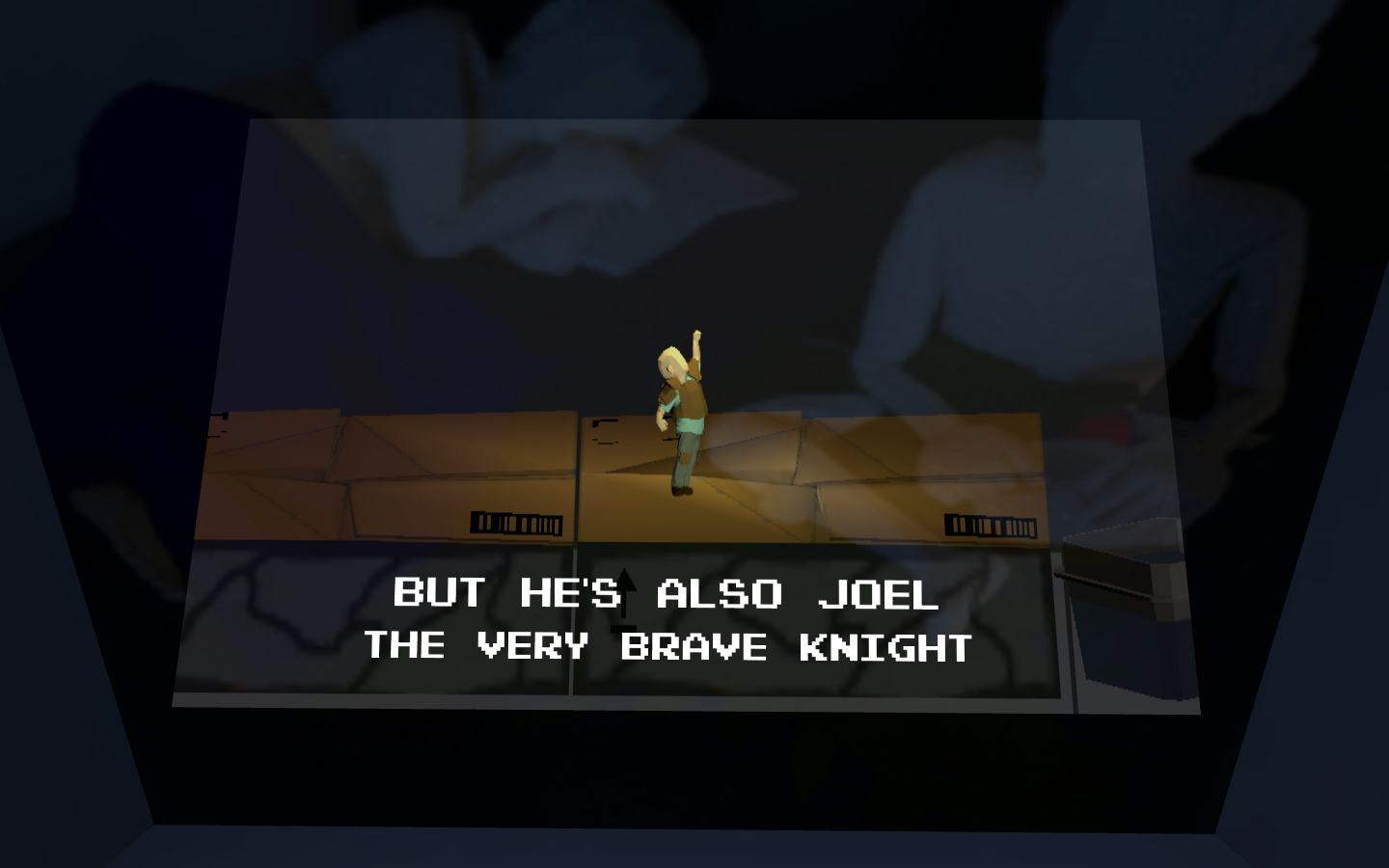
Why did these games make me cry? They have a couple of things in common — both games take place in beautifully rendered, coherent, worlds. These environments are the product of the sort of mythopoeic world-creation that’d have both C.S Lewis and J.R.R Tolkien feeling pretty excited about the capacity for video games to get us in touch with the enchanted reality we really live in. Both games rely heavily on story-telling; we’re carried along on a journey that pulls on the heart strings quite deliberately — even though Fallout 4 is in a sandboxy open world where you’ve got some freedom, while That Dragon, Cancer requires you to click your way from A to B in a very linear manner. Both games — and here’s the rub — hit me in the feels because of what they do with parenting, and loss. Though there’s also a stark difference here which made the impact of That Dragon, Cancer longer lasting for me; in that it is the real story of creator Ryan Green, and his wife Amy, and the loss of their beautiful son Joel. It’s an enchanting story because even amidst the clinical science and the very raw, real, emotions on display from the Green family, and others who’ve battled the dragon, there is a sense that Joel’s story plays out against a transcendent backdrop. This life, this cancer, is not all there is — it’s a dragon to be fought as part of a bigger, spiritual, narrative that is much bigger than simply the Greens versus a horrible and confronting bunch of aggressive cells.

Fallout 4 is pure post-apocalyptic fiction told in a completely ‘immanent’ frame. There’s no real ‘enchantment’ here. Just the ability to explore and craft your way to recovery, building villages for survivors of the nuclear apocalypse while hunting for your abducted son, Shaun. Everything is very ‘tactile’ in a sort of digital way. You scrounge through debris looking for duct tape so that you can upgrade a weapon; you can salvage components from just about anything to use it to build your settlements or upgrade your mechanical armour. I can’t walk into Bunnings or the hardware aisle of a department store now without subliminally thinking ‘jackpot.’  Everything is subject to the laws of cause and effect, and you’re the author of your own destiny. You’re, as you play, in control of your story. The one spanner in the works is that it turns out Shaun was pulled from the grasp of your murdered wife a significant number of years before you’re cryogenically defrosted, many more than you thought, and he’s much older than you. He’s the game’s ‘father’ figure; and now the head of the potentially nefarious ‘Institute,’ the organisation responsible for his abduction and your wife’s death. What you do with this information, and with Shaun, changes the course of the game.

father

Image: “I, Father, am your son” — an awkward reunion in Fallout 4

My virtual self was convinced of the evils of The Institute, and pretty upset that Shaun wasn’t the little kid I’d been searching for; so I shot my son. For the greater good. My finger hovered over the trigger button for quite a while. This was the sort of ethical dilemma that video games now confront us with as they draw us into their worlds — into their ‘narrative frames’ — I shot ‘father’ because any relationship I thought I had with the character was based on lies. He was a manipulator, and his organisation was a threat to the better vision of the future that I was building in the Fallout 4 world. But I felt conflicted doing it.

It helped that the Fallout world is both purely digital, with no real world crossover, and purely immanent — the consequences of my actions were going to change that world, but the flow on effects would only be in the chain of causality in the ‘immanent’ world, there was no cost to my digital soul because in the post-apocalyptic rubble there’s very little room for faith. Those of faith were members of strange post-doomsday doomsday cults. The landscape is littered with abandoned churches that at best are home to a few post-human irradiated ghouls. I wore a clerical robe for much of my time wandering through the landscape, but the hope I brought came from slaying mutant cockroaches and liberating civilians from the grasp of some over-sized mutants. With a custom-made automatic shotgun.

Fallout’s world is our ‘disenchanted’ reality on steroids. This little paragraph from Dreyfuss and Kelly’s All Things Shining a philosophical treatise on the evacuation of ‘meaning’ and lustre from post-modern life, could easily describe the sort of world you inhabit as your character. There’s nothing remotely shiny — physical or metaphorical — about the Fallout world.

“The world doesn’t matter to us the way it used to. The intense and meaningful lives of Homer’s Greeks, and the grand hierarchy of meaning that structured Dante’s Medieval Christian world, both stand in stark contrast to our secular age. The world used to be, in its various forms, a world of sacred, shining things. The shining things now seem far away.” — Hubert Dreyfuss & Sean Dorrance Kelly, All Things Shining

Fallout didn’t end up teaching me much about myself; I enjoyed the scavenging and building of settlements for others more than I enjoyed picking which faction to side with in the bid for some sort of restorative revolution. I felt things about the loss of my son — while pursuing him — but when confronted with the reality, I made a very ‘immanent’ decision; one that benefited my digital minions and my wasteland idealism. One that fit my nobel cleric’s vision of the end times best. I just wanted my people to live another day… so when that happened, I was happy. Happy enough to hang up the shotgun, which I named THE DELIVERER, and start pottering around in my settlement with a robotic barman.

That was Fallout 4. Perhaps the perfect story — or at least ‘a’ story — for the disenchanted ‘secular’ age; where transcendent questions are secondary. That Dragon, Cancer is the reverse. The ‘sciency’ immanent questions are very much the present reality, but there’s something bigger at play. A dragon that needs killing. A dragon we’d like to see killed, as fellow citizens of this world.

“Fear is cancer’s preservative. Cancer’s embalming oil. You’re a snake. A serpent. A dragon with snuffed out coal on his breath. Melting.”

“Whenever I ask sciency questions I nod my head. Digesting every Latin word, hoping it will stick to my ribs, become part of me. That if I ask enough questions, that maybe I could get my brains around this cancer.”

If only cancer could be killed simply by understanding it. If only we could think it gone.

It’s unclear to me still whether That Dragon, Cancer has a happy ending. Joel dies. You know that from the beginning. From the marketing. You’ve got to be prepared to ride that rollercoaster with the family before investing yourself. Joel dies. And yet. He lives. And not just in digital form — though it’s beautiful that Ryan and Amy were able to ‘incarnate’ and preserve Joel’s memory in the bits and bytes of his story in a lasting way. Joel lives because Joel’s family put their faith in Jesus. Joel lives, waiting for that time when Jesus returns to slay the dragon once and for all.

I can’t remember the first time I fell apart while playing. Joel’s polygonal face in game play very readily blurred into the visage of my son. I was destroyed by empathy with every click, as I moved through the journey from early stages, to treatment, to diagnosis, to prognosis, to desparate fight, to Joels’ death. One of the big moments for me was the moment you see Ryan’s immanent world collapse. The moment where asking all the great science questions in the world isn’t going to cut it. The moment where the immanent world collapses, or can’t support us, and we’re left grasping towards the transcendent, and really asking “where are you God?”, “where are you when kids like his, maybe like mine, are getting cancer?”

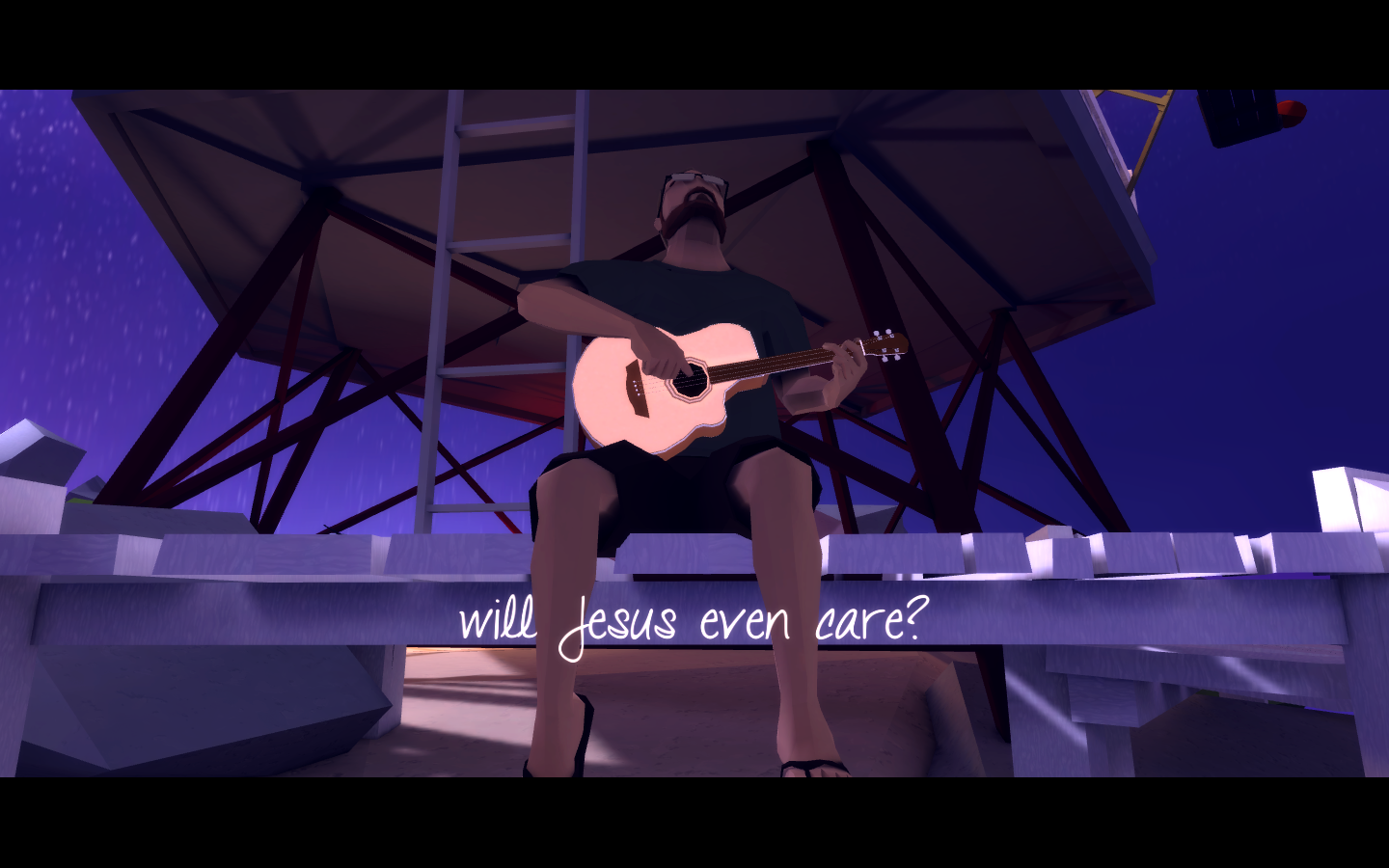
Does God really care? Or as Ryan asks at one point:

“If Joel does die, will Jesus even care? Will he weep for him? Or for me? I think greater than my fear of death, is my fear of insignificance.”

Screen Shot 2016-02-11 at 8.54.43 PM

Ryan and Amy ask those questions. And carry us with sensitivity and beauty and grace through their journey towards answering them. They don’t find all the answers, but they find reason to hope. They find meaning in faith — not just in the latin names of Joel’s dragon-like cells, or in the treatment. They find beauty in moments of pain, and things to be thankful for. They are amazing, and though they’re a world away I love them for it; and I long to spend at least some of my eternity with them and their pancake-loving son. Their story enchanted me. Here are some of the closing words from Amy to Ryan. I know I lost it at this point — I know it made me confront the ‘dragon’ and shake my fist at it, and its master death and Satan. I know it made me place more of my hope and trust in the one who will end the dragon’s grip on this world.


“So here we are. And the air is emptier without his laugh, and yet our hearts are still full, though with a different drink. And this ride we’ve been on for so long is silent. And so also is the Lord. And so we sit here in this new silence. And long for the noise to start again. And long for the music to start again, and for the disc to spin again. Even if it means going round and round for many more years. For at least we would be moving and Joel would be laughing, here on earth. And not only in heaven. I sense that his silence is only because he is drawing his breath. And now we know love and longing, empty and full, all in one moment. And I am grateful that we loved him well. And that we miss him well.” — Amy Green, That Dragon, Cancer


We’re waiting, with Ryan and Amy, Joel’s parents. Waiting amidst pain. Waiting in longing. Waiting in hope. Waiting for that day when Joel’s ‘words’ at the end of the game become reality — “you made it too“… Waiting for our faith to become sight.

And I’m glad they’ve shared some of their waiting with us, and all of their faith, and hope, and love for Joel, and their abiding trust in Jesus through the pain. I’m glad I ‘played’ my way through their story, and that my world was expanded by their experience — by Joel’s love for water, and ducks, and dogs, and pancakes, and by his family’s love for him. I love the final scene of the game — an imagination of reunion. Final reunion. A picture of Joel in the new creation. Cancer dead. Family restored. It’s more compelling than the reunion in Fallout, and ultimately, despite the multi-million dollar difference in budgets for rendering the world — and despite the pain being real — I’d rather live in Ryan and Amy’s world, which is more vivid and real, than in Fallout’s post-apocalyptic flatness and grey. I’d rather face these real questions — real pain, real mess, than that moment — real or virtual — of indecision about what preferred immanent solution I want to pursue with the pull of a lever, or a trigger, as I seek an effect I might cause. I’d rather live in an enchanted world than a disenchanted world where only ‘scientific’ questions have any bearing on the future of my family. I’d rather not feel like I’m in control — because I have no answer in the face of tragedy if I am. I can’t slay the dragons in this world on my own.

So why does this matter? Why overthink video games — no matter how profound — in this way? Stories matter. The worlds our stories occupy matters. Because we’re shaped, profoundly, by story. Especially stories we participate in — which gives video games incredible power. This quote from James Smith could well be contrasting the approach to the world found in Fallout 4 and in That Dragon, Cancer.

“Instead, we should say that we have a “feel” for the world that is informed by stories that dispose us to inhabit the world as either a bounteous but broken gift of the gracious Creator or a closed system of scarcity and competition; and as a result, either I will just “naturally” be disposed to see others as neighbors, as image-bearers of God, whose very faces call to me in a way that is transcendent, or I will have a “take” on others as competitors, threats, impositions on my autonomy.” — James K.A Smith, Imagining the Kingdom

Fallout 4 relies on the premise that you can be totally in control of everything — put the right machines together, make the right choices, control the world and your environment just right — and you’ll live, not just you, but the society you’re building. That Dragon, Cancer makes it clear this promise is a baldfaced lie. It doesn’t matter how good you are at pulling levers, or knowing stuff — the monster will take down the machines every time. Hope is found somewhere beyond the machine. These games and their questions of loss, and children, and control, are interesting examples of the two ways of seeing the world and ourselves that Charles Taylor talks about in A Secular Age and James K.A Smith summarises for us in How (Not) To Be Secular:

“It is a mainstay of secularization theory that modernity “disenchants” the world — evacuates it of spirits and various ghosts in the machine. Diseases are not demonic, mental illness is no longer possession, the body is no longer ensouled. Generally disenchantment is taken to simply be a matter of naturalization: the magical “spiritual” world is dissolved and we are left with the machinations of matter. But Taylor’s account of disenchantment has a different accent, suggesting that this is primarily a shift in the location of meaning, moving it from “the world” into “the mind.” Significance no longer inheres in things; rather, meaning and significance are a property of minds who perceive meaning internally… Meaning is now located in agents. Only once this shift is in place can the proverbial brain-in-a-vat scenario gain any currency; only once meaning is located in minds can we worry that someone or something could completely dupe us about the meaning of the world by manipulating our brains… There is a kind of blurring of boundaries so that it is not only personal agents that have causal power Things can do stuff.” — How (Not) To Be Secular

Fallout 4 and its world of things and control — even its ‘hauntedness’ — is set in a secular world. Even the disease — and the very visible scarring of people and ghouls — is the result of the nuclear apocalypse. That Dragon, Cancer presents us with the reality that the world is broken, and asks ‘is there more to this disease than we might grapple with via science’… these stories, these worlds, leave us with a very different understanding of ourselves, and our limits.

At this point Taylor introduces a key concept to describe the premodern self: prior to this disenchantment and the retreat of meaning into an interior “mind,” the human agent was seen as porous. Just as premodern nature is always already intermixed with its beyond, and just as things are intermixed with mind and meaning, so the premodern self’s porosity means the self is essentially vulnerable (and hence also “healable”). To be human is to be essentially open to an outside (whether benevolent or malevolent), open to blessing or curse, possession or grace. “This sense of vulnerability,” Taylor concludes, “is one of the principal features which have gone with disenchantment”… So the modern self, in contrast to this premodern, porous self, is a buffered self, insulated and isolated in its interiority, “giving its own autonomous order to its life”  — How (Not) To Be Secular

My character in Fallout was most definitely buffered — protected by his isolation, never getting too close to those in the settlements, separated from the world by my mech-suit, totally and symbolically insulated and isolated from the nuclear affects of the world. Even my pet dog was called ‘Dogmeat’ — perhaps to prevent any sort of attachment. Totally buffered. Totally autonomous. Totally in control — which is, ultimately, why I shot my son. Because I preferred my own ‘ordering’ of the world to his proposal, and wasn’t going to sign up. While the Greens, in That Dragon, Cancer couldn’t be buffered even if they tried. They didn’t just have to be completely open to some sort of transcendent blessing amidst their vulnerability, in making the game and consciously ‘unbuffering’ — both seeking contributions from other affected families, and involving ‘players’ like me in their story — they’ve remained vulnerable and connected. There’s a real path towards healing for them. Not in terms of tackling the dragon — Jesus will ultimately do that, and science might help along the way. The path to healing is one consistent with a transcendent world, and the picture of the enchanted, and enchanting, future we see in Revelation. What I’ve really learned in these games, as I’ve played, is that when you’re being beaten and buffeted about by what life in this world throws at you, an unbuffered self actually, counter-intuitively, has more to protect it than the buffered self. We aren’t in control. We need others. We need hope. We need transcendence. We need more than what ‘is’ in this material world. More than Dogmeat, or friendmeat. We need a dragon slayer.

“Then I saw “a new heaven and a new earth,” for the first heaven and the first earth had passed away, and there was no longer any sea. I saw the Holy City,the new Jerusalem, coming down out of heaven from God, prepared as a bridebeautifully dressed for her husband. And I heard a loud voice from the throne saying, “Look! God’s dwelling place is now among the people, and he will dwell with them. They will be his people, and God himself will be with them and be their God. ‘He will wipe every tear from their eyes. There will be no more death’ or mourning or crying or pain, for the old order of things has passed away.”

He who was seated on the throne said, “I am making everything new!” Then he said, “Write this down, for these words are trustworthy and true.” — Revelation 21:1-5

Confessions of a politically religiously motivated radical who wants to see the world as we know it come to its end

I am a religious radical. I confess that my religious beliefs are my primary motivation for how I live in this world, and I believe my actions to be consistent with bringing about the end of the world as we know it. But. Don’t panic.

dontpanic

In How (Not) to be Secular, Christian Philosopher James K.A Smith unpacks fellow philosopher Charles Taylor’s theory that the modern, secular, world has collapsed everything supernatural into a sort of ‘rational’ natural basket.

“It is a mainstay of secularization theory that modernity “disenchants” the world — evacuates it of spirits and various ghosts in the machine. Diseases are not demonic, mental illness is no longer possession, the body is no longer ensouled. Generally disenchantment is taken to simply be a matter of naturalization: the magical “spiritual” world is dissolved and we are left with the machinations of matter…So the modern self, in contrast to this premodern, porous self, is a buffered self, insulated and isolated in its interiority, “giving its own autonomous order to its life”” — James K.A Smith, How (Not) to be Secular

Or, as Douglas Adams put it in The Restaurant at the End of the Universe. 

“My universe is my eyes and my ears. Anything else is hearsay.”
― Douglas Adams, The Restaurant at the End of the Universe

To me, Douglas Adams is a bit like the Lewis/Tolkien of this sort of disenchanted world, perhaps even a bit like the wise teacher in the Bible’s Ecclesiastes. Adams built a fictional cosmos in The Hitchhikers Guide that allows him to fantastically weave his way through the big questions, and implications, of a disenchanted world, giving that helpful piece of advice — “DON’T PANIC” — for anyone who comes to the conclusion that life has no meaning, or that its meaning is 42 (an incorrect answer to “what is 6 times 9”). His point, at one point discussed in a little dialogue between Zaphod and Arthur, is that a world devoid of meaning from beyond itself is a world where a belief in, or search for, a sort of ‘transcendent’ meaning — or any meaning at all — is meaningless, and inaccessible.

“But nothing! Think about it. The Meaning of Life! We get our fingers on that we can hold every shrink in the Galaxy up to ransom, and that’s worth a bundle. I owe mine a mint.”

Arthur took a deep breath without much enthusiasm.

“Alright,” he said, “but where do we start? How should I know? They say the Ultimate Answer or whatever is Forty-two, how am I supposed to know what the question is? It could be anything. I mean, what’s six times seven?”

Zaphod looked at him hard for a moment. Then his eyes blazed with excitement.

“Forty-two!” he cried.

Arthur wiped his palm across his forehead.

“Yes,” he said patiently, “I know that.”

Zaphod’s faces fell.

“I’m just saying that the question could be anything at all,” said Arthur, “and I don’t see how I am meant to know.” — Douglas Adams, The Restaurant at the End of the Universe

One of the implications of this shift is in how we think of the way people are motivated to make choices or decisions. Where, in the past, people saw themselves as actors in a divinely created cosmic play, their position placed, determined, and directed by God’s mysterious plans, now, people assume life is a smorgasbord of choices and we are our own agents, able to place ourselves wherever we want (so we’re more mobile than ever, in terms of social status, education, and physical location, able to determine the course our own life takes, and directing ourselves via our own ethical framework or set of moral rules (sometimes with socially constructed frameworks that make sure other people, or as many other people as possible, enjoy these same freedoms). In this new script every action is ‘political’ because every person is a monarch. According to this new script, no actions are ‘religious’ — even if they are — because religion is just one choice we make among many, and we choose one religion among many equally (in)valid options. Religion, in this secular script, cannot, and should not, be spoken of as a motivating factor for action — because it gets dangerous when it is. In this script religion is, rather, a consequence of action, of choice, rather than a motivator.

“It is folly to say you know what is happening to other people. Only they know, if they exist. They have their own Universes of their own eyes and ears.”  — Douglas Adams, The Restaurant at the End of the Universe

There’s been a bit of a secular paradox at play in the reportage of the Parramatta shooting. On the one hand, the government, and a bunch of secular spokespeople, are very keen to eradicate the clear and present danger presented by ‘radicalisation’ — so keen that they’ll throw all sorts of religions into the mix as potential sources for dangerous radicalisation (see Michael Jensen’s piece on the ABC), they’ll even throw poor people like the hypothetical “Karen” under the radicalisation bus in order to protect the masses from these ills. If you break the Internet’s First Commandment “Never read the comments” on that article you’ll see that the discussion sort of proves the point of Jensen’s piece, any religious belief, taken seriously, is dismissed as dangerous.

On the other hand, when speaking of the Parramatta shooting, reporters do not speak of the event as ‘religiously motivated’ but ‘politically motivated’…

“We believe his actions were politically motivated and therefore linked to terrorism.” — NSW Police Commissioner Andrew Scipione, ‘Teen Shooting Linked to Terrorism

The shooter was ‘politically motivated’ by people he met in a religious place. A place of worship. I’m not claiming that his actions were a necessary product of the religion he aligned himself with by faith, but they were almost certainly a product of his faith. Of his understanding of the world and its end. Obviously there’s a massive link between religion and politics for most people of faith, for good or for ill, but I can’t help but think this plays into a narrative that isolates people of faith and robs us of the dignity that comes from being able to make choices about how we understand life and are understood. As a person of faith, putting myself in the shoes of someone who might be robbed of dignity in this sense, I’d like to offer a few alternatives for ‘deradicalisation’ that don’t involve ‘depersonalisation’… I’d like to suggest that the secular narrative being used to disenchant this narrative with a view to de-radicalising it (making these actions politically motivated (immanent) rather than religiously motivated (transcendent) might actually be counter-productive because it might reinforce a sense that the secular west is not interested in understanding those who don’t subscribe to its disenchanted story. I’d like to suggest that perhaps, even within a secular frame, what would be productive, virtuous, and just response would be to treat the perpetrator — and others — as human agents, giving them the dignity of understanding their choices and motivations, without thinking that doing so would either ‘radicalise’ other like minded people, or insult those who share a similar way of seeing the world as ‘enchanted’ and meaningful through eyes and ears of faith. Maybe a better way forward would be to invite those who share an ‘enchanted’ view of the world — be they Muslims, or people of other faiths — to enter dialogue in the public square that offers alternative ways of seeing the world and its end, through better stories (without shouting them down in angry comment threads).

Secularisation: an exercise in not seeing the emperor’s old clothes

Secularisation in its modern, disenchanted form, and especially the secularist narrative playing out in the analysis of the action of people of faith ends up being a deliberate attempt not to see things as they really are, but also, not to see people as they truly wish to be seen. It fails to give people dignity because it denies them the robes they choose to give context to their actions. When a person of faith acts in a way motivated by that faith the secular narrative is that this is ‘political,’ a category I certainly wouldn’t put first in describing my own actions.

This new narrative is disingenuous and unloving. It doesn’t love ‘political’ actors — or perpetrators — with the kind of just love that requires us to pay real attention to the motivations for action and decide on reasonable and just consequences or solutions. It dehumanises those who do not share the new narrative. It robs a religious person of dignity, stripping their life of the meaning they have ‘chosen’. In this it both undermines the secularist narrative of ‘choice,’ and also deliberately holds ignorance and arrogance in tension — it’s deliberately ignorant, in failing to consider possibilities beyond one’s own ‘eyes and ears’ or beyond a consensus reached by many eyes and ears, and part of this ignorance manifests itself in an arrogant failure to listen to narratives that don’t fit this dominant view. It’s a failure to listen, and a failure to see, other people as they wish to be seen, and perhaps the world as it should be seen.

If the old view of the world was one where the universe was fully clothed in rich, enchanting, meaning, where it was vividly coloured and beautifully formed so that both the emperor wearing the clothes was special, but the designer was clearly a good and creative genius who wished this to be the case, then the new version of the world is one where we, the new emperors, are naked and left to construct an outfit, and dignity, for ourselves.

The secularist assumption is that its those who have stripped off their old clothing who are dressed, while those who hang on to the idea of an enchanted world given meaning by a divine creator, are naked and foolish.

The secular status quo runs a real risk of dehumanising people according to its own account of meaningful humanism, where our sense of what it means to be a person with dignity, a monarch, a ruler of our own tiny kingdom, is caught up in making the decision about how to live and to channel David Foster Wallace, what to worship. In This Is Water, Wallace points out that our new default is to worship things within the world, immanent things, things that will ultimately eat us alive, and that our secular age is structured in such a way that it wants to keep us exercising our freedom, so long as its directed at these immanent things. So long as we don’t rock the boat. But he ponders whether or not this default is really freedom, or if freedom might lie elsewhere, in questioning the default narrative, and the default ‘secular’ gods.

“And the world will not discourage you from operating on your default settings, because the world of men and money and power hums along quite nicely on the fuel of fear and contempt and frustration and craving and the worship of self. Our own present culture has harnessed these forces in ways that have yielded extraordinary wealth and comfort and personal freedom. The freedom to be lords of our own tiny skull-sized kingdoms, alone at the centre of all creation. This kind of freedom has much to recommend it. But there are all different kinds of freedom, and the kind that is most precious you will not hear much talked about in the great outside world of winning and achieving and displaying. The really important kind of freedom involves attention, and awareness, and discipline, and effort, and being able truly to care about other people and to sacrifice for them, over and over, in myriad petty little unsexy ways, every day. That is real freedom. The alternative is unconsciousness, the default setting, the “rat race” – the constant gnawing sense of having had and lost some infinite thing.” — David Foster Wallace, This Is Water


A radical story — motivated by a view of the end of the world

“There is a theory which states that if ever anyone discovers exactly what the Universe is for and why it is here, it will instantly disappear and be replaced by something even more bizarre and inexplicable. 

There is another theory which states that this has already happened.” 
― Douglas AdamsThe Restaurant at the End of the Universe

As he explores Taylor’s understanding of The Secular Age, Smith mentions that part of the movement from an ‘enchanted’ or spiritual sense of reality was a depersonalising move from describing the world as a divine creation (as it had been understood right up to modern times), to simply ‘nature’… a neutral and unthinking thing, at best governed by ‘natural law’…

“The shift from cosmos to universe — from “creation” to “nature” — makes it possible to now imagine meaning and significance as contained within the universe itself, an autonomous, independent “meaning” that is unhooked from any sort of transcendent dependence… Now, from the vantage point of secular humanism, this new interest in nature can look like the next logical step on the way to pure immanence: first distinguish God/nature, then disenchant, then be happy and content with just nature and hence affirm the autonomy and sufficiency of nature. Such a story about the “autonomization” of nature posits a contrast or dichotomy between belief in God and interest in “nature-for-itself”…

Part of the fallout of such a metaphysical shift is the loss of final causality (a cause that attracts or “pulls”), eclipsing any teleology for things/nature. Understanding something is no longer a matter of understanding its “essence” and hence its telos (end). Instead we get the “mechanistic” universe that we still inhabit today, in which efficient causality (a cause that “pushes”) is the only causality and can only be discerned by empirical observation. This, of course, is precisely the assumption behind the scientific method as a way of divining the efficient causes of things, not by discerning “essence” but by empirical observation of patterns, etc. The result is nothing short of “a new understanding of being, according to which, all intrinsic purposes having been expelled, final causation drops out, and efficient causation alone remains””— James K.A Smith, How (Not) To Be Secular

I can understand why people choose to see the world this way though. The universe is vast and intimidating. Douglas Adams goes on and on about infinity in The Restaurant at the End of the Universe, and its to explore just how uncomfortable a view of the universe is if it is very infinite, and we are very finite. There’s this thing in the story called the Total Perspective Vortex which promises to show anyone who attaches their mind to its probes just how small they really are. Trin Tragula built the machine to annoy his wife, but when he plugged her into it, it had disastrous consequences.

“To Trin Tragula’s horror, the shock completely annihilated her brain; but to his satisfaction he realized that he had proved conclusively that if life is going to exist in a Universe of this size, then the one thing it cannot afford to have is a sense of proportion.”

“For when you are put into the Vortex you are given just one momentary glimpse of the entire unimaginable infinity of creation, and somewhere in it a tiny little marker, a microscopic dot on a microscopic dot, which says “You are here.” ― Douglas AdamsThe Restaurant at the End of the Universe

This is what happens when we strip the universe of enchantment, of meaning beyond the physical. Suddenly the sheer, immanent, physicality of the universe is intimidating, rather than comforting. It’s better to think of it as uncaring, and uninvolved, and as without an ‘end’ at that point, so that we don’t have to worry about getting the ‘end’ wrong, given our new freedom to choose how to live in it. Robbing the world of an ‘end’ — a telos in the old Greek sense — a purpose — in itself, means we are in the driver’s seat when it comes to creating meaning. We understand the world as we experience it with our eyes and ears, and we, within the world, are free to come up with our own vision for how things should be, and what things are for, and we’re free to direct our own lives. If people come up with some approach to their own life — an understanding of their own purpose, or ‘end’ that is tied to some broader purpose in the universe, some other director giving things purpose, especially a divine purpose, we treat them with suspicion.

And looking around at all the alternative understandings of the purpose of the world posited by religious people — including some Christians — I share a fair amount of this suspicion. I can totally understand why we’d want to take the shortcut of robbing people of their dignity by stripping them of their metaphorical clothes and leaving them naked. Exposing them and their folly for all to see. But when I put myself in the shoes of those seen as ‘exposed’ it leaves me feeling a little empathy for the religiously motivated person. It leaves me thinking that perhaps this strategy might leave other people of faith, who feel the same way about the world, feeling naked and foolish. Which is a brilliant ‘deradicalisation’ strategy. Except that it’s not. Especially if the ‘secular west’ has a habit of pushing the sorts of people who have faith to the margins, away from the benefits of the ‘secular defaults’ which builds a further degree of resentment.

Let’s come back to that alternative strategy — inviting those who share an ‘enchanted’ view of the world to the table to discuss solutions to radicalisation, rather than excluding us by lumping us all in together as potential dangerous radicals who want to see the end of the world as we know it.

For those who see and experience the world as shot through with meaning, the vastness of the universe helps build self-esteem. The universe is the stage in a divine cosmic drama that tells the story of the value of human life to the creator of the universe — one vaster than the universe itself. In this drama, especially the Christian version, the creator of all this steps onto the stage, and takes part in the drama, by laying down his life for the actors he made. The cross of Jesus is a new Total Perspective Vortex that puts us at the centre of a vast and infinite world. It gives the world a new end, both in an understanding of its purpose — as the ground upon which God became incarnate, made himself human, died, and promised to redeem — and it gives us a new understanding of how it all ends. Jesus, by his resurrection, promised to be the ultimate and final solution for this world, inviting those who follow him to ‘take up their cross’ becoming part of the picture of what the end of the world looks like. Eating with a radical Christian should be like eating at the restaurant at the end of the universe — you should see and taste the end of the world.

I confess, I totally buy into this ‘enchanted’ vision of the world. I believe the world is ‘shot through with meaning’ – that it’s a divine creation, carefully maintained, damaged by our selfish ‘default’ following lives and crying out for a solution. I pray God brings that solution every time I say anything remotely like the Lord’s Prayer. Prayer is an incantation of sorts, an act of enchantment, and this is the prayer of a ‘radical’ who follows the God-man.

“‘Our Father in heaven,
hallowed be your name,
your kingdom come,
your will be done,
    on earth as it is in heaven.
Give us today our daily bread.
And forgive us our debts,
    as we also have forgiven our debtors.
And lead us not into temptation,
    but deliver us from the evil one.’” — The Lord’s Prayer, Matthew 6:9-13

This is a radical prayer for the world as we know it to end, for the world to meet its end — the kingdom of God. I suspect if our politicians knew what they were asking for when they prayed these words the attempt to further disenchant our ‘politics’ by removing ‘religion’ would gather steam.

I’m a religiously motivated Christian radical. I want to bring about this end. I want to confront people with this story and I want them to see that without it they’re actually naked.

This is what being a Christian radical looks like.

Love must be sincere. Hate what is evil; cling to what is good.  Be devoted to one another in love. Honor one another above yourselves.  Never be lacking in zeal, but keep your spiritual fervor, serving the Lord. Be joyful in hope, patient in affliction, faithful in prayer. Share with the Lord’s people who are in need. Practice hospitality.

Bless those who persecute you; bless and do not curse.  Rejoice with those who rejoice; mourn with those who mourn.  Live in harmony with one another. Do not be proud, but be willing to associate with people of low position. Do not be conceited.

Do not repay anyone evil for evil. Be careful to do what is right in the eyes of everyone. If it is possible, as far as it depends on you, live at peace with everyone. Do not take revenge, my dear friends, but leave room for God’s wrath, for it is written: “It is mine to avenge; I will repay,” says the Lord. On the contrary:

“If your enemy is hungry, feed him;
    if he is thirsty, give him something to drink.
In doing this, you will heap burning coals on his head.”

Do not be overcome by evil, but overcome evil with good. — Romans 12

It’s interesting that this largely matches up with how Christians were perceived to be living in the early church, in the Roman Empire. Pliny, a Roman governor, wrote to his friend, the emperor, Trajan, asking how he should deal with the Christian radicals popping up all over the empire and threatening to end the world as they knew it. The Roman world was also a world shot through with meaning — where Gods existed within the cosmos, and men (emperors) could become gods. Christians threatened this status quo, as we now threaten the secular defaults of our age. Pliny describes their radical behaviour as:

“They asserted, however, that the sum and substance of their fault or error had been that they were accustomed to meet on a fixed day before dawn and sing responsively a hymn to Christ as to a god, and to bind themselves by oath, not to some crime, but not to commit fraud, theft, or adultery, not falsify their trust, nor to refuse to return a trust when called upon to do so. When this was over, it was their custom to depart and to assemble again to partake of food–but ordinary and innocent food. Even this, they affirmed, they had ceased to do after my edict by which, in accordance with your instructions, I had forbidden political associations. Accordingly, I judged it all the more necessary to find out what the truth was by torturing two female slaves who were called deaconesses. But I discovered nothing else but depraved, excessive superstition.” — Pliny, Letter to Trajan

It was concern for the status quo that motivated Pliny’s query, and Trajan’s response that Pliny was right to put these Christians to death if they wouldn’t worship his divine image, this was his litmus test for deciding who to execute, he spared those who “worshipped your [Trajan’s divine] image and the statues of the gods, and cursed Christ” — because people who did this were no threat to the established order. Here’s why he says he wrote — because the enchantment/superstition that led Christians to act radically like this was spreading.

“For the matter seemed to me to warrant consulting you, especially because of the number involved. For many persons of every age, every rank, and also of both sexes are and will be endangered. For the contagion of this superstition has spread not only to the cities but also to the villages and farms. But it seems possible to check and cure it. It is certainly quite clear that the temples, which had been almost deserted, have begun to be frequented, that the established religious rites, long neglected, are being resumed, and that from everywhere sacrificial animals are coming, for which until now very few purchasers could be found. Hence it is easy to imagine what a multitude of people can be reformed if an opportunity for repentance is afforded.” — Pliny, Letter to Trajan

People will do all sorts of things in the thrall of a compelling story, be it secularism, or your garden variety secular -isms like communism, materialism (but perhaps not naturalism, unless its paired with something else — or threatened by something else, which is why it’s a compelling antidote to enchantment). People will die for a secular ‘-ism’, just as they will for a religion (or a religious -ism like Judaism or Mormonism), an enchanted story.

Religious stories don’t just enchant life, but death as well. Often they involve some picture of martyrdom, which is closely tied to our sense of the world’s end, and how it the world. An interesting working definition of a ‘radical’ might not just be someone who is prepared to live by their story, but to die by it.

Being a Christian radical also means martyrdom — death to self — not just in the David Foster Wallace sense of death to the default in order to love others — but perhaps even in a literal sense, laying down our lives to give life to others. This is where our ‘enchanted story’ is fundamentally better for the world than any of the others. Jesus produces a different sort of radical, and a different sort of martyr. The diners at the Restaurant at the End of the Universe are horrified by how willing their meal — a sentient cow — is to die for their good, their food and entertainment, and yet, its this same willingness that Christians have historically shown in the face of death so that others might see the way the world ends. This same horror, for a secular citizen, extends to the idea that anybody might throw away their immanent existence — assumed to be their only existence — for the sake of some ‘religious’ notion.

“Good evening,” it lowed and sat back heavily on its haunches, “I am the main Dish of the Day. May I interest you in parts of my body? It harrumphed and gurgled a bit, wriggled its hind quarters into a more comfortable position and gazed peacefully at them.

Its gaze was met by looks of startled bewilderment from Arthur and Trillian, a resigned shrug from Ford Prefect and naked hunger from Zaphod Beeblebrox.

“Something off the shoulder perhaps?” suggested the animal. “Braised in a white wine sauce?”

“Er, your shoulder?” said Arthur in a horrified whisper.

“But naturally my shoulder, sir,” mooed the animal contentedly, “nobody else’s is mine to offer.”…

“You mean this animal actually wants us to eat it?” whispered Trillian to Ford.

“Me?” said Ford, with a glazed look in his eyes. “I don’t mean anything.”

“That’s absolutely horrible,” exclaimed Arthur, “the most revolting thing I’ve ever heard.”

“What’s the problem, Earthman?” said Zaphod, now transferring his attention to the animal’s enormous rump.

“I just don’t want to eat an animal that’s standing there inviting me to,” said Arthur. “It’s heartless.”

“Better than eating an animal that doesn’t want to be eaten,” said Zaphod.

I’m totally on board with being terrified by the sort of martyrdom that comes at the cost of others, but I can’t get my head around being opposed to a deliberate exercise of freedom that takes that sort of freedom David Foster Wallace identified to ‘sacrifice’ for others ‘over and over in myriad petty little unsexy ways, every day’ to its radical conclusion. It’s this sort of exercise of freedom, as he rightly identifies, that helps people see the world through different eyes. But it’s when we connect this freedom to the Christian story — where the infinite God steps into his finite creation as a man, and lovingly sacrifices himself for us — that we are no longer haunted by that “gnawing sense of having had and lost some infinite thing” because in the ‘incarnation’ — in God becoming flesh — the transcendent and immanent are revealed at once in vivid colour. We see the emperor in his truly magnificent clothes as the God-Man hangs naked on the Cross, exposed in order to re-dress us. This story answers that ‘gnawing sense’ of having lost touch with the infinite, because in it the infinite one finds us, and draws us to him. It’s this story that gives us enchanted eyes and ears by which we now see the world, and imagine a better end  — both in terms of a better purpose, and a better future.

This new way of seeing is what brings the political and religious together. It’s what gives a deeper meaning to a radical life and death. It’s people living this radical story that best displays the enchanting and compelling power of this story. The Cross isn’t just our Total Perspective Vortex, it’s our Restaurant at the End of the Universe. When we stand near it — reliving it by living it each day,  through our words and practices as extensions of our story, as we practice dying to self each day, is what gives people the taste of the end of the world that Douglas Adams could only dream of meaningfully depicting in a secular sense by inventing time and space travel.

Tertullian, a guy from the early church, showed what it looks like to be both religiously and politically motivated at the same time when he wrote to the Roman government, the same government that kept executing Christians

“It is our battle to be summoned to your tribunals that there, under fear of execution, we may battle for the truth. But the day is won when the object of the struggle is gained.  This victory of ours gives us the glory of pleasing God, and the spoil of life eternal. But we are overcome. Yes, when we have obtained our wishes. Therefore we conquer in dying; we go forth victorious at the very time we are subdued…

…Nor does your cruelty, however exquisite, avail you; it is rather a temptation to us.  The oftener we are mown down by you, the more in number we grow; the blood of Christians is seed.” — Tertullian, Apology