This series of posts was first a series of sermons I preached at City South Presbyterian and Coorparoo Presbyterian in mid 2026. You can, if it is your preferred medium, watch the video recording of this sermon here (Vimeo), or listen to the audio recording here (Spotify link).
Have you heard Eskimos have 50 words for snow?
This is used to support a disputed theory that our thinking is limited to the words in our language called “linguistic determinism” (it turns out we also think in images and through experiences). But, while debunking this theory, scholars have discovered ways language orients us to the world.
The Kuuk Thaayorre (cook thai-oar) people of North Queensland have been big here.
They do not use ‘self-oriented’ descriptions of space — like ‘left’ or ‘right’ — no matter which way they are facing they talk about east or west, and think of time moving east to west, and instead of saying ‘how are you going’ they say ‘where are you going’… and it turns out they have incredible spatial awareness. This is an example of how language helps us know where we are; mapping out reality; and making sense of it all…
I wonder if you can make sense of these words. This is the Hebrew of Bereshit 1:26; that is Hebrew for “in the beginning.”
וַיֹּ֣אמֶר אֱלֹהִ֔ים נַֽעֲשֶׂ֥ה אָדָ֛ם בְּצַלְמֵ֖נוּ כִּדְמוּתֵ֑נוּ וְיִרְדּוּ֩ בִדְגַ֨ת הַיָּ֜ם וּבְע֣וֹף הַשָּׁמַ֗יִם וּבַבְּהֵמָה֙ וּבְכׇל־הָאָ֔רֶץ וּבְכׇל־הָרֶ֖מֶשׂ הָֽרֹמֵ֥שׂ עַל־הָאָֽרֶץ׃
Genesis 1:26
Or these ones — the Greek of Pros Kolasseis — Colossians 1:15…
ὅς ἐστιν εἰκὼν τοῦ θεοῦ τοῦ ἀοράτου, πρωτότοκος πάσης κτίσεως
Colossians 1:15
When we translate and read these words from ancient Hebrew and Greek into English we are also making a jump across time — and across ways of being oriented to the world; and sometimes we need a map.
When we read the words of the Bible they are ancient, timeless, and translated.
For our nuts and bolts we are considering translation — how we get our English Bibles — and how to understand ancient words.
The Old Testament is written in Hebrew, with a bit of Aramaic, which shares an alphabet and some vocabulary.
About 200 years before Jesus it was translated and read in Greek, the LXX.
The New Testament is written in a form of Greek called Koine…
In the early church, by about 300AD, people are working with both Hebrew and Greek texts — and we have got Greek Bibles collated in book form from this time.
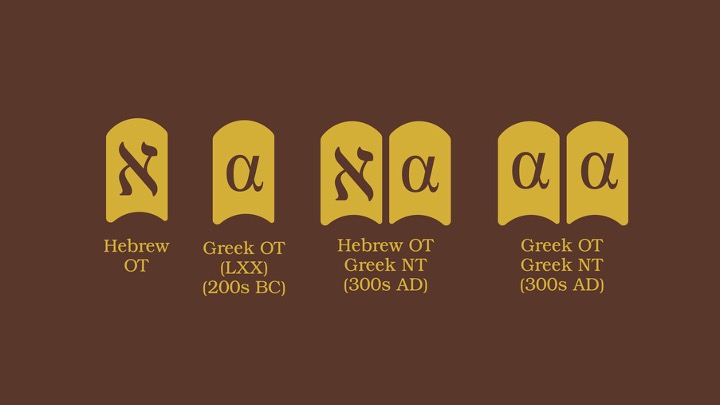
The Roman Empire splits into the Greek speaking East, and Latin speaking West in 395AD, and ten years later a guy named Jerome translates the Greek and Hebrew into a Latin version called the Vulage.
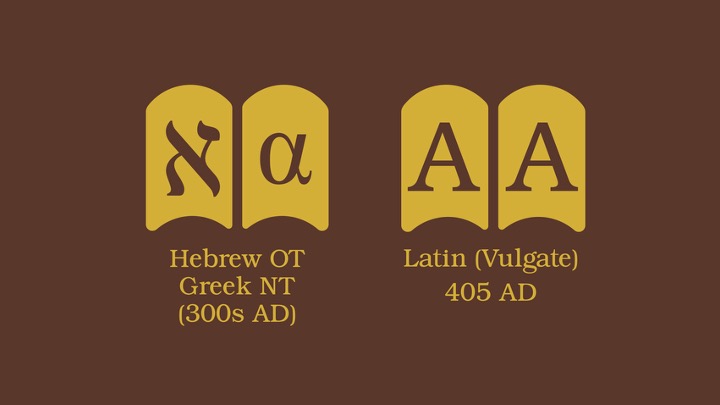
The Latin speaking Catholic Church embraces this, while the Eastern Orthodox church uses Greek. Languages in the Western half of the empire fragment, so Latin is mostly used by royalty and clergy, but not the ‘common language’ of the people.
About 1,000 years later, this guy Wycliffe translates the Bible into English.
The Latin-speaking church hated this so much that after he died, they declared him a heretic, dug him up and burned him… 100 years later, Jan Hus translated the Bible into Czech; he was burned at the stake.
This was not just because they translated the words; their translations allowed them to be critical of the church in the language of the people. Both Wycliffe and Hus translated from the Vulgate.
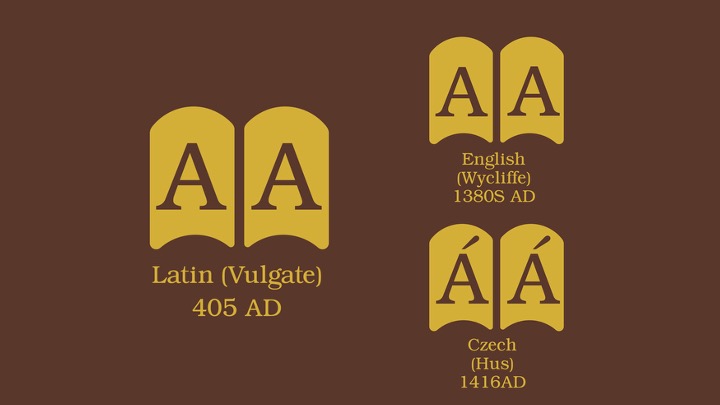
This set the scene for Martin Luther; who translated the Bible into German in the 1500s, and used the printing press to get the Bible, and his criticisms of the church, into the hands of the common person. He translated from the authoritative Hebrew Old Testament — the Masoretic Text, which was circulated from around the 7th century — that is AD — and Luther a Greek New Testament put together by a Catholic contemporary, Erasmus.
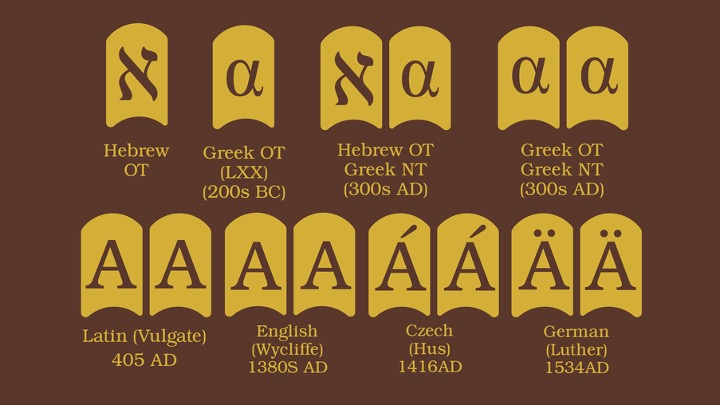
100 years later the Reformation had gained political traction in England, and the King James Version — also translated from the Hebrew and Greek — was released.
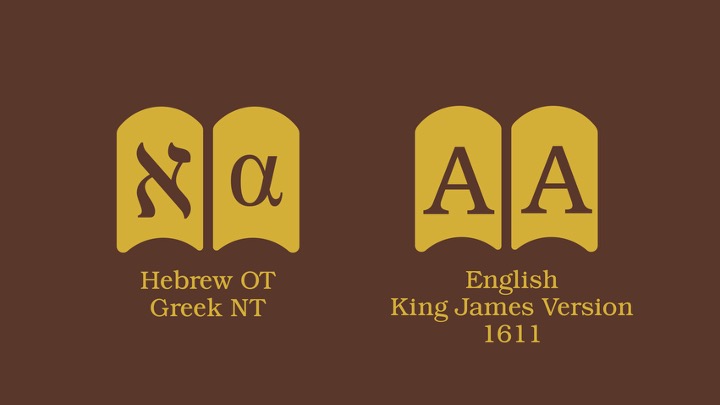
Almost all modern translations are working from the original languages; differences are not so much about the source material — text criticism stuff, when decisions are made on those issues they are usually footnoted; the differences are about translation philosophies; translations are built on this spectrum from formal to dynamic equivalent.
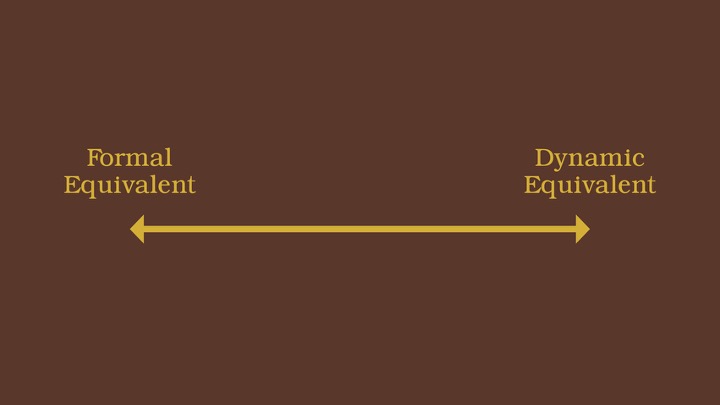
The formal side can be clunky and literal. The dynamic tries to capture the meaning of words, even some of the style.
The ESV is on one end of this spectrum, the NIV is on the other…
Translating is tricky.
Hebrew and Greek structure sentences differently to English, and there are less words in their vocabulary, which gives more room for wordplay and double meanings, and words have a broader range of possible meanings than English, where we are so specific.
Hebrew and Greek have tens of thousands of words, while English has more than 170,000 words.
Translators do an incredible job getting the word of God into our hands so we do not have to learn Hebrew and Greek to read it…
But. Translation always involves interpretation; and cause English is familiar to those of us who think in English, sometimes we can domesticate the Bible; imposing our orientation onto it, or we can be guided by or reoriented by translation decisions, and the layers of meaning that build up as the church talks about words and concepts, that move us away from the ancient meaning and to read well, sometimes we have to dig away these layers to get back to the text.
To show what I mean we are going to do what is called a word study together on the word image.
Let us make mankind in our image, in our likeness
The Son is the image of the invisible GodGenesis 1:26; Colossians 1:15
We are made in the image and likeness of God.
Jesus is the image of the invisible God — or rather we are tselem Elohim, and Jesus is the eikon Theou.
When the Old Testament is translated into Greek, this word tselem is translated into eikon — which is used in Genesis — actually the Greek name for the book, and Colossians.
When it is translated into Latin, Image of God is “imaginem Dei” — or imago Dei.
This meme landed in my feed recently.
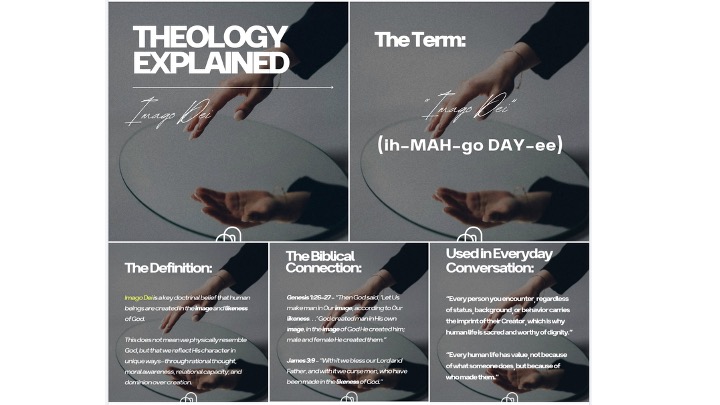
It says “it’s a key doctrinal belief that humans are created in the image of God” — we “reflect his character in unique ways, through rational thought, moral awareness, rational capacity, and dominion over creation” and “every person you encounter,” regardless of their status or identity, carries this imprint which is why human life is sacred and worthy of dignity.”
Now whether you think “imago Dei” or “Image of God” this is probably what you think, right? But — this is an example of layers of meaning — both the integration of biblical ideas, and the way language moves beyond the ancient meaning over time.
The Deity beholds and hears all things, and searches all things out: you too have the power of apprehension of things by means of sight and hearing, and the understanding that inquires into things and searches them out.
Gregory of Nyssa, On the Making of Man, 379AD
So, this guy Gregory of Nyssa wrote a Greek book about the nature of humans in 379AD; he said because God sees, hears, and knows and we do too; the essence of the eikon is in this rational capacity.
“It is clear, therefore, that intellectual creatures alone, properly speaking, are made to God’s image.”
Aquinas, Summa Theologia, 1260s AD
Plenty of people write about imago Dei; maybe the most influential is Thomas Aquinas, in the 1200s, who also saw it being our intellect.
These are major authorities shaping the Catholic tradition, so in Vatican II — in a Latin document titled ‘Gauium Et Spes’ — Joy and Hope — this section — “On the Dignity of the Human Person,” and chapter “On humanity as the image of God,” says authentic freedom is the sign of the divine image; especially to know and choose right from wrong — intellect, freedom, dignity — this is basically the meme right?
“True freedom, however, is an exceptional sign of the divine image in the human person.”
Man achieves such dignity when, emancipating himself from all captivity to passion, he pursues his goal in a spontaneous choice of what is goodVatican II, Gaudium et Spes
But is this what a tselem is in Genesis?
There are rich truths in the meme, and these traditions, and thousands of years of reflection on the imago Dei in Greek, and Latin — in church tradition, but church traditions can add these layers; and we do not just have tradition or doctrines, we can look at the way words are used through the story of the Bible in their original languages — we will call this internal intertextuality — and across the ancient world — external intertextuality.
Translators are not typically being intertextual like this; they are working to make a sentence make sense within its meaning unit; they are not as literary or intertextual as the authors of the Bible. Let me show you this with two famous stories you might think are unrelated.
First — Noah — the earth is full of violence and evil; God chooses Noah to build a floating box; an ark — from trees and tar — to preserve life (Genesis 6:14), so God’s people can be fruitful and multiply. Noah’s family are saved through the waters (Genesis 9:1).
Second — Moses — God’s people are fruitfully multiplying in Egypt, and Pharaoh fills the earth with violence; killing babies (Exodus 1:7); but Moses’ mum puts him in a box — a basket, made of reeds and tar — to preserve his life on the water, so God’s people can be fruitful (Exodus 2:3).
You might think I am forcing the links here; but the same Hebrew word is used for ark and basket; but this literary link is lost in translation cause they are literally a boat and basket.
Anyway. Let us look at tselem…
The writer of Genesis develops our picture of a tselem — an image of God — by zooming in to God breathing into a dust shape to make it live (Genesis 2:7), in this garden in Eden (Genesis 2:8), where there is water flowing from the Tigris and Euphrates (Genesis 2:14).
When Adam had lived 130 years, he had a son in his own likeness, in his own image; and he named him Seth.
“Whoever sheds human blood, by humans shall their blood be shed; for in the image of God has God made mankind.Genesis 5:3; 9:6
Tselem is used two more times in Genesis — Genesis 5 throws back to the beginning in order to tell us Adam makes a son; his own image, in his likeness — part of being an image is being offspring… Then the tselem Elohim idea is used, after the flood, where God prohibits taking human life, cause it is sacred.
Once of rats and tumors (1 Samuel 6:5), but mostly for idol statues — in Numbers (Numbers 33:52), 2 Kings (2 Kings 11:18), and Ezekiel (Ezekiel 7:20). Which is interesting given Israel is commanded not to make or worship idols of other humans, or any form they are made to rule over (Deuteronomy 4:16–18), this is the first two commandments (Deuteronomy 5:8–9)… and these laws use language from Genesis 1; part of the idea is that the living God has made his own living statues to represent him — and worshipping dead statues — being ruled by them — makes us dead.
Here is where we go intertextual elsewhere — in part 1 we looked briefly at the Dead Sea Scrolls; these jars of Jewish manuscripts in Greek and Hebrew that help us understand how contemporaries of Jesus read the Scriptures.
Archaeologists have also found a treasure trove of stone inscriptions — book tablets — from Israel’s ancient neighbours, Babylon and Assyria — mostly written in Akkadian; a language with a different alphabet, that often has similar sounding words — these tablets are from the library of an Assyrian king named Ashurbanipal.
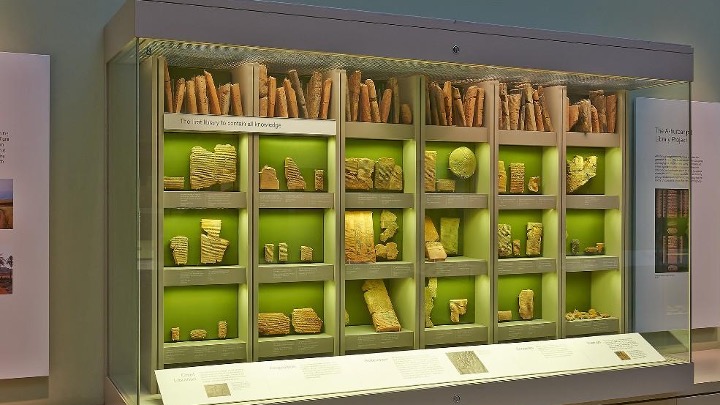
In one tablet Ashurbanipal — boasts like Solomon, about “learning wisdom”; mastering reading and writing so he could read Akkadian — he “had the joy of reading inscriptions on stone from before the time of the flood…”
‘I Ashur-bani-pal, within the palace, learned the wisdom of Nebo, the entire art of writing on clay tablets of every kind. I made myself master of the various kinds of writing. . .
I read the beautiful clay tablets from Sumer and the Akkadian writing, which is hard to master. I had the joy of reading inscriptions on stone from the time before the flood.’Ashurbanipal inscription
There is an Akkadian flood story called the Gilgamesh Epic.
I asked if you could read Hebrew…
How about Akkadian cuneiform?
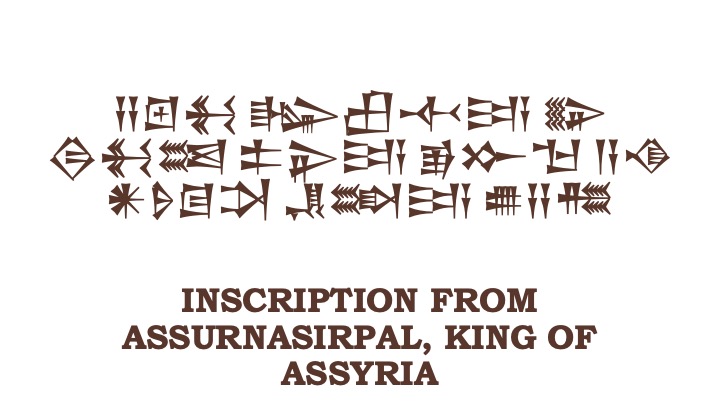
What about when it is translated into our alphabet? This is an inscription about Assurnasirpal — king 200 years before Library guy.
ṣalam šarrūtišu ina dmūt pānišu epušma ana dNinurta ušziz
Inscription from Assurnasirpal, King of Assyria
It uses the words salam and damut; related to the Hebrew words tselem and demut — image and likeness… The king boasts he made an image of his kingship in the likeness of his face, installing it in his God’s temple.
“I made an image of my kingship in the likeness of my face and erected it for Ninurta, my lord.”
Inscription from Assurnasirpal, King of Assyria
Throughout the ancient world kings would make idol statues of themselves and put them in temples — and act as guardians of these statues, only the king was the image of God. Eventually, as you encountered these statues in temples, you would worship them too. There are lots of overlaps between these sources and the Bible; and they are helpful guides for understanding what words mean; this overlap in language and stories makes sense…
Abram — the father of Israel is called out of Ur of the Chaldeans — that is Babylon — we should expect these cultures to share stories and words (Genesis 11:27–28); and these same stories and words — and images — become the basis of Israel’s temptation to worship the gods and god-kings of the nations that lead them to exile in Babylon; where, again, Babylon’s stories and images of God compete for their hearts.
When a sky above had not (yet even) been mentioned, (And) the name of firm ground below had not [yet even] been thought of…
Enuma Elish
The tablet library contained a Babylonian creation story — the Enuma Elish — about the creation of the heavens and earth. Consider how this text compares or contrasts to Genesis 1.
“In the beginning God created the heavens and the earth. Now the earth was formless and empty, darkness was over the surface of the deep, and the Spirit of God was hovering over the waters.”
— Genesis 1:1-2.
(When) only primeval Apsu, their begetter, And Mummu and Tiamat—she who gave birth to them all— Were mingling their waters in one
Enuma Elish
Apsu is the deep; Tiamat was a ‘sea-goddess of chaos’. The Enuma Elish continues. But in Babylon’s story, their god-king, Marduk creates through violence; making humans from the blood and bone of dead gods (including Tiamat), not in their likeness, to rule, but to serve the gods. Babylonian kings are then become images of Marduk.
Genesis says, “Let us make mankind in our image, in our likeness, so that they may rule…” (Genesis 1:26).
The Enuma Elish says:
Blood I will mass and cause bones to be, I will establish a savage, “man” shall be his name. Verily, savage-man I will create.
He shall be charged with the service of the gods, That they might be at ease!Enuma Elish
Then it tells the story of the building of Babylon.
Build Babylon, the task you have sought. Let bricks for it be moulded, and raise the shrine!”
They raised the peak of Esagil… They built the lofty temple tower…
Be-l seated the gods, his fathers, at the banquet. In the lofty shrine which they had built for his dwelling…Enuma Elish
The Enuma Elish describes Babylon being built with moulded bricks, a lofty temple tower reaching the sky; that is what Esagil means — so the gods could party. Genesis describes people making bricks (Genesis 11:3) to build the lofty tower of Babylon (Genesis 11:4)… and this power play being frustrated by Israel’s God (Genesis 11:8–9).
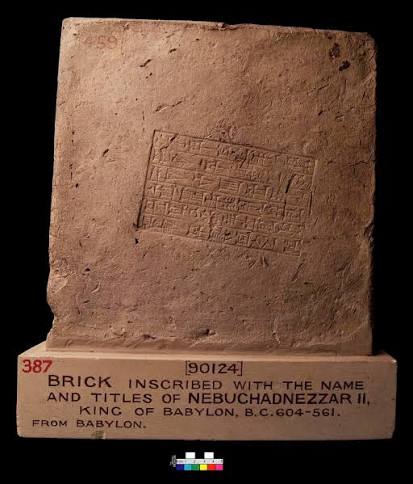
There are plenty of Babylonian kings who like bricks and building projects — none more than Nebuchadnezzar; a fan of the Enuma Elish, who built big temple towers, in Babylon, with bricks stamped with his name… And who Daniel describes building a giant tselem — this time in Aramaic; on the plains of Babylon (Daniel 3:1), that he commands people of all languages to bow before and worship — he is trying to reverse the scattering at Babel (Daniel 3:4–5).
“I added to the palace and raised it as high as a mountain with bitumen and baked brick…”
Nebuchadnezzar, Brick Inscription
There are also inscriptions describing rituals for giving life to images of God — selems.
We meet Library Guy’s grandfather, Sennacherib, and his father, Esarhaddon in 2 Kings, a couple of generations before Nebuchadnezzar takes Judah into exile (2 Kings 19:37)… Sennacherib trashed Babylon’s temples and statues — so, Esarhaddon set about restoring the deity’s presence to these images through rituals described in these inscriptions.
…the wisdom which Ashur and Marduk entrusted to me when they made me aware of the renewal of the the statue of the great gods…
Esarhaddon inscription
Esarhaddon claims Marduk chose him to restore them — the selems of the gods —
I processed with joy before him. I brought him joyfully into the heart of Babylon, the city of their honour. Into the orchards, among the canals and parterres of the temple
Esarhaddon inscription
He parades the selem into a temple orchard in the heart of Babylon; where it is renewed through these rituals.
…they entered by means of the office of the apkallu, mouth washing, mouth opening, washing and purification, before the stars of heaven.
Esarhaddon inscription
We have stone tablets outlining these rituals — by we I mean ‘the British Museum’ — water is brought from the pure spring — from the Tigris and Euphrates (remember Genesis 2)…
Water of the Apsû, brought from the midst of Eridu, water of the Tigris, water of the Euphrates, brought from a pure place…
Mis Pi ritual
Into this pure orchard where water flows — sounds like Eden —
…in the garden of the canal of the pure orchard build a bīt rimki. Bring him out to the canal of the pure orchard…
Mis Pi ritual
And the statue’s mouth is purified and opened, to eat and speak; as they say ‘this selem is made by the gods’. They are cleansed, restored, and repositioned to work as ‘images of god’…
This is the statue that Ninkura, Ninagal, Kusibanda, Ninildu, (and) Ninzadim made.
Mis Pi ritual
The Genesis 2 story sounds like the inversion of this; God making a living image by opening its mouth and nose.
Now. Here’s a couple of warnings — people go crazy with these connections; scholars describe this as parallelomania… and the guy who coined this label calls it a “disease”…
It seems to me that we are at a junction when biblical scholarship should recognise parallelomania for the disease that it is.
Samuel Sandmel, “Parallelomania,” 1962
And Robert Alter — an expert in both Hebrew and literature who has translated a beautiful version of the Old Testament, and written about the art of biblical narrative and the art of translation; he worries we can obsess about borrowed Akkadian words and miss the artistic Hebrew story…
“Bible scholars spent all their time hunting down Akkadian loanwords hidden in the text, but they didn’t know how to read a story…”
Robert Alter
And — especially as Christians, we do not want to miss how the big story is fulfilled in Jesus.
Which is all to say rather than ‘rationality’, an ancient reader of Genesis are going to see God forming living statues — tselems — that are male and female, where a statue is formed and made alive in an orchard where the waters of the Tigris and Euphrates bubble up from the ground as quite different to the picture of violent male kings who claim to be gods.
So it is not these kings who are God’s representative children; but all humans are made to represent God and rule, and fruitfully pass this on in his family.
They will read this embedded in a story that warns about worshipping breathless statues — those made by these kings — that make us dead; in contrast to the stories and inscriptions of Babylon and Assyria.
Let us track the shift from tselem to eikon… there is a text included in the Greek Old Testament, and in the Apocrypha — but not our Bibles — which Paul seems to use in Romans 1 — called the Wisdom of Solomon.
…for God created us for incorruption
and made us in the image of his own eternity…Wisdom of Solomon 2:23
For the idea of making idols was the beginning of sexual immorality,
and the invention of them was the corruption of life, for they did not exist from the beginning,Wisdom of Solomon 14:12–13
After tracking threads through the Prophets and Psalms, this text describes the making of eikons as the root of human corruption… This is very Romans 1…
Then the ungodly custom, grown strong with time, was kept as a law,
and at the command of monarchs carved images were worshiped.Wisdom of Solomon 14:16
And it follows this thread through history from kings making carved images to be worshipped, to people making images of these kings to honour them from a distance… flattering them.
When people could not honour monarchs in their presence, since they lived at a distance,
they imagined their appearance far away and made a visible image of the king whom they honoured…
…so that by their zeal they might flatter the absent one as though present.Wisdom of Solomon 14:17
Then the ambition of the artisan impelled even those who did not know the king to intensify their worship. For he, perhaps wishing to please his ruler, skillfully forced the likeness to take more beautiful form…
Until honour became worship…
…and the multitude, attracted by the charm of his work, now regarded as an object of worship the one whom shortly before they had honoured as a human.
Wisdom of Solomon 14:18–29
With misspent toil, these workers form a futile god from the same clay— these mortals who were made of earth a short time before and after a little while go to the earth from which all mortals are taken. But the workers are not concerned that mortals are destined to die or that their life is brief, but they compete with workers in gold and silver and imitate workers in copper, and they count it a glorious thing to mold counterfeit gods.
Wisdom of Solomon 15:8–9
These eikons — whether of gods or kings — are counterfeit gods. We would never see a pastor championing a gold-coated image of a political ruler to ‘honour them’ would we… This is fine.
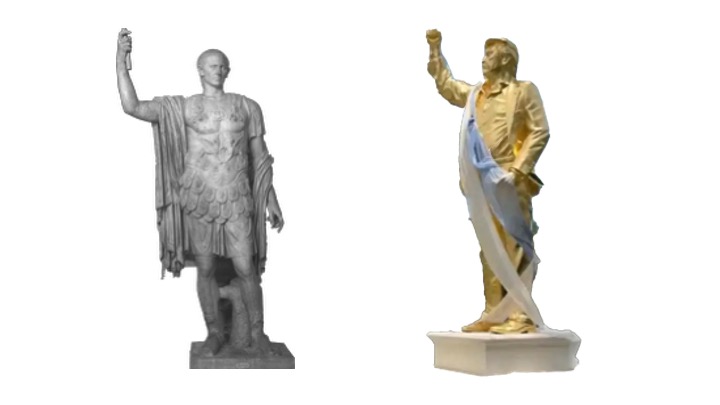
Nothing could go wrong… There’s nothing in what this pastor from the U.S said that resonates with that ancient document…
This statue was not created for worship. It was created as a symbol of resilience, patriotism, courage, and gratitude. It was created to honour a man…
Pastor Mark Burns
When Jesus is born, Roman Caesars are following the game plan; making images of themselves, installing them in temples; being called gods and sons of God.
“His image was placed among the gods, and he had an altar dedicated with the inscription to the genius of Julius …”
Suetonius, Life of the Caesars
…the birthday of the god Augustus was the beginning of the good tidings for the world that came by reason of him…
Priene inscription
Mark opens, “The beginning of the good news about Jesus the Messiah, the Son of God…” (Mark 1:1).
The New Testament authors are very conscious of how icons are tied to worship not just politics.
That is what is going on with the coins featuring Caesar’s icon and inscription, where Jesus says give God what has got his image on it…
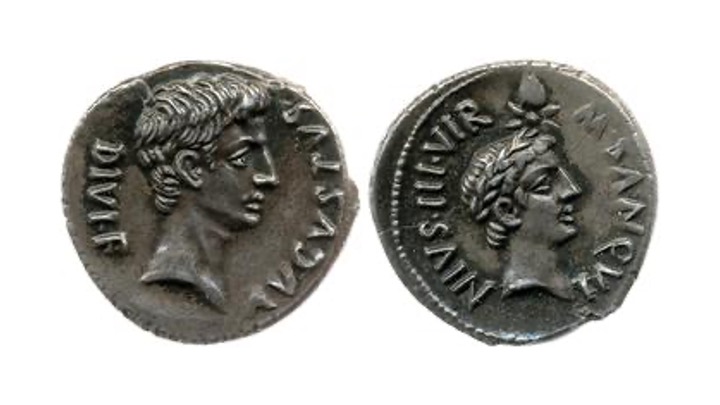
“Whose image is this? And whose inscription?”
“Caesar’s,” they replied.
Then he said to them, “So give back to Caesar what is Caesar’s, and to God what is God’s.”Matthew 22:20–21
And it is there at Jesus’ trial and crucifixion; he is under Roman law, for claiming to be king — the son of God — as Israel’s leaders bend the knee to Caesar’s image: “Anyone who claims to be a king opposes Caesar” and “We have no king but Caesar” (John 19:12, 15).
These are pictures of two kingdoms; two images of God — going head to head.
The cross being contrasted with the sword of Rome. Caesar’s statues being compared with the living image of the God of the Bible.
So Colossians tells the big story of the Bible — and the gospel — as a culmination of the story of images of God; revealing what a true human is restored and re-made for; when we are restored from captivity and darkness.
Paul says God has filled the church with the knowledge of his will that comes from the Spirit (Colossians 1:9); made us alive with his breath so we can be fruitful (Colossians 1:10), while the “Son is the image of the invisible God” in whom all things were created; that he is the “head of the body, the church” and that “all God’s fulness dwells in him” (Colossians 1:12-16)… in chapter 3 he will say we are renewed images of God (Colossians 3:9–10).
He says we have been repositioned, out of the kingdom of darkness, into God’s presence as his children in the kingdom of light (Colossians 1:13-14). Repositioned. Redeemed. Restored as image bearers. Revivified by the ‘breath’ or Spirit of God in our bodies.
Think of the ancient king restoring a desecrated image…
As our sins are forgiven and we are purified so we can dwell with God again, and represent him; following the template we see in Jesus, the eikon of the invisible God.
Jesus is the one who actually shows us who God is; the radiance of his glory; the word made flesh — the firstborn — there is that sonship idea again — and also the ruler and the representative of what God is like…
He is not just like God though; all things were created in him, through him, and for him; and our image bearing is not separate to him but through being united to him, living as his body. We are reconciled to God cleansed through his blood shed on the cross. Brought from exile into Eden-like proximity — before God’s face — restored, and repositioned (Colossians 1:22).
The image of God isn’t just about dignity and rationality — it is about relationship and function. It is eradicated through idolatry, which leads to exile and death, and restored through Jesus, our king, who cleanses us and leads us through the valley, into the temple of God’s presence, and who by God’s Spirit, restores our souls — recreating us to live as God’s children who dwell in his house forever. This calls us from the lure of other images of power, into something glorious and life-giving.
We do not need the Ancient background for this message to be timeless; but, when we remember the Bible is translated and look under the surface, it is rich.