Tag: esarhaddon

How to Read the Bible — As Ancient and Translated but Timeless

This series of posts was first a series of sermons I preached at City South Presbyterian and Coorparoo Presbyterian in mid 2026. You can, if it is your preferred medium, watch the video recording of this sermon here (Vimeo), or listen to the audio recording here (Spotify link).

Have you heard Eskimos have 50 words for snow?

This is used to support a disputed theory that our thinking is limited to the words in our language called “linguistic determinism” (it turns out we also think in images and through experiences). But, while debunking this theory, scholars have discovered ways language orients us to the world.

The Kuuk Thaayorre (cook thai-oar) people of North Queensland have been big here.

They do not use ‘self-oriented’ descriptions of space — like ‘left’ or ‘right’ — no matter which way they are facing they talk about east or west, and think of time moving east to west, and instead of saying ‘how are you going’ they say ‘where are you going’… and it turns out they have incredible spatial awareness. This is an example of how language helps us know where we are; mapping out reality; and making sense of it all…

I wonder if you can make sense of these words. This is the Hebrew of Bereshit 1:26; that is Hebrew for “in the beginning.”

וַיֹּ֣אמֶר אֱלֹהִ֔ים נַֽעֲשֶׂ֥ה אָדָ֛ם בְּצַלְמֵ֖נוּ כִּדְמוּתֵ֑נוּ וְיִרְדּוּ֩ בִדְגַ֨ת הַיָּ֜ם וּבְע֣וֹף הַשָּׁמַ֗יִם וּבַבְּהֵמָה֙ וּבְכׇל־הָאָ֔רֶץ וּבְכׇל־הָרֶ֖מֶשׂ הָֽרֹמֵ֥שׂ עַל־הָאָֽרֶץ׃

Genesis 1:26

Or these ones — the Greek of Pros Kolasseis — Colossians 1:15…

ὅς ἐστιν εἰκὼν τοῦ θεοῦ τοῦ ἀοράτου, πρωτότοκος πάσης κτίσεως

Colossians 1:15

When we translate and read these words from ancient Hebrew and Greek into English we are also making a jump across time — and across ways of being oriented to the world; and sometimes we need a map.

When we read the words of the Bible they are ancient, timeless, and translated.
For our nuts and bolts we are considering translation — how we get our English Bibles — and how to understand ancient words.

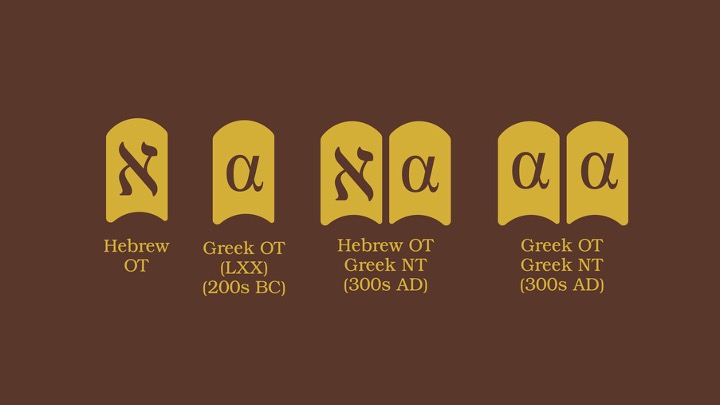
The Old Testament is written in Hebrew, with a bit of Aramaic, which shares an alphabet and some vocabulary.

About 200 years before Jesus it was translated and read in Greek, the LXX.

The New Testament is written in a form of Greek called Koine…

In the early church, by about 300AD, people are working with both Hebrew and Greek texts — and we have got Greek Bibles collated in book form from this time.
The Roman Empire splits into the Greek speaking East, and Latin speaking West in 395AD, and ten years later a guy named Jerome translates the Greek and Hebrew into a Latin version called the Vulage.
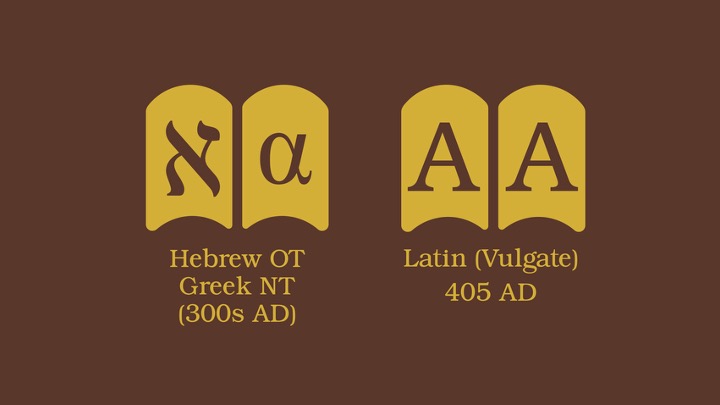
The Latin speaking Catholic Church embraces this, while the Eastern Orthodox church uses Greek. Languages in the Western half of the empire fragment, so Latin is mostly used by royalty and clergy, but not the ‘common language’ of the people.

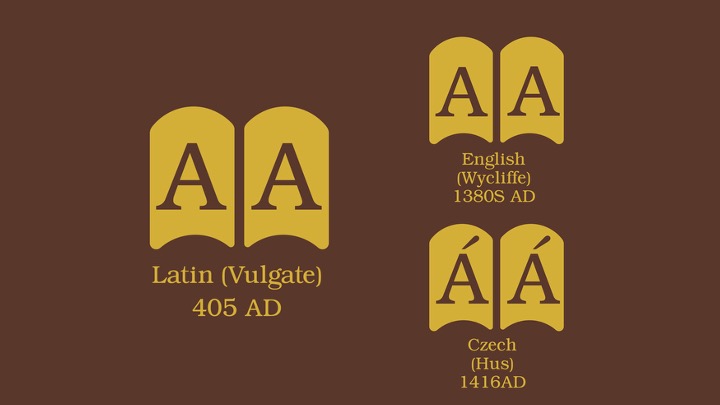
About 1,000 years later, this guy Wycliffe translates the Bible into English.

The Latin-speaking church hated this so much that after he died, they declared him a heretic, dug him up and burned him… 100 years later, Jan Hus translated the Bible into Czech; he was burned at the stake.

This was not just because they translated the words; their translations allowed them to be critical of the church in the language of the people. Both Wycliffe and Hus translated from the Vulgate.
This set the scene for Martin Luther; who translated the Bible into German in the 1500s, and used the printing press to get the Bible, and his criticisms of the church, into the hands of the common person. He translated from the authoritative Hebrew Old Testament — the Masoretic Text, which was circulated from around the 7th century — that is AD — and Luther a Greek New Testament put together by a Catholic contemporary, Erasmus.
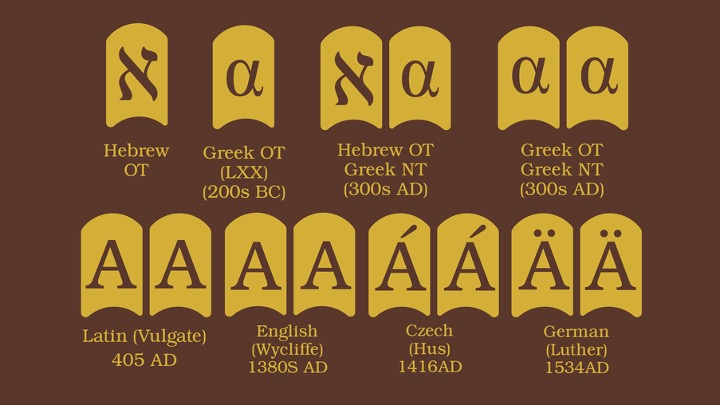
100 years later the Reformation had gained political traction in England, and the King James Version — also translated from the Hebrew and Greek — was released.
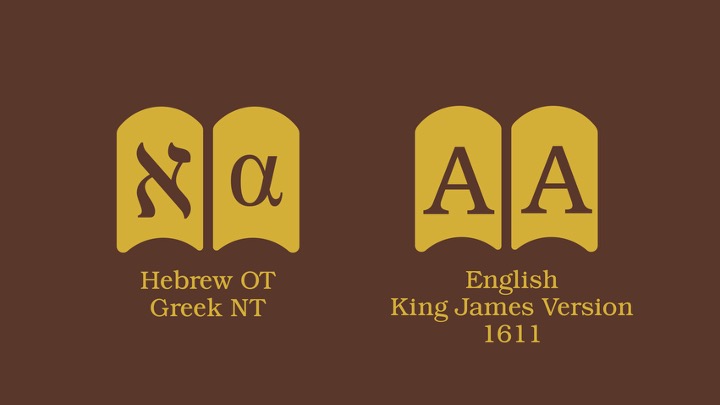
Almost all modern translations are working from the original languages; differences are not so much about the source material — text criticism stuff, when decisions are made on those issues they are usually footnoted; the differences are about translation philosophies; translations are built on this spectrum from formal to dynamic equivalent.
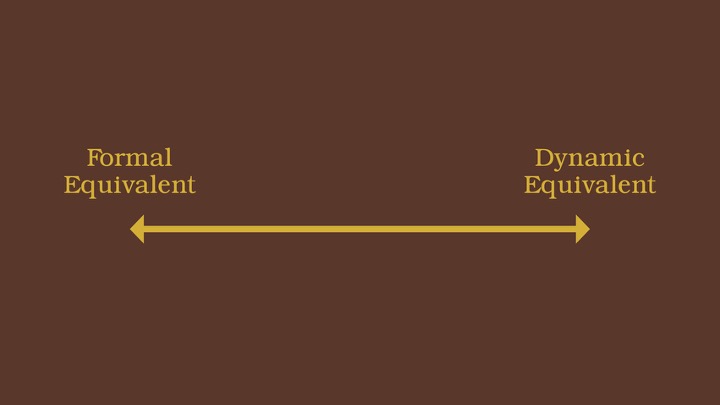
The formal side can be clunky and literal. The dynamic tries to capture the meaning of words, even some of the style.

The ESV is on one end of this spectrum, the NIV is on the other…

Translating is tricky.

Hebrew and Greek structure sentences differently to English, and there are less words in their vocabulary, which gives more room for wordplay and double meanings, and words have a broader range of possible meanings than English, where we are so specific.

Hebrew and Greek have tens of thousands of words, while English has more than 170,000 words.

Translators do an incredible job getting the word of God into our hands so we do not have to learn Hebrew and Greek to read it…

But. Translation always involves interpretation; and cause English is familiar to those of us who think in English, sometimes we can domesticate the Bible; imposing our orientation onto it, or we can be guided by or reoriented by translation decisions, and the layers of meaning that build up as the church talks about words and concepts, that move us away from the ancient meaning and to read well, sometimes we have to dig away these layers to get back to the text.

To show what I mean we are going to do what is called a word study together on the word image.

Let us make mankind in our image, in our likeness
The Son is the image of the invisible God

Genesis 1:26; Colossians 1:15

We are made in the image and likeness of God.

Jesus is the image of the invisible God — or rather we are tselem Elohim, and Jesus is the eikon Theou.

When the Old Testament is translated into Greek, this word tselem is translated into eikon — which is used in Genesis — actually the Greek name for the book, and Colossians.

When it is translated into Latin, Image of God is “imaginem Dei” — or imago Dei.

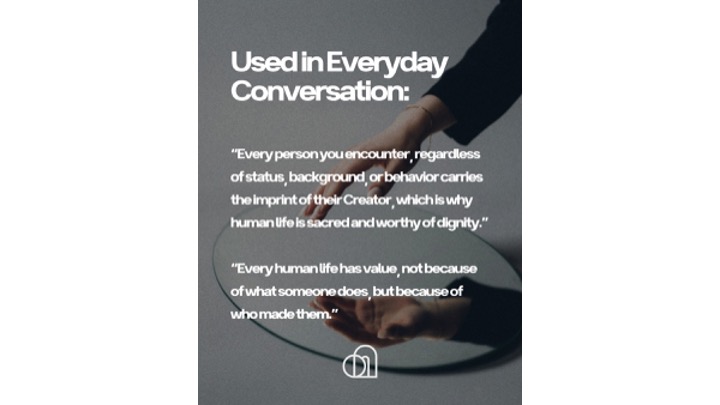
This meme landed in my feed recently.
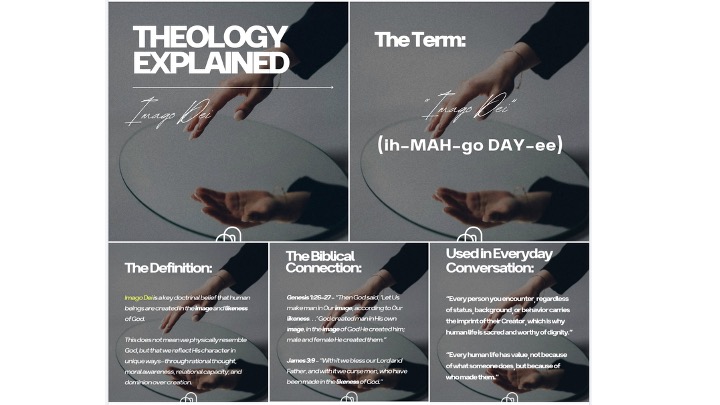
It says “it’s a key doctrinal belief that humans are created in the image of God” — we “reflect his character in unique ways, through rational thought, moral awareness, rational capacity, and dominion over creation” and “every person you encounter,” regardless of their status or identity, carries this imprint which is why human life is sacred and worthy of dignity.”

Now whether you think “imago Dei” or “Image of God” this is probably what you think, right? But — this is an example of layers of meaning — both the integration of biblical ideas, and the way language moves beyond the ancient meaning over time.

The Deity beholds and hears all things, and searches all things out: you too have the power of apprehension of things by means of sight and hearing, and the understanding that inquires into things and searches them out.

Gregory of Nyssa, On the Making of Man, 379AD

So, this guy Gregory of Nyssa wrote a Greek book about the nature of humans in 379AD; he said because God sees, hears, and knows and we do too; the essence of the eikon is in this rational capacity.

“It is clear, therefore, that intellectual creatures alone, properly speaking, are made to God’s image.”

Aquinas, Summa Theologia, 1260s AD

Plenty of people write about imago Dei; maybe the most influential is Thomas Aquinas, in the 1200s, who also saw it being our intellect.

These are major authorities shaping the Catholic tradition, so in Vatican II — in a Latin document titled ‘Gauium Et Spes’ — Joy and Hope — this section — “On the Dignity of the Human Person,” and chapter “On humanity as the image of God,” says authentic freedom is the sign of the divine image; especially to know and choose right from wrong — intellect, freedom, dignity — this is basically the meme right?

“True freedom, however, is an exceptional sign of the divine image in the human person.”

Man achieves such dignity when, emancipating himself from all captivity to passion, he pursues his goal in a spontaneous choice of what is good

Vatican II, Gaudium et Spes

But is this what a tselem is in Genesis?

There are rich truths in the meme, and these traditions, and thousands of years of reflection on the imago Dei in Greek, and Latin — in church tradition, but church traditions can add these layers; and we do not just have tradition or doctrines, we can look at the way words are used through the story of the Bible in their original languages — we will call this internal intertextuality — and across the ancient world — external intertextuality.

Translators are not typically being intertextual like this; they are working to make a sentence make sense within its meaning unit; they are not as literary or intertextual as the authors of the Bible. Let me show you this with two famous stories you might think are unrelated.

First — Noah — the earth is full of violence and evil; God chooses Noah to build a floating box; an ark — from trees and tar — to preserve life (Genesis 6:14), so God’s people can be fruitful and multiply. Noah’s family are saved through the waters (Genesis 9:1).

Second — Moses — God’s people are fruitfully multiplying in Egypt, and Pharaoh fills the earth with violence; killing babies (Exodus 1:7); but Moses’ mum puts him in a box — a basket, made of reeds and tar — to preserve his life on the water, so God’s people can be fruitful (Exodus 2:3).

You might think I am forcing the links here; but the same Hebrew word is used for ark and basket; but this literary link is lost in translation cause they are literally a boat and basket.

Anyway. Let us look at tselem…

The writer of Genesis develops our picture of a tselem — an image of God — by zooming in to God breathing into a dust shape to make it live (Genesis 2:7), in this garden in Eden (Genesis 2:8), where there is water flowing from the Tigris and Euphrates (Genesis 2:14).

When Adam had lived 130 years, he had a son in his own likeness, in his own image; and he named him Seth.

“Whoever sheds human blood, by humans shall their blood be shed; for in the image of God has God made mankind.

Genesis 5:3; 9:6

Tselem is used two more times in Genesis — Genesis 5 throws back to the beginning in order to tell us Adam makes a son; his own image, in his likeness — part of being an image is being offspring… Then the tselem Elohim idea is used, after the flood, where God prohibits taking human life, cause it is sacred.

Once of rats and tumors (1 Samuel 6:5), but mostly for idol statues — in Numbers (Numbers 33:52), 2 Kings (2 Kings 11:18), and Ezekiel (Ezekiel 7:20). Which is interesting given Israel is commanded not to make or worship idols of other humans, or any form they are made to rule over (Deuteronomy 4:16–18), this is the first two commandments (Deuteronomy 5:8–9)… and these laws use language from Genesis 1; part of the idea is that the living God has made his own living statues to represent him — and worshipping dead statues — being ruled by them — makes us dead.

Here is where we go intertextual elsewhere — in part 1 we looked briefly at the Dead Sea Scrolls; these jars of Jewish manuscripts in Greek and Hebrew that help us understand how contemporaries of Jesus read the Scriptures.

Archaeologists have also found a treasure trove of stone inscriptions — book tablets — from Israel’s ancient neighbours, Babylon and Assyria — mostly written in Akkadian; a language with a different alphabet, that often has similar sounding words — these tablets are from the library of an Assyrian king named Ashurbanipal.
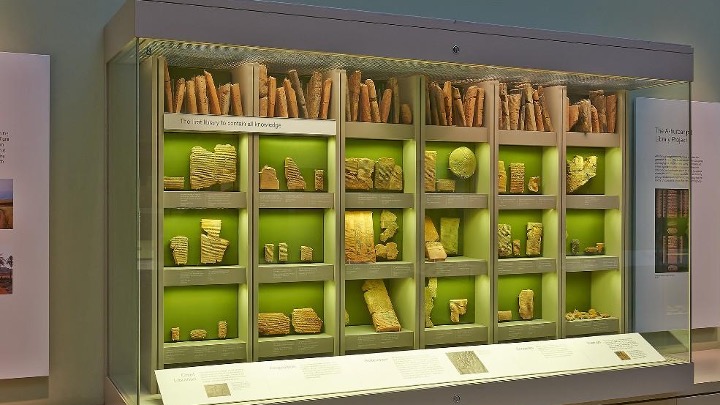
In one tablet Ashurbanipal — boasts like Solomon, about “learning wisdom”; mastering reading and writing so he could read Akkadian — he “had the joy of reading inscriptions on stone from before the time of the flood…”

‘I Ashur-bani-pal, within the palace, learned the wisdom of Nebo, the entire art of writing on clay tablets of every kind. I made myself master of the various kinds of writing. . .

I read the beautiful clay tablets from Sumer and the Akkadian writing, which is hard to master. I had the joy of reading inscriptions on stone from the time before the flood.’

Ashurbanipal inscription

There is an Akkadian flood story called the Gilgamesh Epic.

I asked if you could read Hebrew…

How about Akkadian cuneiform?
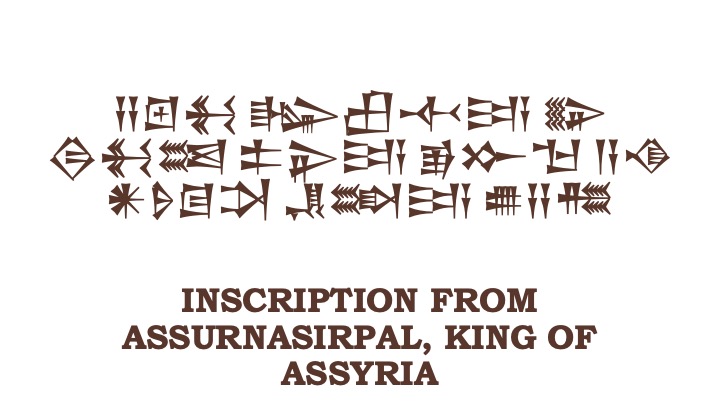
What about when it is translated into our alphabet? This is an inscription about Assurnasirpal — king 200 years before Library guy.

ṣalam šarrūtišu ina dmūt pānišu epušma ana dNinurta ušziz

Inscription from Assurnasirpal, King of Assyria

It uses the words salam and damut; related to the Hebrew words tselem and demut — image and likeness… The king boasts he made an image of his kingship in the likeness of his face, installing it in his God’s temple.

“I made an image of my kingship in the likeness of my face and erected it for Ninurta, my lord.”

Inscription from Assurnasirpal, King of Assyria

Throughout the ancient world kings would make idol statues of themselves and put them in temples — and act as guardians of these statues, only the king was the image of God. Eventually, as you encountered these statues in temples, you would worship them too. There are lots of overlaps between these sources and the Bible; and they are helpful guides for understanding what words mean; this overlap in language and stories makes sense…

Abram — the father of Israel is called out of Ur of the Chaldeans — that is Babylon — we should expect these cultures to share stories and words (Genesis 11:27–28); and these same stories and words — and images — become the basis of Israel’s temptation to worship the gods and god-kings of the nations that lead them to exile in Babylon; where, again, Babylon’s stories and images of God compete for their hearts.

When a sky above had not (yet even) been mentioned, (And) the name of firm ground below had not [yet even] been thought of…

Enuma Elish

The tablet library contained a Babylonian creation story — the Enuma Elish — about the creation of the heavens and earth. Consider how this text compares or contrasts to Genesis 1.

“In the beginning God created the heavens and the earth. Now the earth was formless and empty, darkness was over the surface of the deep, and the Spirit of God was hovering over the waters.”

— Genesis 1:1-2.

(When) only primeval Apsu, their begetter, And Mummu and Tiamat—she who gave birth to them all— Were mingling their waters in one

Enuma Elish

Apsu is the deep; Tiamat was a ‘sea-goddess of chaos’. The Enuma Elish continues. But in Babylon’s story, their god-king, Marduk creates through violence; making humans from the blood and bone of dead gods (including Tiamat), not in their likeness, to rule, but to serve the gods. Babylonian kings are then become images of Marduk.

Genesis says, “Let us make mankind in our image, in our likeness, so that they may rule…” (Genesis 1:26).

The Enuma Elish says:

Blood I will mass and cause bones to be, I will establish a savage, “man” shall be his name. Verily, savage-man I will create.

He shall be charged with the service of the gods, That they might be at ease!

Enuma Elish

Then it tells the story of the building of Babylon.

Build Babylon, ​the task you have sought. Let bricks for it be moulded, and raise the shrine!”

They raised the peak of Esagil… They built the lofty temple tower…

Be-l seated the gods, his fathers, at the banquet. In the lofty shrine which they had built for his dwelling…

Enuma Elish

The Enuma Elish describes Babylon being built with moulded bricks, a lofty temple tower reaching the sky; that is what Esagil means — so the gods could party. Genesis describes people making bricks (Genesis 11:3) to build the lofty tower of Babylon (Genesis 11:4)… and this power play being frustrated by Israel’s God (Genesis 11:8–9).

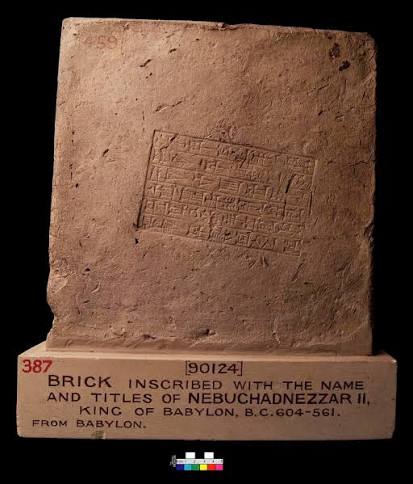
There are plenty of Babylonian kings who like bricks and building projects — none more than Nebuchadnezzar; a fan of the Enuma Elish, who built big temple towers, in Babylon, with bricks stamped with his name… And who Daniel describes building a giant tselem — this time in Aramaic; on the plains of Babylon (Daniel 3:1), that he commands people of all languages to bow before and worship — he is trying to reverse the scattering at Babel (Daniel 3:4–5).

“I added to the palace and raised it as high as a mountain with bitumen and baked brick…”

Nebuchadnezzar, Brick Inscription
There are also inscriptions describing rituals for giving life to images of God — selems.

We meet Library Guy’s grandfather, Sennacherib, and his father, Esarhaddon in 2 Kings, a couple of generations before Nebuchadnezzar takes Judah into exile (2 Kings 19:37)… Sennacherib trashed Babylon’s temples and statues — so, Esarhaddon set about restoring the deity’s presence to these images through rituals described in these inscriptions.

…the wisdom which Ashur and Marduk entrusted to me when they made me aware of the renewal of the the statue of the great gods…

Esarhaddon inscription

Esarhaddon claims Marduk chose him to restore them — the selems of the gods —

I processed with joy before him. I brought him joyfully into the heart of Babylon, the city of their honour. Into the orchards, among the canals and parterres of the temple

Esarhaddon inscription

He parades the selem into a temple orchard in the heart of Babylon; where it is renewed through these rituals.

…they entered by means of the office of the apkallu, mouth washing, mouth opening, washing and purification, before the stars of heaven.

Esarhaddon inscription

We have stone tablets outlining these rituals — by we I mean ‘the British Museum’ — water is brought from the pure spring — from the Tigris and Euphrates (remember Genesis 2)…

Water of the Apsû, brought from the midst of Eridu, water of the Tigris, water of the Euphrates, brought from a pure place…

Mis Pi ritual

Into this pure orchard where water flows — sounds like Eden —

…in the garden of the canal of the pure orchard build a bīt rimki. Bring him out to the canal of the pure orchard…

Mis Pi ritual

And the statue’s mouth is purified and opened, to eat and speak; as they say ‘this selem is made by the gods’. They are cleansed, restored, and repositioned to work as ‘images of god’…

This is the statue that Ninkura, Ninagal, Kusibanda, Ninildu, (and) Ninzadim made.

Mis Pi ritual

The Genesis 2 story sounds like the inversion of this; God making a living image by opening its mouth and nose.

Now. Here’s a couple of warnings — people go crazy with these connections; scholars describe this as parallelomania… and the guy who coined this label calls it a “disease”…

It seems to me that we are at a junction when biblical scholarship should recognise parallelomania for the disease that it is.

Samuel Sandmel, “Parallelomania,” 1962

And Robert Alter — an expert in both Hebrew and literature who has translated a beautiful version of the Old Testament, and written about the art of biblical narrative and the art of translation; he worries we can obsess about borrowed Akkadian words and miss the artistic Hebrew story…

“Bible scholars spent all their time hunting down Akkadian loanwords hidden in the text, but they didn’t know how to read a story…”

Robert Alter

And — especially as Christians, we do not want to miss how the big story is fulfilled in Jesus.

Which is all to say rather than ‘rationality’, an ancient reader of Genesis are going to see God forming living statues — tselems — that are male and female, where a statue is formed and made alive in an orchard where the waters of the Tigris and Euphrates bubble up from the ground as quite different to the picture of violent male kings who claim to be gods.

So it is not these kings who are God’s representative children; but all humans are made to represent God and rule, and fruitfully pass this on in his family.

They will read this embedded in a story that warns about worshipping breathless statues — those made by these kings — that make us dead; in contrast to the stories and inscriptions of Babylon and Assyria.

Let us track the shift from tselem to eikon… there is a text included in the Greek Old Testament, and in the Apocrypha — but not our Bibles — which Paul seems to use in Romans 1 — called the Wisdom of Solomon.

…for God created us for incorruption
and made us in the image of his own eternity…

Wisdom of Solomon 2:23

For the idea of making idols was the beginning of sexual immorality,
and the invention of them was the corruption of life, for they did not exist from the beginning,

Wisdom of Solomon 14:12–13

After tracking threads through the Prophets and Psalms, this text describes the making of eikons as the root of human corruption… This is very Romans 1…

Then the ungodly custom, grown strong with time, was kept as a law,
and at the command of monarchs carved images were worshiped.

Wisdom of Solomon 14:16

And it follows this thread through history from kings making carved images to be worshipped, to people making images of these kings to honour them from a distance… flattering them.

When people could not honour monarchs in their presence, since they lived at a distance,
they imagined their appearance far away and made a visible image of the king whom they honoured…

…so that by their zeal they might flatter the absent one as though present.

Wisdom of Solomon 14:17

Then the ambition of the artisan impelled even those who did not know the king to intensify their worship. For he, perhaps wishing to please his ruler, skillfully forced the likeness to take more beautiful form…

Until honour became worship…

…and the multitude, attracted by the charm of his work, now regarded as an object of worship the one whom shortly before they had honoured as a human.

Wisdom of Solomon 14:18–29

With misspent toil, these workers form a futile god from the same clay— these mortals who were made of earth a short time before and after a little while go to the earth from which all mortals are taken. But the workers are not concerned that mortals are destined to die or that their life is brief, but they compete with workers in gold and silver and imitate workers in copper, and they count it a glorious thing to mold counterfeit gods.

Wisdom of Solomon 15:8–9

These eikons — whether of gods or kings — are counterfeit gods. We would never see a pastor championing a gold-coated image of a political ruler to ‘honour them’ would we… This is fine.
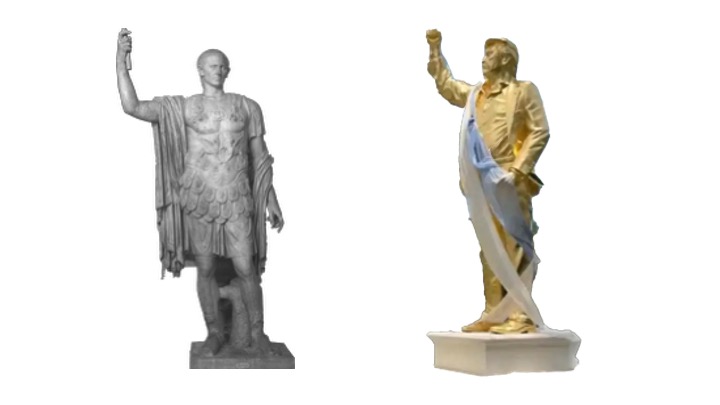
Nothing could go wrong… There’s nothing in what this pastor from the U.S said that resonates with that ancient document…

This statue was not created for worship. It was created as a symbol of resilience, patriotism, courage, and gratitude. It was created to honour a man…

Pastor Mark Burns

When Jesus is born, Roman Caesars are following the game plan; making images of themselves, installing them in temples; being called gods and sons of God.

“His image was placed among the gods, and he had an altar dedicated with the inscription to the genius of Julius …”

Suetonius, Life of the Caesars

…the birthday of the god Augustus was the beginning of the good tidings for the world that came by reason of him…

Priene inscription

Mark opens, “The beginning of the good news about Jesus the Messiah, the Son of God…” (Mark 1:1).

The New Testament authors are very conscious of how icons are tied to worship not just politics.

That is what is going on with the coins featuring Caesar’s icon and inscription, where Jesus says give God what has got his image on it…
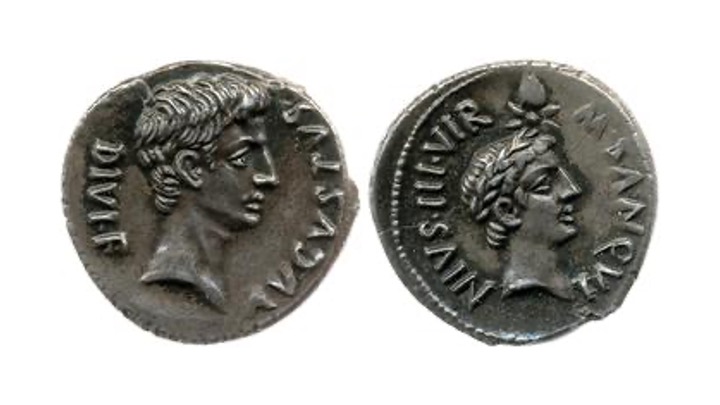
Whose image is this? And whose inscription?”
“Caesar’s,” they replied.
Then he said to them, “So give back to Caesar what is Caesar’s, and to God what is God’s.”

Matthew 22:20–21

And it is there at Jesus’ trial and crucifixion; he is under Roman law, for claiming to be king — the son of God — as Israel’s leaders bend the knee to Caesar’s image: “Anyone who claims to be a king opposes Caesar” and “We have no king but Caesar” (John 19:12, 15).

These are pictures of two kingdoms; two images of God — going head to head.

The cross being contrasted with the sword of Rome. Caesar’s statues being compared with the living image of the God of the Bible.

So Colossians tells the big story of the Bible — and the gospel — as a culmination of the story of images of God; revealing what a true human is restored and re-made for; when we are restored from captivity and darkness.

Paul says God has filled the church with the knowledge of his will that comes from the Spirit (Colossians 1:9); made us alive with his breath so we can be fruitful (Colossians 1:10), while the “Son is the image of the invisible God” in whom all things were created; that he is the “head of the body, the church” and that “all God’s fulness dwells in him” (Colossians 1:12-16)… in chapter 3 he will say we are renewed images of God (Colossians 3:9–10).

He says we have been repositioned, out of the kingdom of darkness, into God’s presence as his children in the kingdom of light (Colossians 1:13-14). Repositioned. Redeemed. Restored as image bearers. Revivified by the ‘breath’ or Spirit of God in our bodies.

Think of the ancient king restoring a desecrated image…

As our sins are forgiven and we are purified so we can dwell with God again, and represent him; following the template we see in Jesus, the eikon of the invisible God.

Jesus is the one who actually shows us who God is; the radiance of his glory; the word made flesh — the firstborn — there is that sonship idea again — and also the ruler and the representative of what God is like…

He is not just like God though; all things were created in him, through him, and for him; and our image bearing is not separate to him but through being united to him, living as his body. We are reconciled to God cleansed through his blood shed on the cross. Brought from exile into Eden-like proximity — before God’s face — restored, and repositioned (Colossians 1:22).

The image of God isn’t just about dignity and rationality — it is about relationship and function. It is eradicated through idolatry, which leads to exile and death, and restored through Jesus, our king, who cleanses us and leads us through the valley, into the temple of God’s presence, and who by God’s Spirit, restores our souls — recreating us to live as God’s children who dwell in his house forever. This calls us from the lure of other images of power, into something glorious and life-giving.

We do not need the Ancient background for this message to be timeless; but, when we remember the Bible is translated and look under the surface, it is rich.
Origin Story: Eden and the earthlings

This is an amended (and extended) version of a sermon I preached at City South Presbyterian Church in 2022. If you’d prefer to listen to this (spotify link), or watch it on a video, you can do that. It runs for 40 minutes.

What does heaven on earth look like for you?  

Where do you feel closest to God? 

Journalist Eric Weiner came up with this idea ‘thin places’ in a travel article for the New York Times in 2011. They made it into his book about his search for God as a secular 21st century Jewish man… 

Thin places are: 

“where the distance between heaven and earth collapses and we’re able to catch glimpses of the divine, or the transcendent or… The infinite whatever.” 

Where do you go to feel closest to God — like you’re in a heaven on earth zone? A thin place? 

That’s what the Garden in Eden was — this paradise garden we read about in Genesis 2. It maybe shows us that all our thin place experiences are a longing for somewhere else. I love the way Tolkien puts this:

“Certainly there was an Eden on this very unhappy earth. We all long for it, and we are constantly glimpsing it: our whole nature at its best and least corrupted, its gentlest and most humane, is still soaked with the sense of ‘exile.” 

In those thin places we feel closest to God — and while we do live with this sense of paradise lost — these moments might be explained by our origin story, and they might point to an ending of the story. 

What would an ideal person in that thin place should look like?

What should they do to cultivate that sense of heaven?

How might they be shaped by the space? Just ponder that with your own pictures of paradise.

Genesis 2 develops some big ideas from Genesis 1 — covering the same creation of the heavens and the earth — while zeroing in on a more local place — this region called Eden, and within it, a garden. And zeroing in on just one human. A human named human, or a human named to sound like ground in the Hebrew language. Adam; Earthling. What we treat as a name — Adam — is really, first and foremost, a pun.  

Before we get this human we get a world that is desolate and uninhabited — there are no plants yet, and no rain yet, and no one to work the ground yet (Genesis 2:4-5). There’s also no deep — no dark or chaotic waters in the way. There is earth. Ground. And springs of water that come up from the ground to give life (Genesis 2:6).  

In the Babylonian view of the world — which we touched on last time — there’s two ‘cosmic waters’ going on in our map of reality — Tiamet — the bad salty water that doesn’t help things grow — and Apsu, the living water — fresh springwater that comes up through the earth.

That’ll be interesting… If you can keep it in your head as you read.

In the Bible’s story though, the life-giving water bubbles up as the way God brings water to the parched ground — water and life. If you’re an ancient person — or even a modern one — water was a source of life through farming; you’d build cities on rivers to guarantee water supply for people. And here these waters are bubbling up out of the ground. 

Next to these waters, God makes a human. He forms the man — shapes him — from the dust of the ground and then breathes the breath of life into his nostrils. And he becomes a living being (Genesis 2:7). Here’s another little thread to hold on to — in the Greek Old Testament (the LXX) this is translated as a “living soul” using the Greek word psyche (from which we get ‘psychology’).

Now. Remember in Genesis chapter 1, we’re told God creates people in his own image, and I said that word is the word that gets used for idol statues and for kings in the ancient world. There’s a fascinating thing going on here where this story of God creating a living image of himself mirrors — or inverts and challenges — the exact story that people in the ancient world, outside of Israel, believed about how idol statues were made.  

To make an idol statue in the ancient world — or to restore one after it’d been taken out of your temple by your enemies — according to a couple of different ancient records — you’d go through this ritual where you’d fashion and form the statue (note: this is called the Mîs-pî ritual, this cracking book by Catherine McDowell does good scholarly work on links between these ancient rituals and Genesis; something I’ve written about before both here and in my thesis).

Here’s some quotes from a translated ritual tablet, this process required:

Water of the Apsû, brought from the midst of Eridu, water of the Tigris, water of the Euphrates, brought from a pure place… in the garden of the canal of the pure orchard build a bīt rimki. Bring him [the statue] out to the canal of the pure orchard…or this statue which stands before you ceremoniously grant him the destiny that his mouth may eat, that his ears might hear. May the god become pure like heaven, clean like the earth, bright like the center of heaven.

They would place a statue in an orchard, surrounded by the waters of the Tigris and Euphrates (rivers mentioned flowing from Eden in Genesis 2), and the water of the Apsu — the living water the bubbles up from the ground.

They would “give life” to the statue through a ritual that involved washing out the mouth, so that in the people’s minds the statue was now a living, breathing, eating, representation of the god in the world; then you would place them in a temple. You’d rinse and repeat this process for all the images of your god that you’d spread around the empire, then everyone involved in the ceremony would have to pretend to cut off their hands with a wooden knife because no real god could be created by humans. 

It was especially the King’s job to build these statues to spread the images of an empire’s god throughout the parts of the world where their gods reigned. There’s another description of this ritual where a king, Esarhaddon, re-built Babylon after his dad destroyed it. He gets a few mentions in the Old Testament (2 Kings 19:37, Ezra 4:2, Isaiah 37:38). He repaired statues that had been removed from the temples — ‘restoring’ the gods to these desecrated statues by re-creating them.

He said he was chosen by Babylon’s gods to make images of god and put them in Babylon’s temples. 

He took these exiled statues that had been captured by his dad and pulled out of their temples back to an orchard, surrounded by waters (the Euphrates river ran through Babylon), and conducted those same rituals to give life to these statues; these images of god.  

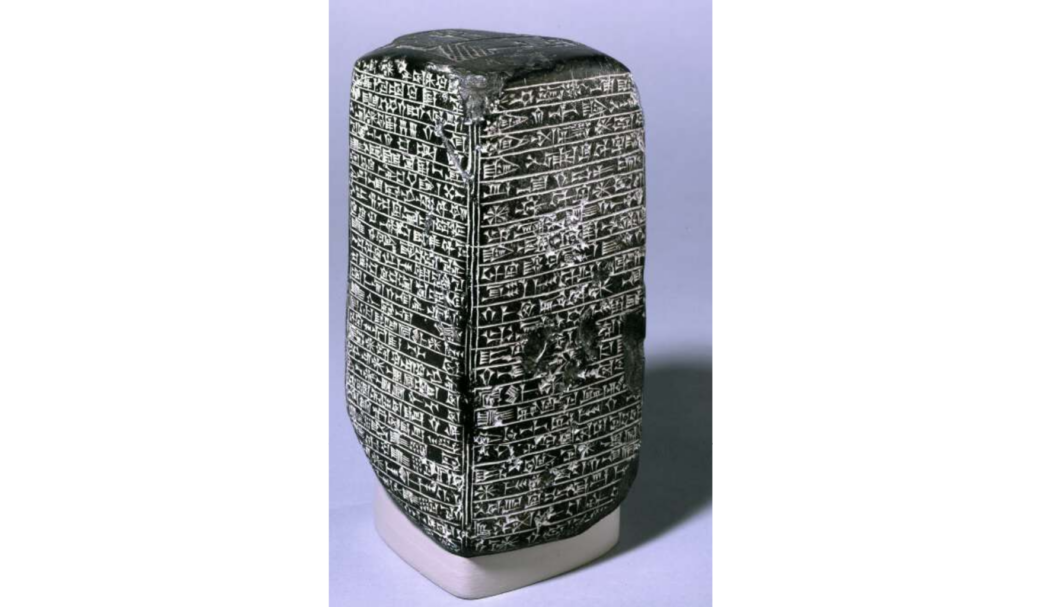
Image source: Record of Esarhaddon’s restoration of Babylon, British Museum

Here’s a translation of the inscription from this tablet.

I, Esarhaddon, led the great god in procession. I processed with joy before him. I brought him joyfully into the heart of Babylon, the city of their honour. Into the orchards, among the canals…

The line between God and king was murky. Kings were also called the image of God. There’s a king of the region that became Assyria, Tukulti Ninurta, who has these inscriptions that call him the image of the god, Enlil. These inscriptions using the same letters the Hebrew word for ‘image’ uses (tselem, or צלם). Eventually kings in the Ancient world ended up having statues of themselves placed in temples around their kingdoms.

There was no separation of church and state in the ancient world — the king was chief priest — the image of their god’s rule in the world.

So through Israel’s history, as they retell this Eden story it’s an alternative origin story — it’s not their king making an image of God — a statue — in a fruitful garden where the waters of the Tigris and Euphrates flow — where the image is given life because his mouth is opened by people washing it. A story told before the same people turn round and worship the statues they just helped make. Israel’s story is that their God makes his own statue-man with his hands, and puts him in an orchard where living water flows all round, and breathes actual life into his image so it can eat and live.

There’s a mirror being held up to these foreign stories and the gods they present, just as the story reveals how God sees humans as his Sacred, divinely formed representatives — living, breathing, statues. Royal rulers. 

Imagine the way this story played out in their life with these nations as neighbours — or as their conquerers in Egypt, or in Babylon. Humans are god’s living images — so, unlike their neighbours — Israel shouldn’t make statues of god — and we see that in the law (like in the 10 Commandments, Exodus 20). Worshipping those statues that they know are breathless and dead would be dumb, they have no breath in them, they are dead, and we see that in the prophets and Psalms.

The prophets — like Isaiah — even mock the whole process of constructing an idol statue that we now read in these rituals. Where craftsmen shape wood into human form, to put it in a temple, while burning the same wood to cook their food (Isaiah 44:13-15).

The Genesis Origin story shows why worshipping idols is stupid. They’re breathless, uninspired pieces of stone and wood; dirt-gods that leave us with a dirt future.

While the living God shows us that real humanity has life by his breath. We weren’t made to stay as earthlings — like statues of wood or clay — but to live as people who reflect heaven on earth; inspired by divine breath, as we enjoy life in God’s presence. Inspired. That’s a cool word, right (as opposed to ‘expired’). We’re given breath by him so that we might create life shaped by him rather than making our own gods; living as heavenly people, not people who worship stuff from the ground; but the God of heaven.

Ancient Idol statues were made from the ground (dirt or stone) and garden (trees), then decorated with the gold and precious stones that are there in the ground in the regions around Eden waiting to be cultivated and used by God’s earth-man in his task of representing god (Genesis 2:11-12). We can worship that stuff; or we can cultivate it and use it in our God-given task Some of the precious resources mentioned here in Genesis 2 — gold and onyx — become part of the clothing of the priest (Exodus 28).

Let’s pop back to Babylon, or another ancient city for a moment — in these cities the kings — images of God — who crafted images of Marduk the violent god to send out into the world, these kings were also gardeners. If you were an exiled Israelite it’s not just the power of Babylon’s armies that confronts you, and offers an appeal to switch allegiance to Marduk or his king — it’s the beauty of the city. The gardens. The king, as representative of divine order, was understood to be responsible for the fruitfulness of their lands. They’d plant gardens — thing the famed Hanging Gardens of Babylon; they would build garden cities on rivers — like the Tigris, or Euphrates. Israel in Babylon doesn’t just have God’s command to plant gardens of their own (Jeremiah 29:5-7), little Edens in Babylon, they’ve got a different story about who brings fruitfulness into the world; the God who plants a garden.

God is the gardener (Genesis 2:8). He brings the fruit. This is what Israel gets told about the fruitfulness of the promised land too. But in the Eden story it’s God who provides fruitfulness — in the form of trees that are pleasing to the eye and good for food, and the tree of life is there too (Genesis 2:9).

He gives human — earthling — the job of working and taking care of the Garden, as a steward of his fruitful provision of trees and life; of this garden space that is somehow marked out as different to the rest of the earth (Genesis 2:15). The word work or cultivate is the word for serve… while the word behind ‘take care of’ has a sense of guard — it’s the same word for what the cherub with the sword is going to do to guard the garden when Adam and Eve get kicked out (Genesis 3:24).

Now these two words get paired together a bunch of times as the instructions for the priests; in the Tabernacle in Numbers (Numbers 3:7), and then the Temple in Chronicles (Chronicles 23:32). They’re the task of God’s priests in these thin places where we see Heaven and earth intersecting. God’s priests are like living idol statues —images —. tasked with guarding and keeping the heaven-on-earth spaces, and that’s the task we find for all humans in Genesis 2… In the Garden in Eden.

Now these two words — they’re the same words used over and over again as instructions for the priests; in the tabernacle in numbers, and then temple in chronicles. They’re the task of god’s fruitful people in the fruitful land in thin places where we see heaven and earth intersecting… 

Think back to your thin place, and that little exercise of imagining how you should live in that thin place to keep it doing that job — if it was a beach, you’d be wanting to preserve the water quality, and stop it becoming overcrowded — you’d clean and protect it. If it’s a mountain, you’d stop people building ugly stuff like ziplines or awful houses, and you’d pick up rubbish. If it’s a garden then you’d cultivate it, looking after the trees, and you’d guard it from outside pests and weeds. This is basically what Earthling (Adam) is told to do in this heaven on earth space — keep it doing that job.

Earthling Adam is to enjoy God’s hospitality while he works — to enjoy with God, feasting on all the trees including the Tree of Life — living for as long as he enjoys life in God’s presence — while contemplating this other tree — this tree he is not to eat from; the Tree of Knowledge of Good and Evil (we’ll see more of it next week. But for now we’ll leave it hanging like Chekov’s rifle).

It’s worth noticing that the streams emerging from the ground at the start of the chapter have become rivers (Genesis 2:10-14) flowing from Eden; this water of life flows from Eden out into the world giving life to all these nations that end up, in the story of the Bible, being Israel’s idol-loving enemies. Life flows out of this garden and into the world. 

The origin story so far introduces us to Earthling; the living idol statue made from the ground, given life by God’s breath, to represent the fruitful living, breathing, life-giving God. Earthling is created to be fruitful and multiply, to fill the earth and rule it for God by gardening — cultivating and guarding this garden — partnering with God in this work of spreading the garden paradise — where God gives life at his table (or trees) — across the earth as God’s living statue; his priestly king. Genesis 2 unpacks the Genesis 1 idea of humans being made in God’s image, and in Israel’s story (unlike Babylon’s) this role is for all humans living in relationship with God, not just for kings.

And not just for men.

Just as the darkness, chaos waters, and vault were problems introduced by the narrative — so is earthling being alone; we know something is missing from his image bearing capacity. There’s a barrier to earthling’s fruitfulness. In Genesis 1, over and over again, we’re told ‘it’s good’ — but here it’s ‘not good’ — because earthling Adam is alone (Genesis 2:18).  

We see a bit of his life in God’s likeness here too; because where in chapter one, God names things and they happen — in chapter two, as earthling meets the animals, whatever he calls them — that’s their name (Genesis 2:19). He’s ruling over the animals and birds, who Genesis 1 says males and females — God’s image — are to rule together. There’s an interesting difference between chapter 1 and 2 here too, where the animals have also been created out of the ground — like the earthling — we’re not told that in Genesis 1; they also have the “breath of life” in them (Genesis 1:30), they are similar, but are not made with this task of representing God in the world and ruling over it.

They’re similar, but none of them are suitable for him as a helper; none of them complete earthling’s ability to do the ‘good’ he was made for. Until God makes a woman — a helper — not from the ground but from his side (Genesis 2:20-21).

It’s worth just pausing on that word “helper” in the context of this human task to be fruitful and multiply. It’d be easy, from the English (and because of history) to think the word helper is subordinate — but that’s not what the word here means, or what the narrative is suggesting. The Hebrew words used here for suitable helper — Ezer Kenegdo — don’t have a picture of a domestic helper in them at all; ‘ezer’ is more like ‘deliverer’ — it’s used of God in the Old Testament, including in military pictures of God holding a shield for Israel and coming to their aid (Deuteronomy 33:29).

Helper is something more like military ally — and her suitability is about the ability and necessity to help earthling function the way God created humanity to function together. Remember how we saw when we looked at chapter one, that in the ancient world a thing is a thing when it does what a thing is made to do. Humanity is incomplete. It can’t represent God as his image — without males and females. Earthling also can’t be fruitful and multiply alone, or make life from the earth; and so God makes a woman.

A woman taken out of man so they can be united as one — that’s going to be important for understanding what happens in chapter 3, where they fail to act as one, turning on each other, and to guard and keep the garden, so that being fruitful and multiplying is frustrated as their relationship is disordered.

The woman is the first creation — plants, humans, animals — not made from the ground in the chapter. Together, man and woman will be fit for their purpose of representing God and fruitfully spreading his rule — his Eden Garden — over the earth. Their union and oneness will be part of that representation, and so will humanity’s fruitful multiplying from their union. Adam couldn’t be fruitful and multiply alone.

This passage might become the basis for how we understand marriage — it’s where Jesus goes when asked about marriage (Matthew 19) — and it’s definitely a pretty big building block for how we think marriage works, but there’s also something happening in the origin story here. The narrative is suggests earthling is incomplete — not good — unable to function as fully human while he’s alone. This isn’t to say we’re half people waiting for a person of the opposite sex to complete us, but that God’s task of producing fruitful life in the world that represents the life-giving, generative, nature of God requires males and females… community, even. The human call to be fruitful and multiply; to fill the earth with God’s representatives anticipates the Great Commission (Matthew 28); Jesus’s call to be fruitful and multiply by making disciples.

By the end of the chapter Earthling Adam and his wife are together, in the garden, and their relationship is secure; they are naked and unashamed. Earthling has not yet named the woman, like he did the animals, he simply says she shall be called woman because she is taken out of man; the language here indicates a unity. The Hebrew word for man is “ish” and for woman it’s “ishshah.” They are united. They have a job to do. They have a heaven-on-earth place to do this job in.

So, imagine you’re an Israelite in Babylon, hearing this story. Babylon doesn’t feel like your picture of Heaven. It’s a violent and chaotic empire built around the worship of war gods like Marduk. It’s ruled by kings who’ve conquered you, and all the empires that came before; Egypt; Assyria; they’re done. It has its own picture of heaven on earth. Its male god-king is claiming to be the image of god who makes images of god. He builds his own garden city as a home for his gods. Babylon’s story (the Enuma Elish) says the city is their resting place on earth. Humans aren’t made in the image and likeness of God, they exist as slaves to the Gods, to feed them with your labour. That’s how Babylon’s creation story views heaven-on-earth space and how humans are to live in it.

As an Israelite, your own heaven-on-earth place — the Temple in Jerusalem — looks a long way away. You’re wondering if God is distant while living in a beautiful and powerful city set up as a thin place for Babylon’s gods. Statues get paraded down its streets and enshrined in its temples, its political order is religious, the architecture of the city — even its parks and gardens — are meant to make you feel like their gods are good and in control.

Genesis would be a subversive story in that sort of environment. A story that told you that you’re as valuable as the king; and images of your God, unlike theirs aren’t dead wood made with weird rituals, but living, breathing, life-making men and women. Earthlings who know we really belong; we truly flourish; somewhere like Eden; a heaven on earth place, enjoying God’s hospitality — and his gift of life; the Tree of Life. The story would create a certain hunger for that kind of place — a sense of longing for home, while also directly mocking, and challenging Babylon’s vision for humanity. This story provides the fodder for Israel’s prophets to undermine the Babylonian stories and its god statues, tipping the Babylonian picture of god and humanity on its head.

You would know, too, that your God is the source of all the life and goodness you see around you — the fruitful trees growing because of the water coming from the Euphrates are downstream from Eden. Babylon, just like the other nations your people have met with through history has been given life by the living water flowing out of God’s provision; his cosmic life-giving water bubbling away in the universe. More radically, you would be shaped to see your Babylonian neighbours as also made to worship and serve your God; the God who gives them life, who created them not to be slaves, but to represent him as pictures of his life in the world. They are captivated images — idol statues — who need restoration to the Eden story. That’s going to shape the way you treat your enemies, isn’t it? Seeing how they were made to be fruitful and multiply; spreading Eden, the real life-giving garden paradise, rather than the deadly and destructive gardens of Babylon.

We’re going to see that this story goes downhill fast; Chekov’s rifle gets fired in the next act. But this picture of heaven-on-earth doesn’t disappear through the Bible’s story even as humans are exiled from Eden.

There are echoes of Eden all over the place; built into the Tabernacle and Temple, where the Holy of Holies, the dwelling place of God is set up with tree decorations and fruit imagery everywhere; where a giant Menorah — a candlestick Tree of Life is there as a picture of life in the presence of the God who is light. Echoes of Eden are there in descriptions of the Promised Land as a land flowing with abundant goodness and provision… it’s there in the Prophet’s hope of restoration.

Ezekiel has this picture of God’s garden mountain — Eden — a meeting place between the heavens and the earth (Ezekiel 28:13-14), and a restored mountain top temple, where the waters of life flow out becoming rivers teeming with abundant life that feed the nations, restoring life — living water that creates fruit trees along the banks of this river (Ezekiel 47:1-12). It’s Eden, but better; it’s Jerusalem, but better. It’s certainly better than Babylon. It’s what God’s faithful image bearing people could have partnered with God to create.

This Ezekiel imagery is something John picks up as Jesus — the Heavenly Man — walks on earth. The man John tells us straight up is God tabernacling with his people — Edening with his people (The Greek word for “tabernacle” is the word used behind ‘dwelling’ in John 1:14). John has us read his whole Gospel through the lens of Jesus’s body being a new Temple (John 2:19-22) — he’s a heaven-on-earth human and a ‘heaven on earth place.’

The waters of life bubble up all around Jesus as he comes as the Eden-on-earth man. He says he’s come to bring living water that will satisfy a sort of existential thirst (one that comes as a result of exile from God), and provide eternal life (John 4:13-14). He says rivers of living water will flow from those who believe in him — and John makes it clear that’s about people receiving God’s Spirit so we too become like the Temples that bring life into the world from Ezekiel’s vision — human Edens (John 7:38-39). Then John describes water pouring from Jesus’s side, in Jerusalem, at his death; a new river flowing from a heaven-on-earth space — the human temple — giving life to a new humanity (John 19:34).

John tells us Jesus was both crucified and buried in a Garden (John 19:41). One of his closest friends, Mary — thinks he is the gardener (John 20:15); in a nod to Ezekiel’s vision there’s also an abundance of fish at a post-resurrection breakfast (John 21:6). This is a new Eden moment.

It’s John, too, who pictures the new heavens and new earth as a new Eden — with the Tree of Life and the rivers of living water flowing together as people enjoy life with God for eternity (Revelation 22:1-2) (also, this sort of thematic richness is why I think, despite what some scholars might say, John’s Gospel and the Revelation were written by the same author).

Tolkien is right; we did lose this Garden paradise. Our yearning for heaven on earth — our experience of longing in those thin places where the barrier between heaven and earth breaks down — testify to our exile from Eden. We were made to live with God, enjoying his gift of life forever in this sort of heaven-on-earth place, but desecration, destruction and death got in the way.

We live in our own modern Babylon; we’re surrounded by people chasing and trying to build heaven on earth; garden cities (which was, until recently, the name of a giant Westfield shopping centre in Brisbane). We live in a world that wants to experience or manufacture thin places; we want the garden without the gardener-God and his gardener-king. Eden without the presence of God isn’t Eden. It offers no life. It’s Babylon; a counterfeit Eden, with counterfeit images of counterfeit gods that lead to death; to exile from God.

Earthling Adam was a priest-king who chose dirt over glory; leading humanity up the garden path. We need a king who’ll lead us out of exile in the nations and back to the orchard so we can be restored images who represent God again. Our neighbours, too, are images of God in need of restoration; the restoration we have received through Jesus; God’s presence restored to us through living Water; his spirit. That’s what baptism is a picture of — an image-restoration ceremony. To not simply be earthlings destined for the ground, we need God’s breath; his presence; his Spirit dwelling in us so we are restored to, and restored as, the presence of God.

That’s exactly the story of the Gospel; which becomes our new origin story. The Gospel is the story of all of us being earthlings — those who didn’t just come from the earth, but worshipped the earth and the gods of our making; even other earthlings… who faced exile from God, and breathless death as a result.

Here’s a cool thing Paul does with the Genesis story — about earthling Adam — in 1 Corinthians. And part of what’s cool is I think there’s a pun. The word “icon” is the Greek word for image; there’s an ending for Greek words “icon” that just means “of the” — they’re not directly related, but it looks the same in writing and would probably sound the same. Paul talks about how humans were — like Adam — breathed icons — where we read this bit of 1 Corinthians 15 as “natural” it’s the Greek word ‘psycheikon’ (psyche was that word used back in Genesis in the LXX). We were people given the breath of God to live in these earth bodies; earthlings. But in Jesus we find a new humanity — a Heavenly humanity — Jesus is a heavenly — or ‘pneumaticon’ — that’s the word for Spirit (1 Corinthians 15:45-46). In Jesus we’re no longer just earthlings, destined to become earth, but heavenly creatures destined for imperishable life in heavenly bodies that don’t die, that reflect God’s glory (1 Corinthians 15:47-48). Paul says just as we bore the image of the earthly man (the earthling), so, those of us who have received God’s Spirit will bear the image of the heavenly man (1 Corinthians 15:49). In Jesus we become heaven-on-earth places filled with the presence of God; his Spirit; so we might fill the earth with his presence.

There are lots of places you might feel close to God; thin places; eden zones; heaven-on-earth spots, and when you’re in those places they’re a reminder of this story — where we came from, and where we’re headed, but maybe there’s actually no place that you should feel closer to God, or more like a heaven-on-earth “Eden” place than as we gather together with God’s image bearing people to worship him and proclaim the hope of the Gospel together; sharing God’s hospitality at his table eating bread, made from grain that comes from the ground, and drinking the cup, made from grapes, grown from the ground, as we remember the life of the new human given for us, and to us, so that we might receive God’s Spirit and live in his presence forever as his representatives in the world.

Reading the Bible (and life) as the story of God ‘re-creating’ and ‘re-vivifying’ broken images of God: Part 1 — By the rivers of Babylon

In which, over a two part epic, I quote significant chunks of Babylonian religious propaganda to make the case that we should understand being made in the ‘image of God’ as a call to play a part in representing God in his world, while our idolatrous hearts keep leading us to play that part for idols.

This post is fairly epic in size, but the good news is, I’ve split it in two. Ok. So here’s a fun way to read the Bible, in sum, think of this as the TL:DR; version of what follows:

  1. The Bible is the story of God giving life to his image bearers — making living images or idols to represent himself — and then restoring life to those images when they stop serving that function. Part of this restoration involves the image being ‘revivified’ — given life, breath, and a function — near or through water. This vivification, or revivification, happens through a ritual ceremony that was a ceremony used throughout the ancient world to give and restore life to broken idol statues.
  2. God’s people are meant to function for him the way idol statues function for the other gods of the ancient world — to represent the presence of his kingdom, to, in a sense, manifest his rule and give legitimacy to it.
  3. The flip side of this reading is that the stuff in the Bible about not making idols to represent God is actually a pointer to the truth that only the living God can make representatives of himself, that share his qualities, because all things that are made by makers reflect their maker. The problem with the gods of the nations — gods of stone, shaped from the human imagination but based on things that God made — is that its an overturning of the created order, in which it is God who makes images (humans), not humans who make gods.

God creates his images (and gives them breath and a purpose, near water)

Creation as ‘giving something a function’…

Old Testament scholar John Walton has written a bunch of stuff about how the Genesis creation account relates to its ancient near eastern context. One really important point he makes is that we, as modern readers, bring modern concerns to the text as well as modern notions of what it means ‘to be’ (a modern ontology). We think ‘being’ is meaningfully tied to questions of what substance a thing is made of, our ontology is material. This wasn’t the case in the ancient world, nor, (just to give you a sense of how this question plays out significantly in different times, while we might take our modern thinking for granted) for some time after that. The Greeks, for example, as described in Plato, saw being as a thing reflecting some perfect infinite form, and a thing’s ‘being’ was measured, in some way, against this ideal. The significance of this, in the Greek world, was that people often separated a thing’s physicality from its ‘ideal form’ — prioritising the ‘spiritual’ over the physical. This question matters more than we think it might. In the world the Bible came from, existence was tied not to its material essence, or a thing’s ‘ideal form’, but to the function it was given within a system of functioning things. The ancient world had what Walton calls a ‘functional ontology’… Here’s a quote where he explains what this means:

“WHAT DOES IT MEAN FOR SOMETHING to exist? It might seem like an odd question with perhaps an obvious answer, but it is not as simple as it may seem. For example, when we say that a chair exists, we are expressing a conclusion on the basis of an assumption that certain properties of the chair define it as existing. Without getting bogged down in philosophy, in our contemporary ways of thinking, a chair exists because it is material. We can detect it with our senses (particularly sight and touch). The question of existence and the previous examples introduce a concept that philosophers refer to as “ontology.” Most people do not use the word ontology on a regular basis, and so it can be confusing, but the concept it expresses is relatively simple. The ontology of X is what it means for X to exist… When we speak of cosmic ontology these days, it can be seen that our culture views existence, and therefore meaning, in material terms… Since in our culture we believe that existence is material, we consequently believe that to create something means to bring its material properties into existence. Thus our discussions of origins tend to focus on material origins.

If we are going to understand a creation account from the ancient world we must understand what they meant by “creation,” and to do that we must consider their cosmic ontology instead of supplying our own. What did it mean to someone in the ancient world to say that the world existed?

People in the ancient world believed that something existed not by virtue of its material properties, but by virtue of its having a function in an ordered system. Here I do not refer to an ordered system in scientific terms, but an ordered system in human terms, that is, in relation to society and culture… In this sort of functional ontology, the sun does not exist by virtue of its material properties, or even by its function as a burning ball of gas. Rather it exists by virtue of the role that it has in its sphere of existence, particularly in the way that it functions for humankind and human society… In a functional ontology, to bring something into existence would require giving it a function or a role in an ordered system, rather than giving it material properties… Unless people (or gods) are there to benefit from functions, existence is not achieved. Unless something is integrated into a working, ordered system, it does not exist… Consequently, the actual creative act is to assign something its functioning role in the ordered system. That is what brings it into existence.” — John Walton, The Lost World of Genesis One: Ancient Cosmology and the Origins Debate

Walton obviously takes a position on how this affects the way we read the nature of ‘creation’ in Genesis 1, but that’s a red herring in this discussion. His observation is borne out through a study of the sort of things ‘created’ and what is said of them throughout the Bible (it’s always linked to function, rather than form), and also in texts apart from the Bible — other creation accounts, and other stories about people ‘creating’ things in the Ancient world. I think its fair to say this ‘ontology’ is not disputed, and you might have to take it to whatever conclusions are necessary when it comes to how to read the Genesis accounts as they relate to our ‘material ontology’ and the questions we might want Genesis to answer. I’m going to go in a very different direction though, and specifically consider the questions this creates for us when Genesis talks about us. Humans. Where we’re made in God’s ‘image’ and likeness. I think the likeness part captures a sense that we share some qualities of God in how we operate in the world, we reflect him, but the ‘image’ part is also functional and is tied to us representing him.

I’m suggesting that to be made in God’s image in the sense in which Genesis (and the rest of the Bible talks about it), is not just to be something, but also to do something. And that something is caught up with the idea that we are the living, speaking, God’s living, speaking, statues, in the same way that dead and dumb statues represented dead and dumb gods.

The Hebrew word for image selem is often translated as idol, both later in the Old Testament (rarely, because there are a few different words used), and elsewhere in the ancient near east (frequently, like, this is a very common word for how the nations describe their statues), it does come up a few times like:

Speak to the sons of Israel and say to them, ‘When you cross over the Jordan into the land of Canaan, then you shall drive out all the inhabitants of the land from before you, and destroy all their figured stones, and destroy all their molten images and demolish all their high places; and you shall take possession of the land and live in it, for I have given the land to you to possess it. — Numbers 33:51-53

“You also took the fine jewellery I gave you, the jewellery made of my gold and silver, and you made for yourself male idols and engaged in prostitution with them.” — Ezekiel 16:17

The verbs used for God’s creation of humanity in Genesis 1 and 2 are later used when talking about the forming of idols, or to refer back to God’s creation of humankind.

There’s a consensus emerging amongst a stream of good Bible scholars — people who believe the Bible is God’s word, and is about Jesus — that Genesis 1-2 should be read as the story of God creating his cosmic temple, a place for him to dwell, and rest, and be worshipped. I don’t think this is controversial. This is the ‘ordered system’ then that we are placed in and given the function we’re given as ‘images’… The word for ‘image’ in Hebrew, selem, has an ancient near eastern link to the word used elsewhere for idol statue, salmu. We’ve added vowel sounds to Hebrew, which was traditionally just written as consonants, so slm. 

There are some steps to notice in what happens as God makes an image of himself in Genesis 2.

  1. Formed and fashioned, near water (and symbolically, in a sense, moved through water, it’s interesting that God places the man in the garden twice, once before the mention of the water, and once after) (Genesis 2:6, 8, 10-15)
  2. Inspired, or given ‘breath’ so that it the image is vivified. It is to be thought of as a living representation of the God whose image it bears. (Genesis 2:7)
  3. Declared fit for purpose within a system, and via connection to God. (Genesis 1:26-31)
  4. Placed (or enthroned) in the Temple/garden sanctuary and given a job within the Temple. (Genesis 2:8-9, 15
  5. The images are provided for with food and drink. (Genesis 2:16-17)
  6. The image fulfills a function in representing the God behind the image (Genesis 2:19-20)

These steps are pretty much a summary of the steps required for people to create images of God in the ancient world. The sequencing is interesting here because 3 actually happens in Genesis 1, and then Genesis 2 zooms in to sequentially cover 1-2 and 4-5. Genesis 1 also supplies the sense in which 5 happens. God creates and rules by speaking good things (and a good system) into being. God creates humans to rule over the things he has made — especially the other living things — as his images. And in Genesis 2, Adam ‘names the animals’ by speaking their names into being, and thus rules them — in the Ancient Near East, to name something was to express your authority over it.

Humans are meant to serve as God’s images in his temple — his living breathing representatives.

The creation, and re-creation, of images of God in the ancient world

The notion of ‘images of God’ in the ancient world, outside the Bible, was linked to the role the king of an ancient nation would play in being the representative of that nation’s god as both priest and king of the nation’s cult. Here are some things written about a couple of kings. The image of the king, and the image of the nation’s god were so closely tied that the king of a successful nation almost always became God.

“He [the king] alone is the image of Enlil, attentive to the voice of the people, to the counsel of the land.” — EPIC OF TUKULTI-NINURTA


“The King’s image, made brilliant like the heavenly stars, was set up before the eyes of the God Enlil”  — A HYMN DEDICATED TO SULGI OF UR


He created his royal image with a likeness of his own countenance and placed it before the God Ninurta.”— INSCRIPTION DESCRIBING ASSURNASIRPAL, KING OF ASSYRIA

Some of the words in this bit are going to seem foreign — because they are. Not just foreign, but ancient. Just let those bits wash over you, but as you read (if you read the chunks of quotes from inscriptions) try to notice the similarities, and the differences, to how the Bible describes the making of an image of God. The Genesis account comes from a world much closer to these tablets than to our modern world. What’s really striking, I think, is how much the conclusion from the first section, and those steps present in making an image of God (and supplying a function), is supported in the ancient world — and what sort of comparison is struck between the Bible’s story of God’s creation of humanity, and the ancient, human, stories of how people were to make images of God. Those same 6 steps are there, with a couple of key subversions, in an ancient Babylonian ritual called Mîs-pî, where images are created, given the job of representing the god(s) who made the universe, and enthroned. Here’s the text of the ritual. There’s heaps of stuff here that sounds like it could be said about the God of the Bible, what’s interesting is what changes if you remember that this is a person speaking to the gods, about the creation of an image of a god. An image that is a statue where they need to create a sort of cognitive dissonance because the statue does not breathe or move, which brings into question just how powerful these gods are. The king/image-creator would say (the times ‘statue’ appears from here on in are ‘salmu’):

Ea, Ṧamaš, and Asalluḫi, the great gods, who judge the heavens and the earth, who determine the destinies, who fix decisions, who make sanctuaries great, who set the foundations of the throne daises, who lay out the plan, who outline the ordinances, who apportion the lots, who watch over sanctuaries, who keep the rites pure, who creates the rites of purification, it is in your hands to determine fates, to draw plans, you alone establish the fate of life, you alone draw the plans of life, you alone make the decisions of life, you inspect all the throne daises of god and goddess, you alone are the great gods who direct, the decisions of the heavens and earth, of springs and seas, your utterance is life, your pronouncement is well-being, the work of your mouth is life itself,  you alone bestride the farthest heavens, you dispel evil (and) establish the good, you loosen the evil portents and signs, disturbing and bad dreams, who cut through the cord of evil. I am the chief exorcist who <knows> the pure rites of Eridu, I have poured out water; I have cleansed the ground for you;  I have set up pure thrones for your sitting; I have dedicated clean red garments for you; I have set up the pure offering arrangements for you; I poured out for you a pure libation; I set up for you an adakurru-bowl with našpu-beer.

I libated for you wine and best beer. Because the completion of the rites of the great gods and the direction of the plan of the purification rite rest with you, on this day be present: for this statue which stands before you ceremoniously grant him the destiny that his mouth may eat, that his ears might hear. May the god become pure like heaven, clean like the earth, bright like the center of heaven. May the evil tongue stand aside! — Mîs-pî Ritual Tablet

After this had been recited, the king would “set up a libation for the gods Kusu, Ningirima, Ninkura, Ninagal, Kusigbanda, Ninildu, Ninzadim,” and ritually carry some incense and a torch past the image of these gods that had already been created. Then, the king would approach the new image that was being given life (vivified).

“You purify him with the egubbû-basin and (then) perform the Mīs Pî ritual, you set up a libation and the āšipu-priest stands to the left of that god. You recite three times the incantation “When the god was made” — Mîs-pî Ritual Tablet

The words of this incantation make it clear, or attempt to, that these statues are the products of all these other gods. Ignore all the funny types of Babylonian stone, and notice where those names of the gods mentioned above come up. And their ‘involvement’ as makers, but the key bits that are bolded. This is an exercise in overcoming the knowledge that these images are crafted by people, and can’t actually do what they symbolise.

“When the god was fashioned, the pure statue completed, and the god appeared in all the lands, then bearing an awe-inspiring radiance totally suited to rule with perfect strength; surrounded on all sides with splendour, endowed with a sparkling-pure appearance, he appears magnificently, the statue shines brilliantly; in the heavens, it was crafted; on earth, it was crafted. This statue was crafted in the entire heavens and earth… this statue grew up in the forest (of) Tir-ḫašur (ḫašur-cedar); this statue went out from a mountain, the pure place; the statue is the product of gods and humans; the statue (has) eyes that Ninkura has made; the statue (has) … that Ninagal has made; the statue (has) features that Ninzadim has made; the statue is of gold and silver that Kusibanda has made; [the statue ] that Ninildu has made; [the statue ] that Ninzadim has made; this statue of ḫulālu-stone, ḫulāl īni-stone, muššaru-stone, pappardillû-stone, pappardildillû-stone, ḫulālu parrû elmešu, by the skill of the gurgurru-craftsman, this statue that Ninkura, Ninagal, Kusibanda, Ninildu, Ninzadim have made,  this statue cannot smell incense without the ‘Opening of the Mouth’ ceremony. It cannot eat food nor drink water…” — Mîs-pî Ritual Tablet

These eyes can’t see. These features can’t do what they represent — see, or smell, or hear. These gods are made of gold and silver. These gods are statues. They are made by craftsmen, not gods. And here’s the ritual that ‘opens’ its mouth, that gives it life and breath and the ability to manifest the presence of the god it represents.

Water of the Apsû, brought from the midst of Eridu, water of the Tigris, water of the Euphrates, brought from a pure place: tamarisk, soapwort, heart of palm, šalālu-reed, multi-colored marsh reed, seven small palms, juniper, (and) white cedar throw into it; in the garden of the canal of the pure orchard build a bīt rimki. Bring him out to the canal of the pure orchard, to the bīt rimki. Bring out this statue before Shamash. Put again at their place the adze that was driven (into the wood), the chisel that carved it, the saw that cut it, and the master craftsmen who prepared it. With a scarf bind their hands; with a tamarisk knife cut off the fists of the stoneworkers who touched him. This is the statue that Ninkura, Ninagal, Kusibanda, Ninildu, (and) Ninzadim made. Kusu, the chief purification priest of Enlil, has purified it with a holy-water-basin, censer, and torch with his pure hands. Asalluḫi, the son of Eridu, made it resplendent. The apkallu and the abriqqu-priest of Eridu have opened your mouth twice seven times with syrup, ghee, cedar, (and) cypress.

May this god become pure like heaven, clean like the earth, bright like the center of heaven. May the evil tongue stand aside.” — Mîs-pî Ritual Tablet

The ceremonial ‘cutting off the hands’ of the stoneworkers to ritually deny human involvement fascinates me. The whole process to this point has been so very human. The king has been in the driving seat both in terms of speaking life into the god, via the incantations, and in terms of organising the design and creation of the god. This human involvement is clear from the number of “I did X” statements. It’s a very human process and this little ritual shows how much the idol maker must operate with a weird doublethink, the “I made this, it is my god” thing that Isaiah nails when he talks about how idol makers cook their food over half a lump of burning wood, and worship the other half. I say ‘ceremonial’ because tthe knife is wooden so I don’t think they actually chopped the hands off. After this ritual the statue is ‘commissioned’ by this prayer, and then carried to its temple.

“In the ear of this god you shall say the following: “Among your brothers you are counted,” you shall whisper into his left ear. “From this day let your fate be counted as divinity; among your brother gods may you be counted; draw near to the king who restored you; approach your temple…. To the land where you were created be reconciled.” — Mîs-pî Ritual Tablet

Notice the water mentioned at the start, is ‘water of the Apsû,’ the Apsû is the divine source of water in the ancient near east so this is ‘divine water’ from the mids of the god Eridu, which is said to come from two rivers. This water is brought into the place where this ritual happens, a ritual that happens in a garden-canal area in a ‘pure orchard,’ you may have identified all six of those elements of the Genesis creation narrative I mentioned above too, but check this out.

A river watering the garden flowed from Eden; from there it was separated into four headwaters. The name of the first is the Pishon; it winds through the entire land of Havilah, where there is gold. (The gold of that land is good; aromatic resin and onyx are also there.) The name of the second river is the Gihon; it winds through the entire land of Cush. The name of the third river is the Tigris; it runs along the east side of Ashur. And the fourth river is the EuphratesThe Lord God took the man and put him in the Garden of Eden to work it and take care of it.” — Genesis 2:10-15

This, then the subsequent creation of Eve, is how God places his images in his Garden/sanctuary/temple. To ‘work it and take care of it’ — and, for bonus points, the two verbs translated as ‘work it and take care of it’ are later used, and only ever used in this pairing, or construction, as describing the role of the priests in God’s temple. It’s also interesting that when God essentially ‘re-creates’ humanity, his images, a few chapters later through Noah, his family, and the waters of the flood, much of the same process repeats.

But God remembered Noah and all the wild animals and the livestock that were with him in the ark, and he sent a wind over the earth, and the waters receded. Now the springs of the deep and the floodgates of the heavens had been closed, and the rain had stopped falling from the sky. The water receded steadily from the earth. At the end of the hundred and fifty days the water had gone down, and on the seventeenth day of the seventh month the ark came to rest on the mountains of Ararat… Then God said to Noah, “Come out of the ark, you and your wife and your sons and their wives. Bring out every kind of living creature that is with you—the birds, the animals, and all the creatures that move along the ground—so they can multiply on the earth and be fruitful and increase in number on it. So Noah came out, together with his sons and his wife and his sons’ wives. All the animals and all the creatures that move along the ground and all the birds—everything that moves on land—came out of the ark, one kind after another.  Then Noah built an altar to the Lord and, taking some of all the clean animals and cleanbirds, he sacrificed burnt offerings on it.” — Genesis 8:1-3, 16-20

Then God blessed Noah and his sons, saying to them, “Be fruitful and increase in number and fill the earth. The fear and dread of you will fall on all the beasts of the earth, and on all the birds in the sky, on every creature that moves along the ground, and on all the fish in the sea; they are given into your hands. Everything that lives and moves about will be food for you. Just as I gave you the green plants, I now give you everything. — Genesis 9:1-3

Here, God re-creates humanity in his image. We see God:

  1. Forming a new people for himself through water (6:1-8:4),
  2. Placing them where the ark — his vessel for salvation — lands on a mountain (8:4, 16),
  3. Giving them a function in this cosmic system — he gives Noah and his family the job he gave his image bearers in Genesis 1 (8:17, 9:1)
  4. Providing food for them (9:3).

And we see Noah and his family ‘representing God’ — even if temporarily, as he builds an altar/sanctuary (8:20), and then as he, ‘a man of the soil,’ gardens, like Adam did (9:20).

There are also plenty of connections here to the later creation of Israel, through the waters of the red sea and the Exodus, to be placed in the Promised Land with it pictured as a rich, fruitful land marked by flowing water… When God speaks of his creation of Israel he talks in terms of creating a nation of priests, he does that through the waters of the exodus, and he moves them from Egypt to the Promised land (where, as they’re about to enter the land, he makes it very clear they’re not to follow any sorts of images given life by empty man-conducted rituals.

Now if you obey me fully and keep my covenant, then out of all nations you will be my treasured possession. Although the whole earth is mine, you will be for me a kingdom of priests and a holy nation.’ These are the words you are to speak to the Israelites.” — Exodus 19:5-6

Note the similarities here to the things humanity was meant to rule, and read it remembering who humans are meant to be.

You saw no form of any kind the day the Lord spoke to you at Horeb out of the fire. Therefore watch yourselves very carefully, so that you do not become corrupt and make for yourselves an idol, an image of any shape, whether formed like a man or a woman, or like any animal on earth or any bird that flies in the air, or like any creature that moves along the ground or any fish in the waters below. And when you look up to the sky and see the sun, the moon and the stars—all the heavenly array—do not be enticedinto bowing down to them and worshiping things the Lord your God has apportioned to all the nations under heaven. But as for you, the Lord took you and brought you out of the iron-smelting furnace, out of Egypt, to be the people of his inheritance, as you now are.

The Lord was angry with me because of you, and he solemnly swore that I would not cross the Jordan and enter the good land the Lord your God is giving you as your inheritance. I will die in this land; I will not cross the Jordan; but you are about to cross over and take possession of that good land. Be careful not to forget the covenant of the Lord your God that he made with you; do not make for yourselves an idol in the form of anything the Lord your God has forbidden. For the Lord your God is a consuming fire, a jealous God. — Deuteronomy 4:15-24

Just as Israel is about to be placed, like a divine image, in the promised land — a new Eden — there’s this reminder of who they’re to be, and a warning that if they do turn away from God, they’ll end up captured and taken into exile — God’s images removed from this temple — where they’ll worship ‘man-made gods of wood and stone, which cannot see or hear or eat or smell’ (Deut 4:25-28).

Images broken by exile, restored through waters

Ok. Here’s an extra fun part. When an image — as in the statue in a temple — was captured by an enemy army and taken into exile it lost its power. The God behind it was emptied, the statue was de-vivified. When nations went against nation they went after the idol statues in their temples. Statues functioned a bit like a flag in a game of capture the flag, if a nation held another nation’s statue of their god it was meant to show how little power the nation and its king had, and the king couldn’t exactly say ‘hey that statue is a fraud’ because the statue guaranteed the king’s own power — oh, yeah, the story of the capture of the Ark of the Covenant and its little power struggle with Dagon in 1 Samuel 5 is a fun example of this. If ever a nation captured back its statue, or if the winning nation wanted to take the power and prestige of the god behind the statue as a means to control the captured nation then the statue had to be re-vivified using a pretty similar ceremony, essentially following those same steps (this is fun background to read when we see foreign kings allowing Israel to restore the temple or practice their religion during exile).

There was a king of Assyria, Esarhaddon (he gets a mention in the Bible, in 2 Kings 19), who, famously restored the idols he’d captured in one of his conquests. I say ‘famously’ because Esarhaddon had his restoration of the Babylonian gods he (and his family) had captured inscribed in stone to shore up his own personal claims to divinity. Here are some bits of what he says in the inscription. In this you get a picture of the role the king played when it came to setting up an image of god, and the kind of kudos that came with it. The TL:DR; version, if you want to skip this quote, is that the king claimed divine right to create gods, found the craftsmen to do it, then decorated the image with gold and jewels to make them ‘more radiant than before,’ before conducting the same ceremony conducted to give them life in the beginning.

“When in the reign of an earlier king there were ill omens, the city offended its gods and was destroyed at their command. It was me, Esarhaddon, whom they chose to restore everything to its rightful place, to calm their anger, to assuage their wrath. You, Marduk, entrusted the protection of the land of Assur to me. The Gods of Babylon meanwhile told me to rebuild their shrines and renew the proper religious observances of their palace, Esagila. I called up all my workmen and conscripted all the people of Babylonia. I set them to work, digging up the ground and carrying the earth away in baskets… When in heaven and on earth signs favourable for the renewal of the statue of the gods occurred, then I, Esarhaddon, king of the universe, king of the Land of Ashur, the apple of Ashur’s eye, the beloved of the great gods, with the great intelligence and vast understanding, which the great Nudimmud, the wise man of the gods, bestowed on me, with the wisdom which Ashur and Marduk entrusted to me when they made me aware of the renewal of the the statue of the great gods, with lifting of hands, prayers, and supplication, I prayed to the divinities Ashur, king of the gods and to the great Lord Marduk: “Whose right is it, O great gods, to create gods and goddesses in a place where man dare not trespass? This task of refurbishing the statues, which you have constantly been allotting to me by oracle, is difficult! Is it the right of death and blind human beings who are ignorant of themselves and remain in ignorance throughout their lives? The making of images of the gods and goddesses is your right, it is in your hands, so I beseech you, create the gods, and in your exalted holy of holies may what you yourselves have in your heart be brought about in accordance with your unalterable word. Endow the skilled craftsmen whom you ordered to complete this task with as high an understanding as Ea, their creator. Teach them skills by your exalted word; make all their handiwork succeed through the craft of Ninshiku… When in the reign of an earlier king there were ill omens, the city offended its gods and was destroyed at their command. It was me, Esarhaddon, whom they chose to restore everything to its rightful place, to calm their anger, to assuage their wrath. You, Marduk, entrusted the protection of the land of Assur to me. The Gods of Babylon meanwhile told me to rebuild their shrines and renew the proper religious observances of their palace, Esagila. I called up all my workmen and conscripted all the people of Babylonia. I set them to work, digging up the ground and carrying the earth away in baskets… With red gold, the product of Arallu, ore from the mountains, I decorated their images. With splendid ornaments and precious jewelry I adorned their necks and filled their breasts, exactly as the great lord Marduk wanted and as pleased queen Sarpanitu. They the artisans made the statues of their great divinity even more artistic than before. They made them extremely beautiful and they provided them with an awe-inspiring force, and they made them shine like the sun… I, Esarhaddon, led the great god in procession. I processed with joy before him. I brought him joyfully into the heart of Babylon, the city of their honour. Into the orchards, among the canals and parterres of the temple E-kar-zaginna, the pure place, they entered by means of the office of the apkallu, mouth washing, mouth opening, washing and purification, before the stars of heaven, before Ea, Samas, Asalluhi, Belit-ili, Kusu, Ninigirim, Ninkurra, Ninagal, Kusibanda, Ninildu, and Ninzadim.” — Esarhaddon Inscription

It’s a bunch of foreign ‘super-powers’ like Esarhaddon who cart Israel off into exile, and gods like those he decorates in jewellery that Israel are so enamoured by, who so capture their hearts, to their peril. Not only are the Israelites taken into exile, as a result of worshipping stone idols dressed in fancy stones, they are ‘de-vivified’ — they lose the essence of their life as they lose connection with the life giver. They need restoration. Isaiah nails the ‘man made’ nature of the nation’s gods, and their destructive capacity, so too Psalm 115. Their idolatry leaves them exiled, and with hearts of stone. No longer living images of the living god in his temple, but dying images of dead gods captured by the foreign kings.

Here’s the thing — to bring this all home to 21st century you and me — we are all Esarhaddons. We don’t have ‘kings’ and ‘national cults’, but we all build pretty idols and become ensnared by them. Our hearts are led astray. We think we’re super impressive, we make life all about us, and our idols, though they don’t speak, are the things we look to, apart from God, for a sense of self worth or a picture of success. They guarantee our self-rule. Only. They destroy us. Because they take us away from God. That tendency you have to put yourself at the centre of the universe, the ‘Lord,’ as David Foster Wallace puts it, ruling your own skull shaped kingdom, that is going to kill you.

Everybody worships. The only choice we get is what to worship. And an outstanding reason for choosing some sort of god or spiritual-type thing to worship – be it JC or Allah, be it Yahweh or the Wiccan mother-goddess or the Four Noble Truths or some infrangible set of ethical principles – is that pretty much anything else you worship will eat you alive… The insidious thing about these forms of worship is not that they’re evil or sinful; it is that they are unconscious. They are default settings. They’re the kind of worship you just gradually slip into, day after day, getting more and more selective about what you see and how you measure value without ever being fully aware that that’s what you’re doing. And the world will not discourage you from operating on your default settings, because the world of men and money and power hums along quite nicely on the fuel of fear and contempt and frustration and craving and the worship of self. Our own present culture has harnessed these forces in ways that have yielded extraordinary wealth and comfort and personal freedom. The freedom to be lords of our own tiny skull-sized kingdoms, alone at the centre of all creation.”

David Foster Wallace is right about the destructive power of worship, but wrong that there is anything other than God the creator who won’t ‘eat you alive’ — there’s only one right option. And the worship of self, which provides this apparent freedom, actually enslaves. We become what we behold. We cut ourselves off from the voice that set creation into being, and that’s why, to pinch another phrase from that famous DFW speech, we have that sense of having had, and lost, some infinite thing. We are, as a result of our worship of things other than God, in exile from God. De-vivified. In need of new breath. In need of re-imaging so we might re-imagine life as God’s people, his images, again. So that we might speak, and taste, and see, and smell, the world the way we were made to, not the way our senses are dulled as we pursue hollow gods.

Israel’s situation, in exile, is dire. They are images waiting to be restored. That Psalm made famous by Bony M, which, somewhat poetically, pictures those waters the Babylonians believe brought life to their statues, picture Israel losing their lives, and their identity and their ability to speak, or sing, as they were meant to — as God’s representatives.

By the rivers of Babylon we sat and wept
    when we remembered Zion.
There on the poplars
    we hung our harps,
for there our captors asked us for songs,
    our tormentors demanded songs of joy;
    they said, “Sing us one of the songs of Zion!”

How can we sing the songs of the Lord
    while in a foreign land?
If I forget you, Jerusalem,
    may my right hand forget its skill.
May my tongue cling to the roof of my mouth
    if I do not remember you,
if I do not consider Jerusalem
    my highest joy. — Psalm 137:1-6

The hope expressed by the prophets, especially Ezekiel, is that life will be restored to God’s people, that they’ll function as his images again. Re-vivified (given life and breath), re-commissioned, and replaced in his temple, through water, with God providing them with food. See how many of the six elements of Genesis 2 you can spot here.

“For I will take you out of the nations; I will gather you from all the countries and bring you back into your own land. I will sprinkle clean water on you, and you will be clean; I will cleanse you from all your impurities and from all your idols. I will give you a new heart and put a new spirit in you; I will remove from you your heart of stone and give you a heart of flesh. And I will put my Spirit in you and move you to follow my decrees and be careful to keep my laws. Then you will live in the land I gave your ancestors; you will be my people, and I will be your God. I will save you from all your uncleanness. I will call for the grain and make it plentiful and will not bring famine upon you. I will increase the fruit of the trees and the crops of the field, so that you will no longer suffer disgrace among the nations because of famine.” — Ezekiel 36:24-30

Or, in chapter 37…

Then he said to me: “Son of man, these bones are the people of Israel. They say, ‘Our bones are dried up and our hope is gone; we are cut off.’ Therefore prophesy and say to them: ‘This is what the Sovereign Lord says: My people, I am going to open your graves and bring you up from them; I will bring you back to the land of Israel. Then you, my people, will know that I am the Lord, when I open your graves and bring you up from them. I will put my Spirit in you and you will live, and I will settle you in your own land. Then you will know that I the Lord have spoken, and I have done it, declares the Lord.’”… I will take the Israelites out of the nations where they have gone. I will gather them from all around and bring them back into their own land. I will make them one nation in the land, on the mountains of Israel. There will be one king over all of them and they will never again be two nations or be divided into two kingdoms. They will no longer defile themselves with their idols and vile images or with any of their offenses, for I will save them from all their sinful backsliding, and I will cleanse them. They will be my people, and I will be their God. My servant David will be king over them, and they will all have one shepherd. They will follow my laws and be careful to keep my decrees. They will live in the land I gave to my servant Jacob, the land where your ancestors lived. They and their children and their children’s children will live there forever, and David my servant will be their prince forever. I will make a covenant of peace with them; it will be an everlasting covenant. I will establish them and increase their numbers, and I will put my sanctuary among them forever. My dwelling place will be with them; I will be their God, and they will be my people. Then the nations will know that I the Lord make Israel holy, when my sanctuary is among them forever.’” — Ezekiel 37:11-14, 21-28


Where and how this restoration happens is part 2.