Tag: Machine Church

The Automating-Automobile City (and the machine church)

C.S Lewis would hate the machine church.

Because the machine church is, fundamentally, a product of the car — and an imagination shaped by mechanics — though it is increasingly becoming a product of the screen.

In De Descriptione Temporum, his inaugural public lecture at Cambridge, Lewis noted that the image of the machine “potent in all our minds, reigns almost without rival,” and that this especially brought with it the idea that the old should not be conserved but superseded with the ‘new’ or the innovative and that “our assumption that everything is provisional and soon to be superseded, that the attainment of goods we have never yet had, rather than the defence and conservation of those we have already, is the cardinal business of life” would be the thing that would most shock people who lived before the age of the machine.

In Surprised By Joy, published in 1955, Lewis reflected, at one point on the automobile. He wrote about being glad that his father didn’t have a car, but sometimes family friends would take him for drives to far off places:

“This meant that all these distant objects could be visited just enough to clothe them with memories and not impossible desires, while yet they remained ordinarily as inaccessible as the Moon.

The deadly power of rushing about wherever I pleased had not been given me. I measure distances by the standard of man, man walking on his two feet, not by the standard of the internal combustion engine. I had not been allowed to deflower the very idea of distance…”

And then…

“The truest and most horrible claim made for modern transport is that it “annihilates space.” It does. It annihilates one of the most glorious gifts we have been given. It is a vile inflation which lowers the value of distance, so that a modern boy travels a hundred miles with less sense of liberation and pilgrimage and adventure than his grandfather got from traveling ten. Of course if a man hates space and wants it to be annihilated, that is another matter. Why not creep into his coffin at once? There is little enough space there.”

The idea that the car annihilates space is something you might get your head around if you imagine the limits imposed on travel by having to use one’s own feet, or a bike, or a horse — the car suddenly makes bit distances less imposing — but also makes it significantly easier not to be embedded in a place; a village, or community.

In a letter to his friend Bede Griffiths, in 1946, Lewis had also commented on the way the radio and newspaper had a similar impact in terms of pulling people from the limits of local life and our ability to pay attention to our local neighbours.

“It is one of the evils of rapid diffusion of news that the sorrows of all the world come to us every morning. I think each village was meant to feel pity for its own sick and poor whom it can help and I doubt if it is the duty of any private person to fix his mind on ills which he cannot help.”

C.S Lewis loved limits, embodied life at a human scale and human pace.

He didn’t like cars, or ‘the machine’ because of their impact on our experience and understanding of what it means to be human.

Humans, as creatures, are limited — without technology — to occupying one little patch of ground and moving from patch of ground to patch of ground quite slowly. We, via our senses, have the ability to know what’s going on in the general area we’re occupying unless some time passes and information can be brought from elsewhere in various forms; now, to borrow a phrase, we’re subject to everything, everywhere, all at once — our attention can be on matters on the other side of the globe almost as they happen. And the car was a step towards this present.

Jacques Ellul, in The Technological Society (1954) expressed similar sentiments, but in this case about the plane. His point is that as we introduce changes to our experience of the world that change our habitat, something about us changes through this process.

“Technique has penetrated the deepest recesses of the human being. The machine tends not only to create a new human environment, but also to modify man’s very essence. The milieu in which he lives is no longer his. He must adapt himself, as though the world were new, to a universe for which he was not created. He was made to go six kilometers an hour, and he goes a thousand. He was made to eat when he was hungry and to sleep when he was sleepy; instead, he obeys a clock. He was made to have contact with living things, and he lives in a world of stone. He was created with a certain essential unity, and he is fragmented by all the forces of the modern world.”

Paul Kingsnorth, whose Against The Machine is still the primary conversation partner for this series, draws a pretty direct line between Ellul’s capital-T “technique” and what he calls the machine. But the idea here is that when our experiences of the world are mediated by machines, this fundamentally changes both the ‘experience’ where the machine is added, and us.

Cars significantly altered the landscape — literally — and metaphorically. They, after the railway, changed the architecture of how and where we live, how cities were designed, and so how we spent time and gathered with others.

The way we organised our lives — our housing — our villages, towns, cities and suburbs was profoundly altered by the rise of various machines.

You can trace some of the automation of life back to the communal clock in the village, which had people working ‘like clockwork.’ There’s a whole rabbit-hole we could go down about how clocks cause secularisation, but… rather than diving head first, I’ll just suggest that change — including changes wrought on our humanity — don’t just happen as a product of ‘ideas’ but also through the deliberate or accidental things we do that shift our environment, or our embodied experience of time and space, which then massage us. Habitats shape habits. Habits are a type of liturgy, or worship. Habitats are a product of how we structure our physical spaces — our architecture and artefacts (like technology). Media ecologist Marshall McLuhan wrote:

“During the Middle Ages the communal clock extended by the bell permitted high coordination of the energies of small communities. In the Renaissance the clock combined with the uniform respectability of the new typography to extend the power of social organization almost to a national scale. By the nineteenth century it had provided a technology of cohesion that was inseparable from industry and transport, enabling an entire metropolis to act almost as an automaton.” — McLuhan

The city became like a robot; coordinating human behaviour so we acted like robots. Machines. Mechanisms in a giant clockwork city.

The clock, the factory — clockwork mechanised production lines — the industrial age, the steam engine, the telegraph, and then the automobile radically reshaped our relationship to space and the architecture of our lives; each embedding the machine more and more into our psyche and practices.  

In Understanding Media (1964) hands down one of the most prophetic commentaries on technology from the 20th century — Marshall McLuhan hammers home the way small technological innovations create big changes to our humanity — where the media is the massage (not just the message). He wanted us to notice the way technology wrought these changes; not so much because he thought they were negative — but because they could be, and if we never noticed we would assume things are good and natural, when in fact they are artificially directed by those who profit — or by happenstance, without intention.

He points out, for example, that the medieval landscape — physically, and in terms of the social dynamics of power — were radically altered by the invention of a stirrup — which meant an armoured knight could be saddled as a powerhouse, and that the power of the wheel was only truly harnessed with the development of a system of harness and collar that allowed horses to carry much larger carriages, leading to “the development of wagons with pivoted front axles and brakes” by “the middle of the thirteenth century.”

This technology had massive impacts on town life; peasants could live in cities and work in fields. Horse power became the metaphor or measure of the machine. Horse drawn ‘public transport’ changed the game; housing could be developed out of sight of shops and factories; having such technologies in use, and in the imagination, meant the railroad was a natural development when steam engines could produce more ‘horse power’ — housing estates sprang up around train stations; the suburbs were born; shops and community spaces were built around these hubs. Where once a church would be built in the ‘town square’ at the centre of urban life, the suburb decentralised, creating suburban churches. Then came the car, which, McLuhan says “dissolved this grouping and ended the pedestrian, or human, scale of the suburb.”

In his account of the development of the city and suburb around the car, McLuhan says machine-created cities ‘fragmented’ pastoral life; the ‘wheel and road’ made centralised life possible by creating access to geographic margins — like a hub and spokes. He predicted a decentralising chain through ‘electronic media’ —think of how we can now ‘telecommute’, or work from home (thanks Zoom and Covid, and see the current discussions around working from home because of fuel prices). He said:

“All electric forms whatsoever have a decentralising effect, cutting across the older mechanical patterns like a bagpipe in a symphony.”

In a future post I’ll track a decentralising development of ‘electronic church’ against the previous ‘car church’ with the machine church paradigm…

McLuhan, a bit like Lewis, sees the ‘expansion’ of our embodied life by car, and then electronically — and the ‘gain in power’ over space where we “extend our bodies” as an explosion of “the inner unity of our beings into explicit fragments,” an annihilation, if you will, and documented a “growing uneasiness about the degree to which cars have become the real population of our cities, with a resulting loss of human scale, both in power and in distance.” As a result of this unease, and observing a shift in technology — he predicted in 1964, a global village where people would work and shop electronically.

“If the motorist is technologically and economically far superior to the armored knight, it may be that electric changes in technology are about to dismount him and return us to the pedestrian scale. “Going to work” may be only a transitory phase, like “going shopping.” The grocery interests have long foreseen the possibility of shopping by two-way TV, or video-telephone.

William M. Freeman, writing for The New York Times Service (Tuesday, October 15, 1963), reports that there will certainly be “a decided transition from today’s distribution vehicles… Mrs. Customer will be able to tune in on various stores. Her credit identification will be picked up automatically via television. Items in full and faithful colouring will be viewed. Distance will hold no problem, since by the end of the century the consumer will be able to make direct television connections regardless of how many miles are involved.”

So. He was right. Since he was prescient on that front, let’s sit for a minute with a couple more of his observations that got him to these conclusions.

McLuhan pointed out that the automobile both ‘democratised’ — levelling out the middle and upper classes through shared access to locations (including for holidays), and ‘standardised,’ he quoted an American author, John Keats (not the poet) who wrote, in The Insolent Chariots (1958), “where one automobile can go, all other automobiles do go, and wherever the automobile goes, the automobile version of civilization surely follows.” McLuhan points out that this dynamic goes back to “the assembly line,” which produces “standardised culture” where “The car is a superb piece of uniform, standardized mechanism,” that “gave to the democratic cavalier his horse and armor and haughty insolence in one package, transmogrifying the knight into a misguided missile.” He says when the car was ‘new’ it “broke up family life,” it “separated work and domicile as never before,” it “ exploded each city into a dozen suburbs, and then extended many of the forms of urban life along the highways until the open road seemed to become non-stop cities,” creating “asphalt jungles,” and causing “40,000 square miles of green and pleasant land to be cemented over.”

They paved paradise, and put up a parking lot.

The car “refashioned all of the spaces that unite and separate” humans — including churches — and would keep doing so until “the electronic successors to the car” turn up. The risk of this electronic form, for McLuhan, was a greater annihilation of space and time through further extending our reach; it’s interesting how much an extension of reach annihilates and fragments. Reach might not be the best name for an attempt to create communities that humanise…

“What the town planners call “the human scale” in discussing ideal urban spaces is equally unrelated to these electric forms. Our electric extensions of ourselves simply by-pass space and time, and create problems of human involvement and organization for which there is no precedent. We may yet yearn for the simple days of the automobile and the superhighway.”

One of the people McLuhan was listening to who expressed the ‘uneasiness’ around the car was philosopher Lewis Mumford. Mumford also gets a fair run in Against The Machine; a prophet to the prophets, if you will.

In The Highway and the City (1963), Mumford explores the how the car physically reshaped cities in Europe after World War II. He called the motorcar a “corrosive” influence bringing “mobility to the countryside” but “congestion,” “frustration,” and “a threat of stagnation and blight, to the city…” The car was taking over. He spoke of his “grim experience,” or observation that “the more facilities are provided for the motorcar, the more cars appear…” and warned that city planners were reluctant to act even though cars make “city life first unendurable and finally impossible.”

He identified four steps to tackle this takeover — and I don’t know if you’ve tracked the politicisation of the debate around ‘walkable cities’ (see for eg this piece, or this one)— but I suspect there’s one side who love automobiles and what they do for individual expression (who don’t think particularly collectively) who would resist these as woke nonsense from the 1960s…

His steps were: “the vigorous restoration and improvement of public transportation,” replanning neighbourhoods to encourage pedestrian movement and restrict the automobile, the restriction of large cars from the city and design of small battery-powered cars using “electric batteries of an efficient type still to be invented” for town use (remember, this is the 1960s), and a decentralising of places of industry, business and administrative workplaces to “outlying subcenters” to deal with “swollen tides of one way traffic” at peak hour.

His love for small cars is interesting; cause he saw his fellow Americans loving ‘bigger’ as ‘better’ and this push as a push towards human scale cars “sized to the human frame, not to the human ego.” I wonder if we applied this same thinking to church size — fitting ‘frames’ not ‘egos’ what would happen…

These were “palliatives” because in the age of automobilisation, people believed in “the right to have access to every building in the city by private motorcar,” which he saw as “the right to destroy the city,” coupled with the “habitual sacrifice” of the special values of the city to “the function of motor transportation, as during the nineteenth century they were sacrificed to the railroad and the factory.”

Mumford observes a similar dynamic to Lewis — while the car has shaped the architecture of cities, he described a “larger order” that had historically shaped our human experience. First, he saw “nature” as a force; a kind of natural law — perhaps shaped by a creator — but the ‘cumulative process of history’ and the ‘human psyche’ as other parts of a dynamic; he believed the developments he described were us turning our backs on these sources “in the name of mechanical progress, for the sake of purely quantitative production, mechanical efficiency, bureaucratic order” which in turn sterilised architecture and the “life that it should sustain and elevate.” He said:

“An age that worships the machine and seeks only those goods that the machine provides, in ever larger amounts, at ever rising profits, actually has lost contact with reality, and in the next moment or the next generation may translate its general denial of life into one last savage gesture of nuclear extermination. Within the context of organic order and human purpose, our whole technology has still potentially a large part to play; but much of the riches of modern tecnhics will remain unusable until the organic functions and human purposes, rather than mechanical processes, dominate.”

Perhaps this means a return to a human scale — and a different understanding of being human than the one that comes from the metaphor of the machine, shaped by life in the machine city.

Kingsnorth notes that only 12 percent of the population lived in towns or cities in 1900, but by 2050 nearly 70% of humans will. This is a staggeringly fast cultural change that those of us who are born into the conclusion, where our ‘social imaginary’ is designed to reinforce the status quo and normalise it, will simply take as the natural way of things. But no, for Kingsnorth:

“A city is, at its heart, just such a ‘relentless collective assault’ on the way that humans have lived for 99 percent of their history; and, maybe more importantly, a collective assault on other forms of life. This is especially true of the modern megacity, with its tens of millions of inhabitants, which bears about as much resemblance to an ancient city as a Reaper drone does to a longbow. The sheer scale of the modern urban conglomeration is mind-boggling, and entirely irreversible.”

“A giant city is a kind of micro-empire: it cannot exist without enclosing and harvesting lands and peoples elsewhere to provide for its own growth. One of the great myths of the city is that we go there to individuate—to ‘find ourselves’. It might be more accurate to say that the city removes our agency, deskills us, and toys with us at its leisure. A city’s inhabitants are dependents: they have neither the space, the skills, the time nor the inclination to fend for themselves. A city dweller exists to serve the city.”

He digs into some Mumford, to articulate a vision — from Plato — of a ‘human scale’ city.

“As so often, this is a question of scale. Plato, according to Mumford, ‘limited the size of his ideal city to the number of citizens who might be addressed by a single voice’. Everyone should be within hailing distance of that voice in order to ensure human-scale living. Some ancient cities were indeed built on almost this scale, at least initially. There are towns, and city centres, across Europe and Asia today which are beautifully organised, stunning to look at and in some cases thrilling to visit or live in.”

“This is the modern Machine city: global in scale and ambition, bland, homogenised and empty at its heart. Plato’s ideal city, and the real cities of the pre-modern period, were a combination, sometimes uneasy, sometimes harmonious, of ambition and aim. They were religious centres, cultural hubs, marketplaces, dwelling places, loci of power. The twenty-first century city exists mainly for one purpose: profit. Everything that exists there, from schools to art galleries to concert halls to government buildings, is pointed towards this end. You can judge a culture, I think, by its tallest buildings; what it chooses to reach towards is a reflection of its soul and purpose. The tallest buildings in a modern city are not cathedrals, temples, or even palaces: they are skyscrapers, which are homes to banks, finance houses and global corporations.”

Some of the machine-church impulse is to compete with these skyscrapers — to be ‘just like’ the significant buildings in our city, and reclaim the space the cathedral tower once held in the skyline.

The possibility of the Plato-sized city is lost — fuelled, in part — by the car — but this does not mean we should not aim for ‘human scale’ communities within the city, resisting some of the impulses of the machine, if, indeed they are massaging us towards particular sub-human ends. We can create Plato-sized, human-scaled, churches. Only, the machine — and the car — work against us.

Kingsnorth also says:

“The pre-modern city and the contemporary metropolis are different not just in scale, but in essence. The city itself ‘becomes consumable, indeed expendable: the container must change as rapidly as its content. The latter imperative undermines a main function of the city as an agent of human continuity. The living memory of the city, which once bound together generations and centuries, disappears: its inhabitants live in a self-annihilating moment-to-moment continuum.”

This is the phenomenon Lewis described — both the annihilation of the things that make us human (limits because we are embodied and located in time and place) and the myth of the machine. That newness and innovation — so we consume more — has become our organising ‘myth’.

What if the city — and its architecture and patterns — don’t just exist to serve cars — our machines — but to form us into cogs that perpetuate the demands of the city itself; the machine? And what if our churches, as communities of formation, imitate the city — even down to our use of technologies — in ways that serve to form us to these same ends?

For many, the technological changes that have shaped modern cities (and houses) and modern life — and the modern church — seem inevitable and almost natural, and if not natural, ‘good’ — but, what if there is a sort of animating impulse behind the ‘machine’ as Kingsnorth describes it that is, at its heart, dehumanising — and, spiritually, a function of the ‘powers and principalities’ that seek to deform us, capitalising on greed; pushing us beyond our creaturely limits and so away from our creator where we want to be ‘like gods’ just like the Serpent promised in the Garden?

Look. This is a lot of words — but — useful, perhaps — and applicable to how churches have been planned and constructed around ‘machines’ and values of ‘the machine-as-entity’, without really doing the ‘human’ work. Here’s the immediate example Mumford gives:

“An organic approach will handle, with equal dexterity, but with greater freedom of choice, every kind of function: it will not automatically reject daylight in favour of a facile mechanical substitute, or fresh air, renovated by vegetation, for a purely mechanical system of modifying the air. But neither will it turn banks into frivolous glass-enclosed pleasure palaces, office building entrances into cathedrals, or churches into airport terminals. On the contrary, purpose and function will provide an organic criterion of form at every stage of the design process; and in the end this will produce, not merely an aesthetic variety and exuberance that are now almost unknown, but even mechanical economies that have been flouted by our compulsive overcommitment to the machine.”

Our compulsive overcommitment to the machine has shaped our cities, our lives, and our churches — in the next two posts I’ll pick up the way we have been massaged by the motorcar in our understanding of our self, and then track the way that the modern machine church — the megachurch — the church for the city — is historically the product of the car, to the extent that I have a theory that a church community will always grow to the size of its car park.

But, while you wait — and with these comments from Mumford about architectured transience that serves the machine… In a sermon series I posted up a while back, on ‘Being Human’, I wrote about the philosopher Marc Auge’s definition of ‘non-places’ — transient architecture with a standardised feel that people ‘move through’ rather than ‘belonging in’ — and about how the black-box church, designed for ‘artificial light’ and screens is a ‘non-place.’ In that sermon I used the example of how our church met in various ‘black boxes’ for our first five years — a theatre, and a rented megachurch — as ‘ideal spaces’ for the kind of service we were creating; and how our mothership painted its interior black and put up blackout curtains.

I think Mumford would say this is a function of a ‘machine’ approach to architecture that reveals our “compulsive overcommitment to the machine,” and that maybe an organic, human scaled approach built on counter formation — planting gardens and building houses in Babylon — is a pathway to resistance.

We’ll track this thread in a follow up post after first exploring the way the “auto” — the Greek word for self — “mobile” fuels a certain view of the self.

Mediating Machines — Part One

I’ve been trying to get the next instalment of my interactions with Paul Kingsnorth’s Against the Machine finished and posted, but, like Alice, I find myself down several rabbit holes and with a document 10,000 words long. So. I’m serialising this next bit.

The machine church, as I’ve been describing it —runs like a well-oiled machine; or tries to — and works best when people fit into the machine like cogs who keep things turning over; or fuel; whose energy (and money) is used to keep the cogs turning.

But growing a church beyond ‘human scale’ — and a ‘local scale’ much like growing a city — requires machines; and this creates an interesting phenomenon where one’s participation in the church is mediated by forms of machinery in ways that are significant and serve to form our experiences and communities — but also go largely unnoticed. Machines and technology reshape the architecture of our homes, public spaces, and cities — and we don’t always notice, and for some of us the revolution happened before we were born. Charles Taylor talks about how our beliefs are a function of our ‘social imaginaries’ — the things we take for granted as part of our everyday life, including architecture. I’m suggesting here that machine church is mediated to us in ways that are a function of a ‘social imaginary’ provided for us by technologies we have embedded into modern life by virtue of ‘the machine’ and that have shaped church life in ‘machine ways’ without us noticing.

In my last post I began to describe the transition that happened while I was on staff at a machine church from aspiring megachurch to multisite church with ambitions for 200 campuses. This is, ultimately, a well-worn machine move from automobile to screen, or mechanical to digital that mirrors the kind of (r)evolution that Kingsnorth describes in his book, and that other thinkers — like Marshall McLuhan — anticipated.

The modern church is — regardless of shape, size, or philosophy — a product of mobilisation and specifically auto-mobilisation aided by the very real machine that drives us (or that we drive) to the location we gather. It’s significant that the ‘auto’ in automobile is the Greek word for ‘self’. The modern church in the western world will either be shaped ‘by the machine’ that shapes the West, or in resistance to “the machine,” and will have to navigate how it employs or relies on technology that ‘mediates’ our message along a spectrum of acceptance to resistance or refusal. Sometimes we will do multiple things at once, but at least knowing we’re doing them seems important.

Unless your church is either limited to one household, or people who gather travelling by foot, it is a product of extending our limits using a machine. It feels impossible to reverse this — and while I love the romantic idea of the ‘walkable city’ and the ‘walkable church’ (and don’t understand the way they’ve become polarised and loathed by the modern right, except that the modern right loves individualism and engines), they are (as we will unpack in subsequent posts) economically almost impossible to produce without significant disruption and expense.

Utopian ideals might pull us incrementally towards more human ends though (or destroy us, like most Utopian visions), but my goal is to at least ask questions and invite recognition of where we are being de-formed and how we might be re-formed or transformed by non-machine forces.

The machine church is not just ‘out there’ in some other church — this is true of the church I lead, and it just is a thing, and it has an impact — and there are many other physical and environmental factors geared up against human scale church that I’ll unpack subsequent to this post that mean there’s not a simple answer to de-couple from the machine and create an alternative — but unless we name what is happening, the massage of the machine continues unchecked. Marshall McLuhan, the ‘media ecologist’ who coined the phrase ‘the medium is the message’ also wrote ‘the medium is the massage’ — we don’t always notice how we are being pressed and manipulated by the forms and mediums and technologies we introduce into our ecosystems.

I want to zero in on two machines that shape the machine church experience — that are vital to it — the car and the screen — and suggest that if these technologies dictate how our communities are shaped and operate, this will form us in certain ways — and that while both technologies seek to collapse limits — especially time and space — they have, and will continue to, transform the habitat in which we form our habits, and the shape our relationships to place and people in ways that might reinforce, or harden, parts of our humanity that the Gospel seeks to soften and change.

My basic argument, that I’ll unpack across a few posts, goes like this:

  1. We live in, and our life and churches are shaped by what Charles Taylor described as the “age of mobilisation”.
  2. The age of mobilisation is a product of machines (like rail, cars and screens) and “the machine” (like an animating principle), which changes our ‘social imaginary’
  3. The megachurch is, historically, demonstrably a product of the automobile, and the ‘age of mobilisation’ as it involves consumer choice, and conceptually a product of ‘the machine’.
  4. The multisite church (and it’s ‘sister’ the ‘digital campus’) is a product of digital image technology, and a “machine church” heir to the megachurch designed to push past the limits imposed by physical ‘car’ space.
  5. Machine churches — whether mega, multisite, or ‘would be if we could be,’ feel the pull of machine technology to expand reach beyond limits, and ultimately become part of the machine paradigm — and come under its spell — as a result.
  6. Machine churches operate like cities not towns, villages, gardens, or families — they uproot and disrupt rather than establishing connection between people and place, creating a tendency towards what I will call the ‘westfieldification of church’.
  7. In the age of ‘surveillance capitalism’ and the production line, machine churches move towards a sort of ‘globalised’ standardisation and form consumers who become resources for the machine to harvest.
  8. Machine churches compete with each other (and all other churches) for consumers by ‘product differentiation’ — including available carparking space and digital output made for the ‘attention economy,’ and compete with the machine world for the attention of ‘not-yet-customers’ towards this end.
  9. Machine churches turn humans — both staff and volunteers — into ‘mechanical turks’ who serve and are ‘discipled’ through participation in the machine; whose ‘maturity’ is assessed on the basis of conformity and contribution.
  10. There are ‘economic factors’ of modern life caused by the machine that fragment and destroy organic, human scale life and community, and sometimes life in a machine world requires machinery, or radical restructuring. So, for example, housing prices and urban sprawl uproot families and communities geographically and maintaining relationship requires technological mediation (driving or calling).

Hopefully now that I’ve decided to chunk these up, they’ll come out a little faster. Happy to start engaging with the listed ideas above though if you want to enter the conversation earlier.

Resisting the ‘growth machine’ with human-scaled limits

The Machine church is geared — and iterated towards — perpetual growth; the ‘human scale’ church is an antidote that deliberately embraces limits to growth.

I plan to tell more of my own story as it relates to machine church in subsequent instalments — but to set the scene for part 2 I need to jump through the story from my first year ‘plugged in’ towards the last.

I want to be clear, too, and I will come back to this — that parts of life in this machine were exciting and some of its ambitions were virtuous. I want the kingdom of God to expand as people find life in Jesus and are united to him, and to his people, by God’s Spirit. I think the church is the means that the mission of the Gospel takes place and so I want the church to grow.

I would like it to grow in ways that are more like a tree or a forest, than like a computer network or machine or monopolising corporation or empire though; and for the growth to be natural and part of cultivating an ecology rather than overpowering and destructive to its surrounds (especially to other church communities). Part of the impulse of the machine, when it comes to growth, is that real growth only comes through the efforts and energy pulsing through the system that is ‘the machine,’ or networked to it, and not in more organic, sustainable and ‘small’ ways; the machine consumes and absorbs competition becomes totalising in part because of the competition for resources to fuel its growth.

I was part of the machine, fully plugged in and ‘complicit’ in perpetuating its growth (and the impact its growth had on humans, for good and for ill). I don’t write this to blame those engaged in the machine with me; or who still find themselves occupying similar positions in a community that has been through significant change since my decoupling from it. This is not an exercise in casting aspersions, but in self-reflecting. I wrote, or helped sharpen, many (though not all) of the words I quote below.

After I establish some of my own story, I’ll turn again to some material from Paul Kingsnorth’s Against the Machine, and an earlier essay on bigness, to draw some parallels between his diagnosis of what is consuming and essentially strip-mining the western world (and the natural world) and a machine-like approach to church growth.

My experience with the machine began first with my recruitment to the machine; I was still a student at theological college (so was Robyn, my wife — that will become important in subsequent posts). We were invited to ‘dream big’ — to join a church where we would be part of a compelling vision; and where, ultimately, I would bring my background in Public Relations to help establish a presence on social media because that was strategic. There were some hiccups in the recruitment process that, again, I will cover in the future, but I began my time ‘officially’ as part of the machine church at our annual staff retreat.

These retreats were vital vision casting moments for a staff team, that over my time at the church ebbed and flowed in size (along with various budget crises) with a high point of approximately 30 staff. At its peak this included as many as six ordained Presbyterian ministers, spread across three campuses, a number of ministry specialists (in kids, youth, and small group ministries), executive and finance managers, support personnel, and a media team.

In the first retreat I was one of many new appointments brought on to support the ‘big vision’ adopted by the elders the previous year. The elders would eventually become a “board” (combined with our managers), a relative novelty in Presbyterian governance, and most of the ordained ministers would be asked not to attend board meetings ‘voluntarily’ (I’ll also write a subsequent post about this; one thing people have observed about large churches is that they encourage ‘fauxnerability’ from those in leadership; I’m going to coin the term ‘fakountability’ — fake accountability — which is vital for machines to throw off limits to growth).

At this retreat we were rallied to the cause — and it was exhilarating. I had come to Bible College two years earlier from a regional centre (Townsville), from a pretty thriving church. My previous experience in Brisbane had been at a large suburban church that was efficiently and effectively engineered (by my father) around clear preaching of the word and a compelling, no-nonsense model of church that produced vitality and steady growth coupled with church planting and revitalisation partnerships with surrounding churches. There are machine-like tendencies in my DNA.

When we arrived in Brisbane as college students, my wife and I found ourselves ministering as students in a small suburban church within the geographic catchment of my former church that was struggling to grow to sustainability despite the faithful energy and effort poured in by the minister, his wife, and a faithful congregation supportive of the church’s mission. It had been a good two years experiencing ministry in a small suburban context, but I was ready to be excited. Before college my career was public relations, and this was in the heady early days of social media; before enshittification and the rampant growth of surveillance capitalism. I genuinely believed that social media could be harnessed for the Gospel — I even wrote articles on this site, and gave guest talks and eventually lectures at the Theological college I attended to that end. I no longer believe social media is an effective tool for evangelism; it is an effective tool for keeping people plugged in to a machine that is designed to deform and strip-mine their data by cultivating habits of attention that use dark patterns. And what you win people with, you win them to…

At this retreat we were, as I say, encouraged to ‘dream big’ — to imagine our church of 600ish as a church of 2,000 — and do everything ‘to that end’ — or, even, as though we were already there; there was a ‘build it and they will come’ mentality. By the next year’s team retreat we were planning to start a 4th Sunday service at the one location. The catch was, we encouraged members aka ‘ministry partners’ to attend twice on a Sunday; once to be served and once to serve — and we counted them twice. The data was always inflated; we were maybe never quite as big as we told ourselves (or others).

The ‘position paper’ adopted by the church leadership in 2011 told “Our Story” in the following paragraph:

“By God’s grace, we are a growing church and part of a growing mission. This growth is testimony to God‘s gracious provision across many years. From the decision to plant in the 1940s, to the decision to relocate in the 1990s, God has been at work growing his church. He has also been at work granting wisdom and strength to make the changes needed to keep promoting the unchanging gospel of Jesus and passing it on to the next generation. This is our gospel heritage. And by God‘s grace we are again growing and considering the changes involved in growing our gospel mission.”

That’s six uses of the words ‘growing’ and growth in one paragraph. That’s what we were about — the vision was to meet our “growth trajectory” which was taking us towards being a church of “2000 people” as a “medium-term rather than a long-term possibility.”

Conversations started, at this point, about what the actual limit to church size on our 15 hectare suburban block was with a smart redevelopment of a facility that was only around 12 years old…

One of our catch-cries, I think at every retreat I remember, was to refer to 1 Corinthians 9 and the idea that we were to become “all things to all people” — that we should use whatever means possible to win as many people as possible to Jesus. Our chosen ‘means’ at least for the first two team retreats, was to be a “large church,” dare I say, a “mega church” — given one definition of a “megachurch” is a church of 2,000 people or more.

By the second team retreat — and after a year where I was on the team and often in the room where it happens, even as a student — we had embraced a ‘2020 Vision’ to “Reach the city and reach the world;” complete with a pretty beautifully produced vision video (so well written and produced, in fact, that a large Anglican church in the hills district of Sydney copied it pretty much verbatim for their own 2020 vision — and when I discovered this and made a bit of a fuss online, this fuss turned out to be verboten because we mega churches like to stick together and pat each other’s backs).

By my third team retreat we had shifted our goalposts (and our focus) to being a multisite church gearing up our ‘infrastructure’ so we could be a church with 200 campuses, or churches signing up for our resources — because, why limit ourselves? That’s not a typo. We were genuinely invited to dream big; to choose the right suite of technologies and techniques to grow big or go home.

Again. Intoxicating — even if back then it already seemed a bit hyperbolic.

Much like in the realm of technology, this pivot from mega- to multisite church involved a shift in thinking towards digital networks not just physical transport and logistics (I’ll unpack more on this below). In 2013, we added a media team — 3 video producers and a graphic designer — to ‘reach the world’ by producing content to broadcast online (including our church services). The conversation around my ongoing place in the team (I was still a student) was that I could be the media/online pastor generating articles and some scripts to pump out; PR for Jesus. Digital reach removed friction (including the friction of face to face human relationships) and maximised bang for buck.

The whole point was removing limits for the sake of the Gospel; to create efficiencies and to avoid the pitfalls of other networks (like denominations) ,which got in the way. I was now going to be the campus pastor of a brand new and shiny city campus — we would spend the money from the sale of an inherited church property in the same ‘patch’ of Brisbane to fund the start up. We launched our first service at the Queensland Theatre Company in 2014.

The idea was you should engineer things as you built them in order for them to scale up rapidly and be easily replicable; you would make better decisions in the beginning; you staff for growth — to be ready to meet the next stage or two stages ahead so that you are always able to expand.

Later down the track, after some multisite misfiring, we spent a day with a multisite consultant from the U.S. He described a variety of multisite models from a denomination, to a network, to a franchise (there were a few other stops along the spectrum). The franchise, he said, was the most efficient. In the U.S, according to this guy, there were churches who had warehouses with trucks fully loaded with the equipment needed to set up a campus, just ready to roll out and set up. Turn on the lights. Much like a fast food franchise leverages the standardisation of the ‘non-place’ so that every location feels the same. This was, for some in our leadership, the dream. It wasn’t mine — and that’s one of the points where the wheels started to fall off. I did not believe in standardisation — the urban context our church operated in, with a community of people gathered by affinity from across greater Brisbane was not the same as the suburban context where our mothership had a large building, and an established ongoing presence in the area that stretched back decades (and a very very big carpark).

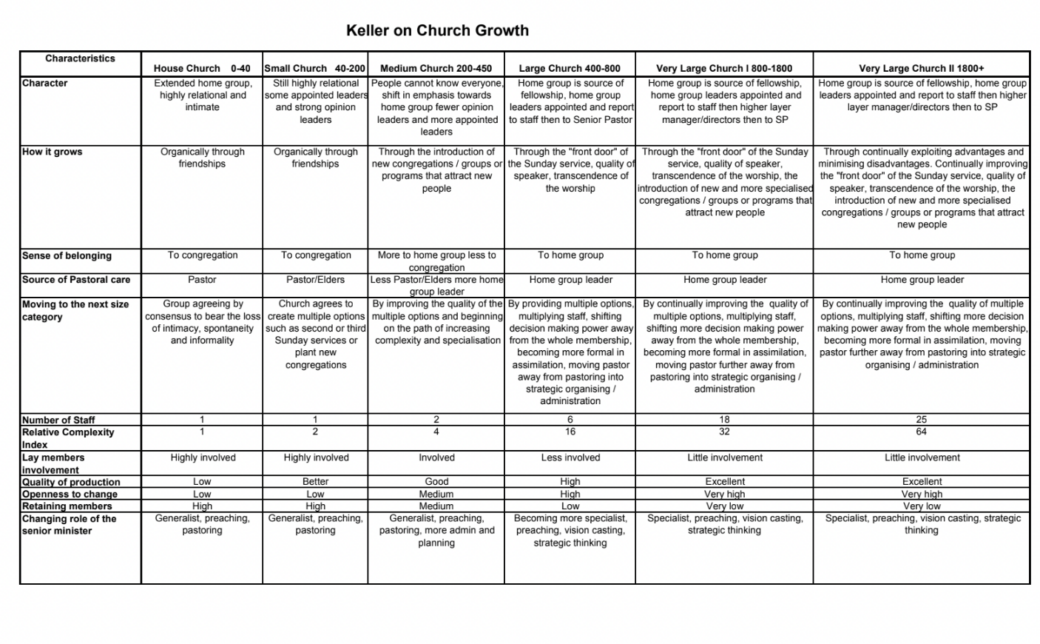
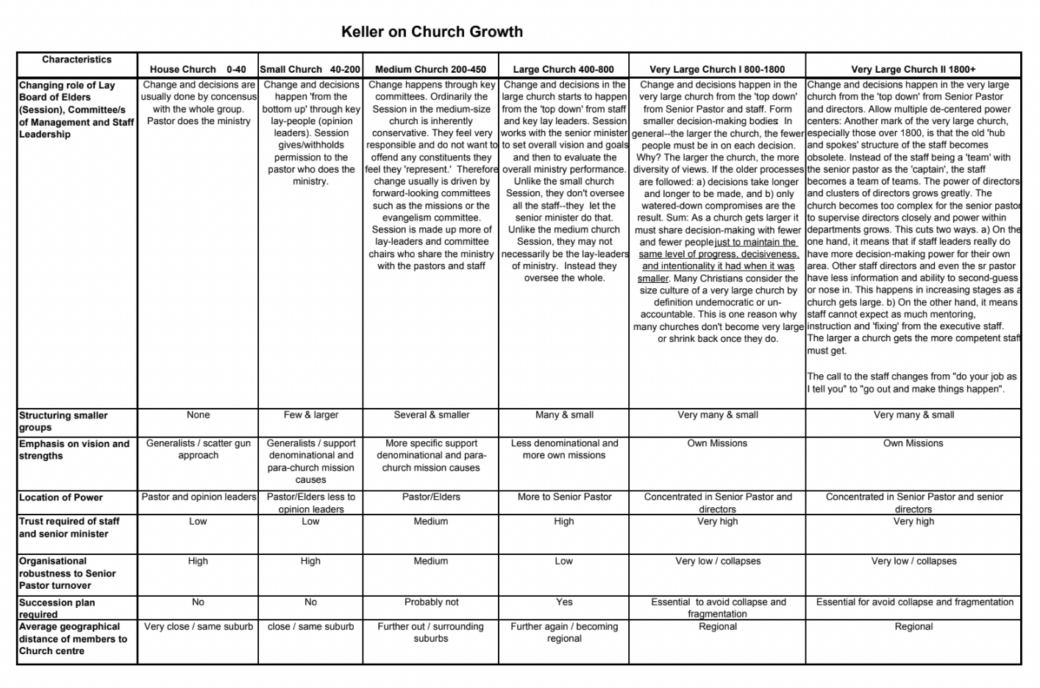
Our manual for thinking about growth and the structures to accommodate it — flagged right from the first vision document approved by the leadership in 2011 — was Tim Keller’s paper ‘Leadership and Church Size Dynamics: How Strategy Changes with Growth’ published in 2006. What Keller described; we prescribed and attempted to systematise. It’s an interesting paper — and particularly interesting to read after Keller’s retirement from Redeemer; where the megachurch that had gatherered around his leadership became a decentralised into a ‘family network’ of autonomous churches (a change announced in 2014).

“One decision we have made that encourages me is that Redeemer will become a family of congregations, not one centralised mega-church.”

In the church size paper, Keller wrote:

“Every church has a culture that goes with its size and which must be accepted. Most people tend to prefer a certain size culture, and unfortunately, many give their favourite size culture a moral status and treat other size categories as spiritually and morally inferior. They may insist that the only biblical way to do church is to practice a certain size culture despite the fact that the congregation they attend is much too big or too small to fit that culture.”

Keller ultimately lays out various aspects of ministry across different sizes of church, but in his discussion before the table he makes the following point:

“…the larger the church, the more a distinctive vision becomes important to its members. The reason for being in a smaller church is relationships. The reason for putting up with all the changes and difficulties of a larger church is to get mission done. People join a larger church because of the vision—so the particular mission needs to be clear. The larger the church, the more it develops its own mission outreach rather than supporting already existing programs. Smaller churches tend to support denominational mission causes and contribute to existing parachurch ministries. Leaders and members of larger churches feel more personally accountable to God for the kingdom mandate and seek to either start their own mission ministries or to form partnerships in which there is more direct accountability of the mission agency to the church. Consequently, the larger the church, the more its lay leaders need to be screened for agreement on vision and philosophy of ministry, not simply for doctrinal and moral standards.”

I would say, rather, that the larger the church the more standardised the vision and execution become across other churches of the same size — vision becomes more motherhood and generic; able to be photocopied — or with vision videos that are able to be plagiarised — because the vision simply becomes to grow; to keep pushing beyond limits — and expanding — through technique, as new members are folded in like cogs in the machine — as the mission of the Gospel becomes more and more aligned with the ‘mission of this church’ — and faithful participation in that mission as disciples becomes faithful service to a philosophy of ministry and vision.

We tabulated the Church Size dynamics paper and used this table as a kind of guideline for where our campuses were at in the matrix. We also struggled to map multisite realities of centralised resources and production values with ‘house church’ vibes.

The machine, by its nature, standardises. The machine church has a standard model for blasting beyond limits that it borrows from the corporate world — the world of the machine — for reasons that are historical and ecological; a product of the technologies that birthed the possibilities for growth via the eradication of limits.

Keller’s paper, and this quote from Larry Osborne’s Sticky Teams were referred to in most documents about our trajectory from here on in.

“Never forget, growth changes everything. A storefront church, a midsized church, a large church, and a megachurch aren‘t simply bigger versions of the same thing. They are completely different animals. They have little in common, especially relationally, organisationally and structurally. It‘s not that one is better than the other. It‘s just that they‘re different. Leadership teams that fail to recognise or adapt to these differences inevitably experience unnecessary conflict or shrink back to a congregational size that best fits the structures and patterns they cling to.”

The impact of this Church Size Dynamics paper being applied to our vision to be a ‘mega church’ was that we were attempting to operate as a ‘very large church’ while arguably a network comprising of a house church, a small church and a medium church. And we were trying to fund the infrastructure of a very large church from this congregation; and then, increasingly, from external sources — whether a user pays subscription model to our resources, or via corporate donors from the big end of town who I speculate may have moved on to fund other similar church planting and resourcing networks and initiatives with similar reach-shaped visions.

I think it’s possible that there actually is a size and a structure where a community is ‘a church,’ and a size where a community must embrace the machine and distorts to being ‘no longer a church’; becoming subject to different technologies and techniques in order to continue to grow by overcoming limits. I don’t think church size is spiritually neutral because it seems to me that to become certain sizes one must embrace methodologies no longer consistent with the nature of a human community, choosing instead to become ‘mechanical’ in nature. Where any person draws the line will be arbitrary — some say more than one service in one location is actually ‘more than one church,’ others might say ‘multisite church’ is a contradiction, for mine, provocatively, my suggestion is that this size could be described as a “human scale church,” with all the human relationships and accountability structures and community and collaboration that involves. For various reasons, my inclination is to see this aligning with the ‘small church,’ which caps out at 200 people. Maybe I’m clinging to a personal preference or moralising my ‘favourite’ size. You can decide.

The thing about a vision so big is, well, its bigness — it removes any limits around what this particular local church in its particular locality might justify as its local mission and replaces ‘local’ with ‘growing’ and ‘reaching.’  

To be fair, locality is an interesting concept when it comes to the modern city and the modern church and the myriad choices available to any Christian living in a city to find a community — does one look for church community where one lives, works, or plays? Whatever church we attend is a choice. This is actually relatively historically novel; and aided by technological and social change.

We live in a world described by Charles Taylor as being shaped by the ‘age of mobilisation’ — where we are no longer pinned down in one geographic location for life (thanks to both social mobility enabled by political and social revolution, and technologies like the automobile and aeroplane), or in one vocation (thanks to technological, industrial, and digital revolutions that broaden the career options available and where work happens) — and the ‘age of authenticity’ where we each cultivate our presence in the world chasing our own ‘expression of self’ based especially on consumer choice and performance (also aided by technologies).

Taylor wrote A Secular Age and Sources of the Self after the internet had occurred, but in the very early days of social media and when Artificial Intelligence was the province of science fiction storytelling. The implications for church membership of mobilisation and authenticity (and post-protestant revolution which created brand ‘choice’ or what Taylor called ‘the nova’) is that church is a choice that individuals make and we make them for individual reasons often disconnected from geography and more aligned with affinity to various other things — people, theological vision, tradition, aesthetic — this consumer choice is fuelled by technology; and the mega church is a creation of technology — and, I would say, of the ‘machine’ as defined by Paul Kingsnorth and others.

This isn’t to say that house churches or small churches can’t be ‘machine’-shaped; of course they can; this is our prevailing culture. I’m seeking, rather, to make the case that big-to-mega churches are necessarily machine-driven, mechanistic or mechanical — relying on technology and technique and shaped by the prevailing conditions of the world around us with a desire to eradicate limits and extract resources in the name of perpetual growth.

At this point, I want to throw in a refresh of Paul Kingsnorth’s ‘machine’ definition, and foreshadow here that I’ll land trying to articulate ‘human scale’ church as an antithesis to machine church (whether that’s small, medium, large or mega-).

In my last post I highlighted a quote from Against The Machine where Kingsnorth wrote “The Machine manifests today as an intersection of money power, state power and increasingly coercive and manipulative technologies, which constitute an ongoing war against roots and against limits. Its momentum is always forward, and it will not stop until it has conquered and transformed the world.”

Grow. Growth. Growing. Growth. Growing. Growing. Reach the city, reach the world.

I also quoted this bit: “The ethos of the Machine is expansion, the busting of limits and the consumption of whatever can be sold to us to meet the ‘needs’ of the individual self which the Machine constructed for us in the first place.”

Our machine church with its emphasis on ’52 Excellent Sundays’ where one could receive ‘transcendent worship experiences’ (no sub-par musicians on stage thanks), and TED style sermons with original graphics and companion videos produced on cutting edge video technology was competing with every other church in our geographic pool to attract ‘ministry partners’ who would give their time and become ‘giving units’ “opening their hearts” to Jesus and then “opening their wallets” because “soft hearts give hard.”

Kingsnorth sees the ‘west’ as inextricably linked to ‘the machine’ such that to engage in ‘western’ practices uncritically is to participate in the machine. Its values are growth and profits and expending profits to secure more growth.

“‘The West’ has become an idol; some kind of static image of a past that maybe once was but is now inhabited by a new force: the Machine. ‘The West’ today thinks in numbers and words, but can’t write poetry to save its life. ‘The West’ is the kingdom of Mammon. ‘The West’ eats the world, and eats itself, that it may continue to ‘grow’. ‘The West’ knows the price of everything and the value of nothing. ‘The West’ is exhausted and empty.”

We were an extraction machine — and this included extracting the time, money and talents of the staff. At one point in a giving crisis, staff giving was being monitored, and senior staff (including me) — most of us renting as close as possible to church at great cost (percentage of our income), had a face to face meeting with the executive team (all a generation older, owning their own homes) and told to tithe our salaries, and to stop visibly spending money on things like fast food (because optics mattered). And, through technology and technique we convinced others to invest in the machine; to invest in the machine. Page 2 of one of our vision documents, titled “Investing in the Next Generation” used the word “invest” 12 times on a single page.

A few pages later the document said:

“We need to invest in people, in the precious people God is bringing to us. We need to invest in the next generation of believers. We need to invest in the people God is raising up from among us to send out as the next generation of labourers in his harvest. In all of this, one more pressing need is very clear. High level management is essential to maximize all our other ministry investments.”

We need to invest in getting our techniques right — and we are the vehicle for this mission. This rhetoric would amp up in subsequent years. People giving ‘hard’ to perpetuate the machine; invited to do so because of the urgent imperative of the Gospel — but the ends of the Gospel were totally identified with expanding our reach and growing beyond limits; even if people were chewed up in the process. Soft hearts gave hard.

I would note at this point, that a feature of machine church — with its acknowledgment that people will leave as you grow — crassly expressed by Mark Driscoll as ‘bodies under the bus’ — is burnout and exhaustion. Once resources are extracted from ‘ministry partners’ because in the parlance of pokie machines they have ‘played to extinction’ they are replaced by newer models and discarded. It is instructive that in a quick survey of vision documents from machine church over the four year period described above, around 80% of the members and staff named in the document are no longer employed by or attending the church.

The problem with the machine when it meets church is that it’s more like Moloch than the one who says “come to me those who are weary and burdened and I will give you rest.” Moloch as Kingsnorth describes it (following the beat poet Ginsberg’s Howl).

“What Moloch wants—Moloch whose soul is electricity and banks—is sacrifice. We must sacrifice ourselves and our children to the robot apartments and stunned governments.”

Kingsnorth writes, at some length, about the relationship between the machine and spirituality (and worship). One issue he identifies is that when we embrace the mediums and methods of the machine — the machine forms us (the medium is the message, thanks McLuhan), and it forms us in its likeness and machinations — not as humans, but so that we are extracted and exhausted.

“In a world in which this Machine consciousness is propagated to us daily through digital technology each time we gaze at a screen, the irrational, illogical world of beauty, wild nature and spiritual truth becomes literally impossible for us to experience, for it cannot be quantified—and therefore doesn’t exist.”

He describes our modern experience in terms similar to Taylor’s, so we westerners, entranced by the machine are “Spiritual but not religious, individualistic on the surface yet conformed beneath to the needs of the Machine, spiritually hungry but devoid of guidance or direction, committed to total self-expression yet unsure who or what we even are, suspicious of any limits to all these enslaving ‘freedoms’: this is our world. One that celebrates the free play of individual desire, that spiritualises the individualistic war on limits, and centres and celebrates the use of technology to win that war—in our bodies as well as the world.’”

We were a church that sought to harness technology and technique — the machine — in our models — mega, multisite, and ‘digital producer’ — breaking limits to win a war; but as soon as we fought this way we were losing.

Though he has converted to Christianity in part as a result of observing the consuming power of the machine, and how the cross of Jesus is its antidote, Kingsnorth notices the way Christianity has been co-opted.

“I learned from that experience that my belief in the profanity of technology is not widely shared. While there have been astute religious critics of the Machine—Wendell Berry, Ivan Illich, Jacques Ellul and Philip Sherrard have all made appearances in this book—it appears that many spiritual leaders and thinkers are as swept up in the Machine’s propaganda system as anyone else. They have bought into what we might call the Myth of Neutral Technology, a subset of the Myth of Progress… On and on it goes: the gushing, uncritical embrace of the Machine, even in the heart of the temple. The blind worship of idols, and the failure to see what stands behind them. Someone once reminded us that a man cannot serve two masters, but then, what did he know?”

In my next post I’ll explore the way the mega church — and the idea of perpetual church growth — the blasting of limits — is a product, directly, not just philosophically, of the machine (first the ‘automobile’) — and tease out some implications.

But here I want to nod towards the beginnings of Kingsnorth’s proposed solution; around the idea of embracing limits — and dip back into an older essay of his to introduce the idea of ‘human scale’ church.

Perhaps the first step of resisting the machine — following Kingsnorth — is to refuse to see (or describe) things that are not machines as mechanical; to cultivate a different imagination — and especially to see organisms and communities as organic rather than technologies to systematise or master; to resist dehumanising language (‘giving units’) and, like the good shepherd, know each sheep by name. Kingsnorth says:

“Perhaps central to this is an effort to see the world as an organism rather than a mechanism, and then to express it that way, through art, through creativity, through writing, through our conversations. The last part is the hardest, very often, but maybe the most important too. If we refuse to see the world or its inhabitants as machines, if we are suspicious of rationalisations and dogmatic insistence and easy answers and false divisions, even for a moment, then we are making a start.”

One of the moments in the life of our church where the machine took over was a time where I had not been living within my own limits — or boundaries — in pastoral care; all things to all people became a mantra not just for evangelistic technique but for constant availability to offer assistance of any manner; fuelled by being constantly contactable. This was bad and my family suffered, I suffered, and the people I cared for suffered — but the solution, proferred by the machine, was to essentially remove me from the same sort of ‘face to face’ contact with people; to move me across Keller’s grid, making me less accessible — behaving less like a ‘pastor sized church’ and more like a ‘big church’ where I led leaders. Overnight the vibe in our community shifted. People lost trust in my love and leadership — not simply in my competency (I am quite happy to admit that I wasn’t competently approaching the task). Instead of a human scaled solution we applied a variety of techniques; people were not people with names and stories, but cases to be managed by teams whose interactions were charted in a ‘customer relationship’ database.

Subsequently he writes:

“The Machine seems a Behemoth, a Leviathan, and it is. But it always manifests its own power at human scale, and that is the scale at which we must take its measure. Jacques Ellul once put it like this: We must not think about Man, but of my neighbour Mario… An anti-Machine politics, it seems to me, must spring from this older, grounded tradition. It should operate at the human scale, and not at the scale on which ideology operates…. A reactionary radicalism, its face set against Progress Theology, which aims to defend or build a moral economy at the human scale, which rejects the atomised individualism of the liberal era and understands that materialism as a worldview has failed us.”

I believe there is a kind of church that operates at this human scale; and that part of this is a differentiated approach to growth. My prayer is that God’s kingdom might grow; that many people might join the Lord of the harvest in fruitful life; experiencing the love of God for eternity — but this growth does not have to be subject to my control, or a ‘machine’ we build in our local church; it does not have to depend on technology or technique. It may come from embracing limits and encouraging others to embrace limits and to expand and duplicate in sustainable ways less reliant on technology, technique, and exhausting the human resources who are united to us by God’s Spirit as we act as the body of Christ together. It might emphasise rest and resistance not just output and productivity. It might take steps to not become big — to not act sizes above the present in order to ‘break through barriers’ and ‘reach more people’ but to steward the gifts and the environment we cultivate together in sustainable patterns that duplicate and give life, rather than joining the mechanical extraction of the natural and human environment that typifies the machine — strip mining all other local churches in the area to fuel your own vision and to add cogs to an ever-more-complex production for people to consume as they are consumed.

Church at a human scale actively resists ‘bigness.’ That’s counter-intuitive, I think, but essential. Before Against The Machine, Kingsnorth published a collection of essays Confessions of a Recovering Environmentalist. This included his essay ‘A Crisis of Bigness,’ in which he observed the failure of nations and systems that go beyond their capacity to operate well and so turn towards staying alive as an alternative to collapse. His thesis, following the work of Leopold Kohr who wrote The Breakdown of Nations in 1957, was that “wherever something is wrong, something is too big.” Kingsnorth asked, “what if big ideas are part of the problem? What if, in fact, the problem is bigness itself?”

Reading back over old vision documents from our machine church I ask myself the same question. Kohr argued that “small states, small nations and small economies are more peaceful, more prosperous and more creative than great powers or superstates,” I wonder if this is true of small churches?

“Socialism, capitalism, democracy, monarchy – all could work well on what he called ‘the human scale’: a scale at which people could play a part in the systems that governed their lives. But once scaled up to the level of modern states, all systems became oppressors.”

I wonder if this is true of megachurches, where, according to Keller, power centralises in the hands of the senior leadership (away from the congregation), and participation in the hands of employees, as growth happens (attendees consume and feed the machine).  

“Kohr demonstrated that when people have too much power, under any system or none, they abuse it.”

This seems true of the countless stories of abusive megachurch leadership we read almost daily. Many of my own reflections on my experience were shaped by having trauma responses while listening to The Rise and Fall of Mars Hill.

For Kohr, “The task, therefore, was to limit the amount of power that any individual, organisation or government could get its hands on. The solution to the world’s problems was not more unity but more division.”

“To understand the sparky, prophetic power of Kohr’s vision, you need to read The Breakdown of Nations. Some of it will create shivers of recognition. Bigness, predicted Kohr, could lead only to more bigness, for ‘whatever outgrows certain limits begins to suffer from the irrepressible problem of unmanageable proportions’. Beyond those limits it was forced to accumulate more power in order to manage the power it already had. Growth would become cancerous and unstoppable, until there was only one possible endpoint: collapse. We have now reached the point that Kohr warned about over half a century ago: the point where ‘instead of growth serving life, life must now serve growth, perverting the very purpose of existence’. Kohr’s ‘crisis of bigness’ is upon us and, true to form, we are scrabbling to tackle it with more of the same: closer fiscal unions, tighter global governance, geoengineering schemes, more economic growth. Big, it seems, is as beautiful as ever to those who have the unenviable task of keeping the growth machine going.”

In my experience these words apply as much to churches as they do to nations.

I don’t want to keep growth machines growing any more — I would love to see more human-scale churches springing up to produce sustainable, life-giving communities as they embrace limits.

Raging against the ‘Machine Church’

I want to start this little mini-series by starting to tease out the idea of ‘machine church’ — and the ‘machine’ as I’m going to describe it, with Paul Kingsnorth as my conversation partner. One of the fundamental ideas behind machine church is the inexhaustible inexorable desire to grow beyond limits, rather than receive and embrace them as creaturely gift; the other main aspect, probably (though there are many components) is the reduction of all things to technology and technique (ala Jacques Ellul’s Technological Society). I’m mostly going to unpack the idea of growth beyond limits being the essence of the ‘machine’ in this post, and will pick up the technology/technique line later.

I don’t want to be Don Quixote tilting at a straw windmill here either, so, through these posts, I’m going to ground these reflections in my own experiences of machine church; which lead me to observe the same fundamentals operating in other churches, systems, and church growth systems.

Paul Kingsnorth’s Against The Machine opens with this line from Wendell Berry.

“It is easy for me to imagine that the next great division of the world will be between people who wish to live as creatures and people who wish to live as machines.”

If he — and Berry — are right in their prophetic/poetic assessment of the modern age, it shouldn’t surprise us to find this tendency at work in the construction of Christian communities as a missiological technique or discipleship strategy — it’s simply an outworking of an anthropology (and perhaps an eschatology).

Kingsnorth also describes — with a dose of Tolkien — the perspective one committed to creatureliness of a certain type might bring to the present moment.

“This world, you can see, is on the way out, if it is not already long gone. The one that is manifesting to replace it is a left-brain paradise, all straight lines and concrete car parks where the corn exchange used to be. The future is STEM and chatbots and cashless parking meters and economic growth and asteroid mining forever and ever. There is no arguing with it. You can feel the great craters that it makes in the world, you can feel what is being tarmacked and neatened and rationalised into oblivion, and the depth of what is leaving, but you cannot explain or justify it in the terms which are now the terms we live by. You just know that something is wrong.”

I’ve written, once upon a time (in 2018 even), about how STEM being the basis of human formation is — to my mind — more dangerous in public schools than sexuality education because it trains a certain sort of participation in the machinery of the economy, to fuel perpetual consumption; so it’s fair to say I resonated with this description (while also, admittedly, often loving being a cog in the consumer machine and the convenience of Amazon’s next day delivery service — a product of its vast magical logistical empire, complex global supply chains, and machine-human hybrid where workers are digitally monitored by wearable tech, and codes and machines augment their productivity).

I know of a church, by the by, that realised it could track an interesting stat — either newcomers or new devices — by observing how many unique/new MAC addresses pinged its router during a Sunday service. Big data.

Kingsnorth describes the machine ‘uprooting’ people from traditions (including religious traditions) and place into a kind of global uniformity, particularly expressed in urban life — those one might, following Marc Auge — describe as ‘non-places’ at a metropolitan level (here’s a sermon from my ‘Being Human’ series exploring how church spaces that are basically black boxes designed for artificial light, smoke machines, and video projection, have become non-places, this is a kind of ‘uprooting’ — the antithesis would be, for example, the rootedness of the Ethiopian Church Forest — that’s an old article where I interact with some older work from Paul Kingsnorth).

At some point in my time at machine church the auditorium at our mothership was painted black. Voices who complained about no longer being able to see one another, or the pages of their paper Bibles were told they would be able to better see the stage and the screen. The goal of this design change was to make Sundays more excellent and the media — on screen and on stage — easier to attend to, and more compelling by contrast. The campus I pastored already met in a black box — first a rented black box theatre, and then a Pentecostal warehouse conversion with an excellent plug and play AV setup with more screens than we could figure out how to use.

Here’s Kingsnorth on the uprooting process:

“We could simply call this process modernity, which is not a time period so much as a story we tell ourselves. But I prefer to call it the Machine, because a machine—as the poets showed me—is what it feels like. This process, which has been going on for centuries, of uprooting us from nature, culture and God, leads us into a mass society, controlled by and for technology, in which we have been on course to become, since at the least the Industrial Revolution, mere cogs in a giant mechanism that we have no control over.”

Kingsnorth talks about the impact of the machine on the architecture of the city; describing a movement from cities designed for ‘human scale living’ where everyone could be addressed by a single voice, to global cities. The idea of a ‘human scale’ church is one I’ll pick up in a future post.

“This is the modern Machine city: global in scale and ambition, bland, homogenised and empty at its heart. Plato’s ideal city, and the real cities of the pre-modern period, were a combination, sometimes uneasy, sometimes harmonious, of ambition and aim. They were religious centres, cultural hubs, marketplaces, dwelling places, loci of power. The twenty-first century city exists mainly for one purpose: profit. Everything that exists there, from schools to art galleries to concert halls to government buildings, is pointed towards this end.”

The goal of the machine is growth — unfettered growth — not to serve its users (who, Matrix style, become its fuel), but its owners — maximising profits, or growth, or bums on seats consuming and paying and spreading your content; probably, in machine church — ‘digital content’ served up on screen corporately, and on your individual pieces of glass through the week. Kingsnorth again:

“This ‘growth’ is the overriding purpose of the ‘global economy’ which the Machine has built: everything else is of secondary concern. The growth has no specific aim and no end in sight, and can always be justified by pointing to problems—poverty, environmental degradation—which were in many cases caused by the growth, but which can now only be solved by more of it. It is facilitated by the production and consumption of ‘goods and services’, the desire (or ‘need’) for which has been manufactured by vast marketing and advertising concerns whose best minds are trained in the essence of psychological manipulation.”

In 2023 I wrote a piece with CPX, also published in Eureka Street, looking at the mechanics of poker machines and how necessary limits are in the design of machines. There’s a thought experiment about the need for limits in the tech-philosophy world, the Paperclip Maximiser Machine (originally from this essay) — this artificially intelligent machine exists with the sole goal to ‘maximise the number of paperclips’; and sets about converting all of material reality into paperclips — ultimately including human bodies. Poker machines, like many other tools of capitalism, are designed to ‘maximise profits’ — in industry parlance, to have users ‘play to extinction.’ This is the machine impulse, and the impulse of the forces Kingsnorth describes.

He introduces Allen Ginsberg’s poem Howl, which compares the consuming power of the machine to Moloch, the devouring pagan god of the Ancient Near East (I’ve used this same poem in an AI talk/lecture thing that I gave at an ISCAST conference a few years ago; I probably should turn that into a post at some point).

The payoff for Kingsnorth, later in his book, is that he sees dark spiritual forces — powers — animating the machine; the kind the Bible might name as Molek (Moloch) and Mammon. And, like the machine Moloch of Howl, or the 1927 silent film Metropolis (that’s the mechanical god from that movie at the top of this post), this profit maximising machine bucks against limits and seeks to devour all it can to serve its ends.

“The Machine manifests today as an intersection of money power, state power and increasingly coercive and manipulative technologies, which constitute an ongoing war against roots and against limits. Its momentum is always forward, and it will not stop until it has conquered and transformed the world. To do that, it must raze or transmute many older and less measurable things: rooted human communities, wild nature, human nature, human freedom, beauty, faith and the many deeper values which we all adhere to in some way or another but find difficult to describe or even to defend. Its modus operandi is the abolition of all borders, boundaries, categories, essences and truths: the uprooting of all previous ways of living in the name of pure individualism and perfect subjectivity. Its endgame is the replacement of nature with technology, in order to facilitate total human control over a totally human world.”

In 2016, when Telstra was running it’s ‘communication technology is magical’ campaign, I read (and wrote about) a book by a technologist, David Rose, Enchanted Objects, he described a kind of ‘machine’ world.

“I HAVE A recurring nightmare. It is years into the future. All the wonderful everyday objects we once treasured have disappeared, gobbled up by an unstoppable interface: a slim slab of black glass. Books, calculators, clocks, compasses, maps, musical instruments, pencils, and paintbrushes, all are gone. The artifacts, tools, toys, and appliances we love and rely on today have converged into this slice of shiny glass, its face filled with tiny, inscrutable icons that now define and control our lives. In my nightmare the landscape beyond the slab is barren. Desks are decluttered and paperless. Pens are nowhere to be found. We no longer carry wallets or keys or wear watches. Heirloom objects have been digitized and then atomized. Framed photos, sports trophies, lovely cameras with leather straps, creased maps, spinning globes and compasses, even binoculars and books—the signifiers of our past and triggers of our memory—have been consumed by the cold glass interface and blinking search field. Future life looks like a Dwell magazine photo shoot. Rectilinear spaces, devoid of people. No furniture. No objects. Just hard, intersecting planes—Corbusier’s Utopia. The lack of objects has had an icy effect on us. Human relationships, too, have become more transactional, sharply punctuated, thin and curt. Less nostalgic. Fewer objects exist to trigger storytelling—no old photo albums or clumsy watercolors made while traveling someplace in the Caribbean. Marc Andreessen, the inventor of the Netscape browser, said, “Software is eating the world.” Smartphones are the pixelated plates where software dines.”

His solution was that rather than ubiquitous black glass and code trying to fill every inch of space, we should harness technology’s magical power by imbuing everyday objects with ‘magical’ properties but in a way that contained (or constrained) the magic within physical limits. He suggested pill boxes that glow when medication needs to be taken (like Bilbo’s sword), or ‘portal wardrobes’ sitting in the homes of extended families across the globe that glowed when a motion sensor across the world revealed the proximity of a family member so you could open the door and chat. He viewed this as an alternative to a world of ‘black glass’ — the black mirror — wall to wall ‘smart’ screens.

There was a conversation I had, while working at machine church, about the prospect of people waking up to start the day staring into a smart mirror that both monitored their dental hygiene and served up a daily devotion — content we could produce — including video snippets from sermons; to maximise our ‘reach’ and the integration of our content into the daily life of our followers. The desire to coat the world in black glass — technology — to have us always attentive to screens that can sell us more stuff and harvest our attention — this is both the warped eschatology of Wall-E or Infinite Jest, and the maximising desire of the surveillance capitalism algorithmic machine. But it, too, is the impulse of the machine to fill all space and to maximise the harvest.

There’s a certain type of thinking that turns the content of the Gospel into a thing — data — to be consumed and believed (and perhaps eventually embodied), something reducible to a series of 0s and 1s — that aims to reduce friction in the transmission of that information and to embrace any possible mediums — without question — so long as they are available and effective.

This reduces ministry, mission, discipleship, teaching, and pastoring to technical issues; a matter of technique, to be amplified by available technology.

Sermons become TED Talks — with imagery and definitely no notes — to be filmed and chopped up into social media highlights, or podcasted around the globe with fancy top-and-tails inviting people to give more or spread the reach — but no rooted, relational, context or connection between speaker and audience. Why shouldn’t they be written by a Chat bot, or delivered by one in virtual reality? Really.

Discipleship becomes ‘serving the machinery’ of the Sunday production, or the extension of the content throughout a network, and being ‘fed’ by consuming more of the product.

Questions about whether the media undermine the message are not asked, or not welcomed. Growth and efficacy — or ‘impact’ — are the measure of faithfulness. This thinking comes from the machine, and serves the machine — embedding it into spheres of human life — communities and spiritual practices — where it should least naturally gain a foothold.

Anyway, back to Kingsnorth — his take is that the ‘machine’ is now so embedded in our physical environment and our psyche that we treat it as natural — there’s a fantastic essay by Neil Postman titled ‘Five Things We Need to Know About Technological Change’ where — in 1998 — he talked about the way technology aims to be ‘mythic’ — to make us think we ‘can’t live without it’ — that it’s part of the natural order; that progress is inevitable and via the mechanisms dictated to us by the workings of our machines. But the machine isn’t natural — it is disruptive.

We do, by our nature, imagine, invent and create tools and technologies. Tolkien’s neat model for thinking about when we do this humanly, as bearers of the divine image, was to create a distinction between sub-creation — making in the image of the maker (like elves) — and a kind of powerful de-creation at the heart of the machinery impulses of Mordor. In a letter to Milton Waldman, who he hoped might publish his books, Tolkien wrote about the sub-creator’s tendency to fall; to try to protect our own creations from the will of the creator, and how this gives rise to ‘the machine’:

“He will rebel against the laws of the Creator — especially against mortality. Both of these (alone or together) will lead to the desire for Power, for making the will more quickly effective — and so to the Machine (or Magic). By the last I intend all use of external plans or devices (apparatus) instead of the development of inherent inner powers or talents – or even the use of these talents with the corrupted motive of dominating: bulldozing the real world, or coercing other wills. The Machine is our more obvious modern form though more closely related to Magic than is usually recognised.”

C.S Lewis, in his first public lecture at Cambridge, recognised the way the machine had coded itself into our imagination and changed our stories — disenchanting them so that the imaginative gap, or conception of the world, between Egypt and Jane Austen was smaller than the gap between Jane Austen and us. Our imaginations have been mechanised — not just in our stories, but in how we perceive and interact with the world, and ‘progress.’ So, Kingsnorth says:

“The values of that Machine are now so ubiquitous that we treat them as if they were as natural as rain or wind. Progress; ‘openness’; an objection to limits and borders; therapeutic individualism; universalism; the rejection of roots, place and history; pure materialism; the triumph of ‘reason’ over ‘superstition’; scientism; commercialism and the primacy of market values: all of these go to make up the unseen and unquestioned value system within which we live, and to which we feel there is simply no alternative.”

Then, citing Lewis Mumford, he says “The Machine, in Mumford’s words, feels ‘absolutely irresistible … and ultimately beneficent’. Opposition to it is presented as naive idealism at best, and a dangerous denial of its benefits to the needy at worst.”

The machine exists to grow. To defy limits. To overcome. At all costs. By any means. To ‘reach the city and reach the world’ — or just ‘reach’ more people… for the good of, well, its mission — even if we claim that it is in Jesus’ name and for his glory; our methods serve the machine, whose mission is antithetical to Christian discipleship; to formation as humans in the image of Jesus; because it exists to form humans into parts of the mechanism — or fuel for the mission; harvesting our attention, our bodies, our energy and our resources to grow and feed itself and produce profits for its masters.

So, Kingsnorth again:

“The ethos of the Machine is expansion, the busting of limits and the consumption of whatever can be sold to us to meet the ‘needs’ of the individual self which the Machine constructed for us in the first place. But all of nature’s functions operate within limits. They rely for their continued operation on a healthy balance of the complex and delicate systems that the living planet brings about.”

I’m not saying that, under God’s sovereignty, faithful mission carried out this way cannot produce fruit — it can and will; God works despite our purposes and against the powers and principalities in many and varied ways. There are still things from my time in machine church that thrill me; much good was achieved, sub-creation occurred — not just magic — the Gospel was preached, lives were transformed as people repented. But results — this sort of fruit — are not the measure of faithfulness; that’s machine thinking (which, again, serves the machine’s goal — self-maximisation and ubiquity).

My thesis is that there are church growth strategies — and models and systems of church life that are functionally mechanical; that share language, methods, and values with the machine — often with the stated goal of a ‘bigger harvest’ — more converts; more people joining the church machine as cogs in the mechanism.

And, even, that this mode of operation will seem natural to anybody building a church community in the machine culture of west, to reach the machine culture of the west, with a genuine zeal to make disciples.

But, just as Kingsnorth sees the machine as cancerous to human flourishing in the western world, I’m going to try to make the case that the nature of the machine — antithetical as it is to being transformed into Christlikeness — is cancerous to discipleship, to community, and to the mission of the Gospel, and we should, indeed, rage against the machine and extract ourselves from its machinating, masticating, cogs — before it chews up more people.