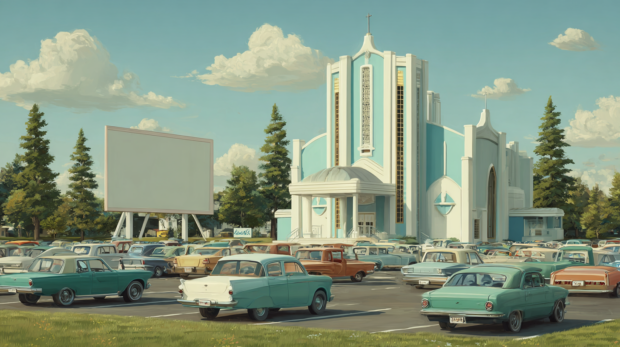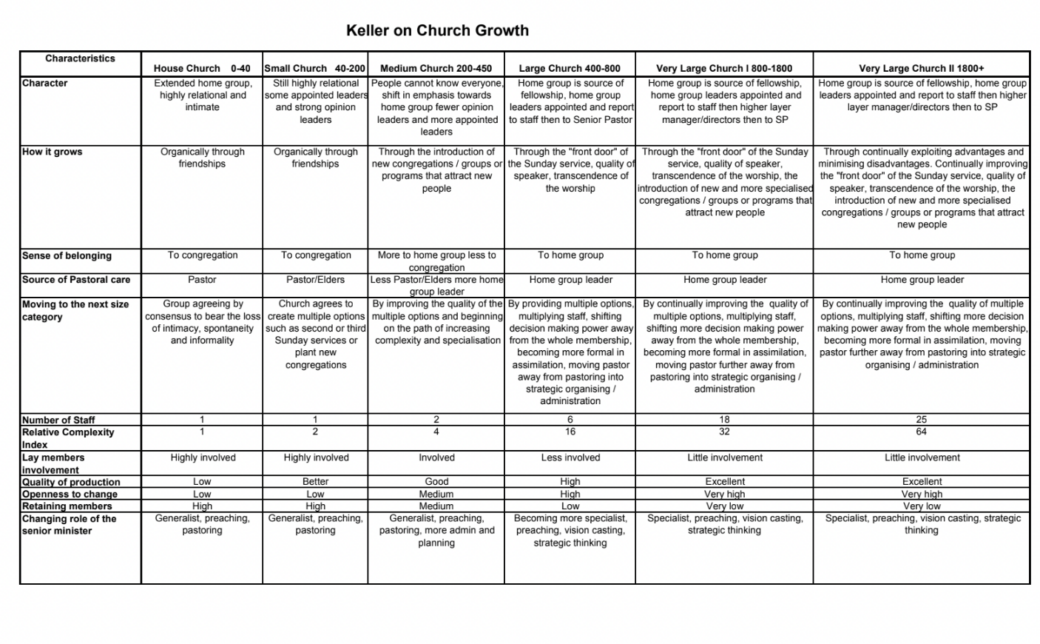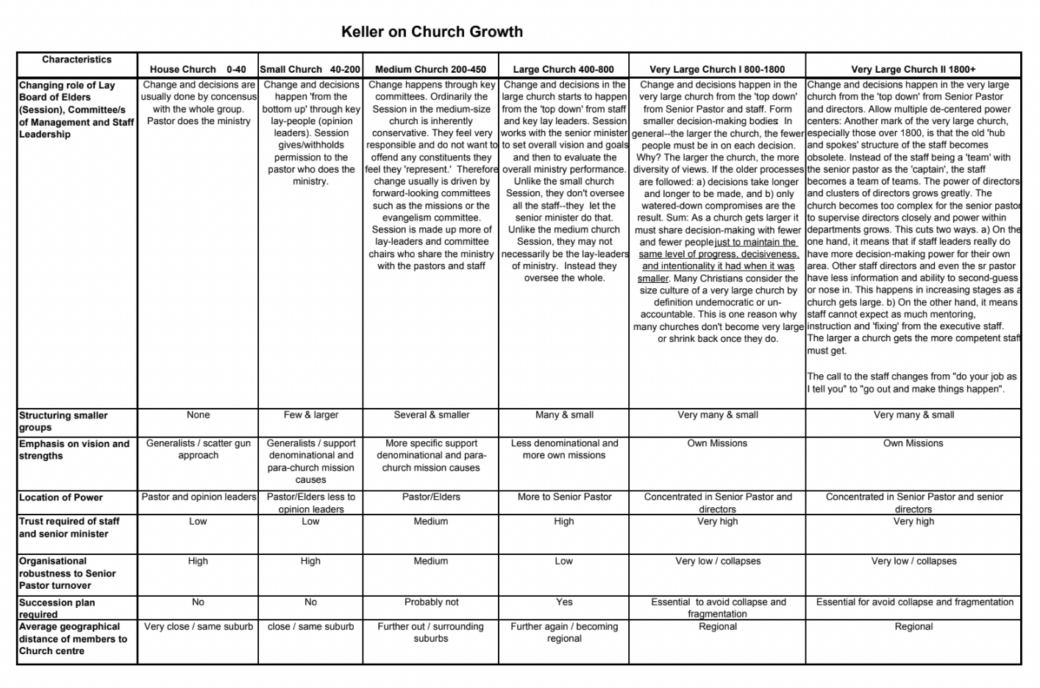
In yesterday’s post we finished an exercise in description that spanned three posts where we describe the way the automobile, when it dropped into the ‘ecosystem’ of human life, re-wrote the physical landscape, and our experience of being human, and through these changes rewrought church community into something new, in ‘its image and likeness’ so to speak.
I’ve drawn quite a bit on Marshall McLuhan in the last few posts; one of my favourite McLuhan books is The Mechanical Bride, where he articulates the challenges and costs of life as a “mechanical bride” wedded to (or as) machines in the “absent-minded technological world” we have created where we become “the robots who are its very conscious victim.”
The idea that the technology we hold — or mediums we work with — shapes our humanity is not new. McLuhan was drawing on the Old Testament’s critique of idolatry in Psalm 115 — you become what you behold. He also observed this pattern working through human history — so that “in a pre-industrial world a great swordsman, horseman, or animal-breeder was expected to take on some of the character of his interests,” but he saw this amplified with people spending all our time and energy “using and improving machines” more powerful than ourselves.
He describes life ‘wedded to the machine’ as a mechanical bride as:
“The ordinary person senses the greatness of the odds against him even without thought or analysis, and he adapts his attitudes unconsciously. A huge passivity has settled on industrial society. For people carried about in mechanical vehicles, earning their living by waiting on machines, listening much of the waking day to canned music, watching packaged movie entertainment and capsulated news, for such people it would require an exceptional degree of awareness and an especial heroism of effort to be anything but supine consumers of processed goods. Society begins to take on the character of the kept woman whose role is expected to be submission and luxurious passivity. Each day brings its addition of silks, trinkets, and shiny gadgets, new pleasure techniques and new pills for pep and painlessness.”
And, finally:
“The human person who thinks, works, or dreams himself into the role of a machine is as funny an object as the world provides. And, in fact, he can only be freed from this trap by the detaching power of wild laughter.”
In what follows, I want to unpack some implications of the descriptive work from the last few posts, and why we might want to avoid being ‘the machine’s kept woman’, and embrace a heroically different approach.
You could probably just read the headings in this one…
Technology is ‘ecological’ and its introduction changes the habitat in which we are habitually human.
The car impacted the physical landscape of both city and country. It changed the architecture of the city street and the home; and the habits and routines of our lives. This change of habitat and habit (or actions), through repetition, shapes our character; it has a kind of feedback loop into our hearts and minds (I’m especially thinking of James K.A Smith’s work on the relationship between ‘liturgy’ and our loves here).
Cars, by changing our physical environment and how we live in it, change our “social imaginaries.” This is a $2 term from Charles Taylor to describe the physical and experiential ‘backdrop’ where we form our beliefs — it ‘frames’ what we can imagine. Social imaginaries — and the things in them — give us new experiences and metaphors and choices by which to think. So, for example, C.S Lewis’s inaugural academic speech De Descriptione Temporum calls the machine the ‘new archetypal image’ that separates us from all humans who came before:
“Between Jane Austen and us, but not between her and Shakespeare, Chaucer, Alfred, Virgil, Homer, or the Pharaohs, comes the birth of the machines… [The machine] alters Man’s place in nature. The theme has been celebrated till we are all sick of it, so I will here say nothing about its economic and social consequences, immeasurable though they are. What concerns us more is its psychological effect.”
Once we have machines in the world, machines become part of our language and the fabric of reality in which we create metaphor and poetry and articulate ourselves.
A few years ago I was asked to speak on generative AI at a conference for young folks in Queensland; one of the things I did for my presentation was ask ChatGPT to rewrite a poem from the Song of Songs where the metaphor was not agricultural, but mechanical — specifically comparing the beloved to a car.
1.
How radiant you are, my love!
Oh, how radiant!
Your eyes behind your glasses are like polished headlights,
Your hair is like sleek carbon fiber,
flowing smoothly over your shoulders.2.
Your teeth are like a row of pristine gears,
perfectly aligned and gleaming.
Each one meshes seamlessly with the other;
not one is out of place.
3.
Your lips are like the curve of a red sports car;
your smile, a flash of chrome.
Your cheeks behind your blush
are like the soft interior leather.4.
Your neck is like a streamlined chassis,
built with precision and grace;
adorned with silver chains,
each one a testament to your elegance.
5.
Your breasts are like twin air intakes,
balanced and symmetrical,
like perfectly tuned components,
enhancing the engine of your heart.6.
Until the dawn’s first light
and the night shadows retreat,
I will revel in your presence
and inhale the new car scent of your essence.
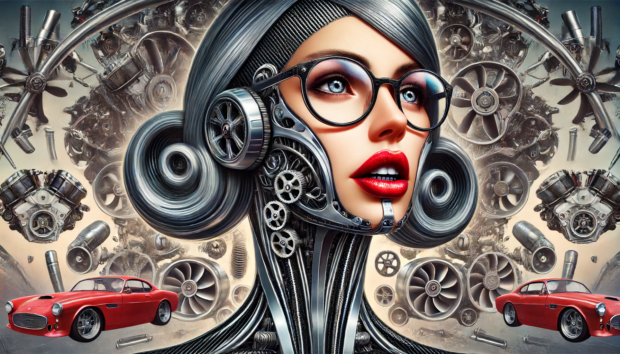
I share this now because this poem was the source of the generated image on this post — a kind of literal rendering of McLuhan’s Mechanical Bride — and because this sort of ‘poetry’ is not imaginable without cars (so comparing this to the original is an example of a changed ‘social imaginary’, and this vaguely nods towards the next point.
Machine technology (including the car) causes Secularisation
Following Charles Taylor’s Secular Age thesis (and descriptive work) one can mount an argument that technology — the machine — mechanisms — produce secularisation, both in the way they open up the landscape, and create autonomy (and the possibility of ‘not’ being in your local church on any given Sunday), and in the way they impact our imaginations, our habitats, and our habits.
You can also get here via C.S Lewis, Neil Postman, Marshall McLuhan, Lewis Mumford, and more recently, Paul Kingsnorth.
The machine secularises.
Here’s some ideas from Charles Taylor that might unpack how this works; again, this is more descriptive work — though Taylor’s arguments around causation are a step more abstract than the description of the car’s impact on the landscape of our cities, and the shape of the church.
Taylor follows a thread from a Dutch philosopher Eduard Jan Dijksterhuis, who describes the “mechanisation of the world picture”; tracking the way scientific thought developed from Pythagoras to Newton. Where once the cosmos was viewed as ‘God’s creature,’ shot through with supernatural meaning and perhaps subject to miraculous intervention, over time it became viewed as a “system” of “mutually affecting parts” — a mechanism — designed to “work in certain ways” to “produce certain results,” and we work out ‘God’s purposes’ by discerning “what ends a mechanism of this kind is well designed to serve.”
This shift was aided by the development of mechanisms — like clocks — that allowed God to be conceived of as a “watchmaker”… Here’s Taylor again arguing that mechanistic theories about the universe didn’t just undermine the idea of ‘ideal forms’ (Plato) or ‘inbuilt purpose’ (Aristotle), but the idea of ‘enchantment’ or Spiritual reality surrounding us, “making the presence of God in the cosmos something which was no longer experience-near… God’s power was no longer something you could feel or see.” It now:
“[God’s power] had to be discerned in the design of things, the way we see the purposes of the maker or user in some artificial contrivance, a machine—an image which recurs again and again in the discourse of the time, particularly in the simile likening the universe to a clock.”
Our metaphorical model of the human brain and body has followed this approach to the universe; where once we described them as ‘machines,’ it became popular to describe the brain as a computer… this 2017 Wired article suggests ‘Tech Metaphors Are Holding Back Brain Research,’ noting:
“In ancient Greece, the brain was a hydraulics system, pumping the humors; in the 18th century, philosophers drew inspiration from the mechanical clock. Early neuroscientists from the 20th century described neurons as electric wires or phone lines, passing signals like Morse code. And now, of course, the favored metaphor is the computer, with its hardware and software standing in for the biological brain and the processes of the mind.”
Taylor observed this shift involved no longer simply “observing” God revealing himself through signs and symbols — but becoming participants in the systems and purposes we discerned in nature — his world, and in his Word — “we have to abandon the attempt to read the cosmos as the locus of signs, reject this as illusion, in order to adopt the instrumental stance effectively,” which ‘disenchants the universe’ and so secularises. This process happens through an exchange where we “trade in a universe of ordered signs, in which everything has a meaning, for a silent but beneficent machine”…
Taylor calls this a shift from ‘cosmos’ to universe.
The cosmos had spiritual and material realities where material things had “undeniable meanings”; pointing beyond the material, revealing “higher and lower kinds of being,” while the universe itself is unresponsive, or indifferent, like a machine, “even if we held that it was designed as a machine for our benefit.”
Taylor describes God’s voice becoming “inaudible… against the din of machines,” against a changing backdrop as the nature of society shifted; where the skyline is no longer framed around a Cathedral, but “individual great buildings each monumentalize some corporation or triumphant entrepreneur, while on the other, vast areas of the city form a crazy quilt of special purpose constructions—factories, malls, docks—following each some fragmentary instrumental rationality.”
Ooft. As the young people say.
The technology we surround ourselves with infiltrates our thinking and experience — and tends towards making us think and act ‘mechanistically’ — one can observe the way the automobile has done this in the description of its reshaping of urban and church life, and sense of being human ‘uprooted’ from location in ‘one space’ for our lifetime, and free to pursue our autonomous individual goals and preferences.
Part of how the machine secularises is by creating consumer choices — and shaping us as ‘consuming machines’. The human temptation, since the Eden story, has been to ‘become like God’ via objectification, extractive commodification, and consumption (seeing, desiring, and taking).
We become what we behold. What we habitually hold — living in a machine world — shapes our habitats and habitats; our cities. Our technology rewires us as consumers who ‘imagine’ life via machine metaphors, forms us to be machine-like. This is not the ‘end’ of the church — which is to habituate us into Christlikeness.
Machine technology, after ‘disenchantment’ offers alternative enchantment through ‘magical idols’ that shape us (and our communities) in their image
The other catch is that these machines don’t just alter our ‘altar moments’ — by shifting our imagination and our habituation, machines end up becoming idols; symbols that themselves have quasi-religious, or actual religious, significance. The spiritual world abhors a vacuum. They don’t just secularise; but paganise — with their own mythology, ritual and eschatologies.
An author named Erik Davis makes this case in a book titled TechGnosis: Myth, Magic, and Mysticism in the Age of Information, he says:
“By appropriating and re-visioning communication technologies, the spiritual imagination often fashions symbols and rituals from the technical mode of communication it employs: hieroglyphs, printing press, the online database. By reimagining technologies in this way, new meanings are invested into the universe of machines, and new virtual possibilities emerge.”
I’m not suggesting we consciously worship the car — but the shift in values, and architecture, and habits, observed in our descriptions suggest this shift has already taken place at a subconscious level.
Davis saw this ‘TechGnosis’ — a sort of technological religion — being pretty closely linked to what Kingsnorth calls the Machine — also drawing on Lewis Mumford.
“For well over a century, the dominant images of technology have been industrial: the extraction and exploitation of natural resources, the mechanization of work through the assembly line, and the bureaucratic command-and-control systems that large and impersonal institutions favor. Lewis Mumford called this industrial image of technology the “myth of the machine,” a myth that insists on the authority of technical and scientific elites, and in the intrinsic value of efficiency, control, unrestrained technological development, and economic expansion.“
If life ‘mediated by machines’ disenchants, we should consider what happens when church life is mediated to us by machine (the car… or the screen)
If our description was correct — that the car (and the way cars were sold) produces radical neo-liberal autonomous (auto-mobile) individual who values “speed, fun, personal freedom, and individual mobility” plus “choice and identity” in ways not before seen (or possible), this seems at odds with a Gospel that says ‘you are not your own, you have been bought at a price, therefore honour God with your bodies” and encourages us into a life of mutual submission and belonging to Jesus and one another in embodied, gathering, community.
When church becomes a consumer product that people ‘choose’, and ‘belonging’ becomes about what you get ‘as you consume’ — or what you can give in order for the machine to grow and attract (and extract) more from other humans in order to keep feeding itself; you end up with something more like Moloch, Marduk, and Babylon, than like Eden or the New Jerusalem. And a church more like the ‘whore of Babylon’ in Revelation who loves the economic value and power on offer from the beastly military and economy of Rome, than the bride of Christ.
Our task as the bride of Christ is not to be ‘mechanical brides’ who represent the values, practices, ecology, and idolatry of our machine cities; which function as extractive, objectifying, consuming, dominion machines built on perpetual desire and promises of ‘heaven on earth’ arriving through our power; our technologies and techniques — through the machine — our task as the church — the bride of Christ — is to be working out how to be united to him and so mediate his presence and way of life to the world, as a ‘holy priesthood’ — this is what priests do.
We should engage technology and technique critically; not as defaults or norms or ‘inevitable’ goods
If machines — like the car — change our habitats and habits, captivate our imaginations, and can lead to ‘secularisation’ and a mechanical view of the universe; we should critically, not uncritically embrace them into our lives and our experiences — and work at being conscientious and conscious observers of the way the ‘machine’ values of the world infiltrate our lives, our churches ‘ecologically,’ including the ways in which we access and participate in life with God.
We are conditioned, by the prevailing culture, to love technology and technique and pragmatism and the ‘instrumental stance’ in ways that disenchant.
This feels abstract until we consider how faithfulness to God can sometimes feel like it is reduced to ‘serving in a production or program in a Sunday event with well-oiled precision.’
Or, until we consider how we might be made to be ‘located’ and limited in time and space — to participate in the ‘fruitful’ mission of God stewarding (cultivating and keeping) our selves and the space we occupy as places where heaven and earth are meeting, but instead are prone to creating ‘black box’ “non-places” of transience (with sufficient car parking), where artificial lighting amplifies what is happening on stage, and darkness amplifies what happens on screen; as we consume — where we could be ‘any where’ and ‘any when’ — in a drive-in, or at home engaging via a screen.
And, maybe we could also consider that the sacraments — in the Reformed tradition — are not simply ‘pedagogical techniques’ but a participation in reality as it is, anticipating what it will become. They are means of grace, and the elements — the water of Baptism, or bread and cup, teach us about the shape of heavens and earth — and the meaning, significance, or purpose of material reality by doing and being something. While also, the event, or practice orients us — where, for example, ‘discerning the body’ in communion is not just about what’s going on in the bread but recognising who you are connected to spiritually and ‘in the flesh’ in the body of Christ around you and participating in an act of spiritual unity. The physical elements are a picture of the way creation itself is oriented to, or has a telos, aligned with worshipping the creator. Churches are not ‘opt in’ events you drive to; but an organic network of flesh, blood, and Spirit, you belong to — with obligations and commitments beyond consumption; where you have a role to play in the gathering, and as the gathered people ‘in the world’ (not just in an event, or for a corporation).
There’s a risk that church can become about consumption of information produced by workers in the machine (content generators and the ‘evangelical industrial complex’), in programs tailored to attract and retain consumers (sometimes crassly called ‘giving units’) who will fuel the perpetual pushing beyond limits. The machine then exists to create more trinkets and shiny gadgets — church apps — and techniques — to maximise engagement with ‘the machine’ that is the church via our mechanical and digital technologies.
Seeing these patterns invites us to conceive of discipleship differently; as oriented away from extractive, objectifying dominion (the ethos of the machine) towards life-giving, fruitful, generativity as image bearers of the living God. I’ll unpack more of the way ‘auto-mobile’ or ‘machine’ church views discipleship and formation (as tied to ‘serving in, or fueling, the machine’) in a future post. Seeing the way we have become subject to machines — without even noticing — to their mythology and allure — does invite us to unplug; and perhaps some of this requires laughter.
A way to resist involves cultivating a different kind of ecology through different habits, and limitations, around our use of machines
We’re already used to thinking about how we limit the impact of things like smart phones on our psyche (and our bodies). What do healthy limits on cars and ‘auto mobility’ looked like (and indeed, as we’ll see, the use of digital technologies in church communities and gatherings too)?
What happens if our churches take on the principles, practices — the technologies and techniques — of the objectifying and extracting, all consuming cities we exist in?
What does it look like to plant gardens and build houses — little Edens where God dwells with his people — in mechanised Babylon? In an automobile city?
Automobile cities and automobile churches are expressions of the logic of ‘the machine’ (and “the Machine” is Babylon)
Here it’s time to bring back some Kingsnorth Against The Machine… to remind ourselves what it is he observes animating the modern city and the modern citizen (that I’m suggesting animates the modern machine church too). Here’s, again, the animating logic of the machine:
“The ethos of the Machine is expansion, the busting of limits and the consumption of whatever can be sold to us to meet the ‘needs’ of the individual self which the Machine constructed for us in the first place. But all of nature’s functions operate within limits. They rely for their continued operation on a healthy balance of the complex and delicate systems that the living planet brings about.”
His take on the myth of progress is pretty much exactly what C.S Lewis spoke about in his lecture… and what Taylor observes in his secularisation thesis built on ‘mobilisation,’ and ‘disenchantment’ of space and time through the rise of a mechanised concept of the universe.
“Here is where we find ourselves: in a world in which all of our desires, needs, projects and even attempts at resistance end up furthering the progress of the Machine. The values of that Machine are now so ubiquitous that we treat them as if they were as natural as rain or wind. Progress; ‘openness’; an objection to limits and borders; therapeutic individualism; universalism; the rejection of roots, place and history; pure materialism; the triumph of ‘reason’ over ‘superstition’; scientism; commercialism and the primacy of market values: all of these go to make up the unseen and unquestioned value system within which we live, and to which we feel there is simply no alternative.”
Babylon’s creation story, the Enuma Elish gives an account of the birth of the city of Babylon, where the God, Marduk, creates the world out of the bodies of the other gods he violently dismembered; he makes humans to serve the gods, and they make a ‘tower of Babylon’ (from bricks) that reaches the heavens, where the gods will feast, attended by their human slaves.
Babylon’s king at the time of Judah’s exile — Nebuchadnezzar, liked to make young men from captured nations into Eunuchs who would serve the royal court; he built towers to the heavens from bricks stamped with his name (there are examples in the British museum). He feasted on wealth he extracted from the world through his grasping, all consuming, power; his city extracted life from the surrounding nations. The book of Daniel describes him building a golden image (using the same word as the ‘image of God’) and demanding all people “of every language and nation” worship him (a reversal of the tower of Babel). The logic of Babylon is violent extraction — the objectification of others, and commodification of nature, fuelled by the desire to consume. This is how Paul Kingsnorth describes the ‘city’ built according to (or shaping) the logic of machines — the kind of city that begins being ‘the norm’ once cars, roads, and suburbs reshape the landscape and our urban architecture:
“The lesson is old and growing more obvious daily: a city, unlike a village, can never be self-sufficient. A giant city is a kind of micro-empire: it cannot exist without enclosing and harvesting lands and peoples elsewhere to provide for its own growth. One of the great myths of the city is that we go there to individuate—to ‘find ourselves’. It might be more accurate to say that the city removes our agency, deskills us, and toys with us at its leisure. A city’s inhabitants are dependents: they have neither the space, the skills, the time nor the inclination to fend for themselves. A city dweller exists to serve the city. If she is lucky, the city will also serve her. If she is unlucky, she will end up juggling three jobs and trying to scrabble together enough pennies to feed her children.”
This is how the Book of Revelation describes Rome — first century Babylon… in Revelation 18…
When the kings of the earth who committed adultery with her and shared her luxury see the smoke of her burning, they will weep and mourn over her. 10 Terrified at her torment, they will stand far off and cry:
“‘Woe! Woe to you, great city,
you mighty city of Babylon!
In one hour your doom has come!’11 “The merchants of the earth will weep and mourn over her because no one buys their cargoes anymore— 12 cargoes of gold, silver, precious stones and pearls; fine linen, purple, silk and scarlet cloth; every sort of citron wood, and articles of every kind made of ivory, costly wood, bronze, iron and marble; 13 cargoes of cinnamon and spice, of incense, myrrh and frankincense, of wine and olive oil, of fine flour and wheat; cattle and sheep; horses and carriages; and human beings sold as slaves.
14 “They will say, ‘The fruit you longed for is gone from you. All your luxury and splendor have vanished, never to be recovered.’ 15 The merchants who sold these things and gained their wealth from her will stand far off, terrified at her torment. They will weep and mourn 16 and cry out:
“‘Woe! Woe to you, great city,
dressed in fine linen, purple and scarlet,
and glittering with gold, precious stones and pearls!
17 In one hour such great wealth has been brought to ruin!’“Every sea captain, and all who travel by ship, the sailors, and all who earn their living from the sea, will stand far off. 18 When they see the smoke of her burning, they will exclaim, ‘Was there ever a city like this great city?’ 19 They will throw dust on their heads, and with weeping and mourning cry out:
“‘Woe! Woe to you, great city,
where all who had ships on the sea
became rich through her wealth!
In one hour she has been brought to ruin!’
Oh yeah, and:
Your merchants were the world’s important people.
By your magic spell all the nations were led astray.
24 In her was found the blood of prophets and of God’s holy people,
of all who have been slaughtered on the earth.”
Rome; Babylon — and, in Revelation, ‘that great city where Jesus was slain’ — Rome/Jerusalem/Egypt — the archetypal city of Cain; of refuge for the rebellious — the city extracts resources and wealth, so the rich get richer — it pulls people of all nations away from God with its pomp and ceremony; its golden images and towers — and it slaughters those who will not bend the knee to its extractive power. You’re on the bus or under the bus, so to speak. People exist to feed the machine; life is created by dismemberment, objectification — turning folks into cogs who plug in and serve, until they are discarded — who enjoy the spoils and trinkets while they can.
Kingsnorth says:
“This is the modern Machine city: global in scale and ambition, bland, homogenised and empty at its heart.”
I fear this could describe the ‘machine’ church — the mega church; geared around consumer satisfaction and consumption; around what will cause an individual to hop in their car and drive to an experience that is ‘fast, loud, and individuating’ with great bells and whistles — differentiated from the other machines, like auto-mobiles offering optional extras or choices of colour.
Kingsnorth describes Plato’s concept of a ‘human scale city’ by contrast. Here are a few quotes,
“As so often, this is a question of scale. Plato, according to Mumford, ‘limited the size of his ideal city to the number of citizens who might be addressed by a single voice’. Everyone should be within hailing distance of that voice in order to ensure human-scale living. Some ancient cities were indeed built on almost this scale, at least initially. There are towns, and city centres, across Europe and Asia today which are beautifully organised, stunning to look at and in some cases thrilling to visit or live in.
Plato’s ideal city, and the real cities of the pre-modern period, were a combination, sometimes uneasy, sometimes harmonious, of ambition and aim. They were religious centres, cultural hubs, marketplaces, dwelling places, loci of power. The twenty-first century city exists mainly for one purpose: profit. Everything that exists there, from schools to art galleries to concert halls to government buildings, is pointed towards this end. You can judge a culture, I think, by its tallest buildings; what it chooses to reach towards is a reflection of its soul and purpose. The tallest buildings in a modern city are not cathedrals, temples, or even palaces: they are skyscrapers, which are homes to banks, finance houses and global corporations.
The pre-modern city and the contemporary metropolis are different not just in scale, but in essence. The city itself ‘becomes consumable, indeed expendable: the container must change as rapidly as its content. The latter imperative undermines a main function of the city as an agent of human continuity. The living memory of the city, which once bound together generations and centuries, disappears: its inhabitants live in a self-annihilating moment-to-moment continuum.”
Machine churches operate with the logic of machine cities — they create dependency, remove agency, promise we will find ourselves but ‘deskill’ and demotivate us, so that faithful discipleship is reduced to participation in the services and programs — and, if you are lucky, they will also serve you. They promise abundance but deliver scarcity and perpetual grasping for more as the machine tries to expand its reach.
Kingsnorth’s treatment of the city — and the human scale — provides an antidote to Babylon, or the machine — a bit like the humble ‘planting gardens, and building houses’ was God’s call to Israel through Jeremiah while they were in Babylon; we are — like Daniel — called to faithful presence and differentiation; to not bow the knee or enjoy the ‘meat’ on offer on the city’s menu.
Nebuchadnezzar demanded people of every tongue and nation participate in the extractive nature of the city; recognising him as the embodiment of Marduk; bowing down and worshipping — on threat of death. Jesus, the lamb who was slain who is seated on the throne of heaven invites people of every tribe, tongue and nation, to come before his throne and join with him as the bride of Christ as he lays down his life for us — the logic of our communities has to be different to the logic (and practice) of those wedded to “the machine,” we cannot simply uncritically employ machines and the logic of the city (or empire) to ‘reach people for Jesus.’
We are not mechanical brides.