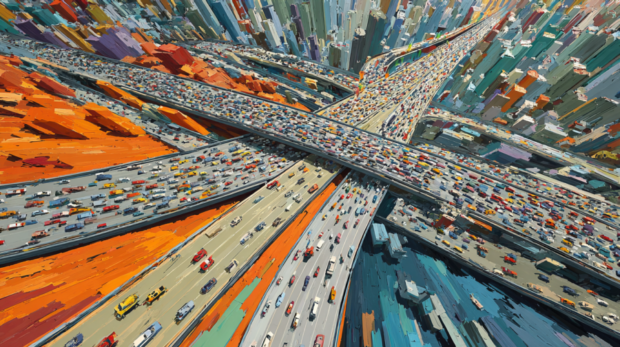
C.S Lewis would hate the machine church.
Because the machine church is, fundamentally, a product of the car — and an imagination shaped by mechanics — though it is increasingly becoming a product of the screen.
In De Descriptione Temporum, his inaugural public lecture at Cambridge, Lewis noted that the image of the machine “potent in all our minds, reigns almost without rival,” and that this especially brought with it the idea that the old should not be conserved but superseded with the ‘new’ or the innovative and that “our assumption that everything is provisional and soon to be superseded, that the attainment of goods we have never yet had, rather than the defence and conservation of those we have already, is the cardinal business of life” would be the thing that would most shock people who lived before the age of the machine.
In Surprised By Joy, published in 1955, Lewis reflected, at one point on the automobile. He wrote about being glad that his father didn’t have a car, but sometimes family friends would take him for drives to far off places:
“This meant that all these distant objects could be visited just enough to clothe them with memories and not impossible desires, while yet they remained ordinarily as inaccessible as the Moon.
The deadly power of rushing about wherever I pleased had not been given me. I measure distances by the standard of man, man walking on his two feet, not by the standard of the internal combustion engine. I had not been allowed to deflower the very idea of distance…”
And then…
“The truest and most horrible claim made for modern transport is that it “annihilates space.” It does. It annihilates one of the most glorious gifts we have been given. It is a vile inflation which lowers the value of distance, so that a modern boy travels a hundred miles with less sense of liberation and pilgrimage and adventure than his grandfather got from traveling ten. Of course if a man hates space and wants it to be annihilated, that is another matter. Why not creep into his coffin at once? There is little enough space there.”
The idea that the car annihilates space is something you might get your head around if you imagine the limits imposed on travel by having to use one’s own feet, or a bike, or a horse — the car suddenly makes bit distances less imposing — but also makes it significantly easier not to be embedded in a place; a village, or community.
In a letter to his friend Bede Griffiths, in 1946, Lewis had also commented on the way the radio and newspaper had a similar impact in terms of pulling people from the limits of local life and our ability to pay attention to our local neighbours.
“It is one of the evils of rapid diffusion of news that the sorrows of all the world come to us every morning. I think each village was meant to feel pity for its own sick and poor whom it can help and I doubt if it is the duty of any private person to fix his mind on ills which he cannot help.”
C.S Lewis loved limits, embodied life at a human scale and human pace.
He didn’t like cars, or ‘the machine’ because of their impact on our experience and understanding of what it means to be human.
Humans, as creatures, are limited — without technology — to occupying one little patch of ground and moving from patch of ground to patch of ground quite slowly. We, via our senses, have the ability to know what’s going on in the general area we’re occupying unless some time passes and information can be brought from elsewhere in various forms; now, to borrow a phrase, we’re subject to everything, everywhere, all at once — our attention can be on matters on the other side of the globe almost as they happen. And the car was a step towards this present.
Jacques Ellul, in The Technological Society (1954) expressed similar sentiments, but in this case about the plane. His point is that as we introduce changes to our experience of the world that change our habitat, something about us changes through this process.
“Technique has penetrated the deepest recesses of the human being. The machine tends not only to create a new human environment, but also to modify man’s very essence. The milieu in which he lives is no longer his. He must adapt himself, as though the world were new, to a universe for which he was not created. He was made to go six kilometers an hour, and he goes a thousand. He was made to eat when he was hungry and to sleep when he was sleepy; instead, he obeys a clock. He was made to have contact with living things, and he lives in a world of stone. He was created with a certain essential unity, and he is fragmented by all the forces of the modern world.”
Paul Kingsnorth, whose Against The Machine is still the primary conversation partner for this series, draws a pretty direct line between Ellul’s capital-T “technique” and what he calls the machine. But the idea here is that when our experiences of the world are mediated by machines, this fundamentally changes both the ‘experience’ where the machine is added, and us.
Cars significantly altered the landscape — literally — and metaphorically. They, after the railway, changed the architecture of how and where we live, how cities were designed, and so how we spent time and gathered with others.
The way we organised our lives — our housing — our villages, towns, cities and suburbs was profoundly altered by the rise of various machines.
You can trace some of the automation of life back to the communal clock in the village, which had people working ‘like clockwork.’ There’s a whole rabbit-hole we could go down about how clocks cause secularisation, but… rather than diving head first, I’ll just suggest that change — including changes wrought on our humanity — don’t just happen as a product of ‘ideas’ but also through the deliberate or accidental things we do that shift our environment, or our embodied experience of time and space, which then massage us. Habitats shape habits. Habits are a type of liturgy, or worship. Habitats are a product of how we structure our physical spaces — our architecture and artefacts (like technology). Media ecologist Marshall McLuhan wrote:
“During the Middle Ages the communal clock extended by the bell permitted high coordination of the energies of small communities. In the Renaissance the clock combined with the uniform respectability of the new typography to extend the power of social organization almost to a national scale. By the nineteenth century it had provided a technology of cohesion that was inseparable from industry and transport, enabling an entire metropolis to act almost as an automaton.” — McLuhan
The city became like a robot; coordinating human behaviour so we acted like robots. Machines. Mechanisms in a giant clockwork city.
The clock, the factory — clockwork mechanised production lines — the industrial age, the steam engine, the telegraph, and then the automobile radically reshaped our relationship to space and the architecture of our lives; each embedding the machine more and more into our psyche and practices.
In Understanding Media (1964) — hands down one of the most prophetic commentaries on technology from the 20th century — Marshall McLuhan hammers home the way small technological innovations create big changes to our humanity — where the media is the massage (not just the message). He wanted us to notice the way technology wrought these changes; not so much because he thought they were negative — but because they could be, and if we never noticed we would assume things are good and natural, when in fact they are artificially directed by those who profit — or by happenstance, without intention.
He points out, for example, that the medieval landscape — physically, and in terms of the social dynamics of power — were radically altered by the invention of a stirrup — which meant an armoured knight could be saddled as a powerhouse, and that the power of the wheel was only truly harnessed with the development of a system of harness and collar that allowed horses to carry much larger carriages, leading to “the development of wagons with pivoted front axles and brakes” by “the middle of the thirteenth century.”
This technology had massive impacts on town life; peasants could live in cities and work in fields. Horse power became the metaphor or measure of the machine. Horse drawn ‘public transport’ changed the game; housing could be developed out of sight of shops and factories; having such technologies in use, and in the imagination, meant the railroad was a natural development when steam engines could produce more ‘horse power’ — housing estates sprang up around train stations; the suburbs were born; shops and community spaces were built around these hubs. Where once a church would be built in the ‘town square’ at the centre of urban life, the suburb decentralised, creating suburban churches. Then came the car, which, McLuhan says “dissolved this grouping and ended the pedestrian, or human, scale of the suburb.”
In his account of the development of the city and suburb around the car, McLuhan says machine-created cities ‘fragmented’ pastoral life; the ‘wheel and road’ made centralised life possible by creating access to geographic margins — like a hub and spokes. He predicted a decentralising chain through ‘electronic media’ —think of how we can now ‘telecommute’, or work from home (thanks Zoom and Covid, and see the current discussions around working from home because of fuel prices). He said:
“All electric forms whatsoever have a decentralising effect, cutting across the older mechanical patterns like a bagpipe in a symphony.”
In a future post I’ll track a decentralising development of ‘electronic church’ against the previous ‘car church’ with the machine church paradigm…
McLuhan, a bit like Lewis, sees the ‘expansion’ of our embodied life by car, and then electronically — and the ‘gain in power’ over space where we “extend our bodies” as an explosion of “the inner unity of our beings into explicit fragments,” an annihilation, if you will, and documented a “growing uneasiness about the degree to which cars have become the real population of our cities, with a resulting loss of human scale, both in power and in distance.” As a result of this unease, and observing a shift in technology — he predicted in 1964, a global village where people would work and shop electronically.
“If the motorist is technologically and economically far superior to the armored knight, it may be that electric changes in technology are about to dismount him and return us to the pedestrian scale. “Going to work” may be only a transitory phase, like “going shopping.” The grocery interests have long foreseen the possibility of shopping by two-way TV, or video-telephone.
William M. Freeman, writing for The New York Times Service (Tuesday, October 15, 1963), reports that there will certainly be “a decided transition from today’s distribution vehicles… Mrs. Customer will be able to tune in on various stores. Her credit identification will be picked up automatically via television. Items in full and faithful colouring will be viewed. Distance will hold no problem, since by the end of the century the consumer will be able to make direct television connections regardless of how many miles are involved.”
So. He was right. Since he was prescient on that front, let’s sit for a minute with a couple more of his observations that got him to these conclusions.
McLuhan pointed out that the automobile both ‘democratised’ — levelling out the middle and upper classes through shared access to locations (including for holidays), and ‘standardised,’ he quoted an American author, John Keats (not the poet) who wrote, in The Insolent Chariots (1958), “where one automobile can go, all other automobiles do go, and wherever the automobile goes, the automobile version of civilization surely follows.” McLuhan points out that this dynamic goes back to “the assembly line,” which produces “standardised culture” where “The car is a superb piece of uniform, standardized mechanism,” that “gave to the democratic cavalier his horse and armor and haughty insolence in one package, transmogrifying the knight into a misguided missile.” He says when the car was ‘new’ it “broke up family life,” it “separated work and domicile as never before,” it “ exploded each city into a dozen suburbs, and then extended many of the forms of urban life along the highways until the open road seemed to become non-stop cities,” creating “asphalt jungles,” and causing “40,000 square miles of green and pleasant land to be cemented over.”
They paved paradise, and put up a parking lot.
The car “refashioned all of the spaces that unite and separate” humans — including churches — and would keep doing so until “the electronic successors to the car” turn up. The risk of this electronic form, for McLuhan, was a greater annihilation of space and time through further extending our reach; it’s interesting how much an extension of reach annihilates and fragments. Reach might not be the best name for an attempt to create communities that humanise…
“What the town planners call “the human scale” in discussing ideal urban spaces is equally unrelated to these electric forms. Our electric extensions of ourselves simply by-pass space and time, and create problems of human involvement and organization for which there is no precedent. We may yet yearn for the simple days of the automobile and the superhighway.”
One of the people McLuhan was listening to who expressed the ‘uneasiness’ around the car was philosopher Lewis Mumford. Mumford also gets a fair run in Against The Machine; a prophet to the prophets, if you will.
In The Highway and the City (1963), Mumford explores the how the car physically reshaped cities in Europe after World War II. He called the motorcar a “corrosive” influence bringing “mobility to the countryside” but “congestion,” “frustration,” and “a threat of stagnation and blight, to the city…” The car was taking over. He spoke of his “grim experience,” or observation that “the more facilities are provided for the motorcar, the more cars appear…” and warned that city planners were reluctant to act even though cars make “city life first unendurable and finally impossible.”
He identified four steps to tackle this takeover — and I don’t know if you’ve tracked the politicisation of the debate around ‘walkable cities’ (see for eg this piece, or this one)— but I suspect there’s one side who love automobiles and what they do for individual expression (who don’t think particularly collectively) who would resist these as woke nonsense from the 1960s…
His steps were: “the vigorous restoration and improvement of public transportation,” replanning neighbourhoods to encourage pedestrian movement and restrict the automobile, the restriction of large cars from the city and design of small battery-powered cars using “electric batteries of an efficient type still to be invented” for town use (remember, this is the 1960s), and a decentralising of places of industry, business and administrative workplaces to “outlying subcenters” to deal with “swollen tides of one way traffic” at peak hour.
His love for small cars is interesting; cause he saw his fellow Americans loving ‘bigger’ as ‘better’ and this push as a push towards human scale cars “sized to the human frame, not to the human ego.” I wonder if we applied this same thinking to church size — fitting ‘frames’ not ‘egos’ what would happen…
These were “palliatives” because in the age of automobilisation, people believed in “the right to have access to every building in the city by private motorcar,” which he saw as “the right to destroy the city,” coupled with the “habitual sacrifice” of the special values of the city to “the function of motor transportation, as during the nineteenth century they were sacrificed to the railroad and the factory.”
Mumford observes a similar dynamic to Lewis — while the car has shaped the architecture of cities, he described a “larger order” that had historically shaped our human experience. First, he saw “nature” as a force; a kind of natural law — perhaps shaped by a creator — but the ‘cumulative process of history’ and the ‘human psyche’ as other parts of a dynamic; he believed the developments he described were us turning our backs on these sources “in the name of mechanical progress, for the sake of purely quantitative production, mechanical efficiency, bureaucratic order” which in turn sterilised architecture and the “life that it should sustain and elevate.” He said:
“An age that worships the machine and seeks only those goods that the machine provides, in ever larger amounts, at ever rising profits, actually has lost contact with reality, and in the next moment or the next generation may translate its general denial of life into one last savage gesture of nuclear extermination. Within the context of organic order and human purpose, our whole technology has still potentially a large part to play; but much of the riches of modern tecnhics will remain unusable until the organic functions and human purposes, rather than mechanical processes, dominate.”
Perhaps this means a return to a human scale — and a different understanding of being human than the one that comes from the metaphor of the machine, shaped by life in the machine city.
Kingsnorth notes that only 12 percent of the population lived in towns or cities in 1900, but by 2050 nearly 70% of humans will. This is a staggeringly fast cultural change that those of us who are born into the conclusion, where our ‘social imaginary’ is designed to reinforce the status quo and normalise it, will simply take as the natural way of things. But no, for Kingsnorth:
“A city is, at its heart, just such a ‘relentless collective assault’ on the way that humans have lived for 99 percent of their history; and, maybe more importantly, a collective assault on other forms of life. This is especially true of the modern megacity, with its tens of millions of inhabitants, which bears about as much resemblance to an ancient city as a Reaper drone does to a longbow. The sheer scale of the modern urban conglomeration is mind-boggling, and entirely irreversible.”
“A giant city is a kind of micro-empire: it cannot exist without enclosing and harvesting lands and peoples elsewhere to provide for its own growth. One of the great myths of the city is that we go there to individuate—to ‘find ourselves’. It might be more accurate to say that the city removes our agency, deskills us, and toys with us at its leisure. A city’s inhabitants are dependents: they have neither the space, the skills, the time nor the inclination to fend for themselves. A city dweller exists to serve the city.”
He digs into some Mumford, to articulate a vision — from Plato — of a ‘human scale’ city.
“As so often, this is a question of scale. Plato, according to Mumford, ‘limited the size of his ideal city to the number of citizens who might be addressed by a single voice’. Everyone should be within hailing distance of that voice in order to ensure human-scale living. Some ancient cities were indeed built on almost this scale, at least initially. There are towns, and city centres, across Europe and Asia today which are beautifully organised, stunning to look at and in some cases thrilling to visit or live in.”
“This is the modern Machine city: global in scale and ambition, bland, homogenised and empty at its heart. Plato’s ideal city, and the real cities of the pre-modern period, were a combination, sometimes uneasy, sometimes harmonious, of ambition and aim. They were religious centres, cultural hubs, marketplaces, dwelling places, loci of power. The twenty-first century city exists mainly for one purpose: profit. Everything that exists there, from schools to art galleries to concert halls to government buildings, is pointed towards this end. You can judge a culture, I think, by its tallest buildings; what it chooses to reach towards is a reflection of its soul and purpose. The tallest buildings in a modern city are not cathedrals, temples, or even palaces: they are skyscrapers, which are homes to banks, finance houses and global corporations.”
Some of the machine-church impulse is to compete with these skyscrapers — to be ‘just like’ the significant buildings in our city, and reclaim the space the cathedral tower once held in the skyline.
The possibility of the Plato-sized city is lost — fuelled, in part — by the car — but this does not mean we should not aim for ‘human scale’ communities within the city, resisting some of the impulses of the machine, if, indeed they are massaging us towards particular sub-human ends. We can create Plato-sized, human-scaled, churches. Only, the machine — and the car — work against us.
Kingsnorth also says:
“The pre-modern city and the contemporary metropolis are different not just in scale, but in essence. The city itself ‘becomes consumable, indeed expendable: the container must change as rapidly as its content. The latter imperative undermines a main function of the city as an agent of human continuity. The living memory of the city, which once bound together generations and centuries, disappears: its inhabitants live in a self-annihilating moment-to-moment continuum.”
This is the phenomenon Lewis described — both the annihilation of the things that make us human (limits because we are embodied and located in time and place) and the myth of the machine. That newness and innovation — so we consume more — has become our organising ‘myth’.
What if the city — and its architecture and patterns — don’t just exist to serve cars — our machines — but to form us into cogs that perpetuate the demands of the city itself; the machine? And what if our churches, as communities of formation, imitate the city — even down to our use of technologies — in ways that serve to form us to these same ends?
For many, the technological changes that have shaped modern cities (and houses) and modern life — and the modern church — seem inevitable and almost natural, and if not natural, ‘good’ — but, what if there is a sort of animating impulse behind the ‘machine’ as Kingsnorth describes it that is, at its heart, dehumanising — and, spiritually, a function of the ‘powers and principalities’ that seek to deform us, capitalising on greed; pushing us beyond our creaturely limits and so away from our creator where we want to be ‘like gods’ just like the Serpent promised in the Garden?
Look. This is a lot of words — but — useful, perhaps — and applicable to how churches have been planned and constructed around ‘machines’ and values of ‘the machine-as-entity’, without really doing the ‘human’ work. Here’s the immediate example Mumford gives:
“An organic approach will handle, with equal dexterity, but with greater freedom of choice, every kind of function: it will not automatically reject daylight in favour of a facile mechanical substitute, or fresh air, renovated by vegetation, for a purely mechanical system of modifying the air. But neither will it turn banks into frivolous glass-enclosed pleasure palaces, office building entrances into cathedrals, or churches into airport terminals. On the contrary, purpose and function will provide an organic criterion of form at every stage of the design process; and in the end this will produce, not merely an aesthetic variety and exuberance that are now almost unknown, but even mechanical economies that have been flouted by our compulsive overcommitment to the machine.”
Our compulsive overcommitment to the machine has shaped our cities, our lives, and our churches — in the next two posts I’ll pick up the way we have been massaged by the motorcar in our understanding of our self, and then track the way that the modern machine church — the megachurch — the church for the city — is historically the product of the car, to the extent that I have a theory that a church community will always grow to the size of its car park.
But, while you wait — and with these comments from Mumford about architectured transience that serves the machine… In a sermon series I posted up a while back, on ‘Being Human’, I wrote about the philosopher Marc Auge’s definition of ‘non-places’ — transient architecture with a standardised feel that people ‘move through’ rather than ‘belonging in’ — and about how the black-box church, designed for ‘artificial light’ and screens is a ‘non-place.’ In that sermon I used the example of how our church met in various ‘black boxes’ for our first five years — a theatre, and a rented megachurch — as ‘ideal spaces’ for the kind of service we were creating; and how our mothership painted its interior black and put up blackout curtains.
I think Mumford would say this is a function of a ‘machine’ approach to architecture that reveals our “compulsive overcommitment to the machine,” and that maybe an organic, human scaled approach built on counter formation — planting gardens and building houses in Babylon — is a pathway to resistance.
We’ll track this thread in a follow up post after first exploring the way the “auto” — the Greek word for self — “mobile” fuels a certain view of the self.