This series of posts was first a series of sermons I preached at City South Presbyterian and Coorparoo Presbyterian in mid 2026. You can, if it is your preferred medium, watch the video recording of this sermon here (Vimeo), or listen to the audio recording here (Spotify link).
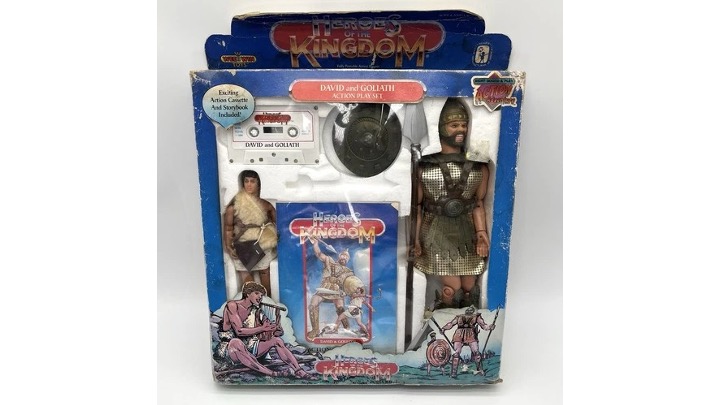
The story of David and Goliath is a Sunday School classic. If you’re my vintage, you might even have had these David and Goliath toys.
How should we read this classic story?
What is its moral or meaning?
Should we grab five smooth stones to kill the giants in our lives?
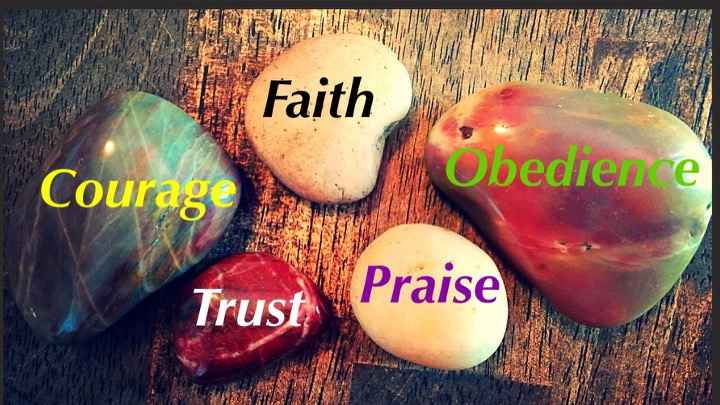
I looked online. One site reckons our five stones are faith, courage, trust, praise, and obedience, and we should carry them wherever we go (1 Samuel 17:40).
Another says David’s victory teaches that God can defeat any of the giants in our lives; fear, depression, financial issues, doubt. And that when we are tested we should stand up.
From the story of David and Goliath, we can learn that the God we serve is capable of defeating any of the giants in our lives—fear, depression, financial issues, doubts of faith—if we know Him and His nature well enough to step out in faith…
When we are tested by these trials, we can, in the power of the Lord, stand up against any giant, trusting our Savior to win the victory.
MinistrytoYouth.com says David uses his skills from previous trials to battle the real giant, so we should do the same.
Bottom Line: David used his skills from previous trials to trust that God would help him defeat the real giant. We can do the same in our lives.
MinistryToYouth.com
This idea it’s about honing our skills away from the battle so when the giants turn up we are ready to rock fits with the thesis of Malcolm Gladwell’s book David and Goliath.
He reckons we have made the story about small beating big; but it’s actually about innovation beating the establishment…
“Goliath was expecting—a warrior like himself to come forward for hand-to-hand combat. It never occurred to him that the battle would be fought on anything other than those terms, and he prepared accordingly.”
Malcolm Gladwell, David and Goliath
Goliath being stuck in his ways — only prepared to take on someone just like him — he is armed and armoured for a sword fight, not for a killer wielding a sling — a recognised ranged weapon in Israel (Judges 20:16). A study by a modern military expert found a stone slung from 35 metres would hit its target at a speed of 34 metres per second; it was like bringing a gun to a sword fight.
“Slinging took an extraordinary amount of skill and practice. But in experienced hands, the sling was a devastating weapon.
…a typical-size stone hurled by an expert slinger at a distance of thirty-five meters would have hit Goliath’s head with a velocity of thirty-four meters per second…”
— Malcolm Gladwell, David and Goliath
Also, Gladwell reckons Goliath was probably almost blind — that his size was a result of a medical condition that also impacts the nerves in the eyes; and there are some clues in the text, cause David only has one staff, and Goliath asks ‘why are you coming at me with sticks…’
…one of the common side effects of acromegaly is vision problems. Pituitary tumors can grow to the point where they compress the nerves leading to the eyes…
Malcolm Gladwell, David and Goliath
He is blind, while David sees clearly and takes down the blind with his skills and speed. So the moral is “clear eyes, full heart, can’t lose…” Or “innovate to win.” But all these readings position us as David in the story; inviting us to learn from his perspective and his experience — and his heart… But is this how we should read the Bible (1 Samuel 17:43)?
In this post we are bringing together our nuts and bolts from the previous posts to read this story.
We have seen how all Scriptures are inspired by God — useful for equipping us and making us wise for salvation in Jesus — inspiring us.
And also incarnated — coming through a human process of writing, editing, receiving and reflecting in community; so the Law, the Prophets and the Writings become a library of interconnected literature; which is fulfilled in Jesus; and that is our interpretive guide. We saw how this fulfilment happens in a bunch of ways; whether we read ‘christocentrically’ and read Jesus back into the text, or christotelically — understanding the text works in the community of humans — Israel — through their history in a way that climaxes in the story of Jesus, the Son of David and Son of God.
We considered that if Jesus is the word made flesh who reveals God’s glory; and the way God now reveals himself, who is the exact representation of his glorious being (2 Timothy 3:16; 2 Timothy 3:16-17; 2 Timothy 3:15; Luke 24:44; John 1:14; Hebrews 1:1-2; Hebrews 1:3). Then looked at Vanhoozer’s ‘transfigural hermeneutic,’ and the Spirit’s role as we read might be to bring us face to face with Jesus like on the mountain of the transfiguration… So we contemplate his glory; which is how we are transformed (2 Corinthians 3:18).
“Transfigural interpretation stands for the whole hermeneutical process of glorifying the biblical letter for the sake of the reader’s glorification.”
Kevin J. Vanhoozer, Mere Christian Hermeneutics
We saw how the Bible is ancient and translated — but timeless — coming in foreign languages and cultures, with different orientations to the universe.
And that we are tempted to reduce the Bible to 2D; words on a page, but when we try to inhabit and contemplate the text in 3D; noticing architecture or geography or rituals, we can join ancient readers who saw 3D reality overlaid with a spiritual dimension — which we called 4D.
Then we looked at how the Bible is literature, where the authors use forms and convensions — genres — so their texts have a recognised function we should be aware of as readers, so we should ‘give it a throw’ to see what it does, not just read what it says, and how this symbolic 4D stuff might help us see our world.
I am going to tell you the David and Goliath story with a bit of a run-up; and a few editorial comments.
1 Samuel is filed in that bit of the Old Testament library called ‘the Prophets’ — and it reflects on the Law, and other Prophets also reflect on it…
Our story begins in Judges; Israel is settling in the promised land, and they start having issues with a violent neighbour; the Philistines; who are left by God as a test. God raises up Judges, like this guy Shamgar, to stand against them.
By the end of Judges, the narrator has pointed out a couple of times there is no king in Israel, and everyone does as they see fit… Literally “what is right in their own eyes.” This is a throwback to the serpent’s promise that eating the fruit would open their eyes, so they would know good and evil themselves (Judges 3:1, 3; Judges 3:31; Judges 21:25; Genesis 3:5).
A lady named Hannah promises she will devote a son she prays for “to God,” then, when she has Samuel, she does this with a song about God lifting up the humble and bringing down the mighty.
Samuel’s mentor is a priest named Eli; he is going blind, and turning a blind eye to his corrupt sons. God tells Samuel Eli’s sons will die, and he will take over; Samuel passes on this news to Eli, who says “God will do what is right in his eyes…”
When Eli hears the Philistines have killed his sons and captured the ark of the covenant, he keels over (1 Samuel 1:11; 1 Samuel 2:7-8; 1 Samuel 3:2; 1 Samuel 3:18; 1 Samuel 4:17; 1 Samuel 4:18).
The Philistines take the ark into Dagon’s temple; Dagon is sometimes represented as a half-man half-scaley thing.
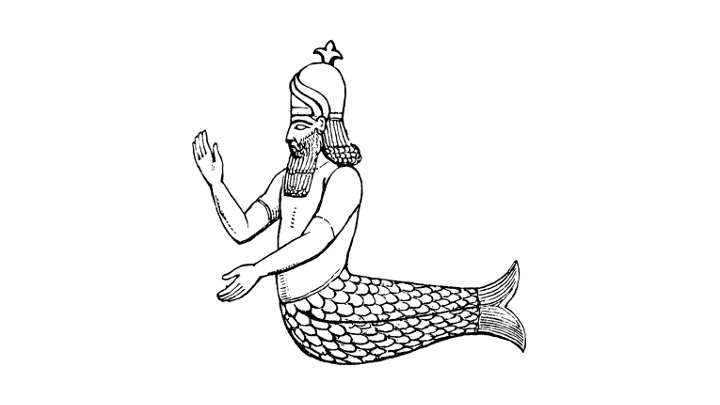
His statue topples onto its belly; and its head falls off… They ark is taken to Gath; Goliath’s home city; where it brings death and destruction until they send it home to Israel (1 Samuel 5:2; 1 Samuel 5:4; 1 Samuel 5:8; 1 Samuel 5:9).
Years pass, there is still no king in Israel, but people come to Samuel, cause his own sons are ratbags, to ask for a king like the nations. Samuel is angry. He quotes Deuteronomy, warning them a king will take and take and take.
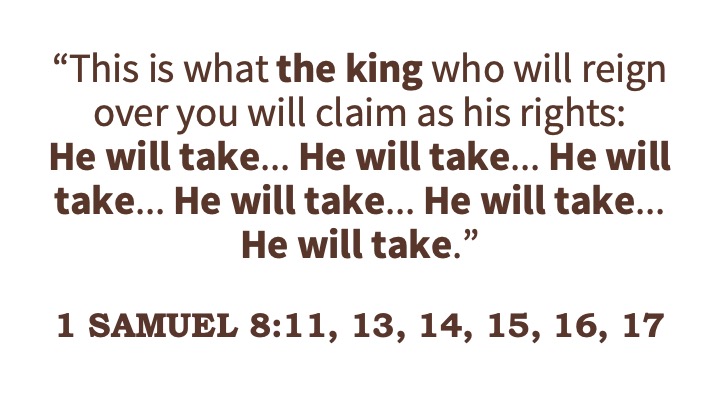
They are rejecting God as their king, so when they turn to him, he told them so…
They insist; they want a king who will lead them in battle; like the warrior kings of the nations; the giants — the Nimrods — so Samuel anoints Saul, who is very tall. So tall we are told twice. He is the king Israel wanted (1 Samuel 8:5; 1 Samuel 8:11, 13, 14, 15, 16, 17; 1 Samuel 8:18; 1 Samuel 8:19-20; 1 Samuel 9:2; 1 Samuel 9:23; 1 Samuel 12:12-13).
But tall Saul is a disappointment; he was small in his own eyes, raised up by God, then did his own thing, so God rejects him as king. Samuel is sad; he liked Saul. God sends him to a farming family with a bunch of tall brothers, to anoint someone else (1 Samuel 15:17; 1 Samuel 15:26; 1 Samuel 16:1).
“Do not consider his appearance or his height, for I have rejected him. The Lord does not look at the things people look at. People look at the outward appearance, but the Lord looks at the heart.”
1 Samuel 16:7
God tells Samuel not to consider their appearance — God looks at the heart not the height — and picks the youngest, David; a short king.
David is anointed — messiahed in Hebrew — and led by God’s Spirit, while God’s Spirit departs Saul and he becomes haunted by an evil spirit from God. David is brought to Saul to calm him with his singing; Saul likes him so much he makes him an armour bearer; which makes their interaction in the next chapter pretty odd (1 Samuel 16:11; 1 Samuel 16:13; 1 Samuel 16:14; 1 Samuel 16:21).
This story sets us up to read the Goliath story — the eyes matter; God’s perspective matters; he doesn’t bless lofty heights or power; he raises the lowly, and brings the tall down — like with Dagon.
Now we are at the main event; the start of the chapter sets the scene; geography matters.
The Philistines are gathered for war near a city called Sokoh, which Joshua tells us is at the western boundary of Judah’s territory — that is David’s tribe — the Philistine city of Gath is close to this boundary.
They are at Ephes Dammim — which is a provocative Hebrew name. Ephes means boundary — and Dammim is the plural of blood — dam — it’s the boundary of bloodshed; in a valley — the valley of blood; this highly contested militarised zone.
The two armies are camped on mountaintops facing each other — this is the Hebrew word for mountain — it’s actually used twice in the Hebrew to paint the picture; there is this valley of bloodshed between them.
In our “cosmic geography” — mountains are significant; they are heaven meets earth places where people would build temples, or altars to worship gods… Valleys are significant too; down towards the grave.
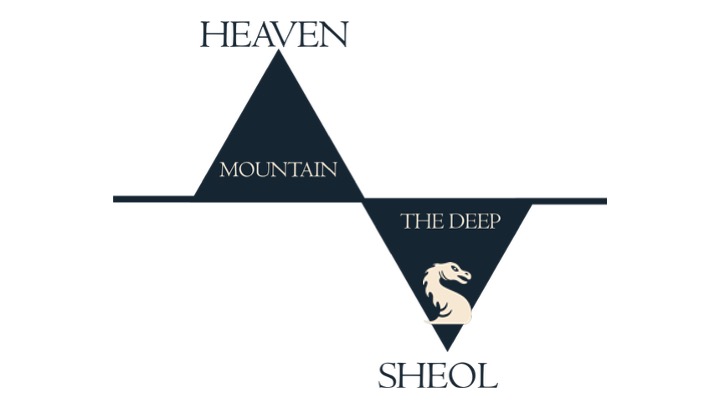
Which mountain is going to win (1 Samuel 17:1; Joshua 15:20, 33-35; 1 Samuel 17:2; 1 Samuel 17:3)?
A champion — the literal Hebrew here is a “man who stands in the middle,” comes towards the other camp, into the valley of blood between the mountains. He is from Gath — where the ark went.
He is very tall. A man mountain — a giant. His height is measured in cubits.
Cubits are used to measure boats and buildings and furniture and distances — the only other time they have linked to a tall person it’s Og, King of Bashan, where it’s actually his bed.
Og is a Rephaite — a giant — who, via the Anakites, is connected to the Nephilim. Later on, Goliath’s brother and these other giants are called sons of Rapha.
Goliath the giant comes down his mountain, into a valley of blood, as a man-in-the-middle representing the Philistines and their gods; he is bronze from tip to toe — and scaly — a walking serpent. And he is covered in bronze.
Bronze helmet… Scaly bronze armour. Bronze greaves. Bronze spear.
The Hebrew word for bronze, nacashet is almost identical in Hebrew to serpent; nacash; like the one in Genesis 3.

And he wears ‘scale’ armour.
This word “scale” is only used elsewhere for fish scales; and sea serpent scales…
Scaly Dagon should probably be in our mind too.
This geography, this man in the middle, and his presentation invite us to see something 4D happening in the story as a violent power opposes God’s people, and insults his name.
Goliath throws out a challenge; naming tall Saul — the king who is meant to fight their battles; he is Israelite man-in-the-middle to fight.
But Saul hides in his tent. He and the nation are dismayed. This challenge goes on for 40 days. Everyone is afraid and shrinking back. Except David. He says do not lose heart; I will be the man in the middle. He has been on the farm; he is a shepherd. He has killed lions and bears, no tigers, oh my… So this giant will be no trouble. Linking their paws to Goliath’s hands has a bit of Daniel and Revelation to it… He is a beast.
David trusts God. Saul tries to dress David in his own bronze — serpenty — tall-king armour and helmet; David says “no”, I am not used to that. Unlike Goliath — and tall Saul… He doesn’t cosplay as a serpent. He dresses like a shepherd. Grabbing his staff, and five smooth stones which he puts in his shepherd’s pouch — and walking into the valley of blood. Trusting the Lord, his shepherd to lead him through the valley. Goliath sees — or maybe he can’t — he despises him; he asks “am I a dog” and maybe the answer is “no, you are a snake…” He curses David, threatening to feed him to the birds and beasts.
God’s annointed responds; you come from your mountain with spear and sword; I come in the name of the Lord Almighty, the God of armies — you defy him, but he will deliver you to me, and I will feed you and your army — to the wild animals and bird. So it’s clear God wins the battle.
“You come against me with sword and spear and javelin, but I come against you in the name of the Lord Almighty, the God of the armies of Israel, whom you have defied. This day the Lord will deliver you into my hands, and I’ll strike you down and cut off your head. This very day I will give the carcasses of the Philistine army to the birds and the wild animals, and the whole world will know that there is a God in Israel. All those gathered here will know that it is not by sword or spear that the Lord saves; for the battle is the Lord’s, and he will give all of you into our hands.”
1 Samuel 17:45–47
Later Prophets meditate on this story as they describe God destroying violent powers who oppose him. Isaiah views these nations as Leviathan — a giant serpent — a sea monster — who God will slay to gather people from their land (Isaiah 27:1; Isaiah 27:12). Ezekiel describes these Egypt’s pharaoh as a giant sea monster; scaly — same word — who will be left on the ground as food for the beasts of the earth and the birds (Ezekiel 29:3-5) — same Hebrew phrase. David — the Messiah — and his battle with Goliath — a giant serpenty man-in-the middle — is a type scene for God judging violent empires of death (1 Samuel 17:44).
David runs towards Goliath, the giant serpent man in the middle, in the valley of blood, between two armies and their mountains (1 Samuel 17:48). Sling whirling, his stone crushes the serpent-man’s head; he falls face down on the ground. Beaten without a sword. His head is removed. Now. Picture Dagon. It’s the same Hebrew words.
Reaching into his bag and taking out a stone, he slung it and struck the Philistine on the forehead. The stone sank into his forehead, and he fell facedown on the ground. So David triumphed over the Philistine with a sling and a stone; without a sword in his hand he struck down the Philistine and killed him. David ran and stood over him. He took hold of the Philistine’s sword and drew it from the sheath. After he killed him, he cut off his head with the sword.
1 Samuel 17:49–51
But also picture Genesis 3; God’s promise that the cursed serpent would end on its belly (Genesis 3:14).
“And I will put enmity between you and the woman, and between your offspring and hers; he will crush your head, and you will strike his heel.”
Genesis 3:15
The serpent “striking the heel” of God’s human offspring, who would crush its head.
Goliath the snake has his head crushed.
And now the Philistines are scared; they run for Gath, but their bodies are also left on the ground; like their God and their champion. And Saul sees this, but doesn’t recognise his armour bearer, David.
I think we are meant to see him not seeing; overlooking David like Goliath did (1 Samuel 17:51-55). There is an epilogue, where tall Saul ends up defeated on a battlefield; and his bronze armour and head are taken to the temple of Dagon (1 Chronicles 10:10)…
After Saul’s fall, David also becomes a taker; he stays home when kings go to war; and he will see, desire, and take Bathsheba like she is an object — this is the same words as with the corrupt sons of God who, in the story, create the giant champions of the nations (2 Samuel 11:2, 4; Genesis 6:2).
But the David and Goliath story is presented and interpreted by the Prophets as a Messiah slaying a serpent-giant in a 4D way; anticipating a man in the middle; a courageous Messiah from David’s family, who God will use to bring down the high and mighty powers of violent empires aligned with the forces of darkness.
This story in Samuel has a genre; it sits in Israel’s library as history told with a theological purpose; and — when you compare it to Chronicles; it seems the purpose of legitimising David’s family line as the line of promise; the serpent crushing line of kings. The family tree Jesus is born into — as the Son of David, and the ultimate serpent crusher.
So how do we read this story?
Here is this week’s nuts and bolts… Most of us read the Old Testament as Gentiles — and we have to remember this.
The implications are most obvious when we read the Israel’s laws; Gentiles were never under the Law, Jesus doesn’t put us under the law.
In Acts, some are saying the Gentiles must be circumcised, and keep the Law — but the apostles say no; they are just to avoid idol food, sexual immorality and drinking blood — so they can eat with their Jewish church family (Acts 15:5, 9). But it’s also true of texts in the Prophets; they do not just give us moral lessons; they are fulfilled in Jesus; and even if we were looking for a moral, we are not Israelites.
We are too quick to place ourselves in David’s shoes — asking what our stones are, or how to face giants — and forget to see Jesus occupying the shoes of the Messiah. Jesus going out to the valley of blood — or the place of the skull — as the man in the middle who faces down not just a short-sighted giant cosplaying as a serpent, but the real thing; the forces of evil and sin and death.
These are the giants we all face; and we are held captive on a mountain with God’s enemies in a way that results in death by a dark spiritual force. We are the Philistines; we are positioned in Goliath’s shoes; cosplaying as serpents — or in the army lined up on that mountain behind him; or the one he represents… Satan — the accuser — is a bad middle man.
There is another word for middle-man — mediator — Satan is a mediator between humans and death; who leads us to do what is right in our own eyes and away from life with God; through kings and powers, and things that look glorious and desirable… We do not need five smooth stones; we need a different middle man to face him; not to destroy those on the mountain behind him, but to liberate us. And so we have Jesus — who doesn’t slay the monster sling and stones, or sword, but with a cross and by his blood.
And having disarmed the powers and authorities, he made a public spectacle of them, triumphing over them by the cross.
Colossians 2:15
Without Jesus we would find ourselves face down, headless and dead. Like Dagon — like Goliath — like the Philistines — like Saul — like Leviathan in Ezekiel — Jesus brings us to life.
This is how Paul puts it in Ephesians — which is a handy guide to remembering our position as we see the story of the the Old Testament fulfilled. He says ‘you’ — distinguishing between ‘we’ and ‘us’ Jewish Christians and Gentile Christians — you were dead in sin, under the rule of the powers of death — the ruler of the kingdom of the air — the serpent… Who is still at work in those who are disobedient; the Goliaths; the kingdoms opposed to God’s kingdom and rule…
As for you, you were dead in your transgressions and sins,in which you used to live when you followed the ways of this world and of the ruler of the kingdom of the air, the spirit who is now at work in those who are disobedient.
Ephesians 2:1–2
We have been made alive; raised and seated with him; moved from one mountain to the other.
God, who is rich in mercy, made us alive with Christ even when we were dead in transgressions—it is by grace you have been saved.And God raised us up with Christ and seated us with him in the heavenly realms in Christ Jesus…
Ephesians 2:4–6
But we Gentiles were “uncircumcised” like Goliath — separated from Christ; excluded from citizenship and the covenants; the promises of God, and participation in the life of his people… We were ruled by Dagons; standing behind Goliaths…
Therefore, remember that formerly you who are Gentiles by birth and called “uncircumcised… you were separate from Christ, excluded from citizenship in Israel and foreigners to the covenants of the promise… But now in Christ Jesus you who once were far away have been brought near by the blood of Christ.
Ephesians 2:11-13
We were far away — but now, Jesus Christ — the Messiah — who stands in the middle — has brought us near — not with a sword; not a sling — but through his death; his blood.
Jesus has reclaimed the Gentiles from those mountains opposed to God and brought us into his people; his family — into union with him.
Reading the David and Goliath story as Christians means seeing it pointing to this moment when God would bring people home from the nations — those mountains and armies — through his anointed king, as he defeats the serpent — with the surprise that he turns his enemies into his family — and that is us.
This story is not about picking up five smooth stones; but picking our man in the middle; our mediator who leads us through the battle.
There might be other moral messages to be gleaned, about courage and trusting God — and innovation and formation — and we do join a spiritual battle; dressed in the armour of God — against the serpent, and these powers; the spiritual forces of evil who shape kingdoms opposed to God…
This metaphorical or metaphysical armour all points us to towards the victory of Jesus (Ephesians 6:11-18), who disarms these powers; death, the Serpent, and the cosplay serpents ‘middle men’ who lead us towards death; our mediator leads us to life as he triumphs through the cross.
Stop trusting blind giants and stand behind him as sheep following the good shepherd king, who leads us through the valley of blood and into life with our Father, forever.