JPGmag has produced a series of photos juxtaposing Disney’s princesses with scenes from everyday life – or indeed – murky every day life… some would say “reality”…


JPGmag has produced a series of photos juxtaposing Disney’s princesses with scenes from everyday life – or indeed – murky every day life… some would say “reality”…
Bumper stickers are always a little too pithy for my liking. So this collection of completely articulated bumper thoughts are my cup of tea.

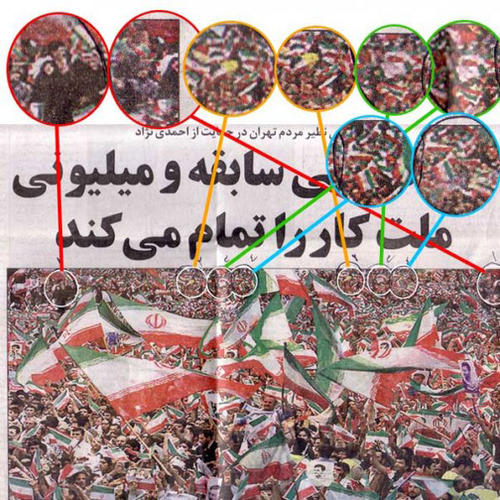
News that Iranian “President” Ahmadinejad has been photoshopping supporters into crowd shots is slowly making its way across the internet.
But making your election results seem more credible isn’t all that Photoshop is good for… you can also:
1. Wipe moustaches off the face of well known cultural figures…
Or unpopular political figures

2. Turn your favourite celebrity (or politician) upside down.

3. Produce some freaky family portraits.
4. Produce a racially diverse piece of marketing collateral
I’m pretty excited about Transformers 2. If you’re a guy you probably understand why already.
If you’re not excited – then you should be. Director Michael Bay has given some reasons why on his blog.
I will not reproduce his post in full. Here are some highlights…
Robots
Disk space
Rendering times
Imax
Once upon a time I annoyed people when I tried to push their buttons… now I ask honest questions, have them ignored, and annoy people all at the same time.
I guess this is growing up.

The coffee of the future will not be made by man – no, we’ll have little robot servants to make the coffee for us. The original post is in Japanese – but this video demonstrates its awesomeness.
Orford is class. This sort of “generosity” is all too rare.
Debate rages at Simone’s blog. Well not really. I just keep writing long comments one after the other as new ideas strike me. This has kept my hippocampuses firing all day.
Simone doesn’t seem to think an Open Source model would produce quality songs.
Every open source product in existence would seem to disagree – but she’s also not sure how it would all work.
I had the following thought.
Open Source companies make money by offering support, some by performing specific development tasks and extensions for companies that request them. Here’s an article about how open source companies make money.
Basically it moves from a model where a product is provided to a model based on service.
I believe Open Source, when applied to computer software, produces better products than proprietary software.
So, an example of how a gifted song writer could make money/produce quality songs under the Open Source business model would be to produce songs upon request (and upon payment) by a particular church for a particular sermon series that they’re working on. Once it is used for that purpose it would then be added to the pool of songs for other churches to use.
Any other ideas?
We had some leftover biscuits in our office after a meeting today. Arnott’s Biscuits. The variety pack. The one with Kingstons and Monte Carlos in it.
The economic crisis is obviously biting pretty hard – both of these perennial favourites were about half their normal size.
This is a long post. Be warned.
Discussion on Simone’s blog has evolved in an interesting direction. And one I’ve been meaning to write about for some time – or at least since the “Ministry Matters” day the Walkers held a few weeks ago.
The debate about the value of secular work vs vocational ministry puzzles me.
Before I begin I want to say that I affirm the value of secular work – in most cases. So long as the job is in some way about “bringing order to creation” I see it as being of some merit. But to suggest that God is as glorified in secular work as he is in “ministry work” just seems odd.
It’s odd because I think the Bible’s pretty clear that one is more valuable than the other, that there are rewards for ministry (including anything that serves and builds up the Kingdom of God) that don’t exist for those who diligently work in their vocation.
The very fact that we get so little information about Jesus’ pre-ministry vocation in the Bible but so much about his ministry and preaching would suggest there’s a difference in value. But that’s a fairly long bow to draw…
I brought up the distinction between the two types of work in the comments on Simone’s post about rewriting song words – because I think it’s right for artists to be protective of their secular work – that which earns them their living, but I think the standard is different for those who are in ministry. I think their aim is to glorify God and serve the body of believers with their gifts.
I don’t think using gifts – for example a gift of communication – for your job is the same as using them for the spread of the kingdom. Luther and Calvin both affirm the value of secular work – and the value of using God given gifts in secular work – but you can affirm this without putting it on par with ministry.
My understanding of what both Calvin and Luther have to say about work is that it’s a valuable activity and should be tackled with gusto. They see work as a means to create or restore order – and again, I’d argue that for the Christian this is most likely to be expressed through the ministry of the gospel – whether by preaching, or teaching, or hospitality, or acts of service – than through secular work (I’m not saying this has no value – just less).
Overt glorification will always win out over intrinsic glorification – both in value and effect.
Full time ministry is a special calling – with special responsibilities, special rewards and special consequences for doing the wrong thing.
There’s also a hierachy within the context of ministry (where preaching and teaching is considered more valuable than other gifts – see below for the passage this idea comes from).
Let me back up my thinking with some Bible verses (which I’ll copy directly from my comment on Simone’s blog…). Obviously the “Great Comission” means that “making disciples” is the fundamental priority of all Christians. And lets face it – nobody is converted without some input from the word of God.Actions alone aren’t enough. They are important though.
1 Corinthians 3 is where I’d be drawing most of my thinking from with regards to the greater heavenly valuation of ministry.
Verse 8 implies a reward directly linked to ministry.
8 The man who plants and the man who waters have one purpose, and each will be rewarded according to his own labor.
Verse 9 implies that Paul is specifically talking about ministry…
9 For we are God’s fellow workers; you are God’s field, God’s building.
Verses 10 through 15 seem to be linking the heavenly outcomes for those in ministry with the quality (not quite the word I’m looking for) of their work…
“10 By the grace God has given me, I laid a foundation as an expert builder, and someone else is building on it. But each one should be careful how he builds. 11 For no one can lay any foundation other than the one already laid, which is Jesus Christ. 12 If any man builds on this foundation using gold, silver, costly stones, wood, hay or straw, 13 his work will be shown for what it is, because the Day will bring it to light. It will be revealed with fire, and the fire will test the quality of each man’s work. 14 If what he has built survives, he will receive his reward. 15 If it is burned up, he will suffer loss; he himself will be saved, but only as one escaping through the flames.”
I contend this isn’t talking about the vocational cleaning of toilets – though that be done well and to God’s glory.
I don’t think you can form a doctrine of work solely from the exhortation in Colossians 3:17…
“And whatever you do, whether in word or deed, do it all in the name of the Lord Jesus, giving thanks to God the Father through him.”
Then 1 Timothy 5 suggests gospel workers are worthy of double honour…
“17 The elders who direct the affairs of the church well are worthy of double honor, especially those whose work is preaching and teaching. 18 For the Scripture says, “Do not muzzle the ox while it is treading out the grain,” and “The worker deserves his wages.” 19 Do not entertain an accusation against an elder unless it is brought by two or three witnesses. 20 Those who sin are to be rebuked publicly, so that the others may take warning.”
Then you’d have to consider Ephesians 4 – which suggests acts of service are a gift, but I don’t think it equates exercising them in the secular context with exercising them in order to serve the body of believers…
“11 It was he who gave some to be apostles, some to be prophets, some to be evangelists, and some to be pastors and teachers, 12 to prepare God’s people for works of service, so that the body of Christ may be built up 13 until we all reach unity in the faith and in the knowledge of the Son of God and become mature, attaining to the whole measure of the fullness of Christ.”
And finally, 1 Corinthians 12. The whole chapter is relevant. It starts off by establishing that while gifts are different they all come from God – but then the chapter only really deals with gifts that serve the body – again, not equating secular work with serving the body of believers.
“4 There are different kinds of gifts, but the same Spirit. 5 There are different kinds of service, but the same Lord. 6 There are different kinds of working, but the same God works all of them in all men.” And the last few verses seem to establish a hierachy – and exhort us to desire the “greater gifts”… “28 And in the church God has appointed first of all apostles, second prophets, third teachers, then workers of miracles, also those having gifts of healing, those able to help others, those with gifts of administration, and those speaking in different kinds of tongues. 29 Are all apostles? Are all prophets? Are all teachers? Do all work miracles? 30 Do all have gifts of healing? Do all speak in tongues? Do all interpret? 31 But eagerly desire the greater gifts.”
That’s my thinking anyway. And I’ve spent enough time on this. I have work to do.
I pity the fool who doesn’t want this ab crunching Mr T USB drive. Or one of the other Rocky III inspired ab crunching USB drives for that matter.

BustedTees is having a sale. They have some funny shirts – and some wildly inappropriate ones. Here are my favourites. Click on the image for the link…


An interesting discussion has been occurring over at Simone’s blog after a Sola Panel post raised her song writing hackles. It all started from a discussion about amending lyrics to make them more theologically palatable.
In my mind it’s a discussion on the “open source” nature of ministry material masquerading as a copyright debate. There’s a useful document on churches and copyright here (PDF).
I sympathise with Simone’s artistic position – as a graduate of the Creative Industries faculty at QUT I can do little else. But I don’t think our understanding of things created as ministry tools should be shaped by our understanding of “secular copyright”.
Bach famously signed off his compositions with a Latin acronym SDG (the phrase Sola Deo Gloria – meaning to the glory of God alone). His understanding was that his creative works belonged to God. At least that’s my understanding of his understanding.
If, as Simone argues, words (and music) belong to the songwriter alone – then there are some broad ethical considerations to make. Her argument opens up, in my mind, an ethical can of worms when it comes to reappropriating and retuning old hymns. It’s legal – because they are “public domain” but just because it’s legal doesn’t make it ethically right. If a song is a possession then it’s odd to argue that its intangible nature makes it somehow different from a material thing. A dead person’s belongings remain with their estate in perpetuity – and yet we’re happy to tinker with their no doubt prized works.
My thinking – and indeed my “preference” – is for a “creative commons” approach to ministry. There are now almost 30 comments on the thread on Simone’s blog – and the majority are from me. It’s an interesting (in my mind) issue to think through. And I’m glad it has been raised.
Even going down the “Copyright” path opens up avenues where I’d suggest congregations should be free to change things. If ministry is essentially working as God’s employees (1 Corinthians 3:9) then our employer owns the copyright for works we produce – so his word should change the content. If a song is theologically wrong, but can be easily redeemed – then I say redeem it.
I don’t know why artistic endeavours are placed on some pedestal over and above exercising other God given gifts. I sympathise. I consider myself a “creative” person. But I don’t see why writing words that glorify God in song is different to writing a recipe that glorifies God through hospitality – and you don’t see chefs jumping up and down when someone tinkers with their ingredients.
I used an argument based on writing media releases too – in the comments – which I quite liked. So I’ll reproduce it.
“I write Media Releases for a living. I agonise over every word because they’re often of a political nature or important to get right. It’s important that they communicate a truth. Just as it’s important that your songs communicate a truth about God.
I get angry if they’re misconstrued and used out of context.
But if they’re being used appropriately to communicate my organisation’s point but my words are not used verbatim (except the bits in direct quotes) then I rejoice. Because they have achieved their purpose.”
If I wrote a song – and learned people were changing it in a way I did not approve of – I’d defend my original position but I don’t think I’d die in a ditch over it.
Did you see it? Obama. Killed. A. Fly. With his bare hands. My hatred for flies is well documented. And now, when I’m home for Christmas, I’ll be able to use the presidential defense when I swat a fly with my hands…
More significantly – Obama is a ninja. Check it out.
This little piece of karate awesomeness (sans chopsticks) has earned Obama the ire of PETA. As if he didn’t have enough to worry about.
PETA’s blog – called the “PETA Files” (as if we needed any more evidence that they’re a massive joke foisted on us by the ultra right) – loudly condemned the President – and the story has received global attention.
They’re sending him one of these awful fly catchers – who needs one of these when you have such awesome ninja skills.

“Simply place Katcha Bug over the bug and slowly slide its plastic trapdoor shut. The bug will step onto the trapdoor as it closes, and you can carry Katcha Bug outside, where all you need to do is slide the trap door open, allowing the bug to walk away. “
Here’s what PETA said – it’s a bit of a beat up – but still, it’s worth learning that if you want to be taken seriously you need to pick your battles.
“Believe it or not, we’ve actually been contacted by multiple media outlets wanting to know PETA’s official response to the executive insect execution,” a blog on the group’s website explained. “In a nutshell, our position is this: He isn’t the Buddha, he’s a human being, and human beings have a long way to go before they think before they act.”
Izaac chimes in on the video preaching issue. Pretty on the money.