Category: Culture

An open letter to my Christian Facebook Friends about School Chaplaincy

My Facebook newsfeed is jammed full of articles, cause invites and petitions suggesting that the Christian sky will fall down if I don’t voice my support for the government funding of school chaplains.

For some background – the Australian government provides some funding for schools to employ chaplains (after consultation with the P&C and support from the local community (which means churches). This funding is generous and has allowed for many chaplains to be hired around the country. In Queensland these services are generally provided through Scripture Union (SU) who are an umbrella body, and a Christian organisation. Chaplains roles are limited because they offer services to people of all faiths, beliefs, lack of faiths, etc. An atheist from Toowoomba doesn’t like that government money is going to what is arguably a religious service, that arguably enshrines Christianity as a state religion (though the legislation is all very clear that chaplains don’t have to be Christian). This is the website for the High Court Challenge. Here’s a few paragraphs from a news story from September last year:

“Mr Williams said that while the rules of the program prohibited chaplains from proselytising, the Queensland provider, the biblical literalist Scripture Union, has as its aim ”to encourage people of all ages to meet God daily through the Bible and prayer”.

”It’s absolutely, totally out of control here. You can’t prevent your children being exposed to chaplaincy,” Mr Williams said.

In Victoria, state school chaplains are employed by ACCESS Ministries, the same group that provides non-compulsory religious education. Chaplains in Victoria are better qualified than in other states, and are required to have at least one degree in teaching, theology or counselling, as well as further training in another of those fields.”

I won’t be joining said causes, signing said petitions, (though I will read the articles).

I think government funding for chaplains is actually borderline a bad thing, for a number of reasons. I wrote something along these lines back in 2006 when federal funding was first announced, and nothing I have seen since has changed my mind.

In case you’re sitting there thinking “oh no, all the chaplains I know are lovely people, and should totally keep their jobs” – I agree. Entirely. One of my best friends really is a chaplain, several other close friends are too. Chaplains, on the whole, have had an incredibly positive impact on the lives of children at school – and somebody in the school community should be doing the job they’re doing, I’m glad the people currently doing the job are Christians. I really am.

I have a couple of problems with the scaremongering going on around this issue.

1. There’s an assumption that government funding of chaplains is a good thing.
2. There’s an assumption that this money is free.
3. There’s an assumption that chaplains would disappear if the funding was pulled.
4. There’s an assumption that chaplaincy, in its present form, is good for the spread of the gospel.

I’d challenge the first three, and suggest that in the case of the third this is no axiom, but reflects the exception, not the rule (indeed, I’d say for chaplains to be spreading the gospel they’d have to be putting their federal funding and positions in danger).

It’s this kind of approach to the interaction with church and state that I think characterises much of what is wrong with the church – we assume we have some sort of entitlement to special access.

Around the same time in 2006 that I wrote that post linked above, I wrote another post, suggesting that because of Christianity’s place in Australia’s heritage we do have a place in the educational spectrum. Particularly in modern history. And I think RE is appropriate – because all students have equal access to religious instruction, and religion is a huge part of life outside of school, and I recognise that there is a spiritual aspect to one’s development as a person that is rightly addressed in an RE program.

But chaplains aren’t even allowed to teach RE. What’s the point of having a Christian voice in a school if they’re not allowed to teach Christian things?

“While exercising their roles from within a Christian framework and promoting positive Christian values, SU Qld Chaplains will be sensitive to and respectful of people who hold beliefs and values different from their own. SU Qld Chaplains will be available to all students, staff and parents within their schools, regardless of religious affiliation.” – From the SU Chaplaincy site

The Queensland Government’s position on Religious Education in schools is quite clearly articulated here.

As is their position on what chaplains can do as part of their role

Whilst personally modeling and owning their own faith positions or belief, chaplains avoid any implications that any one religion, denomination or other set of beliefs is advantageous or superior to any other denomination, religion or belief.

Chaplaincy programs are compatible with policies and practices that apply to delivery of any service in a multi-faith and multicultural state school community. A chaplaincy program is inclusive of and shows respect for all religious and non-religious beliefs and other stances represented in the school community. All activities and events provided within a chaplaincy program are non-discriminatory and equitably available to students of all beliefs who choose to participate.

That earlier link spells this out a little further when it comes to the subject of teaching RE…

Teachers and chaplains are not to teach religious instruction. It is not part of their work duties. However, if a chaplain or a teacher works part-time, they may choose to teach religious instruction in their own time, outside of work hours.

Accepting government money, in a nation where church and state are separate (which is a good thing), creates a relationship of dependency and shifts the power dynamic in this separation to the person giving the money (I suspect this will eventually become a problem with regards to the tax benefits churches enjoy).

The “Save Our Chaplains” campaign is making this a do or die issue for school chaplaincy (and if you disagree with me, go there and sign the pledge – this post then becomes “awareness raising” so everybody wins). I think we can all acknowledge some truth to this campaign, an overturning of the federal funding may well see a bunch of chaplains out of a job – which is not the outcome we want. But if the church, as a whole, believes chaplains are worth keeping – then we should be paying for them ourselves. It’s great that the government wants to recognise the role that these guys play – but as soon as we take their money, they take control. And suddenly there’s a bunch of truths we can’t speak. Can a chaplain, funded by the government, be known to believe that homosexuality is a sin? Can a chaplain explain to a troubled child that Jesus is the only way to God? Can we make any claim that offends any other taxpayer? I don’t know. I’m not a chaplain – but I’ve been to a couple of SU Supporters nights and noticed that it’s all about “having positive impacts on children’s lives” and “being there” – and there’s almost never a mention of God at these nights at all. I once offered to pay $100 per year for every mention of God at one of these dinners, and it didn’t cost me a cent. And this is when they’re preaching to the converted. It’s not even “Scripture Union” anymore. It’s SU. Which is one of those branding decisions that’s made when you’ve moved away from the core product but want to keep your history… SU’s aims and working principles document is still thoroughly Christian, and commendable.

The guy launching the court action against government funding seems to be a bit of a jerk. But he’s a jerk with principles that are actually based in reality – church and state are separate. And we want them to be. Because we can’t afford to have the government controlling our message – look what happens to state churches in European (especially Scandinavian) countries. For a perspective on the issue from the other side (the atheist side) of the equation read this article – it’s long, and it makes some sound points, and some points from a “religious teaching is child abuse” kind of perspective.

Figuring out how to maintain the distinction between being on school grounds teaching Christianity as part of a religious education program and government funded positions for religious workers who can’t teach religions is tricky. One of the other spin-offs of this court challenge against chaplaincy in schools, and the introduction of ethics classes in NSW, and a host of other campaigns being driven by opponents of the gospel who conflate the two into one issue, is this attack on the teaching of RE in schools, or CRE, or RI, or whatever “scripture lessons” are called in your states. This is a period of time allocated for volunteers to come into a school to preach. There’s a campaign on Facebook that wants to keep RE taught in Victorian schools, which is a cause I’d support (not least because the guy running the Facebook cause is a friend of mine).

I won’t be signing anything to keep chaplaincy in its current guise in schools. I love my chaplain friends dearly. And I’d love to continue financially supporting them in the future so that they can get into schools and preach the gospel to kids without the shackles of government funding tying them down.

That is all.
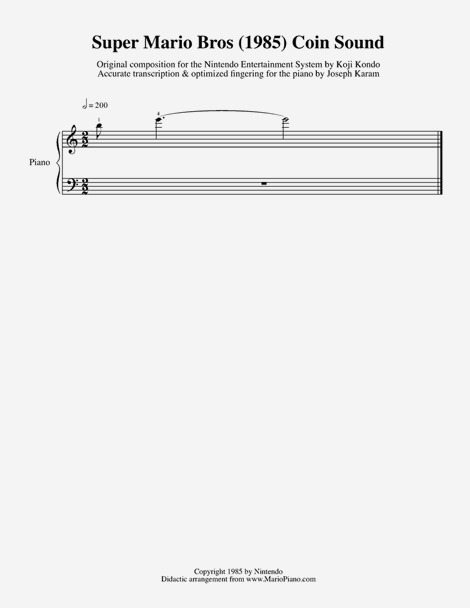
Musical score – the sheet music for Mario’s coin grab

Da-doiiing. That’s my onomatopoeic attempt at making the sound Mario makes (in the original Super Mario Bros) when he picks up a coin.

If you’re more interested in accurate musical representations, I have a special treat for you. The sheet music.

Amy sent me this… It’s from tumblr somewhere.

Shirt of the Day: Furious Fowl

Pretty cool real life Angry Birds design – available on Threadless.

Cocktail Infographics in 3D

You might remember the Engineer’s Guide to Cocktails… well, this is a nicer version.

More here (where you can buy it as a poster). Via FlowingData.

How to be a Ninja using only a T-shirt (and mystical kung-fu powers)

Yes.

Via ChurchCrunch.

Party like a Presbyterian

If there’s one thing Presbyterians like it’s a party.

So if you’re a Presbyterian who likes to party you should get a hold of this slightly awful Christian rap

Here’s a promo video. This is all the sample I needed.

Orchestral Friday

It’s Friday, Friday, Friday. Which means time for fun, fun, fun. Orchestra style.

The Petebox: Human beatbox looping thing

This is clever, and one of my favourite songs. Thanks largely to Fight Club.

Here’s his version of Nirvana’s Lithium.

He promises more regular videos here – and the fun on this one starts about a minute in.

E-I-E-I Yo(ga): Yoga farmer a bit of a stretch…

Honestly, this could only be worse if this was from some sort of Christian Television program. This guy is seriously creepy.

Via Jesus Needs New PR.

A swordid tale: Taiwan’s last bladesmith

Being a red-blooded male I love swords. Every stick in the backyard had sword potential when I was a wee lad. So because I love swords I am fascinated by this little doco (via a list of seven almost obsolete professions) about Taiwan’s last sword maker.

He made the sword from Crouching Tiger, Hidden Dragon, he seems pretty cool. Check it out.

Religious inkling v religious inking

Chris Eckert is an artist. And a philosopher. Of some sort. Though all artists would like to think they’re philosophers. And I really like this “Auto Ink”

He wanted to represent the truism that the greatest predictor for your religious beliefs is where you live. Which is true. It’s not the only factor, but it is a factor.

So he designed this…

It’s a tattooing machine that will randomly assign you a religion – and you’ll be stuck with it for life, symbolically tattooed on your wrist.

What I’d like to know, is what happens if you want to choose a religion after doing the hard work of thinking about it (what would I know though, my parents are Christian so my compliance was virtually assured). Can you get a second tattoo? Over the top of the first?

Here’s the blurb from the machine’s web page:

“The strongest indication of a person’s religion is geography. You are born into your religion. That doesn’t make it irrelevant or incorrect–religion provides a framework for basic morality that’s very powerful and it gives people a cultural identity that spans borders. I’ve attended mass in Dutch, German, French, and Spanish and I’ve always felt like I belonged. While my personal experience with religion is one of inclusion, a system that unites people from different regions and cultures, the public face of religion is often one of exclusion. Muslim, Christian, and Jewish zealots who know what God wants. More specifically they know what God doesn’t want and apparently God does not want me…or you. This public face of religion is always so certain, self-confident, even arrogant. That anyone could possibly know the “truth” when that truth is randomly assigned at birth is just funny.

Auto Ink is a three axis numerically controlled sculpture. Once the main switch is triggered, the operator is assigned a religion and its corresponding symbol is tattooed onto the persons arm. The operator does not have control over the assigned symbol. It is assigned either randomly or through divine intervention, depending on your personal beliefs.”

It’s provocative and creative. So it’s art. Watch it work.

PETA wants animal inclusive Bible

Let me just start by congratulating PETA for sinking to a new low with the name of their blog. The PETA files. Because we all think animal rights should be associated with child abuse, for the lols.

Then, let me move on to highlighting PETA’s latest ridiculous campaign.

“When PETA heard that the Committee on Bible Translation had revised the New International Version (NIV) of the Christian Bible to use gender-inclusive language, such as replacing “men” with “people,” we thought, wouldn’t it be great if the new NIV showed consideration for female (and male) animals too? So we wrote to the Committee on Bible Translation and asked them to use “he” or “she” rather than “it” to refer to animals in the next edition of the NIV.

“Language matters. Calling an animal ‘it’ denies them something,” PETA Vice President Bruce Friedrich told CNN. “They are beloved by God. They glorify God.”

Since God loves all His creation (and if you’re not convinced of this, try reading Matthew 25:40, Isaiah 11:9, or Luke 6:36), it’s only fitting that humans do the same by showing respect to every living being. Maybe Psalm 50:11 says it best: “I know and am acquainted with all the birds of the mountains, and the wild animals of the field are Mine and are with Me, in My mind.” Perhaps if we change the way we speak about animals, our thinking will follow.”

Here’s the CNN piece referred to in that post

There are some more stupid quotes from PETA in that article, here’s the meat of their argument.

“God’s covenant is with humans and animals. God cares about animals,” Friedrich said. “I would think that’s a rather unanimous opinion among biblical scholars today, where that might not have been the case 200 years ago.”

Now, I’m not sure that PETA has even a rudimentary knowledge of Greek or Hebrew – but they may be interested to learn that their beef is with the languages themselves, not with the Bible translators. Because the languages have male, female, and neuter nouns – and you’d have to bring gender to the table by your own agenda, to suggest that animals are anything other than an it. You’d have to create a bias in the text. Which is exactly what translators shouldn’t be doing.

David Berger, a Hebrew scholar lets them have it on this basis in that CNN article:

“In Hebrew all nouns are gender-specific. So the noun for chair is masculine and the noun for earth is feminine. There’s simply no such thing as a neutral noun,” Berger told CNN. “It’s unusual to have a noun that would indicate the sex of the animal.”

Another scholar, from Baylor University, David Lyle Jeffrey, disagreed with the rest of the nonsense from PETA’s suggestion…

“I agree with their contention that God cares for all of creation,” Jeffrey said. “It is true that we have a responsibility to reflect that affection.

“In gender-inclusive Bible translation the generic terms for humankind, let’s say, are then replaced with an emphasis on he or she. Instead of the generic he, you say he and she. I don’t quite see how that would work with animals,” Jeffery said.

“Do we need to know the gender of the lion Samson slew? What would it give us there?” he said. “You could try to specify that, but you would be doing so entirely inventively if you did. It’s not in the original language. … Nothing is made of it in the story.”

“When you get to the point when you say, ‘Don’t say it, say he or she’ when the text doesn’t, you’re both screwing up the text and missing the main point you addressed.”

Double Rainbow for a Choir

This post is mostly for Simone – because she likes to teach her choir songs from YouTube – so what better than a choir, on YouTube, singing a YouTube classic. YouTube style.

That is of course a choral arrangement of this song.

Minimalist Game Characters

A handy visual guide to game characters – provided you can identify them. From a Flickr user called Lishoffs.

You can buy it as a print here.
This operating system icons as Batman villains design (by Lishoffs) is also pretty clever.

Two wikipedia articles that simultaneously restore and diminish my hope for humanity

Now, Wikipedia didn’t think Jeremy Wales was suitable subject matter for an article, but they do think that Fart Lighting and Goldfish Swallowing deserve entries. I’m not sure what Jeremy should think about this. He is less newsworthy than flammable flatulence. Though perhaps the problem with my article about him was that it was somewhat embellished.

In case you’re wondering:

Fart Lighting

Fart lighting, or pyroflatulence, is the practice of igniting the gases produced by human flatulence, often producing a flame of a blue hue. The fact that flatus is flammable, and the actual combustion of it through this practice, gives rise to much humourous derivation. Other colors of flame such as orange and yellow are possible with the color dependent on the mixture of gases formed in the colon.
Although there is little scientific discourse on the combustive properties of flatus, there are many anecdotal accounts of flatus ignition and the activity has increasingly found its way into popular culture with references in comic routines, movies, and television; including cartoons.

You can read more about the science involved at the BBC.

Goldfish Swallowing

Goldfish swallowing was an American school fad starting in the 1930s, where a live goldfish is swallowed.
It is not clear how it became a fad: various people have made claims. A 1963 letter to the New York Times claimed that the fad began in late 1938 when Lothrop Withington Jr., a Harvard freshman with “[class] presidential aspirations,” was encouraged by his “campaign managers” to do so as a publicity stunt: “Reporters and photographers were inadvertently present in the Harvard Freshman Union when Withington swallowed his live goldfish (with a mashed potato chaser) and started a nationwide fad in the spring of 1939.” The editor replied that “unless the Editor’s memory is deceiving him, the goldfish-swallowing craze among school and college boys had begun at least as early as 1930.”[1] However, a Time magazine noted in a 1939 article, “Harvard Freshman Lothrop Withington Jr., son of a onetime (1910) Harvard football captain, started the fad sweeping U. S. campuses…”