It is possible to be a geek about so many things. From here.
![[geekmap.png]](http://1.bp.blogspot.com/_NfKwjR8raUA/SxhAY0izYUI/AAAAAAAAAHs/79k3_xw4dHg/s1600/geekmap.png)
Category: Culture
A handy guide to geek obsessions
YouTube Tuesday: My Guitar Hero
I’m still trying to clear up my queue of stuff I have been planning to post for ages. This is incredible. It takes Christmas light displays to a whole new level. A guy rigged up his lights so that passers by could play guitar hero with them.
Lego robot metaphorically smashes Rubik’s Cube
I had a housemate who could solve a Rubik’s Cube in under two minutes. Every time. It’s just a matter of understanding the fundamental principles of the Rubik’s Cube and applying that understanding with dexterity.
Two minutes is impressive. Twelve seconds is amazing. And that’s how fast this Lego robot solves the cube.

Watch it in action.
Mad Skillz: Izaac on writing Christian parody songs
Do you read Izaac’s blog yet? You should. It’s funny. And it’s by my friend Izaac. Izaac and I grew up in the town of Maclean. We’re both first years at Bible college. Maclean has a good chance of having the highest per capita production of blogging bible college first years in Australia. Anyway. Despite the self deprecation Izaac is a pretty talented guy. I wouldn’t have had him MC our wedding reception otherwise. It might have been ruined.
Here’s his mad skill.
I’m average at a lot of things. I lack the dedication and motivation to be truly awesome at any individual skill. I play piano but don’t read music, I play guitar but can’t play lead, I sing but only by the broadest definition of the word and at 25 I just started learning the clarinet and can only just make a noise. I am in no doubt this ‘could be better’/’could be worse’ stance has continued into the realm of blogging.
One thing I can do however is shamelessly plagiarise the works of others for personal gain (though parody is protected by law and I don’t actually get any benefit from it). I now present to you Mad Skillz – How to write Christian Parody Songs.
- Don’t be obvious.
Every man and his dog has thought about re-writing the lyrics to “I’m a Believer.” No one thinks you’re clever.
And then I saw God’s grace/Now I’m a believer/Now there’s not a trace/Of doubt in my mind.
All you’ve actually done is replaced “her face” with “God’s grace” which is both vague and potentially confusing jargon. It’s akin to re-writing Bryan Adams Everything I Do (I do it for you) by replacing every “you” with the word Jesus. - Choose enduring songs
There’s no point putting all that effort in just to have the original song fade into oblivion by the time the next ARIA chart is released. It’s better to choose songs by established artists and particularly their earlier work. Along the same lines rock and/or roll endures while other styles tend to fade away. Pop sensibilities change and most dance music has a particularly short lifespan. Remember Disco?This is the current ARIA Top 5 – Replay by Iyaz, Fireflies by Owl City, Blah Blah Blah – Ke$ha, Memories – David Guetta Feat. Kid Cudi, Tik-Tok – Ke$ha. No doubt like me you’re scratching your head wondering who these people are and how long since Coldplay released a single. Don’t re-write any of these songs.
- Pick songs with lots of lyrics.
A lot of modern music is based more on the beat and bassline than the lyrics. Go for artists that are particularly verbose. I once attempted to use the entire Beatles #1 album to re-tell Romans. It was really hard with the shortage of lyrics and the length of lines for many of the songs. Make sure you have enough words to tell your story. - Not all ideas are created equal
Sometimes a great idea won’t work in practice, at other times all you need is a word or phrase to kick you into action. When I re-wrote Little Lion Man about Daniel in the Lion’s Den, it was just the word ‘Lion’ that got me thinking. I broke Rule 2 because the song won the Hottest 100 which ensured a lot of instant recognition. For those thinking I broke rule 1, I would contend because the song isn’t actually about lion’s it isn’t all that obvious. Maybe I’m just trying to say you don’t need much of an idea to have a go. - Lighten up
You’re essentially engaged in an act of humour. That means you must try to be funny, even if you fail. People will already be smiling because “Hey, isn’t this that song? But listen that crazy cat has changed all the words.” Don’t get bogged down with too much seriousness. I wanted to convey in Little Lion’s Den that King Darius hoped Daniel would be frightened by the punishment. The line I was trying to rhyme with said “Tremble for yourself, my man” I went for “Tremble in your sandals Dan.” It’s not funny ha-ha, but it works because it’s a play on “tremble in your boots” plus sandals are inherently funny. - Realise it’s not a congregational song
Simone writes God-glorifying congregational lyrics which she tells us aren’t particularly suited to recounting narratives. Parodies on the other hand are a perfect vehicle for retelling Bible stories. The lyrics remain the driving force behind the song, so craft them carefully but just realise you are unlikely to get a parody onto the next EMU cd, so write accordingly. - Follow the metre of the original
Most popular songs aren’t modern poetry. Some are, most aren’t. That means lyricists often squeeze in extra words, change the length of lines, occasionally change the rhyme pattern. Wherever possible try to work off the same number of syllables sung with the same staccato as the original. (Apologies to those who know anything about music and realise I’m using technical musical terms without actually knowing if they’re appropriate.) - Rhyme like with like.
It’s hard to strike a balance between rhyming with the original rhymes and telling the story you want to tell. Wherever possible try to rhyme with the original sound,. If there are multiple rhymes within a line, work extra hard to include them. A lot of the humour in a song can come from rhyming closely to the original. My version of Little Lion Man isn’t overly humourous – but those who know the original hopefully appreciate the effort I went to replacing the repeatedly dropped F-bomb with “Luck”, “just”, “stuck” and “plucked”. - Production values count
There’s nothing worse than writing a parody only for the hearer to be unable to recognise the original. If you are recording try to be as close to the original as possible. Personally, I would never sing on a recording if I had the choice, but seeing as most of my recording is done using my MacBook set up at home when Sarah is busy I am left with the devices and skills that I have. As most people don’t have the budget to accurately record or proficiency to play live close to the original, it is important to understand musically what is the hook to the song. It was too difficult to learn and record my Missy Higgins parody on piano, so I played the piano riff on a harmonica over my guitar to make it stand out and the song instantly recognisible. - Arrogantly overstate the history of parody songs in the Church
Having written a number of parodies, a few of which I’ve recorded I like to exaggerate the history and importance of parody songs. I think I heard somewhere once that many old church songs were written to famous tunes such as “God has spoken by his prophets” to Beethoven’s Ode To Joy. But more than that, a number of songs were written to famous pub tunes. Though on reflection I’m pretty sure the lyrics to pub tunes I’m referring to were by the heretic Arius. Hmm… this is an awkward place to finish.
Value Ad-ding
Television commercials in regional areas are commonly bad. You might, if you live in a regional area, have assumed that low production standards and owner operator cameos were endemic to your particular geographic region – but I assure you – this is a global phenomenon.
Rhett and Link love local commercials. Especially these ones.
They were so inspired by ads like this that they now travel the United States making local commercials for local companies. Awesome.
Cool stories from the news
I have starred a bunch of news stories in the last few weeks that were cool but probably not quite worthy of individual posts (in my opinion) in order to clear my queue a bit I’ll post them all at once.
Have you seen any bank robbery movies where the robbers tunnel their way into the vault from a vacant neighbouring building? These thieves had. If I was a bank I would be buying up neighbouring businesses and being very careful about who I rented them out to.
Thieves in Brazil have stolen more than $6m (£3.7m) from a cash delivery firm, taking advantage of the nation’s passion for football, police say.
Police believe the thieves – who had dug a tunnel into the firm’s building – struck when season-ending matches were played in Sao Paulo on Sunday.
A security guard later told local media he had heard a loud noise but thought it was fireworks lit by fans.
Farmer plants land mines to thwart potato thieves
Only in Russia is it better to maim small children than have your potatos stolen. How else will you make the vodka that keeps you warm in those long winter months.
A Russian farmer has been convicted of planting landmines around his field to ward off trespassers.
Alexander Skopintsev, from the eastern region of Primorye near China’s border, laid the three devices on his land after building them in his garage.
The 73-year-old had apparently been concerned about the frequent theft of potatoes from his farm.
Ex Power Ranger challenges JCVD to MMA fight
That headline was just fun to write. Did you ever watch the “celebrity deathmatch” claymotion series? It was pretty dumb. It pitted sometimes obscure celebs against each other in wrestling matches that resulted in the untimely deaths of one or both of the clay figurines. This little incident is a bad case of life imitating art. It’s B grade meets D grade in a battle for martial art mediocrity.

The guy issuing the challenge is former White Ranger Jason David Frank, who tells TMZ, he’s had it out for Van Damme ever since 1995 when the Muscles from Brussels — who had been Frank’s childhood hero — allegedly blew him off during the premiere of “Mighty Morphin Power Rangers: The Movie.”
As TMZ previously reported, Frank is now a scary-looking MMA fighter who has a fight next weekend in the Octagon — and Van Damme is reportedly looking to make his own pro fighting debut … so the timing couldn’t be better for Frank to settle the score.

Tattoo artist father wants to create a tattoo using his son’s ashes as ink
Creepy? Macarbe? Heartwarming? I can’t decide. A UK tattoo artist plans to turn his son’s ashes into tattoo ink so that he can recreate a photo of his son as a tattoo both for himself, and his wife.
A father from Herefordshire is to have a portrait of his dead son tattooed on his chest using the child’s ashes.
Mark Richmond, 39, and his wife Lisa, 31, said they wanted to do something as a lasting tribute to their son Ayden.
…
The couple, who own a tattoo parlour in Greater Manchester, plan to mix some of Ayden’s ashes in the ink for a 7in black and white portrait of him.
How “creatives” overcome creative block
Nothing sucks more than writer’s block. Well, actually, that sentence is clearly untrue. Being squirted in the eye with lemon juice hurts more than writer’s block. If I ever have writer’s block I just make an absolute statement and try to come up with creative exceptions. Here you try it – what sucks more than writer’s block – did someone say black holes?
Anyway. Here’s a fascinating article interviewing a bunch of creative people about how they get the creative juices flowing. Some good tips. The consensus seems to be that if you want to be creative you need to become familiar with the works of other creative people – or just branch out into a type of creativity you’re not being paid to produce. For the writer this might mean sketching.
One guy came up with this relatively delicious solution.
The solution to a problem–
Slice and chop 2 medium onions into small pieces.
Put a medium sized pan on a medium heat with a few glugs of Olive oil.
Add the onions to the pan, and a pinch of salt and pepper.
Chop finely three varieties of fresh chilli (Birds Eye, Scotch Bonnet & Green/Red).
Add the chilli’s to the pan, stir together and cook for eight minutes.
Add about 500g of extra lean Beef mince to the pan.
Stir in so that the Beef is coated and lightly browned (should take approx. 2 minutes).
Add salt and pepper.
Add Red Kidney Beans and tinned chopped Tomatoes.
Stir well.
Add a pinch of Cinnamon.
Cook on a low heat for approximately 20 mins.
–
Measure a cup and a half of Basmati Rice into a medium pan.
Add two and a quarter cups (the same cup you measured the Rice in) of cold water to the pan with the Rice.
Boil on a high heat until the lid rattles.
Turn down the heat to about half way and cook for eight minutes.
After eight minutes turn the heat off the rice, leave for four minutes (with the lid on).
–
Plate up the Rice (on the side), add the chilli.
–
Large glass of Red wine (preferably Australian or New Zealand).
–Now the important problem solving part–
Take the plates & pans to the sink.
Run a mixture of hot and cold (not too hot) water.
Add a smidgeon of washing up liquid (preferably for sensitive skin).
Start washing up, the mundane kicks in.
The mind clears and new thoughts and ideas appear.
–
Enjoy a second glass of wine to savour the moment.
How not to cut yourself with sharp knives
I love reading professionals giving tips for everyday living. This interview with a butcher is fascinating. He gives five tips (in detail) that I’ll summarise here on how not to cut yourself.
- Keep the knife in your hand
“You should hold your knife like the butt of a pistol, fingers wrapped tightly around the grip “like someone was trying to take it away from you.” Some people hold a boning knife like a conductor’s baton during a particularly slow part of Pachelbel’s Canon. This is wrong. You will either drop your knife through your fingers, causing you to cut your knife hand with your knife, or, more likely, lose track of it in your brain’s motor control center and cut the hand holding the meat.”
- Don’t cut towards yourself
Putting all your strength into a brazen “take it to the board” type of cut is a sure way to bury a knife in your chest, belly, femoral artery or … genitals. We’re not talking stitches here, we’re talking surgery at best and coffin at worst.
- Keep everything clean.
We take care to avoid fat buildup on our knife handles to prevent what I like to call “the knife handshake,” which consists of having your lubricated fist slip over the grip and onto the length of the blade. Wash your hands. Wash your knives. Thoroughly. Often.
- Do not leave knives on the table, ever.
This applies mainly in a butcher shop. The reason we wear somewhat garish knife scabbards on our hips is to avoid ever setting a knife on the table. Why? Our pieces of meat are large and heavy, and knives can be well hidden. Add force and weight, and you can imagine what might happen to your hand or forearm. Gross.
- Bones can be really sharp.
Bones, particularly the chine and feather bones along the spinal column, become extremely sharp and dangerous when cut by a carcass splitter.
Speaking of knives – I’ve been looking for an opportunity to plug a bunch of knives I bought online recently that have turned out to be incredibly awesome and very sharp. They’re also cheap. They are Thai restaurant style chef’s knives and cleavers and they’re the sharpest knives I’ve ever played with (not that playing with knives is a good idea).
Mad Skillz: Ali on being poetic
Ali writes a poetic blog. Which by default means it’s deep. It’s not necessarily all about poetry but it’s the type of blog where just reading makes you feel more artistic and creative. That’s her milieu (to steal an artistic French word). To my knowledge we’ve never met – but we’ve both lived in Townsville. Ali is a former “Steve Irwin” style animal wrangler (as indicated by her link). This gives her some sort of credibility with those who don’t like poetry…
Here are Ali’s tips on how to be, or appear, poetic.
Let me first just say, I don’t get around calling myself a ‘poet’ so I feel like this is something of a joke, and there are those out there who with more credibility than me, so feel most free to comment/differ/add stuff. (My other option was editing, which might have been more use to some but would have been just as farcical. However, if you would like to know how to catch a koala, read here.
I supplemented this with some material from a course I did with Judith Beveridge, so you get something from a real expert.
- Read poetry. Read lots of it, and read the great poetry so your bar is high, but also read contemporary poetry (they are not necessarily mutually exclusive, but a lot of the known greats are actually dead). Having said that, the thing that actually started me writing poetry – even though I’d read it since school – was a friend giving me a poem they wrote for me, and it suddenly came within the realm of possibility, when I had never really thought about it before.
- Find out what sort of poet you are, your sympathies and approach. Then learn by imitation. It is actually the way to learn all art forms.
- Know the elements and rules of poetry. Read a book like “Rules for the Dance” by Mary Oliver (otherwise this post will never end). Only when you know the rules (rhythm, metre, line, form, sound, image, metaphor etc) can you break them effectively and do the “freefall” (as Mark Tredinnick called it) nicely (same goes for grammar might I add – that’s what MT was actually talking about). As with all creative writing, show and don’t tell. (So mostly don’t use abstractions – eg a word like “beautiful” is an abstraction so describe the elements of the beauty instead – or else interpret the concept/abstraction with an object eg “quiet as a house in which the witch has just stopped dancing” – “quiet” is the concept, the rest is the object (and obviously the whole thing is a metaphor) – I snitched this example from Judith Beveridge.)
- Work hard on language and find the language appropriate to the experience, and the appropriate form. The style and the content are inseparable. With the language you want the reader to feel like they are going through the experience and to be engaged on a sensory level. The vocabulary doesn’t need to be sophisticated necessarily but using ordinary words in different ways is good. (This is a kind of summary of stuff from the Judith Beveridge course.)
- As with all creative writing or creativity or skill, keep practicing and writing and also revising and editing and be prepared to fail along the way. (Seeing some drafts from the masters is enlightening – we tend to think poetry just rolls effortlessly off the tongue of the greats – not so, so be encouraged.)
Don’t stop Mario now
I’m not a big Queen fan – but I am a big Mario fan – so this video is right up my alley. Four levels of Mario have been cleverly overlaid to create Queen’s Don’t Stop Me Now. It seems Queen is good fodder for musically inclined geeks. This reminds me of that other thing I posted of computer peripherals playing Bohemian Rhapsody.
Finding new friends
According to a comment on Izaac’s blog – if I blog about how Guy Sebastian is a genre crossing fashion tragic I’ll get some new commenters who have google alerts set up to monitor mentions of Guy Sebastian. I’ve never sat near Guy Sebastian – but I don’t like his v-necked jumpers. I hope I’ve spelled his name properly.
Izaac, by the way, recently celebrated 200 posts. If you’re not already reading him you should.
Mad Skillz: Simone on supply teaching
Simone is married to Andrew. Together they are my boss. Kind of. In that I am currently a student minister at their church. At the moment I feel like Hebrew is my master.
Simone writes songs of goodness and blogs deeply and often at Another Something. When I first started blogging I had a template that featured white text on black. Simone told me it was too hard to read. I changed it. She stopped reading. She started again a while back.
When Simone is not writing songs, children’s material or soppy poems to her husband she is a supply teacher. Here’s what she has to say about Supply teaching.
I have one of the best jobs in the world. A job that makes me a nice pocketful of money, that is strictly school hours, and gives me the flexibility to work or not to work on any particular day. On top of this, it (often) takes little emotional energy, gives me the chance to contribute something nice to the world, and is (mostly) fun.
I am a supply teacher. I’ve been supplying for over two years now, and I’ve developed some mad skilz in my area. Let me share.
My top 5 tips for being a good supply teacher
- Don’t be a nuisance to the school. Schools are busy places. Get in there and do your job. Take responsibility for your kids and try to have things run as smoothly as they would if the teacher you’re replacing was there. And don’t whinge if you have to do an extra playground duty. You are getting paid more than any other staff member and really have nothing else to do. Leave the classroom tidy.
- Make the kids come into the room well. Have them line up over and over again if you need to. Once they are quiet, move to number 3.
- Bribe the kids with fun and semi-educational activities. At the start of the day, write all your incentive activities on the board. Tell the kids that you’d love this to be a great day and if they get through their work, they’ll get to do some of these fun things. Promise them obstacles courses outside, sport, art, anything – but be positive. With you there, there is the opportunity for an unusually excellent day. (If I have to teach a P-3 class, I take in a piece of ‘lovely lycra’ and a few teddies. There is almost nothing younger kids won’t do for you if you promise them a chance to bounce bears on a trampoline! Make them count in 2s or 3s while you bounce the teddies and it becomes a maths game!)
- If the teacher leaves you no work, be thankful! You have 5 hours to teach the kids whatever you want. Pull out your favourite stories (Roald Dahl is always good), read to them for a very long time, then make up some creative writing or art or maths or SOSE activities around your reading. Play with character transformations (‘If the enormous crocodile was a person, what would he look like? What would he do?) or points of view (re-write parts of ‘the Enormous Crocodile’ in a voice sympathetic to the EC). Turn it into a comic, with or without text. Make up maths word problems based on the story. Research the diet of crocodiles… Endless options, and they all take little or no preparation. If you are not tied to any program, you are free! Make the most of it! (If work is left, do it! And thank the teacher.)
- Show the kids that you like them. This goes a long way. (If they are not very likeable, this one will be hard. But try.)
And finally, don’t stress. Whatever happens, it will all be over at 3 o’clock.
(Almost) YouTube Tuesday: The theodicy of Tetris
Pretty funny. Unless there is an outrageous amount of swearing in the last 20 seconds. In which case this is terrible.
The best dumb questions on Yahoo Answers
PC World has collected 20 dumb questions people have asked on Yahoo Answers – but I’m sure there are worse out there. Got any clangers?
Question: I was bitten by a turtle when i was a young lad, can i still drink orange juice?
Best Answer: No! If you drink orange juice now, it will activate the turtle venom in your veins and send you into a coma. Didn’t anyone ever tell you this before?
This proves once and for all that despite what you’re told in the first week of Bible College there are stupid questions.
How to write to a fan
David Bowie hasn’t always been incredibly famous. His name hasn’t always been David Bowie. When he was just starting out he responded to fan mail personally. Here is a scanned copy of his first response to a fan letter from the US.
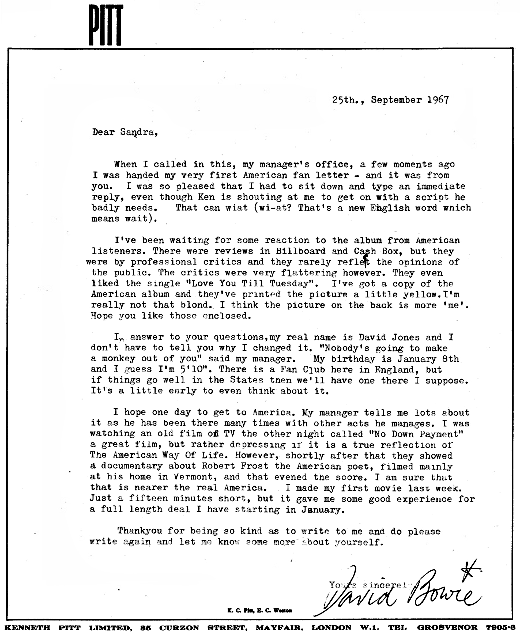
Here’s a cool bit…
“I hope one day to get to America. My manager tells me lots about it as he has been there many times with other acts he manages. I was watching an old film on TV the other night called “No Down Payment” a great film, but rather depressing if it is a true reflection of The American Way Of Life. However, shortly after that they showed a documentary about Robert Frost the American poet, filmed mainly at his home in Vermont, and that evened the score. I am sure that that is nearer the real America. I made my first movie last week. Just a fifteen minutes short, but it gave me some good experience for a full length deal I have starting in January.”