
Trials and Tribulations
After a few days holidaying in Airlie Beach and catching up with friends in Townsville, which have been really nice, tomorrow sees me “trial for license” – part of the ongoing process of becoming a Presbyterian minister.
I’m preaching at a fairly old school Presbyterian Church in Townsville in front of a few members of the North Queensland presbytery who will “appraise” my performance and pass judgment on my ministry suitability.
I’m preaching on the Beatitudes. Here’s a paragraph from my sermon.
“But I want to suggest, at this point, that we’re not looking at the beatitudes right if we understand them as a set of rules to follow to be part of God’s kingdom. I grew up thinking that the word “beatitude” was a description of what these verses mean – I thought they were a set of instructions for how we should behave, and what our attitudes should be. The beatitudes. But I think the meaning of these verses does hinge on what the word beatitudes actually means. It’s latin. It means “blessings.” And it picks up on that repeated “blessed are” phrase at the start of each verse.
The beatitudes aren’t about what we have to do to be in the kingdom – and in fact, as soon as we read them that way we’re slipping into the same trap as the Pharisees. We’re making rules and regulations for belonging to the kingdom.”
Then I say that the beatitudes are about God’s blessing of us, through Jesus, whose life and ministry are modeled on the beatitudes. Doesn’t seem heretical to me… how about to you?
Also (pretty official)…
I have a new day job. For January at least. But I haven’t signed any of the paperwork yet. Doing some marketing of some sort for a government department that houses books. I’m not sure what the rules about writing about this sort of thing are yet (because I haven’t started). But it’s pretty providential timing. And I’ll be working with my friend Amy. Who is an occasional commenter here. Should be fun. I like the idea of not completely losing my marketing/PR skill set. But this job also has some nice menial components to it which won’t entirely do my head in during the college break.
It’s Official: Boy and Bear the new Mumford and Sons
I’m as excited by Boy and Bear now as I was about Mumford and Sons when I wrote this post. Check out this Crowded House cover.
Wikileaks: Of dams and fingers
So, the Wikileaks saga drags on. At least Oprah is gone from our shores…

The whole Wikileaks thing kind of fascinates me. It’s the archetypal immovable object up against the irresistable force. Freedom of speech (particularly of the press) and a desire for transparent government meets public safety, national interests and diplomacy. Chuck in an Australian with a God complex and a stated desire to change the way governments do business, a few tortured souls willing to sacrifice life, limb and well being in order to leak classified documents they’ve obtained illegally… it’s got all the hallmarks of a follow up to the Social Network – the UnSocial Network.
Part of me thinks transparent government is a good thing. Part of me is fascinated by the trainwreck as governments respond to the saga – Julia Gillard’s uninformed “this is illegal” is one such example. And doubtless it presents problems for governments involved – we’re not talking cynical dictators here, but democratically elected representatives who are trying to serve their people. Leaking information is reprehensible – it’s not up to a lowly member of the military to decide what state secrets come out, and it’s doubtless against their employment contracts (and of course, treasonous). Some information is dangerous. And a dangerous world is likely to require dangerous information – information that shouldn’t necessarily be broadcast to everybody, the problem with the Assange model is that it draws no distinction about who should receive what information. Which is naive. Why should Al Qaeda have access to the same information as the average American citizen about how the American government operates? That makes no sense. It’s not as though governments aren’t thinking about transparency themselves – they just err on the side of caution when it comes to disseminating information. Wikileaks errs on the side of stupidity.
The press has always been free to publish fruit from a poisonous tree – provided it’s in the public interest. And I reckon wikileaks, broadly speaking, falls into that category. They’re not stealing the documents themselves, hacking databases or surreptitiously accessing information from behind iron curtains – they’re simply a distributor. But a distributor with an agenda. Just like Fox. So while I reckon the leakers are in the wrong, I think it sets a dangerous precedent to go after the distribution channel rather than the leaker. Wikleaks simply represents the new media’s style of distribution. Too the masses, for the masses, by the masses. The “information is power” equation functions on the law of diminishing returns. More information available to more people doesn’t mean more power. It just robs power from those who previously held it. It’s diluted. In a lot of ways it’s better that the information is available to everybody than that it’s available to a select few on the black market. That’s part of having a free press and a commitment, in principle, to democracy. It’s one thing for Julian Assange to speak of getting rid of the US’s stranglehold on politcal power globally – but what do you replace it with? He’s a typical anarchist in some sense – he doesn’t seem interested in the future, just in displacing the present.
Attempts to control information in this day and age is like standing in front of a cracking dam wall and plugging the gap with you finger. It won’t work. And you’re going to get smashed when the wall cracks. I think that’s what this has taught me. I’d say governments are better off just aiming for complete transparency. The idea of not doing anything you’re ashamed of is as old as debates about privacy. But it works. If governments were more open to freedom of information requests and being transparent then there’d be less chance of damage happening through leaks. Give the people a torrent and it’s likely that bad news would be buried in the sheer volume – and when it surfaces you can always acknowledge that it was there and say “that’s why we’re making this information available”… the Internet is changing the way information can be disseminated and the management of the leaks, from a PR/news cycle perspective has also been interesting. It seems Julian Assange has no real editorial brain. He hasn’t done a great job at managing the flow of information, the bang to buck ratio is poor. Pushing a glut of information out there at once is guaranteed to bury some of the good stuff. Even if you pick a few strategic articles to promote the release by giving juicy exclusives to particular outlets. His strategy has been bad. His personal strategy has been pretty bad too – even though he’s won over a few celebrity campaigners who have adopted him as a cause de jour. The Swedish claims seem a little bit too convenient – but the man does appear to be a bit of a self-interested slimeball with delusions of grandeur.
Here are some good wikileaks articles for your perusal:
The Ugley Vicar considers the motivations behind Assange’s program. Including this quote about the function of wikileaks:
“The more secretive or unjust an organization is, the more leaks induce fear and paranoia in its leadership and planning coterie. This must result in minimization of efficient internal communications mechanisms (an increase in cognitive ‘secrecy tax’) and consequent system-wide cognitive decline resulting in decreased ability to hold onto power as the environment demands adaption.”
The Guardian, a mainstream paper who were the beneficiaries of some of Assange’s leaks asks questions about the motivation behind them and the changes the leaks might bring.
The Economist points out that wikileaks is just the tip of the iceberg, or rather, an example of how easily information can spread in the Internet – suggesting that plugging this leak won’t stop the dam bursting:
“Yet the debate over WikiLeaks has proceeded as if the matter might conclude with the eradication of these kinds of data dumps—as if this is a temporary glitch in the system that can be fixed; as if this is a nuisance that can be made to go away with the application of sufficient government gusto. But I don’t think the matter can end this way. Just as technology has made it easier for governments and corporations to snoop ever more invasively into the private lives of individuals, it has also made it easier for individuals, working alone or together, to root through and make off with the secret files of governments and corporations. WikiLeaks is simply an early manifestation of what I predict will be a more-or-less permanent feature of contemporary life, and a more-or-less permanent constraint on strategies of secret-keeping.”
Here’s an hour long documentary on Wikileaks that you can watch at your leisure.
After PayPal, MasterCard, and other financial institutions went after Assange and Wikileaks – 4Chan struck back for the internet, launching DoS attacks on their servers.
I’ll watch the inevitable movie though. So what do you reckon – is Assange a hero or a villain?
Questioning the premise of Angry Birds
What happens when the troops start questioning the methods employed by their generals? Revolution. That’s what.
And so it begins.


New Transformers: Product Placement goes too far…
The movies in the Transformers franchise are a car company’s dream, with the third installment due out soon, other companies are looking to get a piece of the produce placement pie.
I give you, the Nascar Transformer…
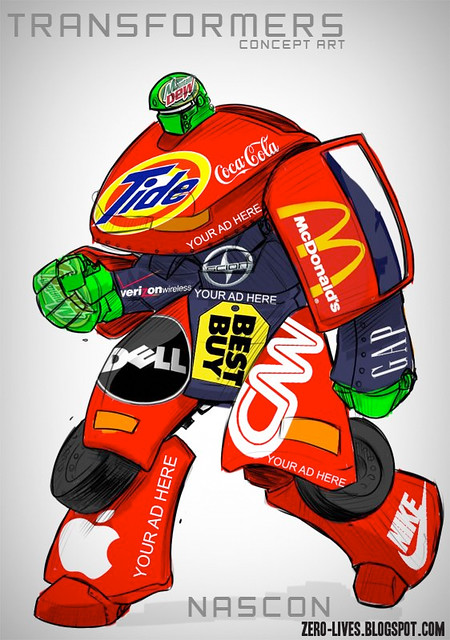
This is from Zero-Lives’ Flickr collection.
Best. Dissatisfied. Employee. Ever
Dissatisfied with your job writing copy for a product you don’t care about. This guy who writes advertising for printer ink cartridges is too.
It’s here, and here’s a cached version in case it gets fixed, but here’s what he wrote, for posterity’s sake:
Remanufactured HP 300 – (CC640EE) Black
Remanufactured HP 300. Contains 8ml of high quality pigment ink and will print 380 … Do you know what? I really can’t be bothered with writing these description anymore, it’s a printer cartridge! What am I supposed to write really??? It’s a cartridge that prints ink on to paper, you could print some work stuff or a colouring in page for the kids that they’ll half do and then leave laying around on the floor or a poster of the horrible Jonas Bothers for your teen daughter hoping that she might stop listening to there pathetic attempt of music so much. There good quality cartridges I’ll admit that, every time I’ve sneakily took some home with me they’ve worked perfectly, but the thing that’s doing my head in now is writing about them day in and day out with the boss giving me an impossible deadline to finish them all by which means I can’t even sit at my desk pretending to work like I know most people do in this place. My advice to you is if you’ve got to this page then you probably need a cartridge, or you have a weird fetish for ink cartridges, either way it’s a ink cartridge, it works perfectly, so if you want one buy one, if you don’t then why havn’t you left this page allready?
Signed: The guy who writes the boring everyday mundane descriptions about printer cartridges everyday.”
Moses: The Waterbender
I didn’t see that movie about the kid who could play with air. Who needs that stuff when you’ve got the Bible.
Check out Moses. From Zero-Lives’ Flickr.

Is your logo elegant and simple?
While looking around the interwebs for a page of logos to flog for this post I found this little infographic. It’s nothing new. But it’s a reminder that logos seem to have devolved rather than evolving into increasingly complex things – even though we have the technology to reproduce much more complicated designs online and in print.

It seems that the companies that have gone against the trend, adding complexity, are the ones most people would say are going backwards (Microsoft and IBM).
There are certainly advantages in terms of printing and reproduction for having a simple logo, and for recognition and memorability.
But it’s also interesting that as “branding” has become a big thing, logos have become smaller and less significant. Which is good. Because a logo isn’t a brand, it’s just a visual tag that makes people think of your brand.
Cross posted on Venn Theology.


Get Stuffed: How to do mouse taxidermy
This is why I love instructables.
Step 1. “Procure Mice.” Awesome.
Here’s what you’ll need if you follow the steps through to the end.

Friends gave me a “Beginners Guide to Taxidermy” for a wedding present, it basically covered how to preserve your dead pets. It’s a cool book. Here’s a taste of the sort of stuff it features…

Charting the social acceptability of peeing in public
This is no laughing matter. It’s serious sociology people. Get with the program.
So, because you all need to think more deeply about your innate desire to pee in public, here’s a graph representing the social acceptability of said action (or other peeing related actions) and the outcomes of such pressure on your bladder. This social pressure creates real pressure.
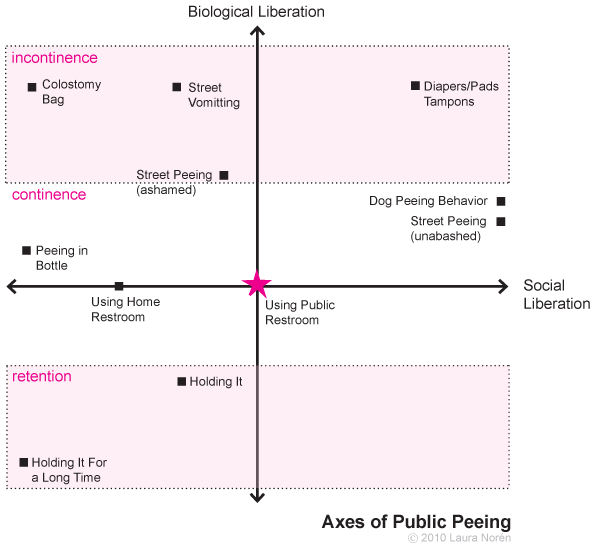
From the artist/sociologist:
This was something I used to help me think through the two main axes that determine peeing behavior – biological and social control. Urination is a biological function that has been subjected to a great degree of social control. Unfortunately, urban design has not kept pace with the demand for clean, easily accessible public restrooms for humans. And there has been no attempt to create any kind of system to deal with canine urine. In most cities it is illegal for humans to pee in public but both legal and widely accepted for dogs to pee where ever they like (in New York, they cannot pee on the grass in parks).