This has simply gone too far. Christian parody songs almost always come off badly on YouTube.
Stop it. Ok.
This has simply gone too far. Christian parody songs almost always come off badly on YouTube.
Stop it. Ok.
What do you get if you combine backwards masking and the Third Eagle of the Apocalypse?
Hidden satanic messages.
In other news, The Third Eagle of the Apocalypse sent me his book (I asked for it on YouTube). He didn’t personally sign it. But he did touch it. If I can be bothered.
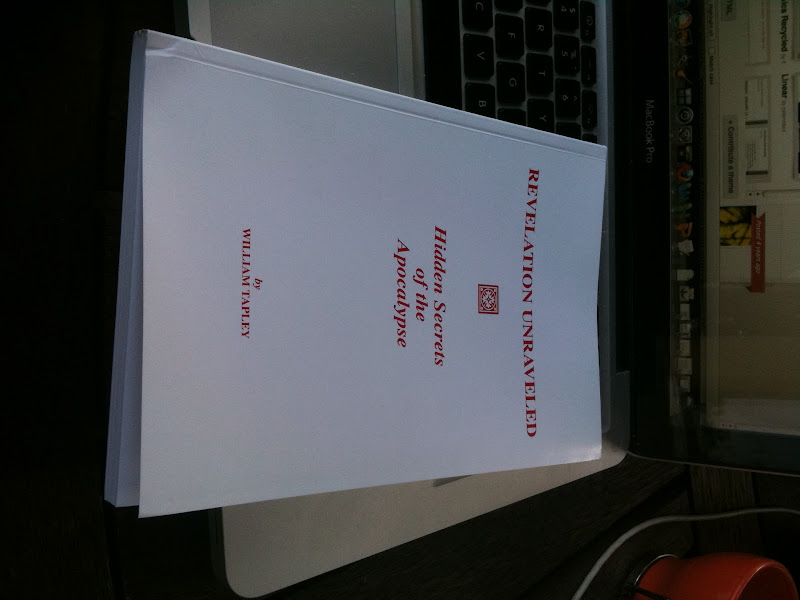

This picture is filed in the “pictures I will one day use on a powerpoint as a sermon illustration” file.
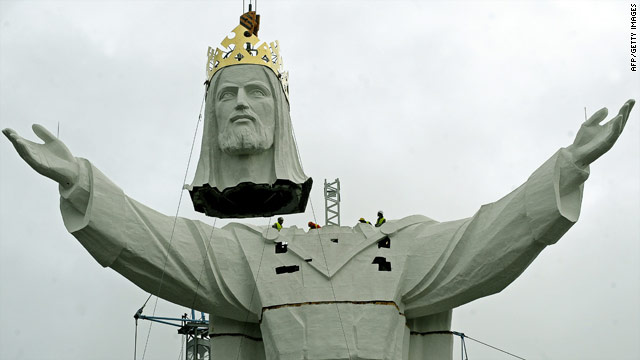
Here’s the story behind the photo from CNN.
What would Jesus have you do? He’d have you build the world’s biggest Jesus statue. That’s what.
Workers in Poland finished erecting the world’s tallest statue of Jesus over the weekend, a 170-foot (52-meter) giant that towers over the countryside near Swiebodzin.
“This is the culmination of my life’s work as a priest. I felt inspired to fulfill Jesus’ will, and today I give thanks to him for allowing me to fulfill his will,” Father Zawadzki said after the head was attached by a 700-ton crane, according to a report from the Warsaw Business Journal.
This is very nice.
So I might resurrect YouTube Tuesday, but on Friday. Here’s today’s submission.
I likes this shirt. I likes it a lot. Two of my favourite things. Coffee. And Venn Diagrams. Combined.

On Threadless.
If you go out in the ocean today, you better be in disguise. But not as anything a massive tuna might take an interest in, or it might drag you into the depths of despair, or at the very least, the depths of the ocean. Giving you a bad case of “Oh man, I almost died because a giant tuna dragged me to a depth of 300 feet” syndrome. A deadly and dangerous syndrome indeed. Though, thus far, it has not killed 100% of its victims…

This happened a while back, but here’s the story (from the Philippines):
“Lt. Commander Armando Balilo, PCG Public Information Officer, said scuba diver Ramir Te, who was on a diving expedition, was 80 feet below the surface when he was pulled down by a giant tuna fish at the waters off Kiamba afternoon of Sunday.”
This is such an amazingly cool invention. A hole punch that turns bits of plastic (like your old credit cards) into guitar picks.

It’s called the Pick Punch. And it has totally solved any pangs of anxiety for not having bought loose acquaintances Christmas or birthday gifts for the last five years. Now you can just grab a pile of plastic and tell those people to take their pick.
Moving right along, like a comedian whose last joke bombed badly, we’re getting towards the final stages of the “Patristic Period” (which covers roughly 100 A.D to 451 A.D, ending at the council of Chalcedon)… these councils all seem to have to decide the same thing over and over again, first against Arianism, and then against Nestorianism and Eutychianism.
Quick guide to fifth century heresies:
Arianism: Different substance, Jesus is creation, not same as creator.
Apollinarianism: Splits Jesus into divine (mind) and human (body)
Nestorianism: Mary bore Christ not God, different substances. Jesus became God (he was two persons in a moral union.
Donatism: Anything touched by somebody touched by a heretic is tainted. Purity at all costs. Your baptism, and salvation, are ruined by a heretic who transmits his heresy.
Pelagianism: No inherited sin, or original sin, or indeed sinful nature. Works can get you to heaven.
Eutychianism: Christ has one unique nature. Not human. Not god.
Quick Guide to the Councils:
325: Nicea – Against Arianism, Athanasius refutes Arianism, vote is hugely in favour, comes up with the Apostle’s Creed – which bears similarities to creedal confessions from 1 Corinthians 15, through the writings of the early church. Takes two months. Decides Jesus is fully human. Fully god. Of like substance.
381: Council of Constantinople – Jesus Christ is truly human. Just like us. Apollinarianism is refuted by the Cappuccino Brotherhood (Cappuccinos actually get their names from the hoods of monks).
393: Council of Hippo – Affirms Athanasius’ definition of the canon, provides criterion for adopting the books.
431: Council of Ephesus – Jesus Christ is one person, contrary to Nestorianism, which held that Christ was two persons, one divine and one human
449: The “Robber Synod” – Declares Christ has only one nature (Eutychianism).
451 Council of Chalcedon: – Response to Robber Synod, decides that “Jesus Christ is “two natures, the Divine of the same substance as the Father (against Arianism), the human of the same substance as us, which are united unconfusedly, unchangeably, indivisibly, inseparably…”
Here’s how the period plays out in timeline form:
325 Council of Nicea
328 Athanasius is bishop Alexandria
329 Basil the Great of Cappadocia is born, he promotes communal monasticism that serves the poor, sick, and needy.
330 Constantinople founded
335 Martin of Tours, a monk who is famous for his compassion for the poor is born.
337 Constantine’s baptism and death
339 Ambrose, a significant figure in the church whose powerful rhetoric converted Augustine, is born, his approach to OT exegesis was closely mirrored by Augustine, anything that wasn’t pure moral instruction he allegorised, looking for a mystical meaning. Follows Origen lots, and borrows allegory from Philo. Fought against Arianism.
340 Ulfias, a German dude, converts to Arian Christianity and ends up converting most of the Germanic tribes.
345 Chrysostom is born, the father of historical and grammatical exegesis (the good stuff) starts a movement away from allegorical interpretations that had been popular since Clement of Alexandria.
347 Jerome is born, Augustine’s interlocutor, and a massive brain who translates the Old Testament out of Hebrew into Latin, producing the Vulgate.
353 Constantius’ pro-Arian policy boots Athanasius out of Alexandria
354 Augustine is born, Augustine. The world’s first blogger. A prolific writer about church, state, doctrine, education, music… you name it, he wrote about it. Had an interesting, and slightly munted, view of the transmission of sin, and a predilection for bizzaro allegory in interpreting the Old Testament. Otherwise a brilliant thinker who should still be read today.
361 Julian the Apostate gains control, converts to Paganism. Rules for two years, gives the Donatists a chance to return to Rome (causing later headaches for Augustine)
367 Athanasius defines New Testament, naming the 66 books of the Bible in a letter.
370 Basil becomes bishop of Caesarea
378 Battle of Adrianople
379 Theodosius becomes emperor, makes Christianity the official state religion.
381 Council of Constantinople: Basil, Greg and Greg take down the Arians. Again. The council deals with pretty much the same issues, concluding that Jesus Christ is truly human, contra Apollinarianism, which split Jesus into a human body and a divine mind. The Great Cappadocians are the inspiration behind the defeat of Arianism at this council. They are St. Basil the Great, St. Gregory of Nazianzus, and St. Gregory of Nyssa
382 A Roman Council affirms Athanasius’ definition of the canon.
385 Ambrose prevails
387 Augustine’s conversion
393 The Council of Hippo also recognises the canon, providing set criteria for recognition: a book had to be Apostolic, fit in with the other scriptures, and have been of fruitful use throughout the church up to that time
395 Augustine becomes bishop of Hippo
397 A council of Carthage recognises the decision at Hippo. We have a Bible.
398 Chrysostom bishop of Constantinople
400 Nestorius, a heretic, dies. He said Mary was the bearer of Christ not God. He could not call a three month child God. So he said that Jesus Christ was two persons, whose only union was a moral one.
406 Jeromes completes the Vulgate
410 Fall of Rome
411 Augustine starts writing against Pelagianism. Pelagius rejected the idea of sin through Adam, original sin, and a sinful nature. Ruled out grace, suggested works was all that was required. Augustine gives birth to Calvinism, ahead of its time. God’s grace is necessary not only to be able to choose to obey God’s commands, but to be able to choose to turn to God initially for salvation.
418 Synod of Carthage: Makes Pelagius a heretic and his teachings an “anathema”
431 Council of Ephesus: Again, forced to rule on Christology. Jesus Christ is one person, contrary to Nestorianism, which held that Christ was two persons, one divine and one human
448 Leo draws on the work of Tertullian and Augustine to define Christology for the church, writes a tome to Flavian (dude in Constantinople)
449 The “Robber Synod”: Declares Christ has only one nature (Eutychianism). Tries to argue that Christ’s nature is unique. Harks back to docetism.
451 Council of Chalcedon: Affirms Leo’s tome, rejects Eutychianism, tosses out Nestorianism (again), decides that “Jesus Christ is “two natures, the Divine of the same substance as the Father (against Arianism), the human of the same substance as us (against Eutychianism), which are united unconfusedly, unchangeably, indivisibly, inseparably (against Nestorianism)”
455 Vandals sack Rome
476 Odoacer deposes last Roman emperor
The power of music. A Justin Timberlake parody no less.
Bringing Serving Back from Parkview Christian Church on Vimeo.
Continuing where we left off in post one, which was somewhere towards the end of the third century, we are rapidly approaching D-Day for the Christian church. Or Armistice Day. Constantine’s conversion to Christianity, or apparent conversion to Christianity, made Christianity the official state religion, and changed the landscape of the church forever. Being a state religion meant having rigid notions of doctrine in place in order to determine who was being a good citizen, and who was inspiring political unrest through heretical rocking of the boat. Truth became a democratic process, and this period saw a number of councils making significant decisions on doctrine, and the collapse of the Empire, and continuation of the church, brought about several interesting interchanges driven largely by power struggles within the church, or seeking the aid of the church… so lets go back to the end of the third century, having just farewelled Origen and Cyprian…
The Life and Times of Constantine, and the Council of Nicea
The Third Century ends with another bout of persecution under Diocletian. Diocletian split the empire into east and west, appointing Maximian as his co-emperor. Eventually the empire is split again, and Constantinus is basically appointed as co-emperor of the West. Diocletian’s persecution of Christians was particularly mean. He tried to wipe them out to satisfy some oracles. He ordered all scriptures, churches, and Christians to be burned (or just to not meet, but to hand over any copies of the Bible they had). The Christians of the west were ok, because their emperors did not enforce the edicts of Diocletian and Galerius.
Diocletian ends up abdicating in 305 A.D, and a year later Constantinus, Constantine’s father, dies and as a result Constantine is pushed into the role of emperor of the West. Constantine basically goes about reuniting the empire, and by 313 he and one of his relatives, Licinius, issue the edict of Milan – a policy of tolerance for Christians. Licinius eventually renegs on this deal, and Constantine then ousts him and becomes emperor of both sides of the empire. He moves the capital to Constantinople, and is eventually baptised as a Christian – fusing church and state, with Christianity now the official religion of the empire. A pretty massive turnaround in 300 years – from crucifying to worshiping Jesus.
This newfound status in the empire means the church has to thrash out some issues that have been bubbling away under the surface. First cab off the rank is Donatism – the Donatists appeal to Caesar, who rejects their views and banishes them in 316 A.D.
Then Arius starts up. Launching the Arian controversy which needed the Council of Nicea to unanimously (almost, 2 said no) define the Creed for Christian belief- the Nicene Creed. The council settled a bunch of issues, and as a result Constantine sacked any Arian sympathising bishops and exiled them.
At around this time Pachomius establishes a monastic community – a communal home for hermits. Monastries become a cool place to hang out by yourself. Monasticism essentially replaces martydom as the means for Christian sacrificial living.
A brief snapshot of figures from this period
1. Constantine: Control freak, megalomaniac emperor who was shrewd and effective often employing propaganda to get what he wanted – he took control of a fractured empire and ruled it for over twenty years, went from protecting the freedoms of Christians, to becoming one and making Christianity the state religion. Unseparated church and state. Though continued to patronise Roman religions throughout his life.
2. Arius: Ascetic dude who liked pagan philosophers and sparked a massive controversy within the church because of his Stoic interpretations of doctrine. Founded Arianism. Eventually died on the toilet just before being reinstated to the church (after Constantine’s successor revealed a penchant for Arian theology. Reinstated by Constantine in in 328 A.D.
3. Athanasius: The main opponent to Arius, presented the adopted view at Nicea. Taught that since only God is to be worshiped, and the New Testament calls for Christ to be worshiped, that Christ is God. Only God can save, Christ saves, Christ is God. Only somebody who is human and divine can offer eternal life. Only God can pay the debt for sins. Son of God, Son of Man used interchangeably for the one figure. Christ came to restore us to God. Becomes bishop of Alexandria after the Council.
4. Eusebius: Submitted a creed to the council that heavily influenced the final form of the Nicene Creed, wrote a history of the church up until 300A.D.
A brief snapshot of beliefs and events from this period
1. Donatism: Sprang up out of the Diocletian persecution (but came to a head a decade later). Argued that anybody who had complied to Diocletian’s orders was permanently tainted, and anybody who had any contact with them was also permanently tainted.
2. Arianism: Taught that Jesus was the Son of God, but not eternal, that he was in fact created ex nihilo before the creation of the world, Jesus was not human, or god, but was unique – a lesser divinity, not of one substance with the father (like, but different) – Arianism saw Jesus as an event in the life of God, rather than leading the life of God all along.
3. Nicene Council : Rejected Arianism, settled on the Nicene Creed as an appropriate outline of the faith. Took two months to decide on an alternative view. 220 Bishops in attendance, recognised Origen’s three hypostasis – the father, son and spirit. Also recognised Alexandria, Antioch and Rome as important churches with authority over others. Also settled the date of Easter.
There’s a likelihood (or perhaps a possibility) that the exam questions tomorrow will ask about the development of the church in the early year’s it’s probably worth covering that off too… The New Testament Church enjoys the benefits of apostolic oversight. Guys like Peter and Paul are running around planting churches, but they’re supported by a bunch of other people (eg Barnabas, Silas, Timothy, Titus, Erastus, etc), The Council, or “pillars” of the church in Jerusalem can be consulted for major doctrinal decisions (like in Acts 15) – and their word is authoritative. But what of the next generation? Or the generation after that. The so-called Apostolic Fathers were seen as a natural link (and many people think that link established a continuous chain of authority). But obviously, based on looking at some of the primary documents, it didn’t take long for errors to creep in, or disputes to arise. The hotly disputed “Pastoral Letters” (that I still think were written by Paul because the arguments against that are just stupid),1 at the very least, demonstrate that some form of pastoral structures were present in the early church (there were elders, and teachers). There would also be false teachers to watch out for (suggesting that there were a bunch of people jumping on the itinerant preaching bandwagon, or people becoming teachers within a city or town). We know from the New Testament that there were churches scattered far and wide, throughout the Roman world. Developing some form of governing hierarchy became important as heresies began to emerge and spread, throughout the church. Marcion, the gnostics, and the Montanists gained traction across the church, causing the leading intellectuals from the orthodox side of the fence to more carefully define what was right and what was wrong belief. Which meant developing some semblance of a canon. Justin Martyr’s apology outlines the practices of the church a century after the last bits of what we know as our canon are assumed to have been written (unless you’re one of those academic nutbags who thinks they were all written mid second century). But it’s likely that the very diverse spread of the church, and very diverse set of academic, philosophical and social influences on leaders of the early church, meant that there were as many differences in writings and teachings (that were still faithful to the gospel) as there are today. There was much “plundering of Egyptian gold” (as Augustine likes to call it) going on with regard to determining and teaching the truth. Most teachers and apologists whose writings were influential on the church showed a mastery of pagan thought and philosophy, most engaged with Roman law, and with Greek philosophy in their apologies for the Christian faith, and most also had errors creeping in to their theology because of pre-existing commitments to human thought and philosophy. Different philosophical commitments gave rise to different exegetical methods – one man’s passage that required historical reconstruction to point to Jesus was another man’s passage that required allegory to point to Jesus. There was much diversity, but also unity. Approaches to theology from opposite ends of the empire both took the forms of “Apologies for the Christian Faith” directed to the emperor, and showed a love and familiarity for God’s word as contained in the Old Testament, and in the gospels and writings of the apostles. Tertullian’s description of Christian practice, with reference to the early letter between Pliny and Trajan, sounds very much like Justin Martyr’s description of Christian practice, though they were from the east and west sides of the empire. Separated geographically, but united in Christ, and in the way they remembered him. It is likely, based on the way the gospel is presented in works from the period across the empire, that Paul’s creedal confession in 1 Corinthians 15 was normative across the early church. Many prototypical creeds even include reference to Jesus trial before Pontius Pilate, Justin Martyr and Ignatius both make allusions to Pontius Pilate in their definitions of the faith. Ignatius in a letter, and Justin in his First Apology. An element of the gospel message which touches on the other common factor for the church, the Roman Empire, and the challenges that adopting the Lordship of Jesus put in the path of one who was living under the authority of Caesar (or one of them). This unity was encouraged by a continuation of the apostolic tradition of communication between churches (as demonstrated by the letter describing the Martyrdom of Polycarp, sent from one church to another for the purpose of encouragement. Though many modern scholars may seek to liberate early writers from the bonds of heresy, the early church was generally fairly sure of what was orthodox and what was not, though filtering through the philosophical presuppositions of the writers of the early church to find the theological truths leaves much more fool’s gold than real gold in some cases. Redeeming some of the thoughts of minority figures in the early church might be a popular past time, and occasionally baby and bathwater were heaved out together, but in most cases the act of heaving was well worth the effort, and the baby was usually found elsewhere anyway.
Here’s a quick chronology of figures from the early period of the church (up to the third century):
1. Ignatius: “Apostolic Father” lived in the first century, and a little of the second, wrote lots, apparently a disciple of John. Established some sense of rule of order for the church, first to use the phrase “catholic church” to describe the universal church, strongly advocated the real humanity of Christ. Also wrote on the Lord’s Day being Sunday not the Sabbath. Martyred.
“I am writing to all the Churches and I enjoin all, that I am dying willingly for God’s sake, if only you do not prevent it. I beg you, do not do me an untimely kindness. Allow me to be eaten by the beasts, which are my way of reaching to God. I am God’s wheat, and I am to be ground by the teeth of wild beasts, so that I may become the pure bread of Christ.”
2. Polycarp: Also said to be a disciple of John. Martyred spectacularly at a ripe old age, 86 years after becoming a Christian.
3. Clement of Rome: Wrote to Corinth in about 96 A.D to assert the authority of elders and bishops as enshrined by the apostles.
4. Justin Martyr: A philosopher who converted to Christianity and wrote two apologies for Christian belief. Taught that only Christianity was the true philosophy. Converted in 130 A.D.
4. Clement of Alexandria – another philosopher who attempted to convince the gnostics of their error by arguing that only the Scriptures contained true knowledge. Used Platonism to support Christianity. Founded the allegorical method (unless you count Paul’s use of Allegory in Glataians). Born 150 A.D.
5. Tertullian: Also an apologist, differed from Justin in that he didn’t use philosophy to support his case for Christianity, saying “what has Athens to do with Jerusalem. Born in 160 A.D. Helped define the Trinity in Against Praxeus, even though he became a Montanus. Not canonised by the Catholic Church. Father of theology in the Latin West, the first to write in Latin.
6. Origen: Born in 185 A.D. Disciple of Clement of Alexandria, develops his allegorical method, heavily influenced by Platonism. Not canonised by the Catholic Church.
7. Irenaeus: Born early in the 100s, a disciple of Polycarp, Wrote against gnosticism.
8. Cyprian: Bishop of Carthage in the mid third century, hides from Decian persecution rather than objecting to the empire or becoming temporarily apostate, discusses the role of baptism, and the return to the church of heretics. Fights against Roman supremacy of the church,. Doesn’t recognise baptisms by heretical church leaders. Martyred.
Here’s a quick list of beliefs that the church thoroughly rejected in its first hundred years, with very brief descriptions:
1. Docetism – the idea that Jesus only seemed to be human. Rejected by a bunch of people. Quote Ignatius. Who wants people to be sure that Jesus was truly born, truly ate, and was truly crucified. As a man. Jesus can’t save people if he’s not connected to people. Theologically speaking.
2. Marcionism – the idea that there are two gods – the Demiurge (nasty Old Testament God) and the God of the New Testament. Marcion only recognised Paul’s writings as Scripture, and a bit of Luke that he edited himself.
3. Gnosticism – Gnostics claimed to possess certain secret knowledge, again regarding the Demiurge and true God, Jesus was said to be a gnostic teacher, and a bunch of false gospels, or collections of sayings, were produced giving accounts of Jesus gnostic teaching. Gnosticism developed too late to have been addressed by the New Testament, but the church fathers (and even Marcion) attacked it with gusto. Valentinus and Basilides were two gnostic teachers who were fascinated by Christian teaching. They adopted certain elements of the Old Testament as their own heritage, identifying other possessors of the “secret knowledge.”
4. Montanism – Most of the church fathers rejected this teaching outright. Tertullian adopted it. Claimed to be a new “spirit led” movement that superseded the authority of the apostles. It was a “new teaching”… basically a doomsday cult.
1 One of the arguments I hate most is that they were written in a different style, or a different voice, with different idioms. Have none of these scholars ever written an email to a friend? Have none of them then compared the style they employ when writing to a friend with the style they employ when writing a journal? We all use different voices in different contexts. Plus, the arguments regarding theology just make no sense, and the idea that the writings are pseudopigraphal and somehow made it into the canon, slipping past the guys who lived much closer to the fact, and spoke Greek as their actual language… it just stops making sense pretty quickly and becomes easier to dismiss based on potential personal objections to the theology (I don’t think there are many people who don’t think life as a Christian would be easier if the passages about women not being allowed to teach weren’t in the Bible). Anyway. That idea is dumb. I can talk about that later. It’s also possible that language changed in transmission, and the manuscripts we’ve found reflect transmission error – in any case, it takes a pretty low view of God’s sovereignty to suggest that someone posed as Paul, wrote a bunch of letters that made it into the canon, and left us with 2,000 years of error to be cleaned up by some naked academics wearing the emperor’s fanciest new robes.
NSFW. Four letters that spell danger on the Internet. But what do you do if your workplace itself is not safe for work?
About a year ago (possibly more, possibly less) somebody (I think it was Ben) tagged me in a meme where you had to show off your desk. And I didn’t. I took a photo of my desk (I have a few workplaces) looking very tidy. But I was a little reluctant to take a photo of my office. Which in our house is called the “naked lady room”… I’ve actually been doing some study in there this week. So I’ve decided to put aside my shame, and post this picture of the room (that’s a photo of my fully clothed wife on the screen of the computer lest you get any other ideas).

Now, I don’t want to lead a brother astray (or a sister) so if you find seventies style pixelated wallpaper featuring black and white nipples at all tempting. Do not click this link to see the wall paper in that room in full detail.
Can somebody tell me what whoever was designing this was thinking? Let alone whoever decided to put it up in that room…
Oh, and here’s the photo of my desk.

Meme win.I can’t imagine the spam comment this is going to get.
So, I’m fast running out of time to put together my church history trading cards before the exam. Which is a shame. Because I really wanted to cover Origen, who emasculated himself so that he could minister to women and sescaped martyrdom because his mum hid his clothes so he had to stay inside the house naked… and Arius, who died on the public toilet just prior to being readmitted to the church… I’ll try to get around them, but the pre-exam motivation really is the driving force behind getting them up…
Anyway. In order to attempt to get a cohesive picture of the first 550 years of the church I’m going to try to give one rapid fire overview of the significant people and moments from that time.
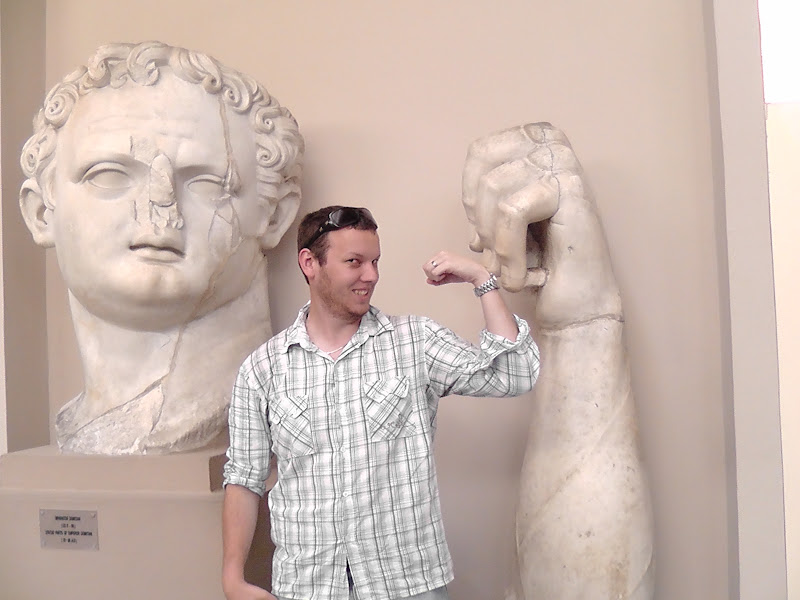
Kicking off in 64 A.D, Nero was the first Roman emperor to actively persecute Christians. It was a pretty sporadic afair. But he also persecuted Jews, and the temple was destroyed in the Jewish revolt of 66-74 A.D. Nero blamed Christians for a fire in Rome, and used that as an excuse to pursue the church. Domitian was the next emperor to systematically pursue Christians. Domitian also had a big head, at least as far as this statues is reliable…
Second Century
The century turned, and in the second century the gnostic movement took off a little bit, trying to rebrand Jesus as a gnostic teacher who taught secret mysteries. Marcion also sprung up with his little heresy (throwing out the Old Testament, and only keeping a few bits of the new). He was a bad guy. A heretic. The first of his kind (well, the first recognised by the church. But his “canon” caused the early church to put together a real canon. The Apostolic Fathers – Clement, Ignatius, Polycarp, and Didache, were some of the leaders of the church at this point – they were guys who were thought to have had contact with the apostles, thus providing some form of doctrinal continuity. Polycarp was martyred in 155 A.D, and Justin Martyr ten years later – having written his two Apologies for Christian belief to the Roman emperor – demonstrating that the church was still on the outer with Rome. The next cab off the rank, heresy wise, was Montanism. Tertullian came on the scene towards the end of the second century and wrote strongly against gnosticism, and Marcionism, and his own apology for Christian belief (seeking much the same as Justin Martyr – to ahve Christians treated fairly and recognised as a religio licita) but he took up the Montanist cause (which meant that the Catholic church refused to make him a saint. Montanists believed they had a new prophecy, and didn’t much like the veneer of compromise they saw in the church – they also loved martyrdom.
Third Century
Irenaeus, Tertullian, Origen and Cyprian were some figures around the beginning of the third century (and at the end of the second). Irenaeus (who studied under Polycarp and Justin Martyr) and Tertullian both got their own trading cards.
Decius, the emperor in the middle of the century kicked off some further persecution of Christians by decreeing that all citizens of the empire were to sacrifice to the emperor in a pledge of allegiance to Rome. They had to do it within a certain time, and they’d get a certificate to prove it. Anybody who refused was a traitor. Many Christians died in the process, luckily Decius was only in power for two years.
Origen was an Alexandrian, and a Christian with a particularly platonic bent. A church council in the sixth century declared him to be a persona non grata – and many of his works were burned as a result. He was a controversial figure and pushed for some sort of hierachy within the trinity (amongst other foibles) – most of which grew from his Platonic philosphy. He wrote lots, learned Hebrew, and put together a parallel translation of the Old Testament. His translations of the Hebrew were discussed in Augustine’s conversation with Jerome (about Jerome’s own translations – Jerome thought following Origen was a good idea, Augustine thought he was a little iffy). His exegetical method was pretty sound, and he only really used allegory as a last resort (and more typographically and Christologically than others). Origen’s exegetical approach, as he looked for hidden meaning in texts, included focusing on the meanings of proper nouns within the OT. He preached through the Old Testament, and while he was into finding hidden meanings in the text, he wasn’t a gnostic (and he wrote against them), he thought historical context wasn’t hugely important, and in a way he was proto-Barthian. He was rigorously committed to the Scriptures, and all his teachings were at least tied to some text or another. He was a theologian (some suggest the world’s first), who was also committed to integrating Christianity with philosophy and ethics. Most of his failings theologically come from this philosophical commitment and arise when his Platonic thoughts about the nature of the soul (for example, that it pre-exists the body) encroach on his theology and exegesis. His ecclesiology was pretty sound. He recognised two churches – the “church of angels” (those in Christ) and the wider church, which also sheltered sinners. A physical church, and a spiritual church. Another pretty Platonic (though correct) idea. His approach to Christian teaching was very similar to Augustine’s, he sought to syncretise the scientific and philosophical understandings of his day with Christian belief. And was committed to his students receiving a broad “liberal arts” education of the classical Roman variety. He wrote against ideas like soul sleep, and Ggnosticism, but his positives, so far as the later church was concerned, were outweighed by his heresies. Origen was tortured as a Christian during the Decian persecution, and he died three years later from the injuries he sustained.
Cyprian was the bishop of Carthage in the mid-third century. His thinking was influenced by Tertullian (both were north Africans, so were from the “Latin West”). He was a trained orator, who taught rhetoric before he became a Christian. He wrote heaps of stuff that has survived – and he was obviously a pragmatist, because while debate was raging within the church about how to handle Roman persecution he bolted. He didn’t stick around for the decision on whether to participate in the sacrifices for Deciu, or to engage in civil disobedience. He ran for the hills, and ruled his church from afar via a messenger. Obviously he wasn’t a complete coward though (which some accused him of being) because he was eventually martyred. Controversially, and somewhat hypocritically, Cyprian didn’t treat other people who avoided persecution by leaving the church very well, or at least he didn’t want to let them straight back in when the persecution ended. He insisted on “earnest repentance,” when some disobeyed him (including a deacon from Carthage) he excommunicated them, and created a bit of a schism. A council of North-African bishops in Carthage sided with Cyprian on the treatment of “lapsed” Christians – and they could only be readmitted to the church on their deathbeds (though this decision was softened somewhat). Church leaders who had sacrificed to the emperor could not be restored to their original posts.
A debate about baptism flared up in 255, where the church believed baptism was ok if done in a church and in the name of the trinity, Cyprian believed any baptisms conducted by heretics were invalid – in this way he was a precursor to Donatism, which emerged later. At this point, his adversary Stephen, Bishop of Rome tried to trump Cyprian’s position on the basis of his geographic situation. Cyprian didn’t like that very much. He said that all bishops were equal. He died bravely in a new bout of persecution under Valerian. Going willingly to his execution
