Apparently that’s normal. 60% of men who took part in a global survey said they would. If they could.

Via here.
Apparently that’s normal. 60% of men who took part in a global survey said they would. If they could.
Via here.
Ninja Terminator
…and Revenge of the Ninja
While you’re waiting for my next installment of “Help Lord — the Devil wants me Fat” you should get into spiritual and physical shape with this workout – Christian style.
It’s apparently all to do with copyright. I don’t think this guy understands the copyright laws.
The ten commandments made easy for the visual thinkers… and for those who have only ever been frustrated by the Veggie Tales characters and wanted them to get their comeuppance.
The 10 Commandments: No. 5 Thou Shalt Not Kill from Global Mechanic on Vimeo.
The Ten Commandments: No.7 – Thou Shalt Not Steal from Global Mechanic on Vimeo.
I drive to college with Jeremy Wales three days a week. You might remember him from such driving to college adventures as “crossing a raging torrent“… So, after posting about wikipedia editing just then I was inspired to create a Wikipedia entry for him. Apparently it has been done before but he was considered “not noteworthy.” I’m hoping that will have changed.
Here’s what I’ve said:
Jeremy Nicholas Wales (born July 24, 1978) is an intellectual polymath from Brisbane, Australia. After completing his studies in Information Technology at the University of Queensland, Jeremy enjoyed a short but distinguished career with one of Queensland’s leading financial institutions[1].
He changed career path in 2009, enrolling in theological education at the Queensland Theological College at Emmanuel College, located at the University of Queensland, in St. Lucia, Brisbane.
Jeremy is famous for having read every theological book and idea in existence. He has become a notable figure on the Brisbane evangelical preaching scene – sharing the pulpit at Mitchelton Presbyterian Church on more than one occasion[2][3]. The audio of his sermons reveal him to be a bold and daring speaker destined for great things. Some have called him the Australian Stephen Fry others have compared his exploits to those of fictional wizard Harry Potter.
He is also a bold and experienced on-road rally car driver – videos of his exploits behind the wheel in the streets of Brisbane have become a phenomenon on YouTube[4].
Feel free to contribute. I made his birthday up.
Nicholson Baker wrote the Mezzanine (the book I reviewed yesterday). He also wrote this article about Wikipedia, where he details time spent protecting obscure articles from deletion. A worthy cause.
He thinks Wikipedia is worth protecting because its checks and balances work well…
“Some articles are vandalised a lot. On January 11 this year, the entire fascinating entry on the aardvark [7] was replaced with “one ugly animal”; in February the aardvark was briefly described as a “medium-sized inflatable banana”.
This sounds chaotic, but most of the time the “unhelpful” or “inappropriate” changes are quickly fixed by human stompers and algorithmicised helper bots. Without the kooks and the insulters and the spray-can taggers, Wikipedia would just be the most useful encyclopedia ever made. Instead, it is a fast-paced game of paintball.”
Except sometimes these bots and human stompers want to stamp out whole articles. That’s where Baker and a team of anti-deleters step in…
“At the same time as I engaged in these tiny, fascinating (to me) “keep” tussles, hundreds of others were going on, all over Wikipedia. I signed up for the Article Rescue Squadron, a small group that opposes “extremist deletion, having seen it mentioned in John Broughton’s invaluable guide, Wikipedia: The Missing Manual. And I found out about a project called WPPDP (for “WikiProject Proposed Deletion Patrolling”) in which people look over the PROD lists for articles that should not be made to vanish. Since about 1,500 articles are deleted a day, this kind of work can easily become life-consuming. I was swept right out to the Isles of Shoals [13]. I stopped hearing what my family was saying to me – for about two weeks I all but disappeared into my screen, trying to salvage brief, sometimes overly promotional but nevertheless worthy biographies by recasting them in neutral language, and by hastily scouring newspaper databases and Google Books for references that would bulk up their notability quotient. I had become an “inclusionist”.”
It’s a tremendous article. Read it.
“Still, a lot of good work – verifiable, informative, brain-leapingly strange – is being cast out of this paperless, infinitely expandable accordion folder by people who have a narrow notion of what sort of curiosity an online encyclopedia should be able to satisfy in the years to come.”
Does your logo feature clipart? Or wordart? Maybe you need an update…
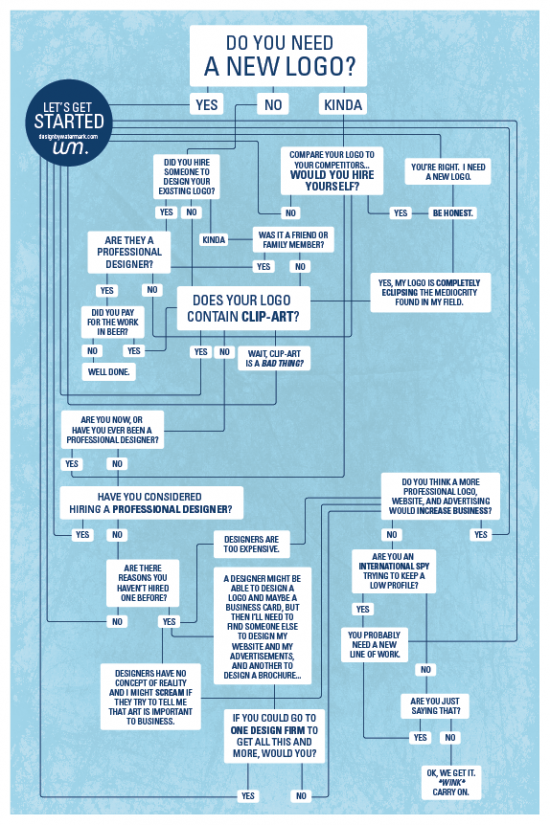
Via FlowingData.
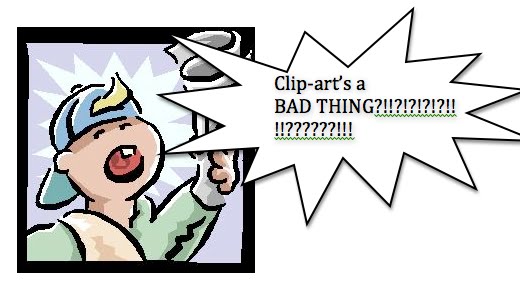
UPDATE: This picture was created in response to Mikey’s comment. If your logo looks like this you might need a redesign…
If ukelele covers are your thing then you should check this out. Amanda Palmer plays Radiohead.

Christopher Hitchens, one of the four horsemen of the atheist apocalypse, has cancer. A pretty nasty case of it. Al has posted a couple of excerpts from a piece he wrote.
This interview is quite phenomenal. He talks about the issue of Christians praying for him – some praying that he’ll cark it, most praying that he’ll get better and/or find God. This starts about 4 minutes in. Apparently the 20th of September is “Pray for Christopher Hitchens” day. I recommend participating.
I picked up this book (via the Book Depository. At $12 it’s a bargain) after seeing somebody mention it in passing in a thread on a forum somewhere in the Interwebs. It intrigued me.

Not a lot happens. It documents an hour in the life of Howie, a cubicle jockey. The hour is his lunch time – and perhaps more appropriately his coming and going from the office to buy new shoelaces. The only tension in the narrative is the exploration of the tension in his shoelaces.
This may not sound like your cup of tea – but he digresses in a fascinating manner in to realms of thoughts and tangents that feature insights into the minutiae of life – everything from the aforementioned shoelace dilemma (and the correct method for tying one’s shoes) to office bathroom etiquette. It’s a steady stream of consciousness account. It’s good stuff. I’ve not read a piece of fiction that has resonated more deeply with my personality and quirks for a long time… do you find yourself running your hand over different objects in your path as you walk – in a bid for some sort of tactile interaction with your environment? I do. I always have. I wasn’t sure if it was normal until this book discussed such behaviour.
Here’s Wikipedia’s synopsis:
“Baker’s digressive novel is partly made up of extensive footnotes, some several pages long, while following Howie’s contemplations of a variety of everyday objects and occurrences, including how paper milk cartons replaced glass milk bottles, the miracle of perforation, and the nature of plastic straws to float, vending machines, paper towel dispensers, and popcorn poppers.”
And here’s a quote from the book itself (not my favourite, just one I found online).
“I stood, rolled my chair back into place, and took a step toward my office door, where my jacket hung all day, unused except when the air-conditioning became violent or I had a presentation to give; but as soon as I felt myself take that step, I experienced a sharpening of dissatisfaction with the whole notion that the daily acts of shoe-tying could have alone worn out my shoelaces … still, I reflected, if it were true that the laces frayed from walking flexion, why did they invariably fray only in contact with the top pair of eyelets on each shoe? I paused in my doorway, looking out at the office, with my hand resting on the concave metal doorknob, resisting this further unwelcome puzzlement.”
This is incredible. A graphic designer, looking to come to grips with the big idea of books of the Bible is trying to put together a design based on each book. I’m sure it’ll be useful for your contempervant Bible Study books… These are some of my favourites.


I’m getting closer to putting pen to paper (or fingers to keyboard) for my Old Testament essay that I mentioned a couple of weeks ago. I still haven’t found many scholars who take the line I’m taking – and those that do come from a particular “missional” bent when interpreting scripture.
But here’s the flow of my logic – feel free to critique…
15 Long may he live!
May gold from Sheba be given him.
May people ever pray for him
and bless him all day long.16 Let grain abound throughout the land;
on the tops of the hills may it sway.
Let its fruit flourish like Lebanon;
let it thrive like the grass of the field.17 May his name endure forever;
may it continue as long as the sun.
All nations will be blessed through him,
and they will call him blessed.18 Praise be to the LORD God, the God of Israel,
who alone does marvelous deeds.
19 Praise be to his glorious name forever;
may the whole earth be filled with his glory.
So, my theory, is that rather than being riddled with inconsistent “acts-consequences” (eg you reap what you sow) theology (Proverbs) and the suffering of the innocent (Ecclesiastes, Job) – the wisdom books serve a unified, dual purpose. Firstly, they’re didactic for Israel – encouraging them to live out their obligations as a testimony to the nations of true wisdom, and a participation in an international “wisdom dialogue” advocating the fear of Israel’s Lord as the beginning of knowledge. And they’re to be read in the light of Solomon’s legendary reign and ministry of wisdom to the whole world.
What do you reckon?
Sometimes I despair over the impact the new atheists are having on the public sphere. I thought this little comic (which I found on Mike O’Connor’s most excellent blog at the most excellent Pastor2Pastor) was a refreshing perspective.
