
If Mario were created today
Once upon a time you picked up a game and figured out how to play it all by yourself. These days the first ten levels end up functioning as a tutorial and you only get about four levels of actual gameplay with all your moves. Here’s what Mario, an incredibly simple game, would have looked like if it were designed today:


Segway Soldiers
I’ve never been so proud to be an Australian. Our army is employing Segway robot soldiers. At this stage the Segway robots are only being used for training exercises as target practice:
“Australia based Marathon Robotics have taken Segways and turned them into human-shaped autonomous robots capable of moving around streets and buildings just like people in a crowd! The Marathon bots can act like insurgents, hostages, or civilians, letting armed soldiers practice before being exposed to the real thing. The Australian Department of Defense already has a training camp using the robots, and the US Marine Corps will be establishing one this year. You’ve got to see these robots in action in the video below – this puts all other shooting ranges to shame!”
Here they are in action:
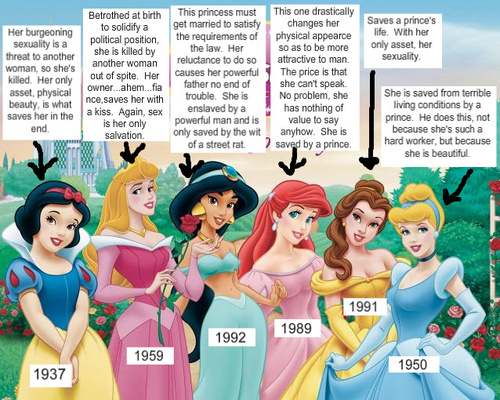
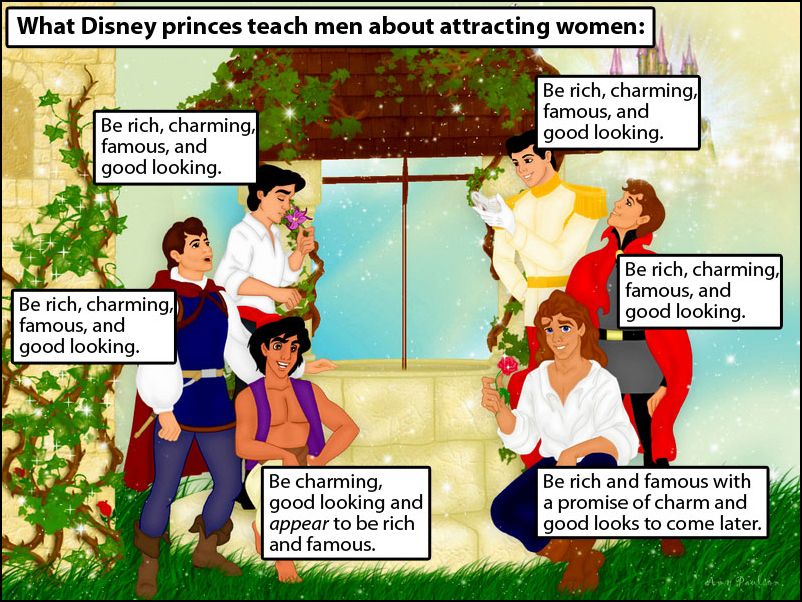
What Disney Teaches your Children
I copped some flak for posting a similar look at Disney’s unhelpful life lessons… but here are some more.


Via BoingBoing.
Here are the old ones:
Get your kid’s claws into the alphabet
Alphabet charts are so passe. If you want your kidlet to learn the alphabet, and learn it fast, let Wolverine and friends teach them…

Sticking around: the disproportional impact of a stick figure cartoon
I <3 XKCD. It’s my regular dose of geeky humour rendered in high definition stick figurey goodness. Millions of other people like it too. In fact, XKCD is arguably the world’s most influential blog. The forum 4Chan might cause more havoc, but XKCD readers tend to use their powers for good. Remember Tetris Hell? That was an XKCD comic. Within hours a reader had made it playable.
In this comic ninjas visit an open source software guru:
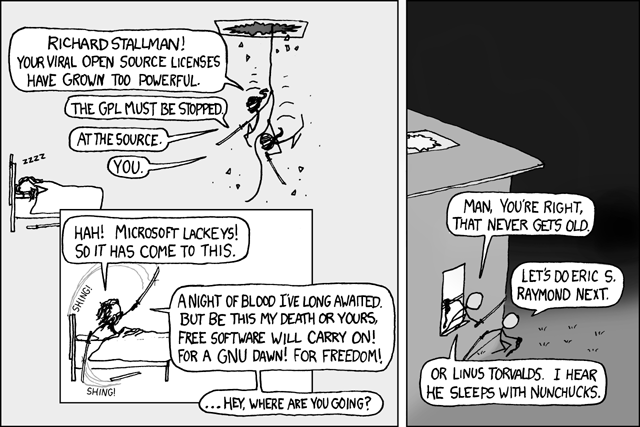
Shortly afterwards… ninjas confronted the guy at a conference.

After this comic:

This guy created a ball room in his house using this calculator that another reader created.
Here’s an article tracking XKCD’s influence.
Colour me “tickled pink”
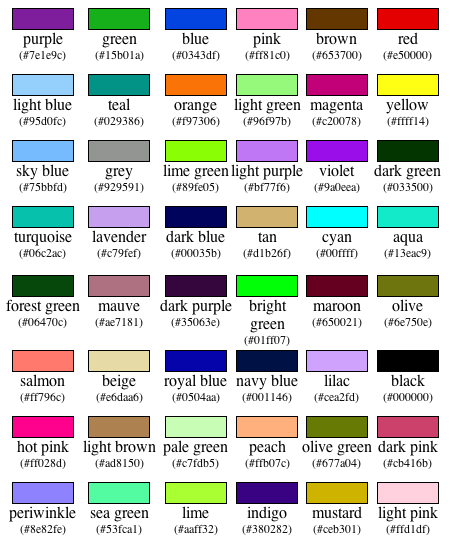
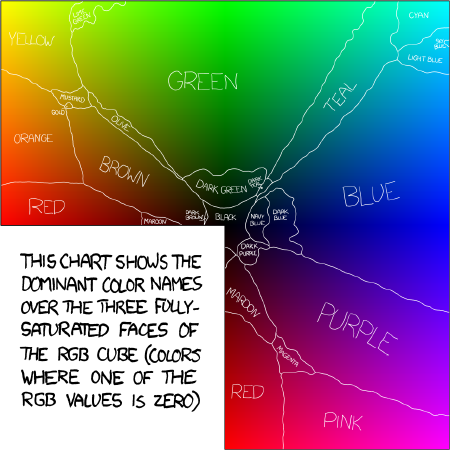
The XKCD man, Randall Munroe, conducted a big survey on colour identification and gender. He found that the difference between men and women on colour recognition has been greatly exaggerated.
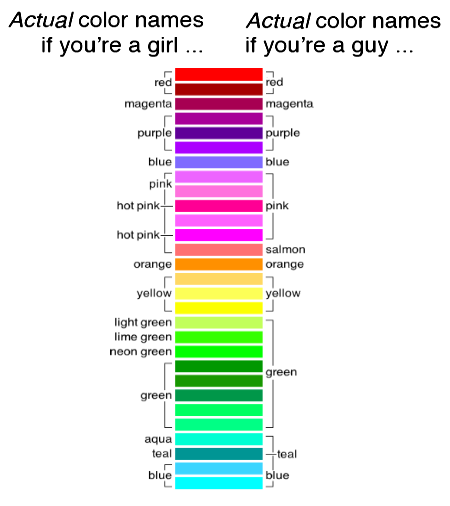
Contrary to this DogHouse Diaries Comic:
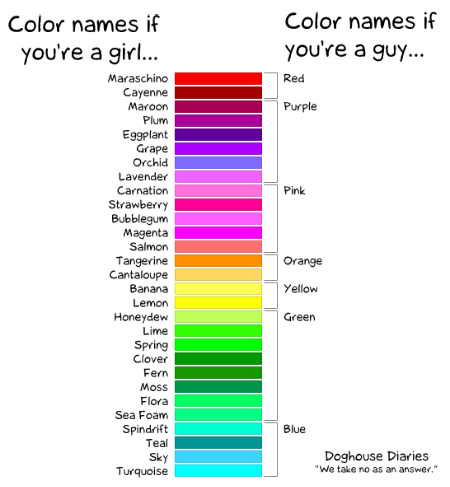
He also gives a nice guide to common colours and their hex codes based on the survey results.
He created a colour map too, which is helpful for colourblind people like me.
The St. Eutychus Guide to First Year Greek – Part Six
Some unboring posts in the pipeline people. I promise.
Personal Pronouns
To recap some English grammar – a pronoun is a noun that stands in the place of a noun. Like “it” or “this.” A personal pronoun is a noun that stands in the place of a person.
The first person singular pronoun in English is “I,” in Greek it’s “εγω.” Fitting really.
Because we’re dealing with nouns we’re looking at the same four major cases (in fact, there are no vocatives in the first person, because you don’t talk to yourself in Greek land. That would be crazy.
So the first person pronouns look like this:
Singular
- N εγω = I
- G εμου or μου = my
- D εμοι or μοι = to me
- A εμε or με = me
Plural
- N ημεις = we
- G εμων = ours
- D ημιν = to us
- A ημας = us
εμου, εμοι and εμε are used to emphasise the pronoun.
The second person pronouns like this:
Singular
- N συ = you
- G σου or an accented σου = of you
- D σοι or an accented σοι = to you
- A σε or an accented σε = you
Plural
- N υμεις = you
- G υμνω = of you
- D υμιν = to you
- A υμας = you
The accented forms of the pronouns are used for emphasis. Accents are too hard to type consistently, so you’ll just have to imagine them all over the place here, and elsewhere.
A tip for differentiating the second person plural nominative and the first person plural nominative is to remember that “u” is the first letter of the second person, and the last letter of the English equivalent (you) while “e” is the first letter of the first person, and the last letter of the English equivalent (we). There has to be an easier way to express that…
And the third person like this (it has masculine, neuter and feminine versions, eg. he, she, and it):
Masculine
Singular
- N αυτος = He
- G αυτου = of him
- D αυτῳ = to him
- A αυτον = him
Plural
- N αυτοι
- G αυτων
- D αυτοις
- A αυτους
Feminine
Singular
- N αυτη = she
- G αυτης = of her
- D αυτῃ= to her
- A αυτην = her
Plural
- N αυται
- G αυτων
- D αυταις
- A αυτας
Neuter
Singular
- N αυτο = it
- G αυτου = of it
- D αυτῳ = to it
- A αυτο = it
Plural
- N αυτα
- G αυτων
- D αυτοις
- A αυτα
There are no vocatives in the third person, and the declension, across the genders, is exactly the same as αγαθος (the adjective), except for the neuter nominative and accusative, which follow the declension of the definite article instead.
Characteristics of Pronouns
- Pronouns are used instead of nouns to avoid repetition.
- The noun the pronoun replaces is called the antecedent, the pronoun agrees with the antecedent in gender and number, but case will obviously vary based on the role the pronoun plays in the sentence – if the antecedent is the accusative and the pronoun is dative (eg. I see the Lord and believe in Him) then the case ending has to change to show that.
- Because verbs already have a built in pronoun based on the person-number suffix a pronoun is only used with a verb for the sake of emphasis. εγω λυω translates the same as λυω but the “I” is more emphatic when the pronoun is used.
- Personal pronouns in the genetive indicate possession. ο λογοσ μου translates to “my word” (literally “the word of me”).
- The emphatic version of pronouns (eg εμου) are normally used after prepositions eg απ εμου = from me, is more likely than απο μου.
Special Uses of αυτος
αυτος has two special uses.
- When used with the article (in the attributive position) it translates as “same” this is called the adjectival αυτος eg ο αυτος αποστολος is “the same apostle”
- When used without the article, in the predicate position, it translates as “self” eg “himself” – this use is called the intensive αυτος eg ο αποστολοσ αυτος is “the apostle himself.” The intensive can also be used with other pronouns to intensify the pronoun – so αυτος εγω λεγω is “I myself say” – this also works with the verb’s internal subject. So αυτος λεγω is also “I myself say”…
The St. Eutychus Guide to First Year Greek – Part Five
Verbs in the past tense (part one)
We’ve covered present and future tense already, where we learned that to futurify a verb you add an s after the stem (eg λυω=present, λυσω = future) Greek likes indicating changes with new letters. It’s much the same in past tense, though there are three past tense varieties to be mindful of. These are:
- The Imperfect = Ongoing action, occurring in the past (eg I was releasing)
- The Aorist = Completed action, with no comment on ramifications (eg I released)
- The Pluperfect = more complicated version of the imperfect, involves both a past action and the ramifications, but focuses on the action (I had released. We’ll deal with this one later.
These “secondary” (ie past) tenses receive a past time morpheme (called the augment) which usually appears as an ε, but there are rules about what happens when the ε meets other vowels. It can’t coexist.
They also get secondary suffixes (bits on the end of the word) that can vary slightly but are mostly:
- First Person Singular: -ν
- Second Person Singular: -ς
- Third Person Singular: none (though sometimes an ν)
- First Person Plural: -μεν
- Second Person Plural: -τε
- Third Person Plural: -ν or σαν
The Imperfect
The imperfect is formed by:
- Adding the past time morpheme to the stem
- Chucking a vowel on the end of the stem (an ο or ε)
- Adding the secondary suffixes
So:
- First Person Singular: ελυον (I was releasing)
- Second Person Singular: ελυες (you were releasing)
- Third Person Singular: ελυε(ν) (he was releasing)
- First Person Plural: ελυομεν (we were releasing)
- Second Person Plural: ελυετε (you(se) were releasing)
- Third Person Plural: ελυον (they were releasing)
The imperfect has four main uses:
- The progressive imperfect – deals with continuous actions in the past (I kept releasing).
- The customary imperfect – deals with habitual action in the past (I used to release).
- The conative imperfect – deals with actions attempted in the past (I tried to release).
- The inceptive imperfect – deals with the initiation of an action in the past (I began to release).
These uses are determined by context.
The Imperfect form of ειμι (I am)
- First Person Singular: ημην (I was)
- Second Person Singular: ης (you were)
- Third Person Singular: ην (he was)
- First Person Plural: ημεν (we were)
- Second Person Plural: ητε (you(se) were)
- Third Person Plural: ησαν (they were)
The Aorist
Aorists have a nice little “aspect morpheme” that makes spotting them in the wild a little easier. They get a σα that sticks on the stem. So to build an aorist verb you:
- Add the past time morpheme to the front of the stem
- Add the “σα” to the stem.
- Add the secondary suffixes.
So:
- First Person Singular: ελυσα (I released)
- Second Person Singular: ελυσας (you released)
- Third Person Singular: ελυσε(ν) (he released)
- First Person Plural: ελυσαμεν (we released)
- Second Person Plural: ελυσατε (you(se) released)
- Third Person Plural: ελυσαν (they released)
You’ll notice that in most cases the σα just takes the place of the connecting vowel from the Imperfect. Except in the first person and third person singular. The first person singular is called the “aorist active principal part” and because it breaks the rules, the third person has to as well. Otherwise it would be the same. So it gets an ε.
The aorist plays three roles:
- The constative aorist – views an action in its totality. It is holistic.
- The ingressive aorist – views an action, tough completed, with an emphasis on its beginning.
- The effective aorist – views the action with an emphasis on its conclusion.
The aorist is more common in the New Testament than the imperfect, so when an imperfect crops up we should ask “why is this imperfect and not aoristic?”
More amalgamation (this time in the aorist tense)
Remember that σ doesn’t play nice with other verbs (from when we were making future tense verbs). This crops up again when you bang a σα onto a stem that ends with a letter that σ doesn’t like.
To recap:
- ξ, κ, γ, χ + σ = ξ
- ψ, π, β, φ + σ = ψ
- ζ, τ, δ, θ + σ = σ
Some examples to watch out for:
- κηρυσσω (I preach) – the stem is actually κηρυκ, so in the future tense it’s κηρυξω, while in the aorist it’s εκηρυξα.
- βλεπω (I see) is βλεψω (I will see) in the future tense, and εβλεψα (I saw) in the aorist
- πειθω (I trust in) Is πεισω (I will trust in) in the future and επεισα in the aorist (I trusted in).
The Complexities of the Augment
The ε is a bit like σ. It doesn’t play well with other letters. These rules obviously come about because of the pronunciation difficulties that would be presented if they didn’t… so εα is harder to say than η. When the augment comes across a stem that starts with a short vowel (ε, ο and sometimes α, ι, and υ) it lengthens to the corresponding long vowel (η, ω). For example, the imperfect form of ακουσω is ηκουν. If the verb already starts with a long vowel, or a dipthong, nothing changes. It has a zero morpheme augment. The pronunciation doesn’t change, but the suffix does. ειρηνευω (I make peace) becomes ειρηνευον (I was making peace).
Some verbs are special and take a double augment. These verbs start with a vowel and consonant, which are duplicated before the augment is added. So αγω (I lead) becomes αγαγ, and then the augment changes it to ηγαγ, and with the suffix ηγαγον (I was leading)
Second Aorists
This is one of those subsets of Greek that is designed to infuriate first years. Second Aorists look almost identical to the imperfect. They don’t take a σα, they just drop a cowel from within the stem. The best way to come to grips with this unusual change is to remember that English does it too. eg. I stink, I stank, I stunk.
ελειπον (I was leaving) becomes ελιπον.
Some other verbs are just confusing. λεγω means “I speak,” but ειπον means I spoke. This happened when two verbs that meant the same thing had other forms that fell out of use. An English example is “I go” and “I went” – one is the past tense of the other, but they have very different origins.
Here are some Second Aorist examples:
- αμαρτανω (I sin) becomes ημαρτον (I sinned)
- ευρισκω (I find) becomes ευρον (I found)
- λαμβανω (I take) becomes ελαβον (I took)
- πασχω (I suffer) becomes επαθον (I suffered)
- φευγω (I flee) becomes εφυγον (I fled)
The stem of γινωσκω is γνο which is lengthened to γνω and in the second aorist becomes εγνων (I knew).
ειδον (I saw) is the second aorist of οραω (I see).
Second Aorist Vocab
- ηγαγον = I led
- ημαρτον = I sinned
- εβαλον = I threw
- εγνων = I knew
- εφαγον = I ate
- ευρον = I found
- εσχον = I had
- ελαβον = I took
- ειπον = I said
- ελιπον = I left
- εμαθον = I suffered
- ειδον = I saw
- εφυγον = I fled
- ηνεγκον = I bore
Vocab and Memory Hooks
- αμαρτανω = I sin (I do αμαρτος)
- βαλλω = I throw = I throw a ballo
- εσθιω = I eat
- ευρισκω = I find = “Eureka!”
- λειπω = I leave = I leap over the barricade and get out of there
- μανθανω = I learn = I need to learn manthano.
- πασχω = I suffer = When I’m suffering I need an ice pasxo
- φευγω = I flee = fugitives flee
These are just aorist versions of previously covered verbs:
- ηκουσα = I heard
- ημαρτησα = I sinned
- εβαπισα = I baptised
- εβλεψα = I saw
- εγραψα = I wrote
- εδιδαξα = I taught
- εδοξασα = I glorified
- ητοιμασα = I prepared
- εθεραπευσα = I healed
- εκηρυξα = I preached
- ελυσα = I released
- επεισα = I trusted in
- επεμψα = I sent
- επιστευσα = I believed
- εσωσα = I saved
- ενεγκα = I bore
The St. Eutychus Guide to First Year Greek – Part Four
Are you bored with this yet? Don’t worry. There are probably only five more of these posts to go, and then I’ll be on to Hebrew… Thanks for humouring me. Feel free to chime in if you have any suggested memory hooks, or if I’m in error. I know some of you read Greek…
Adjectives
Greek adjectives agree with their noun in gender, number and case. This means a feminine ending, plural, nominative adjective has to match up to a feminine ending, plural, nominative noun. They have endings just like the article.
Greek adjectives work in three different ways:
1. Attributively – describes the noun eg “The good man.” In this use the adjective either shares an article with the noun and comes between the article and the noun, or has its very own article and comes emphatically after the noun eg: “The Man, The good one” which you can simplify to “the good man.” In either use the article comes right before the adjective.
2. Predicatively – The adjective can be used to assert something about the noun – “The man is good” – it functions as a complement, or equals sign (like the verb “to be”). The predicate adjective comes either before the article or after the noun. So it literally reads “good the man” or “the man good,” there will not be an article before good, in both examples you supply an “is” to make the sentence read better. Most of the time in the New Testament, ειμι (or one of its conjugations) will be in the sentence too, as an extra clue.
3. Substantively – Sometimes the adjective will supply its own in built noun (based on the word ending) so “ο αγαθος” without a nominative noun will translate to “the good man” and “η αγαθη” will translate to “the good woman.”
Adjective endings don’t always completely match up – they don’t need to in order to agree in number, gender and case – because adjectives can be used with nouns from other declensions.
There’s a tricky adjectival use where the noun is not definite. In this case you have to use context to figure out if the adjective is being used attributively or predicatively.
More Prepositions
The first four prepositions (απο, εις, εν, εκ) only work with one noun case each.
- απο + genitive = from
- εις + accusative = into
- εν + dative = in
- εκ + genitive = out of
There are five more one case prepositions:
- ανα + accusative = up
- αντι + genitive = instead of, in place of
- προ + genitive = before (prologue)
- προσ + accusative = to, toward, with
- συν + dative = with
There are six further prepositions that work with two noun cases each.
- δια + Genitive = through (frequently used with a passive verb as “by”)
- δια + Accusative = because of
- κατα + Genitive = against
- κατα + Accusative = according to
- μετα + Genitive = with
- μετα + Accusative = after
- περι + Genitive = about
- περι + Accusative = around
- υπερ + Genitive = for
- υπερ + Accusative = above, over (hyperactive)
- υπο + Genitive = by
- υπο + Accusative = under (hypoactive)
And two more that have three cases:
- επι + Genitive = upon
- επι + Accusative = upon
- επι + Dative = upon
The distinction between uses of επι has been lost.
- παρα + Genitive = from
- παρα + Accusative = beside
- παρα + Dative = with
Prepositions before vowels and rough breathing…
Ancient Greeks obviously had troubles ending one word with a vowel and starting the next word with a vowel. So all of these prepositions except περι and προ drop their final vowel when preceding a word with a vowel. The vowel is replaced with a smooth breathing mark.
Compound Verbs
Sometimes the words get smashed together into compound verbs. If a vowel has dropped out this happens first. If a verb looks like it has a preposition mashed into it, it probably does.
Some translations are obvious eg. εκβαλλω is “out” plus “I throw” so it’s I throw out. Some have become idioms. αναγινωσκω means “I read” not “I know up”.
When a verb is in the past tense it gets an augment, a letter chucked on the front of the stem, when this happens to a compound verb, like εκβαλλω, the augment (normally an ε) goes in front of the stem. So εκβαλλω becomes εξεβαλλω. When a compound verb is used in the New Testament it is often supported by the preposition also being used with the noun.
Compound Verbs Vocab and Memory Hooks
- αναγινωσκω = (anaginosko) I read = I read my vocab again and again so I’ll know it.
- ανοιγω = (anoigo) I open = I open the door, an-I-go out.
- αποθνησκω = (apothnesko) I die = If I catch apothnesko, I’ll die
- εκβαλλω = I throw out/I cast out
Vocab and Memory Hooks
- αγαθος = (agathos) good = Agatha Christie novels are good.
- αγαπητος = (agapetos) beloved = love + to
- αλλος = (allos) other = Allos the others
- δυνατος = (dunatos) powerful, possible = Powerful Scotsmen dunatos the caber.
- εκαστος = (ekastos) each, every = I get sick at the Ekka every time I go.
- εσχατος = (eschatos) last = Eschatology
- καινος = (kainos) new = The principal brought a new kainos to school.
- κακος = (kakos) bad = kakos sounds like a word for excrement.
- καλος = (kalos) beautiful = Kalostomy bags are not beautiful
- μονος = (monos) only = monobrow=only brow
- πιστος = (pistos) faithful = If I were a superhero I would call my faithful sidekick “Pistos”
- πρωος = (protos) first = prototype.
- σοφος = (sophos) wise = Wise people are so sophosticated.
- τριτος = (tritos) third = Triceratops have a third horn.
- αγιος = (agios) holy = I drank the Holy Water and had to hold on for agios.
- αξιος = (aksios) worthy = People who say aks instead of ask are not worthy.
- δευτερος = (deuteros) second = Deuteronomy is the “second” statement of the law (nomos).
- δικαιος = (dikaios) righteous = I’m just going to have to remember this one too…
- ετερος = (heteros) other, different = I am a heterosexual.
- ισχυρος = (isxuros) strong = I’ve got nothing.
- μακαριος = (makarios) blessing = It will be a blessing to eat Maccas again.
- μικρος = (mikros) small = mikroscopic
- νεκρος = (nekros) dead = with a bit of unnecessary Japanese thrown in, the only good cat (neko) is a dead cat (nekros)
- νεος = (neos) new = neo-orthodox
- πονηρος = (poneros) evil = Dr Evil is so pon(d)erous.
- αδυνατος = (adunatos) = I’m not a powerful Scotsman so a-dunatos the caber, it is impossible.
- αιωνιος = (aionios) eternal = Eternity goes on for aeons.
- ακαθαρτος = (akathartos) unclean = It is not cathartic for an OCD person to have unclean hands.
- απιστος = (apistos) unfaithful = the unfaithful friend apistos in your pocket.
The St. Eutychus Guide to First Year Greek – Part Three
More Nouns
The First Declension (which textbooks tend to deal with second) has a nice rule that helps with the tables. Or a couple of rules.
Feminine Nouns of the First Declension
It splits nouns into categories based on the final letter of the root (which is the noun’s stem). If the root of a word ends with ε, ι, or ρ then the endings go:
- N: α
- G: ας
- D: ᾳ
- A: αν
- V: α
If it ends with a sibilant (ζ, σ, ψ, or ξ) then the α becomes an η in the genitive and dative cases – so:
- N: α
- G ης
- D: ῃ
- A: αν
- V: α.
If the root ends with anything else then it gets an η and the same pattern, so:
- N: η
- G: ης
- D: ῃ
- A: ην
- V: η.
Masculine Nouns
The masculine nouns are different.
They either end with an α or an η and follow the feminine pattern (except in the genitive). But they add an ς to the end of the last So:
- N: ης, ας
- G: ου
- D: ῃ, ᾳ
- V: ην, αν
Plurals
All the first Declension nouns have the same plural endings.
- N/V: αι
- G: ων
- D: αις
- A: ας
Prepositions
Prepositions in Greek always come before the noun they describe. Prepositions in Greek have a semantic range, and depending on the case of the noun they work with have different meanings. Some prepositions only have one case though… These are:
- απο: Genitive. From/of/away from
- εις: Accusative. Into/to/for/in
- εκ: Genitive. Out of/from/by
- εν: Dative. In/within/by/with/among
When these prepositions are used with a noun of the same case they work together to form a prepositional phrase. So crowd in the dative case (“τῳ οχλῳ”) would normally be translated as “for the crowd”, when you chuck the preposition “εν” in front of “τῳ οχλῳ” it becomes “in the crowd”
Vocab and Memory Hooks
- αληθεια = (aletheia) Truth = Aletheia will set you free
- αμαρτια = (amartia) Sin = When children do bad things the other kids go “amar…tia”
- βασιλεια = (basileia) Kingdom, reign = Basil Fawlty reigns over his kingdom
- διακονια = (diakonia) Ministry, service =
- εκκλησια = (ekklesia) Church = Ecclesiastes is an odd name because it doesn’t talk about church
- εξουσια = (exsousia) authority/right = Obama is the president because he had the best exsousia.
- επιθυμια = (epithumia) desire/lust = When you go to romantic lookouts in winter without jumpers you get epithumia (like hypothermia)
- ημερα = (hemera) day = If you sit on the toilet for a day you’ll get hemera.
- καρδια = (kardia) heart = Cardiac.
- μαρτυρια = (marturia) testimony = You have to be maturia to give your testimony in a Baptist church
- οικια = (oikia) house = Even the Greeks by homewares at Oikia.
- παρρησια = (parresia) boldness = People from Paris are unfortunately not very bold, they are cheese eating surrender monkeys.
- σοφια = (sophia) wisdom = You won’t get wise unless you get up off the sophia
- σωτηρια = (soteria) salvation =
- χαρα = (xara) joy = I’ve got that xara, xara, xara, down in my heart. Where?
- ωρα = (hora) hour = Hours spent doing Greek vocab are horas of my life that I won’t get back
- γλωσσα = (glossa) = I had to look up speaking in tongues in the Bible’s glossary.
- δοξα = (doxa) glory = doxology. Again.
- θαλασσα = (thallasa) sea = Trying to remember the sea with this hook is a thallasea
- αγαπη = (agape) love = everyone knows this one.
- αρχη = (arxe) beginning = Just after the beginning Noah went for a ride in the arxe
- γη = (ge) earth = geology is the study of ge.
- γραφη = (graphe) Scripture/writings = If you show me a graphe, I’ll take it as scripture.
- διαθηκη = (diatheke) covenant = When my twoth ekes I make a covenant with my dentist.
- διδαχη = (didaxe) teaching = didactic
- δικαιοσυνη = (dikaiosune) righteousness = I’m just going to have to remember this one.
- ειρηνη = (eirene) peace = Apparently irenic means peaceful, that’s ironic when you think about Ireland, and Iran.
- εντολη = (entole) commandment = When you drive on new roads you are commanded to pay the entole.
- επιστολη = (epistole) epistle/letter = Easy.
- ζωη = (zoe) life = I go to the zoo to see lots of life.
- κεφαλη = (kephale) head = kephale, shoulders, knees and toes, knees and toes
- ογρη = (Ogre) Anger = Shrek is angry.
- παραβολη = (parabole) parable = Speaks for itself.
- περιτομη = (peritome) circumcision = a cut around the perimeter.
- προσευχη = (proseuxe) prayer = Daniel didn’t pray so he got proseuxeted.
- συναγογη = (sunagoge) synagogue = Speaks for itself.
- υπομονη = (upomone) endurance = When Lance Armstrong took upomone he got more endurance.
- φωνη = (phone) sound = You’re making too much sound on that phone.
- ψυχη = (psuxe) soul/life = Greek psuxe the life out of you
- ματητης = The disciples were mathletes.
- προφητης = (prophetes) prophets = Umm. I don’t know.
- στρατιωτης = (stratiotes) Soldier = Soldiers are told to do strategic things.
- τελωνης = (telones) Tax collector = The tax collectors want to get their telones into you.
- υποκριτης = (hupokrites) hypocrites = Again. What’s with the English words.
- Μεσσιας = (Messias) Messiah
- νεανιας = (neanias) young man = When I play soccer against a young I want to kick him in the neanias.
- απο = (apo) from/away from = apostasy is going away from the faith.
- εις = (eis) into = I throw my ace into the mix.
- εκ = (ek) out of = get me the ‘eck out of ‘ere
- εν = (en) in = Enter in.
Pacmania: Google’s Pacman costs world billions
As reported the other day, to celebrate Pacman’s 30th birthday Google created a playable Pacman version of its logo. It’s now permanently available. The playable logo is estimated to have consumed 4.8 million man hours globally.

RescueTime is a program that monitors online usage. They extrapolated their data to reach that figure.
Here’s the baseline:
Our average Google user spends only 4 and a half active minutes on Google search per day, spread over about 22 page views. That’s roughly 11 seconds of attention invested in each Google page view. It doesn’t sound like a lot, but next time you do a search, count to 11- it’s a long time.
Here’s what the study found:
The average user spent 36 seconds MORE on Google.com on Friday.. Thankfully, Google tossed out the logo with pretty low “perceived affordance” – they put an “insert coin” button next to the search button, but I imagine most users missed that. In fact, I’d wager that 75% of the people who saw the logo had no idea that you could actually play it. Which the world should be thankful for.
If we take Wolfram Alpha at its word, Google had about 504,703,000 unique visitors on May 23. If we assume that our userbase is representative, that means:
- Google Pac-Man consumed 4,819,352 hours of time (beyond the 33.6m daily man hours of attention that Google Search gets in a given day)
- $120,483,800 is the dollar tally, If the average Google user has a COST of $25/hr (note that cost is 1.3 – 2.0 X pay rate).
- For that same cost, you could hire all 19,835 google employees, from Larry and Sergey down to their janitors, and get 6 weeks of their time. Imagine what you could build with that army of man power.
$298,803,988 is the dollar tally if all of the Pac-Man players had an approximate cost of the average Google employee.
Get me to 50
Hey readers,
St. Eutychus has 48 Facebook Fans. I’m not that fussed about Facebook fans, but I don’t like numbers that are close to round, but not. So if two of you who aren’t fans yet could click this link, that would be great. Part of me balks at this sort of self-promotion, that part loses out to my round number OCD.
Plus it helps me know who’s out there, reading, especially if you’re a lurker. I’ll understand if you’re worried about Facebook privacy controls and third parties exploiting your details – but I promise not to abuse any contact information that comes my way.