is it just me who thinks taking emails away from POTUS is counterproductive? In a literal sense
Consoling myself
Attention console owners and video gamers you are killing the planet.* I hope you leave your conscience at the door when you turn your machine on.
The Natural Resources Defense Council has released an American study that found gamers in the US are filling the air with toxic carbon emissions and killing the polar bears.**
“NRDC and Ecos Consulting performed the first ever comprehensive study on the energy use of video game consoles and found that they consumed an estimated 16 billion kilowatt-hours per year — roughly equal to the annual electricity use of the city of San Diego. Through the incorporation of more user-friendly power management features, we could save approximately 11 billion kWh of electricity per year, cut our nation’s electricity bill by more than $1 billion per year, and avoid emissions of more than 7 million tons of CO2 each year.”
The news is not all bad for me – as I still don’t own a new generation console. I am an eco-friendly gamer with my Super Nintendo and Nintendo 64 faring best in a tabled comparison of power usage.

For those of you who are visual thinkers, here’s the graph:

You can read the whole report here (PDF). A Playstation 3 ($160) will set you back 16 times the price of a Wii ($10) in energy costs over a year if both devices are left on, and five times the price if both are turned off – $3 and $15 respectively. More video game energy factoids can be found here (another PDF).
Climate Friendly’s carbon calculator says the Playstation 3 user who leaves their console on all year round uses an appropriate 1337 kWh per year – which produces 1.4 tonnes of carbon – offsetting that via the aforementioned company will cost you $95 a year.Year round use of the Xbox 360 uses 1031 kWh per year, produces 1.1 tonnes of carbon and costs $75 to offset.
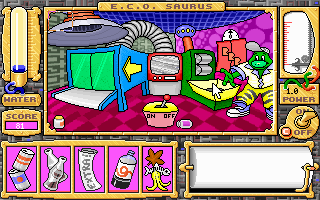
My coffee machine uses 2190 kWh per year (estimated), produces 2.3 tonnes of carbon emissions and would cost $156 to offset. Luckily the Nintendo 64 doesn’t even register on the calculator in terms of its annual carbon emissions so I’ve got a fair bit of credit up my sleeve through my environmentally friendly gaming strategies. Come to think of it, I’ve been an eco-savvy gamer since way back when playing Eco-Saurus (aka Zug’s Adventures on Eco Island). A game so obviously ahead of its time.
*In a literal, physical sense not in the actual game you’re playing.
** Killing polar bears would be another fun game – Polar Bear Hunter the long awaited sequel to Deer Hunter…
Spiderman
The guy behind the spider drawing – David Thorne – has a website full of funny anecdotes, emails and characters who have sent him things. It comes with a language warning – but this is a particularly ingenius account from his own life:
My Confession
When I was in year ten, I would wag school to catch the bus into the city. I would hide the contents of my schoolbag and go to a christian book store called the 'Open Book', covering two levels and a second hand section in the basement. I would go in with my empty bag, select expensive theological volumes, and fill my bag with several hundred dollars worth. I would then use the toilets to remove any price tags before going downstairs to the basement where they would buy my books for half the retail price. I did this twice a week. I figured that if they caught me I would cry and ask for their forgiveness and as christians they would have let me go but they never caught on. I remember one person buying the entire Amy Grant tape collection when it had been on the shelves not ten minutes before. I was saving for a motorbike and bought a Suzuki Katana. The 'Open Book' went broke a year later so it worked out well for everyone.
Weaving a web of success
The spider drawing story I posted last week now has a fitting conclusion. The picture, originally valued at $233.95 by its creator has "sold" on eBay for $15,000. I say "sold" because I think the chance the buyer will honour the deal is not high. From ninemsn:
"After the exchange hit inboxes, the “original” drawing was put up for sale on eBay by a Swedish man.
"David Thorne was … kind enough to give the spider to me," eBay user “Andreas” says.
"However, this spider is driving me nuts. Also he's lacking a leg and thus is useless to me."
The listing shows there were 18 bids for the drawing, with a starting price of $233.95, and that it was sold for US$10,000 ($15,000)."
Laying the smack down
This is a stupid story. I was smacked as a child. Sometimes hard enough to leave a mark. I have nothing but respect for my parents for the way they disciplined me. I think I'm a better person for it. What is a father to do? His seven year old son wandered off at night and he found him in a park – so he smacked him, telling him not to do it again. And he gets arrested thanks to a "concerned onlooker" – the boy clearly deserved a smack on the bum – so obviously do the legislators and police force who perpetuate this nanny state – Supernanny would be all for smacking that kid…
Cheque your emotions

My hatred of emoticons knows no bounds and has been documented previously. They are bad. They are for lazy writers – they are an exclamation mark taken to a new low. So the idea of a USB keyboard dedicated to emoticons just makes me feel empty inside. Those who are interested may like to know that they can be removed from the keyboard and worn as jewelry.
Bajca’s (the company) designer says:
Bajca’s idea arise from connecting deeply the virtual with the real life. Bajca is the instrument that ” make real” the emotion- a digital translation of every sensation- telling the story of everyday life; spoken, touched and wearn every day.
I say :(. No word yet on how much these will set you back financially – socially they’ll be crippling.
walldrop number 4
Thank you for your message. People often write to us about words they have devised, and I am afraid our response is very dull. Before we can even think about drafting a dicttionary entry for a new word, we need a large body of published evidence showing that it has been in widespread and sustained use over a period of at least five years. We are slow to add words to the full Oxford English Dictionary Online, because once added they are never deleted.
You can read more about what is involved at http://www.askoxford.com/asktheexperts/faq (see ‘Will you put in my new word?’ in the Dictionaries section). I shall certainly record your contribution in our files, but cannot promise that it will result in an entry.
Margot Charlton
Oxford English Dictionary
Milestones
Interesting fact – while importing my blog into WordPress (I’m still toying with making the move but am thinking it needs to be done properly to a wordpress.org site rather than a wordpress.com blog) I noticed that today I hit 300 posts, and 2000 comments. My comment to post ratio is still reasonably good – but most of them are from posts a while ago. That seems worthy of some sort of celebration. I think I’ll go home and play some Bomberman on the N64 which arrived in the mail today from eBay.

Walldrop number 3
It turns out urbandictionary.com already has a “walldrop” which is a backdrop featuring a wall. The only way to guarantee my much better definition is for you all to go here and vote down this definition.
Walldrop number 2
I am so taken with my new word that I’ve submitted it to the Oxford English Dictionary… my chances of success are less than good.
Here is the email I sent:
Dear Oxford English Dictionary Editor (or whomever reads this correspondence),
I wish to submit a new word for your consideration.
The rise of Facebook and other social networking hubs has, I believe, created a new sphere of voyeurism whereby readers are able to secretly observe the conversations of their friends via the Facebook element known as “the wall”. As “eavesdropping” was so named for listening to the conversations of others through the “eaves”, I submit the following word and definition:
Walldrop:
intr.v., -dropped, -drop·ping, -drops.To read the conversations of others on Facebook
Etymology – derived from eavesdrop
Best regards,
Nathan Campbell
Corporate Communications Executive
I included my title because it makes me sound impressively wordy.
Just to ensure some modicum of success I also submitted my word to urbandictionary.com which goes as close to guaranteeing inclusion as possible. I’ll let you know how the campaign goes.
Walldropping
Walldrop:
intr.v., -dropped, -drop·ping, -drops.
1. To read the conversations of others on Facebook
2. To fall off a wall eg – Humpty Dumpty
I don’t know about you – but Facebook awakens my inner voyeur – I think walldropping is a good new word to describe using the “wall to wall” link to peer into other people’s conversations.
You heard it here first people. Remember that. I don’t think you get royalties for coining new words. Coining is therefore an inappropriate word to describe the creation of new words.
Rudd’s speech writer issued new vocabulary
Stop Press. BBC News is reporting on the 20 most annoying conversational cliches – coming soon to a Prime Minister’s address near you…
Warning signs

This fully posable warning sign finally allows you to warn others of the perils of your mastery of obscure strains of martial arts. Otherwise it’s completely useless.
Milking the debate
My ongoing investigation into milk prices continues. My research reveals a shocking fact. Milk costs about the same to produce per litre as petrol – and yet we still pay significantly more at the Servo.
To begin my research on the matter I first contacted Ben, my economics consultant, who said the following:
“It probably costs more to produce/transport (I’m no milkologist, so i don’t know about this for sure), at any particular time there is only a certain supply of milk, so it is open to general market forces, you demand less milk than petrol, so the marginal utility you gain at 1 litre of milk is vastly lower than that of petrol.
Really, they are totally different items. People who think that comparing the price of milk to petrol will reveal some holy grail of pricing failure are retards.”
Not content to be left in the retard basket I pursued the issue with expanded economic factors…
If scarcity is a factor though surely the ease in which milk can be created as opposed to fuel should make the supply side of the equation the larger side and lower the price – also the fact that milk has a much shorter shelf life should keep the price low because retailers can’t afford to hang on to it? Shouldn’t it? Milk is expensive – it’s about $2 a litre if you buy it from a servo – and around $1.25 from a Supermarket – it can’t cost that much to produce – all you need is a cow and some grass – I assume too, that a cow, being an appreciating asset (as long as it’s getting fatter) has a net cost of zero to the farmer.
It can’t possibly cost more to squeeze a cow’s nipple than to extract crude oil from the ground and refine it into petrol. Isn’t part of the deal with oil pricing that there’s a central pricing body who make the call based on available supply, future supply and market conditions? Surely milk has an almost infinite future supply and ample current supply, and pretty consistent, steady demand. Unless there’s a sudden spike in demand for milk products like ice cream and milkshakes… There shouldn’t be any inefficiencies in its production created by fluctuations in the market and it shouldn’t cost more than petrol.
Its carbon footprint is an issue because Cows produce methane so I guess emissions trading will also impact on milk pricing.
Ben says I have it all wrong:
“Cows apparently cost a lot to upkeep. Cows also are relatively labour intensive per litre. Milk requires handling up to health and saftety standards, specific packaging, refrigeration. sure, pumping oil out of the ground is expensive, but they can pull out a million litres with only a few personnel and throw it in a ship and take it places. Sure it has to be refined, but i wouldn’t be surprised if fuel refinement is about on par costwise with milk refinement, if not cheaper.”
Not content to let my research die at a secondary source – I decided to pursue details from the primary producers. I found the following:
“Milk prices paid to farmers are determined on the basis of milkfat, protein and volume:
Payment = milk fat ($/kg) + protein ($/kg) – volume charge (c/L)”
According to the current figures Milk farmers receive about 44c per litre of milk – and $5.80 per kilo of Milk solids (milk fat and protein). I’m not sure why the volume charge is subtracted… but that’s a separate issue. Milk it seems costs 44c per transaction in the initial purchasing stage. It must then be processed, bottled, and distributed to the retailer.
Milk prices, assuming you haven’t visited that link above, are set to rise this year due to the following factors:
“The Australian Bureau of Agriculture and Resource Economics (ABARE) expects that milk prices will continue to rise through to 2008-09 (Outlook Conference, 2007):
- High prices in recent years have been driven by constraints to growth in the three main exporters (EU, NZ & Aust.) at a time of rising global demand
- The current drought in Australia will limit total production in 2006-07 and 2007-08
- Poor seasonal conditions have also been evident in New Zealand
- There has been heat and drought in the EU, and CAP reforms have reduced incentives to produce milk
- On the other hand increased supplies are expected from emerging exporters such as Argentina and the Ukraine, while China’s dairy production (mainly for domestic consumption) continues to rise”
This UK site estimates average cost per litre of milk at about 13.7 pence per litre – that’s not taking into account the milk solid production.
Costs of production of milk are actually decreasing. And the average Tasmanian cow (which I assume is similar to the average Australian cow) produces 386kg of milk solids – and each cow produces about $1,488 worth of milk and milk solids while costing $1,196 to maintain (on a 250 cow farm).
So, that’s all quite long winded – but basically the farmer is selling the milk at 44c per litre – and being looked after in the process. The extra 80 cents (at least) is being added by the retailers and others. The government currently levies 11c per litre – but that’s all set to change. Good to see the Rudd Government doing something about this issue.
The whole debate (in my mind) centres on whether the production costs of milk and petrol are comparible – I am assuming that the transport/bottling/refining costs are within the ballpark of each other – refrigeration should be cancelled out by the distance fuel is transported etc…
So these guys put the average price of production of a litre of fuel at 25-50c. Another UK site suggests the cost of producing fuel accounts for about 32% of the total cost per litre. The cost of production of a litre of milk accounts for about 35% of the total price based on the regular retail price of $1.25 per litre. So it’s Servos that sell milk for $2 a litre or more that are really jacking up the price – and for this they should be held accountable. The figures don’t lie. Milk is where the Service Stations are guilty of price gouging.
Unfortunately I promised Paul I’d only make interesting posts after he added me to his RSS reader. I lied.
Let your light shine…

I’m all for “letting your light shine” for Jesus at Christmas – it’s what the Holy day is for. But this Christmas light product produced for the American market to share their “burning” desire for Jesus during the festive season will no doubt be welcomed by an altogether different sector of the community.
Klan meetings can now be called with just the flick of a switch – saves money on all that fuel, and reduces the chance of those pesky white robes catching fire.