
Tag: Tim Keller

Resisting the ‘growth machine’ with human-scaled limits

The Machine church is geared and iterated towards — perpetual growth; the ‘human scale’ church is an antidote that deliberately embraces limits to growth.

I plan to tell more of my own story as it relates to machine church in subsequent instalments — but to set the scene for part 2 I need to jump through the story from my first year ‘plugged in’ towards the last.

I want to be clear, too, and I will come back to this — that parts of life in this machine were exciting and some of its ambitions were virtuous. I want the kingdom of God to expand as people find life in Jesus and are united to him, and to his people, by God’s Spirit. I think the church is the means that the mission of the Gospel takes place and so I want the church to grow.

I would like it to grow in ways that are more like a tree or a forest, than like a computer network or machine or monopolising corporation or empire though; and for the growth to be natural and part of cultivating an ecology rather than overpowering and destructive to its surrounds (especially to other church communities). Part of the impulse of the machine, when it comes to growth, is that real growth only comes through the efforts and energy pulsing through the system that is ‘the machine,’ or networked to it, and not in more organic, sustainable and ‘small’ ways; the machine consumes and absorbs competition becomes totalising in part because of the competition for resources to fuel its growth.

I was part of the machine, fully plugged in and ‘complicit’ in perpetuating its growth (and the impact its growth had on humans, for good and for ill). I don’t write this to blame those engaged in the machine with me; or who still find themselves occupying similar positions in a community that has been through significant change since my decoupling from it. This is not an exercise in casting aspersions, but in self-reflecting. I wrote, or helped sharpen, many (though not all) of the words I quote below.

After I establish some of my own story, I’ll turn again to some material from Paul Kingsnorth’s Against the Machine, and an earlier essay on bigness, to draw some parallels between his diagnosis of what is consuming and essentially strip-mining the western world (and the natural world) and a machine-like approach to church growth.

My experience with the machine began first with my recruitment to the machine; I was still a student at theological college (so was Robyn, my wife — that will become important in subsequent posts). We were invited to ‘dream big’ — to join a church where we would be part of a compelling vision; and where, ultimately, I would bring my background in Public Relations to help establish a presence on social media because that was strategic. There were some hiccups in the recruitment process that, again, I will cover in the future, but I began my time ‘officially’ as part of the machine church at our annual staff retreat.

These retreats were vital vision casting moments for a staff team, that over my time at the church ebbed and flowed in size (along with various budget crises) with a high point of approximately 30 staff. At its peak this included as many as six ordained Presbyterian ministers, spread across three campuses, a number of ministry specialists (in kids, youth, and small group ministries), executive and finance managers, support personnel, and a media team.

In the first retreat I was one of many new appointments brought on to support the ‘big vision’ adopted by the elders the previous year. The elders would eventually become a “board” (combined with our managers), a relative novelty in Presbyterian governance, and most of the ordained ministers would be asked not to attend board meetings ‘voluntarily’ (I’ll also write a subsequent post about this; one thing people have observed about large churches is that they encourage ‘fauxnerability’ from those in leadership; I’m going to coin the term ‘fakountability’ — fake accountability — which is vital for machines to throw off limits to growth).

At this retreat we were rallied to the cause — and it was exhilarating. I had come to Bible College two years earlier from a regional centre (Townsville), from a pretty thriving church. My previous experience in Brisbane had been at a large suburban church that was efficiently and effectively engineered (by my father) around clear preaching of the word and a compelling, no-nonsense model of church that produced vitality and steady growth coupled with church planting and revitalisation partnerships with surrounding churches. There are machine-like tendencies in my DNA.

When we arrived in Brisbane as college students, my wife and I found ourselves ministering as students in a small suburban church within the geographic catchment of my former church that was struggling to grow to sustainability despite the faithful energy and effort poured in by the minister, his wife, and a faithful congregation supportive of the church’s mission. It had been a good two years experiencing ministry in a small suburban context, but I was ready to be excited. Before college my career was public relations, and this was in the heady early days of social media; before enshittification and the rampant growth of surveillance capitalism. I genuinely believed that social media could be harnessed for the Gospel — I even wrote articles on this site, and gave guest talks and eventually lectures at the Theological college I attended to that end. I no longer believe social media is an effective tool for evangelism; it is an effective tool for keeping people plugged in to a machine that is designed to deform and strip-mine their data by cultivating habits of attention that use dark patterns. And what you win people with, you win them to…

At this retreat we were, as I say, encouraged to ‘dream big’ — to imagine our church of 600ish as a church of 2,000 — and do everything ‘to that end’ — or, even, as though we were already there; there was a ‘build it and they will come’ mentality. By the next year’s team retreat we were planning to start a 4th Sunday service at the one location. The catch was, we encouraged members aka ‘ministry partners’ to attend twice on a Sunday; once to be served and once to serve — and we counted them twice. The data was always inflated; we were maybe never quite as big as we told ourselves (or others).

The ‘position paper’ adopted by the church leadership in 2011 told “Our Story” in the following paragraph:

“By God’s grace, we are a growing church and part of a growing mission. This growth is testimony to God‘s gracious provision across many years. From the decision to plant in the 1940s, to the decision to relocate in the 1990s, God has been at work growing his church. He has also been at work granting wisdom and strength to make the changes needed to keep promoting the unchanging gospel of Jesus and passing it on to the next generation. This is our gospel heritage. And by God‘s grace we are again growing and considering the changes involved in growing our gospel mission.”

That’s six uses of the words ‘growing’ and growth in one paragraph. That’s what we were about — the vision was to meet our “growth trajectory” which was taking us towards being a church of “2000 people” as a “medium-term rather than a long-term possibility.”

Conversations started, at this point, about what the actual limit to church size on our 15 hectare suburban block was with a smart redevelopment of a facility that was only around 12 years old…

One of our catch-cries, I think at every retreat I remember, was to refer to 1 Corinthians 9 and the idea that we were to become “all things to all people” — that we should use whatever means possible to win as many people as possible to Jesus. Our chosen ‘means’ at least for the first two team retreats, was to be a “large church,” dare I say, a “mega church” — given one definition of a “megachurch” is a church of 2,000 people or more.

By the second team retreat — and after a year where I was on the team and often in the room where it happens, even as a student — we had embraced a ‘2020 Vision’ to “Reach the city and reach the world;” complete with a pretty beautifully produced vision video (so well written and produced, in fact, that a large Anglican church in the hills district of Sydney copied it pretty much verbatim for their own 2020 vision — and when I discovered this and made a bit of a fuss online, this fuss turned out to be verboten because we mega churches like to stick together and pat each other’s backs).

Much like in the realm of technology, this pivot from mega- to multisite church involved a shift in thinking towards digital networks not just physical transport and logistics (I’ll unpack more on this below). In 2013, we added a media team — 3 video producers and a graphic designer — to ‘reach the world’ by producing content to broadcast online (including our church services). The conversation around my ongoing place in the team (I was still a student) was that I could be the media/online pastor generating articles and some scripts to pump out; PR for Jesus. Digital reach removed friction (including the friction of face to face human relationships) and maximised bang for buck.

By my third team retreat we had shifted our goalposts (and our focus) to being a multisite church gearing up our ‘infrastructure’ so we could be a church with 200 campuses, or churches signing up for our resources — because, why limit ourselves? That’s not a typo. We were genuinely invited to dream big; to choose the right suite of technologies and techniques to grow big or go home.

Again. Intoxicating — even if back then it already seemed a bit hyperbolic.

The whole point was removing limits for the sake of the Gospel; to create efficiencies and to avoid the pitfalls of other networks (like denominations) ,which got in the way. I was now going to be the campus pastor of a brand new and shiny city campus — we would spend the money from the sale of an inherited church property in the same ‘patch’ of Brisbane to fund the start up. We launched our first service at the Queensland Theatre Company in 2014.

The idea was you should engineer things as you built them in order for them to scale up rapidly and be easily replicable; you would make better decisions in the beginning; you staff for growth — to be ready to meet the next stage or two stages ahead so that you are always able to expand.

Later down the track, after some multisite misfiring, we spent a day with a multisite consultant from the U.S. He described a variety of multisite models from a denomination, to a network, to a franchise (there were a few other stops along the spectrum). The franchise, he said, was the most efficient. In the U.S, according to this guy, there were churches who had warehouses with trucks fully loaded with the equipment needed to set up a campus, just ready to roll out and set up. Turn on the lights. Much like a fast food franchise leverages the standardisation of the ‘non-place’ so that every location feels the same. This was, for some in our leadership, the dream. It wasn’t mine — and that’s one of the points where the wheels started to fall off. I did not believe in standardisation — the urban context our church operated in, with a community of people gathered by affinity from across greater Brisbane was not the same as the suburban context where our mothership had a large building, and an established ongoing presence in the area that stretched back decades (and a very very big carpark).

Our manual for thinking about growth and the structures to accommodate it — flagged right from the first vision document approved by the leadership in 2011 — was Tim Keller’s paper ‘Leadership and Church Size Dynamics: How Strategy Changes with Growth’ published in 2006. What Keller described; we prescribed and attempted to systematise. It’s an interesting paper — and particularly interesting to read after Keller’s retirement from Redeemer; where the megachurch that had gatherered around his leadership became a decentralised into a ‘family network’ of autonomous churches (a change announced in 2014).

“One decision we have made that encourages me is that Redeemer will become a family of congregations, not one centralised mega-church.”

In the church size paper, Keller wrote:

“Every church has a culture that goes with its size and which must be accepted. Most people tend to prefer a certain size culture, and unfortunately, many give their favourite size culture a moral status and treat other size categories as spiritually and morally inferior. They may insist that the only biblical way to do church is to practice a certain size culture despite the fact that the congregation they attend is much too big or too small to fit that culture.”

Keller ultimately lays out various aspects of ministry across different sizes of church, but in his discussion before the table he makes the following point:

“…the larger the church, the more a distinctive vision becomes important to its members. The reason for being in a smaller church is relationships. The reason for putting up with all the changes and difficulties of a larger church is to get mission done. People join a larger church because of the vision—so the particular mission needs to be clear. The larger the church, the more it develops its own mission outreach rather than supporting already existing programs. Smaller churches tend to support denominational mission causes and contribute to existing parachurch ministries. Leaders and members of larger churches feel more personally accountable to God for the kingdom mandate and seek to either start their own mission ministries or to form partnerships in which there is more direct accountability of the mission agency to the church. Consequently, the larger the church, the more its lay leaders need to be screened for agreement on vision and philosophy of ministry, not simply for doctrinal and moral standards.”

I would say, rather, that the larger the church the more standardised the vision and execution become across other churches of the same size — vision becomes more motherhood and generic; able to be photocopied — or with vision videos that are able to be plagiarised — because the vision simply becomes to grow; to keep pushing beyond limits — and expanding — through technique, as new members are folded in like cogs in the machine — as the mission of the Gospel becomes more and more aligned with the ‘mission of this church’ — and faithful participation in that mission as disciples becomes faithful service to a philosophy of ministry and vision.

We tabulated the Church Size dynamics paper and used this table as a kind of guideline for where our campuses were at in the matrix. We also struggled to map multisite realities of centralised resources and production values with ‘house church’ vibes.
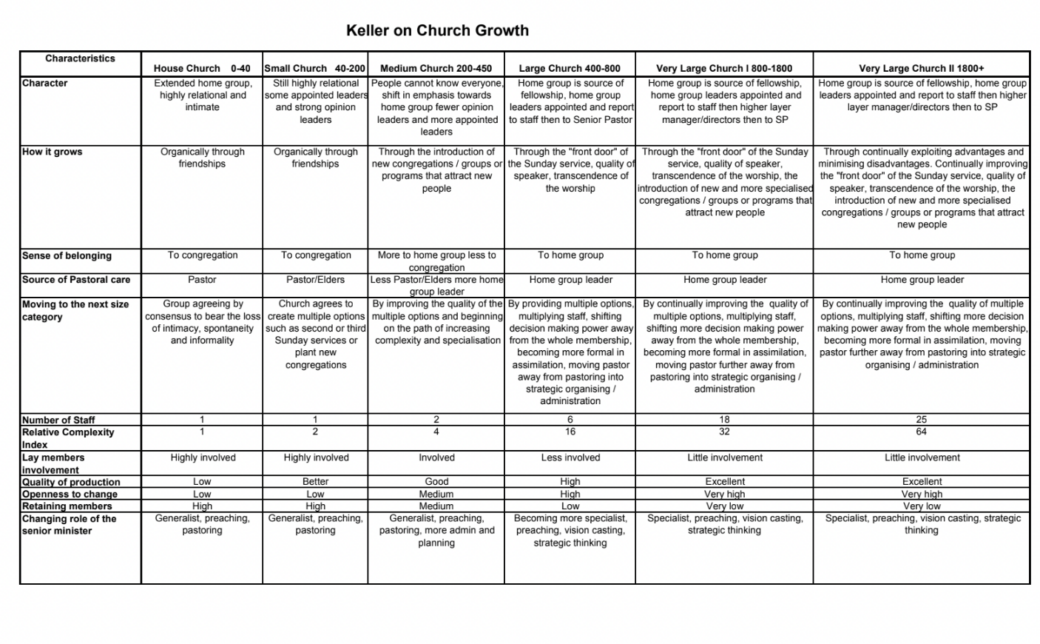
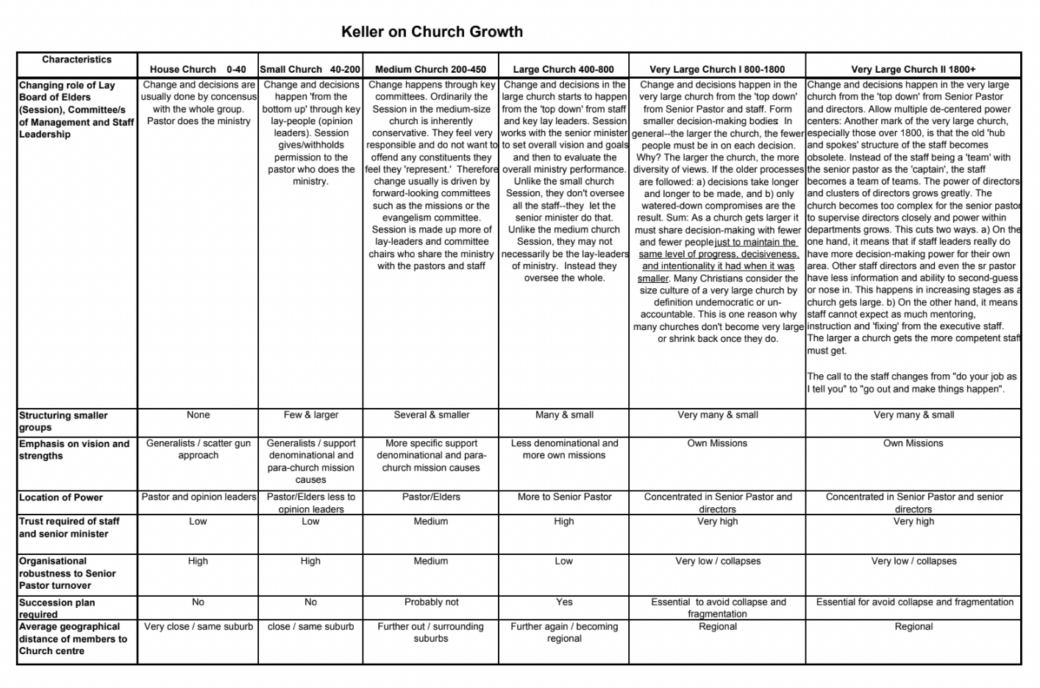
The machine, by its nature, standardises. The machine church has a standard model for blasting beyond limits that it borrows from the corporate world — the world of the machine — for reasons that are historical and ecological; a product of the technologies that birthed the possibilities for growth via the eradication of limits.

Keller’s paper, and this quote from Larry Osborne’s Sticky Teams were referred to in most documents about our trajectory from here on in.

“Never forget, growth changes everything. A storefront church, a midsized church, a large church, and a megachurch aren‘t simply bigger versions of the same thing. They are completely different animals. They have little in common, especially relationally, organisationally and structurally. It‘s not that one is better than the other. It‘s just that they‘re different. Leadership teams that fail to recognise or adapt to these differences inevitably experience unnecessary conflict or shrink back to a congregational size that best fits the structures and patterns they cling to.”

The impact of this Church Size Dynamics paper being applied to our vision to be a ‘mega church’ was that we were attempting to operate as a ‘very large church’ while arguably a network comprising of a house church, a small church and a medium church. And we were trying to fund the infrastructure of a very large church from this congregation; and then, increasingly, from external sources — whether a user pays subscription model to our resources, or via corporate donors from the big end of town who I speculate may have moved on to fund other similar church planting and resourcing networks and initiatives with similar reach-shaped visions.

I think it’s possible that there actually is a size and a structure where a community is ‘a church,’ and a size where a community must embrace the machine and distorts to being ‘no longer a church’; becoming subject to different technologies and techniques in order to continue to grow by overcoming limits. I don’t think church size is spiritually neutral because it seems to me that to become certain sizes one must embrace methodologies no longer consistent with the nature of a human community, choosing instead to become ‘mechanical’ in nature. Where any person draws the line will be arbitrary — some say more than one service in one location is actually ‘more than one church,’ others might say ‘multisite church’ is a contradiction, for mine, provocatively, my suggestion is that this size could be described as a “human scale church,” with all the human relationships and accountability structures and community and collaboration that involves. For various reasons, my inclination is to see this aligning with the ‘small church,’ which caps out at 200 people. Maybe I’m clinging to a personal preference or moralising my ‘favourite’ size. You can decide.

The thing about a vision so big is, well, its bigness — it removes any limits around what this particular local church in its particular locality might justify as its local mission and replaces ‘local’ with ‘growing’ and ‘reaching.’  

To be fair, locality is an interesting concept when it comes to the modern city and the modern church and the myriad choices available to any Christian living in a city to find a community — does one look for church community where one lives, works, or plays? Whatever church we attend is a choice. This is actually relatively historically novel; and aided by technological and social change.

We live in a world described by Charles Taylor as being shaped by the ‘age of mobilisation’ — where we are no longer pinned down in one geographic location for life (thanks to both social mobility enabled by political and social revolution, and technologies like the automobile and aeroplane), or in one vocation (thanks to technological, industrial, and digital revolutions that broaden the career options available and where work happens) — and the ‘age of authenticity’ where we each cultivate our presence in the world chasing our own ‘expression of self’ based especially on consumer choice and performance (also aided by technologies).

Taylor wrote A Secular Age and Sources of the Self after the internet had occurred, but in the very early days of social media and when Artificial Intelligence was the province of science fiction storytelling. The implications for church membership of mobilisation and authenticity (and post-protestant revolution which created brand ‘choice’ or what Taylor called ‘the nova’) is that church is a choice that individuals make and we make them for individual reasons often disconnected from geography and more aligned with affinity to various other things — people, theological vision, tradition, aesthetic — this consumer choice is fuelled by technology; and the mega church is a creation of technology — and, I would say, of the ‘machine’ as defined by Paul Kingsnorth and others.

This isn’t to say that house churches or small churches can’t be ‘machine’-shaped; of course they can; this is our prevailing culture. I’m seeking, rather, to make the case that big-to-mega churches are necessarily machine-driven, mechanistic or mechanical — relying on technology and technique and shaped by the prevailing conditions of the world around us with a desire to eradicate limits and extract resources in the name of perpetual growth.

At this point, I want to throw in a refresh of Paul Kingsnorth’s ‘machine’ definition, and foreshadow here that I’ll land trying to articulate ‘human scale’ church as an antithesis to machine church (whether that’s small, medium, large or mega-).

In my last post I highlighted a quote from Against The Machine where Kingsnorth wrote “The Machine manifests today as an intersection of money power, state power and increasingly coercive and manipulative technologies, which constitute an ongoing war against roots and against limits. Its momentum is always forward, and it will not stop until it has conquered and transformed the world.”

Grow. Growth. Growing. Growth. Growing. Growing. Reach the city, reach the world.

I also quoted this bit: “The ethos of the Machine is expansion, the busting of limits and the consumption of whatever can be sold to us to meet the ‘needs’ of the individual self which the Machine constructed for us in the first place.”

Our machine church with its emphasis on ’52 Excellent Sundays’ where one could receive ‘transcendent worship experiences’ (no sub-par musicians on stage thanks), and TED style sermons with original graphics and companion videos produced on cutting edge video technology was competing with every other church in our geographic pool to attract ‘ministry partners’ who would give their time and become ‘giving units’ “opening their hearts” to Jesus and then “opening their wallets” because “soft hearts give hard.”

Kingsnorth sees the ‘west’ as inextricably linked to ‘the machine’ such that to engage in ‘western’ practices uncritically is to participate in the machine. Its values are growth and profits and expending profits to secure more growth.

“‘The West’ has become an idol; some kind of static image of a past that maybe once was but is now inhabited by a new force: the Machine. ‘The West’ today thinks in numbers and words, but can’t write poetry to save its life. ‘The West’ is the kingdom of Mammon. ‘The West’ eats the world, and eats itself, that it may continue to ‘grow’. ‘The West’ knows the price of everything and the value of nothing. ‘The West’ is exhausted and empty.”

We were an extraction machine — and this included extracting the time, money and talents of the staff. At one point in a giving crisis, staff giving was being monitored, and senior staff (including me) — most of us renting as close as possible to church at great cost (percentage of our income), had a face to face meeting with the executive team (all a generation older, owning their own homes) and told to tithe our salaries, and to stop visibly spending money on things like fast food (because optics mattered). And, through technology and technique we convinced others to invest in the machine; to invest in the machine. Page 2 of one of our vision documents, titled “Investing in the Next Generation” used the word “invest” 12 times on a single page.

A few pages later the document said:

“We need to invest in people, in the precious people God is bringing to us. We need to invest in the next generation of believers. We need to invest in the people God is raising up from among us to send out as the next generation of labourers in his harvest. In all of this, one more pressing need is very clear. High level management is essential to maximize all our other ministry investments.”

We need to invest in getting our techniques right — and we are the vehicle for this mission. This rhetoric would amp up in subsequent years. People giving ‘hard’ to perpetuate the machine; invited to do so because of the urgent imperative of the Gospel — but the ends of the Gospel were totally identified with expanding our reach and growing beyond limits; even if people were chewed up in the process. Soft hearts gave hard.

I would note at this point, that a feature of machine church — with its acknowledgment that people will leave as you grow — crassly expressed by Mark Driscoll as ‘bodies under the bus’ — is burnout and exhaustion. Once resources are extracted from ‘ministry partners’ because in the parlance of pokie machines they have ‘played to extinction’ they are replaced by newer models and discared. It is instructive that in a quick survey of vision documents from machine church over the four year period described above, around 80% of the members and staff named in the document are no longer employed by or attending the church.

The problem with the machine when it meets church is that it’s more like Moloch than the one who says “come to me those who are weary and burdened and I will give you rest.” Moloch as Kingsnorth describes it (following the beat poet Ginsberg’s Howl).

“What Moloch wants—Moloch whose soul is electricity and banks—is sacrifice. We must sacrifice ourselves and our children to the robot apartments and stunned governments.”

Kingsnorth writes, at some length, about the relationship between the machine and spirituality (and worship). One issue he identifies is that when we embrace the mediums and methods of the machine — the machine forms us (the medium is the message, thanks McLuhan), and it forms us in its likeness and machinations — not as humans, but so that we are extracted and exhausted.

“In a world in which this Machine consciousness is propagated to us daily through digital technology each time we gaze at a screen, the irrational, illogical world of beauty, wild nature and spiritual truth becomes literally impossible for us to experience, for it cannot be quantified—and therefore doesn’t exist.”

He describes our modern experience in terms similar to Taylor’s, so we westerners, entranced by the machine are “Spiritual but not religious, individualistic on the surface yet conformed beneath to the needs of the Machine, spiritually hungry but devoid of guidance or direction, committed to total self-expression yet unsure who or what we even are, suspicious of any limits to all these enslaving ‘freedoms’: this is our world. One that celebrates the free play of individual desire, that spiritualises the individualistic war on limits, and centres and celebrates the use of technology to win that war—in our bodies as well as the world.’”

We were a church that sought to harness technology and technique — the machine — in our models — mega, multisite, and ‘digital producer’ — breaking limits to win a war; but as soon as we fought this way we were losing.

Though he has converted to Christianity in part as a result of observing the consuming power of the machine, and how the cross of Jesus is its antidote, Kingsnorth notices the way Christianity has been co-opted.

“I learned from that experience that my belief in the profanity of technology is not widely shared. While there have been astute religious critics of the Machine—Wendell Berry, Ivan Illich, Jacques Ellul and Philip Sherrard have all made appearances in this book—it appears that many spiritual leaders and thinkers are as swept up in the Machine’s propaganda system as anyone else. They have bought into what we might call the Myth of Neutral Technology, a subset of the Myth of Progress… On and on it goes: the gushing, uncritical embrace of the Machine, even in the heart of the temple. The blind worship of idols, and the failure to see what stands behind them. Someone once reminded us that a man cannot serve two masters, but then, what did he know?”

In my next post I’ll explore the way the mega church — and the idea of perpetual church growth — the blasting of limits — is a product, directly, not just philosophically, of the machine (first the ‘automobile’) — and tease out some implications.

But here I want to nod towards the beginnings of Kingsnorth’s proposed solution; around the idea of embracing limits — and dip back into an older essay of his to introduce the idea of ‘human scale’ church.

Perhaps the first step of resisting the machine — following Kingsnorth — is to refuse to see (or describe) things that are not machines as mechanical; to cultivate a different imagination — and especially to see organisms and communities as organic rather than technologies to systematise or master; to resist dehumanising language (‘giving units’) and, like the good shepherd, know each sheep by name. Kingsnorth says:

“Perhaps central to this is an effort to see the world as an organism rather than a mechanism, and then to express it that way, through art, through creativity, through writing, through our conversations. The last part is the hardest, very often, but maybe the most important too. If we refuse to see the world or its inhabitants as machines, if we are suspicious of rationalisations and dogmatic insistence and easy answers and false divisions, even for a moment, then we are making a start.”

One of the moments in the life of our church where the machine took over was a time where I had not been living within my own limits — or boundaries — in pastoral care; all things to all people became a mantra not just for evangelistic technique but for constant availability to offer assistance of any manner; fuelled by being constantly contactable. This was bad and my family suffered, I suffered, and the people I cared for suffered — but the solution, proferred by the machine, was to essentially remove me from the same sort of ‘face to face’ contact with people; to move me across Keller’s grid, making me less accessible — behaving less like a ‘pastor sized church’ and more like a ‘big church’ where I led leaders. Overnight the vibe in our community shifted. People lost trust in my love and leadership — not simply in my competency (I am quite happy to admit that I wasn’t competently approaching the task). Instead of a human scaled solution we applied a variety of techniques; people were not people with names and stories, but cases to be managed by teams whose interactions were charted in a ‘customer relationship’ database.

Subsequently he writes:

“The Machine seems a Behemoth, a Leviathan, and it is. But it always manifests its own power at human scale, and that is the scale at which we must take its measure. Jacques Ellul once put it like this: We must not think about Man, but of my neighbour Mario… An anti-Machine politics, it seems to me, must spring from this older, grounded tradition. It should operate at the human scale, and not at the scale on which ideology operates…. A reactionary radicalism, its face set against Progress Theology, which aims to defend or build a moral economy at the human scale, which rejects the atomised individualism of the liberal era and understands that materialism as a worldview has failed us.”

I believe there is a kind of church that operates at this human scale; and that part of this is a differentiated approach to growth. My prayer is that God’s kingdom might grow; that many people might join the Lord of the harvest in fruitful life; experiencing the love of God for eternity — but this growth does not have to be subject to my control, or a ‘machine’ we build in our local church; it does not have to depend on technology or technique. It may come from embracing limits and encouraging others to embrace limits and to expand and duplicate in sustainable ways less reliant on technology, technique, and exhausting the human resources who are united to us by God’s Spirit as we act as the body of Christ together. It might emphasise rest and resistance not just output and productivity. It might take steps to not become big — to not act sizes above the present in order to ‘break through barriers’ and ‘reach more people’ but to steward the gifts and the environment we cultivate together in sustainable patterns that duplicate and give life, rather than joining the mechanical extraction of the natural and human environment that typifies the machine — strip mining all other local churches in the area to fuel your own vision and to add cogs to an ever-more-complex production for people to consume as they are consumed.

Church at a human scale actively resists ‘bigness.’ That’s counter-intuitive, I think, but essential. Before Against The Machine, Kingsnorth published a collection of essays Confessions of a Recovering Environmentalist. This included his essay ‘A Crisis of Bigness,’ in which he observed the failure of nations and systems that go beyond their capacity to operate well and so turn towards staying alive as an alternative to collapse. His thesis, following the work of Leopold Kohr who wrote The Breakdown of Nations in 1957, was that “wherever something is wrong, something is too big.” Kingsnorth asked, “what if big ideas are part of the problem? What if, in fact, the problem is bigness itself?”

Reading back over old vision documents from our machine church I ask myself the same question. Kohr argued that “small states, small nations and small economies are more peaceful, more prosperous and more creative than great powers or superstates,” I wonder if this is true of small churches?

“Socialism, capitalism, democracy, monarchy – all could work well on what he called ‘the human scale’: a scale at which people could play a part in the systems that governed their lives. But once scaled up to the level of modern states, all systems became oppressors.”

I wonder if this is true of megachurches, where, according to Keller, power centralises in the hands of the senior leadership (away from the congregation), and participation in the hands of employees, as growth happens (attendees consume and feed the machine).  

“Kohr demonstrated that when people have too much power, under any system or none, they abuse it.”

This seems true of the countless stories of abusive megachurch leadership we read almost daily. Many of my own reflections on my experience were shaped by having trauma responses while listening to The Rise and Fall of Mars Hill.

For Kohr, “The task, therefore, was to limit the amount of power that any individual, organisation or government could get its hands on. The solution to the world’s problems was not more unity but more division.”

“To understand the sparky, prophetic power of Kohr’s vision, you need to read The Breakdown of Nations. Some of it will create shivers of recognition. Bigness, predicted Kohr, could lead only to more bigness, for ‘whatever outgrows certain limits begins to suffer from the irrepressible problem of unmanageable proportions’. Beyond those limits it was forced to accumulate more power in order to manage the power it already had. Growth would become cancerous and unstoppable, until there was only one possible endpoint: collapse. We have now reached the point that Kohr warned about over half a century ago: the point where ‘instead of growth serving life, life must now serve growth, perverting the very purpose of existence’. Kohr’s ‘crisis of bigness’ is upon us and, true to form, we are scrabbling to tackle it with more of the same: closer fiscal unions, tighter global governance, geoengineering schemes, more economic growth. Big, it seems, is as beautiful as ever to those who have the unenviable task of keeping the growth machine going.”

In my experience these words apply as much to churches as they do to nations.

I don’t want to keep growth machines growing any more — I would love to see more human-scale churches springing up to produce sustainable, life-giving communities as they embrace limits.

Unicorn Church

I was bouncing some ideas around with a friend the other day; unpacking some of my frustrations with the institutional status quo of churches and denominations and movements grappling with ministry and mission — with being the people of God — in post-Christian Australia.

I have a handful of pebbles in my shoe around the Presbyterian Church of Australia (and its federated state-based expressions) as we respond to various challenges in the culture by circling the wagons. An article by Kevin De Young, a Presbyterian minister in the United States, about a book about his friend Tim Keller gave me a certain sort of language for what’s going on in our denomination, and what it feels like to be more aligned with Tim Keller’s approach than De Young’s. Watching the eulogising of Keller by the people who take De Young’s approach (at the expense of Keller’s) felt like being gaslit. Anyway, the De Young piece in First Things included this paragraph:

Though I hope to be kind and careful, my public ministry has often involved correcting error, guarding the truth, and warning against creeping liberalism. By contrast, though Keller usually lands squarely on the traditional side of doctrinal matters, he has a public ministry focused on making the gospel attractive to outsiders, staying out of intramural theological disputes, and warning against extremes. You might say I specialize in building walls, and Keller specializes in building bridges. 

Bridges or walls.

Our denomination has responded to a changing culture, in the main (not necessarily at the level of every local church) by building walls; walls with good defensive positions from which to launch projectiles at “the culture” (whoever isn’t behind our walls).

And a good defensive position sometimes means either bringing up the bridge (turning it into a drawbridge) or burning it. And it’s tiring and a self-defeating strategy that requires not taking any new ground for one’s kingdom, and maintaining a birth rate (or increasing it) in order to sustain the thing behind the walls or to expand it. I’ve written a couple of things about these dynamics within the Presbyterian Church over the years, including a submission to a review of how we operate in Queensland, and I fear things are getting worse, not better.

De Young reckons Keller would’ve said we need both bridge builders and wall builders. I’m not sure an institution built on wall maintenance has a future, especially when the walls are built in the wrong place — out of reaction against people — and so exclude those seeking life within them. If the walls are meant to mark out those who have received life in Jesus, by his Spirit, then excluding those whom God has included is a problem. Our approach to this problem has been, I think, to legitimise building such institutions around, say, the “Reformed Tradition,” because there are other places with other walls where one can find that life. I think that sort of differentiation might turn out to be both ill-advised, and a luxury in a culture where the walls can be less porous and where Christendom’s still kinda a thing. I’m not one of those ‘the sky is falling in’ types who is devastated by the loss of Christendom; and I think we have to keep acknowledging that secularism and its ethical vision, in the west, are still profoundly shaped by Christian values (even the left who want justice, liberty and dignity for humans; to liberate people from oppressive structures — that’s Christian right there), but I do think it’s patently obvious that a ‘secular age’ has dawned (in part through maximised choice about what to believe), and that we’re in for a period of being a minority who’re being called to account for what the church did when it enjoyed political and social power.

Anyway. This bridge building v wall building paradox (or simply a commitment to bridge building) stuck itself firmly in my craw, and has created a growing sense of dissatisfaction with my institution; which seems committed to building walls on matters of race (where we’ll build walls on acknowledgments of country and the Voice to parliament), on sexuality, and on the full participation of women in the life of the church (even if one holds convictions about different roles for men and women, at the moment you couldn’t say we’ve fully imagined a mutual and cooperative co-labouring in the mission of the Gospel as fellow workers). The catch is, I’ve looked at the denominational or institutional landscape on offer in Australia and found all the alternatives suitably lacking. So in this conversation with my friend Dave Benson — who I’ll name because I’m about to quote (badly), I sketched out what I’d love to see in a church network (and hey, it could be within an always reforming Presbyterian Church) not just responding to the challenges of the present time, but as an expression of who we’re actually called by Jesus to be. I described this sort of church as a ‘unicorn’ — I’ve described some of this previously as a church for the “excluded middle”; ignored and alienated by a culture war.

A few days after reading the De Young piece, I happened to listen to a podcast interview where Dave described a church he’d been part of establishing here in Brisbane — there’s much that resonates with me about his vision for church in this interview, but nothing more than when he described what I think is an even more Biblical vision for church than bridge building. Dave talks about his in-laws experience as livestock farmers, and how farmers gather their animals. In a sheep farm fences have some use — but if you want the sheep to gather together in a spot, you don’t build a tiny paddock with a strong fence to contain them; you build a well.

Wells are a profoundly cool thing in the Bible — there’s a bunch’ve well-building projects in Genesis that are little ‘living water bubbling up to give life’ moments; where husbands meet wives and there’s the possibility of Edenic life on display. In Jeremiah God is described as “living water” and idolatry is described as ‘drinking from broken cisterns’ or wells; and the Hebrew word for well is beer. Which is fun. When Jesus meets the Samaritan woman at the well and offers her living water he’s offering her life connected to the source; a return from exile; an invitation into Eden. Wouldn’t it be great if we conceived of the project of being the church as being little Edens — little wells — connecting people to the source of life and confident in the drawing power of the Gospel; of the person of Jesus and the life of the Holy Spirit (which hey, it turns out is what Living water is as we get a little further into John’s Gospel). What would happen to our vision of church and our approach to forming a community if we weren’t trying to keep people in or out with a wall, but inviting people to drink?

What would a denomination look like if it was committed to this? How would we approach contentious political, cultural, or ethical questions? Or the people experiencing those lived realities? We might see that transformed lives actually come from drinking that water, and that some of our fences or walls keep people out who might otherwise be changed; they might be brought from death to life; from exile from God to restoration to life in his presence. Wouldn’t that be amazing.

Anyway. In spelling out a little of where I think we’ve built fences not walls, in my conversation with Dave, I laid out some areas that I’d love to see at the heart of a network or denomination that I reckon would be ‘building a well’ that might draw people towards life in a pretty dry and dusty landscape.

I’d love a church that embraces a “Bible Project style Biblical Theology” rather than a systematic theology/doctrinal framework that is used to build walls — I say this not because the Bible Project gets everything right, but because too often denominations and traditions create an authority structure that is used to police people and frame our engagement with the Bible, and these structures tend to impose human constructions that are a product of time and place and expertise on how we approach the Bible. Biblical scholarship is good — and we’re always learning more about the richness of the Biblical text, especially read as a unified story that leads to Jesus (which is kinda what Jesus himself says it is). So much ‘wall building’ is bad traditionalism. We protestants even claim to be the church always reforming. A rich Biblical Theology is exciting and it gives the Bible back to people who’ve experienced the worst forms of abuse, exclusion, and trauma as a way to encounter God and be drawn into his life, as it is revealed in Jesus and poured out to us in God’s Spirit as both the fulfilment of the Bible’s narrative and our invitation to participate in that story.

I’d love a church that thinks about politics and ‘the systems’ and cities we live in through the spiritual lens the Bible provides where we see powers and principalities at work dragging people away from God so are more keen not to just bring those powers into the church as though they don’t need to be crucified, and radically altered (technology and techniques from the business world might be ‘wisdom’ that can be plundered, but they aren’t ‘neutral’ if they’re left in the form of a golden calf).

I’d love a church denomination that embraces a Side B sexual ethic — one that offers a positive vision of what life as an LGBTIQA+ person — or any person — with what has been described as a “vocation of yes” — a sense of how to faithfully steward our bodies in response to things we might otherwise sinfully desire, as an expression of living out our new story. So much wall building is built around ‘saying no’ and excluding those who might find new life in Jesus in a way that radically alters (altars even) the way we approach sex and our desires. I feel like LGBTIQA+ Christians committed to a Biblical/traditional view of sex and marriage and trying to work that out ‘in the flesh’ are caught between a progressive and affirming church and a church that wants to leave these folks outside the walls to be hit by projectiles, and there are few (if any) denominations built on saying “come to the waters and find life and work out what faithfulness looks like securely planted in Jesus and his people.”

Alongside this, I reckon it’d be great to have a church with a theology of the body — and of place and beauty — a vision for creation that doesn’t just reduce these physical things to ‘potential objects of worship or temptation’ but finds ways to encounter the physical world to glorify and enjoy God as the source of these good created things (and people). This would be transformative not just for how we approach questions of non-straight sexuality, but, for example — would counter both ‘purity culture’ and ‘porn culture’ (where bodies are reduced to tempting objects), and how we think about money, and generosity, and art, and architecture, and the full and abundant life we are called to. It’d be nice to have a positive vision at the heart of a movement; not just a commitment to avoiding sin. This might be part of building a well.

I’d love a church with a non-hierarchical, mutualist (and genuinely inclusive — regardless of sex, age, race, etc) approach to governance that avoids the pitfalls of congregationalism and top-down authoritarianism. This is tricky to build in to a church culture, but one would have to value listening, and the limits to growth and ‘productivity’ produced by such a structure. This also means rethinking how we approach metrics; I’d love a network that encourages and supports kingdom growth in various forms and expressions that isn’t wedded to raising money to expand one’s own little kingdom; or to the machine — to efficiency and technology and the market.

I’d love a church that appropriately holds Gospel clarity (proclamation) together with Gospel charity (deeds/justice etc), not as a tension or paradox, but just as a picture of integrity. It’d love this to include avoiding bad syncretistic church politicking that aligns with either conservatisve or progressive politics.

And a church where we all get to ride unicorns.

This is what a church that offers life — functioning as a well — would look like for me (and I’m aware that there’re plenty of wall builders whose bricklaying reflexes have been triggered by this stuff who’d now be keen to exclude me, and other cynics who just reckon this is motherhood and apple pie stuff that’s all good in theory and abstraction). These are the values — the distinctives even — that we’re trying to embody as a church community in the little corner of the church I belong in, in ways that have been rich (at least for me).

The really big paradigm shift here isn’t in the political or technical stuff — though that’s part of it — it’s in a shift in posture from defensive and pessimistic; a constant vigilance because we don’t want sinners in the camp or sinful ideas corrupting us , to a posture that is confident and invitational — where we want sinners in the camp, and at the table — drinking from the well — because that’s how God works to transform people.

Now, I’m not naive enough to believe a utopian church is possible, and institutions have a tendency towards become corrupted, sure — but I’m experienced enough in the machinations of church to know that there aren’t many churches reacting to a rapidly changing cultural context by asking ‘how do we build more wells’ rather than ‘how do we build more walls.’

I reckon if you’d like to be part of a church like this then the only thing really stopping us is not having enough wells. And, like the people of God in Genesis, maybe we should start digging so that life might bubble out. And if you have your own vision for a unicorn church — or what building wells looks like — hit me up. I think it’s time to break new ground.

On demolishing strongholds: Approaching both wokeness and whiteness with weakness

Owen Strachan is, increasingly, a ‘thought leader’TM in the hardline evangelical Reformed Baptist movement in the United States. He was, for a time, the President of the Centre for Biblical Manhood and Womanhood. He’s an influential voice. If one was to peruse his Twitter output in recent weeks, and months one would find that he’s turned his earnest voice to ‘wokeness’ and ‘critical race theory’ and ‘intersectionality’. These are the bad guys in the culture war, where feminism was, for the CBMW guys, just the pointy end of the spear.

Strachan posted a video clip from one of his recent talks yesterday where he quoted 2 Corinthians 10. Here’s the full lecture for context.

He said:

“We are speaking the truth in love. We are demolishing strongholds according to Paul in Second Corinthians 10:4. A lot of us today, we don’t think in those terms, that language sounds kind of hostile and arrogant and imperial and very western. That is an apostle of the Lord Jesus Christ, martyred in the Christian faith, who tells us that he demolishes strongholds, the Corinthian church is to demolish strongholds, and by extension, two thousand years later roughly, you demolish strongholds that would seek to take you captive. We want unity in the truth of Jesus Christ, but where people have embraced wokeness, we must follow the steps of discipline per Matthew 18:15-20. We need to treat them as if they are being taken captive by ungodly ideology. Because they are… Even as we also publicly confront those teaching unbiblical ideas in a broader sense. Though it will pain us greatly, excommunication must be enacted for those who, after going through the Matthew 18 steps, we pray we don’t have to go all the way to the end, but if we do, excommunication must happen for those who do not repent of teaching CRT, wokeness, and intersectionality. At the institutional level the same principles apply. Trustees, voting members, organisational heads, educational boards, and so on, must not tolerate the spread of wokeness any longer. Not one day more. Not one hour more. It is time. It is time for a line in the sand.”

Critical Race Theory, wokeness, and intersectionality are quickly replacing ‘Cultural Marxism’ as the term of choice in these culture war debates; which is a small mercy, at least, because Critical Race Theory is not so much a pejorative label with anti-Semitic undertones, but an actual discipline. These umbrella labels are attempts to describe the same sort of phenomenon; a cultural move afoot that recognises that the established status quo typically benefits those holding cultural and institutional power, and indeed is systemically set up to benefit those holding cultural and institutional power such that this status quo also costs those excluded from cultural and institutional power.

One way to observe this status quo, in the West, is to look at the question of power through, say, a prism of individual wealth. Globally, the white male comes out pretty well. This systemic ‘status quo’ stuff is more obvious in other cultural contexts, like Russia’s oligarchy, or China’s communist party. More ‘free market’ based nations, cultures, or economies, have changed the power dynamic so that power is more connected to wealth (success in the free market). But this isn’t a neutral status quo, the market isn’t free of history or the institutions (banks, corporations, etc) that mediate it to us, or even the expertise to navigate it (that comes via education, opportunity, and connections). It is geared through cultural, structural, and political systems, to benefit those already at the centre; and those people are typically white and male. It’s not that being white and male guarantees success, it’s just that the status quo keeps benefiting the same people. This also isn’t to say that all white people benefit from these systems, or that no non white people do, one’s success will depend on how well one adapts to, or challenges, the status quo. An example might be that not all white people can afford a sports car or a nice suit, but if you have a sports car and a nice suit as a white person in the west, particularly in America, you’re less likely to be assumed to be a criminal than a black person in the same car, and more likely to be assumed to be an individual success. If you’re a non white driver of a sports car the narrative is often that you’ve succeeded by sheer force of will, against the odds. Those odds, or what is overcome, are the ‘status quo’…

In short, critical theory says there’s a system built to perpetuate this, and that we experience that cascading down from the top into all systems and relationships. Critical race theory observes that in the west there’s an ethnic element to this status quo, partly through the colonial history of the ‘commonwealth,’ where the British Empire brought an ‘establishment class’ into various nations, benefited from the wealth of nations connected to the empire, and built cultural and physical infrastructure to benefit that establishment class (universities, old boys networks, gentleman’s clubs, legal systems, political parties, corporations etc) at the expense of non-establishment (non-white) people (including through slavery, but also in dispossessing people from their lands). Then, these establishment institutions assume the white experience as a default, whiteness as a norm, and white voices at the center, and this perpetuates itself generation by generation. Often these nations and cultures have not just been built on ethnic inequality, entrenching a biased status quo that benefits the establishment class, but they have been built by cultures where power was held by blokes, sometimes for theological reasons, other times because of the typical power dynamic created by brute physical strength. So when ‘woke’ CRT people speak of ‘whiteness’ — it’s not white skin they’re particularly interested in, but the assumption implicit in our culture and institutions that whiteness is the default, such that, for example, I never have to describe ‘where I’m from’ (and really, I don’t actually know with much precision), I’m just white, and I don’t suffer the downsides of systemic racism, or the inherited baggage of intergenerational economic disparity built from those establishment decisions that created a status quo I see as ‘normal’ and am not particularly predisposed to change or challenge, on my own, because not only is it normal, it is beneficial.

Where feminists particularly focused on the maleness caught up in the patriarchy, race theorists look at ethnicity, and when those groups recognised the similarities in experience and outlook the idea of ‘intersectionality’ was born. Throw in the sense that the status quo operates through the application of power, given to maintaining, or further entrenching the status quo as ‘the norm,’ sometimes the ‘God given’ or ‘natural’ norm, and we get the language of oppressed and oppressor in the mix.

This wokeness, when you open your eyes to the systemic reality — whether as an oppressed, marginalised, person, or someone benefiting from the system — then brings a new ethic. So we see groups or institutions that subscribe to ‘critical race theory’ and ‘intersectionality’ seeking to re-alter the landscape so that the voices that are dominant ‘status quo’ voices — that are all too often centered — are turned down, while the voices of the oppressed are amplified.

In the ultimate expressions of intersectionality or wokeness, powerful ‘centered’ voices can find themselves ‘cancelled,’ or historic statues toppled, for perpetuating oppression, while marginal ‘intersected’ voices — especially, say, the voices of a black trans woman (the ultimate intersection of oppressed classes) — are elevated, or centered. Now, we’ll come back to the question of whether this is actually a change of structures, or just a change of people occupying the positions of power in a structure that is essentially the same, below. It’s worth noting too that this whole intersectional agenda only really works in the west, it’s a particular product of western history, multiculturalism, violence, and even (in a positive sense sometimes) Christianity. Intersectionality doesn’t see ‘whiteness’ as a problem in China; it’s not a universally true, all encompassing worldview, and the people who want it to be have a pretty small view of history and geography. In some ways, our ability to even identify injustice, oppression, and systemic sin in our ‘status quo’ might, itself, be a product of the Christian framing and vocabulary that comes to the west via its heritage. It’s worth bearing that in mind when declaring it a heresy or a ‘line in the sand’ where anybody who uses any wokeness, CRT, or intersectionality should be excommunicated.

There are, of course, truths to the criticism of the west offered by critical race theory, or intersectionality, that anybody with a Christian anthropology might recognise. Our story — the Bible — is full of political leaders who create empires and cultures that perpetuate their godlike power, and that oppress and enslave (think Egypt, Babylon, and Rome). It shouldn’t surprise us when power based empires or cultures create a marginal experience where those not sharing power, or benefiting from the status quo, have similar observations, language, and experience that builds a shared revolutionary suspicion of the status quo.

In these ‘dominion’ style cultures it was hard to be from another ethnic group, or a woman, and to be a woman from another ethnic group did work in a sort of intersectional way. If Jesus had met, for example, the Samaritan woman at the well in Jerusalem, she’d have been an example of an intersectionally marginalised and oppressed voice on an additional count; as it was she was an outcast in her community, a bit like the woman accused of adultery, caught up and spat out by what we might now call the patriarchy and its status quo benefits offered to blokes (so that women bore the cost of sin and shame disproportionately). We see these dominion systems as an outworking of the sinful rejection of God, and our desire to rule in his place and to seek dominion over others, rather than co-operation.

This is the fall written into the fabric of human society — our beliefs, our structures, our institutions, our cultures — are as fallen as we are at an individual level, and then serve to perpetuate that fallen view of the world (so a Babylonian was raised to think like a Babylonian, according to Babylonian stories about what the gods were like, and who the king was as ‘the image of God, and this was the same in Egypt, or Rome, where the rulers of those empires were also ‘images of God’ in imperial propaganda).

The trick is that it’s hard for an Egyptian, Babylonian, or Roman kid to realise how much the default system, or status quo, was a departure from God’s actual design for life; and how flawed their picture of God was when built, inductively, from the life and rule of the ‘image of God’ at the heart of their empire. It’s harder still for someone caught up in the power games at the heart of the empire, and benefiting, to hear that their stronghold is a house of cards, and to see the oppression and destruction it brings.

It might take, like it did with Naaman, a general serving the King of Aram, an empire opposed to God’s people, the de-centered voice of a marginalised ‘servant girl’ to bring the whole house crashing down. Naaman wanted to keep playing the power game in his interaction with Israel; the girl sent him to the one who would speak God’s word — a prophet — but Naaman went to the king. The prophet, when he got there, wouldn’t take wealth, or power, or glory for healing Naaman, but sent him to get dirty and lower himself into a river. His picture of power was inverted; his stronghold demolished.

To suggest ‘CRT, wokeness, and Intersectionality’ are grounds for discipline and excommunication is a fascinating step, given that there are pretty strong Biblical precedents for reaching a similar diagnosis of what happens when idolatry and sin are systematised; namely, that people are oppressed or enslaved. It might be better, I think, to question the solutions offered by those bringing this diagnosis to bear on modern cultures and institutions (including the church). There’ve been some interesting contributions to this project from Tim Keller recently, and in these two response pieces to him from David Fitch (part one, part two).

Here are some additional further possibilities that might lead us to be cautious when it comes to drawing ‘lines in the sand’ — and ‘excommunicating people’ — especially when we belong to the ‘identities’ that are typically the beneficiaries of the status quo (especially if much of your professional life has been given to entrenching the gendered part of that status quo).

It’s possible that exactly the power structures that CRT, Intersectionality, and Wokeness identify are the structures we should be demolishing both in the world and in the church, but that the trick is we’re meant to demolish those with different weapons than the weapons of this world; and those same weapons might also be turned against the new world order dreamed about by those championing regime change or revolution under the CRT, Intersectional, or ‘woke’ banners.

That is, it’s possible that the demolition job the Gospel of the crucified king does on human structures and empires and power games actually demolishes both ‘whiteness’ or the patriarchy and ‘wokeness,’ intersectionality, and CRT.

It’s possible that the whole ‘identity politics’ game, whether played from the right or from the left is a politics built on a model of the human person where we’re creating our own ‘image’ and thus projecting our own ‘image of God’ as we pursue some sort of authentic self or ideal human life and experience (‘identity’).

It’s possible that democracy means that instead of having empires where the king is the image of God, we’re all kings and queens trying to carve out our own space, playing the game Charles Taylor calls ‘the politics of recognition‘ — where we want our identity to be affirmed and recognised and upheld by the law, and our chosen ‘identity’ to be the one that is at the centre of society, and that flourishes most of all.

It’s possible that Christian contributions to politics in the culture war have simply been a form of the identity politics we claim to hate, built from a desire for our own recognition as the ‘images’ that should be the social and cultural norm in a particular form of empire.

It’s possible then, that the church built by people playing this sort of ‘politics of recognition’ game, uncritically adopting worldly mechanics of power, or not demolishing the strongholds of our particular empires (democracy, meritocracy, technocracy, etc) have created a situation where those in positions of power in the church, at least those whose voices are centered, tend to look a whole lot like those in power in the world.

It’s possible that in all this we’ve totally lost the sense of personhood being something given to us from above, and built in relationships and community, not something we build by playing an individual power game where we claim our space in the world and yell ‘this is me, know me and love me for who I really am’ at the universe (see The Greatest Showman’s anthem ‘This Is Me’ for example).

It’s also possible that we’ve lost something of the essence of the Gospel in both the shaping of our own institutions, communities, and culture — the Gospel that is the story of a member of an oppressed people group (Israel under Rome), born into a system that was threatened by his very existence (Herod’s rule as a symbol of Caesar’s rule), and so further marginalised him (his exile into Egypt). Jesus was a non-centered voice in both Israel’s religious institutions (he wasn’t a priest, or a pharisee), and he consistently sought to ‘demolish the stronghold’ the Pharisees had built — the religious edifice that oppressed the people for their own wealth, relied on cosying up to imperial power (Herod and Pilate), and claiming, ultimately, that Caesar, not Jesus, was king of Israel as they sought to silence his voice.

It’s possible that we’ve missed the New Testament’s diagnosis that opposition to Jesus and his kingdom, particularly through the use of the power of the sword, was beastly, or Satanic, and represented a false image of God being held by those who were meant to be living as God’s image bearing, priestly, people; and that the leaders of the Temple had become oppressors who ‘devoured widows houses’ just like their tax-collecting Roman rulers did; as beastly, prowling, Satan-like wolves, rather than being like lambs trusting God as a shepherd.

It’s possible that where we’ve missed that essence, and even systematised the domination system caught up in our status quo in our churches the ‘strongholds’ that need demolishing will not be ‘out there’ in the community, but ‘in here’ in the church. Some examples might be where we uncritically embrace leadership manuals, or business practices, or status quo practices (like old boys clubs, gentleman’s clubs, setting the parameters for who gets authority in our institutions in ways that perpetuates a ‘sameness’ to the voices that are centered, etc). It’s possible, too, that the church will never see where it has sided with the ‘oppressor’ or the status quo unless we see these practices through the eyes of those who are marginalised and oppressed. If voices like ours are the voices we keep centering, how will the status quo ever be challenged? How will the strongholds ever be demolished? If, God forbid, we have systematised sinful patterns in our church structures, then it’s precisely the ‘woke’ intersectional critical race theorists we may need to hear from; there are plenty of examples in the Gospels of voices who would normally be ‘marginalised’ being centered in the kingdom; including the women who are the first witnesses to the resurrection (see the response of the disciples who “did not believe the women”).

If we’re going to discipline people and excommunicate them; let’s do it when they have a Lord, or king, who is not Jesus, and pursue an image of God not found in Jesus, and want revolution that looks something other than like bringing in the kingdom of Jesus. You know, like supporting Trump for president.

Let’s demolish strongholds. But let’s demolish all strongholds.

And let’s recognise that we might need to listen to voices who are typically excluded in order to see what we’re missing. The catch is, we won’t find many black trans women in our churches (and nor should we play the game of intersectional one upmanship, perhaps our posture should simply be to listen to those members of the body of Jesus, including the global church, whose experience and outlook is different to our own). This isn’t to say that wokeness, intersectionality, or critical theory aren’t ‘strongholds’ that need demolishing because they pull us from Jesus, just that they might be allies in tearing down some strongholds that have already dragged us into captivity. ‘Wokeness,’ in the culture wars, often feels like an attempt not to change the game, but change who occupies the centre (even whose image gets turned into a statue that sits at the centre of civic life). Our solutions to the problems of this world aren’t meant to look like elevating other, previously excluded, voices to the place of supremacy or dominion (though God does oppose the proud and give grace to the humble), that just perpetuates the same system under different parameters, our solution to the problems of this world don’t just sit in the space of diagnosis, but revolution. Our revolution isn’t about picking other humans as kings or queens who’ll become the image of our God to us, but about following the king who is the image of the invisible God. Wokeness, where it seeks to play a dominion game, captivating us and pulling us away from Jesus as the radical inversion of beastly empires we need, but also whiteness, the status quos from the world we’ve brought into the church.

This is, of course, why culture wars style politics, or worse, culture war Christianity, is problematic. And this is, in a sense, exactly what Paul is writing against in his letters to the Corinthian Church.

In the city of Corinth the dominant culture was one of power and status. They played the Roman game harder than most. The city skyline was dominated by an imperial temple. The city was big on oratory and impressive orators. They wanted Paul to be an orator — a big and flashy speaker who’d sway their power obsessed neighbours over to this new empire. They liked Apollos because he was an impressive orator, then, by the time 2 Corinthians rolled around, they were enamoured with the ‘super apostles,’ who, when you look at Paul’s response seem to be the very opposite of him; the sort of church leaders wielding the weapons of this world — sharp tongues — playing a power game that the Corinthian church was getting behind. Winning the culture war.

The Corinthian Christians didn’t quite understand how revolutionary the message of the Gospel was; how much Jesus being the antithesis of Caesar, Pharaoh, or a king of Babylon meant for how we’re meant to approach life, as individuals and in community. Jesus’ diagnosis of the world — from Israel outwards — was that the powerful had become oppressive; that sinful rebellion against God and siding with Satan and cosying up to Rome had corrupted the people and institutions who were meant to be representing God and his heart for the humble.

Jesus upended the ‘dominion’ style status quo, and its politics, and brought something very different as a solution. A cross. This is how Paul sees strongholds being demolished. God’s power and wisdom is found in the crucifixion. This realisation shaped Paul’s message — so that he resolved to know nothing but Jesus, and him crucified, but it also shaped his posture — his approach to persuasion — so that he came to the Corinthians not with powerful words, but in weakness and trembling. So that he ‘renounced underhanded ways’ of persuasion, and ‘carried the death of Jesus in his body so that the life of Jesus might be made known’ (2 Cor 4). If we’re going to trot out a part of 2 Corinthians 10, lets ground it in Paul’s criticism of the Corinthian pursuit of dominion within the life of the church, and for the church within the life of the city. If Paul were here today I don’t think he’d be speaking for ‘wokeness’ or ‘whiteness’ in a sort of fight-to-the-death battle for supremacy; I think he’d be pointing us towards weakness. I don’t think he’d be kicking out those who identify how the pursuit of strength in church structures has led to oppression of people we should be loving with our might, or those who cry out for reform and justice in the church on that basis (it’s worth seeing, for example, how Strachan’s speech plays out specifically against conversations about race in the American church in the midst of the conversations amplified by the black lives matter movement, and the current unrest in America produced by generations of racism that are now entrenched in the status quo). Paul might have used a ‘war’ analogy in 2 Corinthians 4, but it was precisely to subvert the sort of power games we’re so used to playing in the church and in the world.

For though we live in the world, we do not wage war as the world does. The weapons we fight with are not the weapons of the world. On the contrary, they have divine power to demolish strongholds. We demolish arguments and every pretension that sets itself up against the knowledge of God, and we take captive every thought to make it obedient to Christ. — 2 Corinthians 10:3-5

The cross of Jesus is our weapon; it demolishes both wokeness and whiteness because it stops us playing the culture war and invites us, instead, to be ministers of reconciliation (2 Cor 5), who carry the death of Jesus in our body, and have relationships marked not by dominion but by the self-emptying example of Jesus.

This might mean rejecting, or re-directing, the power and opportunity given to us by the status quo; the platform, or the centering of our voices in the life of the church. It might mean making space to listen to those voices marginalised by structures that perpetuate the same sorts of people being given authority and influence. It might mean hearing the critique of our church structures, and the west, from those who stand among the oppressed. Maybe that’s where we find what the paradoxical strength in weakness of the cross looks like embodied in the western world. In the voices of those, faithfully in our churches, but from the margins of our society.

This might mean that CRT, intersectionality, and wokeness aren’t the enemy, even if they challenge the things we hold dear. It might mean that the things we hold dear, the things that give us strength and influence, are actually things we should be letting go as we embrace weakness, rather than grasp worldly weapons.

Here’s Paul again, just after talking about the ‘weapons’ he uses to demolish strongholds — the things Satan uses to capture us and pull us away from Jesus.

Therefore I will boast all the more gladly about my weaknesses, so that Christ’s power may rest on me. That is why, for Christ’s sake, I delight in weaknesses, in insults, in hardships, in persecutions, in difficulties. For when I am weak, then I am strong. — 2 Corinthians 12:9-10

Which, of course, is an outworking of his whole understanding of the Gospel of his king, and the way it confounds the systems and conventions, the status quo, of the world he lives in.

For the foolishness of God is wiser than human wisdom, and the weakness of God is stronger than human strength. Brothers and sisters, think of what you were when you were called. Not many of you were wise by human standards; not many were influential; not many were of noble birth. But God chose the foolish things of the world to shame the wise; God chose the weak things of the world to shame the strong. God chose the lowly things of this world and the despised things—and the things that are not—to nullify the things that are, so that no one may boast before him. It is because of him that you are in Christ Jesus, who has become for us wisdom from God—that is, our righteousness, holiness and redemption. Therefore, as it is written: “Let the one who boasts boast in the Lord.” — 1 Corinthians 1:25-31

Confessions of a “reluctant” “inner city church planter”

There’s a bit of a conversation happening in the Australian Evangelical Blogosphere (so about the smallest pool in the world) about inner city church planting. They’ve got me mulling over next year and life at Creek Road South Bank – a new church, in Brisbane’s inner city, that I’ll be serving as the Campus Pastor (note, I think just about any name/title for a ministry position can sound a bit ego driven, the emphasis here hopefully will remain on the “serving” not on the “Campus Pastor”).

Here are some of the posts I’ve read…

The answer to the question “do we need more inner city church plants?” is clearly a yes.

It’s the answer to any question about “do we need more churches?” Churches are like broadcast towers that send the message of the Gospel around Australia – we need something like the National Broadband Plan to ensure good Gospel coverage around Australia. We also need more workers to work in these churches, and we definitely need more Christians. Australia isn’t meaningfully becoming less Christian, Australia has never been particularly “Christian” – church attendance was high when we started because people were forced to go to church. Australian laws might have assumed or reflected a Judeo-Christian moral framework – but that was the default, it didn’t mean they were written by people whose hearts were owned by Jesus, even if some of our early colonists were passionate Christians, others weren’t. We need more churches in Australia because Australia is full of lost people. And so are our inner city areas.

Which is why, for want of a better understanding of the nuance of what the church I’m part of is doing (hopefully this post will clear this up a little) – next year I’ll be an “inner city church planter.”

I’m finishing college soon. I’m thinking about what life in ministry, post-college, is going to look like for me, and what I thought it would look like before college. So just indulge me a little with this poorly structured stream of consciousness response to the posts above. It’s more about me than most posts you’ll read here, but indulge me a little.

Why I do what I didn’t want to do…

I feel like this whole South Bank thing is forcing me to think through a whole heap of competing thoughts and passions of mine in a way that hopefully ends up being consistent and a healthy compromise on my youthful idealistic zeal.

Before college I was pretty outspoken and cynical about church planting (or church planters) – and what I meant was inner-city church planting. I was cynical about the guys who wanted to plant churches without working with an established church, in a hip, non-denominational way (or even in the denomination but not of the denomination) – they’re the guys who were a little bit too sure of themselves, a little bit too sure of their central place in God’s plan. Or so I thought (and still think). I was especially cynical about people who wanted to plant megachurches.

This quote I shared from a guy assessing church planters a few years ago still resonates with me… It’s still a problem.

It’s amazing how many young pastors feel that they are distinctly called to reach the upwardly-mobile, young, culture-shaping professionals and artists. Can we just be honest? Young, upper-middle-class urban professionals have become the new “Saddleback Sam”.

Seriously, this is literally the only group I see proposals for. I have yet to assess a church planter who wants to move to a declining, smaller city and reach out to blue collar factory workers, mechanics, or construction crews. Not one with an evangelistic strategy to go after the 50-something administrative assistant who’s been working at the same low-paying insurance firm for three decades now.

One of the problems Josh Dinale identified with the current crop of church planters is:

“1) pastors wanting to be the next Mark Driscoll

the more I connect with young pastors (yeah I know I am still generally young, having said that, I have been in Christian minsitry for 10 years, I have been around the block a few times) I am seeing guys who look like Driscoll, speak like Driscoll, act like him, teach like him. I am sorry to tell you, but you are NOT him. you  are fearfully and wonderfully made, God has a plan for you, and you alone. I am pretty sure it is not to be like Driscoll but to be the best pastor God has created you to be. Be content with where you are, minister out of your gifts not someone elses.”

Mike Bird also identifies a similar trend.

“I’ve come across many young men who seem to think they have some kind of destiny to become the next Mark Driscoll or the next Tim Keller. They have a church planting strategy from the movie Field of Dreams. Remember the motto of that movie: If you build it, they will come. But the reality is a bit more complex as church planters are not just battling against a secular culture, but competing with existing churches in their area and even competing with existing church plants. In addition, many church planters are abandoning their denominations to plant these new independent churches, leading to a kind of righteous remnant mentality, cultivating a very low ecclesiology without historic bonds to the past, and looking down disparagingly on pastoral leaders who decide to keep working within their existing denominations.”

The whole “thinking you’re the new Driscoll” thing is nothing new (see this post from 2009 – five years ago) – Driscoll has an incredible ability to create fanboys out of the disenfranchised. But I haven’t spoken to many Driscoll fanboys lately, most people in that sort of camp seem to be man-crushing pretty hard on Matt Chandler. And most people of the generation slightly above me seem to be keen to shave their heads, read CS Lewis, and be Tim Keller.

Part of my reluctance to embrace the inner city thing is that there’s a perception that to do this sort of ministry you have to be some sort of bleeding edge hipster. And while I score pretty well on the “Are you a Christian Hipster?” tests because I like specialty coffee and craft beer (and I have a decorative typewriter, and a beard), I don’t want to be that guy.

As soon as ministry becomes about the minister it starts being dead.

This is also my problem with Josh’s thoughtful corrective – I may have been fearfully and wonderfully made – but more importantly I’m being amazingly remade into the image of Jesus – and it’s him people should be thinking about when they go to church. Not me. Or any pastor. If we talk about something a pastor brings to the table, or the locale, and it’s something other than Jesus, we’re talking about the wrong thing. I’m not naive, I think there are good pragmatic reasons that I’m not a bad fit in the inner city, but as soon as I start thinking about myself being a good fit, or being in any way necessary, or the inner city needing me to come in and save it – the narrative is wrong.

I don’t want to be an inner city church planter.

I don’t want to target the yuppies with a trendy and edgy ministry.

I do want to play my part in God’s program of reaching people, including the yuppies, including people in the inner city, and the regions, and the small towns. Sacrificially, doing ministry that resonates with people of whatever culture is around me – a bit like Jesus did when he entered Jewish culture as a Jewish man who spoke the language of the people around him, and told stories they could understand… using imagery they were familiar with… everywhere he could.

I might be a pseudo-hipster, but I have good reasons not to want to be an inner city church planter. I love regional Australia. I grew up in country town New South Wales (after a few years in Sydney), I worked in regional Queensland after uni. And regional Australia punches above its weight on the evangelical scene. In my experience. I think, and still think, that the human resources we suck into cities would, in the providence of God, also produce great results in regional areas. Regional areas and regional people need the Gospel.

Plus. I don’t buy into the tendency to spiritualise “the City”. Cities are significant because there’s a high concentration of people there, but the whole “heaven is a city, therefore city” thing just strikes me as ridiculous. This is a quote from a Christianity Today article about Tim Keller’s philosophy/theology of City ministry from a few years back…

““Surely God’s command to exiled Israelites applied to Christians in New York: “seek the peace and prosperity of the city to which I have carried you” (Jer. 29:7). Long before that, God had designated cities as places of refuge when Israel entered the Promised Land. They remain so today, Keller noted—which explains why poor people, immigrants, and vulnerable minorities such as homosexuals cluster in cities. They attract people who are open to change. Paul did most of his missionary work in cities, and early Christianity flourished within them. Revelation portrays the final descent of the kingdom of God to earth as a city, although a garden city, with fruit trees and a life-giving river at its center. Keller suggests that, had Adam and Eve lived sinlessly and obeyed God’s directions, they would have made Eden into just such a city.”

I get the appeal of the vision of transforming a culture from the city out (ala Tim Keller), but having spent time in a parochial regional centre that wanted no bar of most of what came from a city, simply because it came from the city, I’m not sure how effective this nationwide campaign of transformation is going to be beyond the urban elite, and those who wish they were urban elite in regional cities – who never really gel with the culture of their town or regional city.

I do, however, think that cities are incredibly useful for producing dominant cultural narratives, that do filter out into the regions via the consumption of media and advertising. But if you’ve ever watched the ads on regional television, you’ll know that even the impact of these zeitgeisty narratives is limited, and watered down by being presented along with not so slick regionally produced media.

And I do think the Gospel is the best story there is going round, and it should be told more, and it should become part of conversations where different narratives compete – ala Peter Hitchens presence on Q&A last night. We need to get better at telling the Gospel story in the places where stories are told or presented professionally. And being crucified for it.

I like what Keller’s attempts to transform culture from the city, but I’m pessimistic about the impact of his method beyond the city. Though less pessimistic than Carl Trueman. I’m less Presbyterian than him too.

“And, to put it bluntly, Keller is the transformationists’ best shot today.   It does not matter how often we tell each other that our celebrity transformationists are making headway, such claims are only so much delusional hype.  A Broadway play and a couple of nice paintings do not help the man who cannot rent space to worship on the Lord’s Day.  Indeed, I wonder if any of these transformationists have ever asked themselves whether what we are seeing are not in fact transforming inroads into the culture but the modern equivalents of bread and circuses designed to gull the gullible — meaningless trivia, conceded by the wider culture, that make no real difference; where and when the stakes are higher and actually worth playing for, no quarter is, or will be, given.

Surely it is time to become realistic.  It is time to drop the cultural elitism that poses as significant Christian transformation of culture but only really panders to nothing more than middle class tastes and hobbies.  It is time to look again at the New Testament’s teaching on the church as a sojourning people where here we have no lasting home.”

I think the example we get from the New Testament church, especially from Paul, is that it’s incredibly unlikely that we’re going to change a city by producing cultural artefacts – the Roman Empire was eventually transformed by the sheer weight of Christian converts, but I think we produce Christian converts by borrowing or subverting cultural artefacts to tell the story of the Gospel. The early church grabbed hold of a bunch of terminology associated with the announcing and promoting of a new king, they used terminology and titles for Jesus that were identical to the terminology and titles used of Roman emperors, but they promoted a king who was crucified, which was a cultural anathema, and was never going to result in immediate wholesale change.

Paul’s Areopagus speech, probably the best strategic attempt at cultural change we see in the New Testament, ends in what many would suggest is a failure to transform… most people laugh at him, and only some are transformed… and yet his speech, which presents the Gospel in a culturally informed way, is recorded in one of the longest lasting transformative texts in the world.

“The God who made the world and everything in it is the Lord of heaven and earth and does not live in temples built by human hands. And he is not served by human hands, as if he needed anything. Rather, he himself gives everyone life and breath and everything else. From one man he made all the nations, that they should inhabit the whole earth; and he marked out their appointed times in history and the boundaries of their lands. God did this so that they would seek him and perhaps reach out for him and find him, though he is not far from any one of us. ‘For in him we live and move and have our being.’ As some of your own poets have said, ‘We are his offspring.’

“Therefore since we are God’s offspring, we should not think that the divine being is like gold or silver or stone—an image made by human design and skill. In the past God overlooked such ignorance, but now he commands all people everywhere to repent. For he has set a day when he will judge the world with justice by the man he has appointed.He has given proof of this to everyone by raising him from the dead.”

When they heard about the resurrection of the dead, some of them sneered, but others said, “We want to hear you again on this subject.” At that, Paul left the Council. Some of the people became followers of Paul and believed. Among them was Dionysius, a member of the Areopagus, also a woman named Damaris, and a number of others.

Paul goes to the heart of the city, the best place to tell the story of the Gospel, and he tells it in a culturally engaged way. But it doesn’t instantly transform the whole city (Jonah might be a better story about a city being transformed).

Which is why I’m excited that Creek Road South Bank is telling this story, hopefully excellently, at the Queensland Theatre Company’s Billie Brown Theatre, every Sunday. And it’s why I’m excited that our band is aiming for musical excellence, and Creek Road Media is aiming to produce culturally engaging video that tells this story in excellent ways. And I hope this does result in transforming the lives of enough individuals so that the fabric of our city starts to change. Person by person.

I also get that inner city ministry is incredibly hard. Because of the Inner City Pressure (cf this Flight of the Conchords song).

It’s hard because people who live in places that tell incredible narratives that provide apparent satisfaction to deep desires are often pretty convinced that they already live in heaven, while simultaneously feeling profoundly dissatisfied because they are surrounded by lots more people who both are broken, and reveal one’s own brokenness through interpersonal interactions.

But ministry is hard everywhere. Because it involves gathering a bunch of people who naturally think about what’s best for their sinful selves – even while God is uniting them behind the cause of the gospel by his Spirit. Let’s not fall into the trap of hyper-spiritualising inner city ministry.

Inner city ministry – and by extension, inner city church planting, is important because there are people in the inner city.

And, in a city like Brisbane, it’s strategic because there is public transport to the inner city from just about every corner of the city – and evangelical churches in Brisbane are not well represented in the statistical breakdown of religious belief in our city. So if people from parts of the city where there’s no evangelical presence can get to a place where there is, because they’ve been invited there by people who work in the City, then that’s a good thing. The notion of place or a patch for churches is just culturally out of touch. We don’t live, work, and play in the same suburb. Our relationships are likely to stretch not just across suburbs, but across cities, states, and countries. Building a strategy for church planting based on geographic saturation is a bit old school. People travel. We’re better of putting churches in strategic hubs – in Brisbane this might mean places where there are major shopping centres, that people are already in the habit of travelling to…


Image: Relationship networks visualised using Facebook friendships and flight routes, Credit: Robot Monkey

South Bank is also exciting for me because we’ve got a burgeoning ministry to refugees in Brisbane, and many of them live around where this church plant is happening. We’re reaching the world from Brisbane. I’m not sure Iranians on bridging visas are going to be all that enthused about a pastor with a fixie, and a well manicured ironic moustache.

… to do what I do want to do (or rather, what God wants us to do)

Paradoxically, part of the reason I’m excited about being an “inner city church planter” is that I didn’t ever want to be an “inner city church planter.” The bigger reason I’m excited is that I’m not going out on my own as some gung-ho, got all the answers, inner-urban hipster type who is cutting all ties with pre-existing structures. I’m part of a team, that is part of a church, that is part of a denomination, that also has a bigger agenda in terms of church planting. That’s a great way for ministry to not be about me.

While it looks like I’m an “inner city church planter” because each Sunday I’ll be at a new church in Brisbane’s inner city, that’s not what really excites me about next year. As exciting as it is. I went to college as a Presbyterian because being a Presbyterian is a great boat to fish from in Queensland to do Gospel ministry, because I’m theologically pretty Presbyterian, and because I like the attachment to a narrative that has history, that unfolds and is deliberately linked to things that have happened in the past, rather than being deliberately disconnected. I think it’s a little disingenuous to attempt to start a church with a clean slate. With no ties. With no baggage.

I’m excited about being part of the Creek Road team for a few reasons. Mostly because I’m excited about what I think is a reinvention of “team ministry.” I’m excited about team ministry at least in part because I’m an extrovert, but I’m theologically excited about team ministry in terms of what it looks like for a church to function well as the body of Christ, where each bit of the body uses different gifts in complementary and sacrificial ways, that benefit a variety of congregations who are either part of Creek Road, or part of our network. The approach we’re taking at Creek Road has the potential to be incredibly scalable – with some of the benefits of franchising a business in terms of quality control, pooling of resources, and some sort of “brand identity” (which, lets face it, is part of the appeal of denominations), but also the flexibility to do things differently in different places based on who is there – both in the pulpit, and in the congregation.

I think if people in ministry are just thinking about their immediate patch they’re thinking too small. If we’re only thinking about the city, but not the regions, if we’re only thinking about reaching Australia, but not reaching the world, then we’re omnifocused to our detriment, and the detriment of the church’s mission. It’s possible to focus on more than one thing at once. Despite what certain personality types will tell you. Jesus was pretty happy to leave this mission global (making disciples from every nation), while providing a starting place that was geographically bound (first in Judea, then Samaria, then the ends of the earth). We not think global, and act local and global, simultaneously?

Physical presence is a big part of ministry, but the God we serve is transcendent and omnipresent. And prayer works. And prayer is ministry. And communication isn’t geographically contained anymore. Physical distance has collapsed into bits and bytes that can be fired through the skies. Why are we so keen to limit our footprint to our suburb? Using the incarnation of Jesus as a paradigm for local ministry is terrific and necessary, but we’ve also got to learn from the Apostles who used mediums that could be copied and spread, and fly through communication networks (like the Roman roads), whose relationships and span of care stretched across geographic boundaries.

I don’t think of myself as an inner city church planter because I want to serve the church and its mission wherever I can, not just in South Bank.

I don’t think of myself as an inner city church planter because I’m part of a team that is intentionally trying to create resources that will serve churches anywhere.

I don’t think of myself as an inner city church planter because, as part of the team at Creek Road, I’m contributing, with the rest of the team, to what happens every week in three different locations.

Mike Bird’s suggestion, in the face of this whole inner city church planting trend thing is:

“So I’m wondering, without disparaging church planting efforts, if we need to focus more on church rejuvenation over church planting in areas already well served with churches.”

I think this question presents a classic false dichotomy (on the back of a false premise – that there are areas well served with churches). And I don’t buy it. Why not do both? Why not focus equally on both?

Denominations are in a position to do that – so are bigger churches within denominations. Just about every objection to “inner city church planting” raised in those posts linked above is addressed by a model that sees big churches using their resources to serve and help smaller churches, be it starting them from scratch, or in partnership. And this is why I’m excited about the Creek Road model (you can read a bit of an explanation of this model here), and why I’ve signed up.

Big churches have an incredible opportunity to provide resources for small churches – in their own city, or beyond, that help in the rejuvenating process, they have the opportunity to start new churches that share the economies of scale and resources of the mothership. Whether or not regional churches take up the opportunity is entirely up to them, and there’s a gap between city culture and regional culture that needs to be carefully bridged. But Australia is full of people who don’t know Jesus. I’d really like more people to know Jesus. That’s why Robyn and I quit our jobs and left Townsville to go to theological college. It’s why I’m a candidate for ordination with the Presbyterian Church. It’s why despite myself I’ll be hanging out in a new church in Brisbane’s CBD next year with Creek Road.

We need more churches in the inner city because we need more churches everywhere. Brisbane will have a population of 3 million people in 2020. That’s heaps of people who need to know Jesus. That scales up the wider you cast the net – Queensland’s population is growing, Australia’s population is growing, the global population is growing. We need more churches. We need better resourced churches.

Unifying unifying ideas

Izaac has been reflecting on life at Moore College – and I’m happy to see that stuff first year Moore College students are taught in the early weeks of their course is similarly formative to the stuff we’re taught in the early weeks of our course at QTC.

It would be really nice if the Bible could be summed up with one unifying idea that every passage drives towards. I think it’s something like “you need God”… other people have more nuanced interpretations of that. There are classic systems for understanding every passage of the Bible – a lens through which people come to terms with every passage they approach.

Here’s Izaac’s helpful diagram.

Let the reader understand.

Here are some of the big ideas that “famous” preachers are famous for:
John Piper: Joy.
Mark Driscoll: Missional contextualisation (and sex, lots of it).
Tim Keller: Idolatry.
Graeme Goldsworthy: God’s people, God’s place, God’s rule.
Phil Campbell: Deuteronomy 30.
Matthias Media: The answer to your every question is Jesus – and we’ll even skip the actual answer to your question and get to Jesus straight away in order to sell books that are the right size for people to read.
NT Wright: Who knows, but it makes people angry (possibly “the people of God”).

Share any more in the comments…

The nice thing about these ideas is that they all capture the essence of something true and good. And something big, but just that little bit elusive. Like an animal you try to spot in the wild – like bigfoot or the Sydney panther – that comes close to being caught but escapes just when you think you’ve got it… Thinking through how each passage we’re exegeting fits into these schemas is useful when it comes to applying them, and to pointing people to Jesus. All have their place.

The problem comes when we push one barrow as the “big” idea driving every part of the Bible. These ideas suffer because they’re never quite big enough. I’m going to plant myself into the “The Bible has more than one big idea that ultimately help us to live our lives as God’s people, joyfully, forsaking idols while pursuing righteousness by the spirit so that people will know that they need Jesus”… I’m not sure that I can fit Driscoll’s second big idea in there… Is this rocket science? It feels like one of those posts you write that is really obvious to everybody reading it.

Jesus was way cool*

You know. Jesus was pretty darn awesome and he hung out with all the movers and shakers in first century Jewish society – so we should totally do the same with our ministries… no wait. That’s not right. An Acts 29 church planting screener has pointed out that a number (all is a number) of the planting candidates he’s interviewed have the same missional passion – the desire to see cool people saved.

It’s amazing how many young pastors feel that they are distinctly called to reach the upwardly-mobile, young, culture-shaping professionals and artists. Can we just be honest? Young, upper-middle-class urban professionals have become the new “Saddleback Sam”.

Seriously, this is literally the only group I see proposals for. I have yet to assess a church planter who wants to move to a declining, smaller city and reach out to blue collar factory workers, mechanics, or construction crews. Not one with an evangelsitic strategy to go after the 50-something administrative assistant who’s been working at the same low-paying insurance firm for three decades now.

His conclusion is just as on the money.

It could be that we’re simply following in the footsteps of the church growth movement that we’ve loved to publically criticize while privately trying to emulate – we’ve just replaced Bill Hybels and Rick Warren with Tim Keller and Mark Driscoll.

In the Australian context it’s probably not so bad – but it’s just something to remember. Jesus loves city people, young professionals, farmers, retirees and the homeless. Our ministries should love those people too.

* Check out the King Missile song by this name if you haven’t already discovered it.

Thoughts and resources regarding Christianity and Science

The question of origins is one of those elephants in the Christian room – it causes fights. I’ve started treating it as a taboo topic – it only ever causes division. But it’s a question that is increasingly an important one to have thought through when it comes to apologetics and evangelism.

Sometimes Christians can be a bit like the guy in this XKCD cartoon when it comes to widely held and established scientific belief.

Scientific questions can be hard – but ultimately our faith is not predicated on rejecting the scientific method and human knowledge of the world – but on accepting the resurrection of Jesus and God’s revelation of his grand plan to tackle the problem of sin and death in a new creation.

The issue of science can be polarising. I shared this article in Google Reader the other day (also – please note – I don’t always endorse the content of articles I share, I simply share articles when I find them interesting) and prompted an interesting discussion with some Christian siblings on google buzz.

Here are some interesting articles I have been reading and pondering on the issue in recent times. Including a few from BioLogos – an organisation set up by Francis Collins to highlight the compatibility of Christian faith and faith in scientific discoveries (I’ll post the blurb about the organisation after the links).

You may have noticed that most of these resources support a non “young earth” position – I am sympathetic to those who want to put a high value on scripture, and I think we should recognise the science is a fallible human construct. If you’re going to read any of those articles read Keller’s it is by far the most useful.

But I think we also need to consider that the author of Genesis did not intend his work (and depending on your view of scripture – neither did God) to be read as science but as theology. The question then is what does this teach us about God and his redemptive plan first and foremost.

And I want to stress that I don’t think your personal views on Genesis are salvific – and it is possible to lose your faith in a young earth without losing your faith in the atoning work of Jesus on the cross – if we make this issue the yardstick of orthodoxy or fellowship we run the risk of being gravely wrong when we get to heaven and find out the truth.

About BioLogos
On one end of the spectrum, “new atheists” argue that science removes the need for God. On the other end, religious fundamentalists argue that the Bible requires us to reject many of the conclusions of modern science. Many people — including scientists and believers in God — do not find these extreme options attractive.

BioLogos represents the harmony of science and faith. It addresses the central themes of science and religion and emphasizes the compatibility of Christian faith with scientific discoveries about the origins of the universe and life.

Violence: a natural selection

I wrote this in the car today while mulling over a talk we listened to yesterday. Why do some new atheists hate the Christian faith?

I was going to use the word “religion” in that question. But I hate religion too. Jesus spends a whole lot of time rebuking people for their religion. Religion, for those scratching their heads, is the idea that one’s actions win them salvation. It is what distinguishes Biblical Christianity from any other form of faith. For the sake of clarity I should have probably used “antitheists” rather than atheists in the title. But I’ll stick with the label the people I am thinking of apply to themselves.

At the heart of almost every objection to faith that I read from atheists is that people of faith use their beliefs to stymie the desires and actions of people with different faiths. Which is kind of a fair enough criticism. Until you think about it.

What would happen if the new atheists were in the majority and their moral framework (which basically comes down to “if it feels good, do it”) was the yardstick?

Morality is always the standard of behaviour set by the highest power one chooses to acknowledge – be it the individual, community standards, government or a deity. To suggest that morality is set internally is disingenuous and results in a really odd and selfish decision making.

The moral outcome and conclusion of natural selection is either violence or submission. How else does one survive? As soon as one entity, be it an individual or a community, acts in a way that threatens the survival of another the only natural response at that point is to act violently – or to submit and possibly die.

Richard Dawkins has famously suggested that our culture is beyond the “evolutionary” need for religion. That we’ve somehow moved past the need for our behaviour to be moderated by a higher power. Hogwash.

Even if the higher power is a figment of the collective imaginations of believers throughout human history, even if each “imaginary friend” causes their fans to act in an irrational manner towards the other teams, and even if morality that flows from a position of faith is an arbitrary and less “good” moral framework than one’s own “harm based” equation – the alternative to a planet with faith looks much worse than the current state of affairs.

People would no doubt find other reasons to kill one another. Believers must admit that religious codes have caused conflict (and continue to) since the beginning of time. This says nothing about the truth of the beliefs.

I think the reason the new atheists hate faith is not that they think faith is harmful – that cannot possibly the reason. If faith is an evolutionary survival mechanism then people are simply outworking their inherent and instinctive violent natures.

Until the New Atheists come up with a system of morality that curtails this inner violence better than religion they should shut their mouths, to deconvert people can in fact do more harm than good.

It is illogical to operate with a harm based ethical framework and a philosophical framework grounded in nihilistic survival (protect one’s ability to do what feels good) and to call for the removal of the influence of faith from public life. It is irrational, and stems from prejudice.

It can be logical to decide that oneself, on an individual level, does not need to believe God to survive and prosper – but to apply your own personal moral framework to everybody else is dangerous. It only works until someone wants something different to what you think they should want and they decide to take it for themselves.

For many antitheists the question isn’t so much of morality but that they find posited gods immoral. With their superior internal moral framework. These slightly more consistent atheists hate the God they don’t believe in for sending bears to render injustice to intemperate youths. They hate the God they don’t believe in for committing genocide by flooding the world. More accurately they hate that people are willing to describe such a God as loving.

How can a loving all powerful God allow or cause suffering? How can a loving God send people to Hell?

I commend this talk (MP3) by Tim Keller to those asking that question (he touches on the natural selection = violence idea in this talk).

The key to both these questions hinges on the unjust suffering and death of Jesus for his enemies.

I don’t understand how antitheists can be angry at a belief that calls for this sort of action – John 15 says…

“My command is this: Love each other as I have loved you. Greater love has no one than this, that he lay down his life for his friends.”

Where Jesus did not just walk the walk – he ran it – Romans 5 says…

“You see, at just the right time, when we were still powerless, Christ died for the ungodly. Very rarely will anyone die for a righteous man, though for a good man someone might possibly dare to die. But God demonstrates his own love for us in this: While we were still sinners, Christ died for us.”

That’s what, in my mind, makes Christianity impossible to hate. How can you argue with a person who is willing to follow that same model? (Luke 9).

“Then he said to them all: “If anyone would come after me, he must deny himself and take up his cross daily and follow me. For whoever wants to save his life will lose it, but whoever loses his life for me will save it.”

It’s completely counter-instinctive to take that position. Particularly if instincts are defined as actions that contribute to one’s survival under a natural selection model. Christianity doesn’t seem to bear the hallmarks of a tool of natural selection because it rails against the basest element of natural selection – selfishness, and works against our natural inclination to violently defending our rights. I can’t see how the continued existence of such a mindset can be bad for society – even if some believers use their faith to call for different standards of behaviour.

Seriously – if you can’t tolerate a little bit of moral criticism – or persecution – from those with opposing views to you (just because you don’t have evidence to support their deity) – then move to France. It’s really not that bad – and the moderate Christian voices will eventually gain traction as they try to encourage other Christians to put Jesus at the centre of the gospel not religious acts.

I don’t want to go down the path of the “no atheists in the foxholes” fallacy – but how many atheist martyrs are there? How many atheists are dying in Christian nations? I’m sure there are atheists dying for their lack of belief in Islamic nations – but they’re not getting special treatment, the Christians are dying there too.

That is all.

New York magazine on Keller

If you read the blogs I read you’ll already have seen a link to this profile on Tim Keller in the New York Magazine.

If you don’t read those blogs it’s worth reading.

The journalist seems to have a little bit of trouble reconciling this intelligent, rational, passionate urban preacher man with “conservative” positions on homosexuality and abortion.

“At Redeemer, I tell Keller, you may teach that you should treat your gay, pro-choice, or, for that matter, atheist neighbor with respect, even love, but as a matter of belief, you know that he or she has the misfortune of being wrong. “Well, you know what,” he says, “you can’t teach what we teach—that you must be born again through belief in Jesus Christ—without saying most of the world is wrong.”

Keller on ministry experience

Tim Keller is cool. In a geek-chic kind of way. So when he talks about city ministry being important people get all excited and want to plant churches in the heart of big, pagan cities… just like Keller did.

But Keller has a piece of sage advice for those wanting the best ministry experience to build a platform of longevity on…

Young pastors or seminarians often ask me for advice on what kind of early ministry experience to seek in order to best grow in skill and wisdom as a pastor. They often are surprised when I tell them to consider being a ‘country parson’ — namely, the solo pastor of a small church, many or most of which are in non-urban settings. Let me quickly emphasize the word ‘consider.’ I would never insist that everyone must follow this path. Nevertheless, it is worth thinking about. It was great for me.

Yeah. Preach it brother.

Some will be surprised to hear me say this, since they know my emphasis on ministry in the city. Yes, I believe firmly that the evangelical church has neglected the city. It still is difficult to get Christians and Christian leaders to make the sacrifices necessary to live their lives out in cities. However, the disdain many people have for urban areas is no worse than the condescending attitudes many have toward small towns and small churches.

I’ve said it once (literally), I’ve said it a thousand times (metaphorically)… cutting the teeth of young ministers in regional areas makes sense on both the pragmatic and evangelistic levels.

It’s good for the minister – and it’s good for regional areas.

On typology

I’ve had a fair bit to say about typography lately – so don’t get confused here. The first one is about the patterns made by letters, typology is the study of “types” and theologically it’s a way of linking the Old Testament to the New Testament.

Think of the way we use the words archetype and prototype and you’re getting close.

One of the foundational reasons that I think Jesus is something special is the way he fulfils the Old Testament. I don’t mean just the specific prophecies regarding the coming saviour that atheists are so keen to claim are debunked on the basis of generality or whatever other reasons they give. I mean the way he is the fulfillment of the narrative of the Old Testament. In particular the pivotal characters of the Old Testament. And I don’t see how it’s possible for that to be debunked any time soon. Here’s a cool list from a Tim Keller sermon via the new Evangel group blog

  • Jesus is the true and better Adam, who passed the test in the garden and whose obedience is imputed to us.
  • Jesus is the true and better Abel, who, though innocently slain, has blood now that cries out not for our condemnation, but for our acquittal.
  • Jesus is the true and better Abraham who answered the call of God to leave all the comfortable and familiar, and go out into the void, not knowing whither he went, to create a new people of God.
  • Jesus is the true and better Isaac, who was not just offered up by his Father on the mount,but was truly sacrificed for us. And when God said to Abraham, “now I know you love me, because you did not withhold your son, your only son whom you love from me, now we can look at God, taking his son up the mountain and sacrificing Him, and say,” now we know that you love us, because you did not withhold your son, your only son whom you love from us.”
  • Jesus is the true and better Jacob who wrestled and took the blow of justice we deserve, so we, like Jacob, only receive the wounds of grace to wake us up and discipline us.
  • Jesus is the true and better Joseph, who at the right hand of the king, forgives those who betrayed and sold Him, and uses His new power to save them.
  • Jesus is the true and better Moses, who stands in the gap between the people and the Lord and who mediates a new covenant.
  • Jesus is the true and better rock of Moses who was struck with the rod of God’s justice, and now gives us water in the desert.
  • Jesus is the true and better Job, the truly innocent sufferer who then intercedes for and saves his stupid friends.
  • Jesus is the true and better David, whose victory becomes his people’s victory though they never lifted a stone to accomplish it themselves.
  • Jesus is the true and better Esther, who didn’t just risk losing an earthly palace, but lost the ultimate and heavenly one, who didn’t just risk his life, but gave his life to save his people.
  • Jesus is the true and better Jonah, who was cast out into the storm so we could be brought in.
  • He is the real passover lamb, innocent, perfect, helpless, slain so that the angel of death would pass over us

It’s not an exhaustive list – there’s no mention of any of the judges or many of the prophets. But until atheists get this, and critique this properly, they don’t have a leg to stand on when it comes to the claim that anyone can “fulfill the Old Testament” given the right mix of intention and coincidence.

Why Redeemer Lives

Justin Moffat (another one of my favourite bloggers – his series on things he’s learned about preaching is worth a read) has a list of ten things he observed about Tim Keller’s Redeemer Presbyterian Church during his time in New York (where he worked in a church plant).

Here are my favourite bits from his list:

3. Redeemer seeks to ‘exegete’ the city. They ‘walked the streets’ early on to breathe in and consider the needs, drives and fears of New Yorkers. They didn’t generalise, patronise, or assume that they knew the needs before they began their project. But when they decided, they were specific.
5. They assume that people can be involved in a ‘service project’ (Mercy Ministry) without sacrificing their commitment to the Gospel.
6. They speak in church as though new people and not-yet-Christians are always present.
7. Tim Keller is positive, insightful, and a good example of the new apologetic. He has clearly identified and articulated certain ‘defeater beliefs’, and he systematically goes about answering them.

It’s a useful reflection – though doesn’t touch on the whole theology/idolatry of the city issue (though he teases a future post on the matter in the comments.

I was going to mention this the other day – but didn’t – but dad paid Redeemer a visit once upon a time during a whirlwind visit of the states – and wrote this useful article about Missional Churches (PDF) (back in 2004 before it the buzzword reached zeitgeist status) – he also wrote something about Redeemer that I can’t find on his old, abandoned blog (again in 2004 before blogging was cool – isn’t he such a trendy/geeky dad) … but I’ll keep looking.

Made in Manhattan

Tim Keller is pretty much the thinking man’s Mark Driscoll. Well, not really, Mark Driscoll is intellectually brilliant too – and communicates brilliant things in a clear way. Keller doesn’t seem to worry as much about the everyman – he knows his audience.

Christianity Today has a rather long feature about Keller’s church – Redeemer Presbyterian in New York. It’s a worthy read.

“The Kellers stick to a few rules. They never talk about politics. Tim always preaches with a non-Christian audience in mind, not merely avoiding offense, but exploring the text to find its good news for unbelievers as well as believers. The church emphasizes excellence in music and art, to the point of paying their musicians well (though not union scale). And it calls people to love and bless the city. It isn’t an appeal based on guilt toward a poor, lost community.”

Sherman [a guy interviewed for the article] relates Keller’s vision to the apostle Paul. “Paul had this sense of, I really should go talk to Caesar. He’s not above caring for Onesimus the slave, but somebody should go to talk to Caesar. When you go to New York, that’s what you’re doing. Somebody should talk to the editorial committee of The New York Times; somebody should talk to Barnard, to Columbia. Somebody should talk to Wall Street.”

That’s all good. But then he gets on the city high horse…

“Surely God’s command to exiled Israelites applied to Christians in New York: “seek the peace and prosperity of the city to which I have carried you” (Jer. 29:7). Long before that, God had designated cities as places of refuge when Israel entered the Promised Land. They remain so today, Keller noted—which explains why poor people, immigrants, and vulnerable minorities such as homosexuals cluster in cities. They attract people who are open to change. Paul did most of his missionary work in cities, and early Christianity flourished within them. Revelation portrays the final descent of the kingdom of God to earth as a city, although a garden city, with fruit trees and a life-giving river at its center. Keller suggests that, had Adam and Eve lived sinlessly and obeyed God’s directions, they would have made Eden into just such a city.”

I wonder where he thinks his food comes from? It annoys me that people feel the need to scripturally justify the heart they have for the place in which they minister. Surely we’re all called to do so in different places (unless I’m missing something and the “ends of the earth” only includes cities).

But then he gets back to the good stuff.

On Morality

“Redeemer holds high moral standards, but Keller puts all 10 commandments under the first one—to have no other gods. Preaching about idolatry—the sin of putting something or someone else in the place of God—enables Keller to communicate with relativists, who would respond to Christian moral standards by saying, “That’s just your opinion.”

“When you say the ultimate sin is to put things in the place of God,” Keller says, “you take that argument away. You find that they say, ‘Hmm, I don’t know if there is a God.’ When I describe sin in such a way that people wish there were a God, I’m making progress.”

This next bit is perhaps my favourite. It’s a refreshing approach to interdenominational relationships. And perhaps even tempers my opposition to Mars Hill’s plans for global domination… (though I still hate church by video as a model, perhaps some people prefer to get their pastoring from a big screen…)

“Keller’s PCA denomination proclaims classic Puritan doctrine. Keller not only adheres firmly to that doctrine, he also is a student of it, with a first-class knowledge of such luminaries as Jonathan Edwards. Yet he balances this doctrinal narrowness with catholicity, appreciating not only the Reformed theology of his heritage, but also actively supporting the efforts of charismatics, Lutherans, and the Christian and Missionary Alliance. Of the 65 churches that Redeemer has helped to plant in the New York area, only 10 are PCA. The largest is Southern Baptist.”