Archives For boat people

Did you catch that really uncomfortable interview with Tony Abbott and Leigh Sales last week? The really embarrassing thing, as far as I could tell, wasn’t that he flip flopped on whether or not he’d read the BHP statement about why they’re shelving a massive mining project (I think economics is complex enough that he’s probably right)… no. The embarrassing thing was when the conversation moved to “boat people”… here’s the transcript of that part in full

“LEIGH SALES: Why have you referred repeatedly to illegal asylum boats coming to Australia? Do you accept that that’s illegal and that seeking asylum by any means is legal?

TONY ABBOTT: Most of the people who are coming to Australia by boat have passed through several countries on the way and if they simply wanted asylum they could have claimed that in any of the countries through which they’d passed.

LEIGH SALES: But I don’t believe that it’s actually illegal to pass through countries on your way to somewhere where you want to have asylum.

TONY ABBOTT: You try turning up in America without documents, without a visa, without a passport; you’ll be treated as very, very much illegal, Leigh. The other point I make, from recollection at least, is that the very term that the Government has officially used to describe these vessels is “suspected illegal entry vessel”.

LEIGH SALES: Do you – I’m asking you though, not about the Government. I’m asking: do you accept that it’s legal to come to Australia to seek asylum by any means – boat, plane – that it is actually legal to seek asylum?

TONY ABBOTT: I think that people should come to Australia through the front door, not through the back door. If people want a migration outcome, they should go through the migration channels.

LEIGH SALES: That’s an answer to the question if I asked you: how do you think people should seek asylum?, it’s not an answer to the question: is it legal to seek asylum?

TONY ABBOTT: And Leigh, it’s the answer I’m giving you because these people aren’t so much seeking asylum, they’re seeking permanent residency. If they were happy with temporary protection visas, then they might be able to argue better that they were asylum seekers, but obviously the people who are coming to Australia by boat, they want permanent residency; that’s what they want and this government has given the people smugglers a business model by putting permanent residency on the table. And even though the Government has adopted just one of the Howard Government’s successful policies, it won’t adopt temporary protection visas or the willingness to turn boats around where it’s safe to do so.”

That’s just awful. But there’s no backlash, because there’s no political mileage. No votes are going to change hands here because the Labor Party is every bit as culpable on that front (though they are going to increase the refugee intake).

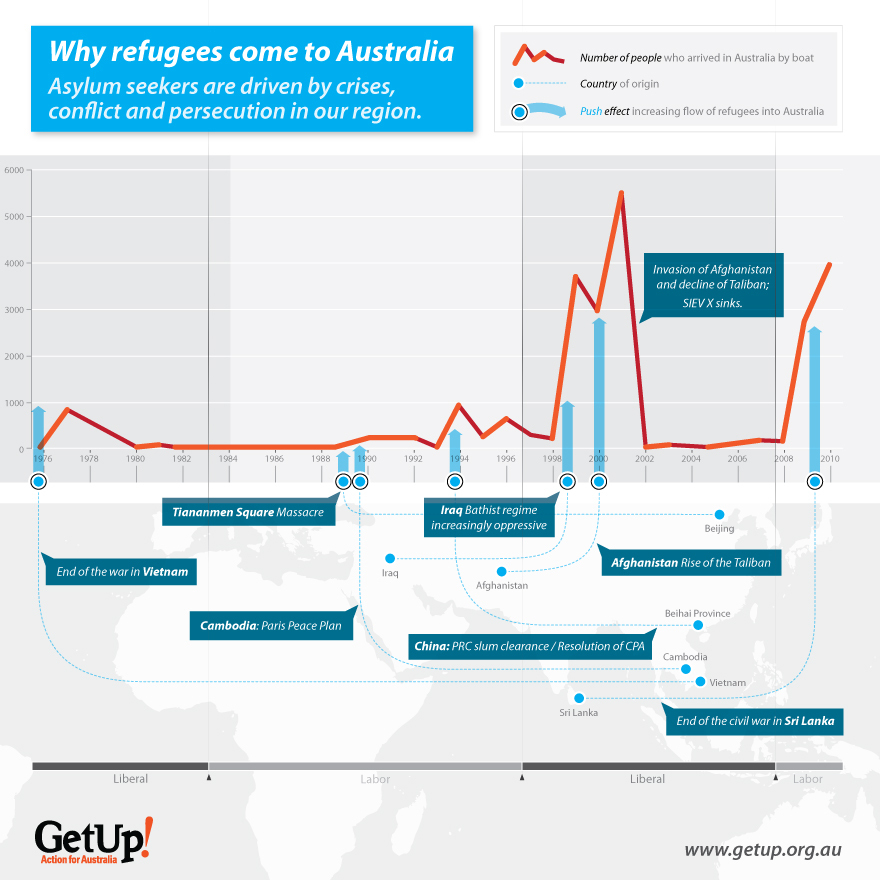
Season 2 of Go Back To Where You Came From kicks off tonight. The first season was pretty powerful stuff. For all their agitation surrounding gay marriage, which probably annoys a lot of Christians, GetUp is doing some good work on the asylum seeker front. They’ve produced this infographic to coincide with the show. And there’s a petition you can sign ahead of this week’s vote on the new refugee legislation, they’ve also got a form where you can email your member of parliament with a personalised message. If you’re a Christian you might also like to email Jim Wallace at the Australian Christian Lobby (their emails are typically firstname.lastname@acl.org.au), and tell him you’d like the ACL to spend more effort speaking out for those who aren’t providing their organisation with financial support – and maybe ask them to do less than just “welcoming” whatever the government does like they do in this Media Release, and this one).

This shouldn’t be an issue where a response falls along right/left lines. You can read my last two posts on boat people – the first, in response to Tony Abbott’s claim that boat people are “unChristian”, the second, a follow up to that.

UPDATE: Somebody questioned the legitimacy of this infographic in the Facebook comments below. So I did some digging and found what appears to be the source of this data. The following is from pages 17 and 18 of this DIAC report: Submission to the Joint Select Committee on Australia’s Immigration Detention Network September 2011 Department of Immigration and Citizenship (http://www.immi.gov.au/media/publications/pdf/2011/diac-jscaidn-submission-sept11.pdf).

“From 1989 to 30 June 1995 a further 41 boats carrying 1893 people arrived in Australia, most of whom came from Cambodia, the People’s Republic of China (PRC) and Vietnam…No Cambodian IMAs arrived after the United Nations Transitional Authority in Cambodia (UNTAC) mission was established in 1991. The flow of Vietnamese IMAs effectively stopped in 1995–96, with none arriving in the next three financial years. The last major arrival of IMAs from PRC was in 2000, with 25 arrivals. ”

“The profile and origins of IMAs coming to Australia began to change in 1999. Previously, most IMAs had come from Cambodia, PRC and Vietnam. As the tide of IMAs from east Asia and south-east Asia receded, a new movement of IMAs—predominantly from Afghanistan, Iran, Iraq and Sri Lanka—emerged. In total, 12,272 people arrived in this period. ”

“Boats began arriving again in October 2008. Over the course of 2009–10 the number of asylum seekers increased significantly. As with the preceding wave, the majority of IMAs came from Afghanistan, Iran, Iraq and Sri Lanka. Notably, however, the number of Iranians to arrive since January 2011 has increased significantly.”

UPDATE 2: You can watch episode 1 of season 2 of Go Back To Where You Came From online.


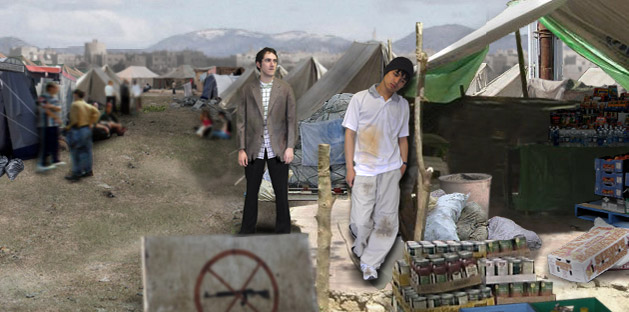
Image Credit: SBS Go Back To Where You Came From Refugee Simulation.

A friend gently chided me for the image I used in that last post – suggesting it represents a bit of a caricature of what it is that causes people (average, conservative voting, Australian citizens) angst when it comes to boat arrivals, border security, and the rest.

I find it pretty hard to put myself in the headspace of someone who doesn’t think we should be looking after people displaced by hardship in their home countries – but I’ve spent the few hours since trying to do it.

It could be, as my friend suggested, something more like the fear that if we don’t get our policies right the floodgates will be opened and we’ll suddenly have all sorts of resource problems – there’s certainly an element of that when it comes to protesting about skilled migration and plans to find off shore workers to fill so called “Australian Jobs”… and doubtless some of the refugees who come here will be employed, and others will be on welfare, and thus, some will consider them a tax burden.

Most of the hyperbole surrounding this debate is pretty bizarrely short sighted. Population growth in Australia, rapid expansion at least, has almost always been as a result of migration. Right from white settlement, through the gold rushes, waves of migration in various industrial booms, and the boom when the White Australia Policy was revoked in the 70s, our culture has been enriched and our population has been boosted, by the arrival of people from other nations (arguably not so much in the convict settlement). We wouldn’t have a great coffee scene in Australia if it wasn’t for migration. Almost 1 in 3 people who currently live in Australia were born overseas, almost half of us had one or both parents born overseas (according to the 2011 Census Data).

Another friend on Facebook mentioned that white Australia’s inability to truly come to terms with Australia’s indigenous history makes dealing with new arrivals pretty hard, he said it in a slightly more profound manner (and I’m still trying to figure out if I agree)…

“Until we reconcile our own history of arriving on boats, and mistreating the original people and failing to assimilate (and creating our own segregated communities) we will never appropriately and lovingly approach refugees in the 21st century.”

Most of my disagreement with that line of thinking is because I’m not sure assimilation is the answer – I don’t think assimilation and segregation are the only options, I wonder if integration or something where unique identities are maintained and differences appreciated is more worthwhile and achievable… but I also wonder if there’s a correlation here rather than causation.

Anyway. I reckon most fears are misplaced – though I appreciate that a huge influx of migrants would put a pretty major strain on our infrastructure and economy and would need to be something we strategically planned for rather than an overnight thing.

I realise that comments made on articles online aren’t a great way to represent the population – they’re opt in, they’re usually made by people who are overly passionate, rather than objective, and often they’re made by PR people or their friends who are trying to boost some sort of cause without disclosure.

But here are some comments from two different articles – from the left and the right, dissenting and agreeing with the content of the articles in question…

First we’ve got Clive Palmer who makes what I think is actually a fairly sensible and worthwhile policy suggestion (I wonder what it would look like if we got some big cruise ships and picked up people wanting to come to Australia and processed them en route. But that’s pretty pie in the sky stuff). Here’s the story as reported by the Herald Sun, and here are some of the choice comments:

“Perhaps Clive Palmer should fly out. His suggestion would open the floodgates for anyone who can raise $1,000. Coming here at one tenth of the cost means the numbers will increase tenfold.”

“SINK THEM. Lets face it most Australians don’t want them here and they are que jumpers so, SINK THEM at sea and they will stop coming.”

“At the risk of incurring the wrath of all the do gooder human rights activists, if they try to come here via the back door, put them on the first plane home. That is the only plane we should be supplying them with I refuse to apologize for wanting a country that has a viable economy to support my children’s future.”

“Allow refugees to come here safely? Or queue-hoppers? THAT is the question. If we do that then anyone can come, whoever wants to and the hell with the normal application process that others have to go through. All we’re teaching them is how to be dishonest and move easily into a better, welfare-laden life. I don’t want hundreds of thousands of these people in my beautiful country, I would rather focus my energy on those whom I know to be genuine, those who struggle to eat, let alone buy expensive passages here that I could only dream about (as a fulltime worker i get no breaks from the govt but i constantly struggle on one income including paying private family health insurance). Does mr Palmer then propose that the money these illegals would save on their boat fares will then be used to support themselves instead of centrelink? No? I didn’t think so…”

“How bout they don’t come here at all, I want my tax dollars used for things that benefit me not these free loaders.”

“That s a Great Idea, lets fly them in First Class. Some champagne to celebrate coming to Australia. Free 5 star accommodation for 5yrs. Free Child care, Free Cigs and Food. Centrelink benefits for life. Australia best place in the world Come one come all. Were the bloody hell are ya.? Come off it…”

Interesting reading.

Now here’s the response to refugee advocate Julian Burnside and his excellent piece responding to Abbott’s “unchristian” comment on ABC Unleashed

“It is strange that people seem to justify not accepting the boat arrivals by the fact that not every refugee is able to get on a boat. Hence “queue jumper”.

It is not legitimate to use one unfairness for which you are not responsible to justify another inhumanity for which you are.”

“Well said Mr Burnside but don’t expect Abbott to respond to your question. He knows that a majority of Australians are so anti-refugees that they don’t want to know about the logic of your argument. He is simply waiting to walk into office as PM, that’s all he cares about. And as for the aforementioned Aussies, well they don’t really care what happens to “queue jumpers” so long as it doesn’t concern them. What happens when he is PM (if ever)and the refugees continue to arrive? Will he again resort to christian rhetoric to justify his failure – like washing his hands of the whole affair?”

“What is unchristian is Abbott’s inhumane policy and his refusal to genuinely engage in some plan to prevent the loss of human life at sea”

“Point 1 – When a nation has a set number of assylum seekers or refugees that it will take in per annum, your chances of being accepted are greatly influenced by your circumstances. If you are in a refugee camp anywhere in the world, you are applying through the UN to be resettled. If you came by boat, you are taking up space in one of our numerous detention centres at great cost to the taxpayer – who do you think will be the first one processed simply because they are occupying space in a detention centre?

Point 2 – the moral question. I think that it is immoral to award limited annual intakes of refugees and assylum seekers to those who can afford it over those who can’t. Argue with that.

Point 3 – Dog whistle? This just lives in the minds of activists. We are talking about undocumented illegal arrivals who have paid for transport to Australia. Don’t care what their colour or race is. Its the method of arrival and the associated documentation you require for different types of arrival thats in question here.

Point 4 – You forgot to add that that hypothetical person also has a wad of cash to pay the smugglers. Which others do not. I thought progressives thought that financial position should not lead to advantages. Apparently not in this case however.”

This is a wide spectrum of views being presented in two different forums, featuring two fairly different demographics. It’s interesting that so many of the reasons against accepting boat people, or any refugees, are selfish and oddly nationalistic – especially given the stats about the current make up of Australia’s population. There’s a trend in comments dismissing refugees to see living in Australia and being Australian as something exclusive and worthy of protection – as though the place you’re born is somehow meritorious, deserved, or gives particular human rights. Caring for refugees should be part of being a global citizen – but sadly we live in a globe full of sinful and selfish people – which is why being a Christian citizen, living as a foreigner and caring for outsiders is something radical.

But tying these two posts together – what is there that Australian Christians, or concerned Australians, can do to be better global citizens. I have a few ideas.

  1. Get informed. It would be hypocritical for me to say that “raising awareness” is an activity – but combating ignorance probably counts for something. Direct people to Go Back To Where You Came From, or some facts about asylum seeking and Australia. I haven’t gone much past this point to date, most of this is a knee jerk response to this week’s idiocy.
  2. Get welcoming. This is cool. Welcome To Australia wants to connect Australians with refugees. One of my Facebook friends had a BBQ with some Iranians recently, and inspired me to think about how I can do stuff like that. A guy in Toowoomba drives a busload of Sudanese guys to Bible study and church every week. There’s a football team made up of migrants/refugees in the church league I play in. There are lots of ways I can think of – but if you’ve got other ideas tell me (and I’d be interested in knowing more about how the BBQ came about – that’s for you Matt). Given the stuff I said yesterday about Christians having special motivation to welcome the outsider (because we were all once outsiders) – our welcome of refugees should reflect and present our view of reality. Churches can play a huge role in welcoming refugees – we’ve got all sorts of collective resources and a pre-existing community that should be good at welcoming already.
  3. Get active. My friend Joel is riding for refugees with a team from his church – you can donate to their team – or get involved in other ways. The Refugee Council of Australia has a list of other ways you can volunteer.
  4. Write to a politician. Don’t send a form letter. They suck. Say something you mean. Tell them what you really think. I need to change my enrolment and figure out what electorate I actually live in. In the mean time I’ve sent a link to my last post to the Australian Christian Lobby, hoping they’ll one day change their tone a little.

If you’ve got other ideas I’d love to hear them…


Credit: Boat People Infographic from Crikey providing numerical perspective on the current situation (I’m not suggesting that people’s anxiety on the issue is fully captured by this picture.)

Wow. Tony Abbott. Here’s a pearler of a quote from a radio interview yesterday, where admittedly, Abbott was responding to a gibe about his asylum seeker policies being “unChristian”…

“Look I don’t think it is a very Christian thing to come in by the back door rather than the front door.”

Now. Before we get into the myriad problems with this statement coming from a politician in a heated policy debate, I want to be a little sympathetic to what he’s trying to say… it’s a tragedy that genuine asylum seekers waiting in camps around the world obeying due process are missing out because some people engage in dangerous and expensive people smuggling. In an ideal world there’d be no need for people to seek refuge, but in our fallen world where bad stuff happens this sort of displacement is nothing new – it’s been happening since at least Exodus.

Whoops. I started on the theological problems already.

Every aspect of Abbott’s statement is problematic. He would have been better off copping the gibe on the chin or talking about the people trying to obey due process without even mentioning the people jumping on boats.

UPDATE: Here’s the fuller context of Abbott’s quote, lest you feel I’m misrepresenting the interview…

“And I’m all in favour of Australia having a healthy and compassionate refugee and humanitarian intake program.

“I think that’s a good thing. But I think the people we accept should be coming the right way and not the wrong way.

“If you pay a people-smuggler, if you jump the queue, if you take yourself and your family on a leaky boat, that’s doing the wrong thing, not the right thing, and we shouldn’t encourage it.”

This makes a complex ethical question into an absolute question of morality – I’m not sure you can argue that genuine asylum seekers have done the wrong thing by seeking asylum, and 97% of people who seek asylum in Australia, after arriving by boat, are found to be genuine refugees… (END UPDATE).

But ignoring the elephant in the room, that most boat people are coming from countries that aren’t exactly known for fostering significant Christian populations (though some refugees are Christians fleeing persecution) – and thus the idea that the boat people should be Christian is perhaps patently ridiculous… let’s consider for a moment that God’s people, since the very beginning, and Jesus himself, have essentially been refugees. Here are some more useful facts about boat people (PDF from the Australian Government).

Abraham left his father’s land and sought asylum in various foreign kingdoms as he headed off to the promised land.

Joseph was a refugee to Egypt.

Moses led Israel out of Egypt as asylum seeing refugees. Israel was called to care for asylum seekers/the aliens in their midst, as God does, as a result of Israel’s experience as refugees. So Deuteronomy 10:

“18 He [God] defends the cause of the fatherless and the widow, and loves the foreigner residing among you, giving them food and clothing. 19 And you are to love those who are foreigners, for you yourselves were foreigners in Egypt.”

Their failure to care for the foreigner is listed as part of the reason they’re booted out and forced into exile again in Ezekiel 22…

“‘See how each of the princes of Israel who are in you uses his power to shed blood. In you they have treated father and mother with contempt; in you they have oppressed the foreigner and mistreated the fatherless and the widow.”

Now, I know Australia isn’t the promised land, and isn’t meaningfully able to be spoken of as a Christian nation, but if the leader of the opposition brings Christianity into the debate, then it should at least be represented fairly… It’s not unChristian to seek asylum – it is the most Christian thing in the world as we’ve had to seek refuge for ourselves in Jesus. It’s arguable, though I don’t think we should really make anything of this, that Jesus’ family sought asylum when Herod was out to get them in Matthew 2.

13 When they had gone, an angel of the Lord appeared to Joseph in a dream. “Get up,” he said, “take the child and his mother and escape to Egypt. Stay there until I tell you, for Herod is going to search for the child to kill him.”

And I think a fair case can be made that Jesus replaces the cities of refuge that OT people were to flee to (Joshua 20), and that turning to Jesus, as all Christians have, is the ultimate expression of seeking asylum. It’s certainly the ultimate expression of seeking citizenship somewhere better where we’re not truly entitled to on our own merit (especially for Gentiles). So this big quote from Ephesians 2…

12 remember that at that time you were separate from Christ, excluded from citizenship in Israel and foreigners to the covenants of the promise, without hope and without God in the world. 13 But now in Christ Jesus you who once were far away have been brought near by the blood of Christ.

14 For he himself is our peace, who has made the two groups one and has destroyed the barrier, the dividing wall of hostility, 15 by setting aside in his flesh the law with its commands and regulations. His purpose was to create in himself one new humanity out of the two, thus making peace, 16 and in one body to reconcile both of them to God through the cross, by which he put to death their hostility. 17 He came and preached peace to you who were far away and peace to those who were near. 18 For through him we both have access to the Father by one Spirit.

19 Consequently, you are no longer foreigners and strangers, but fellow citizens with God’s people and also members of his household, 20 built on the foundation of the apostles and prophets, with Christ Jesus himself as the chief cornerstone.


Now the comparison isn’t exact, and the issues here are referring to something different because Australia isn’t the kingdom of God – but there are two principles here that make it hard to justify the claim that urgently seeking asylum without regard to due process is unchristian. Firstly, Christians are asylum seekers, and secondly, the idea, for Christians, that our earthly citizenship of an earthly nation is something to be protected at the expense of being united with other people in Christ doesn’t really stand up to scrutiny. Christians in the early church framed their understanding of citizenship, a particularly significant concept when it came to the Roman Empire, around being aliens in the empire – sojourners, who loved other outsiders accordingly – loving foreigners wasn’t exclusive to Israel when they occupied the physical kingdom of Israel with some power. We seem to have lost that vibe a little bit as Christianity became a dominant socio-political force – but now we’re starting to be part of a post-Christian society we need to start being informed by this as a category again, and caring for our fellow aliens.

If we’re taking a “Christian” approach to the chance to show love to the poor and oppressed people who don’t know Jesus then we’re going to want to welcome and love them. That’d be my thinking anyway…

The onus isn’t really on the asylum seekers to act as Christians when they’re approaching a country – unless they’re claiming to be Christians, in which case the decision to jump the queue is something they’ll have to wrestle with personally – the onus is on the country receiving them, if they claim in any sense to be Christian (which Abbott does), to be receiving the refugees in a Christian way. This is where Abbott went really wrong. The question was legitimate. Because caring for refugees, or any oppressed people, or any people, is a definite outworking of following Jesus.

Interestingly, Jesus echoes the Deuteronomic principle that people who are trying to be like God should be caring for the oppressed, he framed his understanding of his mission this way (quoting Isaiah):

16 He went to Nazareth, where he had been brought up, and on the Sabbath day he went into the synagogue, as was his custom. He stood up to read, 17 and the scroll of the prophet Isaiah was handed to him. Unrolling it, he found the place where it is written:

18 “The Spirit of the Lord is on me, 
    because he has anointed me
    to proclaim good news to the poor.
He has sent me to proclaim freedom for the prisoners
    and recovery of sight for the blind,
to set the oppressed free,
19     to proclaim the year of the Lord’s favor.”

20 Then he rolled up the scroll, gave it back to the attendant and sat down. The eyes of everyone in the synagogue were fastened on him. 21 He began by saying to them, “Today this scripture is fulfilled in your hearing.”
So. You might be thinking. It’s all well and good for Jesus to say this and apply it to his own ministry, if he is this refuge for the oppressed – but it doesn’t follow that it is “Christian” to love refugees.

You would be wrong.

Jesus rebukes the Pharisees in Luke 11 on the basis that they care for their religiosity but not for the poor.

39 Then the Lord said to him, “Now then, you Pharisees clean the outside of the cup and dish, but inside you are full of greed and wickedness. 40 You foolish people! Did not the one who made the outside make the inside also? 41 But now as for what is inside you—be generous to the poor, and everything will be clean for you.42 “Woe to you Pharisees, because you give God a tenth of your mint, rue and all other kinds of garden herbs, but you neglect justice and the love of God. You should have practiced the latter without leaving the former undone.”

Then, when he’s talking about how people who want to follow him should approach social conventions and the hosting of status building banquets, he makes it clear that his concern is on provision for the poor (Luke 14)…

12 Then Jesus said to his host, “When you give a luncheon or dinner, do not invite your friends, your brothers or sisters, your relatives, or your rich neighbors; if you do, they may invite you back and so you will be repaid. 13 But when you give a banquet, invite the poor, the crippled, the lame, the blind, 14 and you will be blessed. Although they cannot repay you, you will be repaid at the resurrection of the righteous.”

Then, when he’s talking about how his followers, Christians, will be distinguished from people not following him (unchristians?), he makes it clear that this is one of the markers of a Christian, someone whose thinking has been truly transformed by the Spirit as they follow Jesus.

34 “Then the King will say to those on his right, ‘Come, you who are blessed by my Father; take your inheritance, the kingdom prepared for you since the creation of the world. 35 For I was hungry and you gave me something to eat, I was thirsty and you gave me something to drink, I was a stranger and you invited me in, 36 I needed clothes and you clothed me, I was sick and you looked after me, I was in prison and you came to visit me.’37 “Then the righteous will answer him, ‘Lord, when did we see you hungry and feed you, or thirsty and give you something to drink? 38 When did we see you a stranger and invite you in, or needing clothes and clothe you? 39 When did we see you sick or in prison and go to visit you?’40 “The King will reply, ‘Truly I tell you, whatever you did for one of the least of these brothers and sisters of mine, you did for me.’”

James follows suit.

27 Religion that God our Father accepts as pure and faultless is this: to look after orphans and widows in their distress and to keep oneself from being polluted by the world.”

It’s pretty hard to maintain anything that looks like the policies of either of Australia’s major parties on “boat people” if you’re trying to take a Christian approach – the justification for taking a Christian approach is obviously quesitonable for the same reason that introducing any policy into a secular democracy for solely theological reasons is questionable. But we have every right to speak in the democratic process, and you’d hope such contributions would be framed by our theological reality, more than by political expediency, you’d hope we’d be the most compassionate voice out there, and call for something more than what our major parties are happy to settle for… and yet, when given the opportunity to make a statement following Abbott’s theological faux pas, here’s what Lyle Shelton from the ACL says:

“It is unfortunate that the term ‘Christian’ has been co-opted in the debate… I don’t want to say what is Christian and what is not, but it is important that our policies give people languishing in camps a fair go. We have to stop the people smugglers’ business model. We have to stop people perishing at sea.”


Could this organisation stoop any lower in its bid to represent as broad a church as possible? How bout defining Christian as “somebody who follows Jesus and holds to something representing the historic confessions of the church”? It’s not that hard. And this sort of waftiness is precisely why the ACL can’t claim to speak for anybody in particular. It’s also an issue that needs the  voice of Christians to offer some compassionate clarity.

It’s unfortunate Christianity has been misrepresented in the debate, but it’s more unfortunate we had to be co-opted, and haven’t been on the front line from the beginning (which notable exceptions have been – like Melbourne’s Crossway Church, which offered to care for unaccompanied minors who were at risk of being deported).

People who follow Jesus are refugees. People who follow Jesus are to love the oppressed, including refugees. This has to be the basis of a “Christian” response to the tragedy that leads people to flee their countries, and the tragedy that many of those people are turning to criminals and jumping on dangerous boats.