Author: Nathan Campbell

Nathan runs St Eutychus. He loves Jesus. His wife. His daughter. His son. His other daughter. His dog. Coffee. And the Internet. He is the pastor of City South Presbyterian Church, a church in Brisbane, a graduate of Queensland Theological College (M. Div) and the Queensland University of Technology (B. Journ). He spent a significant portion of his pre-ministry-as-a-full-time-job life working in Public Relations, and now loves promoting Jesus in Brisbane and online. He can't believe how great it is that people pay him to talk and think about Jesus. If you'd like to support his writing financially you can do that by giving to his church.

Old Testament 101: Biblical Theology: background, pros, and cons

I promised my wife I’d do some reading up on Biblical Theology for the both of us… This is a long post. Feel free to just skip it.

What is Biblical Theology

Biblical Theology is a framework, or the attempt to create a framework, that sees the Bible not as a set of disparate texts brought together by chance and the say so of a council of clergy centuries later – but rather as a consistent piece of revelation. One work that outlines God’s interaction with his creation from beginning to end. It is different to systematic theology, which seeks to bring pieces of the Bible together in order to approach particular topics, but good systematic theology stems from solid Biblical theology.

Geerhardus Vos, apart from having a cool name, described Biblical Theology as the art of drawing a straight line through Biblical texts, where Systematic Theology draws a circle.

He also, when taking the chair as Princeton’s inaugural professor of Biblical Theology, made the following statements about the value of Biblical Theology.

First, he defined the anti-supernatural readers (textual critics) that he says Biblical Theology counters:

“Revelation [by their definition] consists in this, that the divine Spirit, by an unconscious process, stirs the depths of man’s heart so as to cause the springing up therein afterward of certain religious thoughts and feelings, which are as truly human as they are a revelation of God, and are, therefore, only relatively true… The people of Israel are held to have possessed a creative religious genius, just as the Greek nation was endowed with a creative genius in the sphere of art…Writers of this class deal as freely with the facts and teachings of the Bible as the most extreme anti-supernaturalists. But with their evolutionistic treatment of the phenomena they combine the hypothesis of this mystical influence of the Spirit, which they are pleased to call revelation. It is needless to say that revelation of this kind must remain forever inaccessible to objective proof or verification. Whatever can pretend to be scientific in this theory lacks all rapport with the idea of the Supernatural, and whatever there lingers in it of diluted Supernaturalism lacks all scientific character.”

I especially like the last bit.

Then he uses this analogy of the intricacy of the human body (with a hat tip to the argument from design) to describe why Biblical Theology opens up exciting new possibilities for understanding the Bible:

“In the Bible there is an organization finer, more complicated, more exquisite than even the texture of muscles and nerves and brain in the human body; that its various parts are interwoven and correlated in the most subtle manner, each sensitive to the impressions received from all the others, perfect in itself, and yet dependent upon the rest, while in them and through them all throbs as a unifying principle the Spirit of God’s living truth. If anything, then, this is adapted to convince the student that what the Bible places before him is not the chance product of the several human minds that have been engaged in its composition, but the workmanship of none other than God Himself.”

Recognising the unity of the Bible is not a priori a reason to dismiss analysing its individual parts (provided you recognise that they have a larger role to play), there is, to stretch the analogy, value in studying the anatomy and physiology of the human hand (or the eye – if you want to follow the traditional path of the argument from design). The Biblical body is both the sum of its parts, and greater than the sum…

Vos saw Biblical Theology as the antidote to what he perceived (writing in the late 19th century about ten years after Wellhausen had proposed the “Documentary Hypothesis” – that there were four separate writers, or schools of writers, responsible for the Pentateuch)…

“Biblical Theology is suited to furnish a most effective antidote to the destructive critical views now prevailing. These modern theories, however much may be asserted to the contrary, disorganize the Scriptures. Their chief danger lies, not in affirmations concerning matters of minor importance, concerning errors in historical details, but in the most radical claims upsetting the inner organization of the whole body of truth. We have seen that the course of revelation is most closely identified with the history described in the Bible. Of this history of the Bible, this framework on which the whole structure of revelation rests, the newest criticism asserts that it is falsified and unhistorical for the greater part. All the historical writings of the Old Testament in their present state are tendency-writings. Even where they embody older and more reliable documents, the Deuteronomic and Levitical paste, applied to them in and after the exile, has obliterated the historic reality. Now, if it were known among believing Christians to what an extent these theories disorganize the Bible, their chief spell would be broken; and many would repudiate with horror what they now tolerate or view with indifference.”

Cons – Problems with Biblical Theology

The effect of holding to no consistent theological framework or understanding led Carl Trueman to make the following observation about the state of modern “theological” studies in universities:

With no coherent epistemological or ontological basis to hold itself together, the university discipline has long ago collapsed into an incoherent mish-mash of courses of the `Theology and ….’ variety, where you insert your own particular concern or interest, be it women, ecology, politics, vegetarianism, or Tom and Jerry cartoons. Hey, it’s a postmodern world, cartoons are as worthy of time and energy as starving children, and the unifying factor in our disciplines, if there is one, must be found in our own little universes, not in the God of revelation.

Ouch. I guess I’ll be shelving plans to write “Theology and Coffee”…

Trueman offers a valuable critique of Biblical Theology – a corrective from a self styled theological revolutionary (from his first paragraph)… in his sights is the redemptive history movement championed on the global stage by Australian’s like Graeme Goldsworthy through Moore College. He thinks, in the circles that he moves in, this framework has become the “establishment” and because he self identifies as a “Marxist” when it comes to challenging establishments he wrote the following critique:

“First, there is the problem of mediocrity. It is one thing for a master of biblical theology to preach it week after week; quite another for a less talented follower so to do. We all know the old joke about the Christian fundamentalist who, when asked what was grey, furry, and lived in a tree, responded that `It sure sounds like a squirrel, but I know the answer to every question is `Jesus’’.

One of the problems I have with a relentless diet of biblical theological sermons from less talented (i.e., most of us) preachers is their boring mediocrity: contrived contortions of passages which are engaged in to produce the answer `Jesus’ every week. It doesn’t matter what the text is; the sermon is always the same.

Second, the triumph of the biblical theological method in theology and preaching has come at the very high price of a neglect of the theological tradition. The church spent nearly seventeen hundred years engaging in careful doctrinal reflection; formulating a technical language allowing her theologians to express themselves with precision and clarity; writing creeds and confessions to allow believers over the face of the earth to express herself with one voice; and wrestling long and hard with those aspects of God which must be true if the biblical record was to be at all coherent or make any sense whatsoever.”

His closing statement (in an online debate that Goldsworthy subsequently responded to)…

My fear is that the biblical theology movement, while striving to place the Word back at the centre of the church’s life, is inadequate in and by itself for the theological task of defending and articulating the faith. Reflection upon the wider church tradition is needed, creeds, confessions and all, because this is the best way to understand how and where the discipline of biblical theology and redemptive history can be of use to the wider picture without it usurping and excluding other, equally necessary and important theological disciplines.

A paragraph from Goldsworthy’s response to Trueman is useful when assessing the importance of Biblical Theology when reading the Old Testament:

Biblical theology is necessary to prevent this de-historicising of the gospel by anchoring the person and work of Christ into the continuum of redemptive history that provides the “story-line” of the whole Bible. The only thing that can rescue systematics from such abstractions is biblical theology. In fact, systematic theology is plainly impossible without biblical theology. Biblical theology is the only means of preventing every biblical text having equal significance for Christians (eg. we need it to sort out what to do which the ritual laws of the Pentateuch). It prevents us from short-circuiting texts so that we isolate them from their theological context and then moralize on their application to believers.

Old Testament 101

Greek is done and dusted. So now its on to the Old Testament. Which I like. Much. Much more. I dug up some past exam questions in the library today, and our exam is on Thursday, so I’m thinking I might engage in a little learning through blogging exercise…

Our first Old Testament subject covers Genesis to 2 Samuel (I think). Which means the following academic “chestnuts” are sure to feature strongly:

1. The creation account(s)
2. The flood (though this has been covered by an essay topic)
3. Something about the covenant promises to Abraham.
4. The patriachs/creation of a nation.
5. Something about the law
6. Something about violence (though this has also been covered by an essay topic)
7. Something about the historicity of the Genesis-Joshua accounts of occupation of the promised land.
8. Something about Judges
9. Something about Biblical theology
10. Something about kingship (1-2 Samuel, and probably, to a lesser extent, Judges).
10. Something about the documentary hypothesis (source criticism), form criticism, sociological criticism, literary criticism etc or the structure of the Pentateuch…

There’ll be eight questions, we’re expected to answer four. I like all of these topics. Does anybody have any recommended readings for the next 32 hours that will see me through?

Reverse engineering the perfect hot chip

It’s only three weeks until I can once again enjoy the bountiful wonders of McDonalds and its fast food counterparts. My new financial year resolution for 2009/10 was to give up fast food and soft drink. It’s a shame I didn’t hear about this sooner… this food blogger will go down in history as the man who reverse engineered McDonald’s fries so that you can enjoy them at home… add this to your own homemade KFC with 11 reverse engineered herbs and spices, and you’ve got the perfect meal to enjoy with the World Cup in the early hours of the morning.

In a ground breaking piece of research he managed to get hold of a batch of frozen fries (through some vicarious deception) to put them through the rigours of scientific investigation.

He started with the following parameters for the perfect batch of fries, lets call them “the golden rules”:

  1. The exterior must be very crisp, but not tough.
  2. The interior must be intact, fluffy, and have a strong potato flavor.
  3. The fry must be an even, light golden blond
  4. The fry must stay crisp and tasty for at least as long as it takes to eat a full serving.

Here’s how he secured the frozen fries. He had a friend on Facebook create a scavenger hunt with frozen fries as a required element. Genius.

He measured them:

They’re precisely a quarter of an inch thick.

He fried them in regular peanut oil (and saw that they were good)…

So concluded that the mystery was in the method of potato preparation. He goes into the science quite extensively, examining the changes in potato structure at every turn (McDonald’s fries are blanched, pre-fried, and frozen again). Then he stumbled on to a brilliant addition to the McDonalds method, perfect for home chefs… putting vinegar in the water used to blanch the potatos.

He claims the proof of the potato is in the eating, but here’s the recipe

On judging books by their covers…

Also on the subject of reading, and also from Andy Unedited, comes this insight into book cover design, from the horse’s mouth so to speak…

Every genre of book has a code—a visual set of criteria that readers instinctively expect to find represented on the cover. We expect brightly colored illustrations for children’s books. We expect large-block type (probably embossed) on the covers of political thrillers. We expect restrained sophistication on academic books. And we all know what the cover code is for a biography—a prominent head-and-shoulders photograph or painting of the person who is its subject.

I noticed this the other day when a couple of the books I was reading on Roman history (for an essay) from different publishers had essentially the same cover. Maroon blocks, serif font in cream (Timesish), and a the use of some first century art (or artistic representation) as a hero image… I don’t know what genre that is specific to…

I can’t remember what the second one was… but it wasn’t this one…

Or this one (though I did use this one)…

IVP publisher Andy Le Peau says the key to cracking the market is twofold:
1. Keeping the aforementioned “code”
2. Positioning.

Here’s what he says about positioning:

“But if a cover looks like every other book of its type, won’t it get lost? That’s where positioning comes in. The book also has to clearly offer something different, something that sets it apart from all the other books in its category.

The trick is to make a cover different but within the confines of the code. That’s what great design does. It’s like writing. Great authors know when to break the rules to make their piece even more powerful, to make it stand out. But they don’t break the rules so much that the book falls completely out of its category.”

Speaking of book covers – here’s a time lapse of one being put together.

Reading the future

John Stott has enjoyed a distinguished career as one of evangelical Christianity’s foremost voices. And he’s hanging up his pen. He has this to say about the future of books (not necessarily in the face of the challenge of the e-book – he may not know they exist)…

“Our favorite books become very precious to us and we even develop with them an almost living and affectionate relationship. Is it an altogether fanciful fact that we handle, stroke and even smell them as tokens of our esteem and affection? I am not referring only to an author’s feeling for what he has written, but to all readers and their library. I have made it a rule not to quote from any book unless I have first handled it. So let me urge you to keep reading, and encourage your relatives and friends to do the same. For this is a much neglected means of grace.”

I love reading. I love books. I love that each book represents at least one idea, recorded and accessible for future generations. I love that sometimes that which is recorded is almost immediately archaic and worthy of ridicule. Three of my favourite things about studying are:
1. Reading too many books for each essay.
2. Hanging out in the Library, a big room full of ideas.
3. Having an excuse to buy new books. I love the book depository, and price comparison website booko is a handy tool.

I have dreams of a lounge room with a fireplace and comfy armchair, and three and a half walls of books… or an ipad.

I like Stott’s rule of handling a book before quoting from it – but I’m almost equally enamored by google books and its quest to archive every book in the world like the grandest of libraries. It is much easier to flick through a hard copy of a book when you’re in the process of writing and wanting to skim between different sections, but it is oh so handy to be able to search for particular words and phrases in a search box.

My rule of thumb is that I want to have read the chapter I’m quoting from and at least enough of the book to get its vibe before I’ll interact with it in an essay.

I used to love albums in their tangible form, and probably photos as well, but having tossed all my CD cases in the move in exchange for a couple of large CD wallet things, I’m enjoying just using my computer and getting new stuff with iTunes. Books are, in a sense, the last bastion of tangible media for me. And I don’t think I can give them up, especially when all the existing ones will end up going cheap in second hand book stores as everybody else makes the move to the electronic age.

I read the Stott quote on Andy United – the blog of an IVP publisher – which is worthy subscribing to.

Answering life’s big questions

Just how do astronauts go to the toilet?

YouTube Tuesday: A Hinnderance

Apologies if you have seen this already (3 million people have). But this made me laugh. In a sad way. I know that ultimately Hinn and his ilk are harmful, but treatment like this can only lessen their influence… right?

Anyway, somebody set Benny Hinn’s “spiritual slayings” to this song that I only know of as a theme song from a wrestling show. His stuff is about as real as wrestling (ie only as real as the people in the audience think it is).

He even Hulks up in this video… watch it brother…

I don’t think the verse he’s looking for is in the Bible. And I’m almost certain this bit isn’t:

But his wife takes the cake…

The man scarf

I pride myself on being a bit of a manly man. I like football, red meat, and tinkering with bits of technology until they no longer work. I don’t wear v-neck t-shirts, or pastel colours, I can barely tell which side of most clothes shops is for men, and which is for women. And don’t get me started on modern shorts… alright. It’s too late.

A shorts digression
In summer I like to wear shorts. I don’t really like wearing board shorts (except to the beach) and I have lots of denim shorts (I don’t know why) – but nothing really in between except a trusty pair of cargos. Cargos are practical. Manly men wear them. They have lots of pockets.

So I went to DFO in Brisbane. It’s factory outlet mecca. The females of the species love it. It has lots of clothes shops, bag shops, and shoe shops. I searched high, I searched low, but other than designated sportswear and outdoor workwear there was nary a pair of shorts to be found that didn’t have stovepipe type legs with a folded up hem. These are girls shorts. Even I can tell that. Popular only with practical women and effeminate males. When did it become acceptable for men to wear shorts that tapered and finished above the knee, with the excess fabric folded up and stiched into a hem shape? And why can’t I buy normal shorts? Just regular. Practical. To the knee or below (but shorter than three quarter pants). Shorts. It drove me bonkers. Luckily it’s winter now so I don’t have to worry about the situation for another three months.

Back on topic
It is winter. And having spent the last four years living in the tropics, in Townsville, where the weatherman taunts the southerners by reminding them that it’s still 27 degrees during the day, I am no longer acclimatised to cold weather. Anything below 20 degrees requires three layers. My wife, who has blue blood (she tells me it’s a broken hypothalamus) can’t leave the house in less than four.

And it’s only going to get colder.

One piece of sartorial style of women and gay men that I envy is the scarf. It’s practical. It warms the neck. But in most senses and uses these days is a fashion accessory that is the realm of the metro or the homo:


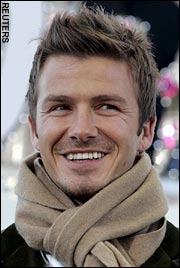
Beckham even wears a scarf in the summer:

I think real men, if they’re going to wear scarves, wear them like this:

Though, according to this article, the way men are meant to wear scarves is:

“A man’s scarf should be worn inside his overcoat and exposed an inch above the collar, with the tie on view.”

But I don’t own an overcoat.

Apparently wearing a scarf, in this style, in New Zealand:

Prompts people to question your sexuality.

Pilots can wear scarves without similar questions being raised:

When I googled “man scarf” I found this “fresh off the press” article from news.com.au suggesting that man scarves are “in” this winter, and given my conformist tendency to non-conform I now have to suffer a cold winter, or invent some sort of leg warmer for the neck… Which somebody on instructables has already done for the ladies

Or I could throw my lot in with the cowl wearers – there are worse things than dressing like Batman…


Here’s a man’s guide to knitting one

He looks manly.
The cowl is a hoodie without the jumper. Practical and fashionable. Form and function. A triumph of winter wear. Problem solved.

Keen on Keanu

So Keanu Reeves is apparently a really nice guy. So says the Reddit forum, and it knows everything. This comment thread even spawned a website in his honour – Thank you Keanu Reeves.

This is the anecdote that gave birth to what could be a Hollywood meme to rival Chuck Norris facts.

Back in the late 90s and fresh out of college I got my first job as an assistant prop designer on the set of Chain Reaction (Keanu was a supporting actor with Morgan Freeman). EVERY DAY for the last few weeks of filming, Keanu treated the stage hands and “grunt workers” (including myself) by taking us out for free breakfast and lunch. He was genuinely a very nice guy to work with.
Since then, I’ve worked on about 30 different sets and have never met an actor as generous and friendly as him. Most actors I’ve seen and worked with are total douches who always think they are better than us. Keanu on the other hand, at the very least, was socially approachable and definitely kindhearted.
That was one example (that involved me directly), but (on the same set), I remember him going out of his way to give my friend a ride to the repair shop to pick up his car… I’ll write more as I remember, but its been a while.

I hope our turtles don’t grow up to look like this…

This guy looks like Bowzer, the bad guy from Super Mario Brothers.

He’s an alligator snapping turtle. Apparently people keep these for pets.

This is what our little guys look like…

If I fail Greek…

I still won’t enroll at this college…

So, last night, I decided to do some research on the fellow from this post. He has an Australian accent, so I figured he was probably one of ours… I was right. He’s in Brisbane. And he is an utter nut case. There are people who are on the fringes of Christianity who I don’t agree with, and then there are people so far gone that I think it’s ok to insult them.

This guy might have Tourette’s – but he’s also permanently drunk. He calls it “drunk in the spirit” – he claims to have been taken up to God for three days when he was converted 11 years ago, and to have been a “whacked prophet” ever since. He runs a college in Brisbane – I think he has two students. They are featured in this video.

His church, based on what I’ve seen in the background of his videos – appears to be his house. It looks like he’s painted the logo on one of the walls. He has pretty good graphic design, video production, and social media stuff going on – which is weird, because he’s otherwise completely insane. Here’s a bit of his “bio”…

Matt has been intoxicated (drunk in the Spirit) on the Father’s love since 1998, and at times is not able to function well in the physical realm due to the glory that rests on his life. He is a God pleaser. He is about his Fathers business….. drinking in the wine of Heaven and setting the captive free. Even though Matt has been in full time ministry for 11 years, he has kept himself out of the church “scene” so as to allow Holy Spirit to do His work in his life. Matt carries a strong prophetic revelatory, anointing and preaches whilst in a trance… or preaching whilst inside an encounter with Heaven.

Matt has a really simple style of ministry. He gets whacked (drunk… filled with Holy Spirit) and ministers from the glory realm. He spends hours a day drinking in the presence of Heaven so that he can unleash the torrent of the Fathers love every time he preaches. We have a staffing structure in place which enables Matthew to carry out his call and be filled with the “too much” anointing… continually.

It’s ok though, according to Mr “pisseth against the wall” himself – Steven L. Anderson – Bible College is a sin and will lead me out of fundamentalist KJV only soul winning orthodoxy…

Commenting Rules

Commenting rules on blogs are generally pretty passe.

Mine can be summed up as:

  1. Please do, unless you’re a spammer.
  2. If you disagree with me prepare for me to argue my case. For a long time. Making sure I have the last word. Unless your name is Andrew.*

There are times when I wonder how Christians should be governing their behaviour online. Justin Taylor had some good guidelines. He took the high road and used the Bible.

  1. I hope this can be a place where we “seek understanding” before critiquing, where we are quick to listen and slow to speak, where we judge others charitably not critically, where we encourage and build up each other rather than tearing down and destroying each other.
  2. I would encourage commenters to consider carefully the following commands and principles regarding our speech:
  3. “Let your speech always be gracious, seasoned with salt” (Col. 4:6).
  4. “By your words you will be justified, and by your words you will be condemned” (Matt. 12:37).
  5. “Love one another with brotherly affection. Outdo one another in showing honor” (Rom. 12:10).
  6. “Let no corrupting talk come out of your mouths, but only such as is good for building up, as fits the occasion, that it may give grace to those who hear” (Eph. 4:29).
  7. Speak the truth in love (Eph. 4:15, 25).
  8. “If anyone thinks he is religious and does not bridle his tongue but deceives his heart, this person’s religion is worthless” (James 1:26).

Those are great if your commenters are Christians… I like these ones (via Gordo) from Triablog (they expand on each point in this list on the post).

These are the first five, of ten.

  1. You can say pretty much anything you please about the team. Attack us with impunity. We don’t care. We can take it.
  2. It is not, however, equally acceptable to turn the combox into a free-fire zone whereby one outsider can heap personal abuse on another outsider.
  3. Dialogue is a two-way street. If someone comments on what we say, we reserve the right to respond.
  4. By the same token, we reserve the right not to respond. You don’t pay the bills around here. We choose where to put our time.
  5. Expletives, abbreviated or not, will not be tolerated. Ad hominem invective, as a substitute for reasoned argument, is unacceptable.

*He sometimes gets the last word.

Want to speak TED style?

TEDtalks are inspirational. Revolutionary. Amazing. And now you can create your own TEDTalk thanks to this bloke who conducted a careful analysis of the transcripts of every available TED Talk and counted up the most common words. Coffee was one of the results. These words are connected by the top ten four word phrases, and the final pieces of the puzzle are computer generated. I did have one combination of keyword options that started “It’s not nose picking” – I can’t get it back.

Here’s my speech.

When you look at the student’s, they rely on coffee that is quite nuanced in the same way that our neurons are. Efficient trimming causes the brain to recognize the exact way it’s supposed to think et cetera, et cetera. It is like French products becoming a very ecological choice. You don’t have to like it, but it is a choice that I often discuss in my seminars. When you look at the student’s, they rely on coffee which makes you both happy and excited. How many of you would prefer that to tea? I think it’s just like when the middle of it all, you could see the situation running the same way that a downward spiral would. It makes you yearn for coffee making you jittery et cetera, et cetera. So I thought maybe a mirror does not always reveal pleasant surprises. How many of you would rather consider coffee sponsored for by the administration of the United States. Who wouldn’t agree that happiness can only be achieved by connecting with the world.

Rallying the troop(er)s

Stormtroopers365 is a Flickr set that features photos of two stormtrooper toys doing stormtroopery things. It’s quite brilliant. I can’t remember if I’ve posted it before (which is happening a lot lately). But it’s worth checking out.

The land of the generous

Australians are generous people, and we’re always prepared to give from our own pockets to others, even if the others are multimillionaire actors in costume as a homeless person. This is what happened to Lord of the Rings (amongst other things) star Sir Ian McKellen, while sitting in Sydney a few weeks ago: