Author: Nathan Campbell

Nathan runs St Eutychus. He loves Jesus. His wife. His daughter. His son. His other daughter. His dog. Coffee. And the Internet. He is the pastor of City South Presbyterian Church, a church in Brisbane, a graduate of Queensland Theological College (M. Div) and the Queensland University of Technology (B. Journ). He spent a significant portion of his pre-ministry-as-a-full-time-job life working in Public Relations, and now loves promoting Jesus in Brisbane and online. He can't believe how great it is that people pay him to talk and think about Jesus. If you'd like to support his writing financially you can do that by giving to his church.

Groceries and the gospel

Have you ever seen a 7-11 in a country town? How bout a Woolworths? How about an evangelical church? When it comes to spreading the “bread of life” around the country the evangelical church’s (defined for the sake of this post as Bible believing and theologically reformed) strategy has been closer to 7-11’s urban focus than Woolworths’ approach of putting Supermarkets wherever it might be viable.

Woolworths has more than 700 stores in Australia (according to Wikipedia). 7-11 boasts more than 350 stores in Australia

At our college weekend away our principal, and brother in the Lord, Bruce Winter (he doesn’t like the “Dr” honourific) encouraged us to consider our ministry futures as a blank cheque – and specifically raised and criticised the attitude of some people he’d met who scoffed at the notion of leaving a city to engage in country ministry. This idea stands in stark contrast to Izaac’s report from the other day.

Here’s a quote from the post where Izaac quotes Phillip Jensen.

God cares for people more than sheep. So we need to send gospel workers where there’s more people than sheep.

Alright then. Guess I won’t be leaving the city. And New Zealand is definitely out of the question. On further explanation I understood Phillip’s point. He was just using the line as an introduction to his reflections on strategic thinking. He went on to inform us if we drew an imaginary triangle between three Western Sydney suburbs (I forget which ones), there’s more people contained within than in the entire state of South Australia – so we theoretically need at least as many workers in that triangle as in South Australia. Phillip wasn’t against country ministry, but highlighted the increased importance of regional centres rather than establishing a formal church in every tiny community.

Perhaps Phillip Jensen might reconsider his quote (boldened) if those in the country stopped sending their sheep and grain to the cities for food? I commented on the post suggesting that the church should not consider itself as 7-11 but rather as a supermarket. We don’t need an evangelical church on every corner of Sydney’s bustling streets. We need a supermarket mentality where we’re in every town in Australia. All Australians need to be able to shop for groceries – and all Australian’s need the gospel. If we’re convinced that the gospel is a necessity then like Izaac says in the comments on his post – we need to be thinking in terms of access rather than saturation.

Part of me likes to think in the category of access. Though churches need to operate evangelistically as individuals that “go out” with the gospel, it is also true that churches can have an attractional quality whereby people “come in” to hear the gospel. So there is a certain reality to a smaller town with a church gathering where the gospel is proclaimed, is doing a similar thing to having one good church per suburb in the city; namely providing an opportunity for those keen to hear about Jesus the chance to do so.

I disagree with the premise that you need one good church per suburb – I suspect you need one good church hub for every six or seven suburbs.

When I defined “evangelical” churches as “Bible believing and reformed” earlier you can be sure that most of these churches in Australia are enjoying the fruits of faithful men who happened to serve in Sydney. Most evangelical churches around the country can trace their roots to Sydney (just like any white settlement in Australia). But the same can be said for Woolworths.

In 1788 Samuel Johnson’s York Street Anglican was the “cradle” of evangelical Christianity in Australia, the first Woolworths opened in 1924, about 150 years later, just two streets away in Pitt Street.

I don’t want to toy around with counting up the number of “evangelical” churches in the country – but I’d say in Queensland there are a handful (more than ten, less than twenty) in the city of Brisbane and ten or less throughout the state’s regional centres. I may be undercounting in both cases. And I’m certainly not au fait with the number of evangelical Chinese Churches around the traps (I learned this over the weekend).

I’m not arguing that we should neglect the city – I just don’t buy the argument that the number of work(er)s should be proportional to the size of the population. Here are some stats from the National Church Life survey (NCLS)

“According to the Australian Community Survey (ACS), some 63% of adults live in urban areas. Of the remaining 37%, 10% live in large regional centres (population greater than 20,000 people), 15% in centres of between 2000 and 20,000 people, 8% in centres between 200 and 2000 people, and 3% in centres of 200 people or less.”

How many of those 37% of people have easy and convenient access to groceries thanks to Woolworths or Coles? How many have access to faithful Bible teaching? If there’s a disparity we’re doing it wrong. Bible teaching is as necessary for life as bread and milk.

The NCLS provides a further breakdown…

“Reported church attendance among people in urban and rural areas is similar, with 20% of urban dwellers attending frequently compared with 19% of rural dwellers. However, farmers and agricultural workers have much higher levels of frequent church attendance (28%) than others. This could be because churches provide opportunities for social interaction, although other community organisations do this too. Alternatively, the higher attendance levels among farmers could be because the way of life of farmers and their work in providing the necessities of life receives greater affirmation from the churches than most other occupations (Why People Don’t Go to Church, 2002, p 20).”

“Christian belief is average. Urban and rural dwellers are just as likely to hold a range of traditional Christian beliefs (30%). Rural dwellers (12%) are less likely to be interested in alternative or New Age spiritual practices than urban dwellers (15%). Urban dwellers are a little more likely to value spirituality, freedom and an exciting life than rural dwellers. But rural dwellers place more importance on national security than urban dwellers (69% compared with 62%).”

Extrapolating on denominational attendance figures from census data it’s a safe bet that a high proportion of these rural church goers aren’t enjoying the benefits of reformed evangelical Bible teaching.

Denomination No. of People (2001 Census) 2001 Estimated Weekly Attendance Percent attending of people identifying
Anglican 3881162 177700 5%
Baptist 309205 112200 36%
Catholic 5001624 764800 15%
Churches of Christ 61335 45100 74%
Lutheran 250365 40500 16%
Pentecostal 194592 141700* 73%
Presbyterian & Reformed 637530 42100 7%
Salvation Army 71423 27900 39%
Seventh-day Adventist 53844 36600 68%
Uniting 1248674 126600 10%
* NCLS attendance estimate for ‘Pentecostal’ only includes Apostolic, Assemblies of God, Bethesda, Christian City Churches, Christian Revival Crusade and Vineyard

If you don’t buy the 7-11 argument you should check out this map of Sydney Anglican Churches in North Sydney

How many staff do each of those churches have? How many overseas missionaries do they support? Probably heaps – how many churches around Australia could be created and supported by deconcentrating this presence?

How is it that Coles and Woolworths are caring better for the average Australian than the church that claims to adhere to the teachings and instructions of Jesus? If the gospel was all about reaching the most concentrated populations wouldn’t he just have stuck to Jerusalem or hit the road to Rome?

He was the guy who not only traveled the countryside preaching the gospel (Matthew 9):

35Jesus went through all the towns and villages, teaching in their synagogues, preaching the good news of the kingdom and healing every disease and sickness. 36When he saw the crowds, he had compassion on them, because they were harassed and helpless, like sheep without a shepherd. 37Then he said to his disciples, “The harvest is plentiful but the workers are few. 38Ask the Lord of the harvest, therefore, to send out workers into his harvest field.”

He also sent 72 of his followers out in pairs to the countryside (in Luke 10) to reap a plentiful harvest, and then of course there are Jesus’ last words to the church prior to his ascension – it’s not an instruction to “go to the people of the earth” but the “end of the earth” – which despite my less than rudimentary understanding of Greek suggests a geographical element rather than anthropological understanding (I haven’t actually looked at the Greek at all – feel free to correct me). How much more plentiful is the regional harvest in our time – when our “country” centres (like Townsville) are the same size as Corinth in Paul’s day (according to Biblegateway).

If secular culture and corporations understand the value of getting groceries to consumers everywhere – why are we so good at saturating the city of Sydney and so bad at reaching the rest of the country?

Seven Deadly Coffee Sins


Having just returned from our college weekend away I’m convinced of many things – this is not the chief amongst them – but it is important nonetheless. Bad coffee is a sin. Mikey has spent the last couple of days blogging about coffee (and here). But he’s said a few things I disagree with – chief amongst these is that you should drink instant coffee in certain situations, he also suggests that if you want good coffee you should go to a cafe.

Bad coffee is a sin. Good coffee is good hospitality. Having lugged my 100kg machine up Mount Tambourine to provide good coffee for my college brethren I want to take a stand on this matter and provide the seven cardinal sins of coffee. I hope this list will contain some helpful tips for people wanting to avoid the sin of bad coffee in their ministry… when it comes to coffee there are sins of omission and sins of commission.

  1. The sin of Instant Coffee – Instant coffee is the chief among the cardinal sins of church hospitality. We are so far past the need to provide instant coffee at church events that its like putting songs on an overhead projector rather than data projector. There are degrees of coffee sin – International Roast is not coffee at all. Do not serve instant coffee in your church or house. This is not loving. Buy a plunger – source some real beans – or stick with tea. It is better to offer tea than to risk offending your guest with instant.
  2. The sin of Stale coffee – Instant coffee is bad, real coffee served stale is only marginally better. Coffee starts going stale almost as soon as it is ground. As soon as those particles of coffee start feeling a breath of fresh air the coffee is going stale. It’s a chemical reaction. It’s unavoidable. Don’t buy your coffee from the freezer. Don’t buy your coffee in volumes you can’t consume in a week. Don’t put your ground coffee in the freezer, don’t buy ground coffee. Grind it yourself. The closer to roasting the better. Coffee beans need to rest for a couple of days after roasting – but once that time has passed it’s a case of the sooner the better when it comes to consumption.
  3. The sin of off, or burnt, milk – Nothing ruins a good coffee like off milk. Read Ben’s account here. Burning the milk is inexcusable – if you can’t tell that your milk is too hot by touch then get out of the game or buy a thermometer.
  4. The sin of burnt coffee – Burnt coffee (or “over roasted ash” like Starbucks sell) is bad coffee. Burnt coffee under the guise of “quality control” in the roasting process is unforgivable. It’s one thing to have a machine that runs hot – or to use water hotter than 98 degrees in your plunger – it’s another thing entirely to produce black beans intentionally. Which is what Starbucks do. They roast any original (as in “of origin”) characteristics out of their beans so that they can produce a consistent flavour using beans from different origins. Unfortunately this results in consistently bad coffee.
  5. The sin of unethical coffee – I am yet to find “ethical” instant. It might exist. But coffee is not like eggs. I’m happy to buy caged eggs, but I won’t drink coffee produced by the slave like conditions of many mass production focused coffee plantations. This doesn’t mean I’m a fan of “Fairtrade” coffee – ethical coffee has many labels – and I’d much prefer “relationship” or “direct trade” coffee given the choice, and Rainforest Alliance stuff failing that. If the church wants to take social and culinary responsibilities seriously there is just no place for instant or unethical coffee to be served from your church kitchen or conference.
  6. The sin of adding sugar – This one is not so serious – but unnecessary sugar is bad for your health and my mum always said if you were not adult enough to enjoy coffee (or tea) without sugar you were not adult enough to enjoy coffee.
  7. The sin of not sharing the gospel of coffee – Mikey made one valid point – if you’re going to be a coffee snob at a conference be a coffee snob who shares. Bring some for everybody. Sharing the gospel of good coffee is not only good for the hearer – but for the friends of hearers also. Instant coffee will not disappear if people aren’t shown the light. The principles of good coffee are simple and easy to share – and good coffee done well will actually be cheaper than good coffee bought from cafes. Good coffee saves money – even taking into account the cost of equipment.

Someone on camp asked me how much my coffee habit “costs” me – it doesn’t cost me. It saves me. Before I started roasting my own beans I was buying two large coffees a day at $4 each. That’s $56 a week. $2912 a year (if you take into account the one coffee my wife would drink a day it’s $4368 a year).

18gms of coffee is required to create a single double shot of espresso. That means you get 55 coffees per kilo (assuming you waste none). The average boutique roaster sells 1kg of coffee for $30. That’s $1.80 for two shots. That’s $1300 a year for the coffee part of my four shot a day habit (milk is also expensive and should be taken into account). By home roasting rather than buying supermarket beans (or boutique beans from artisan roasters) I’m saving about $18 a kilo (including the cost of the roaster). Which means converting to coffee snobbery is cutting my personal cost of coffee down from $2912 a year to less than $520 per year. The $600 I’ve spent on my machine, $475 I spent on my roaster and $600 I spent on my grinder has paid for itself in less than a year (not to mention the money it has made me through selling coffees).

There really is no excuse to drink bad coffee, and less excuse to drink instant.

Sausage stylus

Cold weather in Korea is prompting an odd development for cold fingered commuters. Rather than pulling off their gloves to use the iPhone citizens of Korea are splashing out for some novel styluses. The iPhone doesn’t work with the traditional “pen” stylus, they’re geared to work with sausages. Which is where we pick up the (oddly translated) story.

Some holds barred

Did you know that the term “no holds barred” comes from wrestling? Not the fake stuff. The real ancient art.

I’ve been reading a bunch of articles and discussions online recently surrounding a Christian response to cagefighting. Craig started it in his column at SydneyAnglicans. He suggested we should be coming up with an articulate position on what appears to be a pretty divisive matter of conscience populated by two unbiblical extremes…

For many, their first gut reaction to the sport will define their position. But it may be worth spending some time to work through the issue properly. I predict this sport will become enormously popular in Australia over the next few years, especially amongst young men. If this happens, it will be good if we have done some proper thinking on the subject beforehand.

Now everywhere I turn on the interwebs I’m reading the debate.

Ben commented on it yesterday, the NY Times ran a story about cage fighting churches, Justin Taylor quoted this rebuttal to the kind of Christianity modeled in the times piece and Mark Driscoll has been banging on about UFC for years. Cage fighting is well and truly established there and I haven’t read a middle ground response from the Christian community – you’re either in the Jesus was a cage fighter camp or the sissy pacifist camp… which led to this quote.

It discourages and mocks godly men who aren’t macho. There is an undercurrent of disdain in all of this. Proponents of this testosterone Christianity can’t help but take shots at guys who wear pastels and drink cappuccino. You might not like guys with manicures, but there’s absolutely nothing morally wrong with it. A reserved, quiet, well-groomed man can be a good Christian. Believe it or not.

I think the debate is pretty silly and out of all the Christian interactions I’ve read or experienced they descend in to ad hominem non-arguments the quickest (though arguments about Genesis 1 and alcohol consumption are up there).

From the NY Times:

The goal, these pastors say, is to inject some machismo into their ministries — and into the image of Jesus — in the hope of making Christianity more appealing. “Compassion and love — we agree with all that stuff, too,” said Brandon Beals, 37, the lead pastor at Canyon Creek Church outside of Seattle. “But what led me to find Christ was that Jesus was a fighter.”

Some of the arguments for cage fighting are just stupid. Jesus was not a cage fighter. No matter how hard some of the Americans want to believe that to be the case. Being a cage fighter does not make one a man, it does not even make one more manly. If this is just a correction to the feminisation of the church then it’s an odd and ill directed attempt to get more men along – but Craig was right. This is a discussion we need to have. Cage fighting is huge.

While I think some of the extreme positions on the pro fighting side are silly I wonder how much of the bellicose criticism coming from the anti-violence side of the debate is just ill-conceived grandstanding.

Gentleness is a good thing. Sure. And Christians are called on to turn the other cheek. But to suggest that a sporting endeavour where two combatants engage in a competition with agreed upon rules and parameters is somehow definitively ruled out in the Bible just seems odd to me. It’s a conscience issue – surely.

I’m not out to change anybody’s opinion on this matter – if you think violent sports are wrong then don’t watch or take part in them. I watch boxing. I enjoy WWE (which isn’t real). I haven’t watched much UFC – but I don’t have a problem with it – really. It’s just not my preference. I’d rather watch a bunch of other sports. I love the violence and physicality of league. Anybody who says they don’t watch league for the collisions is just a touch football fan in disguise. Does this make me a bad person? Anybody who thinks that league players don’t go out of their way to “hurt” others has never seen a forward make a tackle or a hit up (and they certainly haven’t spoken to any successful league players).

Why are we pain averse? I don’t understand why causing other people pain it’s clearly expected and mitigated by rules is possibly wrong? Is it less good than not causing them pain? I don’t know… but lines drawn in this debate seem completely arbitrary. League is ok (or perhaps Union), UFC is not – where does the line fall? How do you decide? As an aside – in the comments on Craig’s post Kutz suggested we need a doctrine of sport. I like that idea.

The clincher (for me) came up in the Sydney Anglicans discussion. I love the stories of violence in the Old Testament – I don’t glory in them (too much) – but I see them as pictures of justice and of the struggle between good and evil. The Bible contains more violence from righteous men than UFC will ever produce.

If it comes down to a question of “purpose” and violence not being suitable for entertainment then I wonder how many of the brothers coming out against UFC enjoy violent movies or TV shows? How can one affirm the quality of the Godfather while decrying a sport?

If it’s a problem with the unholiness of the entertainment then what about every TV show that contains sexual immorality… if it’s that the sin is real and not imagined then what about game shows where contestants are motivated by greed?

I don’t see why the objections to this passion or interest are so heated and so different to the reactions to anything else – except perhaps for a declaration that one considers the earth to be billions, not thousands, of years old or the suggestion that beer is one of God’s best ideas.

More synchronicity

I meant to keep track of occasions where non mutual Facebook friends had similar status updates close to each other. But like so many of my promises and ideas that one was put to the side (my current exciting idea is photo flash cards for Greek vocab – Greek verbs often describe an action that has many English equivalents like our paradigm word luo (which I can’t be bothered writing in Greek characters).

But now I want to share an odd coincidence and then three people who had the same theme in their status within an hour of each other this morning…

On Tuesday we were driving home from college and I took the wrong turn – while we were trying to figure out how to best get back on track JJJ started playing a song – I didn’t catch the name – but the lyrics were “this is not the way home” and “you’re going the wrong way”… It was like I was driving Bumblebee.

Coffee related status updates are not uncommon on Facebook – but this morning was a coffee withdrawal overload.

The statuses were as follows:

Person one: Coffee Cravings :/
Person two: is going to find some coffee… probably good coffee… probably Campos coffee.
Person three: Need coffee.

What was it about today that prompted this outpouring of caffeine related feelings?

Hi, my name is…

Names are funny things. In the Bible there are heaps of characters whose names either shape their lives – or their lives later shape the names – I can’t figure that out. Did Esau mean hairy before Esau turned out to be hairy? Or did Esau’s hairiness change the meaning of the word?

There are plenty of occasions where God communicates with parents to be who then name their child on the basis of the role they will play – like with Jesus.

When I moved to Brisbane in 1999 two people gave me the same nickname without having the chance to collude – and thus “Smiley” was born. I was called Smiley for six years. When I moved to Townsville the name didn’t really come with me.

Now that I’m back in Brisbane and amongst a mix of people who I’ve never met before and people who’ve known me for years I have to decide which name to propagate. I’m not sure. I don’t know how much I want my name to be synonymous with an emoticon. Especially after a friend just used this emoticon to describe me in a conversation on google buzz…

It’s a lame smiley.

On my depth

I mentioned in a post a while ago that a dear friend and brother in the Lord suggested that I am “not deep” in a conversation before we left Townsville.

The comment stung, and I have been pondering it since, as deep people are wont to do.

I have come to this conclusion.

It’s not that I’m bad at being deep, I’m just better at being shallow.

I think, reflecting deeply (as capably as I can), this applies to relationships as much as it does to thought.

Furthermore, I wondered if using long and complicated words and explanations would give the appearance of depth. But I don’t think complexity is deep. And I think it’s harder to be clearly understood than it is to be complex. I’m not afraid of complexity – I just prefer the elegance of simplicity.

So there.

That is all.

Theological leanings and Acts 15

After a week of studying theology and one team meeting bandying about a bit of (in my opinion) a speculative theological interpretation of Acts 15 (see Andrew’s blog for details) I’ve been wondering about how to balance the excitement I feel at new “special knowledge” interpretations of old passages.

On the one hand I think there’s lots to learn from better understanding the original culture and context of passages and grappling with different nuances of the original languages – and on the other I have a high view of God’s sovereignty and the perspicuity of scripture (the idea that God teaches truths clearly through his word).

So I wonder what place new theological ideas grounded in particular and special knowledge (as opposed to general knowledge and a plain understanding of the text understood in the context of the Bible rather than in the context of history) has when it comes to application.

Because I’m now all about nuance and balance I have come up with this fence sitting position where you can own both the perspicuous reading of a passage and the more historically and theologically nuanced position at the same time – unless they are in direct conflict with one another.

The example I’m thinking most about is the Acts 15 passage that Andrew wrote about. Acts 15 is a little story where the church leaders are called on to decide how Gentile converts to what is essentially the continuation of the Messianic Jewish faith should conduct themselves. Some Jews want Gentiles to circumcise themselves and obey the law – but the church leaders decide this is unnecessary because salvation is through grace, not the law.

But they do give the Gentiles some ground rules – rules that have been traditionally understood as relating to how Gentile and Jewish Christians could share “table fellowship” – ie eat together as brothers – while not causing one another offense.

Kutz’s position (based on someone else’s position) on Acts 15 is slightly more exciting. The Gentile Christians are given a list of four things they are not to do as Christians. They can’t eat food sacrificed to idols, food strangled, food with the blood still in it, and they can’t engage in sexual immorality. These requirements tie in to the Levitical law (and in Leviticus also apply to gentiles sojourning amongst believers). The exciting new bit is that this may well have been shorthand for not participating in first century idol temple worship. All of the prohibitions address elements of that practice.

I would argue that the everyday Christian believer throughout the last two thousand years would understand this passage on the basis of table fellowship – I don’t think the new argument is convincing enough to do away with this perspicuous understanding – it is enough to nuance it though. We can better understand that these actions were synonymous with the worship of idols, but that doesn’t negate the understanding that Gentiles should be avoiding that conduct in order to stay in fellowship with Jewish believers.

In conclusion, I think it’s a case of “both” not “either”. And I wonder how this is going to work out as we continue to grapple with new and exciting ideas. I think the temptation can be to throw out the old understanding when we come up with something better, rather than improving our understanding of the old. And I don’t know what that does to two thousand years of church history which if you’re a trinitarian and Calvinist is Holy Spirit inspired and God ordained.

Buzzing

I signed up for Google Buzz just then – have you? Google is going after Facebook. And they’ve integrated with gmail so that I have a nice one stop shop.

Here, in case you’re wondering, is my google profile (that existed before Buzz) – I don’t know how “friending” works with this thing yet – but feel free to work it out and add me.

Dead letter day

A long time ago in a galaxy far away a stream of text was released with earth as in its path. Or so it seems.

This video made me laugh.

A Swift rebuke

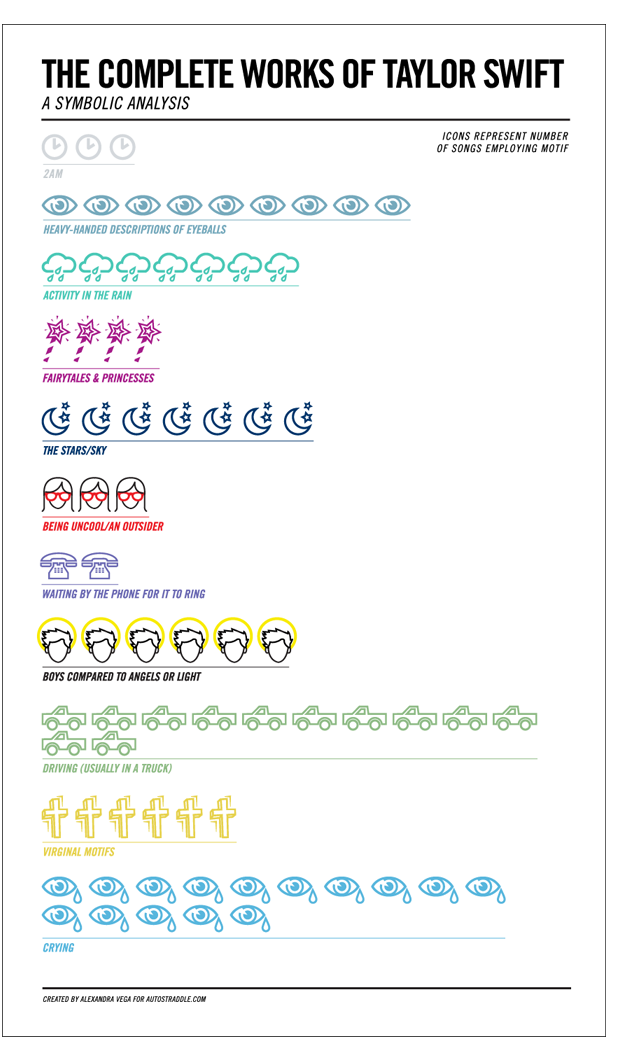
I have to confess that other than that she was the girl Kanye interrupted there’s not a whole lot I know about Taylor Swift. Apparently I’m not missing much though… here’s an infographic about the themes and motiffs of her songs. It’s probably slanderously simplistic. But I like it. So there.

From here (an article that is doubtlessly slanderous in its views – perhaps justifiably so).

If Swift’s work connects with teenage girls, it does so on the most simplistic, reductive territory of all: pining for boys, walking in the rain, kissing in the rain, crying drops of tears on her guitar, driving in trucks with cool boys, wanting boys she can’t have, more rain, more letter-writing, more stalking, more broken hearts, breathing problems as a side-effect of broken hearts, fairytale princess this, white horse that, more pining at the window, more psuedo-stalking, more incomplete hearts yearning for your touch, and one song that misinterprets Shakespeare and The Scarlet Letter so criminally I’m certain she’s never read either.

Swift simply hasn’t had the life experience and doesn’t inherently possess the emotional maturity to create great art. Which is fine — most young pop stars don’t, which is why they don’t win Grammys.

Nice.

Lava Lamp Love

I love my lava lamp. I picked it up for $15 from a market about eight years ago – much to my father’s chagrin. “It’ll never last,” said he. It has thus far proved him wrong. And he was, at one point, admittedly envious.

I’m told that Andrew and Simone’s boys like some of the stuff I post here – and I know they’ve been working on their own lava lamps… so here’s a Lava Lamp recipe I found at “What’s that stuff“… a cool site exploring the ingredients of stuff. Sadly it seems most of the ingredients are a “trade secret” or not available in the home laboratory… but this is a start.

Water and wax, which the original patents name as main ingredients, remain components of the commercial recipe, says Tom Spain, vice president of sales, marketing, and product development for Haggerty Enterprises, the official U.S. manufacturer of Lava brand lamps. Additional agents, he explains, help the wax gently plume upward instead of breaking apart into bubbles as it is heated and keep wax from sticking to the sides of the container.

Walker’s U.S. patent mentions additives such as dye, mineral oil, carbon tetrachloride, and polyethylene glycol (PEG), but the exact formula of commercial lamps is a trade secret. Spain tells C&EN that only five or six staff chemists know the formula and are in charge of occasional reformulations. Densities must be recorded for each batch of wax that Haggerty makes, which is mixed in 5-foot-tall vats in factories in China.

Last but not least, the water layer is added to the cooled wax very slowly so as to avoid creating emulsions, which are cloudy-looking oil-water mixtures. In fact, the recipe for the water layer is carefully adjusted to perfectly complement the density of each unique batch of wax.

Pacman media shelf keeps your loungeroom ghost free

For those looking to brighten up a loungeroom or home theatre with some Pacmany goodness I suggest going no further than this set of shelves. For those not looking to do that – I suggest checking out this shelf and reconsidering.

Uninstallation Art

This is a cool sculpture. Created by artist Caleb Larsen, it is set up to perpetually sell itself on eBay.

Every ten minutes the black box pings a server on the internet via the ethernet connection to check if it is for sale on the eBay. If its auction has ended or it has sold, it automatically creates a new auction of itself.

If a person buys it on eBay, the current owner is required to send it to the new owner. The new owner must then plug it into ethernet, and the cycle repeats itself.


It’s currently listed at just over $6,500.

Strange books for adults

A few days ago I shared a bunch of odd books for kids – here’s the equivalent post for adults. Most of these come from this list of ten strange books… which in turn comes from the Abe Books “Weird Books Room“. Every aspiring writer wants their tome to end up listed here… don’t they?

Here’s one for impressing your guests:

And one for the Emo first home buyer… how hard can it be to just paint everything black?

Looking for some Bible study material? How about Bible study with the Clampetts?

How about some arts and crafts for the construction site where all you have is Duct Tape?

Want a romantic career? Consider proctology and get yourself a copy of “The Romance of Proctology” which has been out of print since the publishing company realised what proctology actually was and pulled their fingers out.

And finally, here’s one I might actually buy – If I ever want to properly take over the world