Author: Nathan Campbell

Nathan runs St Eutychus. He loves Jesus. His wife. His daughter. His son. His other daughter. His dog. Coffee. And the Internet. He is the pastor of City South Presbyterian Church, a church in Brisbane, a graduate of Queensland Theological College (M. Div) and the Queensland University of Technology (B. Journ). He spent a significant portion of his pre-ministry-as-a-full-time-job life working in Public Relations, and now loves promoting Jesus in Brisbane and online. He can't believe how great it is that people pay him to talk and think about Jesus. If you'd like to support his writing financially you can do that by giving to his church.

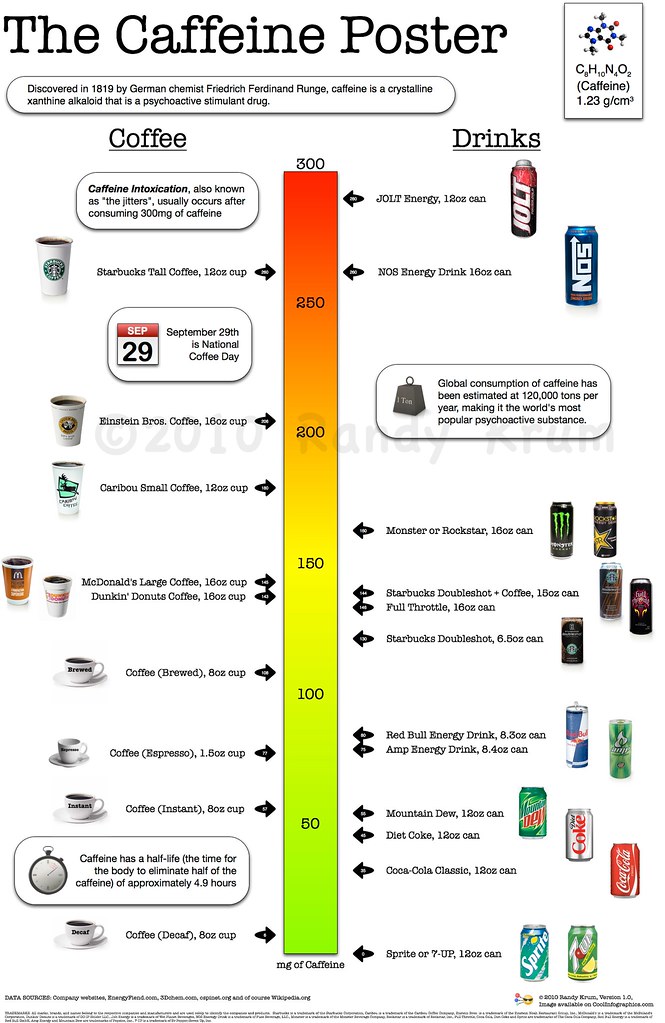
Would you like caffeine with that?

You’ll never catch me drinking decaf. But it’s not because I drink coffee for the caffeine hit. You can get caffeine from so many other places that it’s just not worth the effort of drinking a less than optimal coffee.

If you’ve been reading for a while you would have caught this infographic about how healthy different drinks are for you based on sugar content.

Here’s a complementary (and complimentary – as in free, not as in it says nice things about you) infographic that gives you the caffeine content.

How to know if nobody likes you

The word “douche” traditionally means something very different to the current pejorative definition given below. I would, perhaps, not use it. If I were you.

“The term refers to a person with a variety of negative qualities, specifically arrogance and engaging in obnoxious and/or irritating actions without malicious intent.”

I suggest redeeming this flowchart by replacing douchebag with the more culturally appropriate (from an Australian perspective) “tool”… at least that’s how Joel described the type of character here.

And so, I give you, via “bits and pieces” the “Are you a Tool” flowchart…

For Ben – who is back blogging and has decided he likes the third person.

P.S. Ben is not a tool (unless he fails the flowchart test). And I am glad he is back blogging.

P.P.S. Oh yeah, if you got here because you googled “how to know if nobody likes you” then you probably should do the flowchart, and if you pass it, you should probably consider that actually needing to ask that question is probably a sign that you’re doing something wrong.

Typesetting Acronyms

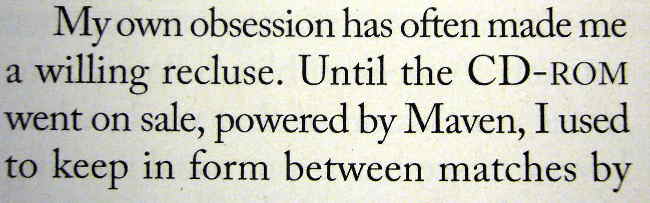
Should you set acronyms in small caps like some style guides suggest?

Computer says no.

This nonsense, promulgated by snobs like that bore Bringhurst who have not read anything written after Jane Austen croaked, ostensibly improves typographic colour. What it actually does is inhibit reading: Acronyms are not regular words. All-small-caps setting fools the reader into thinking an acronym is a real world. That discomfort you feel is a reverse fixation you underwent trying to reread the word.

This was always a bad idea, but it’s much worse with abbreviations that mix case (ATypI) and, indeed, with alphanumeric abbreviations (H1N1). Then what happens when you pluralize one of those? Plural s is almost exactly the height of the small caps.

But wait. You say. Acronyms are initialisations designed to be read as words.

Or there’s the equally nonsensical habit of using small caps solely for word-pronounceable acronyms, some of which are mated to acronyms you read letter by letter.

Like this example:

The conclusion…

Use of small caps for acronyms and abbreviations is a surefire indication your compositor is a snob. Stop acting like acronyms are dirt you need to sweep under the rug.

How online content works

I’d love to be at the top of this pyramid. But generally sit somewhere between the second and 4th.

It’s ironic that in creating this diagram the author no doubt fell victim to those at the bottom of the pile. Read the original post for a description of the types of people operating online.

This is the author’s description of the “Aggregator” which aptly describes both himself and myself…

The third tier are people with an interest in a subject but with no real insight of their own. The kind of people who retweet the aggregators or make a list of “10 Great Resources” from stuff they’ve read in the papers that week. You’re looking at the kind of content that is read just by a small circle of people.

I class my own blog in that kind of sphere – I could probably give you the names of 50% of my daily visitors and I don’t really write anything of consequence there. But! The people who come there have a laugh and remember it. There are a lot of these blogs out there, and they touch each other in unexpected ways. You might not get relevant links from a site like this, but the ripples can spread quite widely. These people are probably also susceptible to a little flattery or cash

This is a similar idea, in many ways, to the “five types of blogger” I came up with last year.

Pencil moustache

Can you balance a pen between your lip and your nose?

If you answered “yes” to that question then these might come in handy.

Making “headlines” today

I’m reconsidering the Sydney Morning Herald’s place as my news source of choice. What do other people use?

The writing is as good as ever – there is no political commentator as astute as Annabel Crabb, and few sports correspondents can match it with the likes of Peter Roebuck and Will Swanton.

But when your banner of featured stories looks like this you’ve well and truly jumped the “sex sells” shark…

On arguments…

Two of the things I commonly say in arguments are the phrases “you aren’t listening to me” or “you don’t understand me”…

What I mean is “you don’t agree with me. Idiot.”

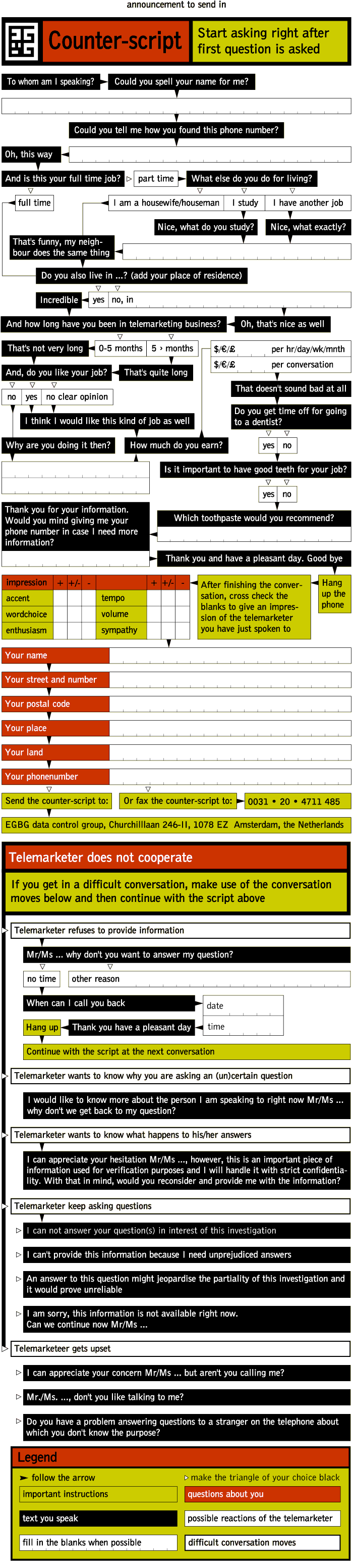
How to get rid of telemarketers

Sick of your dinner being interrupted by telemarketers? Too stupid to put yourself on the “do not call register“?

Follow this scientifically tested script.

Or you could try my trick – engage them in conversation, pretend you’re interested, and then just stop talking. Works every time.

Via CafeDave.

Typography Textbook

Useful.

Tips like:

“In the nineteenth century, which was a dark and inflationary age in typography and type design, many compositors were encouraged to stuff extra space between sentences. Generations of twentieth century typists were then taught to do the same, by hitting the spacebar twice after every period [full stop]. Your typing as well as your typesetting will benefit from unlearning this quaint Victorian habit. As a general rule, no more than a single space is required after a period, colon or any other mark of punctuation.”

And:

If you do need to insert more than a single word space between sentences, or any other characters, then use one of the many space characters available in Unicode. Even if the character itself isn’t included in the current font, Unicode-aware browsers will display a good approximation. Avoid the temptation to use a non-breaking space,  , as this has a meaning in and of itself.

For example:

  •   en space
  •   em space

Bohemian like youse

It seems that everybody on the Internet wants to be known for a unique version of Queen’s Bohemian Rhapsody.

Here are a few different videos for your prog-rock listening pleasure.

There are more where that came from

Build it and basejumpers will come

Did you catch the news about the world’s tallest building that was opened last week?

Yeah? Well so did the BASE jumping fraternity.

The Motherboard Lisa Smile

Here’s a digital rendition of Da Vinci’s classic.

Her smile doesn’t have that lopsided effect. There are just too many chips in her teeth.

From here.

Circular Reasoning and the Bible

This is an amazing infographic depicting the 63,000 cross references within the 66 books of the Bible.

It’s available in much bigger formats at the source. I found it at Andrew’s blog.

The bar graph that runs along the bottom represents all of the chapters in the Bible. Books alternate in color between white and light gray. The length of each bar denotes the number of verses in the chapter. Each of the 63,779 cross references found in the Bible is depicted by a single arc – the color corresponds to the distance between the two chapters, creating a rainbow-like effect.

One of the lines from atheists that annoys me is that Christians only believe the Bible is true because it says it’s true (circular reasoning).

I have two things to say to that.

One: If the Bible said it wasn’t true that would be reason not to believe it.

Two: The “Bible” as we know it was only bundled together in around 363 AD. The “circular reasoning” should instead be treated as cross referencing and corroboration from multiple sources. Not one self referencing source.

That is all.

A discussion on the health benefits of cured pig

I’ve never watched Wife Swap. But this kid is possibly the funniest testament to the “you are what you eat” theory I’ve seen in a long time. He’s right about one thing though. Bacon is good for you. Right?

Penning the classics

This video is pretty clever. But I spent most of my time watching it thinking about how cool the guy’s shirt is…

Here’s a guy who takes pen rapping to a whole new level…