If yesterday’s crazy PUMA was a Segway on steroids then today’s variation on the theme is a Segway on Tetrahydrogestrinone. It’s a wearable Segway. Essentially. And it’s designed for amputees or the very lazy. It’s called “the Chariot”… original nomenclature.
Author: Nathan Campbell
Nathan runs St Eutychus. He loves Jesus. His wife. His daughter. His son. His other daughter. His dog. Coffee. And the Internet. He is the pastor of City South Presbyterian Church, a church in Brisbane, a graduate of Queensland Theological College (M. Div) and the Queensland University of Technology (B. Journ). He spent a significant portion of his pre-ministry-as-a-full-time-job life working in Public Relations, and now loves promoting Jesus in Brisbane and online. He can't believe how great it is that people pay him to talk and think about Jesus. If you'd like to support his writing financially you can do that by giving to his church.
Sunday roast…
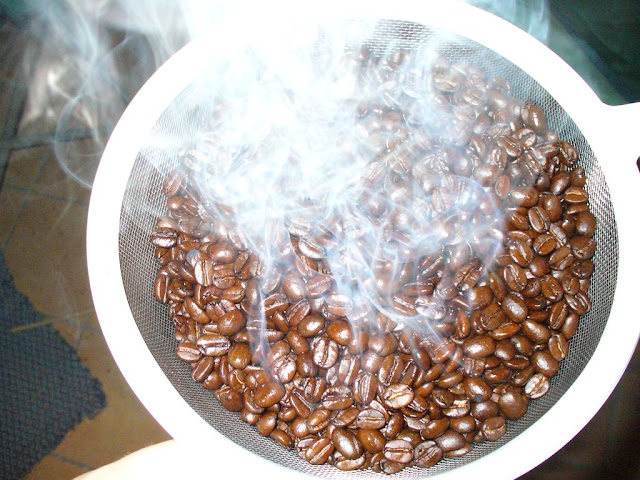
This one is mostly for those of you reading here in Townsville. Although little sister number 3 has already put her hand up for some hand delivered service on our next southern sojourn.
I have a few kilos worth of green beans, a new breadmaker, a new heatgun and four days of “leisure” time coming up – if anybody would like to purchase some roasted coffee for a fraction of the price you’ll pay in stores – let me know in the comments.
I’ll sell roasted beans for $5 per 250 grams (including a fancy zip lock bag) – and I’m happy to offer this as a regular service if you like them.
I will grind it for you if you like – but suggest if you want coffee pre-ground you get them in much smaller batches.
Protectionism: A guest post
I often preface my posts on economics by saying “I’m not an economist” – I also often have discussions with my friend Ben – who is an economist – and based on his uni results and work history, a good one, before posting things. Today, rather than rehashing his comments on protectionism and the economics involved I’ll just reproduce them verbatim.
_______________________________________
Okay, you have a bunch of people working in for an Australian company in Australia. They get $20 and all profits remain in Australia. Assume a competitive industry so they receive the fair market price for their goods.
Compare with an overseas producer, who has labour costs of $5 a unit. There are arguments that offshore employees are less productive than domestic workers, but I don’t know about that. Anyway, they also have export costs of $2 to transport the items to Australia.
Thus, per unit the offshore company is always going to make $13 more per unit. In a competitive market, the price should come down to the opportunity cost of producing the item. Given as many offshore competitors should be able to enter the market as they want, the price of the item at market value will be somewhere around $15. There is no way that this item can be sold at a rate covering the value of the labour in Australia.
What does this mean? Well, most likely the level of protectionism we have isn’t just keeping shirt prices high, but also wages. If there were true globalisation, that should extend to a worldwide labour market, and a close level of parity of wages.
If the company went overseas, it would increase demand for labour upwards, and labour costs would go up to $6 per unit. Some Australians would now not be able to find employment at the same level, and would take jobs at $19 an hour.
So those are the first degree effects. If the market was always competitive, this shouldn’t have much effect on the market price of the good. if the level of protectionism inflated the market price, then there should be some drop in the price of item. In the current situation in Australia, the latter is the case, and there should be a drop in prices.
The idea of free trade is that people displaced from employment would move elsewhere, generally to industries that the nation has a comparative advantage in.
Let’s explain comparative advantage.
Country A:
wheat costs 2 units to produce
computers costs 5 units
country B:
wheat costs 10 units to produce
computers costs 50 units
In this situation, country A can produce both wheat and computers for less resources than country B. However, thought of differently,
country A:
wheat costs 2/5 unit of computers
computers cost 2.5 units wheat
country B:
wheat costs 1/5 unit of sugar
computers costs 5 units of wheat
Country A has a comparative advantage in producing computers, B in producing wheat.
now, for 100 resources:
A could make 50 wheat or 20 computers. B could make 10 wheat or 2 computers.
A focuses on making its comparative advantage, computers. It makes 20 computers. It trades 3 computers and gets 10 wheat. It now has 17 computers and 10 wheat, which it could not have produced before. And country B has 3 computers, which it couldn’t have obtained before. Any linear combination between A trading 0 and 4 computers for wheat can result in both countries obtaining a different level than otherwise obtainable.
So I guess that is the basis for why trade benefits all countries.
You mentioned farmers in your post. And in particular rice. Here is my comparative advantage of rice production for Australia vs. the world:
Australia
Rice costs 1000 units to produce
all other goods (a basket of other good) costs 10 units
Rest of world
Rice costs 1 unit to produce
all other goods costs 8 units.
Work through that example. Australia should never produce rice.
One good thing about free trade is our rice industry should take a dive, which is fair enough. I still think our farming industry retains inefficiencies due to our ridiculous farm protection policies. I think when you think farm protection, you are thinking maintaining farms. I think it would just result in a shift in farming to more efficient products/farming techniques.
But back to my point, and I touched on this in my thesis, when people nearing retirement lose their manufacturing jobs, they don’t really shift into other industries. There is less incentive for employers to retrain them given they only have a few years of working left, and the workers have low incentive for a range of reasons (including the fact they are angry hold men). And this grudge remains well into retirement, leaving a group of people who will always be anti-free trade.
I also don’t buy the whole ethical argument suggesting they are exploiting offshore labour. I think this is generally used as an emphatic argument that carries little weight but often thrown against companies who source labour overseas. The first point alone doesn’t make much sense, that the workers don’t get a lot of money for their work. On so many levels. If they weren’t getting much money they wouldn’t be working. True, their conditions may be worse than ours, but better than their current standard. Allowing full free trade should resolve this issue, as noted above. It’s only when trade trickles to these countries that their progress in workplace development is stunted. those people might not be getting a “fair” wage, but then you have to extend that argument to domestic matters, where it would appear the workers much by mirroring the argument also not be getting a “fair” wage (but a greatly inflated one). The “loss of traditional skills” argument I don’t think is relevant, again refer to the comparative advantage deal, and if it’s a free labour market there should still be a required allocation to the relevant markets. I don’t like to use analogy, but in the western world, the proportion of people today compared to prior to the industrial revolution, not many now know how to tend the fields, hustle cattle, build cottages, etc. why the developing world needs to be further stunted for the argument of losing traditional skills just seems like a kick in the face.
The Beginners Guide to Taking Over the World – Where to next?
Overcoming opposition
Sooner or later, as your empire expands, and your threats of global extinction begin to reach the wrong ears, you will face some form of opposition to your vision statement. This opposition is likely to come up at the most inopportune moment so it is a good idea to prepare for it early.
The universally recognised quick-fix method for combating opposition is to blackmail your opponent. If blackmail fails you should blackmail your opponents enemies into attacking your mutual adversary.
The problem with blackmail is that you need to have something over your opponent. The best way to get dirt on your opponent is to throw mud at them. You would naturally think that I’m speaking figuratively, not literally. But no, in this case, literally might actually work. A leader with dirt on their clothes is obviously not fit to be governing a country. The best way to achieve this sullying of your foe’s image, figuratively and literally, is to invite all the world leaders to a barbeque at your new palace. At some point during the barbeque you should have your clown goons interrupt proceedings with some apparently spontaneous mudslinging. Have a cameraman on hand to capture the foreign dignitaries with mud all over their best suits. You now have the dirt on all your potential opposition. This should prevent anything other than a token effort on your future opponents behalf.
Where to next?
The ball is truly in your court, your opponents are subdued, your army is trained up, and your people love you. What is your next move going to be? You need to expand the only way upwards is outwards. If you want to become the next global authority you need to increase your grip on the globe.
The key to successful expansion is to do it incrementally. There’s an old fable about a farmer who very slowly increases the size of his paddock by moving the fence posts, no one notices, and eventually the kings castle is inside the farmers paddock and he now owns the kingdom. The moral to that story should be quite clear. The application should also be clear. You don’t want to conquest in leaps and bounds, that creates ripples and the other international parties like everything to sail very smoothly.
I’m also reminded about that story about frogs on the stove, when you put a frog in a saucepan of room temperature water on a stovetop and turn the stove on the frog doesn’t notice the water heating up and eventually expires because it is too hot.* If however you put a frog in hot water he tries to make his escape and at that point if you want cooked frog you have to hit him with your wooden spoon, at least that’s what I imagine you do, I’d never do that to a poor frog. Unless it was a Freddo and for some reason I wanted melted chocolate.
Anyway the meaning to be found amidst all that rambling is that your best bet is to take small steps, slowly moving up in the world. If you started with Tasmania, your next move might be to take New Zealand. Then Samoa, Fiji, the list goes on, there are plenty of small island nations to take over before you move onto the continental mainland. Sooner or later, everyone who wants to take over the world has to invade Poland, it’s like a rule, or a tradition, it’s not worth breaking traditions over trifling matters like logistics so you should include Poland in your schedule somewhere.
___________________
*One wonders what would happen if room temperature was the temperature at which water boils, if the frog instinctively jumps out of the water, does he still die – is it a case of out of the frying pan and into the fire? Who knows.
A bunch of links – April 8, 2009
- WordPress Blogs: Create Custom Tag Pages
- Parent /Teacher interviews…
- DoubleTwist lets you manage all your media from one place — UPDATED
- Peeps Blow Up on YouTube [VIDEO]
- Rise of the Christian pagans | Herald Sun Andrew Bolt Blog
- Beware the Perils of Caffeine Withdrawal
- Subservient Chicken Anniversary
- “Jesus was a Good Teacher” dodge (NEXT! #9)
Peeps are marshmallow creatures popular at Easter. This is a series of videos of Peeps getting nuked.
I’m linking to this purely because of the debate in the comments. It’s the old chestnut about Christian holidays and pagan festivals. Atheists dogmatically hold onto their stupid arguments despite consistent historical arguments to the contrary. But it raises a question on whether Christians should be engaging in these debates in the first place because they just seem pointless at times and Christians often end up fighting each other rather than arguing the point.
Tidal title

There is a new Gomez album out. It’s titled “A New Tide”. You should most definitely get a copy. Unless three part harmonies sung over the top of complex multilayered melodies and infused with a bit of alt.country banjo isn’t your thing. Then you should probably go listen to something else.
On the first listen this sounds like a bit of a mix of old Gomez and more recent Gomez – with a bit of Athlete thrown into the mix. But they’re a band who are notoriously difficult to pigeon hole with categorical certainty.
It really is most excellent. And they maintain their position on the top of the pile of my current favourite bands.
The new Augie March CD is also worth a spin. But that’s probably something I should have mentioned a few weeks ago.
Segway 2.0

What do you get when you cross a Segway with a smart car? A Puma apparently. The world has gone bonkers over this new announcement – and given my previous fixation with the gyroscopic transporter I couldn’t let this slide…
Here it is in action. It’s like a golf buggy. Only crapper. If you’re reading this in the sidebar you may have to click the link through to the post for the video.
Package deal
Coffee tasters love finding nuanced flavours in bean varieties – and they can at times seem a stretch… other times they can punch you in the face. There’s a particular bean I like that tastes almost exclusively like blueberry.
Square Mile Coffee are a roaster/cafe of some repute – with involvement from a couple of previous World Barista Champions – they label their coffee with a tag cloud to demonstrate different flavour notes in their beans. I like it. It’s clever. Particularly this underlying idea – that didn’t get off the ground (yet).
We did have an idea of a microsite that allowed customers to input their cupping notes into the site to constantly update a swirling live tag cloud of the espresso. Crowd sourcing descriptors seemed like fun! However that probably won’t happen as the cloud would only really become useful when enough people enter data and at that point the espresso would be close to the end of its run as a seasonal blend.

Lock stock
Here’s something for the security conscious puzzle nerd – try getting out of a room locked with one of these puzzle locks (let alone getting into one).

When it comes to locking doors it pays to remember the three S’s – security, security, security… you should probably also make sure you fit it to the right side of the door.
On the road(kill) again…
Driving is a hungry business. Sometimes when I’m on the road and I run over some Australian fauna or driving past a hoard of dead animals I think to myself “boy, I wish I had a crock pot here with me so I could cook this up…”
It’s that sort of thinking that no doubt led to the release of this in car slow cooker… the Road Pro – $US29 of awesomeness.

There’s actually a whole series of in car cooking appliances – from pizza ovens to portable stoves (and everything in between).
Got Milk?

This is a novel take on the idea of “literal packaging“…
These fruit juice cartons follow a similar, but slightly varied theme.
Amy mentioned that she’s a sucker for a well designed product package – so no doubt she’ll be ordering up big on fruit juice if these ever hit the shelves.
Dead set legend?
I mentioned the ABC radio’s unique take on the stats released by the Centre for Public Christianity yesterday. Dan has helpfully shared a link to the ABC Radio transcript of the story I was listening to on the world today.
The reaction to the statistics has been somewhat amusing. On the one hand 55% of the “non born again” community don’t believe in the resurrection. Which should be comforting to atheists, Muslims and the liberal church.
The Uniting Church in New South Wales was one of the first organisations to put its own spin on the findings – claiming most of the 45% of (non “born again”) people who believe in the resurrection only believe it in a metaphorical sense.
Many Australians, although certainly not a majority, would see Jesus as metaphorically real, or his resurrection as metaphorically real, but would expect that the bones of Jesus would be found in Palestine.
And that’s my own position.
But I think that the resurrection of Jesus is principally about the continuing reality of Jesus of Nazareth in this world. – Ian Pearson from the Pitt Street Uniting Church…
Hmm, interesting take on things. You’ve got to wonder why this guy is still a “Christian” minister if this is what he thinks. If they found the bones of Jesus in Palestine I’d throw in the Christian towel. Immediately. If it’s all just a metaphor you’ve got to ask “why bother at all?” – Exactly the point Sydney Anglican Archbishop Peter Jensen raised…
If he just rose metaphorically, well, it’s Alice in Wonderland sort of stuff, and is not worth worrying about.
I wouldn’t be a Christian if I thought that. Just wouldn’t be worth the trouble.
But that’s not what the New Testament says; that’s not what the evidence says.
The evidence is really talking about a real resurrection from the dead.
The atheists on the other hand. Well. They still kind of miss the point of serving God if you believe in him – which many clearly still do… talk about imposing your value judgments on others…
The world needs to get away from this dependence on an imaginary super person in the sky, and start looking at the problems that we’re encountering in real terms – David Nichols, the president of the Atheist Foundation of Australia
POTUS Pots
Barack Obama is apparently so popular he’d win elections in most countries around the world. Without even turning up. It can be tough at times to pay appropriate tribute to a man as influential and exciting as the current President of the United States (POTUS). How bout your very own herbal treatment for America’s first ever pot smoking president* – a Chia Obama. A few US retailers are now refusing to carry them instore. There are two varieties – happy and determined…


*at least the first to openly admit “inhaling”…
Pillow talk: The key to sleeping at work
I’ve never really found myself nodding off at the desk but I’m sure it’s a dangerous occupational health and safety issue requiring novel solutions. Like these.
A pillow tie/sleeve combo from designer Maja Ganszyniec…

And for those narcoleptic office workers who just can’t type a sentence without nodding off – a pillow with a built in keyboard… From Russia with love (and Google Translate).

Meth related spirits
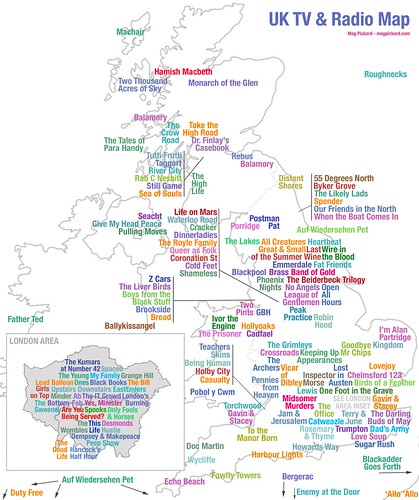
US designer Dan Meth received much kudos for his map of US sitcoms. I posted about it here. It was a nice idea and it’s good to see it replicated for British comedies – because everyone knows that British comedies are superior.
Here’s the intro post from the designer of this most fantastic map.