Is an all singing, all dancing, choir of middle aged people who all wear the same thing.
It actually gets worse.
Is an all singing, all dancing, choir of middle aged people who all wear the same thing.
It actually gets worse.
Here’s one of those posts where I try to synchronise a few years working with a marketing and economic development agency with the realm of ministry. Hopefully it’ll be useful both to me, and to you…
I’ve been trying to figure the suburb of Clayfield out. It’s a tough one. I’m sure others I work with have faced the same quandary (Andrew, Simone and Kutz) for years.
Marketing is a confusing blend of guesswork and social science – with new theories cropping up all the time – most marketing budgets are limited, so most marketers spend a lot of time putting their advertising in places that will get the best bang for their buck. Because most churches don’t have big marketing budgets or the time to conduct thorough demographic research here are five ways that you can let them do the hard work for you, which in turn will help you understand the people you’re serving.
Some bonus points for regional areas, unless there’s a suburb based equivalent these aren’t going to be that great for your specific context in a bigger city:
Incidentally, age demographics are dead as far as tourism marketing is concerned. Age is irrelevant (mostly). Place is also mostly irrelevant (except that it has a bearing on income). People want experiences that they can fit into the narrative of their lives. Postcard perfect photos are a thing of the past – you’ll find most tourism ads from here on in (thanks to some new market segmentation work produced by the state tourism body) will feature a mix of people enjoying different experiences.
People want a holiday they can go back and tell their friends about. Holidays aren’t about collecting photos of the seven wonders of the world anymore – they’re about doing something authentic, learning something new, or meeting interesting people from interesting cultures.
This new way of thinking is possibly relevant if you’re putting together an event for your neighbourhood – because I think events are similar to holidays.
But demographics still have an influence over where people live – you won’t find many low income students living in the austere realm of Ascot (think the upper class eastern suburbs) so understanding one’s geographic context is important when it comes to pitching events and sermon applications at people.
According to Gizmodo the Bible is the most represented book app on the iPhone. There are 1000+ versions to choose from (see the infographic below for a comparison with other classics.
“The Holy Bible has more than a thousand applications at the App Store. We counted up to 1001, but it was too boring to keep on going. Of those copies, not all were free. Some of the most popular works also have multiple copies, some are free, some are paid. Pride and Prejudice is one of the most popular, with 48 copies, seven of them available for a few rupees. Dracula has 34, five being paid copies for whatever reason. And so on.”
One of my college buddies (and his brother) put together this pretty exceptional Easter video – they’re planning to do all of Luke.
Only at this blog will you find a post like this coming right after a post like this. One of the things I’ve been thinking about while arguing about UFC, studying at college, and grappling with the social context of the early church, is the idea of how far you can stretch a particular passage of scripture as you grapple with a particular issue. While the “context is king” hermeneutic is really useful for figuring out the “impossible application” of a passage – there are lots of circumstances that it seems we can pull a verse out of the ether (or the Bible) to address – without looking too hard at the context of the verse. Sometimes we call this ethics, other times its doctrine.
I have always hated the concept of “memory verses” as some sort of bandaid solution to every personal calamity, I get suspicious when I walk into houses that have verses stripped of context strewn all over the walls. I reckon putting big slabs of text all over your walls is much more Godly. Well, not really. As Carson famously argued “a text without a context becomes a pre text for a proof text” or something… but I think we can actually legitimately “proof text” without completely paying attention to the full “original audience” context. We don’t need every historical nuance to come up with a sound systematic understanding of an issue. The Bible doesn’t consider Climate Change – but says lots about our responsibility for the planet, its brokenness, and our new gospel priorities (and expectation of a new creation)…
I’ve been thinking about this since giving a presentation on Question One of the Westminster Shorter Catechism at church a couple of weeks ago.
The proof texts for the “chief end of man” are, in my opinion, pretty weak. If you consider the context of those passages it’s almost impossible to argue that this is the “big idea” of any of the specific passages, but it’s a “big idea” from the Bible, and we seem to feel like we need a good proof text for every position – we can’t just argue on the basis of “the vibe”… you can stretch a fair bit of Bible over the idea that one of our chief purposes being to glorify God. We have this correct concept that we get to by doing our systematics properly, but no great proof text, so we pull all the little bits of Bible into a paper mache type shape to build our idea, or we have an idea and we stretch (like a balloon) passages over it to give it a Biblical flavour.
Pacifism is not specifically mandated in the Bible, but I can see how one might reach that end by stringing together the teachings of Jesus, the fruits of the Spirit, and also our understanding of church history (how the early church acted based on the teachings of the Apostles) – but I think you can equally look at the Bible and come to a just war/justifiable violence position. Depending on what passages you want to string together. I can see why systematic sermons are hard – but they’re also, as forms of communication, heaps more compelling and much better for application.
But just how far can we stretch “scripture” when building a systematic framework? And where does context fit into this picture of systematising? If we’re Mark Driscoll we just talk about the idea without bothering using the Bible – which may, in the end, be preferable (and possibly prophetic).
What do you reckon? How far is too far when it comes to proof texting?
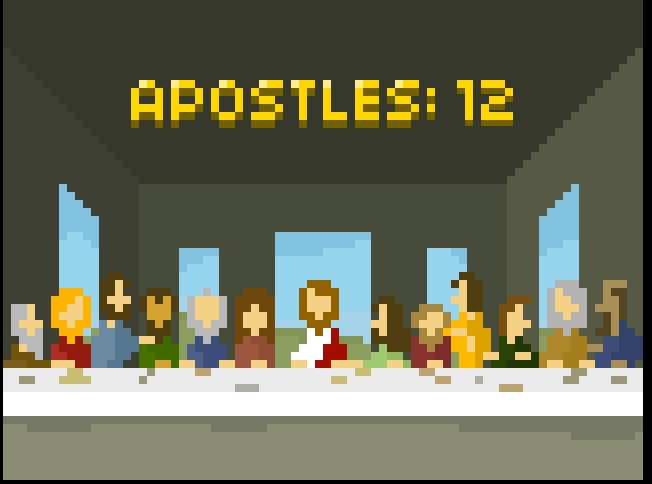
You know that famous painting – the one the Da Vinci code is all about… well, there have actually been a bunch of “last supper” paintings over the years – and it seems Jesus and the 12 (or 11 depending on what time of the evening the painting captures) are eating a little bit more each time.
That’s the subject of a new study of 52 of the paintings, conducted by a pair of American brothers.
Using computer-aided design technology, the pair scanned the main dish, bread and plates and calculated the size of portion relative to the size of the average head in the painting.
Over a thousand years, the size of the main dish progressively grew by 69.2%, plate size by 65.6%and bread size by 23.1%, they found.
The study, published in Britain’s International Journal of Obesity, is co-authored by Mr. Wansink’s brother, Craig, a professor of religious studies at Virginia Wesleyan College in Norfolk, Virginia, and an ordained Presbyterian minister.
Grant me, if you will, this moment of complete self indulgence. This post is purely here for the purpose of citation in the essay I am handing in tomorrow.
The story of Eutychus (Acts 20) demonstrates that Pauline churches met not only in the courtyards of tradtional flat pack Roman homes – but in any available and appropriate domestic space.
This is really a cheap way to get my principal visiting my blog – though I’m not sure how wise this course of action is.
The inverse graphical calculator creates a graph out of words you input then gives you the equation to generate the graph.
Here is the equation for Jesus.

Here is one I prepared earlier.

I’ve been thinking about my approach to the Bible. The first five weeks of college have been pretty intense for me – but probably not as intense as they have been for other people who possibly feel like the rug has been pulled out from under their feet a little when it comes to the way theologians treat the Bible and the interaction between the historical context and theological truths. Here is my thinking…
My overarching understanding, or first principle, is that the Bible is the clear word of God, our job is to make sense of it based on what we know of the original audience, the way God communicates, and ultimately the work of Jesus. This understanding colours my understanding of everything from Genesis to Revelation, and each form of biblical literature.
Theology is like science – we’re constantly moving to a more perfect understanding of each part of the Bible as we build our picture of the lives of the original hearers and readers of the word. We’re unlikely to ever completely overturn our current “theories” based on this evidence, but we will gain a slightly more nuanced picture of the meaning of different writings if we learn something new about what was going on in the first century (NT) or in the history of Israel.
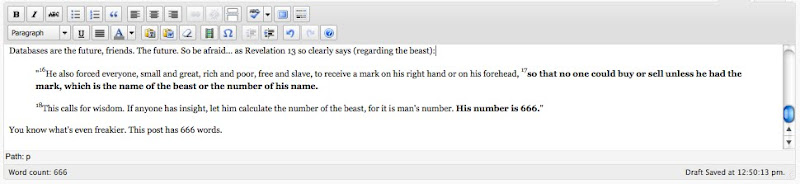
So understanding that “this current distress” that Paul talks about in 1 Corinthians 7 may refer to a massive famine in the Corinthian region means we don’t have to assume that Paul was a failed apocalyptic prophet who thought the world would end in his lifetime, but rather that he thought it wise for couples not to marry if they couldn’t feed likely offspring. Revelation makes more sense if you understand that Nero was on the scene around the time it was written, that the number 666 was particular to Nero, and that Rome was persecuting Christians around the time it was written… this makes more sense to me than some sort of dispensational premillenialism.
Which leads me to this point of applying Occam’s razor to every “theological” position. If there’s a better explanation that requires less jumps, that is consistent with the rest of scripture, and preferably magnifies the work of Christ – then I’ll be pretty prepared to take that explanation quickly – rather than fighting to hold on to ingrained presuppositions.
Again, I don’t think this is rocket science or revolutionary – it’s just something I’ve been thinking about.
I wonder what an equivalent would look like in Australia.
Probably a lot of empty, nominally Catholic space.

We’re all very excited anbout the new ESV iPhone app – which presents the well documented dilemma regarding being spotted staring at an electronic device in church services.
Izaac devised this solution:

Long time readers may have seen this before – but there is a commercial solution (you don’t need to hack up a Bible – give it to an enquiring friend instead)… this was designed for hiding a flask – but it looks like it would do well with an iPhone… it also comes with a bonus flask so that you can carry around your spirits with you as well.

If you’re more musically inclined there’s a hymn book iPhone cover that will do the trick too.


Mikey responded to yesterday’s rant about media releases with a post on Christian Reflections urging churches to think about how they can use the media. The day before yesterday a friend in Townsville sent me an email asking for some tips on how to talk to the media – she had sent a release out and had received some interest from a local television station.
For those wondering what makes me qualified to give this advice here are my qualifications in a nutshell. I’m a journalism graduate who spent four years working as a corporate communications hack for a regional development and tourism marketing body – I marketed my organisation and the Townsville region. I wrote hundreds of media releases and had a pretty good strike rate in terms of getting them placed. This was partly because Townsville is a regional centre with lots of media outlets and a finite number of sources, and partly because my organisation had a finger in just about every pie, and probably partly because I know what I’m doing. Enough self promotion for now…
It’s time to put all those years of spin twitting to good use – here’s my guide to writing a media release for your church event, and some tips for what to do when it is picked up, and when it’s not…
The first thing you’ve got to remember when sending out a release is that journalists are time poor and get heaps of media releases. You need to be prepared for the idea that they may not get past the heading and the lede (the first line). If you’re lucky they’ll think your release is interesting and read to the end, if you’re really lucky they’ll want to follow it up. With that in mind… follow these steps.
Once your release is in the wild you need to play a little game I like to call “wait and see what happens”… if you do get a call from a journalist – relax. Take a deep breath. Most of them are nice people, and most of them aren’t out to build a reputation as a bloodhound who takes down churches and disgraces ministers. Here’s how to get the best out of your interaction with the media post release…
If this all sounds too hard I’ve set up a fiverr task where you can pay me $5 to write you a ten line media release. If you want to use me more than once I’ll probably make you pay more – but I’m happy to help. And I’m always happy to read over something before you send it out…
While I’m in the mood for trying to express myself by the power of analogy I thought I’d share – for those not reading the comments on yesterday’s post – I thought I’d share this “gem” with you.
I’m still trying to come up with a way to affirm the good in all the good frameworks for Biblical Theology – and I’m loving Dr Leigh’s “expectation and fulfillment” (coming soon to a publication near you) idea.
I think any simplification causes the object in focus to suffer, because it can’t possibly not – simplifications involve cutting out of bits that don’t fit the “big idea”, though like some sculpture said “when I sculpt a statue of a horse I take a block of wood and cut away all the bits that aren’t horse” (rough paraphrase)… this got me thinking a bit. Simplifications are good for clarity. They help us see the main game. They help us appreciate the value. It’s a bit like diamonds. Uncut diamonds are worth a lot – because they have such potential. There are all sorts of directions you can go with the diamond thing as an analogy for Biblical Theology – each system is like a jeweler’s lens – they help us to appreciate something about the value of the diamond. And they help us to get rid of rubbish ideas about the meaning of passages (eg moral teachings from the OT that ignore Christ). But here’s where I went in the comments last night (with some modifications). I think it’s more helpful to think of each (good) system of Biblical theology as a facet of a precious jewel…
I like to think of the Bible as a really big diamond – one that is so big we can’t look at it all at once. You can look at one facet of the diamond and through it see all the others, this can distort each other facet if you forget that you can flip the diamond around and look at it from a different angle. Some people stand too close, or lack depth perception, and will only see one facet of the diamond ignoring all the others. Some will want to break the diamond up into lots of pieces, thus devaluing it.
The best way to appreciate the diamond is to step back and see that there are many facets at work and that each of them contributes to the diamond’s beauty in a slightly different way. Light hits each and refracts differently. If I wanted to be trite I would say “when you shine a light into any facet of the diamond and focus that light on a smooth surface it makes a cross – no matter which facet you point the diamond through…” But I’m not trite, so I won’t.
I think I quite enjoy essay writing. Though I may have romanticised it from my fleeting memories of putting in caffeine fueled all-nighters on deadline day while I was at uni. I’m trying to figure out what the difference is between essay writing and blogging (other than the finding reputable sources to cite bit).
Here is what I’ve come up with (not as a difference, but as a reflection on the art). I might be wrong. Feel free to crush my analogy in its infancy in the comments.
Essay writing is like finding threads of common quality from an array of garments, and tugging them out of those items in order to weave your own smaller and less significant rag.
Obviously you don’t damage the original in the process – unless you really go out of your way to discredit it.
I am enjoying the essay I’m writing for Bruce Winter’s Christ and the Clash of Cultures subject. Here is the question:
Citizens in the first century met in the context that declared who they were. Discuss the implications of this for the gatherings of the first Christians in the Roman East.
I’m sort of dancing around the question and trying to just write about the differences between the way the church ate together and the way pagan Rome ate at idol temples and banquets. I think I’ve jumped through enough logical hoops to synchronise the question with my topic.
Remember all that furore last year about Mark Driscoll’s plans to go global – planting video screen churches all over the planet? Here’s some timeless advice Mark should probably listen to – pulled from a list of tips for young preachers.
Beware of the radio preachers.
As a new Christian I listened to many hours of Chuck Swindoll, Greg Laurie, Tony Evans, Billy Graham, John MacArthur and others and was blessed. However, when men preach for the radio they are preaching to the masses. Subsequently, they are not as likely to speak personally of themselves, their struggles, their families, and the specific issues in their church because they are preaching to America. Most pastors don’t preach to the nation or world, but just to their flock who need to know their pastor, see what the Holy Spirit has been doing with the Bible in their life, and how the Bible is integrated into their daily life and relationships instead of vague and general illustrations and principles that are true but not specific to their community. Also, younger preachers can often listen to so many hours of a radio preacher that they end up parroting him rather than finding their own voice and style.
Emphasis mine. You could quite easily replace the word “radio” with “internet” and have it still ring true. The catch – this quote is from Mark Driscoll’s own list of tips for preachers. Which is mostly useful.