[[6869]]
[[6879]]
[[6909]]
Category: Christianity
Why I’m not an Atheist
The problem with Dawkins
An atheist scientist takes up the case from Eagleton, criticising Dawkins for his approach to the discussion with Christians.
The trouble with Richard Dawkins from CPX on Vimeo.
Why I’m not an Atheist #3 – Jesus
Everything Iʼve said to this point you might describe as the negative reasons for my not being an atheist — things which others find persuasive about atheism which I donʼt find persuasive.
But the strongest reason I refrain from choosing atheism is because of Jesus. I suppose itʼs natural for someone like myself to be categorised as a ʻtheistʼ, but I feel no particular attachment to theism per se. I am a Christian — if I am a theist, it is not because I have highly developed arguments for theism which have led me there. It is because I am convinced — rightly or wrongly — that God took on human form in the man Jesus Christ, and that he did so in order to save humanity from his own judgement.
But again atheism is quick to expose my convictions as a delusion.
“Although Jesus probably existed, reputable biblical scholars do not in general regard the New Testament (and obviously not the Old Testament) as a reliable record of what actually happened in history…” (The God Delusion, p. 122)
Why do I hold on to my convictions about the historicity of Jesus Christ when there is so
much scholarship indicating itʼs a myth generated over time?
Well, the thing about this scholarship Dawkinsʼ talks about is that it doesnʼt actually exist.
I donʼt mean that there are NO scholars that propose the kind of things Dawkinsʼ says, but that the claim that ʻreputable biblical scholars in generalʼ say this kind of thing is just not defensible. There are SOME scholars who make those kind of claims, and often do so not in journals but in publishing direct to the public.
But reading a little more widely than just Richard Dawkins, and Barbara Thiering, you discover that within scholarship itself there is large ʻmiddle groundʼ which just gets on and analyses the NT documents in just the same way you would analyse any other document from history — neither to debunk nor to defend Christianity, but to see what they say historically. Sweeping claims that that scholarship slants towards a mythological reading of those gospels is just absurd. It shows that Dawkins is not acquainted with serious historical scholarship, or chooses not to write about.
Terry Eagleton is a marxist scholar who wrote a justly famous review of Dawkins book. In it he had this to say about Dawkinsʼ engagement with scholarship:
Imagine someone holding forth on biology whose only knowledge of the subject is the Book of British Birds, and you have a rough idea of what it feels like to read Richard Dawkins on theology. Card-carrying rationalists like Dawkins, who is the nearest thing to a professional atheist we have had since Bertrand Russell, are in one sense the least well-equipped to understand what they castigate, since they donʼt believe there is anything there to be understood, or at least anything worth understanding. This is why they invariably come up with vulgar caricatures of religious faith that would make a first-year theology student wince. The more they detest religion, the more ill-informed their criticisms of it tend to be. If they were asked to pass judgment on phenomenology or the geopolitics of South Asia, they would no doubt bone up on the question as assiduously as they could. When it comes to theology, however, any shoddy old travesty will pass muster. These days, theology is the queen of the sciences in a rather less august sense of the word than in its medieval heyday. – Terry Eagleton, “Lunging, Flailing, Mispunching”, London Review of Books, October 19, 2006.
In talking about Jesus, I need to address that historical question, because you may be expecting me to defend my convictions about the historical Jesus. But I would suggest the shoe is on the other foot — if you are convinced of the mythology of the gospels, and heir mutilation over time … where have those convictions come from? Why are you so sure of them? Is it because you understand the history, or because you have taken on faith the claims of certain scholars and writers? I know you can run off to the web, or pull out the God Delusion and find someone who agrees with you — but Christians can do that too.
Finding someone to agree with you can help, but it doesnʼt make it right.
For me, there is good reason to understand the documents of the New Testament as providing a historically reliable connection with Jesus Christ. The documents were written by eyewitness, or were the words of the eyewitnesses written down within the lifetime of those who had lived with Jesus. There were many other gospels, but these were second century documents that synthesised the original Jesus with 2nd century gnosticism — which was the reason for their rejection. The transmission of the documents was not without error, but there are so many copies of the NT from different periods and different regions that the copying errors are pretty easy to identify, and very few of them are of any real significance.
Now they are just claims, and there is historical data behind those claims — I did a whole talk on it at CU last semester called “True Words?”— you can listen to it on CUʼs website if you want.
So when I say that Jesus is the definitive reason that Iʼm not an atheist, I hope you donʼt think to yourself, Well heʼs just deluded, and has an imaginary friend called Jesus, or that Iʼm worshipping some later myth about Jesus. When I say Jesus, I mean the real historical Jesus who I think it is plausible to believe was a man who claimed to be both the son of God and the saviour of the world.
But itʼs not Jesusʼ historicity — itʼs Jesus himself who is the main reason why I interpret atheism’s claims negatively.
I donʼt worship Jesus because Iʼve got good arguments about him — I worship him because he is supremely worthy of worship. He is the creator who has written himself into his creation. I hope you will forgive me if I speak about him!
He claimed to be without sin; he claimed to be God, and did things that only God could do; he claimed to be the only path to reconciliation with God. It was because of those claims that Jesus was treated without compassion. He wasnʼt crucified for telling people to love each other — but for claiming to be the king! He was lied about, arrested, endured a mock trial, beaten, whipped, nailed to a cross and a crowd mocked him and spat on him. In the face of that rejection, on the cross, his concern was for the forgiveness of his enemies. In his death, he paid a penalty, enduring our death for us – that we could be forgiven. The creator died for us in order to reconcile us to himself.
Jesus confronts us: he says we are corrupt, not just morally, but intellectually. That in cut
ting ourselves off from God we have forced ourselves into a position of having to invent
alternative explanations for the world that donʼt include God.
So I have a choice — I can listen to what the atheist says about Jesus (a mythological figure, misunderstood by Christians), or listen to what Jesus says about the atheist (humans loved by God but in rebellion against him creating philosophies with which to remove Godʼs influence). Each has an explanatory power about the other — itʼs not an easy decision. I am not an atheist, because I have listened to Jesus and for my part, I am persuaded he speaks truth.
Defining issues
I think the way we, as people, choose to define ourselves is telling. So I often look at people’s profiles online with interest.
I, for example, put “A Christian” as first on the list. I am many more things, but I primarily self identify as a Christian, not a husband, son, brother, or blogger.
Atheists, upon occasion, have expressed their displeasure that Christians want them to define themselves by their non belief – and yet in the blogosphere they proudly identify that way with a big red A.
Some gay people I’ve spoken to prefer not to be identified by their sexual preferences, while others join together to form lobby groups.
I think Christians should, when defining their beliefs and identities, start off talking about Jesus. And this, more than anything else, is the problem I have with “Answers in Genesis”. They should be called “Answers in Jesus”, or “Answers from Jesus”… and they’re not.
After trying to explain why I think it’s a problem that AIG evangelise using pseudo science I conducted a little experiment. I went to the AIG homepage and searched it for “Jesus”… the little search box on Firefox came back “Phrase not found”… Here is a screenshot…
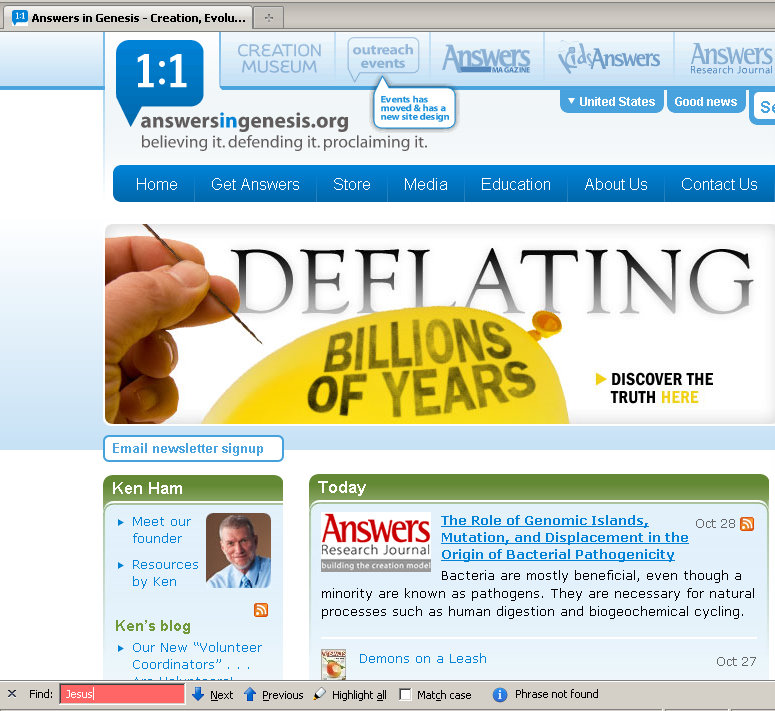
UPDATE: In case you, like a commenter below, think my little search trick is misleading – I give you one other piece of evidence that Answers in Genesis overplay the significance of their understanding of Genesis when it comes to the gospel…

On Hitchens
Four interesting little articles or events surrounding Christopher Hitchens have piqued my interest in the last few weeks. For the uninitiated, Hitchens one of the more prominent voices of the New Atheist movement.
Hitchens, in a recent column on Slate, described himself essentially as the modern day champion of atheism – in the same sense that medieval kings had champions who would throw down the gauntlet to knights from near and far…
Ever since I invited any champion of faith to debate with me in the spring of 2007, I have been very impressed by the willingness of the other side to take me, and my allies, up on the offer.
Hitchens is making his big screen debut shortly. A series of debates he held with American pastor Douglas Wilson is being turned into a feature film called Collision.
Some of his preconceptions about Christians have been challenged in the process – and they’re the issues I find most offensive about the manner in which atheists conduct themselves in debates.
On one hand they say “don’t generalise us, we’re all different” and on the other they throw all Christians into the same boat as the Westboro Baptists or (medieval) Crusaders.
Hitchens made this comment on his interactions with Christians in debates:
“I have discovered that the so-called Christian right is much less monolithic, and very much more polite and hospitable, than I would once have thought, or than most liberals believe.”
Who’d have thought that some Christians might actually act like Christ.
Then he ends up committing what I think is the other great error in the discourse – the inability to split the Bible up into literary sub-genres.
Wilson isn’t one of those evasive Christians who mumble apologetically about how some of the Bible stories are really just “metaphors.” He is willing to maintain very staunchly that Jesus of Nazareth was the Christ and that his sacrifice redeems our state of sin, which in turn is the outcome of our rebellion against God. He doesn’t waffle when asked why God allows so much evil and suffering—of course he “allows” it since it is the inescapable state of rebellious sinners.
Some stories in the Bible are clearly metaphors – like the parables. Others are not. The fact that some Christians can’t tell the difference doesn’t mean that every piece of the Bible needs to be taken at literal face value, and it doesn’t make anyone who sees a place for metaphor or symbolism a liberal.
Hitchens was in Sydney recently speaking at the “Festival of Dangerous Ideas” – his presence earned him a gig on the ABC’s Q&A. You can watch his exchange here. I only hope that Christians presenting their belief in an absolute truth can avoid the smugness the he occasionally exhibits. I know we often don’t.
While he was in Sydney Michael Jensen had an opinion piece published in the SMH that thanked Hitchens for getting people talking about God…
He points to certain passages in Hitchens’ work that fail to grasp any form of nuance in Christian thinking and buy into other people’s subjective hatchet jobs…
“Please repeat your completely erroneous claim that, in the Old Testament, God never shows or speaks of compassion or mercy; or that one about how the gospel writers can’t agree on anything. Or drop once more that clanger about how the Christian doctrine of the resurrection means that Christ never died.
Say again, in front of an audience, your historically laughable tale of how the Maccabees of the 2nd century BC were responsible for both Christianity and Islam. Say that the missing document called “Q” influenced all four gospel writers (p. 112) – when everyone who knows anything about it knows that this is just plain false.
Give full vent to your magnificent spleen. Remind us of the lack of marsupials in the book of Genesis and watch us squirm with embarrassment. Display once more that you read the Bible with no more sophistication than a snake-handler. Dismiss with an elegant wave of your hand the whole exercise of New Testament scholarship, especially the authors you haven’t read.
State again, with the conviction of someone who knows he is right, why it is that you can’t stand people who know they are right (p. 242).”
This was followed by a piece in the SMH this week by a Jewish scholar – who again points out the problems with the way Hitchens handles both the Jewish and Christian Bibles (particularly the OT).
Hitchens cites the Binding of Isaac and “eye for an eye, tooth for a tooth” injunction as brutish and stupid. Yet, scholars have interpreted the binding as ending child sacrifice and the injunction as a caution against excessive vengeance. Hitchens says that the God of Moses never refers to compassion and human friendship, overlooking “love your neighbour as yourself”.
For his part, Dawkins is clearly out of his depth when it comes to Jewish teachings and ethics. He claims, for instance, that “love thy neighbour” meant only “love another Jew”. He apparently is not aware that in the same chapter, Jews are commanded to love the stranger that lives in their land as they would themselves. When Jesus, himself a Jew, was asked “Who is my neighbour” he did not refer to other Jews, but to a Samaritan, considered at that time as heretical and unclean.
Which prompted this response from an atheist physicist also on the SMH website. The reason I post this is that in one paragraph he raises two of the points that Dave wrote about in post two of his “Reasons I’m not an Atheist” series.
The human brain has evolved over millions of years to be well adapted for dealing with and surviving the challenges thrown up by the kinds of environments in which human beings live. It has been suggested that the same adaptations that have contributed to humanity’s success as a species have also, as a side effect, predisposed us towards accepting certain kinds of mystical and religious beliefs. Our brains may well be “hard-wired’ for religion. Add some cultural nurture to our evolved nature and we have the beginnings of an explanation for why so many people follow some form of religion. When it comes to choosing one particular religion over another, it seems to be largely a matter of indoctrination; the best predictor of a person’s religious beliefs is the beliefs held by his or her parents.
Meanwhile, my conversation with the “friendly” atheists on the post I linked to yesterday is still going.
Arking up
These made me laugh.

From here.
And this one from the Friendly Atheist.

Almost as much as the lecture I got from a couple of premillenial dispensationalists last night. Sometimes different elements of Christianity can be funny. And I’m all for self deprecation.
I’m fairly convinced by my take on both Genesis and Revelation – but I’m much more convinced that neither actually truly matters. I don’t get people who make these bits of the Bible the big deal. Or points of division and distinction. Though I do get how your eschatology shapes your actions here and now… so I can see how it is important (but not essential).
Why I’m not an atheist #2 – Scientific Naturalism is powerful, but not enough.
I resist naturalistic explanations of my belief in God.
Atheist still use philosophical arguments, but it seems they are more a tool for unsettling Christians rather than the lifeblood of atheism. What seems to give much of modern atheism its strength is that in scientific naturalism it has found a way of explaining the world that doesnʼt need God. The philosophical argument still has its place of atheism, but it is less urgent and less pressing. The best argument against understanding the world in a theistic way is to provide an elegant, attractive, powerful mode of explanation that has no need for God.
The scientific naturalist mode of explaining the world is very powerful. It is indeed an impressive and elegant human achievement to have come up with this naturalist explanation of the world.
And yet I hold out on this very powerful way of understanding the world.
Why maintain a belief in God, when there is a very reasonable explanation of the world that doesnʼt require God? Indeed why am I not an atheist?
A couple of reasons:
Firstly, I maintain a difference between the conclusions reached by science, and the
assertions made by naturalism.
Science is a methodology. It takes as its starting point observation – physical evidence of
one sort of another is the means by which science discovers physical causes.
You can do lots with the methodology of science. Itʼs very powerful! But one thing you cannot do with science is prove that physical causes is all there is. You assert a conclusion if it has already been woven into your methodology at the start. Naturalism conscripts science — it says: Look at all the physical causes science has discovered, and science can explain how it all works, so there must be no other causes.
But the interpretation of your scientific conclusions depends not on your science, but on your philosophy.
I look at the conclusions of science, and I see in them a discovery of how God has done things in the world.
A naturalist looks at the conclusions of science and says, There is no need for God.
Both assertions are beyond the realm of science — there is no scientific experiment you can do that can prove one over against the other. Any observational data you find will just fit into a prior philosophical framework you have established for yourself.
This is why some of you are agnostic rather than atheist. You are committed to the scientific method, but have seen that it is not in itself sufficient to say anything about God, for or against. We decide on other basis. Science is like a big bucket — an enormous bucket — that you can plumb the depths of the ocean with. But just because youʼve got a full bucket doesnʼt mean youʼve got the whole ocean. Itʼs far too imperialistic to claim that!
But secondly, I reject naturalism as a philosophy because it is too powerful.
Iʼll need to explain what I mean!
Naturalism explains my convictions about God in evolutionary terms. This is one of the humorous back and forths that always happens when atheists and Christians engage: the Christian will present some sort of reason or fact why the atheist should believe in God, and the atheist will respond with: Well I can explain fact using just natural physical explanations. I point to the fine tuning of the universe as evidence that God made it; the naturalist says, that doesnʼt prove God, because, as unlikely as it is, sheer random forces just made it like this.
I point to the number of people around the world, and throughout history who believe in God, as evidence that we are hardwired for God — but the naturalist explains all such belief as a kind of by-product of our evolutionary development … religion has helped us survive, but that doesnʼt prove thereʼs a God. I point to the beauty and design in the world and all the things we value, as signs that we are built and created by and for someone greater than ourselves; but the naturalist will encourage me to be suspicious of my perceptions “The illusion of design is a trap that has caught us before” Dawkins writes.
Thereʼs a long list of things that evolutionary naturalism is powerful to destroy and tear down, and the harder atheists use it with entertaining and formidable skill.
But hereʼs my question: why stop with religion? If religion is the product of evolutionary
adaptation, then why not rationality? Why ought I to be suspicious of my perceptions of design, but not suspicious of my perceptions of whatʼs rational?
If evolutionary naturalism is true, then ʻrationalityʼ is not to be explained as some characteristic of our species that connects us with the real world — it is merely a characteristic of the species that helps us survive better in the real world. The power of reason depends on its objectivity — that it is really true and connects me to the world in a way that is true. But evolution is not interested in truth — itʼs just interested in survival. What we think about the world may be nothing more than a dream, an invention of our pragmatic minds.
Darwin himself realised this, and wrote to a friend:
“With me the horrid doubt always arises whether the convictions of manʼs mind, which has been developed from the mind of the lower animals, are of any value or at all trustworthy.”
Naturalism is a very powerful sword. Naturalism does away with God, to be sure. But in the process, it does away with everything. Nothing we know or perceive can be depended on as connecting us to the real world — anything our brains tell us are merely the product of evolutionary adaption. If physical forces really do explain everything, then they must truly be allowed to explain everything — even my own explanations. It is just a case of special pleading to ʻexemptʼ naturalism from its own razor.
Naturalism, and atheism, in terms of what it actually teaches, seems to me to be a counsel of despair. My love for my family, my concern for others, the reasons I get out of bed in the morning — all of them are illusions, and irredeemably so.
Now please donʼt misunderstand me: I donʼt mean that every atheist is living in despair!
Iʼm glad to say thatʼs not the case. But if the physical evolutionary causes are the only explanation for life you have, how can you assert the reality of meaning of any kind? Itʼs not enough to say that you do assert the existence of meaning and love and beauty! When I hear atheists do that, I just think they are talking as a semi-Christianised atheist, still spending some cultural credit hanging around from Christianity! Itʼs not enough to say evolutionary naturalism doesnʼt lead to meaningless for you — you have to show why it shouldnʼt?
Why I’m not an Atheist #1 – Because my Parents weren’t
I put this as the first reason for not being an atheist, not because itʼs most important, or because it is representative of how someone stays out of atheism — itʼs not. But because for many atheists this is the great explanatory factor behind my theism.
Only a fool would deny the influence of parents and society. Itʼs a helpful analysis of the way in which we come to believe the things that we believe — the sociology of knowledge.
But is that sufficient to sink my “non-atheism” right in the beginning?
Well that would only be the case if in fact other forms of knowledge were free from the same kind of sociology. But all knowledge is sociological to one degree or another. Only a fool would say that every thought he ever had, heʼd come up with himself. Most of our thoughts come from others. We all belong to a community of one sort or another that reinforces the plausibility of some beliefs and discourages other kinds of beliefs.
The atheist PR machine likes to talk as if itʼs the exception — it talks as if atheism is the conviction one arrives at when you start thinking for yourself.
But the more I look at atheism, the more it seems to me that there are plenty of others to help you do your thinking. Richard Dawkins writes about the aim of his book like this:
“My dream is that this book may help people to come out. Exactly as in the case of the gay movement, the more people come out, the easier it will be for others to join them. There may be a critical mass for the initiation of a chain reaction.”
Dawkins aim is not simply to present the arguments, and let the arguments speak for themselves. Rather his aim is, one might say, a sociological one — he hopes to give people courage to own their convictions through the knowledge that there are others who share them. And through that, others might be encouraged to join the thronging crowd.
But Dawkins is not being deceptive. Itʼs the way all human knowledge works. We are not just rational beings — we are also relational beings, who depend on each other for all sorts of things, knowledge included. The fact that I depend on something for my knowledge does not make me irrational, it makes me human.
I talk to a lot of university students who are atheist or agnostic, who all use the same kind of arguments. Did they all really, somehow astonishingly, come up with the same arguments independent of each other? No, the majority have just bought into intellectual trends of the day — they have been ʻindoctrinatedʼ, and most donʼt have the sense to see it. (They really think they think for themselves!) They disbelieve, in other words, because they were born in the West! If theyʼd been born in Iran, odds are, they would believe something completely different.
Luckily for atheists, their beliefs might still be true irrespective of the fact that they got them from their culture — but that would need to be demonstrated in some other way. Which is how I treat my Christian convictions — theyʼre not true because my parents believed them, but neither are they deceptive just for that reason either.
About Dave
Speaking of atheism… which I’ve been doing a lot lately…
Dave Walker has kindly agreed to post his talk that he gave to JCU’s Society of Atheist Philosophy last week as a series of posts here. It’ll be online as an audio file as soon as I get it off my iPhone (provided the recording actually audibly worked).
Dave works for AFES in Townsville. He has one wife and four sons. He studied sciency stuff at University so isn’t completely ignorant when it comes to matters of science (like I am) and shouldn’t be dismissed on that basis.
This is a photo of Dave in silhouette form.

He is a real person. He has feelings. Be nice to Dave.
Degrees of delusion
I’ve been having an interesting debate with some atheists (well I think it’s interesting and this is my blog afterall) over at the Friendly Atheist after the Friendly Atheist himself made this claim:
“Now, how do we shame those people who believe in reincarnation?
Or those people who believe that Heaven or Hell are actual places?
Or those people who believe that a god created the world in a week, that Adam and Eve were actual people, or that Jesus came back to life after being killed and has any ability to cleanse us of sins now?
It’s all the same degree of delusion“
Emphasis mine.
I didn’t like the idea that Christians, who are monotheists, are as delusional as either pantheists those who see God in everything, everywhere (eg Hindus who, crudely speaking, believe in reincarnation because spiritual matter can not be lost), or polytheists who believe in many Gods.
I think as soon as you add the word “degree” into a statement like that you have to show that all these beliefs are equally ridiculous. I think it’s patently clear that they’re not. Mostly because there are certain beliefs that are universally ridiculed – like Scientology.
I think it’s funny that atheists seem quite happy generalising about Christians using the most crazy fundamentalist doctrines they can find while at the same time refusing to allow Christians to generalise about atheists – because they’re all different.
In the discussion I put forward a proposition, which I think was a good one, and as yet nobody has addressed it in their responses… I’ll reproduce it here.
“I often wonder if the atheist cause would be better served by supporting the Christians who are trying to teach other Christians good doctrine rather than throwing out the proverbial baby and bathwater.”
More on Moses
While we’re on the subject of Moses…
The Big Mac (which is what I’m going to call Dave McDougall today) made a really interesting link that I’d never noticed today.
We’re doing a series on prayer at the moment (I’m preaching on the Lord’s Prayer next Sunday) and today was on the subject of God saying “no” to our prayers.
God said “no” to Moses when he prayed to be allowed to set foot in the Promised Land in Deuteronomy 3. I always felt a bit sorry for Moses. He worked pretty hard at trying to keep an unwieldy people in line. And I felt vicariously ripped off for him that he had to miss out on the fulfillment of the promise he worked so hard to deliver.
I’ve also always struggled to figure out the significance of his presence at the transfiguration (Matthew 17). He, like Elijah, is a pretty significant Old Testament player. And I thought that could be it. This is where the Big Mac came to the fore this morning. At the transfiguration Moses is present both in the Promised Land and with the fulfillment of all Old Testament prophecy. Which is pretty special – and now I don’t feel sorry on his behalf at all.
Moses v Jesus
I just found this pretty interesting article (though it’s on Fox’s website so it’s probably inaccurate and full of bias) that concluded that Moses is more culturally important to the United States than Jesus.
Which I guess says a lot about some of the religious identity problems plaguing America.
“But as important as Jesus was to Americans’ private lives, he had far less influence than Moses on the great transformations of our public life. The themes of Jesus’ life – love, charity, alleviating poverty – would not make the list of the defining impulses of most Americans.
The themes of Moses’ life, by contrast – social mobility, standing up to authority, balancing freedom and law, dreaming of a promised land – would make any short list of America’s defining traits.”
On typology
I’ve had a fair bit to say about typography lately – so don’t get confused here. The first one is about the patterns made by letters, typology is the study of “types” and theologically it’s a way of linking the Old Testament to the New Testament.
Think of the way we use the words archetype and prototype and you’re getting close.
One of the foundational reasons that I think Jesus is something special is the way he fulfils the Old Testament. I don’t mean just the specific prophecies regarding the coming saviour that atheists are so keen to claim are debunked on the basis of generality or whatever other reasons they give. I mean the way he is the fulfillment of the narrative of the Old Testament. In particular the pivotal characters of the Old Testament. And I don’t see how it’s possible for that to be debunked any time soon. Here’s a cool list from a Tim Keller sermon via the new Evangel group blog…
- Jesus is the true and better Adam, who passed the test in the garden and whose obedience is imputed to us.
- Jesus is the true and better Abel, who, though innocently slain, has blood now that cries out not for our condemnation, but for our acquittal.
- Jesus is the true and better Abraham who answered the call of God to leave all the comfortable and familiar, and go out into the void, not knowing whither he went, to create a new people of God.
- Jesus is the true and better Isaac, who was not just offered up by his Father on the mount,but was truly sacrificed for us. And when God said to Abraham, “now I know you love me, because you did not withhold your son, your only son whom you love from me, now we can look at God, taking his son up the mountain and sacrificing Him, and say,” now we know that you love us, because you did not withhold your son, your only son whom you love from us.”
- Jesus is the true and better Jacob who wrestled and took the blow of justice we deserve, so we, like Jacob, only receive the wounds of grace to wake us up and discipline us.
- Jesus is the true and better Joseph, who at the right hand of the king, forgives those who betrayed and sold Him, and uses His new power to save them.
- Jesus is the true and better Moses, who stands in the gap between the people and the Lord and who mediates a new covenant.
- Jesus is the true and better rock of Moses who was struck with the rod of God’s justice, and now gives us water in the desert.
- Jesus is the true and better Job, the truly innocent sufferer who then intercedes for and saves his stupid friends.
- Jesus is the true and better David, whose victory becomes his people’s victory though they never lifted a stone to accomplish it themselves.
- Jesus is the true and better Esther, who didn’t just risk losing an earthly palace, but lost the ultimate and heavenly one, who didn’t just risk his life, but gave his life to save his people.
- Jesus is the true and better Jonah, who was cast out into the storm so we could be brought in.
- He is the real passover lamb, innocent, perfect, helpless, slain so that the angel of death would pass over us
It’s not an exhaustive list – there’s no mention of any of the judges or many of the prophets. But until atheists get this, and critique this properly, they don’t have a leg to stand on when it comes to the claim that anyone can “fulfill the Old Testament” given the right mix of intention and coincidence.
Six areas atheists and Christians should agree
I had the chance this week to head along to JCU’s Society of Atheist Philosophy (SOAP) meeting where Dave Walker was invited to speak on the reasons he’s not an atheist.
The meeting itself had all the trappings of a Christian meeting. It had a nice positive tone.
Dave did a great job. I’m hoping he’ll turn his three reasons into guest posts.
But here are six areas I think Christians and atheists should agree.
- The separation of church and state is a good thing
One of the big branding problems facing Christianity, and one of the major problems atheists have with Christians, is that we’re inconsistent in our approach to politics.We can’t want to impose Christian morality on people through the legal system unless we’re happy for an atheist government, or Islamic government to do the same to us. If we all believe we’re right and everybody else is wrong we need to make accommodations for this in the way we deal with each other.
- Freedom of speech
I’m a bit shocked at how Christians respond when atheists want to advertise or gather. This week two atheist websites were hacked – probably by crazy Christians. Complaints flood in every time an atheist association puts up a billboard or advertises on a bus.If we want to be free to discuss and promote our beliefs we need to uphold the rights of others to do the same. Even if we don’t like what they’re saying.
- Most religious beliefs are crazy
I think it was Peter Jensen who said that atheists are the closest group philosophically to Christians because we’ve both made a deliberate decision regarding the existence of God. We believe there is one, they believe there is none, the rest of society is either undecided, pluralistic, or quasi-spiritual.In most cases we’ve applied logic and reason to the rejection of other Gods. We shouldn’t be overly upset when atheists do that to us. Even if we think they’ve discounted one God too many.There are also a lot of subsets of Christianity that fit the crazy bill. Anyone who bases a distinctive on one verse in a part of a gospel that is not even in all the original manuscripts (like the snake holders and poison drinkers do) should be considered crazy.
Most people who read Revelation as though it’s a literal description of what’s going to happen (even though it is introduced as a vision) can also rightly be labeled crazy.
- Pluralistic relativism is a dumb idea
If there’s one idea that truly unites atheists and Christians it’s the idea that we can’t all be right. Both groups make absolute claims. All religions make contradictory claims. Even the monotheistic Abrahamic religions that are theoretically following the same God make claims that can not be reconciled. Islam teaches Jesus didn’t die. Judaism teaches Jesus isn’t the Messiah, and that he didn’t rise. We can’t all be right. We can’t pretend that we are. - Morality is not dependent on belief in God
Atheists are capable of doing good things. The group contributing the most money to developing small businesses in developing countries on Kiva is an atheist society.Christian statements about morality are slightly confused, which in turn confuses atheists. There are two definitions of good at play in the Bible. One describes actions. It’s “good” to feed the hungry. The other describes our nature. Where nobody can be “good enough” for God.
It’s true that Christians believe that all goodness, and good actions of people come from God. Whether you’re a Christian or an atheist. And that good atheist actions come because they too are made in the image of God.
But you don’t have to believe in God to be good.
To throw further confusion into the mix – not even Christians are “good” in the complete sense. And nobody is good (or righteous) except Jesus.
- Science is a great tool for understanding the world
Christianity’s stance on science (particularly in America) is confused and confusing. Science has no scope to prove or disprove God, unless you think the Bible (written before the scientific method was developed) somehow seeks to be a scientific textbook.Science teaches us about the way God does things. It reveals more about the world we live in. Christians should love science. Not fear it. The reason some Christians fear it is the same reason someone attacked by a vicious dog fears all dogs. Science handled badly is dangerous.
What Christians shouldn’t like (and one of Dave’s points) is the idea of naturalism – that only what we can sense and test is real. This is a philosophy that embraces science as a sword. It’s not science.
On sticks and logs
Here’s a little story, picked up by the Friendly Atheist, that highlights why getting people who think they’re Christians to rightly understand how Biblical law works, how it should (or mostly shouldn’t) be applied today.
At the very least we should be able to point out that the law was written for the Jews, who were God’s people. So that they could be different to the people around them. It wasn’t written for the Jews to impose on everyone else.
An American redneck decided to use a little bit of Old Testament sanctioned force to bash a homosexual man.
He even has a tattoo that proclaims the need to understand homosexuality as an abomination.
Now, it’s all well and good emblazoning that sort of verse on your arm. But, as even atheists know, this is problematic given a verse that appears just a chapter later…
"You shall not make any cuttings in your flesh for the dead, nor print any marks upon you: I am the LORD. Leviticus 19:28″
We need to fix this kind of thing if we want to (rightly) argue that God’s intention for relationships between humans is for sex to occur in a marriage between a man and a woman. And that Christians should not be practising homosexuals (because the New Testament reaffirms God’s intentions and understandings of sexual expression).
Even Answers in Genesis can understand that this definition of marriage applies to Christians – they commented on a recent story where a judge in the US ruled that an interracial couple could not marry because the Bible forbids it… Which is strange.
What the Bible does say in the Old Testament is that Jews (the people of God) should not intermarry, and in the New Testament that Christians should ideally marry Christians – but that if two non-Christians marry and one becomes a Christian they should stay married.
Here’s what Ken Ham said (again mentioned in an article on the Friendly Atheist) when he was asked about interracial marriage in the Bible. It’s somewhat convoluted, but at the end of the day it is useful. From the Answers in Genesis website…
At AiG we have always taught that biologically there is only one race (Adam’s race), however, spiritually, there are two races (the saved and unsaved). It is the two spiritual “races” that God clearly instructs in His Word not to mix in marriage. In other words, when someone asks me “does the Bible deal with interracial marriage?” I answer, “it sure does, it makes it clear the saved ‘race’ should never knowingly marry the unsaved ‘race’—and that’s all the Bible teaches about ‘interracial’ marriage.’” Biologically, there is no such thing as “interracial” marriage as there is only one “race”—we are all descendants of one man, Adam.
I’m not sure that Ham’s stance would extend to the unsaved being able to enter into any marriage they want…
But at the end of the day we (Christians) need to make sure our house is in order before throwing stones, literally or otherwise.
They even provide this helpful infographic.
b.jpg)