More brilliance from The Oatmeal. All the stuff you should know about beer.

Category: Culture
Beerfographic
Rockclimbing is for posers
Rockclimbing is a stupid activity driven by some primal urge to reach high points and uncharted territory.
XKCD expresses the rockclimbing mentality best by lampooning wannabe rockclimbers. It’s all about being seen to be awesome.
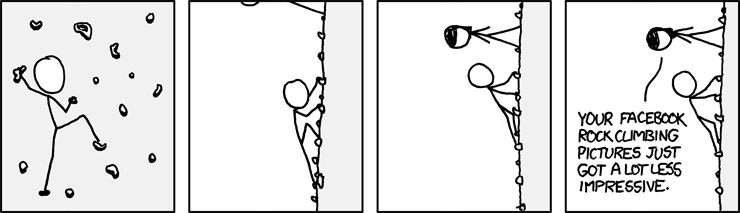
I see through your ruse climbers.
And I loved Soph from the fountainside’s comment on Ben’s post.
I reckon Christians want activities that are ‘cool’ to do, but our obedience to Scripture stops us from doing things the world considers ‘cool’ – i.e. going to parties, raves, pubs and bars…pretty much anything to do with alcohol.
So we tend to flock towards activities that have some cool cred without the ‘worldly’ factor. This is why christian people like random things such as rock climbing, board games, bikes, coffee (the holy man’s drug), jazz (the holy man’s version of ‘cool’ music) and BBC dramas (the holy man’s movie choice).
Abbott and Costello on leadership
Apparently political leadership is all about unity. Unity is much easier when there’s a common cause involved – particularly a cause of value, or one that people can unite to believe in.
Tony Abbott doesn’t really get it. In a manifesto on his political leadership he suggests being in opposition successfully is about being in opposition.
Mr Abbott said he would work to bring the party together because it’s easier to manage a party when they oppose rather than negotiate with the government.
“The best way to unite a political party is to really go after your opponents, which is what I intend to do,” he told the Nine Network today.”
I disagree. I think the electorate does too.
Successful “opposition” doesn’t depend on disagreeing with everything the Government puts forward.
K-Rudd started getting traction with the electorate when he positioned himself as the “alternative Prime Minister” and his party as the “alternative government”… I got so sick of hearing those words before the last Federal election was announced – but mostly because I didn’t like K-Rudd and I could see a correlation between those words and his boost in the polls.
Real leadership means offering policies and informed, decisive alternatives. Not just saying “they’re wrong” as loud as you can.
Peter Costello has a column in today’s SMH detailing his problems with Turnbull’s approach to leadership.
He acknowledged some strengths of his methodology. But diagnosed the problem with Turnbull’s leadership as an inability to cultivate much needed unity.
“To promote unity, Turnbull needed to give all the shades of party opinion a say in proceedings, and to promote colleagues on merit regardless of whether they voted for or against him.”
“A political leader cannot take his base for granted. He must give voice and confidence to the party membership. Australian politics is detribalising. Rusted-on supporters are fewer than ever. To keep those supporters, a party must nourish and respect them.”
Costello seems to think Turnbull was unable to cultivate unity because he was a grasping power monger climbing above his station. He’s particularly scathing on Turnbull’s public statements about Liberal Party colleagues.
I have never seen a Liberal leader attack senior colleagues in the way Turnbull did on the weekend. Turnbull’s attacks have been sharper and inflicted more damage on his colleagues than Kevin Rudd ever did.
If I was running the Labor Party’s campaign in the seemingly inevitable double dissolution election I would be rubbing my hands at the prospect of ads just featuring quotes from Liberal Party members about other Liberal Party members.
YouTube Tuesday: What if?
Do you ever engage your imagination in the pursuit of speculative scenarios.
How would the world be different if Hitler had won the war? What if Ghandi had lived? What if Hillary Clinton had won the US Presidential Election?
What if James Dean had lived?
Or better – what if George Lucas had directed Singing in the Rain…
What’s your favourite what if? Or, what’s the best YouTube video you’ve seen this week – post it in the comments.
A folksy confession
I am on the record, as an intemperate youth, suggesting that Folk Music is of the devil. I recant.
In my dotage I am really enjoying alt.country, folk, bluegrass and other music with banjos.
There’s a slight language warning on this clip – well, it’s not slight. It says a bad word starting with f many times. The rest of the album is free of cringeworthy cursing.
I give you. Mumford and Sons.
I’ve also really been enjoying Fionn Regan. But his “Put a Penny in the Slot” video has embedding disabled. So you’ll have to go to YouTube to watch it.
Conspiracy, correlation and causation
It looks like climate change is going to scupper one man’s ambition to be the next leader of our country. While Malcolm Turnbull considers this inconvenient truth, some might be thinking “at last, climate change has done something good”…
Some are looking forward to the day that climate change does away with our particular stretch of the Great Barrier Reef so that North Queensland can have waves.
And those who sell air conditioning are rubbing their hands together and counting their pools of money ala Scrooge McDuck.
This whole climate change phenomena has me thinking…
Many of my friends are skeptics. Some of my friends are believers. Most of the skeptics believe that the climate is changing (as it always has) though not because of human intervention. I oscillate between the two positions. I do think it’s funny that we’re worried about how much carbon dioxide is in the world when I always thought the net mass of chemicals everywhere was a constant… anyone who remembers photosynthesis lessons in high school science knows we just need to plant more trees…anyway. I’m not a climate scientist and do not intend to talk about what I don’t know in this post…
I have a theory that there are links there are between a few different philosophical outlooks on life.
I’m wondering about what correlation there is between the following beliefs and climate change.
- Christianity
- A “young earth”
- The effect of sin/the fall on the planet
- An old earth
- Atheism
Biblical Christianity suggests that God intervenes in the workings of his creation, that it is under his control (particularly the Psalms) and that sin has tainted the planet as well as its people. There is an obvious link between humanity and any problems with the planet.
Because Atheism rejects the idea that anyone is in control – and must therefore assume that our finely balanced universe is always on the cusp of imploding under its own improbable existence* – atheists should be more concerned about climate change and therefore more ready to jump in and lend an environmental hand even if they’re not convinced by the science. Just in case.
My friends who believe in a young earth should find it heaps easier to believe that humans are partly responsible for what happens to the environment because we’re a more significant part of the planet’s history – and the change is occuring over a much faster period of time if the hockey stick graphs are to be believed. This has to be balanced against the fact that many of them are really good at ignoring scientists anyway.
Answers in Genesis has an article that pretty much sits on the fence, and one that suggests claims of our impending demise are greatly exaggerated…
My Christian friends who believe in an old earth probably fall into one of two categories – they’re either the most skeptical of all when it comes to climate change, or they’re died in the wool believers. For the skeptics, the assumption that God’s sovereignty extends to the planet, meets the assumption that humans haven’t been around for long enough to have had a remarkable impact on the planet’s health.
For the Christian “climate change disciple” the idea that humans have wrecked the planet is consistent with the Bible, and the idea that scientists can teach us about how everything works is consistent with the way they understand the world.
I don’t understand atheist climate change skeptics. Where does their justification come from?
Regardless of these philosophical positions the suggestion that Australia should introduce an emissions trading scheme before the rest of the world is just silly. It comes from some sort of cultural aggrandising that suggests that somehow whatever our relatively small nation does will have an impact on the global scene.
From what I understand of the issue – particularly with relation to energy production (a fair bit at that point) – there are two things we could do that would have a major impact.
- Stop exporting coal
- Start exporting more uranium
I can’t see either of those happening any time soon.
*Not really what atheists think…
Benny on Hitler and the question of evil
Nathan often uses Hitler in religious discussions.
From what I know Europe at the time was a generally disjointed, unhappy place, and everyone knew that war would eventually outbreak, it was just a matter of when. So I wasn’t exactly sure what he was getting at between Hitler’s religion and religion’s involvement in war.
So I got Nathan to explain his point:
“It’s not that wars are based on atheism – it’s that atheism doesn’t rule out wars.
Atheism is not a cause of war any more than Christianity is.
The fact that people are sinful – greedy, power hungry, angry, evil – is what causes wars.”
I would like to make some points:
1. I don’t think evil exists as a being, thing or intangible presence. Evil is a description of behaviour.
2. Hitler didn’t do the things he did because he was evil. Some of the things he did were abhorrent, terrible, disgusting and/or evil.
3. When people do bad things, its not because they are inherrently evil, or were overtaken by momentary evilness. They did it because they were human, and humans make bad decisions for whatever reasons, are prone to being inconsiderate, to certain extent, and have different utility functions, such that some believe risking other people being injured is outweighed by the benefit of robbing the bank.
4. Morals don’t need to come from an external source. People are perfectly good at developing them themselves.
From my understanding, the French/English civil revolutions weren’t uprisings against God, they were class wars, where the poor and oppressed wanted better. I think this could be said to an extent about communism and the disputes in the first half of the 20th century.
Most recently, the war on terrorism has been labeled as a war against evil. I don’t like terrorism, but I also don’t like the way it has been discussed at times. I have always wondered, without being particularly knowledgeable of the situation overseas, if by labeling terrorism as acts of pure evil results in more harm than good, as it fails to address the root causes of offshore grievances.
Further military action in the region is not going to help in the healing of decades-old wounds, which stem from military action of the West into these regions for the past century plus. Dare I say, I think many people within these regions would hold grievances against the West. Further, relying on non-western media, these nations would also have different perceptions of why the West was involved in these regions (I am not necessarily talking about purposeful distortions of history here either, historical accounts and perceptions would likely be different between those who lived through it and those who lived back in the invading country). We can’t expect to be able to interfere with any of these regions, and not step on a few toes.
The remnants of America’s war techniques in Korea and Vietnam still remain to impact the general populace. Many of these people no doubt hold some anger towards the techniques that were used during these disputes that have a continuing legacy.
So, in summary, it may not be best labelling terrorism as acts of evil, which seems a simplistic excuse. It may be that more effort should be made to recognise that the seeds for these peoples anger were sown a long time ago, and that the West played a larger role in creating this anger than we are willing to acknowledge. What we perceive as terrorism could be the remnants of a group of people fighting a decade-old war the only way they have available. They may be cowardly tactics, attacking easy targets of civilians. But they didn’t agree to any war conventions, nor have any large military budgets or technology.
Going forward, hopefully leaders will acknowledge these lessons, and realise that you can’t interfere with a country and expect it not to have repercussions in the future. The conflict doesn’t end with the end of the fighting. More needs to be done to rebuild international relations.
Surviving the Zompocalypse Part 2
Here’s a nice vodcast on how to survive a zombie apocalypse…
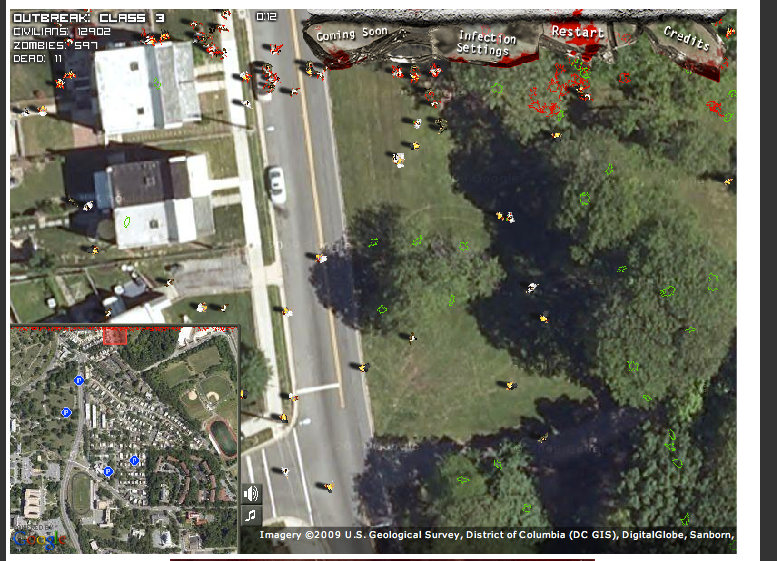
And here’s a nice little webapp for calculating just when your city will be overrun by zombies. Based on modelling conducted in the District of Columbia…
How Twilight Works
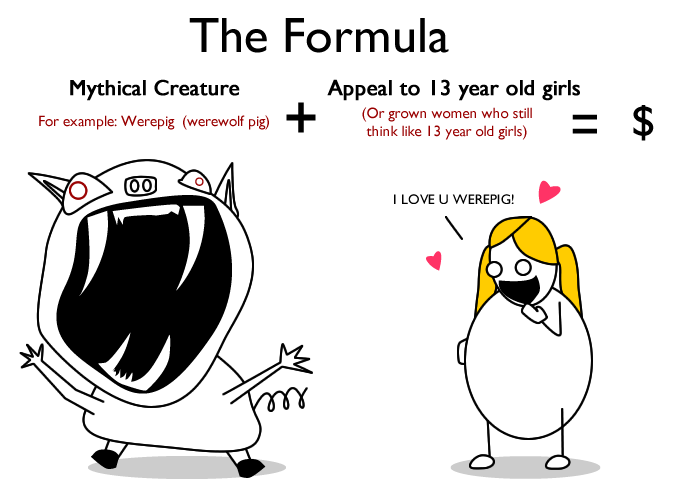
The Oatmeal is brilliant. Here’s the best review of the Twilight phenomena I’ve read yet…
First off, the author creates a main character which is an empty shell. Her appearance isn’t described in detail; that way, any female can slip into it and easily fantasize about being this person. I read 400 pages of that book and barely had any idea of what the main character looked like; as far as I was concerned she was a giant Lego brick. Appearance aside, her personality is portrayed as insecure, fumbling, and awkward – a combination anyone who ever went through puberty can relate to. By creating this “empty shell,” the character becomes less of a person and more of something a female reader can put on and wear. Because I forgot her name (I think it was Barbara or Brando or something like that), I’m going to refer to her as “Pants” from here on out.

Murdoch v Google
Rupert Murdoch is boldly going where no media baron has gone before – bravely stepping outside Google’s search results and thumbing his nose at the internet establishment – and he’s taking his media establishment with him… all the way to Microsoft’s Bing.
I’ve been sharing a few links via google reader on this matter (and on that note – does anybody want to see a return to the daily links posts?). Most “new media” experts agree – Murdoch is a wily dinosaur.
I think there’s a method to this supposed madness. Murdoch’s empire provides a fair whack of content to the Internet – giving Bing exclusive access may give a boost to Microsoft’s bid to enter the search arena. It’s a bold move. But it’s fraught with danger. Murdoch is facing a decline in circulation many people are attributing to the Internet – and he’s decided to tackle that by removing himself from the picture. Quite literally. For most casual internet browsers.
He’s in a quandary. News Ltd relies on advertising dollars to produce content, it doesn’t make a lot of sense for Murdoch to pay for traffic to come to his site via google adwords so that they might click on his ads. The internet gives the distributor all the power, not the content producer – but it’s pretty much the same story anywhere in the media business. Distribution is where all the profit is.
What will be interesting will be looking back on this decision in six months and seeing if the lesser availability of News Ltd work online (it’ll still be there – you just won’t find it via google) will have any impact on circulation. Will people pay to read the hard copy of the paper rather than breaking habits to use Bing? Will the status quo bias prevent people changing their online habits?
Much vaunted internet marketing guru Seth Godin has suggested that Murdoch’s approach to the new age of media is back to front. He says:
“You don’t charge the search engines to send people to articles on your site, you pay them.”
I’m not sure – Rupert Murdoch hasn’t got where he has by paying other people – this is fundamentally a battle of ideologies between the new “free content to everybody” consumer/marketer and the old school monopoly/conglomerate approach.
People don’t want to pay for news anyway – while I read the papers every day (in tangible form) I wouldn’t choose to pay for them personally when I can find stuff online for free. Striking a commercial and exclusive deal with a search engine seems to be a pretty sound rearguard action from Murdoch.
From a PR perspective I reckon Murdoch’s tabloid rags are going to go the way of the magazine – an interchangeable blend of advertorial, advertising and paid comment/editorial. Product placement is the marketer’s dream. I’d much rather pay money to bring a journalist to Townsville on a tour than spend the same amount on a clearly labeled advertisement.
If I were Murdoch I’d be trading on my established credibility/brand and pushing products on unwitting customers via editorial. But I’m not a greedy media baron. So I’ll stick to pushing stupid products via my blog and not receiving a commission at all – or encouraging you to buy a shirt…
There was an old lady…
This book version of the story of the old lady who swallowed a fly looks beautiful.


You can get it here (bookdepository) or pay more here (Amazon).
How to “humanely” kill an animal
Right. It seems people didn’t like the idea that you can’t “humanely” kill anything you’re going to eat.
Perhaps this is what the soldiers from Townsville should have used. A photocopier shaped “taser” that stuns lobsters so that you can then kill them without them feeling the pain… except the pain of 110 volts passing through their exoskeletons.

The application of a stun (110 Volts – 2-5 amps) causes an immediate interruption in the functioning of the nervous system of the shellfish. By interrupting the nerve function, the shellfish (be it Crab. Lobster or other) is unable to receive stimuli and thus by definition, cannot feel pain or suffer distress (Dr. Dave Robb 2000 – Bristol University – paper on sentience in Crustacea, Baker 1975, Jane Smith 1991, Bateson 2000, Sherwin 2000 & Gregory & Lumsden 2000). The prolonged application of the stun causes a permanent disruption which kills the shellfish.
Muppethian Rhapsody
Speaking of Queen tributes – here’s one from the Muppets. Andrew beat me to it.