The recording industry is notoriously harsh on music pirates. They’ve pursued individuals with almost no sense of mercy or having a punishment that fits the crime (I’m not condoning piracy here – I think creative people are worth their keep). And it’s little wonder when you read a factoid like this, about the Recording Industry Association of America’s legal costs when compared to their “wins”:
“…they [the RIAA] spent around $64,000,000 in legal and investigative expenses to recover around $1,361,000.”
If you knew it, you’d say, “Wait a minute. The decision I just made does not make much sense. I had better go and get some independent advice.” But when you’re incompetent, the skills you need to produce a right answer are exactly the skills you need to recognize what a right answer is. In logical reasoning, in parenting, in management, problem solving, the skills you use to produce the right answer are exactly the same skills you use to evaluate the answer. And so we went on to see if this could possibly be true in many other areas. And to our astonishment, it was very, very true.
And here’s a funny story illustrating the issue (which will doubtless make a good sermon illustration)… from the same article.
“Wheeler had walked into two Pittsburgh banks and attempted to rob them in broad daylight. What made the case peculiar is that he made no visible attempt at disguise. The surveillance tapes were key to his arrest. There he is with a gun, standing in front of a teller demanding money. Yet, when arrested, Wheeler was completely disbelieving. “But I wore the juice,” he said. Apparently, he was under the deeply misguided impression that rubbing one’s face with lemon juice rendered it invisible to video cameras.
In a follow-up article, Fuoco spoke to several Pittsburgh police detectives who had been involved in Wheeler’s arrest. Commander Ronald Freeman assured Fuoco that Wheeler had not gone into “this thing” blindly but had performed a variety of tests prior to the robbery. Sergeant Wally Long provided additional details — “although Wheeler reported the lemon juice was burning his face and his eyes, and he was having trouble (seeing) and had to squint, he had tested the theory, and it seemed to work.” He had snapped a Polaroid picture of himself and wasn’t anywhere to be found in the image. It was like a version of Where’s Waldo with no Waldo. Long tried to come up with an explanation of why there was no image on the Polaroid. He came up with three possibilities:
(a) the film was bad;
(b) Wheeler hadn’t adjusted the camera correctly; or
(c) Wheeler had pointed the camera away from his face at the critical moment when he snapped the photo.[2]
As Dunning read through the article, a thought washed over him, an epiphany. If Wheeler was too stupid to be a bank robber, perhaps he was also too stupid to know that he was too stupid to be a bank robber — that is, his stupidity protected him from an awareness of his own stupidity.”
You might be wondering where part two of my book review is. And so am I. More correctly, I’m wondering where the book is. I can’t find it. Maybe the devil stole it.
I’ll keep you posted. Hopefully.
In the meantime, enjoy this profound spam comment left on my last post:
“Think of how retarded the average guy is, and realize halve of them are stupider than that.”
a creation myth highlighting the counter-cultural origin and emergence of the Apple Mac as a transformative moment;
a hero myth presenting the Mac and its founder Jobs as saving its users from the corporate domination of the PC world;
a satanic myth that presents Bill Gates as the enemy of Mac loyalists;
and, finally, a resurrection myth of Jobs returning to save the failing company…”
The scholar responsible for that article summed up the Apple experience:
“When you’re buying into Mac, you’re buying into an ideology. You’re buying into a community.”
It’s funny. In a day and age where the church is trying to figure out how to learn from Apple, Apple seems to have flipped the metaphorical apple cart – in basing its business practices on the church.
I haven’t seen Kick-Ass yet. But real life vigilante Super Heroes are pretty cool in a “don’t try this at home,” “what you’re doing is illegal and stupid” kind of way. You’ll find a bunch of Real Life Super Hero posts around these parts (check the tag below). Here’s a story about a little posse of heroes that covers the basic elements for your gang. If you do want to start one. Which you shouldn’t.
Z is the enforcer. His bedroom just has weights, a punching bag, and a mattress. Victim is the gadget man. He’s based out of town so operates a bit like Q from the Bond movies – shipping in gadgets and technology and scientifically tested armour. Zimmer is the medic. He also wears a blindingly bright light, Iron Man style, as part of his costume. He uses it to stun would be assailants. Tsaf is the group’s girl power. Her name is “fast” backwards. Lucid is extra muscle. Lucy the kitten is their animal mascot
They wear costumes:
“Z sits down and begins strapping on his full body armor, a homemade medley of leather, pads and stainless steel bits and pieces, which he describes as a “poor man’s Iron Man suit.” The suit includes boots, leg, knee and ankle pads. A pair of arm bracers he made out of leather and steel are attached to his arms with truck ties and work as both defense and offense. To complete the look, he wears a black Predator-type mask sure to creep out anyone who sees it on the street. He then puts on his “butcher mail,” a stab-proof apron of metal scales over a lightweight bulletproof vest, which he then covers with a sleeveless, brownleather zip-up.”
Functional costumes – no aesthetic but impractical spandex.
“Everything I wear is either protective gear or to blend in during plainclothes patrols, with gear underneath. No spandex. Ever,” Z explains. “If I ever wear spandex, I deserve to get shot down in the street like the dumbass that I am.”
By night they patrol the streets – essentially hoping to entrap bad people into doing bad things in their presence.
“The strategy is that Z will skate ahead on a longboard, a sturdy, fast skateboard made for cruising. The longboard is also a good excuse to be wearing a lot of protective gear. Next in the lineup is the bait (described as the “nucleus” of the patrol)—usually TSAF or Zimmer. In tonight’s case, TSAF wears a white dress, purple eye makeup and is carrying a bulky purse. She tries to lure predators looking for someone vulnerable. Zimmer follows on foot about a block behind her.
Lucid, if he were here, would act as a runner, skating back and forth on his longboard between the group members as they move forward. TSAF watches for Z; Zimmer watches for TSAF; and Lucid would be watching everyone. Communication is vital: All parties are connected by cell phone, ready to leap into action if anything happens.”
“TWO Victorian couples are suing doctors for failing to diagnose Down Syndrome in their unborn babies, denying them the chance to terminate the pregnancies.”
I hope the judge takes one look at this case and throws the couples on the street.
“The girl, 4, who now attends a specialist kindergarten, was born with heart, kidney and thyroid problems, can’t walk, and needs help feeding, her father said.
“Don’t get us wrong: we love our daughter. She’s part of our family, and we treat her like gold,” he said.”
So they’re saying “we love her, but we wish she had never been born.” That’s not love. That’s sick. You know who else wanted to breed disease out of the human gene pool through selective breeding programs…
I don’t often give serious parenting advice here. I know my audience. But my purpose for this post is twofold – first, to congratulate Steve Kryger from Communicate Jesus for this piece on Sydney Anglicans that has been syndicated on Gizmodo.com.au, and second, to share Steve’s list of ten tips for parents. I think they’re good, and a great acknowledgment that clean feed, or no clean feed, the issue requires a thought out approach from parents not a government mandate.
Understand what your child is doing online (put the computer in a public space, talk to your children, use accountability software).
Ask your child to explain to you what they are doing, and why they are doing it.
Talk to your child about your values, and how these should be lived out, regardless of the environment.
Filter the content that your family views online.
Understand the minimum age requirements for different websites and technologies (children under 13 should not be on Facebook).
Understand how these popular websites are used, and what the opportunities and threats are.
Understand what avenues are at your disposal if something goes wrong (e.g. your child’s Facebook account is hacked).
Consider how you will respond if you discover your child is acting inappropriately, or viewing inappropriate material.
Decide when or if your child will get a mobile phone.
Understand the new functions of mobile phones, and what the opportunities and threats are.
David Thorne, you’ve heard of him right? The guy who tried to pay his debts with a picture of a spider. Amongst other things (hit the David Thorne tag below for all his hijinks that I’ve previously featured).
You’d think, if you worked with such a renowned internet prankster, he’d be the last person you’d turn to for design help. Which is what his colleague did after her cat went missing. She asked for a “lost cat” poster – here are some of the suggested designs (read the email thread here).
I thought I’d share with you some tidbits from the newest edition/addition in my library. These are photos from my iPhone.
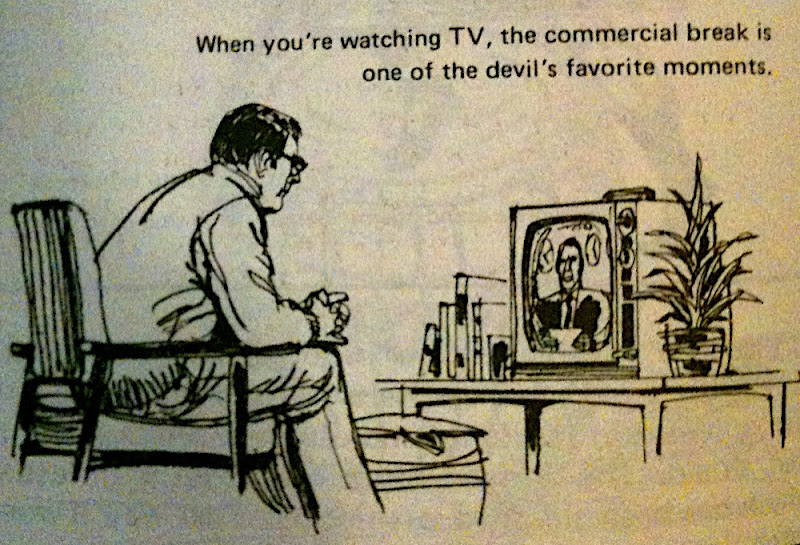
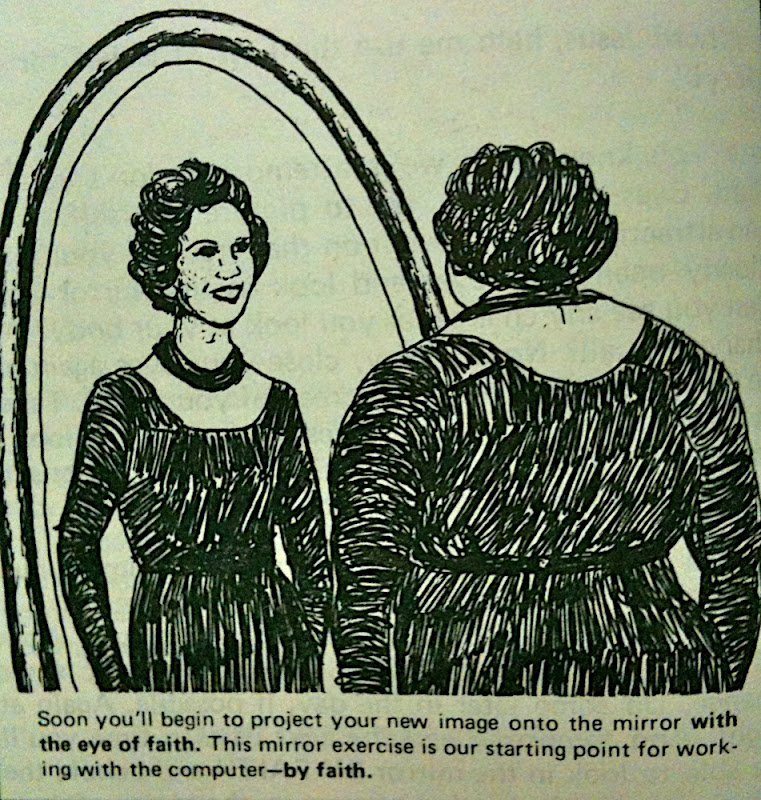
It’s brilliant. It opens with a statement I can paraphrase as: if you/r friend are/is overweight, not only is it the devil’s fault but you should question your salvation.
I’ll deal with the substance of the argument in a future post – but now I’m going to share with you some of what I think makes this book special – its style.
Some of its illustrations look like Chance cards from Monopoly:
With a bit of high art (which may suggest that the original sin was gluttony not disobedience).
The problem is your sub-conscious. It’s the Devil’s playground.
It’s this sort of advice that will set you on the path to skinniness:
It says: “A glass of water will do you for breakfast. It’s surprising how satisfying a glass of water can be.”
The Devil is an imp in a top hat.
He ends up in web of positive thinking and healthy eating advice:
I’ve only posted less than half the post-worthy illustrations here (and they’re photos from my iPhone). I’m hoping to post the rest in coming days/weeks in better quality and with the kind of analysis you’ve come to expect from St. Eutychus.
I trust you’ll enjoy this journey of self discovery thoroughly.
This Old Spice campaign is going to be dissected by social marketing students for years to come. It is almost perfectly executed (I can’t actually think of a flaw yet).
It all started with this critically successful commercial launched during this year’s Superbowl. A commercial which has now had more than 13 million views on YouTube.
It’s a one shot shoot, here’s the explanation of the process:
Here’s the accompanying 15 second ad.
Then there was an equally well executed follow up (with 7 million views).
That was apparently also shot in one take. Isaiah Mustafa, the actor (an ex NFL player) explains…
This was the point at which the Old Spice campaign went from well executed and hilarious commercial to social media phenomenon. They organised an online campaign where the Old Spice Guy responded, in video, to interactions from around the internet. Here he responds to popular tech blog Gizmodo:
Here he helps someone propose to his girlfriend:
Here he, as Old Spice Guy, responds to himself, Isaiah Mustafa…
“In the room there are two social media guys and a tech guy who built a system pulling in comments from around the web all together in real time… We’re looking at who’s written those comments, what their influence is and what comments have the most potential for helping us create new content. The social media guys and script writers are collaborating to make that call in real time. We have people shooting and we’re editing it as it happens. Then the social media guys are looking at how to get that back out around the web…in real time.”
Here’s his sign off from a day of answering the audience:
It’s a campaign where everybody wins. Old Spice, the Creative company Wieden + Kennedy, the writers, Craig Allmen and Eric Kallman, the director and production company, and finally the actor himself.
Successful viral campaigns strike the right balance of humour, production quality, strategy, and level of interaction with the audience. If they’re pitched right they become juggernauts – like this one has – inspiring users to generate their own content. This is the Holy Grail of viral marketing. Getting people past talking about your product and into participating in your conversation.
Here’s an almost equally well produced parody.
This campaign, coupled with Tourism Queensland’s “Best Job in the World” campaign from last year, will set the bar for thinking about integrating marketing campaigns across traditional and new media. It’s an amazingly well executed feat. To close, here’s an analysis of where advertising might go from this point, complete with a nice little quote about the social medium:
“Start here: as it became apparent that this wasn’t just a one-time media drop, but instead an ongoing live performance—a spectacle in progress—I was reminded of some thing that I heard Rex Sorgatz say years ago. I’ll paraphrase, broadly: blogs are actually more related to live theatre than they are to, say, newspapers. The things that make a blog good are almost exactly the things that make a live performance good—and the most important, the magic catalyst, is the interplay with the audience.”
Science has solved the great riddle of poultry origins – in a manner entirely consistent with the notion of an entity creating life (so don’t worry my fundamentalist brethren).
The chicken came first.
“It had long been suspected that the egg came first but now we have the scientific proof that shows that in fact the chicken came first,’ said Dr Colin Freeman, from Sheffield University, who worked with counterparts at Warwick University.
‘The protein had been identified before and it was linked to egg formation but by examining it closely we have been able to see how it controls the process,’ he added.”
Farmville is not a good game. While Caillois [an author of a book on gaming] tells us that games offer a break from responsibility and routine, Farmville is defined by responsibility and routine. Users advance through the game by harvesting crops at scheduled intervals; if you plant a field of pumpkins at noon, for example, you must return to harvest at eight o’clock that evening or risk losing the crop. Each pumpkin costs thirty coins and occupies one square of your farm, so if you own a fourteen by fourteen farm a field of pumpkins costs nearly six thousand coins to plant. Planting requires the user to click on each square three times: once to harvest the previous crop, once to re-plow the square of land, and once to plant the new seeds. This means that a fourteen by fourteen plot of land—which is relatively small for Farmville—takes almost six hundred mouse-clicks to farm, and obligates you to return in a few hours to do it again. This doesn’t sound like much fun, Mr. Caillois. Why would anyone do this?
if Farmville is laborious to play and aesthetically boring, why are so many people playing it? The answer is disarmingly simple: people are playing Farmville because people are playing Farmville.
Here’s the rub. This is why you keep feeling compelled to play a stupid game. It’s social psychology.
“The secret to Farmville’s popularity is neither gameplay nor aesthetics. Farmville is popular because in entangles users in a web of social obligations. When users log into Facebook, they are reminded that their neighbors have sent them gifts, posted bonuses on their walls, and helped with each others’ farms. In turn, they are obligated to return the courtesies. As the French sociologist Marcel Mauss tells us, gifts are never free: they bind the giver and receiver in a loop of reciprocity. “