Category: Culture

On entertaining violence

Craig’s UFC post has opened up a philosophical can of worms. The discussion continued in real life at our Queensland Theological College weekend away with quite a few people seeing the debate in black and white terms based on their personal gut feel. The naysayers don’t see the debate as a matter of conscience, the blood sport apologists don’t see a Biblical problem with the sport, the debate is at an impasse.

For me the debate begs a broader question about violence in entertainment. How many of the anti-UFC types are anti-UFC because it is real and not fictional? That seems to me to be an odd and somewhat arbitrary distinction to make. If the problem is bloodlust then surely the problem arises for those who enjoy violent movies and video games. If I can watch UFC to appreciate the technical side of things (and I watched my first intriguing bout last week – I believe this is possible, like it is possible to enjoy League despite the violent collisions not because of them) and don’t glory in the violence does that appease the anti-bloodlust lobby? Some in the debate say that it is a question of ends and means. If the end is testing to see which martial art is superior, and which fighter is superior – I don’t see how this by necessity equates to the end being violence.

But the begged question remains – can you position yourself against ultimate fighting while also enjoying Fight Club? Can you be for all intents and purposes a pacifist while watching war movies for enjoyment? Can you tell people that their love for mixed martial arts is Biblically unjustifiable while shooting people in a computer game?

I don’t think so. I don’t feel any pangs of remorse about enjoying the Hitman game series – the object is to be a sneaky assassin killing victims with a wide range of weapons. I don’t feel like there’s a distinction between enjoying the violence of Judges (like the story of Ehud) and the violence of whatever David Baldacci novel I’m ploughing through… In this case it would be hypocritical of me to take a stance against those who enjoy a sport that I have not, in the past, enjoyed, simply on the basis of violence. And much of this debate smacks of hypocrisy. I did speak to one Godly brother on the weekend whose aversion to violence (as a conscious conscience based decision) now extends to the war movies he enjoyed in his youth. At that point the issue is surely a conscience thing rather than a Biblically mandated aversion. If you can not, in good conscience, enjoy the spectacle of any of these elements of culture then do no. It’s a pretty easy decision.

All line drawing in these issues – other than being dictated by conscience – seems to be pretty arbitrary (unless it’s clearly spelled out in the Bible). When it comes to computer games where do we draw the line. Is it ok to kill Nazis (Wolfenstein) but not to kill police (when you’re an assassin)? Why is it almost universally ok to chomp on a ghost in Pacman or stomp on a walking mushroom (a goomba) in Mario?

I always feel bad when I kill a civilian in a game (and hope that I always do), and it seems that there’s an ethical line when you kill someone not expecting it as part of their job (in a game that is) – which is why I think the fact that highly trained UFC competitors are involved in the sport of their own volition (as opposed to gladiators in Rome and anyone featured in “bumfights” an online sensation where people make homeless people fight for money).

Here’s a post I just read about how video game developers seek to dehumanise bad guys so that we don’t feel bad about popping them in the head with whatever weapon we have at our disposal. Their tactics include featuring zombies, vampires and nazis as universally recognised bad guys – and if in doubt – masking the antagonist so that you don’t confront their emotions. The writer’s conclusion is this:

I believe that developers have come to realize that, while violence is often a necessary part of the action in many games, most people feel put out at the prospect of ending other peoples’ lives, even digital ones. While there are plenty of games that don’t adhere to the general categories I mentioned, most do. It’s the action and excitement of a scenario that draws us in, death is usually just an unintentional byproduct, but even so some effort is made to separate the gamer from what would be the terrible consequences of their actions. Developers do this because we are, despite what so many political blowhards and half-wit news anchors would have us believe, sensitive to violence in the real world.

I don’t get why as Christians we’re so keen to point the finger at our brothers and sisters to suggest that their enjoyment of a sport is due to some sort of sinful appreciation of unabashed violence. We should give one another the benefit of the doubt on matters like this shouldn’t we? It doesn’t surprise me that the vast majority of people commenting in support of watching UFC have some technical training or appreciation of the sport that they enjoy. These people aren’t the type to get excited about the misapplication of violence outside the context of sport or the pursuit of justice. They just happen to like a sport that is open and honest about the fact that violence is part of the game.

Mad Skillz: Ben on how to create an animation storyboard

Ben is one of my favourite bloggers. He’s also probably my favourite e-friend. I’ve never met him in the real world but his blog is grand and his comments elsewhere are open, honest and full of goodness. Ben drew the little logo on the top right of my page. I’m eternally grateful to him for that.

Ben lives in Sydney with the vowels E, e, and i. His blog is full of the goodness of Proverbs, Peanuts, a weekly quiz and reflections on life in Sydney. As well as the occasional piece of art, cultural review and insight into Ben’s struggles. It’s like a Snuggie (the wearable blanket not the nappy).

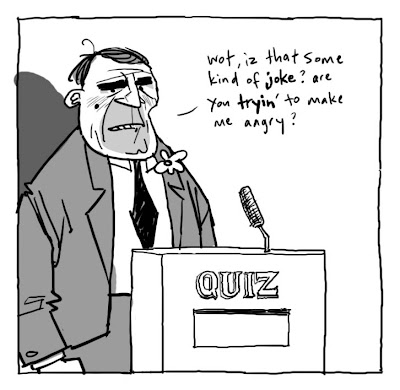
Did you know that Ben is an animator? Cool huh. From what I can gather he works on children’s cartoons. But I might be wrong. There was a time when his inimitable Monday Quiz was accompanied by a weekly cartoon. Like this one.

The key to good animation – or in fact good crafting of any production – is storyboarding. And that is where Ben has chosen to share his expertise as part of “Mad Skillz Week”… I emailed some people last week asking them to contribute (and I thought I’d posted this invitation the other day – but I couldn’t find it when I went looking).

I work in animation, mostly doing storyboards for kids TV cartoons. A storyboard is like a rough laying out of an episode, using a script and soundtrack as the guide. It shows visually how the story will go, and will set up all the required shots. From there it gets into all the laborious gruntwork of actually animating all this– something that I aspire to never have to do myself. Here’s a few things that I’ve learnt the hard way over the years.

  1. Learn how to tell a story. Learning to draw is pretty important too, but there are plenty of good drawers who can’t tell a story visually. And there are rubbish drawers who can tell awesome stories.
  2. Watch movies. Not necessarily animated ones, just movies full stop. This is really the way that you work out how people string together a bunch of different shots and scenes to make a narrative.
  3. Don’t watch new movies. They’re bog. It’s all about flash and dazzle, and a million cuts and camera angles, which mostly just leave the viewer confused, seasick and a little traumatised. These techniques are great ways of disguising the fact that your story telling is rubbish and plot is threadbare. As they say in the industry, you cant polish a turd (editor’s note – Ben had removed the “u” because he’s gentlemanly – but I didn’t want it to look like I was censoring him).
  4. Watch old movies. They’re awesome. What they had to work with was limited, so they really had to think. There was no, ‘oh, we’ll just make that CGI’. Also they were often working with black and white, so they had to work hard on each shot, to make sure what needed to be ‘read’ in the shot could be done so immediately (for example, if you want something dark to be seen, put it in front of white, don’t bury it in a busy background). Hitchcock is a great place to start.
  5. Have as few shots as possible. It’s not clever to move the ‘camera’ around all the time, making tricky, edgy compositions. The priority is that the viewer knows what the heck is going on. Work out an establishing, wide shot to show the environment and where the characters are in relation to each other. From there, just cut in for close-ups and mid-shots. This requires more planning, but means much less work for everybody else down the line, including the viewer.

Follow these 5 tips, and you will soar to realms you dared not ponder in your wildest dreams.

There you have it. Thanks Ben. Anyone else interested in taking part in Mad Skillz Week should send me an email (nm dot campbell at gmail dot come).

Dead letter day

A long time ago in a galaxy far away a stream of text was released with earth as in its path. Or so it seems.

This video made me laugh.

A Swift rebuke

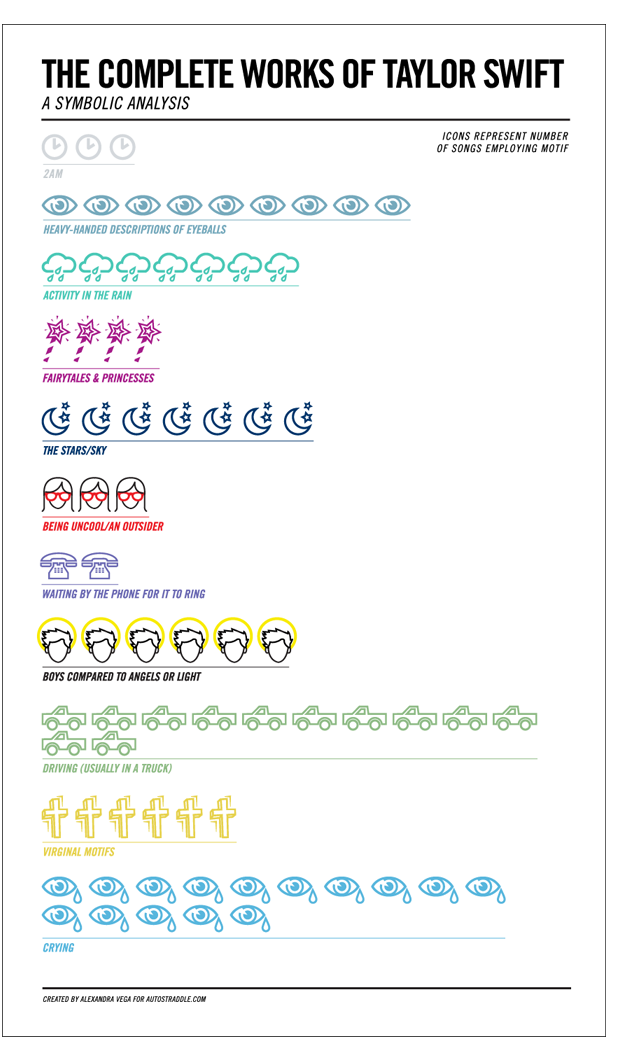
I have to confess that other than that she was the girl Kanye interrupted there’s not a whole lot I know about Taylor Swift. Apparently I’m not missing much though… here’s an infographic about the themes and motiffs of her songs. It’s probably slanderously simplistic. But I like it. So there.

From here (an article that is doubtlessly slanderous in its views – perhaps justifiably so).

If Swift’s work connects with teenage girls, it does so on the most simplistic, reductive territory of all: pining for boys, walking in the rain, kissing in the rain, crying drops of tears on her guitar, driving in trucks with cool boys, wanting boys she can’t have, more rain, more letter-writing, more stalking, more broken hearts, breathing problems as a side-effect of broken hearts, fairytale princess this, white horse that, more pining at the window, more psuedo-stalking, more incomplete hearts yearning for your touch, and one song that misinterprets Shakespeare and The Scarlet Letter so criminally I’m certain she’s never read either.

Swift simply hasn’t had the life experience and doesn’t inherently possess the emotional maturity to create great art. Which is fine — most young pop stars don’t, which is why they don’t win Grammys.

Nice.

Lava Lamp Love

I love my lava lamp. I picked it up for $15 from a market about eight years ago – much to my father’s chagrin. “It’ll never last,” said he. It has thus far proved him wrong. And he was, at one point, admittedly envious.

I’m told that Andrew and Simone’s boys like some of the stuff I post here – and I know they’ve been working on their own lava lamps… so here’s a Lava Lamp recipe I found at “What’s that stuff“… a cool site exploring the ingredients of stuff. Sadly it seems most of the ingredients are a “trade secret” or not available in the home laboratory… but this is a start.

Water and wax, which the original patents name as main ingredients, remain components of the commercial recipe, says Tom Spain, vice president of sales, marketing, and product development for Haggerty Enterprises, the official U.S. manufacturer of Lava brand lamps. Additional agents, he explains, help the wax gently plume upward instead of breaking apart into bubbles as it is heated and keep wax from sticking to the sides of the container.

Walker’s U.S. patent mentions additives such as dye, mineral oil, carbon tetrachloride, and polyethylene glycol (PEG), but the exact formula of commercial lamps is a trade secret. Spain tells C&EN that only five or six staff chemists know the formula and are in charge of occasional reformulations. Densities must be recorded for each batch of wax that Haggerty makes, which is mixed in 5-foot-tall vats in factories in China.

Last but not least, the water layer is added to the cooled wax very slowly so as to avoid creating emulsions, which are cloudy-looking oil-water mixtures. In fact, the recipe for the water layer is carefully adjusted to perfectly complement the density of each unique batch of wax.

Uninstallation Art

This is a cool sculpture. Created by artist Caleb Larsen, it is set up to perpetually sell itself on eBay.

Every ten minutes the black box pings a server on the internet via the ethernet connection to check if it is for sale on the eBay. If its auction has ended or it has sold, it automatically creates a new auction of itself.

If a person buys it on eBay, the current owner is required to send it to the new owner. The new owner must then plug it into ethernet, and the cycle repeats itself.


It’s currently listed at just over $6,500.

YouTube Tuesday: Party Trick edition

So keen am I to bring you this regular column that I’m posting these having not actually watched them. We’re still working with a tethered iPhone here…


What’s your party trick?

Back to the blackboard

Blackboard was the best thing about Mr Squiggle. His “upside down” catchphrase was the backdrop to my childhood. At least once a week. And while I’m on the subject of Children’s television in my childhood – does anybody else remember that show called “Teabag” or something – the one where people were looking for spoons and pearls or something? Anyway. I’ll probably google it.

This photographer has put together a gallery of upside down portraits of people. I assume he hung them by their toes or something… whatever he did… it came out pretty awesome.

The Beatles hit the charts

The Beatles are no strangers to the charts – but they are perhaps unfamiliar with online fanboys turning their careers into infographics. Charting the Beatles is a cool, and slightly ambitious project that is producing charts like this one which is based on the fun fact that Beatles songs often contained references to other Beatles songs.

iWant


The geek brigade have pretty roundly condemned the iPad (that picture from here). I can’t help but think that they might be missing the point – like this guy suggests – the iPad isn’t an awesomely powerful tool for geekiness. It’s an e-reader with a built in media player.

Today a Kindle 2 is $289 on Amazon.com. A Kindle DX with a 9.7″ screen is $489. For $10 more for an iPad I get:

-8x the storage
-a color screen
-a touch screen
-a touch OS
-a better web browser
-a better media player (iTunes)
-works on my home/work/plane wifi network
-the ability to download apps that do other things like play Scrabble and do Crosswords

Sure, it could have been so much better. Apple could have packed in the features. But then the price just couldn’t have compared with that of the Kindle. Being a recent convert to the Apple Fanboy Club I am going to put my faith in Steve Jobs to deliver a workable product rather than all the Internet critics who apparently know (and expect) better…

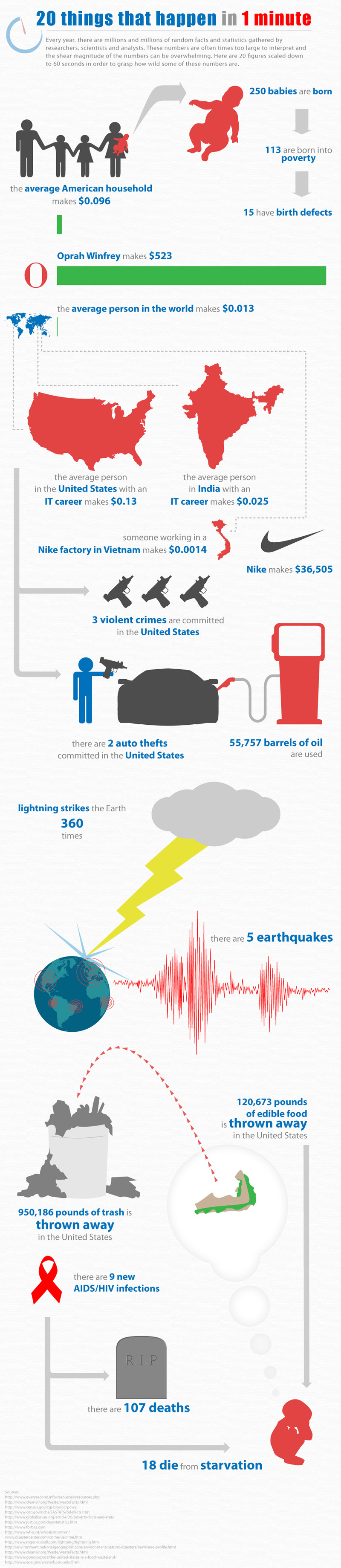
Stuff that happens in one minute

Have you ever wandered away from roasting coffee for just a minute only to look back and see your kitchen filling with putrid smelling smoke that brings about mild symptoms of asthma? No. Well I have. Just now. A lot can happen in a minute (or 6 minutes which truth be told was how long I had left for).

Here are just some of the amazing things that happen in a minute.

The quick are the dead

Have you ever paid close attention to duels in Westerns? The guy who gets his gun out first always loses. A scientist decided to “mythbust” this phenomena.

It turns out you do actually move quicker if you’re reacting rather than acting.

Bohr was seemingly unhappy with the Tinseltown explanation that the good guy, who never shoots first, always wins. Legend has it that he procured two toy pistols and enlisted the aid of fellow physicist George Gamow. In a series of duels, Bohr never drew first but won every time. The physicist suggested that the brain responded to danger faster than it carried out a deliberate intention.

A UK scientist named Welchman put the theory to the test.

Welchman’s team organized simulated “gunfights” in the laboratory, with pairs of volunteers competing against each other to push three buttons on a computer console in a particular order. The researchers observed that the time interval between when players removed their hands from the first button and when they pressed the final button was on average 9% shorter for the players who reacted to an opponent moving first. However, those who reacted to a first move were more likely to make an error, presssing the buttons in the wrong order. Welchman speculates that this rapid, if somewhat inaccurate, response system may have evolved to help humans deal with danger, when immediate reaction is essential and the risk of an error worth taking.

Natural functions

Maths and nature go hand in hand. Pine Cone patterns occur in a Fibonacci sequence. And now it seems that plants grow according to mathematical functions. At least if you’re a mathematically inclined photographer who goes looking for such patterns.

More here.

How to be “awesomely” sneaky like the CIA

This is one of those “ah ha” moments. The CIA has released some operating secrets from the pre-technology era. Those guys were high tech. You can buy a book filled with awesome tips. Like these. Via the Boston Globe.

Among the CIA's many tricks during the Cold War, it turns out, was some actual magic.

That’s not the best one.

Among the CIA's many tricks during the Cold War, it turns out, was some actual magic.
And this, friends, is my excuse. It’s particularly prescient because a good friend told me (before I left Townsville) that he doesn’t think of me as a deep thinker.
Among the CIA's many tricks during the Cold War, it turns out, was some actual magic.

A lightbulb moment

Cardboard tube fighting is so passe. All the tough guys are now taking their sporting conflict to the streets with fluorescent tubes. At least in Japan.

Once, at work, after replacing a dead bulb I thought it would be fun to swing the old tube around and ended up whacking it on the big bin outside. They shatter like crazy. I can’t imagine this being good for one’s health.

Some of the pictures at this link are a little disturbing. This is the least disturbing of the bunch.

japanese_neon_fight4.jpg