I like this shirt. I would like to own it. I wonder if little sister number 2’s birthday shirt voucher extends to Threadless…

Shirt of the Day: The Beetles
Thoughts and resources regarding Christianity and Science
The question of origins is one of those elephants in the Christian room – it causes fights. I’ve started treating it as a taboo topic – it only ever causes division. But it’s a question that is increasingly an important one to have thought through when it comes to apologetics and evangelism.
Sometimes Christians can be a bit like the guy in this XKCD cartoon when it comes to widely held and established scientific belief.
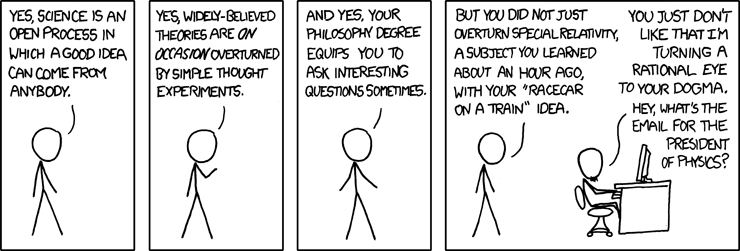
Scientific questions can be hard – but ultimately our faith is not predicated on rejecting the scientific method and human knowledge of the world – but on accepting the resurrection of Jesus and God’s revelation of his grand plan to tackle the problem of sin and death in a new creation.
The issue of science can be polarising. I shared this article in Google Reader the other day (also – please note – I don’t always endorse the content of articles I share, I simply share articles when I find them interesting) and prompted an interesting discussion with some Christian siblings on google buzz.
Here are some interesting articles I have been reading and pondering on the issue in recent times. Including a few from BioLogos – an organisation set up by Francis Collins to highlight the compatibility of Christian faith and faith in scientific discoveries (I’ll post the blurb about the organisation after the links).
- Michael Jensen advocating a less tolerant approach to the issue.
- A follow up to the “why I’m no longer a (young earth) creationist” linked above entitled “Why I’m neither a creationist or an evolutionist”
- A “scholarly” article from BioLogos on Theistic Evolution (PDF).
- An article from Tim Keller on how to handle the issue pastorally.
- An article linking the currently accepted “fundamentalist” position on Genesis 1 to the “Fundamentalist” movement of the early 20th century and the failed Seventh Day Adventist prophetess Ellen White.
- Here’s a quote from Augustine that shows what the oft-venerated church father thought of reading Genesis as science
- Evangelical Christian and quantum physics genius Ross McKenzie recently shared the slides from a sermon he preached on Genesis 2.
You may have noticed that most of these resources support a non “young earth” position – I am sympathetic to those who want to put a high value on scripture, and I think we should recognise the science is a fallible human construct. If you’re going to read any of those articles read Keller’s it is by far the most useful.
But I think we also need to consider that the author of Genesis did not intend his work (and depending on your view of scripture – neither did God) to be read as science but as theology. The question then is what does this teach us about God and his redemptive plan first and foremost.
And I want to stress that I don’t think your personal views on Genesis are salvific – and it is possible to lose your faith in a young earth without losing your faith in the atoning work of Jesus on the cross – if we make this issue the yardstick of orthodoxy or fellowship we run the risk of being gravely wrong when we get to heaven and find out the truth.
About BioLogos
On one end of the spectrum, “new atheists” argue that science removes the need for God. On the other end, religious fundamentalists argue that the Bible requires us to reject many of the conclusions of modern science. Many people — including scientists and believers in God — do not find these extreme options attractive.BioLogos represents the harmony of science and faith. It addresses the central themes of science and religion and emphasizes the compatibility of Christian faith with scientific discoveries about the origins of the universe and life.
Dial a colour spray can will recolutionise street art
Brilliant concept. Lugging a bag full of spray cans around is what has always turned me off being a graffiti artist.

“Generally, spray cans contain only one colour. If only a small amount of paint is required, there will be considerable wastage. Color Dial Spray is a new type of spray can that contains CMYK colour cartridges in the one can. The user can immediately change the colour by turning the colour dials near the top of the can.
There are two dials: one for hue and one for brightness. These allow for precise mixing of the particular colour desired. The colour cartridges can be refilled many times over. This helps with the reduction of waste. The compact form of Color Dial Spray is convenient and portable.”
Cool Star Wars Hoodie not a contradiction in terms
I’m not really a Star Wars fan – I haven’t seen episodes three or five of the six movies – nor have I read any books or watched any of the other productions (like the animated ones). But I would totally wear one of these Marc Ecko hoodies if they weren’t so prohibitively expensive (there are five varieties).


Pacman joke book is no joke
I saw this Pacman book on Awful Library Books and thought “ahh, prime blog fodder… a book filled with funny Pacman stuff”… so I did some research. And I was disappointed. These aren’t jokes. They’re Pacman themed cartoons that aren’t at all funny.

Here are some examples that I dug up (here).


YouTube Tuesday: My Guitar Hero
I’m still trying to clear up my queue of stuff I have been planning to post for ages. This is incredible. It takes Christmas light displays to a whole new level. A guy rigged up his lights so that passers by could play guitar hero with them.
Just shoot them
Sometimes, when I am watching stupid people on television (normally reporters on current affairs programs) I wish I had a gun that could transfer energy through the television and cause the person at the other end some pain. This would be a great way of showing frustration and a terrific piece of user interaction. Eddie Maguire would be in big trouble.
This one function remote will, when pointed at the television, either turn the box on or off, turn up the volume, or change the channel. One day Eddie. One day.

Dust to dust
Dust makes me sneeze – and getting rid of it makes me happy. This artist, Paul Hazleton, collects dust and turns it into art.

Lego robot metaphorically smashes Rubik’s Cube
I had a housemate who could solve a Rubik’s Cube in under two minutes. Every time. It’s just a matter of understanding the fundamental principles of the Rubik’s Cube and applying that understanding with dexterity.
Two minutes is impressive. Twelve seconds is amazing. And that’s how fast this Lego robot solves the cube.

Watch it in action.
Jesus and science
Have you been to promotingjesus.org? Why not. It’s Mitchelton Presbyterian Church’s new evangelistic tool – they’re spending a year encouraging people to promote Jesus. It’s a great resource.
My future brother-in-law, Mitch, put most of it together. He’s done a great job. I am writing a few articles there. There’s one up already and here’s one I’ve just written (that’ll no doubt be edited before going live).
Jesus ignores science
There are many people – both from the scientific and Christian communities – who would take this statement to a further extreme. They would argue that being a follower of Jesus means rejecting science. And certainly, science is ultimately a fallible human product. It is not perfect. To hold what we now think we know to be absolutely true (based on science) is dangerous ground. This is why scientific principles are called theories. Science is always waiting for a better explanation. A more complete picture.
Jesus did not ignore science. Jesus does not contradict science – and in fact you can hold to scientific truth and still be a Christian – providing you are willing to submit to the idea that Jesus, as God, is not bound by the rules that apply to you and I. Our null hypothesis as believers – the point at which all scientific theories begin – is that there is a God who has influence over the way the world works.
The truth of Christianity doesn’t pivot on a great conflict between scientific beliefs like evolution and contrary claims in the Bible. The truth of Christianity hangs on the person of Jesus. Did he exist? Did he perform the miracles the Bible claims he did? Did he die and rise?
There is a scientific element to these questions – but more than any other religion – Christianity submits its claims to the scientific method for observation and testing. Jesus started by posing a hypothesis. He asks us to test his claims that he is the son of God and the saviour of mankind. His ministry was measurable and observable. It occurred in public in front of tens of thousands of witnesses around the regions he travelled. His miracles were repeatable – they were not – based on the accounts of his life – one offs.
Those around Jesus were able to measure and observe – and had his claims been bunkum they would have been able to refute them. But time and time again those in positions most likely to refute his actions – for example his sparring partners the Pharisees – were left having to accept that there was something unique about him.
No other religion subjects its deity to such scientific scrutiny. Jesus was tangible, he was tactile. The resurrection is without doubt the hardest claim for us to accept based on current scientific knowledge. We know people don’t just rise from the dead. This is where the hypothesis that there is a God involved becomes important.
If Christians claim that Jesus rose from the dead – a claim seemingly counter to our scientific principles – then this is where science and Christianity collide. The resurrection of Jesus is a question of history not a question of science. Did it happen? If it did then it must influence our understanding of science. We must accept that Jesus was who he claimed to be.
The scientific method is relatively young. The model we understand and apply when testing truths is the product of the 19th century enlightenment. People were no less skeptical of claims of resurrection prior to the enlightenment. We’ve always had a sense that rising from the dead is an extraordinary occurrence. Even the religious people of Jesus’ day didn’t necessarily believe in the possibility of the resurrection of the dead – Paul uses this division when he’s on trial in Acts chapter 23.
While the scientific method wasn’t around while Jesus was alive, God knows the type of questions people ask. And so we meet Thomas – often called “Doubting Thomas” but perhaps more appropriately “Scientific Thomas”.
Thomas was a disciple. He’d travelled with Jesus for years. He had heard Jesus say (a few times) that he would die and be raised from the dead. It seems he didn’t believe this was possible.
After Jesus had died and been raised he appeared to the other disciples and ate some food. But Thomas wasn’t there – and he didn’t believe the claims his friends (the other disciples) made about their meeting with Jesus.
So when Thomas was confronted by the resurrected Jesus his first thoughts were the same that ours would be if we were confronted by a friend we knew was dead. Thomas had seen Jesus die, he knew he had been buried. So he thought he was hallucinating. He thought, perhaps, he was being confronted with a ghost. He didn’t believe in that sort of stuff so he put it to the test. He conducted an experiment.
This is the story John’s gospel ends with – an account of the scientific testing of the resurrection and the belief of a skeptic… in chapter 20…
Jesus Appears to Thomas
24 Now Thomas (called Didymus), one of the Twelve, was not with the disciples when Jesus came. 25 So the other disciples told him, “We have seen the Lord!”
But he said to them, “Unless I see the nail marks in his hands and put my finger where the nails were, and put my hand into his side, I will not believe it.”26 A week later his disciples were in the house again, and Thomas was with them. Though the doors were locked, Jesus came and stood among them and said, “Peace be with you!” 27 Then he said to Thomas, “Put your finger here; see my hands. Reach out your hand and put it into my side. Stop doubting and believe.”
28 Thomas said to him, “My Lord and my God!”
29 Then Jesus told him, “Because you have seen me, you have believed; blessed are those who have not seen and yet have believed.”
Jesus does not ignore science – though he could be forgiven for doing so because the scientific method wasn’t around when he was – Jesus submits his claims to science, and he triumphs over science. True knowledge and understanding of the world comes from an understanding of the one who created the world – and the one who triumphs over the realities of the world – death and our inability to live meeting God’s standard.
What not to wear in a mug shot
Want to know what not to wear when you’re about to get arrested for a crime? Don’t wear what these people wore. It’s that simple.

Mad Skillz: Izaac on writing Christian parody songs
Do you read Izaac’s blog yet? You should. It’s funny. And it’s by my friend Izaac. Izaac and I grew up in the town of Maclean. We’re both first years at Bible college. Maclean has a good chance of having the highest per capita production of blogging bible college first years in Australia. Anyway. Despite the self deprecation Izaac is a pretty talented guy. I wouldn’t have had him MC our wedding reception otherwise. It might have been ruined.
Here’s his mad skill.
I’m average at a lot of things. I lack the dedication and motivation to be truly awesome at any individual skill. I play piano but don’t read music, I play guitar but can’t play lead, I sing but only by the broadest definition of the word and at 25 I just started learning the clarinet and can only just make a noise. I am in no doubt this ‘could be better’/’could be worse’ stance has continued into the realm of blogging.
One thing I can do however is shamelessly plagiarise the works of others for personal gain (though parody is protected by law and I don’t actually get any benefit from it). I now present to you Mad Skillz – How to write Christian Parody Songs.
- Don’t be obvious.
Every man and his dog has thought about re-writing the lyrics to “I’m a Believer.” No one thinks you’re clever.
And then I saw God’s grace/Now I’m a believer/Now there’s not a trace/Of doubt in my mind.
All you’ve actually done is replaced “her face” with “God’s grace” which is both vague and potentially confusing jargon. It’s akin to re-writing Bryan Adams Everything I Do (I do it for you) by replacing every “you” with the word Jesus. - Choose enduring songs
There’s no point putting all that effort in just to have the original song fade into oblivion by the time the next ARIA chart is released. It’s better to choose songs by established artists and particularly their earlier work. Along the same lines rock and/or roll endures while other styles tend to fade away. Pop sensibilities change and most dance music has a particularly short lifespan. Remember Disco?This is the current ARIA Top 5 – Replay by Iyaz, Fireflies by Owl City, Blah Blah Blah – Ke$ha, Memories – David Guetta Feat. Kid Cudi, Tik-Tok – Ke$ha. No doubt like me you’re scratching your head wondering who these people are and how long since Coldplay released a single. Don’t re-write any of these songs.
- Pick songs with lots of lyrics.
A lot of modern music is based more on the beat and bassline than the lyrics. Go for artists that are particularly verbose. I once attempted to use the entire Beatles #1 album to re-tell Romans. It was really hard with the shortage of lyrics and the length of lines for many of the songs. Make sure you have enough words to tell your story. - Not all ideas are created equal
Sometimes a great idea won’t work in practice, at other times all you need is a word or phrase to kick you into action. When I re-wrote Little Lion Man about Daniel in the Lion’s Den, it was just the word ‘Lion’ that got me thinking. I broke Rule 2 because the song won the Hottest 100 which ensured a lot of instant recognition. For those thinking I broke rule 1, I would contend because the song isn’t actually about lion’s it isn’t all that obvious. Maybe I’m just trying to say you don’t need much of an idea to have a go. - Lighten up
You’re essentially engaged in an act of humour. That means you must try to be funny, even if you fail. People will already be smiling because “Hey, isn’t this that song? But listen that crazy cat has changed all the words.” Don’t get bogged down with too much seriousness. I wanted to convey in Little Lion’s Den that King Darius hoped Daniel would be frightened by the punishment. The line I was trying to rhyme with said “Tremble for yourself, my man” I went for “Tremble in your sandals Dan.” It’s not funny ha-ha, but it works because it’s a play on “tremble in your boots” plus sandals are inherently funny. - Realise it’s not a congregational song
Simone writes God-glorifying congregational lyrics which she tells us aren’t particularly suited to recounting narratives. Parodies on the other hand are a perfect vehicle for retelling Bible stories. The lyrics remain the driving force behind the song, so craft them carefully but just realise you are unlikely to get a parody onto the next EMU cd, so write accordingly. - Follow the metre of the original
Most popular songs aren’t modern poetry. Some are, most aren’t. That means lyricists often squeeze in extra words, change the length of lines, occasionally change the rhyme pattern. Wherever possible try to work off the same number of syllables sung with the same staccato as the original. (Apologies to those who know anything about music and realise I’m using technical musical terms without actually knowing if they’re appropriate.) - Rhyme like with like.
It’s hard to strike a balance between rhyming with the original rhymes and telling the story you want to tell. Wherever possible try to rhyme with the original sound,. If there are multiple rhymes within a line, work extra hard to include them. A lot of the humour in a song can come from rhyming closely to the original. My version of Little Lion Man isn’t overly humourous – but those who know the original hopefully appreciate the effort I went to replacing the repeatedly dropped F-bomb with “Luck”, “just”, “stuck” and “plucked”. - Production values count
There’s nothing worse than writing a parody only for the hearer to be unable to recognise the original. If you are recording try to be as close to the original as possible. Personally, I would never sing on a recording if I had the choice, but seeing as most of my recording is done using my MacBook set up at home when Sarah is busy I am left with the devices and skills that I have. As most people don’t have the budget to accurately record or proficiency to play live close to the original, it is important to understand musically what is the hook to the song. It was too difficult to learn and record my Missy Higgins parody on piano, so I played the piano riff on a harmonica over my guitar to make it stand out and the song instantly recognisible. - Arrogantly overstate the history of parody songs in the Church
Having written a number of parodies, a few of which I’ve recorded I like to exaggerate the history and importance of parody songs. I think I heard somewhere once that many old church songs were written to famous tunes such as “God has spoken by his prophets” to Beethoven’s Ode To Joy. But more than that, a number of songs were written to famous pub tunes. Though on reflection I’m pretty sure the lyrics to pub tunes I’m referring to were by the heretic Arius. Hmm… this is an awkward place to finish.
Internet loop
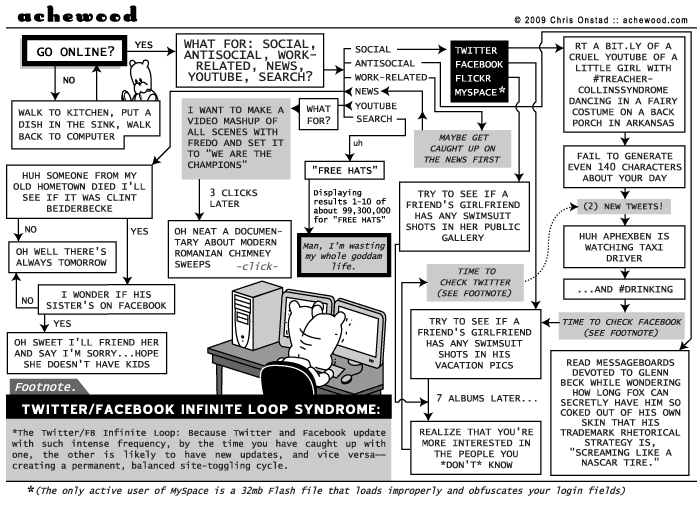
Have you ever tried to procrastinate for just a minute and ended up in an infinite loop of social networks. I try to create my own loop by sending all of my posts to Twitter and Facebook – and then sharing them in google reader and sending them to Twitter again. People must get so sick of me if they follow me everywhere… but that’ll teach you. Stalkers.
If I enabled one of my plugins that creates a new post from every tweet and the other plugin that creates a new tweet from every post I’d have some sort of perpetual internet motion going on.
Anyway, here’s a nice flow chart that documents the phenomena.
Value Ad-ding
Television commercials in regional areas are commonly bad. You might, if you live in a regional area, have assumed that low production standards and owner operator cameos were endemic to your particular geographic region – but I assure you – this is a global phenomenon.
Rhett and Link love local commercials. Especially these ones.
They were so inspired by ads like this that they now travel the United States making local commercials for local companies. Awesome.
Shirt of the Day: πzza in a shirt
I wore my maths shirt to college this week because it has a Greek letter on it. I might have to splash out on this one so that I can fill all my days with π humour.
