You have to watch this until 1:10 seconds in. The kid is a pro simply because of how he recovers from that point.
Coffee: A real page turner
Brilliant. This is what life powered by coffee looks like. Everything is broken, but small tasks are manageable.
Crossposted at thebeanstalker.com
Cool five person solo guitar Gotye cover
This is all over Facebook already. But I’m on the farm in Dalby, so can be forgiven for being behind the times.
Also interesting, and related, is the content of the deluxe version of Gotye’s making mirrors, which describes the process of putting together some of his songs.
Will you bring social media to the real world with a “Facebook Card”?
These are interesting. I thought social media and online profiles were meant to kill the business card. Not reinvigorate them.

They appear to be officially endorsed by Facebook. You order them via your Facebook account. Once you’ve got Timeline turned on.
“To make your own Facebook cards just go to your http://www.facebook.com/yourfacebookusername/info and hover over the little Business Card in your Contact Info.”
Once Facebook figures out how timelines are going to work with business pages I might get some of these for a few of my pages, and some social media clients. They look a bit schmick.
Sadly they’re being released in small batches, and are sold out today.

Amazing dot art is amazing
Some details:
3.2 million dots. Using one pen.
“The number of dots is an approximation, not an exact number. But it’s a very very close approximation. I filmed myself in just about every section of my drawing and got an average of 4.25 dots per second. That translated into 3,213,000 dots if you multiplied that by 210 hours, which is what I logged in for the entire drawing. Because I know it can’t be exactly accurate, and because I think I might be off just a few thousand dots or so, I rounded it off to an even 3.2 million.
How long did this take?
I logged in exactly 210 hours of just stippling, but it took nearly one full year to complete from start to finish.How many pens did you use?
Just one! I had many pens as backup, but I never had to use any of them. Go Sakura!”
Video games as pro-God propaganda
Two pieces have piqued my interest today. Unrelated, but related. The first, from Overthinking It, questions whether video games, by their nature, inspire belief in a creator.
Now, I’ve given up on taking part in apologetics debates online, and mostly on the need to convince people of God’s existence using science and philosophy. It’s not that I don’t find the arguments convincing, it’s just that I think that the gospel is more than fancy logic, and people aren’t going to be argued into believing it (though such arguments might be part of conversion).
Anyway. This is interesting because it considers Christian apologetics from the perspective of a video gamer, who seems to be more interested in philosophy than religion.
Here’s a longish extract.
““It was incredible,” you say. “I mean, if anything had been just a little different – if those question blocks hadn’t been exactly where they were, or if there hadn’t been those Piranha Plants and that Propeller Cap inside but, let’s say, a Fire Flower instead, I’d never have been able to get those star coins! Everything was arranged so perfectly, so precisely. It really makes you think it was all put there on purpose, you know? Like it was designed.”
Luigi, ever the skeptic, replies: “But if things weren’t the way that they are, they’d just be some other way instead. Maybe in that case you’d be raving about how unlikely that was. Or you wouldn’t have known there was any star coin there at all and you would have just kept on going.”
The argument Mario and Luigi are having here is what’s known in philosophy as the Anthropic Principle. In one certain formulation, the Anthropic Principle puts forth the idea that the laws of the universe and the particular circumstances of our place in it seem so precisely modeled to bring about the necessary conditions for intelligent life – so fine-tuned that if any one element had been just a little different it would be impossible for human beings to exist – that it indicates a Creator who intentionally made things this way in order to bring us about in the way that we are. Basically, it’s an argument for the existence of God. That’s what Mario is proposing and it’s often referred to as the Strong Anthropic Principle. Luigi’s point is that the appearance of design is no proof of design, because if things were different enough that we couldn’t exist to observe them, we wouldn’t be around to notice. So we don’t exist “on purpose,” but since the universe happens to be the way that it is, it just happens to be possible that we exist too.”
The article goes in pretty interesting directions after that. It’s worth reading.
The second article was from a Christian gamer, writing at Christ and Pop Culture, reflecting on the Skyrim experience, and the treatment of “theology” present in the latest, greatest, RPG.
“As I was exploring Skyrim, I was attacked by a band of cultists dedicated to the god “Boethiah.” Upon defeating them, I learned of the location of their cult and out of curiousity, decided to go investigate it. When I found the priestess of Boethiah, I learned that the cultists had been luring innocent people to their shrine and killing them in worship of their god.
There was no option to report the cult to the governing authorities, so I decided it was time to bring some vigilante justice to these murderers. I carefully planned out each of my attacks and took out each of the 6 cultists who were stationed near the shrine. Just as I took down the last one and was beginning to feel as though I had done something good to protect the innocent citizens of Skyrim, my screen blurred and I heard a voice from the heavens shouting, ”WHY HAVE YOU KILLED MY SERVANTS!”
It was disturbing to say the least. In a moment, a god, who in my mind only existed as a cultural artifact, came to life. I couldn’t have a detached relationship to Boethia because in the world of Skyrim, he actually exists and I found myself face to face with him.”
Fun stuff. But ignore all this, because video games are stupid (at least according to some).
Photo renditions of famous art
I love this idea. From now on most of my photos are going to be inspired by the composition of famous artworks. At least until I have my next cup of coffee.
Some that I recognise…



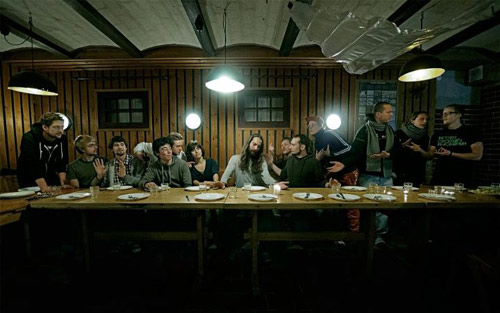

Here’s the first of the series on booooooom.com, there is some “artistic” nudity involved (of the painted, classical, variety, and some discrete photographic recreations).
Via Kottke.org
News presenter loves lamp, reads everything on his autocue
Anchorman is one of my favourite comedies. This, then, is brilliant.
Via 22 Words.
Vinnie Jones is heart smart
Thanks to Scooter for this one.
I love Vinnie Jones.
This is why.
Then for his turns as a crim/hardman in the fillums.
Goalkeeper scores amazing length of the field goal
Go Tim Howard. This is a goalkeeper’s dream, and the other goalkeeper’s nightmare.
How to get over a broken engagement with poise and awesomeness
This guy had a leftover engagement ring he didn’t know what to do with. So he sold it on ebay and bought a Master Chief suit.
“Eventually, unable to sell the ring in-person to anyone, the canary yellow diamond found its way to eBay, sent away in a priority mail, insurance stamped box. Distancing myself from the process made it easier. The funds in my PayPal warmed my heart for the most part, but lurked there, reminding me of what I lost and where that money came from.
I had to get rid of it.
And not just some of it, but every last penny. On something I always wanted, but could never afford. Something that would make me feel a little less empty inside.
So I immediately spent the money on a suit of Master Chief armor.
This wasn’t as sudden or spontaneous as it sounds. The Halo armor was a long time coming. For years, I’d mused over the idea, driving my closest friends mad. One day when I have the money, I’d say, thinking about that canary yellow diamond. I have to be responsible right now.”

Via the Bygone Bureau
Coining the offside rule
The British Mint is producing a series of sport related coins for the Olympics. This one will be welcomed by husbands/boyfriends/brothers/fathers everywhere.

My wife assures me she understands the offside rule. So I’ll just have to use it to teach my daughter.
Via One Plus Infinity.
A(nother) new blog: Hey Soph
So I am a father. With a daughter. That’s going well for me. I’m also a blogger. So putting two and two together, I give you Hey Soph, a blog where I’m collecting things I think will either amuse my daughter now, or in the future. Mostly its animals. Cute animals. At this stage.
I like to think that St. Eutychus exists to amuse my inner 10-12 year old boy. So this is a bit of a change of pace for me – though I will be trying not to enforce gender stereotypes. So there will be Lego. I’m sure.
Bests of 2011
This isn’t necessarily indicative of release, it also includes stuff I discovered this year.
Best Music
Best Concert
Boy and Bear, supported by Jinja Safari was pretty amazing. But I can’t go past Gotye playing live at the Powerhouse in Brisbane. Sonic gold. The Whitlams playing with the Queensland Symphony was also pretty special.
Best Album
There were a few cracking releases this year. Gomez. Gotye. Radiohead. Jinja Safari. The Fleet Foxes. Boy and Bear. I’m going to give it to the Fleet Foxes by a whisker – but only because Gotye got best concert.
Best Film and TV
Best TV Series
Community. Hands down. Is probably my second or third favourite comedy series of all time. Up there with Black Books and Arrested Development.
Best Movie
In a year where the Transformers franchise stormed back to form with more alien robot carnage than you can poke a stick at, and when I caught the highly entertaining Scott Pilgrim vs the World, the best movie I saw, hands down, was Four Lions.
Best Books
Biography – Steve Jobs
Funny – The Brick Bible
Fiction – the Game of Thrones/Song of Ice and Fire series.

2011 on St. Eutychus
My highlights:
- We welcomed a daughter
- I took on the ACL (1,2,3).
- I interviewed Guy Mason and Mike O’Connor about doing PR as a church.
- 50 iApps for your iThings
- The A-Z of Coffee
- My guide to Fork Criticism
Your Highlights
The ACL posts linked above did well, they were some of the most popular posts this year. Also ranking well:
Google’s Highlights
My Armchair Guide to Planking
Dance Like Thom Yorke T-Shirt
The Origins of a Fake Martin Luther King Quote
Instagram Web Profiles
Favourite Tags
Tumblrweed
Taxidermy
Stats
63,051 visitors made 87,160 visits and 119,111 page views.