Tag: dragons

That dragon, cancer

Ten years ago I played my way through the most redemptively tragic video game that I think will ever be released — That Dragon, Cancer. I wrote about that experience at the time, but the premise is you follow a family through the process of their young son’s diagnosis, treatment and death, with all the feels — including the eucatastrophic hope (that’s Tolkien’s word for ‘good catastrophe’) of resurrection because the family placed their trust in the Lord Jesus through their darkest valley.

That dragon, cancer.

I have, for a bit, been fairly interested in the way a battle with that dragon, Satan, is actually the narrative framing of the Bible from its first page to its last. And the way that — like Eustace in the Voyage of the Dawn Treader — to give in to our baser desires to objectify, extract and consume the world — becoming ‘like gods’ (especially the ancient gods of Babylon with their pet dragons) — is to become ‘dragon-like’ or serpenty.

Reading the Bible through this sort of ‘enchanted framework’ does change the way we encounter and view material reality — not just things like politics or ‘the machine’ — the rapacious individualism driving extractive neo-liberal capitalism to the detriment of the planet and our fellow and future humans, but also things like cancer. And so, for the last month, I have been facing (and continue to face in various ways) the dragon.

I am red-green colour blind. It turns out that being red-green colour blind makes it harder for a person to notice blood in their bowel movements (and another study suggests this is also the case with urine). This means I don’t know when I began having symptoms of a dragon growing in my colon; but at one point there was undeniably blood, and, though I was tempted to ignore it because ‘young people don’t get cancer’ or ‘it couldn’t happen to me’ and also ‘I don’t want people looking at or sticking things up my bum’ — I’d read just enough tragic stories of people in their 20s-40s being diagnosed with bowel cancer and discovering it too late that I went to my GP.

I have heard horror stories of people in similar situations being ignored or sent down the path of various other medical explanations and being again, diagnosed at a much later stage, and so I am thankful my GP sent me off for a colonoscopy.

And — if you’re a young person (or youngish or ‘too young’ or middle aged person), and you have symptoms (look them up), or a colour blind person and you ‘wonder’ if that is a weird colour or mucousy or something — go get checked. Our modern way of life is, for whatever reason, producing more of these tumours in younger and younger people.

So. Just over a month ago, I woke up from my twilight anaesthetic after my colonoscopy to hear the doctor who wheeled me back to the recovery area tell the nurse who would help me wake up “this was a bad one, we found something.”

I spent a harrowing thirty minutes knowing I had cancer lying in a hospital bed waiting to be officially told (and for Robyn to arrive so we could be told together). How was I going to face this dragon?

I spent some of that time — in the absence of much clear knowledge about staging or anything really — facing worst case scenarios. This wasn’t helped much when the doctor told us the tumour was the ‘size of his palm’ — that sounded big. I wondered how I would tell our kids; how we would help them not fear the dragon or be tempted to turn towards the darkness. I wondered how I would occupy a ‘public’ position as a Christian — in both the context of our family, our church family, our neighbourhood and even the Internet — while facing a dragon.

What would I say to the church congregations I preach to? How do I practice what I preach? How would I live out that calling?

How does one be public and grapple with a dragon without being performative while also being, by virtue of a position ‘exemplary’ — I’m not the first, or the last person who will face these questions and there were examples of others I had admired previously, including the Green family who created That Dragon, Cancer, and others closer to home like Dave McDonald, a long-term family friend who wrote Hope Beyond Cure (a book I’ve given people on their own cancer journeys for years).

How would I, in this moment of tempation — heading into a valley — or a wilderness journey — turn towards God and trust him, even if things were to turn towards the grave — rather than becoming miserable and introspective and bitter and angry; or grasping and objectifying and using all those around me to secure the ‘end’ I desired?

How would the way I think the story of the Bible works — full of enchantment and dragons and the push to shed one’s scales and discover true humanity in Jesus, by his Spirit — moving back towards ‘garden like’ life with God shape these next moments? Does the story work?

How would I steward this season with a kind of generosity and vulnerability rather than being miserely, miserable and walled off from others — all my self-protective impulses that would close me off and buffer me from the good, the true, and the beautiful?

And I found the phrase ‘that dragon, cancer’ bouncing around my mind from diagnosis day. And the picture of the Lord as ‘my shepherd’ who would lead me through the valley; the ‘lamb who was slain’ as the one who defeats that dragon, Satan, meant ultimately I didn’t need to slay the dragon but I could trust that he has, and he leads me towards life (it maybe helped that this banger, Shepherd, was one of the songs we sang the Sunday straight after my diagnosis as I kicked off a series on Numbers as a ‘journey with God through the wilderness’).

The last month facing the dragon has been a whirlwind.

In the first few days I found telling people my news an interesting form of processing and catharsis; firstly this looked like clearing my calendar for the next six months of all sorts of commitments “hey friend, you know I said I could do this — I probably can’t. I have cancer…” It was a comfort to simultaneously unburden myself of those commitments so I could face this thing, but also share the burden of knowing. Once I went ‘public’, I sort of ran out of people to tell. I have not had much time to privately stew or ruminate on this whole journey, but this cathartic verbal processing has continued as a way of being simultaneously introspective and extrospective (is that a word); this has largely come in the form of writing up some thoughts and sharing them with my network on social media. I have been inundated with messages from people throughout the wider church offering prayer and encouragement; and hearing stories of others also facing the dragon at various stages. I committed to praying for these fellow travellers at every step of my treatment journey as a way to not be miserably turned in on myself. That has been an incredibly helpful spiritual discipline — and the comfort of knowing others are praying for me has encouraged me to be a better prayer when I find myself out of the valley.

On the day I was diagnosed I was admitted to hospital. This was a surprise, a bonus, and a blessing. We were sent for an immediate CT Scan which picked up some liquid in my bowel and raised the possibility that it had perforated during the colonoscopy. It turned out to be the saline solution used as the tumour was tattooed during the procedure, but admission meant that rather than waiting for a week or two to have an MRI, these tests could be fast tracked by my surgical team while I was admitted. That night was long and dark. I had a cannula in my elbow that was a miserable experience. My ward mate snored. I snored too probably. I ‘dr googled’ bleak bits of information about worst case scenarios. I think this was the closest I came to staring into the abyss and being overcome by darkness, but the nurses and doctors in the surgical team and Ward 2B at Brisbane’s QEII hospital are experienced dragon fighters, and I both decided to trust them and like them — to perform ‘joy’ come what may, in the face of this darkness, and that this was probably the best posture to embrace for Robyn, for my kids, for my community and for me. It also probably wasn’t just performative or ‘faking it till I made it’ but actually an expression of who I would most like to be.

I left hospital the next day having heard my surgeon tell me the cancer had not spread to any secondary locations, and looked ‘treatable, operable, and curable’ — with a suggestion that the lymph nodes around the tumour were swollen and so a probable staging of ‘PT3 PN3 M0’ (the equivalent of an early stage 3), and a tentative surgery date less than two weeks later.

These next two weeks moved very quickly; they were full of appointments where I was pricked and prodded, where I was educated on how to use a stoma (on the possibility I would wake up from surgery and find myself having one), where I was asked to consent to robot-assisted surgery, and where I had to get some of my short term affairs in order. There still was not much time for rumination — I did not ask ‘why me?’ I did ponder the possibility that I would be ‘put to sleep’ for the surgery and not wake up; imagining not knowing that some complication had led to my death. That was as heavy as things got. I had to — and still have to — contemplate the long term implications of a “lower laproscopic bowel resection” on my continence (so far the signs are ok here, thanks for asking).

I had one or two moments of anger or ‘overwhelm’ at the absolute loss of control this all involved, and a kind of grief that no matter what happens in this fight with the dragon I will emerge scarred, and changed — and I have to grieve the version of me who ‘never had cancer’; that me is now gone. I like the metaphor of kintsugi and the idea that we can mend our broken bits with gold and become more valuable and beautiful; and certainly believe God works in that sort of ‘beauty from ashes’ way with all of us as the master potterer — but — I would still maybe prefer an unscarred bowel that is its full length, and a tummy without keyhole scars, and a slightly less painful and scary valley to have to walk through.

In one moment, between diagnosis and surgery, I was picking up dog poo in our back yard resenting the idea that I had to spend any minutes on such a task while my minutes might be so fleeting; I wondered who was really ‘controlling’ my life or my time in this moment — me, or the dogs (or God) — and about whether CEOs or celebrities who think their time is valuable (based on $ per minute or whatever) conceptually ‘bill’ their dogs for this time, or pay others to do the work that is ‘beneath them.’ I like the idea that we humans get the name ‘human’ from the ground (humus) so actually no work, or all work, is really ‘beneath us’ and we’re meant to be ‘humble’ (also from humus). This moment being confronted with my mortality and the picking up of dog poo from the ground was grounding for me in a way I can’t quite explain but that stands out. Perhaps because in my anger — and I feel like it’s ok to get angry at dragons and the anger needs to go somewhere — in my anger I recognised the temptation to become like a dragon, but I decided I actually love my dogs and being angry at them for pooing in the yard was a bit stupid; so too was being angry at my kids for not picking up the poo. I chose, instead, to be angry at the dragon himself.

Cancer is such a picture of the problem the Bible links to the dragon’s entry into the story — the curse of sin and death. Cancer exists to eat and destroy; to extract and siphon off good nutrients in healthy bodies, and convert those nutrients to its own likeness; causing death and decay. Cancer sucks.

Cancer is a dragon.

I long for a time when this dragon is destroyed; not just in my body, but in the cosmos. And I want to line up behind the one who promises to destroy all dragons. I want my kids to do that too. And my church. And my community. And my medical team.

I was facing the dragon, and, on the whole, not giving way to despair.

I had my surgery two weeks ago — it was ‘successful’. I woke up to ‘no stoma’. The pain of laproscopic surgery mostly — it seems — comes in the form of referred pain in your shoulders because you have been inflated; this pain passed. Constant ‘low level’ wound pain will pass too. Eventually.

I had my two week follow up appointment from surgery earlier this week. I no longer, it seems, have cancer in my body — the swollen lymph nodes near the tumour and the other 17 they took to check showed no sign of cancer. This meant a restaging of PT3 PN0 PM0 — or stage 2, and a way better treatment pathway and prognosis. There’s always the chance it has fired off its tendrils in the form of little invisible dragons waiting to emerge elsewhere, and so I’ll enter this period of vigilance (and perhaps preventative chemotherapy).

I am counting my blessings.

One of the biggest ‘killers’ when it comes to this sort of diagnosis comes in the form of complications from ‘co-morbidities’. Since last September I have been on a deliberate (perhaps tumour assisted) weight loss journey. I wanted to prolong my ‘soccer career’ (such as it is). I ended the season with a torn hamstring and back pain (and a grand final victory) and those injuries and pains were both a function of middle age and being well and truly in the ‘obese’ weight category. I lost 22kg prior to my surgery; I had attributed some of the symptoms I was experiencing to a ‘low fibre’ diet and went to hospital for the colonoscopy expecting a diet change — but my weight loss, and desire to work that diet thing out were part of how the cancer was found, and also part of why everything treatment wise is in a lower risk category. This is quite amazing to me.

The tumour was 3mm from perforating the wall of my bowel; that’s a jump from ‘stage 2’ to ‘stage 4′ — and to a much riskier prognosis and treatment pathway. It was so close to perforating that it broke that last wall as the surgeons pulled it out of my body. It was also reasonably close to obstructing my bowel (again, a path to ’emergency’ rather than ‘elective’ surgery). A journal article from the 1980s suggests that aggressive bowel tumours grow 3mm or so in a month. This timing seems providential (and I have to balance this against ‘not getting cancer at all’ is also providential, and God would continue to be my shepherd and provider even if the worst case scenario had eventuated).

I don’t know what the future holds on this cancer journey; it seems — for the minute — this dragon has been slayed (slain?).

It may be that I spend some months later this year undergoing chemo, which may bring its own different despair and pain and misery. It may be that the dragon will re-emerge down the track and I will have to face it again. If not this dragon, then, some other dragon. It may be that I am cured already.

For now I’m pausing to be thankful; thankful for microscopic and milimetre sized mercies; thankful for small and large decisions in the last few months; thankful for the stories of others that prompted me to act, and to pray; thankful for the incredible public health system in Australia that means all this care from all these people has cost me nothing (I know, taxes), thankful for my friends and family who have pitched in to help through this time (my parents are about to arrive to provide all sorts of help at home for the second time in a fortnight), thankful for my church family and those who have stepped in to cover my tasks and to love and pray for our family, thankful for the visits and the phone calls, and the comments and the messages from so many of you, and thankful for my kids and Robyn for the way they have cared for me as we’ve faced the dragon together.

I am thankful that I did not give in to despair or self-pity because I am not alone, and did not feel alone.

I am thankful that it seems like the idea that character isn’t about ‘how you choose to act, or what you decided to do, in a crisis’ but ‘who you habitually become before the crisis’ seems to have worked out — not because I don’t have any sinful or dragony tendencies in this moment. I haven’t been or behaved perfectly — but because this moment too has been an opportunity to deliberately practice ‘habits of the heart’ for the next crisis, or the bigger dragons out there.

I am thankful that this period has revealed to me — and I hope to my kids most of all — that I really believe this stuff about God, and it really matters in these moments. It’s easy to give a kind of lip service to one’s allegiance when that fidelity isn’t being tested (or when you don’t notice how it is being tested in myriad little battles or choices or moments).

And ultimately, I am thankful that the Lord, my shepherd, is a slayer of dragons who will — no matter the outcome of my story in this body — return to make all things new; and to eradicate cancer and other dragons from the cosmos.

That is a good story.
The Technological fallacy: Just because you can, doesn’t mean you ought (Lessons from Jurassic Park, and some more thoughts about church and technology in a Covid-19 world)

“I desired dragons with a profound desire. Of course, I in my timid body did not wish to have them in the neighbourhood, intruding into my relatively safe world, in which it was, for instance, possible to read stories in peace of mind, free from fear. But the world that contained even the imagination of Fàfnir was richer and more beautiful, at whatever cost of peril.”

Tolkien, On Fairy Stories

I’ve decided I want to be a dinosaur.

The more I watch technology be uncritically embraced — not simply by the church in Covid-19 lockdown, or even by society at large, but by myself, the more I wonder what we’re inviting into our lives in the name of progress.

I fitted multiple rooms in our house with Google Homes, and that wasn’t enough. We have Alexa devices in the kids room to read them bedtime stories. I spend hours staring at backlit black glass. I’ve been blogging for longer than I’ve been married, and on Facebook for almost as long. I registered domain names for my kids when they were born. I’m not quite a digital native, but I’m very close… I love technology. And yet. I’m convinced there’s a dark side to technology — that we become what we behold, that technology is not neutral. Marshall McLuhan once said:

“Our conventional response to all media, namely that it is how they are used that counts, is the numb stance of the technological idiot.”

McLuhan, Understanding Media

Neil Postman, a student of McLuhan’s, suggested that unless we can see the impact technology has had on society and culture in the past, we shouldn’t be allowed to set rules for adopting new technologies — or to assess their potential.

“A sophisticated perspective on technological change includes one’s being skeptical of Utopian and Messianic visions drawn by those who have no sense of history or of the precarious balances on which culture depends. In fact, if it were up to me, I would forbid anyone from talking about the new information technologies unless the person can demonstrate that he or she knows something about the social and psychic effects of the alphabet, the mechanical clock, the printing press, and telegraphy. In other words, knows something about the costs of great technologies.”

Neil Postman, ‘Five Things We Need To Know About Technological Change.’

I wonder how many churches who have jumped to livestreaming broadcast media style services (rather than social media services, or gatherings) have thought about the impact the clock had on the human psyche, or the printing press (let alone the alphabet). I wonder how many people have paused before Zooming off into livestream meetings. And how many of us, then, are surprised by the developing phenomenon of ‘Zoom fatigue’ and the interesting reminders it provides, as we assess that phenomenon, that we’re actually creatures created to live in time and space, not be broken up into pixels like Mike Teavee from Charlie and the Chocolate Factory and beamed across space to be put together in tiny pieces on someone else’s screen? Curt Thompson has a great piece on how to push ourselves back into our bodies for those struggling with this phenomenon.

I’ve seen lots of conversations from church leaders about technology; what to buy, how to solve issues, how to engage those checking out your service with technological follow up… questions about technique, that all assume we’re doing what we should be doing by jumping to technology to extend us from one space to another, without asking what happens as communications technology annihilates space and time the way C.S Lewis described the car ‘annihilating space’ — and bemoaned its impact on village (and church) life as suddenly we were empowered by the choice not to go to our local church, but to find other options, including the option of not going to church at all. How much more is this true of our incredible capacity to drop in on a seemingly infinite number of churches from around the world through their digital platforms; never having to physically visit in order to consume church. And look. We don’t have much choice at the moment; technology has to be part of our solution if we want to love our neighbours and obey our government.

I read one piece that suggested churches have, or are now needing to, reinvent themselves; where once we were ‘event organisations’ suddenly we’re ‘media organisations’ — what happened to community organisations, or relationship networks, or any other descriptor that might provide a different approach to how we be the church in this time; this pivot expresses the way that we uncritically participate in what Jacques Ellul described as the technological society, where we solve problems by finding the best technique using the technological tools at our disposal; because thats’ what we think we ‘ought’ to do.

Maybe one of the things that makes me want to be a dinosaur is that I spend a significant amount of time playing the augmented reality game Jurassic World Alive, think Pokemon Go but with dinosaurs. Dinosaurs are great.

The thing about every Jurassic Park movie ever is that it explores a particular question about our relationship with technology. Sure. Dinosaurs are awesome. But just because we can do something with technology, doesn’t mean we ought, no matter how awesome we might think the results are or could be, there are always unforeseen circumstances that come from unleashing the raptors, or in the case of Jurassic Park, the T-Rex.

There’s an old fallacy — the naturalistic fallacy — that says you can’t infer an ought from an is, just because something is the way it is, doesn’t mean it ought to be that way. Think about, perhaps, a human propensity to dishonesty or violence — just because those come naturally, doesn’t mean we ought to enshrine them as virtues or the basis of our society. The technological fallacy we’re too quick to fall for in our desire to see all progress as good progress is that because we can do something with technology, we ought to. I think we’re seeing an outwork of this technology in the way the Aussie church is responding to Covid-19 with some ‘technological advances’ — just because you can bring TV style production to your church service, or make your kids church a TV show that can be watched from the lounge room at any time, doesn’t mean you ought. Just because you can create algorithms that generate a more accurate understanding of a person’s desires and behaviours than a person’s spouse has of them (and this was in 2015) doesn’t mean you ought, just because you can deploy meme generating tweet bots to skew elections or opinions in favour of your perspective, even if you believe that perspective is good and true, doesn’t mean you ought. A Philosopher of Technology, Robin K. Hill, has dubbed our propensity to take an ‘ought’ from a ‘can’ as the Artificialistic Fallacy. It’s not necessary that any use of tech is the result of the fallacy; but any assumption that technology will necessarily solve our current situation or make things better, is a fallacy. I wonder if we’re better off, as the church, now because we have technological solutions that weren’t around during the Spanish Flu, our countless other crises and pandemics, than the church living through those times were; or than the New Testament church that got by in various forms of danger or isolation with a few letters from the Apostles (letters themselves being a technology that their own writers acknowledged were limitations — like John saying he’d rather be face to face in two of his letters, and Paul expressing the same idea frequently).

We have a problem with technology and technique as moderns. We accept it, and its extensions of our personhood, almost uncritically — or we don’t engage our critical faculties until it is too late, and the technology has already been incorporated into our ecosystem. Like dinosaurs escaping their enclosures in a dinosaur zoo. Loose, hungry, and destructive.

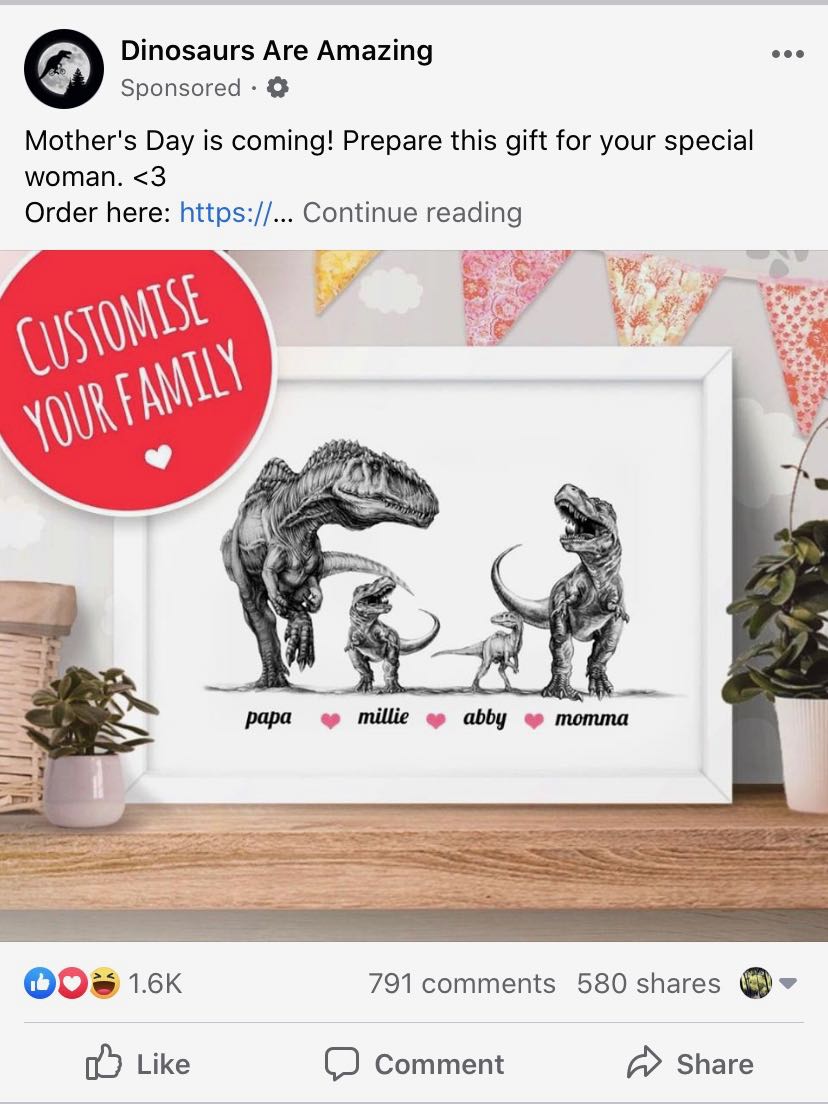
Here’s a fun fact. I wrote some of this post and left it open in a tab in my browser. I have not typed the phrase dinosaurs are awesome anywhere but in this tab. This morning when I opened Facebook I had some new ads in my feed.

I’m not sure a framed picture of our family as dinosaurs is going to cut it for Mother’s Day, but it’s creepy that Facebook’s algorithm either knows me well enough to coincidentally decide that this is something I’m into, or that my as yet unpublished text in a browser has given them more data to mine in order to sell me a solution. This is what has been called ‘surveillance capitalism’ — the sort of economic world we buy into through our uncritical participation in technology; our falling for the fallacy that just because we can (and companies can), we should (and they should).

Much as I love technology, and much as its introduction into our ecosystem is hard to keep safe, and much as uncaging the beast causes massive changes to our safety and day to day lives; I do want to be a dinosaur. Maybe this is part of Tolkien’s “desire for dragons” — maybe I want to live in a world of enchantment, a purer world where technology isn’t linked up with the Babylonian impulse to dominate the natural world, and other people, to secure prosperity for me (or the companies that are part of the fabric of this technology shaped society). Maybe I want to live in a world where it’s easier to sense the presence of God because the way our idolatry has seeped into the construction of our society makes it harder; it’s not that there was an age free from systemic corruption because of sin (see Babel, and then Babylon, and then Rome)… it’s just that it’s hardest to see that in our own age, because idols blind us; and technology plays part of that role in our lives now.

I want to try to reclaim some of what life was like before technology impacted the way we live and relate; and I’m certainly cautious about what sort of devastating impact unleashing the technology dinosaurs into the mix (and the very mixed metaphors) of Covid-19 and family life, and church life, and my own life. Much as I might seek escape into the world of augmented dinosaur battles on Jurassic World Alive, exploring a map littered with digital beasties to capture — I’m in real danger of being conformed in the image of a digital beasty myself.

C.S Lewis, in his inaugural speech at Cambridge, De Descriptione Temporum, suggested that technology — specifically the introduction of the machine — was the major contributing factor in a move from an enchanted to a disenchanted world; the thing that pushed the de-Christianisation of the west faster than any other phenomena. He says our belief in progress — specifically the good of technological advance and our ability to do new things by taking new technology and chucking old stuff, basically forms what Charles Taylor would later describe as our “social imaginary” — the building blocks of our imagination, especially how we understand life in the universe and so how to approach living in the universe. This image of ‘the good’ being ‘technological progress’ means that we often uncritically adopt new technologies and turf old ones. Lewis says this is bigger for our belief in progress, even, than Darwin’s theory of evolution… this is what he calls our ‘new archetypal image’ of how life works.

“It is the image of old machines being superseded by new and better ones. For in the world of machines the new most often really is better and the primitive really is the clumsy. And this image, potent in all our minds, reigns almost without rival in the minds of the uneducated. For to them, after their marriage and the births of their children, the very milestones of life are technical advances. From the old push-bike to the motor-bike and thence to the little car; from gramophone to radio and from radio to television; from the range to the stove; these are the very stages of their pilgrimage.”

C.S Lewis, De Descriptione Temporum

He ended his speech with a note of apology to his students; knowing, even then, that he was speaking to those in post-machine world as a non-native. The man didn’t even use a typewriter because of the impact he thought its machine like rhythms would have on his writing. He said people in a tech-obsessed world should listen to him like they’d listen to a freak — because his critique — from a different world to theirs — might help them look with fresh perspective on their relationship with technology. His approach to medieval literature and the idea that there was an image of the universe in the medieval world closer to the truth than the image we replaced it with when we discarded enchantment (the subject of his academic work The Discarded Image) allowed him, he believed, to see the dangers of the present age differently, even if it meant his students might have to view him as a dinosaur. He was prepared to embrace being a dinosaur.

I claim that, even if the defence of my conviction is weak, the fact of my conviction is a historical datum to which you should give full weight. That way, where I fail as a critic, I may yet be useful as a specimen. I would even dare to go further. Speaking not only for myself but for all other Old Western men whom you may meet, I would say, use your specimens while you can. There are not going to be many more dinosaurs.

— C.S Lewis, De Descriptione Temporum

Interestingly, his intro essay to Athanasius On The Incarnation encouraged people to read old books — not just books from our time — because their concerns would reveal some of the folly of our concerns and practices. There’s a way to become a dinosaur that doesn’t involve virtual reality, but digging in to old books from the past. In Surprised By Joy he talks about the sort of chronological snobbery that helps us jump from the naturalistic fallacy to the artificialistic fallacy via our changed imaginations; we think technology is good and necessary and that we ought do what it allows us simply because we think we’re much more sensible than those who came before us; we’re more highly evolved and have made progress in all areas. Lewis calls this ‘Chronological snobbery.’ Avoiding that might require being a dinosaur, or at least walking with them…

Maybe we need more human dinosaurs before we unleash the technological dinosaurs on our ecosystems anew. Charles Taylor saw ‘excarnation’ working alongside ‘disenchantment’ as the causes of secularity in the modern west. He said this was produced, historically (via the Reformation and its emphasis on the brain/knowledge rather than embodied practice) by “the steady disembodying of spiritual life.” How much faster is that happening via technology? Alan Jacobs, in this fantastic piece Fantasy and the Buffered Self, talks about technology as ‘Janus faced’ — he says our economic and cultural structures are produced by a ‘technocracy’ (the sort of structures present in telco and techno companies and their advertising right now), and this technocracy, through its various institutions, “speaks dark words of disenchantment with one mouth, and the bright promise of re-enchantment with the other.” Technology offers itself as the man made solution, from within a disenchanted frame — a world without God — and we buy it because it lets us be gods, even while it becomes a new god for us; an idol.

Whether we buy the pessimism about the potential danger of letting the T-Rex of Tech loose in in our church ecosystems, or we think we can put the tyrant back in his cage once this pandemic passes, we need to be aware that our jumping in to swim with the tide of technology puts us in a stream that has an ‘end point,’ and connects us with artefacts (technology) that aren’t neutral because they carry their own myth, their own anthropology, and their own eschatology. I’ve been struck, for example, by how much television advertising in night time pandemic viewing has pivoted to telcos and tech companies showing the ‘magic’ of technology; the way technology has transcended space and time to bring us together and keep us creating in this moment.

Amazon Prime is now advertising the show Upload, an alternative Good Place, that looks like it has humanity escaping to the cloud; not the heavenly one with angels, but the digital one. Becoming one with the machine (and hey, Elon Musk reckons we’re already there. That we are digital figments existing in some strange computer game). There’s a whole cultural apparatus pushing us to the idea that the future is digital; the eternal future even. Like the gnostics of old, they see technology freeing us from the meatflesh existence of our bodies (think cyberpunk fiction like Gibson’s Neuromancer). The idea that we might be saved from our bodies and from death and decay by becoming one with the machine is one legitimately explored and advocated by technologists; and celebrated in our advertising (like Telstra’s ‘magic of technology’ ad).

This all follows a trajectory identified by Lewis way back in his first speech in his role at Cambridge, and by Jacques Ellul in the same year, 1954, with his publication of The Technological Society. Ellul was both pessimistic and prophetic about the impacts of technology, and the belief in technique as the path to the good, on our humanity (in the same way McLuhan was later).

“Technique has penetrated the deepest recesses of the human being. The machine tends not only to create a new human environment, but also to modify man’s very essence. The milieu in which he lives is no longer his. He must adapt himself, as though the world were new, to a universe for which he was not created. He was made to go six kilometers an hour, and he goes a thousand. He was made to eat when he was hungry and to sleep when he was sleepy; instead, he obeys a clock. He was made to have contact with living things, and he lives in a world of stone. He was created with a certain essential unity, and he is fragmented by all the forces of the modern world.”

— Jacques Ellul, The Technological Society, 1954

It’s really hard to step back from the impact technology has on us — to unwind its impact on the deepest recesses of our humanity. To undo the ecological impact technology has on us where, in the words of another of McLuhan’s students, “we shape our tools and thereafter they shape us.” The egg can’t be totally unscrambled. And the making of technology is a deeply human task — part of our call to ‘cultivate’ the earth as God’s image bearing people who can imagine and create artefacts; but just because we can doesn’t mean we ought and sometimes we need human, biological, dinosaurs to step back and point out the impact artificial dinosaurs are having on the world we live in; lest we be eaten while on the toilet, or participating in the life of the church.

My hunch is that one of the ways back is less time in man made worlds that rely on technology, and that we interact with using technologies and techniques honed for us by the technocracy, and more time rediscovering the enchanted world we live in; the view those ‘dinosaurs’ from pre-modern times had, and part of that might be walking through the same forests, or looking at the same stars, that they did, or engaging art and stories that throw us into fantasy worlds away from ‘augmented reality’ — the stuff Jacobs advocates in the piece linked above, or Tolkien in On Fairy Stories, the thinking that helped Lewis produce Narnia.

I wish clever technology could do that for me more (and perhaps it can if the tools we create are extensions of our life as creatures created by a creator and we receive them with thanksgiving as gifts from God (1 Timothy 4), the technocracy works to blind us to that ‘enchanted’ dimension of technology; and technology as idol often pulls us away from, rather than towards God… Augmented reality dinosaurs, where my fantasy world, created by clever programmers (who want me to spend money), is mediated to me by a screen, in a way that makes me beastly, don’t do for my imagination or “desire for dragons” what imagining the trees in the bushland up the road from me as living, breathing things that speak to the goodness of my creator does… and yet, that’s what trees are for (Romans 1:20).

“He does not despise real woods because he has read of enchanted woods; the reading makes all real woods a little enchanted.” — C.S Lewis

The Christmas Dragon

Also. While we’re on the subject of Christmas. I’m preaching on John’s nativity scene at our Christmas Eve service this year.

But wait. You say. John’s gospel doesn’t have a nativity scene.

Indeed. But Revelation does.

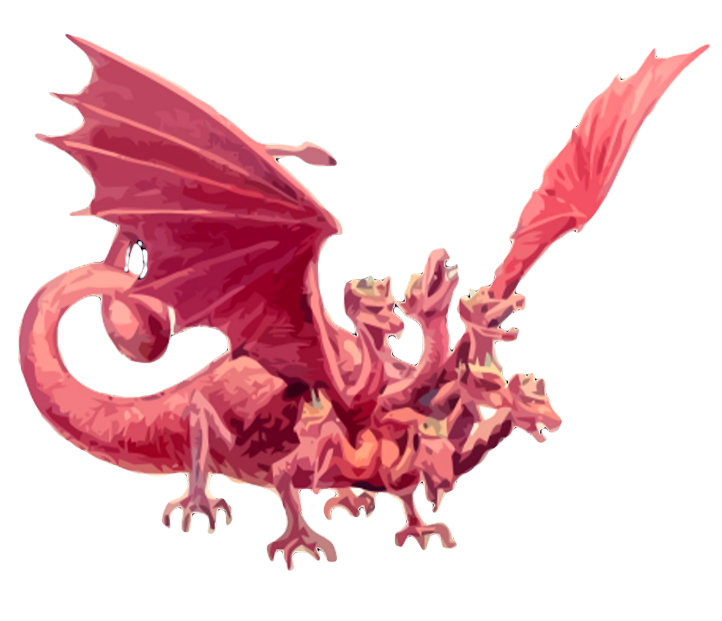
A great sign appeared in heaven: a woman clothed with the sun, with the moon under her feet and a crown of twelve stars on her head. She was pregnant and cried out in pain as she was about to give birth. Then another sign appeared in heaven: an enormous red dragon with seven heads and ten horns and seven crowns on its heads. Its tail swept a third of the stars out of the sky and flung them to the earth. The dragon stood in front of the woman who was about to give birth, so that it might devour her child the moment he was born. She gave birth to a son, a male child, who “will rule all the nations with an iron scepter.”

This ain’t no stable story.

I’ve preached on it before – but my last talk wasn’t great. So I’m gutting it. And rewriting it. It’s difficult to turn this pretty weird passage into something evangelistic. But I like the coolness of it, and the timing – given that the Hobbit is coming out on Boxing Day and it is pretty dragony.

I’m going to lean heavily on this bit, and just fly over the weird stuff with a short, sharp, explanation of why Revelation tells the Christian story in a symbolic way.

10 Then I heard a loud voice in heaven say:

“Now have come the salvation and the power
and the kingdom of our God,
and the authority of his Messiah.
For the accuser of our brothers and sisters,
who accuses them before our God day and night,
has been hurled down.
11 They triumphed over him
by the blood of the Lamb
and by the word of their testimony;
they did not love their lives so much
as to shrink from death.

Sound enthralling? Come along.

Meet this guy… and the baby who smashes him.

dragon

One of the things I’m finding tough is how to articulate that as Christians we do believe in something bigger than ourselves, something supernatural, other than the intangible God and his tangible son, Jesus. That we believe Jesus’ birth, death, and resurrection had some meaning beyond what it achieves for us as individuals, and for humans with the arrival of the crucified king of the world… that there was, and is, an entity who didn’t want this to happen. The dragon. Satan.

I find it pretty easy to talk about Jesus. Because he was a man, in history, who is historically plausible. But Satan? And Satan presented as a dragon? I’d rather deal with that in brush strokes and get back to safe and rational ground as quickly as possible.

I can’t figure out why.

We’re pretty good at buying in to struggles between good and evil in just about every story we consume – the Hobbit is an example – so I can’t figure out why I baulk at presenting the “evil” entity, not just the evil that dwells in each sinful person, when it comes to telling people the gospel.

Merry Christmas

What does Christmas have in common with a seven-headed dragon?

Ever wondered why the birth of baby Jesus so long ago is still a big deal? Here’s a nativity scene that doesn’t get preached on all that much in Christmas services, from Revelation chapter 12. It’s what’s going down in a figurative sense in the person of Jesus.

1 A great sign appeared in heaven: a woman clothed with the sun, with the moon under her feet and a crown of twelve stars on her head. 2 She was pregnant and cried out in pain as she was about to give birth. 3 Then another sign appeared in heaven: an enormous red dragon with seven heads and ten horns and seven crowns on its heads. 4 Its tail swept a third of the stars out of the sky and flung them to the earth. The dragon stood in front of the woman who was about to give birth, so that it might devour her child the moment he was born. 5 She gave birth to a son, a male child, who “will rule all the nations with an iron scepter.” And her child was snatched up to God and to his throne. 6 The woman fled into the wilderness to a place prepared for her by God, where she might be taken care of for 1,260 days.

7 Then war broke out in heaven. Michael and his angels fought against the dragon, and the dragon and his angels fought back. 8 But he was not strong enough, and they lost their place in heaven. 9 The great dragon was hurled down—that ancient serpent called the devil, or Satan, who leads the whole world astray. He was hurled to the earth, and his angels with him.

10 Then I heard a loud voice in heaven say:

“Now have come the salvation and the power
and the kingdom of our God,
and the authority of his Messiah.
For the accuser of our brothers and sisters,
who accuses them before our God day and night,
has been hurled down.
11 They triumphed over him
by the blood of the Lamb
and by the word of their testimony;
they did not love their lives so much
as to shrink from death.
12 Therefore rejoice, you heavens
and you who dwell in them!
But woe to the earth and the sea,
because the devil has gone down to you!
He is filled with fury,
because he knows that his time is short.”

Jesus wins. Why this passage isn’t at the top of the Christmas pile is beyond me. I reckon a Christmas lights diorama of this passage installed at your church would win all sorts of prizes.

Have yourself a very wooden Christmas

Christmas is just around the corner. Shops are setting up their displays, playing Christmas Carols and being generally annoying.

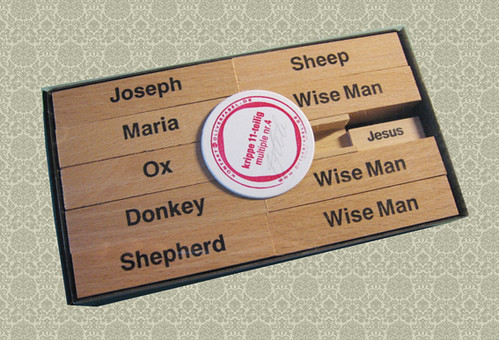
If I was going to set up a nativity scene in my house – or anywhere actually – I would totally consider this minimalistic set designed by German Oliver Fabel (and available, apparently, in both English and German)…

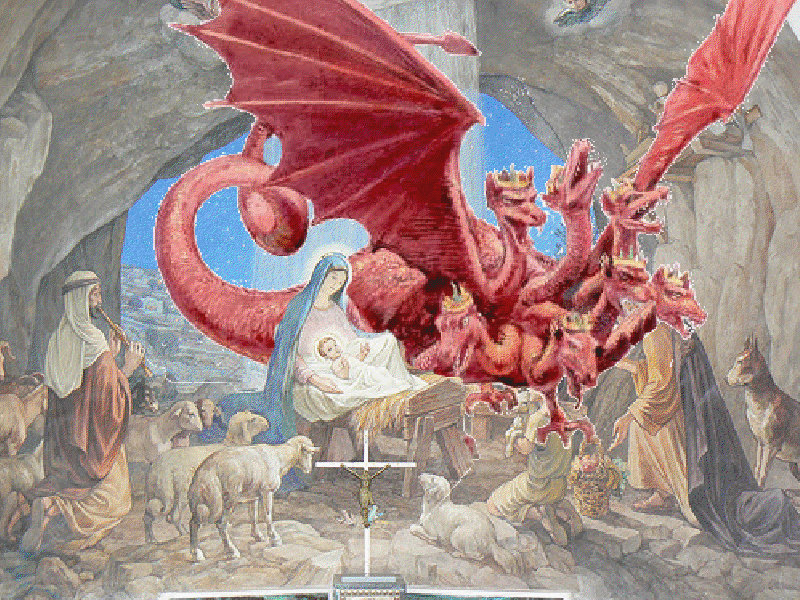
That’s cool right? But where’s the dragon from Revelation 12. We need an extra block… here’s a photoshop nativity I did for a sermon on Revelation 12 last December.