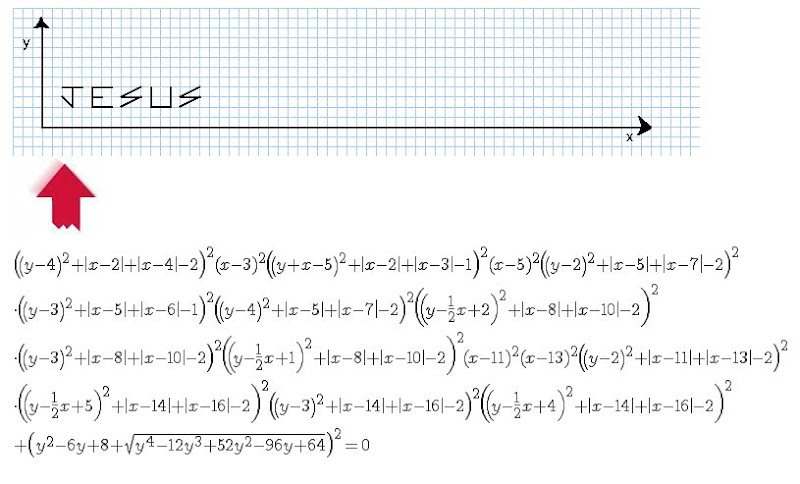
The inverse graphical calculator creates a graph out of words you input then gives you the equation to generate the graph.
Here is the equation for Jesus.
Here is one I prepared earlier.
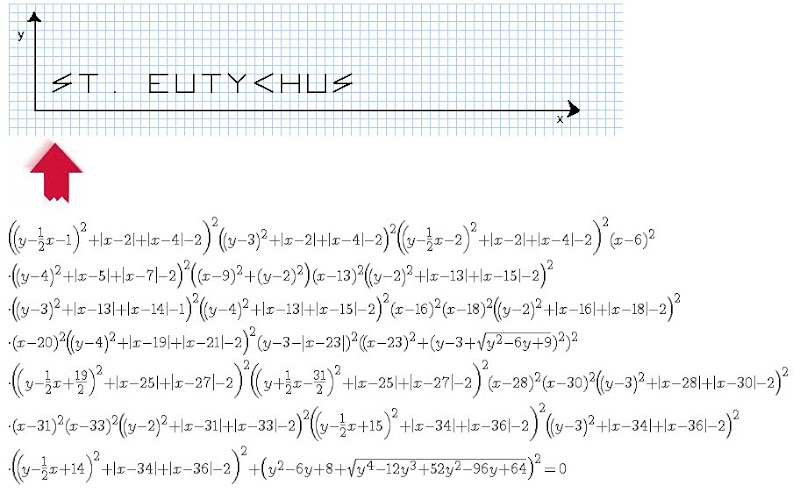
The inverse graphical calculator creates a graph out of words you input then gives you the equation to generate the graph.
Here is the equation for Jesus.
Here is one I prepared earlier.
I am really looking forward to this movie. Here’s the new trailer.
This Duck Hunt wall decal is brilliant.

Especially because it’s essentially made of pixels.

As a bonus – courtesy of the designer – is this flash version of the original Duck Hunt.
How do you like your bacon? Crispy? Squishy with the delicious fatty bits? Chocolate coated? There are hundreds of ways to cook bacon, hundreds of ways to eat bacon, and hundreds of ways to serve it to your guests.
You could buy this recipe book.

Master the art of bacon bowls.

We were all outraged when we figured out that Avatar was Pocahontas – but not so many of us have complained that so many of our favourite blockbusters are essentially exactly the same story. Star Wars, Star Trek, the Matrix and Harry Potter are all just about exactly the same. The full plot outline is here… below is an abstract.
Once upon a time,
Luke | Kirk | Neo | Harry
was living a miserable life. Feeling disconnected from his friends and family, he dreams about how his life could be different. One day, he is greeted by
Obi Wan | Captain Pike | Trinity | Hagrid
and told that his life is not what it seems, and that due to some circumstances surrounding his
birth | birth | birth | infancy
he was meant for something greater. Deciding to leave with
him | him | her | him,
Luke | Kirk | Neo | Harry
is taken to
Mos Eisley | Starfleet Academy | the real world | Hogwarts
where he meets lots of new, fascinating people. For the first time in a very long time, life is exciting, and
Luke | Kirk | Neo | Harry
explores the new life that has opened up for him. With his new friends, he starts to work hard to become the sort of man that
Obi Wan | Captain Pike | Trinity | Hagrid
said he could be. Although
Han | Spock | the Oracle | Draco
challenges his abilities, things go relatively well until suddenly,
Alderaan is destroyed | Vulcan is attacked | Morpheus is captured | Voldemort returns.
What this post doesn’t include is the obligatory montage that occurs in the bit where the main character is learning his mad skillz.

This latte art is actually tea art. Cool huh. A while ago (in 2008 I think) I posted a link to this Rooibos that you make like an espresso. I didn’t think much of it until I spotted this the other day.

Pretty cool.
Don’t ever introduce yourself by your job title. Job titles are terrible and should be scrapped. Unless they’re really literal. There is only one thing worse than someone who introduces themselves by their title – and that’s someone who introduces themself with an obtuse and confusing buzzy weasleword description that requires a follow up question.
First impressions are important. Especially if you’re a conference speaker, or somebody it is important for the people meeting you to know. Don’t start a conversation with an obtuse statement unless it’s a joke that you explain straight away, and even then… don’t do it.
It was refreshing listening to the guest speaker at our camp over the weekend introduce himself and speak passionately about his new role – “campus evangelist” – by itself this would be buzzwordy and unclear – but he told us what it looked like and spoke with genuine passion about the task. This was cool. If you must use your title do it properly.
I’ve been thinking about my approach to the Bible. The first five weeks of college have been pretty intense for me – but probably not as intense as they have been for other people who possibly feel like the rug has been pulled out from under their feet a little when it comes to the way theologians treat the Bible and the interaction between the historical context and theological truths. Here is my thinking…
My overarching understanding, or first principle, is that the Bible is the clear word of God, our job is to make sense of it based on what we know of the original audience, the way God communicates, and ultimately the work of Jesus. This understanding colours my understanding of everything from Genesis to Revelation, and each form of biblical literature.
Theology is like science – we’re constantly moving to a more perfect understanding of each part of the Bible as we build our picture of the lives of the original hearers and readers of the word. We’re unlikely to ever completely overturn our current “theories” based on this evidence, but we will gain a slightly more nuanced picture of the meaning of different writings if we learn something new about what was going on in the first century (NT) or in the history of Israel.
So understanding that “this current distress” that Paul talks about in 1 Corinthians 7 may refer to a massive famine in the Corinthian region means we don’t have to assume that Paul was a failed apocalyptic prophet who thought the world would end in his lifetime, but rather that he thought it wise for couples not to marry if they couldn’t feed likely offspring. Revelation makes more sense if you understand that Nero was on the scene around the time it was written, that the number 666 was particular to Nero, and that Rome was persecuting Christians around the time it was written… this makes more sense to me than some sort of dispensational premillenialism.
Which leads me to this point of applying Occam’s razor to every “theological” position. If there’s a better explanation that requires less jumps, that is consistent with the rest of scripture, and preferably magnifies the work of Christ – then I’ll be pretty prepared to take that explanation quickly – rather than fighting to hold on to ingrained presuppositions.
Again, I don’t think this is rocket science or revolutionary – it’s just something I’ve been thinking about.
Dear readers,
I will not be blogging much this weekend. I have an essay to write, a church camp to attend and a debut to make for Kustard FC – the Baptist League’s most brilliantly coloured football team. That is roundball football. I am very excited.
I look forward to catching you on the flip side. I trust that you won’t feel withdrawals as much as I will.
Bacon toilet paper*. I’m not sure there’s anywhere I can go with this. Except to say that if you’re going to print something on your toilet paper it may as well be something awesome.

If you’re trying to understand why I talk about bacon so much perhaps you should read point four from this Slate article.
*not made from bacon.
I love Overthinking It. They truly raise the stakes of analysis to amazing levels. Take this post on sandwiches. It opens with a rather spectacular chart of the relationship between ingredients and preparatory skill.
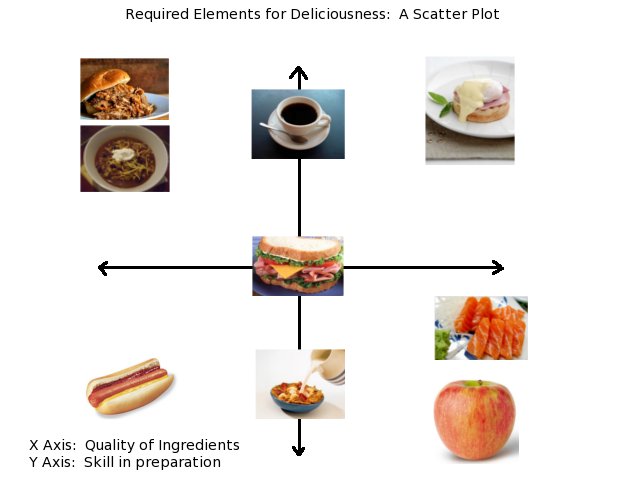
They also get points for knowing about coffee.
Coffee is in the top middle. The ingredients do matter here, some, but not nearly as much as the preparation. It’s very easy to take some high-end small-batch free-trade shade-grown hand-roasted Ethiopia Harrar, and turn it into something that tastes like cat piss by messing up the brewing process. Its opposite number is breakfast cereal. This is all but impossible to screw up: your culinary experience is determined entirely by which brand of cereal you buy…
But it’s their take on sandwiches that really deserves to be considered.
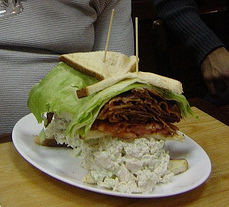
The atrocity at left [above] is the “Bacon Whoopee,” available at the Carnegie Deli for a mere $22. As a bacon-delivery vector, this is superlative. As a sandwich, it is completely incompetent. A properly calibrated sandwich is all about balance. It is an exquisitely tuned chord. Allow any one element to overwhelm the others, and the sandwich is ruined. Ruined! You need to be able to taste every component. At the Carnegie Deli, this is not going to happen. This is also the problem with the sandwiches at Subway. It doesn’t really matter what you order at subway: they basically all taste like the bread, with a little crunchiness from the lettuce. (This is why when I have to eat at Subway, I just get the vegetarian sub. It tastes the same, and it’s cheaper.)
The solution… summarised.
Cheese: The slices should be very, very thin, and no more than two layers… If you want more cheese, don’t put the layers next to each other. I list cheese first because it’s the sandwich’s limiting factor.
Meat: About two to three times the size (by thickness) of your cheese layer. Thin slices are important here too: this is the one thing that the standard deli sandwich gets right. But it’s not so much because of the flavor. It’s because a thick slice of meat is hard to bite through…
Lettuce, Tomatoes, Pickles, Cucumbers, and the like: The combined [vegetable] layer, though, should be exactly the same size as the meat layer. Obviously if you’re using something very strongly flavored… you want to use less…
Condiments: Less than you think… Spread thin, using just enough to moisten the surface of both slices of bread, and let it go. Grinding a some fresh black pepper onto the bread after you apply the condiments is often a nice touch.
Bread: …firm enough to hold the sandwich together… not be so coarse as to scratch the roof of your mouth. The two slices, together, should be about the same thickness as the meat layer…
I wonder what an equivalent would look like in Australia.
Probably a lot of empty, nominally Catholic space.

Apparently a bunch of my fellow first years think of me as “the bacon guy”… I confess I may use bacon as a yardstick of orthodoxy. It’s what separates the (Christian) men from the (Jewish) boys in the early church. I have framed a couple of questions about theology with bacon as the pivotal point… and I did ask a question in New Testament about why Jews kept pigs for Jesus to drive demons into (I’ve pondered that here somewhere too). My reputation is probably deserved – but, my fellow first years, watch who you make these statements to. I have ears everywhere…
But I digress. I can’t help but be excited about this post. Bacon and chips are two food groups that I enjoy as part of my balanced diet. I can cut a food group completely – and thus be healthier – just by eating these bacon chips. That’s right. Bacon chips.
We start with the best quality potatoes and add a proprietary blend of some extra-bacony goodness. They will put a grin on your face and promise to test your limits of self-control.

We’re all very excited anbout the new ESV iPhone app – which presents the well documented dilemma regarding being spotted staring at an electronic device in church services.
Izaac devised this solution:
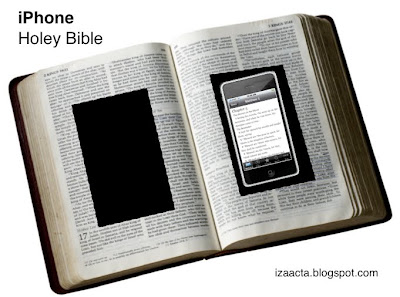
Long time readers may have seen this before – but there is a commercial solution (you don’t need to hack up a Bible – give it to an enquiring friend instead)… this was designed for hiding a flask – but it looks like it would do well with an iPhone… it also comes with a bonus flask so that you can carry around your spirits with you as well.

If you’re more musically inclined there’s a hymn book iPhone cover that will do the trick too.


I made a throwaway comment in class the other da that Jesus probably drank coffee. This is incorrect. Coffee was discovered as a beverage in about 800 AD. There’s a nice, concise history right here. Including a passage that tells the story of how coffee came to Christendom (before it was a legitimate form of ministry).
“Europe was introduced to coffee in the late 1500s by Venetian travelers. Priests tried to get coffee banned for Catholics by Pope Clement VIII because it was so popular in the Muslim world. They thought that since Muslims did not drink wine (a holy sacrament), the devil must have given them this devilish brew. For Christians to drink it was to risk the devil’s trap. Curious, the good Pope wanted to examine this “devil’s brew” and had some brought to him. At first he just smelled it, but then to the horror of the priests, he drank some. The priests thought he might die or turn into the devil. Instead he declared it delicious and baptized it, thus snatching it away from the devil’s grasp and opening up the coffee trade to Europe.”
So the pope isn’t always wrong.