Doug Green on Genesis – part 2

More notes from Doug Green… including some more speculative stuff (by his own admission) that was pretty thought provoking. You’ll notice that in order to convey the essence of some sort of characteristic Doug would often add “ness” to the end of a word, and occasionally negate that with an “un”… my spellcheck didn’t really like that so much…

Evangelicals have a low view of what it means to be human even before we introduce the subject of sin. In our unfallen condition we were like God as a son is like his father.

The Fall Stuff – less pretty, and a little more speculative…

We know how the story in Genesis 3 transpires – the “king and the queen” reject their undergodness. The consequences of Adam’s sin have been understood conventionally in expressions like the WCF.

Five things that happened in the fall:

  1. Exile from God’s presence – there’s an interesting connection between Israel’s story and Adam’s story. Adam and Eve are tossed from the garden – which opens up an interesting insight into the human condition – do we live in a perennial state of homelessness. Sin has rendered us spiritually homeless and homesick. If we’re honest with ourselves even our experiences of being at “home” – family, tribal connections etc – are a longing for a deep feeling of home. Why does it feel so good to be “home”… Psalm 37 – we live out our days in a foreign land… there’s an interesting “human condition as homelessness” notion at play. Fulfillment is found in coming home to God. So Israel, when they return from exile, rebuild the temple. The Prodigal Son is a great New Testament example. Home and family is one of the new gods of Australian culture. But it’s a god destined for failure because humans (and thus families) are sinful.
  2. The king is dethroned and the son loses his inheritance – the language is of dethronement, of being cast back into humanity. The dethroned king is also the disinherited son (another link to the Prodigal Son – the father is willing to restore the disinherited).
  3. No longer “like one of us” – take this with a grain of salt… By sinning the first humans fell from the almost godlike status – Genesis 3:22 in the NIV is typical of the received tradition “behold, the man has become like one of us” – it seems to be saying that it was in the fall that we became like God. Which seems to completely contradict this position. Was the serpent telling the truth? When he said “you will become like God” – the Hebrew could be equally translated in the past tense – what he once was – “behold, the man was like one of us, he used to know good and evil. But now he is no longer…” This would be consistent with Genesis 1 – where humanity was created like God. That should have been Eve’s response to the serpent when he said “you will be like God” – “but we already are”… now, because of the fall they’re no longer entitled to the life of the Gods. In Doug’s opinion the serpent tricked both Eve and the translators of Genesis. If this interpretation is correct then the gospel story – the redemption – can be understood as taking us back to being like God. If this is correct then not only did humanity used to be like the heavenly beings but also that status was essential for understanding the difference between good and evil. Everything, under the one word torah, was good – other than disobeying and doing the one thing that God has prohibited. Because they had this “law” they were able to discern between good and evil. What do Adam and Eve have after the fall that would fit into the category of now knowing good and evil?
  4. After the fall we lose our moral compass and don’t think straight anymore. So. If this interpretation is correct – before the fall, Adam and Eve were like God and able to pick the difference between good and evil. The command gave them the guideline for making this distinction. The serpent lies. They already know.  Eve’s response should have been “you’re a liar.” The knowledge of good and evil is something they lose. That is compromised. As a result of the fall. This is part of humanity’s problem – we call good evil, and evil good [ed note – cf Romans 1]. Moral confusion, far from being marks of the true humanity, is a mark of fallen humanity. One dimension of the gospel then will be that through the Spirit, and union with Christ, will realign our moral compass and restore us to full humanity. The sinful nature has damaged our ability to think straight. Similar picture with Jesus and the demoniac – who is insane, and once Jesus heals him, he sits at his feet “in his right mind”…
  5. It results in the loss or reduction of our original glory – “the Lord God made garments of skin” – traditionally understood as requiring an animal sacrifice (which has been read in as atonement). God’s clothing of Adam and Eve is a symbolic act of changing their cultural status. A big deal in ancient culture – clothing carries symbolism of a change of status (white wedding dress). Clothing the man in skins may be the Lord identifying them with the animals. They become more like animals than gods. They’ve lost their godlike status and their new status is more like the animals. A stretch. Sure. But so is the atonement reading. Daniel 4 – one of the consequences was being dethroned as king, throughout the OT there are stories of kings being dethroned that are framed as a retelling of the Adam story. When you read them this way they can give us some insight into the human condition. So the story of Nebuchadnezzar is an example – what do you do when you have worldwide dominion? You wander around looking at what you’ve done – this is a picture of a king who thinks he rules the world. It’s arrogance and hubris. The words are still on his lips when a voice comes from heaven – “your royal authority has been taken from you” – echoing Adam’s dethronement. You will be “exiled from people” and will “live with the wild animals” until he recognises that he is not God. The description of Nebuchadnezzar is beastly – he has become an animal. He moves from the pinnacle of human experience, glorifying in his achievements to the humiliating state of “an animal” – this is the human story. We’ve moved from royalty to being beastly. Nebuchadnezzar’s redemtion is a gospel story – his sanity is restored, he praises the most high, he puts himself under God’s authority, he ends up in a better place (good, bad, better – the redemption cycle). Redeemed humanity is elevated from a beastly humanity to a humanity that exercises dominion – back to where we should be, but possibly in a better place than we began in. The transformation comes when we recognise God as God. True humanity will rule creation, rather than being a ruled over creature, only when we recognise God. Nebuchadnezzar “my knowledge, my understanding, returned to me” as a result of submitting. Sin makes us insane. The good news is that Christ makes us sane.

Romans 3:23 – because we’ve sinned we now fall short of the glory of God that attached to us as unfallen humans (rather than being a case of missing God’s standard of perfection). Psalm 8 – for all have sinned and we no longer have our heavenly nature. We are “falling short” humans.

Doug Green on Genesis

Doug Green is speaking at QTC today. His first session was on the “image of God” in Genesis (and a bit of Psalms, and a bit of Kings). Here are my notes.

Guilt and Depravity – the two problems facing humanity

Guilt is the bigger issue in western sentimentality.
Depravity concerns inner corruption.

This double focus means that when it comes to defining the gospel we focus on these two conditions.

The WCF mirrors this focus on these concerns. This is what our reformed minds are interested in. If we talk about the gospel it’s likely we’ll end up talking about these concerns.

Justification – we get a new legal position and inner moral orientation. This is how we define the work of Christ and the Spirit. These views have come under criticism in recent years (the justification debate). Our definition is possibly too individualised. We need to do a better job at describing the gospel as it applies to the cosmos – but that’s not our focus today.

The Human Condition

The atonement is incredibly important for understanding the solution to the human problem. It is the central element in God’s answer to the human condition.

Nothing today is a contradiction of that central tenant.

“The Gospel as the Way to be Truly Human”

The salvation or gospel story told from the perspective of what it means to be truly human.

Image of God – that was our original definition of humanity.

The consequence of human sinfulness can be enriched by saying when humanity sinned we lost our glorious godlike status. We metaphorically fell from heaven, and we became less human as a result. We became more like the animals we were supposed to be ruling over. All sin has a dehumanizing effect. It makes us more beast than human.

Imagine a sliding scale on a continuum with God on one side and the animals on the other – we were, in the beginning – closer to the God end of the spectrum than the animal side.

Doug is pushing a very high anthropological view – true humanity was more like God in the beginning than we often think. Sin tipped the spectrum.

The word “fall” captures the idea of this change in status.

We didn’t become mere animals, and the image of God was not obliterated within us (Genesis 9). Something happened there to decrease our “image of godness.” Before the fall we were “glorious” creatures – but there’s a sense that sin ripped away or diminished that glory. We now live in perpetual quest for our lost honour and glory – perhaps an interesting angle on our human condition.

The good news of the gospel is that you can become glorious again. You can become human again. This has implications for pastoral life and evangelism.

The Godlike Glory of Humanity

Genesis 1 v 26-27

When we read the text we focus on the word “image” and forget the “likeness” – what does this mean? It confirms the creator/creation distinction. WE are creatures like the fish and the birds, but on the other hand among the creatures there is one that resembles God. That is man. We have “one foot on either side of the creator/creature distinction” – in the ancient world if you wanted to know what a God looked like you were supposed to look at his image or statue. His physical resemblance. However you talk about the image of God in humanity you can’t ignore Psalm 8.

“You made him a little lower than (Hebrew) Elohim” – a little lower than divine beings. That’s an awfully high anthropology. That we were just a tad short of divine.

Instead of saying that humanity was created like God the psalmist says that we were made similar to heavenly beings. The main point is that there’s something almost divine about unfallen humanity. [ed note – which would be consistent with reading the passages in the light of an eschatological view of humanity].

“You crown them with glory and honour” – this divine glory, traditionally divine characteristics, rested on humanity.

To bear the image of God meant that the first human, Adam, bore aspects of divinity.

Our doctrine of “total depravity” leaves us with a low view of humanity – but that’s our post fall humanity – what does it mean for us if we’re in Christ. Sometimes Doug wonders if our view of who we are as Christians is a little anemic. “There but for the grace of God go I” – we’ve been transformed, on the road to glorious humanity, so we’re not just forgiven sinners anymore…

The Holy Spirit in us gives us an element of Godlikeness. Maybe we need to take that work a little more seriously.

We’re godlike – but we’re also “sons” – Genesis 5 gives us an interesting hint about what it means to be made in the image and likeness of God. “Adam had a son in his own image, in his own likeness who he named Seth…” Seth was to Adam what Adam was to God. Luke’s genealogy makes that point (Luke 3 – Adam the son of God).

“Son of God” is a way of referring to exalted humanity.

We were godlike. We were glorious. We were sons.

We were godlike, therefore we were kings over creation.

“then God said let us make mankind in our own image, in our likeness…” with a purpose construction in Hebrew “so that they might rule.”

Because the original humanity was created in the image of god they were created to be kings over the rest of creation – exercising dominion.

It’s a vice-regency deal. In the ancient world creation isn’t a neutral act. When gods create they gain mastery over their creation. [Interesting aside – perhaps our postmodern approach to literature (denying authorial intention) is part of this desire to not associate creation with mastery/ownership. It’s certainly consistent.]

God’s rule over the world is meant to be a mediated rule – through his creatures, humans. Who are designated to rule on his behalf.

The first humans were not kings over creation – they were “God’s kings” – like the governor general with teeth. With real power.

“You made him ruler” [ Psalms ]

“The flocks and the herds… all creation belongs to the Lord God, all creatures are the works of his hands”

Genesis 2 portrays Adam as a king (subtly). One is obvious – the naming of the animals. Name giving was also a way of exercising dominion and authority.

Genesis 2:7 – much more subtle. The language of being taken out of dust, throughout the OT, is the language of enthronement. 1 Kings 16 is an example. The prophecy against Bashar “I lifted you up from the dust and I made you a leader…”

Dust is the language of “nobodyness” this language of being created from the dust is the metaphorical “raising up of a king” – “dust you were, and to dust you will return” is the language of dethronement.

2:15 – the portrayal of Adam as a gardener – in the Ancient world the kings were the garderners who made their nations fruitful. Ecclesiastes 2 – “this is my greatness, I built houses and I planted vineyards and parks, I planted all kinds of fruit trees…” the proof of the author of Ecclesiastes’ great kingship is that he is a gardener.

We were created to be kings over creation, but we are also kings under God.

Humanity was godlike – but not god. And the godlikeness was subject to recognising this relationship. Should they forget that they would immediately lose their godlike standing.

“The Lord God commanded them: “you are free to eat of any tree of the garden…”

Adam receives a one word Torah. A single test of obedience, of creatureliness. Failure to comply casts him out of his kingly role.

To be truly human is to submit to God and to obey his commands.

Moto X jumping for Jesus

Gary explains why this sort of behaviour (setting up a dirt bike ramp in church and having a motorbike jump the minister in the middle of the sermon) is a bad thing. The Awesome Driven Gospel isn’t the Gospel driven Gospel.

But it is, I must admit, slightly awesome. Though the protective barricades with “Thor” written on them surrounded by flames are an interesting touch.

Via ChristianNightmares.

Confessions #5: Sometimes I post here rather than commenting elsewhere

I think blogging time, in my schedule, is a fungible thing. That’s a cool word I just learned. Basically, I have an allocated amount of time for “blogging” and I have to spread that time between writing, reading and commenting.

So sometimes I write lots of posts here and neglect the “community” aspect of blogging. Times like yesterday. Yesterday my blogging comrade and e-friend Ben mentioned a really significant moment. A momentous moment. He sold his house. Without having to go to auction. Which he had expressed concern about. What a relief that must have been for him, and his family. But here’s little old me. Blogging about pointless stuff like Jesus themed thongs. So caught up in my own world that I didn’t comment on his post. Nor did I take the obligatory Monday Quiz.

And now, a day afterwards, I feel guilty because I’ve missed the commenting boat. Other people, who have commented, clearly love Ben more. The only way I can possibly rectify the situation is by trumping a comment with a link. That’s how blog love works. The blug1 beats the comment. It’s like a game of scissors rock paper. The Blug beats the comment. The comment beats the read. And the read must therefore beat the blug – because there’s no point blugging if people aren’t reading.

1A portmanteau2 of blog and plug.
2The strategic mashing together of two words to form one concept. Like Venn diagramming words.

Confessions #4: When I’m sick I wish I was faking it

I’m struck down with a case of man flu today. I don’t really have a voice anymore. My throat hurts. Last night I had a bizarre bout of shivering complete with chattering teeth. I think I’m actually sick. And I hate it. It seems like such a waste of a day at home. There are heaps of things I’d rather do while not being where I’m meant to be. I could watch movies. I could make grass angels in the yard (like snow angels but not).

Today is a rainy and miserable day too. Perfect for watching movies and drinking hot drinks. In front of a fire. But I feel dreadful. I’m still in bed. How I wish I was faking it.

Chucking a sickie is awesome. Ferris Bueller’s Day Off captured the sickie zeitgeist and also provided me, in my childhood, with a foolproof method of creating clammy skin. Lick your hands. Rub your forehead. Wallah. A day off. Faking diarrhea is always good too – because it’s almost completely unverifiable (who wants to check) and it has that awkwardness about it that means people don’t ask questions when you’re phoning it in.

Family Last: Why I’m not voting 1 for Family First despite being a Christian

A well meaning friend, perhaps unaware of my position on Family First, suggested that I become Facebook Friends with Queensland Senate Candidate Wendy Francis. I have met Wendy (a few years ago), I used to play football (soccer for the luddites) against her son. Anyway. I added her. She seems like a decent, hard working, Godly Christian lady, I’ve no doubt she’s a great mum. I’ve got no doubt she’s a Christian. I’ve got no doubt she’s moral. And I’ve got no doubt she’s intelligent. But I won’t be voting for her. She’ll probably end up somewhere above the Greens and the Australian Sex Party on my ballot paper (I like numbering the senate paper completely. I’m a politics geek. Sue me.). And here’s why. I don’t think she’ll make a good politician. Pretty much by her own admission. If you want a godly, motherly, intelligent amateur holding the balance of power in the senate (which might happen) then feel free to vote for her. I won’t judge you.

She’s been busy on Facebook posting 101 reasons to vote for Wendy Francis. Here are some examples.

#13 I’ve never had media training and I don’t know how to avoid or fudge questions.

#88 I really don’t know quite how to be a politician and I rather suspect I should stay that way and those who vote for me would agree

#71 In a campaign featuring robotic candidates controlled by media minders I’m a fresh contrast. It’s time for un-politicians!

My big problem with the Family First campaign (and its epitomised by Wendy’s appearance on Sunrise) is that they completely lack any form of nuance or any sense that they’ll be, if elected, governing for everybody. Not just the people who vote for them. What they say is fine (almost) coming from the mouths of lobbiests and special interest groups. But this sort of comment from her Facebook profile is just a little scary: “Atheist Prime Minister & atheist Greens with senate balance of power equals the wrong road for Australia”.

I can’t help but think that if she had media minders, or thought like a politician, she may have avoided situations like this.

“legitimising gay marriage is like legalising child abuse”

Comparing anything that’s clearly not in the same category of child abuse to child abuse is like comparing things to Hitler. We have a pretty solid definition of child abuse to work from – and we have myriad victims of child abuse in our community who must feel somewhat slighted by the idea that children with two loving parents are being placed in the same category.

Christians hate it (I know I do) when atheists suggest that Christian parenting is child abuse. So why would we, as Christians, use similar language to describe family structures we disagree with. Even if it wasn’t her who posted the message (and she says it wasn’t, but that it was a staffer) it’s the kind of amateur hour thing she seems to be proud of (based on her points above). And she didn’t distance herself from the sentiment in subsequent interviews. A little media training and political nous goes a long way.

Something can be bad for a child without it being child abuse. This lack of nuance is appalling. Is she saying that any child without a father is suffering abuse? Does it follow that any mother who leaves her husband and becomes a single parent is also an abuser? Or is it only if they leave their husband for another woman?

I sympathise with her position on same-sex couples adopting. But I think it’s a much more complex situation than can be adequately argued or justified on Twitter in 140 characters or less. Is it better for a child to have loving gay parents than no parents? Probably. As soon as you concede that point you’re on the back foot. Coming out with emotive tripe that seems designed purely to cause scandal is a ridiculous political strategy designed only to resonate with the lowest common denominator of Christian thought.

My biggest problem with Family First is that they almost completely fail to empathise with the people they oppose. Christians, by the grace of God and our parliament, enjoy incredible freedom in our country. This kind of “we speak for the majority so we’re going to prevent any minorities being represented” mentality is just scary. You know what happens in cultures that oppress and silence minorities. They start sending them to death camps. There. I made a Hitler comparison.

Politics has famously been described (probably by Churchill) as the art of compromise. By being definitively “non-compromising” and “non-political” you’re essentially saying that you don’t care about the outsider. The people who don’t hold your views. That’s not what being a senator, or being a Christian, is about.

Peter Jensen on politics

This interview with Peter Jensen on the current election is worth a listen. I’m surprised it hasn’t been spoken about more in the blogosphere this week. Perhaps it’s not controversial enough. It’s from Sunday night.

Q: Do Christians necessarily vote from the viewpoint of faith, do you think?
A: Yes we do. And fortunately in Australia it’s perfectly possible, even across the range of options, to vote from faith and to vote differently. You can not say to a Christian in Australia “you must vote for such and such a person. It’s a matter of balance. You’ll work out which way you want to go.”

He discusses Gillard’s atheism and its impact on Christian voters frankly. He discusses Abbott’s faith and its impact on voters with equal frankness.

Butterflies and Vampires

The sparkling vampires of Twilight have long annoyed vampire purists. Nowhere in the history of vampire mythology have vampires been said to sparkle like fairies.

But an enterprising student of science has made a connection by observing the behaviour of vampires in the realm of Twilight. Vampires are unusually strong for their size. Like insects. They feed on blood from other animals. Like insects.

Here are some of the important connections you’ll need to make to fully accept this brilliant conclusion:

“What about vampires’ superhuman abilities? The Tiger Beetle is technically ‘the fastest running land animal’. The strongest animal is the world is the horned dung beetle. Insects also have incredible vision; most see colors invisible to humans and bees see in color at five times the speed we’re able. Vampires and other insects don’t breathe like we do, nor do they possess a human heartbeat. As an added bonus, invertebrates are notoriously hard to kill.”

Accepting all these factors led this particular blogger (and I confess I am convinced also) to conclude that vampires are in fact butterflies.

“Vampires are gorgeous, metamorphosis is a key part of their development, and they are natural experts at camouflage and mimicry. Some butterflies have even been observed feeding on blood.

Why do they sparkle? That’s easy: Vampires, like butterflies, are covered in tiny iridescent scales.”

And thus, the sparkling that has annoyed me so, is completely feasible as another step in the evolutionary scale of these larger than life insects.

Microwaved Potato Chips

Has anybody out there tried this?

Via That’s Nerdalicious.

Social Media Mythbusting

College Humor is a social media icon. They make funny videos that are popular and viral both on their own site and on YouTube. Chances are you’ve seen their stuff without necessarily realising it. The College Humor CEO, the typical 20-something webtrepreneur, shared ten social media myths that you might find enlightening if trying to understand social media or trying to “seed” your stuff on social media is your thing. Otherwise they’re a bit of an insight into how the Internet works… these points are fleshed out in detail here. But the ten myths are as follows (the myths are in bold – the truths are the italics bits):

  1. People will want to watch your branded content: If your goal is 75% to entertain and 25% to sell a product, you already have a handicap” (a sub point to this one is understanding the audience of the social media outlet you’re targeting – and contextualising appropriately).
  2. People will be patient with your content “35% tune out soon after starting to watch a web video.”
  3. People will find your content
  4. The Internet is a level playing field ie. people with big readerships are more useful sharers of your content than say, this blog…
  5. We have no idea why things go viral: “…all viral videos give the user a reason to pass it on. This all has to do with identity creation: What does passing this video on say about me?”
  6. Experience beats documentation: “We have a new generation that puts documentation above experience. It’s all about Flickr feeds and Facebook status updates.”
  7. You should build your own community and tools: if you want people to share photos and whatnot, use Facebook and Flickr. You get much more exposure and reach in that way.”
  8. Keep things professional: “Show the people behind the scenes. It gives your site personality and makes it sticky. Personality drives your brand.”
  9. Traditional media is irrelevant to the web: Content creators are always working to get to TV and film — that’s where the money is.”
  10. People will create good content for you

College Humor apparently has this strategy for their content:

  • Only hit for nines and 10s.
  • The shorter the better.
  • The hook comes within the first 20 seconds.
  • Sweet spots College Humor taps into: Topical issues and “Candycorn” (cultural touchstones that everyone knows, but doesn’t actively think about).

Jandles for Jesus

I thought about calling this post “thongs for Jesus” or “flip flops for Jesus” but both of those were open to misinterpretation and lacked the alliterative quality of using the kiwi term for this particular item of footwear. But I digress. Nothing helps you walk a mile in the shoes of Jesus like walking a mile in Jesus themed shoes. Right? So I give you: Walk the Walk Flip Flops.

They even have a poorly sourced scriptural proof text.

*If we live in the Spirit,
let us also walk in the Spirit.
Galatians 5:25

The Life and Deaths of Jack Bauer

24’s Jack Bauer is a particularly deadly adversary. In just eight days he managed to kill 266 people.

This website collated the kills using the following criteria:

  1. Jack must be the one who causes the death.
  2. The death must be confirmed with video evidence.
  3. Jack must cause death, not just serious injury.
  4. The death must have occurred on the TV show; kills from novels, comics and games are not included.

And also recorded the following statistics:

  • Jack has killed 266 people on screen. Of these deaths, 210 were the direct result of gunshot wounds (79%).
  • Jack killed, on average, 1.4 people per hour over the whole run of the show, or 1 person every 44 minutes.
  • Jack killed the fewest people on Day 1 (10).
  • Jack killed the most people on Day 6 (50).
  • Jack killed the most people in a single episode in “Day 6: 5:00am-6:00am” (14).
  • Jack has killed more people between 10:00pm and 11:00pm than he has in any other hour (29).
  • Jack has killed fewer people between 8:00am and 9:00am than he has in any other hour
  • Jack has killed at least one person in each of the 24 hours in a day.

Rectifying a sin of omission

I have been somewhat remiss in not including a link to Arthur and Tamie’s most excellent blog in my footer. That has been fixed today. If you don’t already check it out from time to time you really should. They’re from South Australia but they live in Melbourne. Arthur is famous for once running a particularly awesome Christian forum called Logos that sprung out of the murky waters of AFES.

Here are a few recent posts that I think make a compelling case, on their lonesome, for reading regularly.

Check them out.

Start them young…

Proverbs 22:6 says “Train a child in the way he should go, and when he is old he will not turn from it. “

That must have been what the people who designed this toy had in mind.

From Flickr.

My Christian Values Election Scorecard

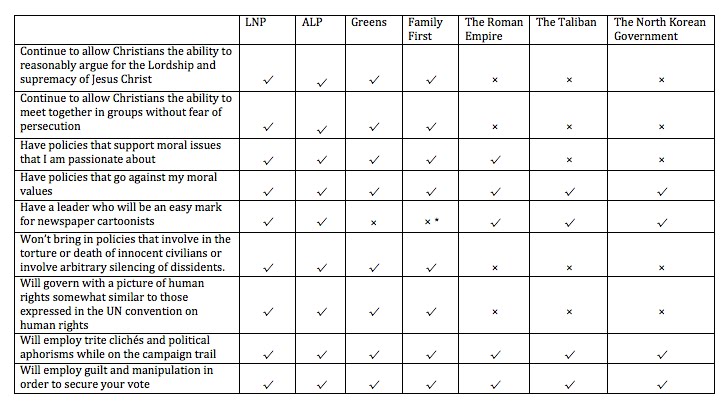
Simone posted her scorecard yesterday. Here’s mine. I hope it brings a little perspective to what can be an overly manipulative procedure. I probably should have included a column for Jesus. Click the image to see a bigger version.