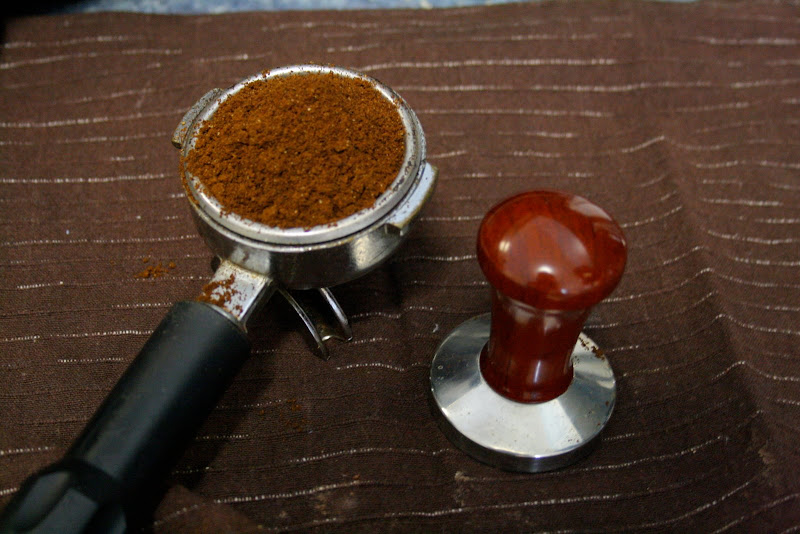
How to turn coffee cherries into coffee beans: Step 4

Continuing my series on the incredibly time consuming process of producing a cup of coffee from a pile of coffee cherries (part one, part two, part three)… this next step is the roast. In theory the easiest, and quickest, step in the procedure. In theory. Because nothing in this little game is as it seems.

I use a Behmor 4600 roaster for my beans – it’s a purpose built unit with a rotating basket and two heating elements. Normally it roasts 500gm of coffee in about 20 minutes.

First, I put my 410gms of coffee into the basket.

Then the basket in the roaster.

Then, I turned it on. All very straightforward. But nothing in this process has been as straightforward as it seems. Here’s a scrambled together video (shot on my phone) of the process. It tracks the time a little, it took much longer than expected, perhaps because I hadn’t allowed the beans to dry out quite enough, and perhaps because I kept opening the door of the roaster to shoot video.

This was the situation after the second roasting cycle…

I prefer the beans to be slightly darker, and more evenly roasted, so I put them on for another 15 minutes.

Now I’ve got to rest them for a couple of days before tasting the final product.

Celebrate “Freethinking” with GodBlock

If there’s one thing I love about our new atheist friends it’s that they’re so open minded and freethinking. They really strive to get to the bottom of different points of view, while considering the “evidence.” They definitely don’t want to censor ideas they disagree with – because myopia is exactly what they accuse us blinkered theists of suffering from.

True freethinkers should surely be encouraging their children to participate in religious discourse – even if it’s being promoted by people from philosophically divergent points. That is, of course, what freethinking looks like. Participation in the marketplace of ideas without regulation or constraint. Free thinking should be to ideas what the free market is to the economy – the unrestrained ability to find a product, or position, that you believe is best.

Which is why I’m happy to present the latest tool in the atheist toolkit – GodBlock – don’t let your children stumble across God on the Internet lest their judgment become clouded (or indeed lest they become “indoctrinated” – the side effects of which are greater than any immunisation).

Here’s why GodBlock exists:

“In the last century, the United States has seen a resurgence of fundamentalist religion. Fundamentalist Evangelicals, Mormons, Baptists, Muslims, and Jews have held back progress in science, human rights, civil rights, and protecting our environment. How can we reverse this trend and join the rest of the world in the gradual secularization of society and government?

Most deeply religious people are born into their religion, but even children raised in a secular household are vulnerable to content on the web. That’s why we’ve produced GodBlock. GodBlock is a web filter that blocks religious content. It is targeted at parents and schools who wish to protect their kids from the often violent, sexual, and psychologically harmful material in many holy texts, and from being indoctrinated into any religion before they are of the age to make such decisions.”

Yes, on no account must we allow people to think for themselves. If the Bible (or other texts) are so inherently harmful and violent then surely good atheist parents will be able to talk through the issue with their children in order to guide them on paths of righteousness…

A love match

An author, and former professional drummer, Nic Brown, took on his friend, and former (low ranking) tennis pro Tripp Phillips, the rules – if Brown won a single point he was to be declared the winner.

It’s a question I guess we’ve all asked – though, having been to the gym with dual international footballer Brad Thorn, it’s not a question I ask myself very often.

But like any sports fan, I’ve wondered: How would I stack up? I mean, I know I’m not going to win. But I’m not bad. When I play my friends, I almost always win. I hit the ball cleanly, serve consistently. I’m not embarrassing. I play smart.

The conclusion might seem foregone (but read the piece anyway) but here’s the gap in ability…

“No matter what,” he says, “I was going to have you off balance. And no matter what you did, I was going to be perfectly balanced. I knew where you were going to hit it before you hit it. It’s the difference between me and you. But if I played Roger Federer right now, he’d do the exact same thing to me.”

Reading between the lines: What the Oxford English Dictionary can teach us about typography

Dictionaries can be fun. This is an amusing article exploring the subject of typography through the archives of the Oxford English Dictionary.

“Take this 1688 quote for bake: “when Letters stick together in distributing… This is called the Letter is Baked.” So we learn that, when printing, the physical pieces of type occasionally stuck together, but we’re left to wonder why this happened, how severe it was, and how printers corrected it. Did baking ruin the type? Did each printer have his own method to prevent baking, a trade secret he passed down only to his apprentice? Did some Elizabethan Edison develop a method for casting type that eliminated baked letters altogether? These are the sorts of questions that the OED can raise, which can be investigated later (but will more likely just be blended in with the actual definition, creating a fictitious pseudo-history in the memory of the reader). Though sometimes the dictionary answers its own questions, as a similar citation for bake from 1963 shows that printers likely never overcame the issue of sticky letters.”

Here’s why the Oxford English Dictionary is cool:

“Indeed, the dictionary serves as an ad-hoc catalog of every experience that any English-speaking person felt interesting enough to write down.”

What, in the name of science, is Big Bird

Stick with this video. It’s worth it after the first 45 seconds.

From here.

Cup half empty

Ahh, the post World Cup low. I didn’t think it’d come so quickly, but now I’m wondering what I’m going to do with 4am. We’ve only recently become acquainted. Alas, I think our relationship will be brief.

Here are some World Cup odds and ends to help you overcome your fixation.

Starting with an analysis of the metaphysics of the World Cup from Overthinking It – Overthinking It is, without doubt, one of my favourite blogs. Other good recent posts include overthinking the problem of Mortal Kombat’s fusion of fantasy and verisimilitude (a form of plausibility),1 and a novel solution to the BP oil spill – namely the use of a band of merry men epitomised by the A-Team to clean up the spill.2 They also suggested the producers of Burn Notice might be criminally negligent or indeed open to prosecution under anti-terrorism laws. Here’s a quote from the World Cup post about England’s unfortunate goal line decision:

“The real world does not have official review. Even if we can determine the exact causes of a misfortune, we cannot rewind time to unmake it. All we can do is grit our teeth and try harder next time. But a sport — like any game — is a fenced-off version of how we’d like the world to be. It’s the World Plus Rules for Fairness. The arrow of time has less hold in the world of sport. We have the power to wind back the clock.”

If that’s not filling a World Cup void for you how about this video of Lego players reproducing the highlights of the round one clash between England and the USA?

Or this commemorative poster featuring all the nations from this year’s cup in the shape of the real star of the tournament – the Vuvuzela.

Or indeed, pre-order your copy of the best game spin off from the tournament.

Or you could be inspired by Remi Gaillard and drum up a gang of supporters to crash your local league game, turning it into the World Cup Final you wish you’d had this time around (H/T Tim).

It’s been a while since Argentina was knocked out – but if you’re a lady type hankering for some Maradona action (lets face it, he was one of the stars of this World Cup as demonstrated by this photo (h/t Dave Miers, from Boston.com))…

… you’ll be happy to know that Diego Maradona is most definitely not gay.

Perhaps you’re an aspiring player. If that’s the case there are two things you can do ahead of the next World Cup – sign me up as your agent/publicist and check out the mechanics of the perfect freekick (from FlowingData).

Also, check out this piece on why the pressure involved in taking a penalty kick may cause a player to choke (metaphorically of course).

“The “Yerkes-Dodson Law” predicts that participants in a penalty shootout should buckle under pressure. According to the theory, human performance follows an “inverted U shape.” Under the effect of mild stress, or “arousal,” proficiency improves as the subject expends more concentration and energy. But past a certain point, too much pressure leads to panic and attention problems, and choking ensues.”

Or, you could fill that gap by reading St. Eutychus.

1It’s a cool word, worthy of its own post, but I’ll footnote it in this one with Overthinking Its definition: To say something is “realistic” — a loaded word in itself — means that it could have come from real life. To say something has verisimilitude means that it appears that it could have come from real life. An explanation does not need to be plausible, but it needs to sound plausible, for it to have verisimilitude. It needs to stand up to casual regard, if not a concerted investigation.

Example: “Superman can fly” is fantastic. “Superman came from a planet with much higher gravity, so he can jump so far that it appears he can fly” has verisimilitude.

2 Such a team would traditionally feature: “individuals who fit into one of five types: Mastermind, Grifter, Hitter, Hacker, and Thief.”

Why do people play Farmville?

Farmville is boring. I’m proud I gave it up (remind yourself why). If you’re one of the 75 million people who regularly play Farmville – here’s a description of what you’re actually doing (from a broader exploration of why you, and your ilk, are doing it too).

Farmville is not a good game. While Caillois [an author of a book on gaming] tells us that games offer a break from responsibility and routine, Farmville is defined by responsibility and routine. Users advance through the game by harvesting crops at scheduled intervals; if you plant a field of pumpkins at noon, for example, you must return to harvest at eight o’clock that evening or risk losing the crop. Each pumpkin costs thirty coins and occupies one square of your farm, so if you own a fourteen by fourteen farm a field of pumpkins costs nearly six thousand coins to plant. Planting requires the user to click on each square three times: once to harvest the previous crop, once to re-plow the square of land, and once to plant the new seeds. This means that a fourteen by fourteen plot of land—which is relatively small for Farmville—takes almost six hundred mouse-clicks to farm, and obligates you to return in a few hours to do it again. This doesn’t sound like much fun, Mr. Caillois. Why would anyone do this?

 if Farmville is laborious to play and aesthetically boring, why are so many people playing it? The answer is disarmingly simple: people are playing Farmville because people are playing Farmville.

Here’s the rub. This is why you keep feeling compelled to play a stupid game. It’s social psychology.

“The secret to Farmville’s popularity is neither gameplay nor aesthetics. Farmville is popular because in entangles users in a web of social obligations. When users log into Facebook, they are reminded that their neighbors have sent them gifts, posted bonuses on their walls, and helped with each others’ farms. In turn, they are obligated to return the courtesies. As the French sociologist Marcel Mauss tells us, gifts are never free: they bind the giver and receiver in a loop of reciprocity. “

Read the essay. It just might change your life.

Comic Sans fights back in an expletive laced tirade

Comic Sans, the world’s most maligned typeface, has come out swinging via this imagined monologue from McSweeny’s Mike Lacher. A sample (the language is a little blue).

“You don’t like that your coworker used me on that note about stealing her yogurt from the break room fridge? You don’t like that I’m all over your sister-in-law’s blog? You don’t like that I’m on the sign for that new Thai place? You think I’m pedestrian and tacky? Guess the **** what, Picasso. We don’t all have seventy-three weights of stick-up-my-ass Helvetica sitting on our seventeen-inch MacBook Pros. Sorry the entire world can’t all be done in stark Eurotrash Swiss type. Sorry some people like to have fun. Sorry I’m standing in the way of your minimalist Bauhaus-esque fascist snoozefest. Maybe sometime you should take off your black turtleneck, stop compulsively adjusting your Tumblr theme, and lighten the **** up for once.

People love me. Why? Because I’m fun. I’m the life of the party. I bring levity to any situation. Need to soften the blow of a harsh message about restroom etiquette? SLAM. There I am. Need to spice up the directions to your graduation party? WHAM. There again. Need to convey your fun-loving, approachable nature on your business’ website? SMACK. Like daffodils in m********* spring.”

Penn and telling: An atheist magician on Christianity

Penn Jillette, half of Penn & Teller, is a famous illusionist who once even guest starred on the West Wing. He’s a pretty outspoken atheist, though he also reserves some praise for Christians who act in a way consistent with their beliefs. I posted a video from YouTube where he praised Christians who hand him Bibles a while ago, here it is again:

He was recently named the most influential performer in Las Vegas by one of the casino state’s media outlets – and in the interview he had this to say about why Penn and Teller don’t go after Islam like they do Christianity (and why they respect Christians for the way they take a verbal beating).

Are there any groups you won’t go after? We haven’t tackled Scientology because Showtime doesn’t want us to. Maybe they have deals with individual Scientologists—I’m not sure. And we haven’t tacked Islam because we have families.

Meaning, you won’t attack Islam because you’re afraid it’ll attack back … Right, and I think the worst thing you can say about a group in a free society is that you’re afraid to talk about it—I can’t think of anything more horrific.

You do go after Christians, though … Teller and I have been brutal to Christians, and their response shows that they’re good f***ing Americans who believe in freedom of speech. We attack them all the time, and we still get letters that say, “We appreciate your passion. Sincerely yours, in Christ.” Christians come to our show at the Rio and give us Bibles all the time. They’re incredibly kind to us. Sure, there are a couple of them who live in garages, give themselves titles and send out death threats to me and Bill Maher and Trey Parker. But the vast majority are polite, open-minded people, and I respect them for that.

This seems true of almost every atheist blog or book I read – Christianity is an easy target, mostly because “turn the other cheek” is a lower risk than “kill the infidels”…

Penn does believe that reading the Bible (or Koran, or any other “Holy Book”) will lead to atheism:

“…if you read the Bible or the Koran or the Torah cover-to-cover I believe you will emerge from that as an atheist. I mean, you can read “The God Delusion” by Richard Dawkins, you can read “God Is Not Great” by Hitchens… but the Bible itself, will turn you atheist faster than anything.

Question: Why would reading the Bible make you an atheist?

Penn Jillette: I think because what we get told about the Bible is a lot of picking and choosing, when you see, you know, Lot’s daughter gang raped and beaten, and the Lord being okay with that; when you actually read about Abraham being willing to kill his son, when you actually read that; when you read the insanity of the talking snake; when you read the hostility towards homosexuals, towards women, the celebration of slavery; when you read in context, that “thou shalt not kill” means only in your own tribe—I mean, there’s no hint that it means humanity in general; that there’s no sense of a shared humanity, it’s all tribal; when you see a God that is jealous and insecure; when you see that there’s contradictions that show that it was clearly written hundreds of years after the supposed fact and full of contradictions. I think that anybody… you know, it’s like reading The Constitution of the United States of America. It’s been… it’s in English. You know, you don’t need someone to hold your hand. Just pick it up and read it. Just read what the First Amendment says and then read what the Bible says. Going back to the source material is always the best.”

It’s a shame that such a well thought out guy couldn’t engage with the notion of reading the Bible as a unified work rather than cherry picking stories he didn’t agree with and stories like the one of Lot’s daughter as though God was ok with it because it wasn’t the focus of the narrative… it’s like saying the author of a crime novel is ok with the crimes he describes…

How Should Jesus Smell? Scent branding church

Scent branding fascinates me. It seems so obvious. Appealing to all the senses – especially when taste is so related to smell. It’s like nailing two senses with one blow. I went to a tourism marketing seminar with Tom O’Toole, the owner of the Beechworth Bakery. One of the first things he did when turning the bakery into a landmark tourist attraction and nationally renowned bakery was to pump the smells from the kitchen out onto the street. I read elsewhere that fast food joints use similar strategies (which is why they always smell so good).

Smells effect us all. They trigger memories, comfort us, stimulate us, warn us off dodgy food… Jasmine is apparently as effective as valium. Smells are chemically complex – the aroma of your freshly ground pile of coffee can be formed by as many as 800 different aromatic compounds. Smell is powerful stuff – and besides food chains and deodorant manufacturers its been a pretty underutilised element of branding. Sure, we describe new purchases by their scent (cars, leather etc) – but this seems more a marker of quality than a factor in the purchase decision (though you wouldn’t buy a stinky new car). Scent marketers Air Aroma cite research that suggests that 75% of our daily emotions are triggered by smell.

The practice of creating artificial smells is pretty controversial (unless you’re a celebrity launching a perfume brand – ala Bruce Willis… because smelling like a sweaty male action figure is awesome.

Hotels have trademarked fragrances that get pumped into their lobbies and rooms take this little anecdote for example:

Since Le Méridien was founded in 1972 by Air France, Penot and Roschi took a very old copy of Antoine de Saint-Exupéry’s Le Petit Prince—the author was a pilot—and had the rich smell of the book’s pages analyzed. (Capturing the scents of familiar objects is quite standard in this industry, though presumably the choice of this particular old book for the testing was more whimsical then determinative.) They used the results to create a scent, which they took to Ziegler. She decided it would be Le Méridien’s signature fragrance, its olfactory logo.

Scent branding isn’t new, the article above dates its use in travel to the 1970s – it even has a name for the part of your brain that the method targets: “Singapore Airlines has a branded scent… used in all of its planes, a light sweet scent like pure steam from fresh rice. If you’re booking a flight…you’ll find it that much harder to go with the competition because the Singapore scent builds the brand in the limbic system.”

The future of the hotel industry will apparently involve us selecting a scent for our room at check in, and the room smelling of roses (or whatever we choose) by the time we get to the door. Some people see this practice as a form of subliminal manipulation, or have problems with the ethics of the perfume industry.

Natalie Dee, a designer, very usefully put together this periodic table of smellements – a grading of smells we find pleasant or noxious.

And, incidentally, it’s now possible, through the availability of precise scientific measuring tools like mass-spectrometers (made famous by NCIS), to analyse a person’s “scent print”…

“Florida International University chemist Kenneth Furton studies the smells that might be of greatest use in a crime investigation. These, he says, are the ones that come from the hands. (Murderers rarely wield weapons in their underarms.) For the last five years, Furton has been cataloging the many chemicals that compose hand scent, including odoriferous acids, alcohols, aldehydes, hydrocarbons, esters, ketones, and nitrogen-containing compounds.”

Robyn tells me that using aromatic oils in the classroom also helped moderate behaviour – lavender calmed the kids down, lemon and eucalyptus perked them up.

Which all adds up to a compelling case for harnessing smells in branding – but is this an area churches should be playing in? Should we install ventilation systems dedicated to pumping the odour of a well read bible through the auditorium at reading time? Should we be pumping the smell of morning tea onto the street to entice people in on a Sunday? What smell do you think captures, or enhances the church experience? What did Jesus smell like? A mix of sawdust, dirt, and after his anointing a liberal dash of perfume. Was that the first case of scent branding?

Kitchen Mythbusters

A scientist has put common kitchen myths to the test, finding many wanting. Like these:

  1. Searing meat seals in the juices
  2. A box of baking soda in the fridge or freezer absorbs odors
  3. When you add alcohol to a recipe it all evaporates during cooking so there is none in the final dish
  4. Avoid aluminum cookware because of Alzheimer’s disease
  5. Microwave cooking destroys nutrients more than other cooking methods

Why smart people fail

Apparently there are at least these 20 reasons that smart people fail. If you want to look into why dumb people are overconfident (or the Dunning-Kruger effect),

1. Lack of motivation.
2. Lack of impulse control.
3. Lack of perserverance and perseveration.
4. Using the wrong abilities.
5. Inability to translate thought into action.
6. Lack of product orientation.
7. Inability to complete tasks.
8. Failure to initiate.
9. Fear of failure.
10. Procrastination.
11. Misattribution of blame.
12. Excessive self-pity.
13. Excessive dependency.
14. Wallowing in personal difficulties.
15. Distractibility and lack of concentration.
16. Spreading oneself too think or too thick.
17. Inability to delay gratification.
18. Inability to see the forest for the trees.
19. Lack of balance between critical, analytical thinking and creative, synthetic thinking.
20. Too little or too much self-confidence.

I wonder how many of these factors must be present before intelligence must be questioned.

The design

I have, unless you notice any major dramas dear reader, finished playing with my design.

It should look a little something like this:

If it doesn’t, could you let me know (and tell me what browser you’re using too…) Could you also let me know if you really hate it? Or like it. That would be great.

How to turn coffee cherries into coffee beans: Step 3

I was all set to roast the beans at the end of step two (which followed step one).

And doing so would probably have proved disastrous. The husks were still on. That would have thrown out all my roasting calculations and I probably would have set the beans on fire in my roaster. This DPI article was useful. Although it suggested storing the dry beans in a sack for two weeks before continuing with the hulling process (which may have saved me significant time).

Removing the husks proved to be the most time consuming process to date – and the most mechanised. Even with the help of modern technology (a food processor) the process require sorting through every bean by hand and often removing either flakes of husk or the whole husk – depending on how effectively the food processor had worked on the individual bean.

I started shelling the beans by hand – as though they were peanuts.

Before turning to the food processor. The plastic blades (recommended by the DPI) took too long – and the beans probably did more damage to the blades than the blades did to the beans. So I switched to the metal ones. This process was very loud. I started at about 11.30pm, and then decided our neighbours might not appreciate the machine gun like sound.

I enlisted some help, and even with these three dedicated shellers the process took about two hours.

These beans (approx 430gm worth) are now roast ready, but they’ll lose another 20% of their weight in the roast – so I’m going to end up with around 350gm of roasted coffee for my troubles.

Microanalysing the World Cup

It turns out world cup success does not depend on the ability of the players a team fields – but rather the presence of a particular parasite within their home country. This parasite, Toxoplasma Gondii (which sounds like the name of a footballer), may influence the natural dopamine levels of those infected. This diagram (from wikipedia) shows its life cycle, though it omits the bit where it helps win a World Cup for its host.

From Slate:

If we set aside the qualifying rounds (in which teams can play to a draw) and focus on matches with a clear winner, the results are very compelling. In the knockout round of this year’s tournament, eight out of eight winners so far have been the teams whose countries had higher rates of Toxo infection. If we go back to the 2006 World Cup, seven out of eight knockout-round winners could be predicted by higher Toxo rates. The one exception to the rule was Brazil’s defeat of Ghana, a match between two nations that each have very high rates. (Aside from having the winningest team in World Cup history, Brazil has quite a few cases of Toxo: Two out of three Brazilians are infected.)

It gets better. Rank the top 25 FIFA team countries by Toxo rate and you get, in order from the top: Brazil (67 percent), Argentina (52 percent), France (45 percent), Spain (44 percent), and Germany (43 percent). Collectively, these are the teams responsible for eight of the last 10 World Cup overall winners. Spain, the only one of the group never to have won a cup, is no subpar outlier—the Spaniards have the most World Cup victories of any perpetual runner-up. “

Coincidence? Perhaps. But I wish I’d read this before tipping a World Cup winner.