The site selling these Teenage Mutant Ninja Turtle backpacks went all out and got a teenage mutant to model this ninja turtle bag.

How to promote your band on Google Street View
It’s simple really. If you’re an aspiring musician just wait until you hear Google is updating images of the streets in your suburb and then follow these steps and you’ll sell millions, if not billions of copies to workers in Indian call centres.
- Get a guitar.
- Get a sign.
- Drive around until you see the Street View Car.
- Go one block past the Street View Car.
- Set up a placard and pose.

Calculating circular mathematics in the shower: as simple as pi
Did you know that water droplets are perfectly spherical? You could measure it for yourself if you could remember the formula for the volume of a sphere and if you had one of these pi shower curtains featuring pi to 4,600 decimal places.

Why I prefer email to phone conversations
Email you can do from the bathroom without fear of condemnation or suspicion.
The Oatmeal has ten reasons. I like this one.

Things I would do if I had an annoying little brother
This made me:
a) wish I had a little brother.
b) glad I don’t have a little brother.
c) laugh.
d) all of the above.
UPDATE: I posted the wrong video – I’ll leave both up.
Mad Skillz: Mad on mad skillz
My little sister obviously didn’t get the memo. You know. The one I addressed to the whole world inviting contributions for the increasingly inappropriately named “Mad Skillz Week”… you can decide the basis that I think the name is inappropriate for yourself. Anyway, Maddie, aka little sister number 2, had this to contribute.
I was annoyed that Nathan didn’t ask me to give input during mad skillz week. I thought perhaps he didn’t believe I had any mad skillz, and he may have been right.
I’m Mad, but the skill part still eluded me. I considered giving 5 tips on how to be me. But then if all the readers took my advice there could be maybe 3 or 4 of me running around and so I thought the better of it.
I considered writing 5 tips on how to be a cat lady.
- Buy two cats of the opposite sex.
- Never shower.
- Walk hunched.
- Wear scarves and cardigans.
- …
Well now you see the problem. Plus since I’m not actually a cat lady it seemed like a fallacy.
Still I was convinced I could give 5 tips on something. Then it hit me…
Mad on How to share mad skillz:
(in no particular order of importance, except point 4)
- Be humble. Suggest you’re not that skilled, that there are a million people better than you and that you only have the skills because they were bestowed upon you by a mentor/teacher/father figure.Including other people’s names makes it clear you’re not a self centred blogger and that you’re part of a real world community without suffering some superiority disorder. I’m not really sure I’m qualified to advise you on how to write about your real skills, but growing up with Nath has taught me a little about writing stuff.
- Never say your skills all come naturally. If people are reading about your skills part of them wants to be like you. Fill them with a little false hope – tell them if they work hard they’ll be able to do your skill too. Anyone could write 5 tips to others, all you need is a skill and a communication medium – chisel/stone tablet, pen/paper, fingers/iPhone.
- “Although seemingly contradictory to rule number 1” – this phrase should always be included in your 5 key points. why? Because it shows there are shades of grey, there’s no best way, and it makes it look like your skill is a fine balancing act – so is actually a real skill.And although seemingly contradictory to point 1, it’s important your 5 points show that you are skilled, don’t shy away too much from your abilities because if people think you don’t know what you’re talking about why should they listen??? I know this because I won a public speaking award in grade 10.
- Always have something funny in point 4.
- Don’t put too much technical jargon in your points, but do include examples, photos, diagrams, flow charts – things that can be grasped fast. People outside your world aren’t familiar with the culture and stuff. And to be honest they probably don’t care about technicalities because how many people are going to become substitute roller-skating photography teachers? Not many.

They are interested in the general gist of your skillz. So stick with simple words, concepts and grammar. Keep it short. <- see?
So there you have it – if you’re inspired feel free to keep sending mad skillz my way – nm
How to write a post that links to other posts
Sometimes I read links to awesome posts about cool stuff where the person does such a good job of describing the content at the other end that I don’t feel the need to click through. This is probably a bad thing. A few weeks back Kottke linked to a post about how to write an incendiary blog post. His post was good. I shared it via google reader, and thought nothing further of it.
Then Amy linked to the same post and I read the original. It’s funny. You should read it – and make sure you check out the comments too…
This sentence claims that there are many people who do not agree with the thesis of the blog post as expressed in the previous sentence. This sentence speculates as to the mental and ethical character of the people mentioned in the previous sentence. This sentence contains a link to the most egregiously ill-argued, intemperate, hateful and ridiculous example of such people the author could find. This sentence is a three-word refutation of the post linked in the previous sentence, the first of which three words is “Um.” This sentence implies that the linked post is in fact typical of those who disagree with the thesis of the blog post. This sentence contains expressions of outrage and disbelief largely expressed in Internet acronyms. This sentence contains a link to an Internet video featuring a cat playing a piano.
Here’s my favourite comment…
“This comment is by a trolling Jehova’s Witness who is filled with brotherly love for all the other commenters, but knows without meeting any of them that they all deserve to burn in hell forever. Fortunately, anyone willing to read this far is already jaded from way too much time spent reading comments.”
The moral to this story (other than that you should read both Amy’s blog and Kottke.org) is that you should always click through to interesting links.
Undercover unbelievers
An article from Freakonomics has caused a bit of a stir. A family from the Bible Belt confessed to feigning Christianity in order to fit in. It’s sad. If the church is pressuring people – either overtly or covertly to conform behaviourally without a change in beliefs first then it is not doing its job. The church should be loving and seeking the welfare of non-Christians – and Christian parents should be encouraging their kids to play with the non-Christian kid next door. If they’re so worried about their kid being converted by the friendly neighbourhood atheist then maybe they should reconsider their parenting strategy lest the kid make up their own mind when they reach his/her 20s only to discover a big and scary world of ideas beyond their sheltered milieu.
Here’s a quote from the article…
We found by experience that if we were truthful about not being regular church attenders, the play dates suddenly ended. Thus started the faking of the religious funk.
It seemed silly but it’s all very serious business down here. We don’t go to church or teach or children one belief is “right” over another. We expose them to every kind of belief and trust that they will one day settle in to their very own spirituality.
I know we Christians want our children to grow up just like us (and I’m not a parent – though I have been a child) but surely we can be just as confident that our children will make the right choice as the agnostic is about theirs… I wonder if there’s a correlation between the parents who don’t believe in vaccination and parents who don’t let their children play with the scary atheists.
This was not the most interesting part of that particular Freakonomics post. Oh no. The most interesting part was this study of the effect of using an open collection plate rather than a closed bag thing – this further demonstrates the hypocrisy inherent in the system.
In these churches, the collection was taken up in a closed bag that was passed along from person to person, row to row. Soetevent got the churches to let him switch things up, randomly substituting an open collection basket for the closed bags over a period of several months. He wanted to know if the added scrutiny changed the donation patterns. (An open basket lets you see how much money has already been collected as well as how much your neighbor puts in.) Indeed it did: with open baskets, the churchgoers gave more money, including fewer small-denomination coins, than with closed bags — although, interestingly, the effect petered out once the open baskets had been around for a while.
Mad Skillz: Andrew on low light photography
Andrew isn’t just an opera singer about to hit the big time in Germany. He’s also a photographer of some repute. Here are his tips on low light photography. I’ll update this to include a link to his Flickr. If he’ll let me. I guess you’ll soon find out. Ahh, stuff it, it’s public domain. Here you go. Check his work out.
And here’s one of his photos – it is copyright so look but don’t touch (even though I’ve hypocritically stolen it – but we all know how I feel about copyright…).

A couple of years back I had a 10-tips article on photographing rock concerts published in JPG Mag (Read it here). So for Mad Skillz Week, here’s an adaptation of 5 tips for photographing in low light. Whether it’s a concert, candle-lit cuisine or the cool colours of the Eiffel Tower light-show, these tips will help make the most of difficult lighting situations.
*Disclaimer: of course, you shouldn’t be taking photographs in professional performances, but if you happen to have a child star, then this will be of use.
Mad Skillz: Kutz on how to play international roller hockey
Of all the people in all the blogosphere Kutz is the only person I have lived with in Brisbane. Tim also blogs, and Mattias used to. I also work with Kutz. And go to the same college. And we play futsal together, and very soon we’ll play football together.
For a guy who almost staged a coup on my only claim to presidential authority (QUT Christians in 2005) we get on surprisingly well and spend a lot of time together. Kutz is a deep thinker, who I think sometimes thinks so deeply he gets lost in his own thoughts while trying to articulate them. Lots of people know Kutz – both online and in the real world. His two greatest personal achievements are convincing his wife to marry him and playing international roller hockey – that’s my assessment not his. How many sporting internationals do you know? I can count them on two fingers. While the cynics out there might think that picking an obscure sport to play is kind of cheating – Roller Hockey is hard core (I watched a tournament once) and Kutz was a standout.
Anyway, here are his tips on how to be awesome at Roller Hockey. He gets extra points for diagrams – though I suspect he was making them when he should have been writing a sermon.
I’m Kutz and I’m an ex roller hockey player. Hoquei em patines, for those Spaniards among you.
Roller hockey is awesome. You take 5 steps, and then all of a sudden you’re already going fast. Seriously. You don’t need to keep running. You just roll. Your legs are still. And yet you’re still going fast. A beautiful concept. Add to this the feeling of smashing someone into the wall, flicking a ball into the top corner (probably on the keeper’s stick-side) and getting to hit a ball (and, on occassion, other people) with a stick and how can you go wrong?
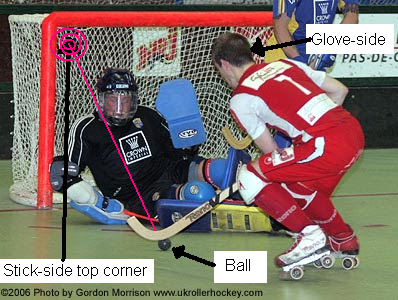
Now, I used to play with a team of guys: Michael, Les, Dion, Matty, Serge (my bro), Chris, Peter and some others.
Michael’s top 5 rules were:
Rule #1 – Hit Dion
Rule #2 – Hit Dion
Rule #3 – Hit Les
Rule #4 – Hit Dion
Rule #5 – Hit Les
Fun rules they were too. They aren’t, however, mine.
My Five best* tips for playing roller hockey. (And these are genuine, and hence will interest only a very few of you.) (They will also mostly be team, not individual, principles. That’s because that’s all my dad taught me.)
- In negative sports**, a strong defence that puts some pressure on the opposition is the key to winning. So defend tightly, and communicate well.
- Don’t give away the ball close to the halfway line. Breakaways goals are imperative to avoid.
- If you’re trying to score, the hot-spots to skate to are here. (see diagram)
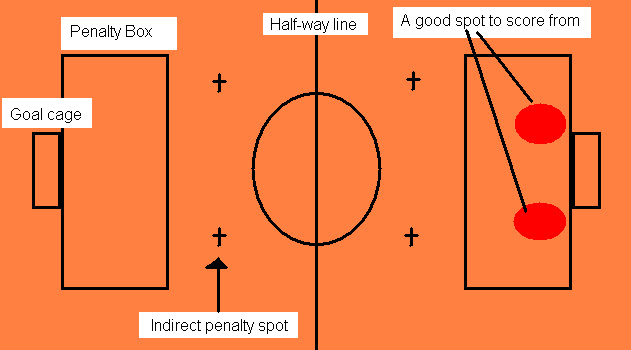
- When defending man-on-man (ie, you’re marking a specific player, not defending in a zone) skate in straight lines, roughly parallel to your penalty box lines. Skating in straight lines gets you there faster than skating in curves.
- Try to make your team-mate look good. If everyone on the team has this mentality, hockey is a beautiful thing.
- 6. (Unofficial, but vital) Don’t drop the soap in the showers.
Nathan’s asked me to tell you now how applying these 5 tips will change your life. I would suggest that after intense thought and application these principles will simply confuse you if you try to use them while learning to play hockey. Our coach Eduard Karayan (ex-pro in Italian league) just let us go and have fun. So we did. :)
* May change after more than 10 minutes of contemplation.
** A ‘negative sport’ is my short-hand for a sport where in any given attacking phase it is more likely that the attacking team will not score than that they will score. Ie, football(soccer). A ‘positive’ sport would be something like basketball where the expectation is that more likely than not the attacking team will score from their attack.
Hi, ho, hi, ho, it’s off to court we go
The saga of our unreturning bond continued today (as part of the larger epic tale of woe that results from dealing with Townsville’s worst real estate agent – J0hn Gribb1n realty). I will update this post with the correct spelling once our case is over.
Not only did we suffer through two years living on site with the landlord from Hell – he wants us to pay for every paint chip, cracked tile and wall mark in the house (otherwise known as wear and tear). Better yet, he wants us to pay him $370 to conduct the repairs. Does anybody else see a conflict of interest here? We asked the real estate agency if we could have quotes from other tradespeople in Townsville and were told that it was too late – that the work had already been completed while the mail was in transit. Dodgy city.
Now we are going to the Small Claims Tribunal – now known as QCAT where I get to put everything I have learned from years watching legal television (and from a little bit of a Law Degree) into good use. Legal representation is not allowed – but I will get our friendly neighbourhood lawyer to have a bit of input into my preparation.
In conclusion – do not live at unit 1, 11 Diprose Street. The landlord not a very nice man who takes great delight in yelling at his tenants for no logical reason, and do not rent with J0hn Gribb1n – who advise their landlords that a 25% reduction in costs of a piece of broken kitchen equipment (that can’t be logically demonstrated to be broken because of the reckless, negligent or malicious actions of the tenant) constitutes negotiation.
From Russia, with “blood”
Russians like weird vodka – like this “Kabbalah” Vodka containing the blood of “Christian infants”…

From beverage maker EZ Protocols is the newest, and weirdest, entry into the premium Russian vodka market. Given the explosion of capitalism and the influx of money into the former Soviet empire, there has been a huge rise in this market as neuveaux riche wish to show off how riche they are. Hence, Kabbalah Vodka with Christian Infants, the premium wheat vodka enfused with silver, gold, platinum ions that features a glass model of a baby inside. This plays off the old wives tale circulated in Europe that Jewish religious rites required the blood of Christian babies.
A handy guide to geek obsessions
It is possible to be a geek about so many things. From here.
![[geekmap.png]](http://1.bp.blogspot.com/_NfKwjR8raUA/SxhAY0izYUI/AAAAAAAAAHs/79k3_xw4dHg/s1600/geekmap.png)
Facebook login fail
It seems that an article on Read Write Web about an emerging trend in social networking managed to rank better than Facebook’s login page for the phrase “Facebook Login”…
Hilarity ensued when a bunch of luddites thought the page was some sort of new landing page for Facebook – and many of them left comments venting their frustration at being unable to log in with the new red and white designed page.
Seriously the most fun you can have laughing at the technologically illiterate…
- just want to get on facebook
 Posted by: cassandra james | February 10, 2010 10:01 AM
 - please give me back the old facebook login this is crazy……………..
 Posted by: Nancy
  | February 10, 2010 10:04 AM
 - EXCUUUUUUUUUUUUUUUUUUUUUUUUSE ME!!!!!!!!!!!!!!!! WHY NOT JUST LEAVE IT ALONE!!!!!!!!!!!1111
Posted by: Nora | February 10, 2010 10:05 AM
- I just want to sign in…………
Posted by: Ann | February 10, 2010 10:09 AM
- I just want to log in to Facebook – what with the red color and all? LOLLLOLOL!!!!!111
 Posted by: Frederic Lardinois
  | February 10, 2010 10:13 AM
