Self Help Books for Dummies – Writing the book

The key to success in the self-help market is to understand that you don’t actually need to provide any merit to your readers. They get enough benefit from simply adding your book to their self-help library to impress visitors. However, there are several tools that the successful self-help writer should have in their toolbox.

1. Statistics
2. Diagrams
3. Illustrations
4. Clichés
5. Repetition
6. Repetition
Statistics

The truth is 90% of self help books are never read, at least past the first chapter. Once your first chapter is finished you can pretty much write whatever you want to fill in the next nine chapters. This is both a valid lesson for the self-help writer to learn and an example of how statistics can be misused or just plain made up.

Diagrams

The old saying that a picture is worth a thousand words holds true in the self-help market. Because any given sample of 1000 words of a self-help book are unlikely to make any sense, you as the writer have a bit of freedom when it comes to diagrams. In fact the more complicated the diagram appears the more impressive it seems.
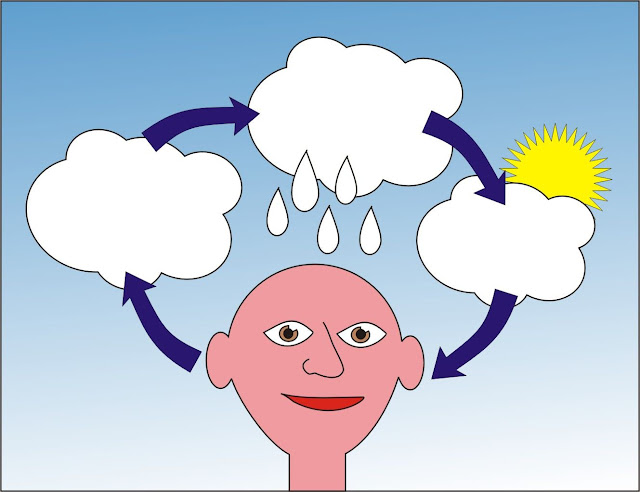
The idea cycle – another pointless diagram.

The most important part of a diagram is to have an appropriate caption so that people know what they are looking at. A really good caption will say a lot but mean very little to the reader.

Illustrations

One tool that the prospective self-help writer will have to develop if they want to increase their word limit in a hurry is to be able to use pointless, long-winded illustrations. Here’s an example of an illustration that will leave the reader looking for a point or moral:

“It’s like a boat, sailing on a really choppy sea, the sailors are getting sick, throwing up all over the place. In a situation like this the last person you want to be on the boat is the ships boy who has to clean up everyone’s mess, including their own.”

Often the reader’s interpretation of a story like that one will be much more beneficial to them than anything you could come up with yourself. While there are obviously many meanings that could be taken from this illustration its ambiguity is important if people are to gain any “real” meaning from your writing.

Clichés

Clichés are another important key to success. Especially when misused, they allow the real meaning of sentences to flow like water off a ducks back, where the duck is the reader. The more clichés you can pack into a paragraph the more confused the reader will get. It’s important when using clichés that you really give 110% to your writing.

Repetition

It’s a sad truth that people these days rely on repetition to enforce truth. Well sad unless you’re a self-help writer with a lot of space to fill and not much to say. The importance of repetition means that you can pretty much just say the same thing over and over again in new and innovative ways for the whole book if you want.

It’s vital that you repeat yourself so that the reader will recognise the importance of your message. Unless you repeat yourself several times your message won’t be enforced. This isn’t such a bad thing. It means that you will be able to fill up the empty pages of your book very quickly.

Always remember the golden rule for self-help writing – confusing the reader is the ultimate goal. You’ll eventually be able to release a sequel to your first book further explaining the concepts of the first. You can even use “for dummies” or “idiots guide to” in the title of the new book.

A rather smart casual dinner dress

If you’re a fan of Black Books – like me – you’ll no doubt be thrilled to know that Dylan Moran has a movie out fittingly called “A film with me in it“, because that is perhaps the only reason anybody is going to watch it. And I will. But I digress. Black Books has pretty much disabled any YouTube embedding of clips from the show – which is a shame. But one of my favourite moments from series one episode one is when Bernard turns his accounts into a “rather smart casual dinner jacket” – if you were a woman looking to date someone in a jacket like that you’d need a matching outfit. Like this one.

A bunch of links – April 23, 2009

Pop art

The latest in a string of retro remakes of popular culture “texts”… this time it’s CD covers getting the treatment – essentially being elevated to serious, high art… here’s a link to some others from Kottke.

Ode to Bach

Johann Sebastian Bach was pretty awesome. Awesome enough for me to own this shirt.

While I’ve always appreciated Bach for his robust theology and amazing musical ability – it was not until the weekend that I learned that Bach was a coffee snob. He wrote a cantata describing his love for the bean. The Coffee Cantata. Here’s a rough English translation of some of the lyrics:

Recitative Schlendrian
You wicked child, you disobedient girl, h! when will I get my way; give up coffee!

Lieschen
Father, don’t be so severe! f I can’t drink my bowl of coffee three times daily, then in my torment I will shrivel up like a piece of roast goat.

Aria Lieschen
Mm! how sweet the coffee tastes, more delicious than a thousand kisses, mellower than muscatel wine. Coffee, coffee I must have, and if someone wishes to give me a treat, ah, then pour me out some coffee!

The piece was a moral treatise on the place of coffee in daily life. The protagonists were a father and a recalcitrant coffee addicted daughter who would not forgo her daily java. The father demanded she do so lest she forfeit the right to marry and she relents… seemingly. Although in a sub clause of sorts she indicates she’ll only marry a fellow coffee snob – sage advice indeed.

The uplifting final movement brings the father, daughter and narrator together to sing a song expounding on the benefits of coffee and proclaiming it “natural”. Hurrah.

Here’s a performance from YouTube:

Universally speaking

Henry Petersen probably googles himself pretty religiously – so if you’re here, reading this Henry – thanks for the mangoes.

Henry Petersen is the promoter behind the “Fashion Bash” an event that sees young girls from Townsville fight it out on the catwalk for modeling supremacy every year – and an event that can now claim to have launched the career of the new “Miss Universe Australia” – Rachel Finch.

Henry apparently spotted her at the airport.

When you’re talking about shameless self promotion in Townsville, Henry Petersen takes the cake. He’s everywhere. He made national news for his “wife hunt” a few years back (his story is at the bottom of this link), he repays locally bestowed favours with fruit grown on his farm – and he relentlessly plugs his events with terribly worded emails. I’m sorry Henry. If you’re reading this. They truly are terrible. He once requested recognition at our tourism awards for his outstanding contribution – comparing himself to Peter Brock and Steve Irwin weeks after they died saying it was a shame accolades are so often dished out posthumously.

Well, now he’s a success again. In the news for all the right reasons. As a model scout. A teen model scout.

And Townsville is on the map. As a place capable of producing a Miss Universe Australia (MUA). Not sure if this little description of Townsville from the new MUA is productive or not as far as marketing northern Australia’s “largest city” goes…

Coming from such a small town it’s not only somewhere to grow up that’s naturally beautiful but you really learn the value of growing in that small community and you get a lot of support and love and you can take that in your heart and take that to a bigger city or move on with your life and your career and really make a change.

Yes, we’re all only here so that we can leave. Thanks Rachel.

Social networking

Being a marketer at heart my approach to “social networking” (outside of this blog) is pretty much to relentlessly promote things. To me Facebook and Twitter are pretty much marketing vehicles – though I do read my friends status updates and click their links – because I think that if I expect people to do that for me I should pay others the same courtesy. I will also comment on things that interest me, and chat to people. I’m not completely soulless. But still, I unabashedly use my status to direct people here.

You may have noticed. If you’re my friend on Facebook, or following me on Twitter. 9 out of 10 of my status updates or posts are a shameless piece of self promotion. This is mostly because I see my blog as my most substantive and relationally focused web presence – and because I like the idea of people hanging out on my blog and discussing things – like Christian music – I put a lot more time and effort into this blog than anywhere else online (excluding Tetris on Facebook). The shameless self promotion thing works. Here’s a graphic of visitors to this site and the correlation with posting links…

plugs

Salt: of the earth

I’m writing an article for WebSALT – the online edition of the AFES magazine. The next edition is all about the environment.

My topic: “How should Christians relate to the green party in the political sphere?”

It’s a good question – and I’ve shared my own thoughts on the Greens – or at the very least the environmental lobby here in the past.

In the interest of objectivity – I’d be interested in hearing the thoughts of some others.

If your thoughts are good enough I may even include a quote in the piece.

If they’re not they’ll no doubt shape the final product anyway.

Self Help Books for Dummies – The Title and establishing credibility

Now that we have picked our topic, the next, equally important, step is to pick a catchy title for the book. There are several self-help brand names, and unless you have been specifically employed by those brands, it’s a good idea to steer clear of titles that end with the words “for dummies” or start with the words “an idiot’s guide to”. However, it may be a good idea to cater for the section of the market that these books ignore and launch your own “for geniuses” brand. Because lets face it, nobody really likes being called a dummy do they? And you don’t want to be a nobody now do you? Like any good title a little pun never goes astray. Catchiness is also important, but believe it or not, this doesn’t mean your title needs to be short and punchy. Think of the books you’ve seen at bookshops in the last year. Which books had the longest titles? That’s right, the self-help books. Titles need to grab attention. They need to speak to the potential reader on more than a superficial level. They need to make a connection with the average bookshop browser, a connection that says, “you really want to buy me.”

The three big rules for writing a successful title are:
1. Don’t insult your reader
2. Be as catchy as possible
3. Less is not necessarily more

So a good title for our book about getting into the fresh fruit juice industry might be – “The big squeeze – a genii’s guide to creating your very own fruit juice franchise”

Establishing Credibility
It’s important that a self-help author establishes their credentials early on in the piece. Self-help writing is one of the few times in life where having lots of letters after your name is actually an advantage. If you have no really fancy qualifications, don’t worry. There are a few really easy solutions. There are several online “universities” offering diplomas for just 12 easy payments of $39. If that is beyond your financial means or you just don’t have the four weeks to wait for them to mail your certificate there is still hope. Simply legally change your name from ‘Joe Smith’ to ‘Joe Smith (B. Fruit Juice Studies, hons, Dip Bus Man, OBE)’. It’s always nice to award yourself a couple of prestigious awards. While a knighthood may seem a little pretentious, an order of Australia or other fancy award looks impressive and nobody will really question its legitimacy. Now that you have your new identity and your credibility is established, it’s time to start writing.

A bunch of links – April 22, 2009

Taking over the world geek style

Perhaps my series on taking over the World wasn’t comprehensive enough. Perhaps you’re looking to solve a more pressing and specific problem. Perhaps this book will help.

It deals with a number of tricky issues like:

  • Brew your own beer
  • Build a laser beam
  • Clone your pet
  • Exorcise demons
  • Grasp the theory of relativity
  • Kick ass with sweet martial-arts moves
  • Master the Ocarina of Time
  • Pimp your cubicle
  • Quote He-Man and Che Guevara
  • Unmask Linus Torvalds
  • Write your name in Elvish

Gorilla marketing

Guerrilla marketing is all the rage. Sneaky. Subvertive. In your face and yet subtle at the same time. Gorilla marketing is another area all together – Cadbury tried it with their virally popular drumming gorilla – and who can forget Yogo (the chocolate yoghurt and its mascot Yogorilla).

Now, a health insurance company is in on the act. Gorillas don’t like eye contact. Apparently an escaped gorilla attacked a zoogoer for making too much eye contact recently. FBTO, this Dutch health insurance company responded by handing out these innovative zoogoing goggles. Found here.

Definitely, maybe

So, you can’t spell “definitely” – here’s a bookmark for you.

You can even buy a mug. Or a wide range of defiantly “definitely” merchandise.

Primal scream

243112609-1 is the world’s largest known prime number. Written down in full it’s 12,978,189 digits long. That would take a long time to read out, let alone scream. It would be much simpler to type it out. Maybe.

Reproduced in real life this number would stretch for up to 32km. Depending on the typeface. Different fonts apparently produce markedly different results.

Prime numbers are also, apparently, useful for things other than cryptography.

In case you’re wondering, prime numbers aren’t just the stuff of academic longhairs: like typefaces, they have interesting properties that make them strangely useful. The classical example comes from mechanical engineering, where two meshed gears will wear most evenly if each has a coprime number of teeth, since this evenly distributes the possible ways in which they interact (thereby minimizing the effects of any irregularities.) Some have suggested that 13- and 17-year cicadas each follow prime numbered life cycles in order to ensure that their populations compete as little as possible, coexisting only once every 221 years.

I know this, and now so do you, because of here, and here.

Bottomless glass… almost

Refilling your wine glass is tiresome – this is probably the reason so many lazy homeless people prefer their wine in a cask. This designer clearly got sick of the problem – and designed this wine glass with a built in storage tank.