Author: Nathan Campbell

Nathan runs St Eutychus. He loves Jesus. His wife. His daughter. His son. His other daughter. His dog. Coffee. And the Internet. He is the pastor of City South Presbyterian Church, a church in Brisbane, a graduate of Queensland Theological College (M. Div) and the Queensland University of Technology (B. Journ). He spent a significant portion of his pre-ministry-as-a-full-time-job life working in Public Relations, and now loves promoting Jesus in Brisbane and online. He can't believe how great it is that people pay him to talk and think about Jesus. If you'd like to support his writing financially you can do that by giving to his church.

Brickscuits

Imagine a world where playing with your food is obligatory. When towers of biscuity goodness are limited only by the height of your roof. Are we on the same page?

Ready. Set. Go.

Pottering around


While I was thinking about the whole PK issue the other day I was struck by a comparison that I’ve thought of in the past but not, until now, documented.

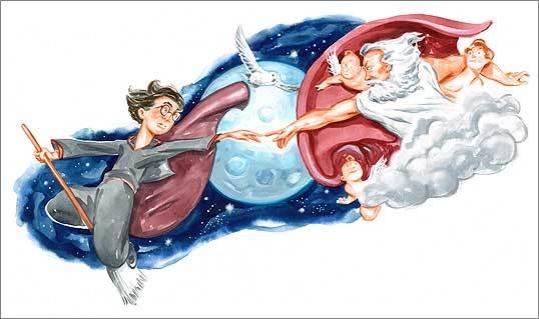
Being a PK is just like being Harry Potter. Hogwarts is the broader church, the houses within Hogwarts are either the different types of people within a congregation or representative of multiple denominations. Atheists are muggles, and people who come to faith from outside of Christian homes are “mudbloods” according to some of the less tolerant members of the church – obviously only the nasties. (this actually closely reflects some comments I’ve heard from people who come into the church from other backgrounds).

So being a PK is like being a child of promise – and you rock up to Hogwarts and all the faculty know you by reputation and have expectations.

I promise this will be the last time (for a while) that I mention Harry Potter. But it seems a valid meta interpretation of the world in which the wizards operate.

What say you?

Also, the picture at the top comes from this great article about how Christendom has suddenly decided that Harry Potter is OK because they’ve figured he’s a messianic figure with plenty of plot allusions to Christ.

Pieces of eight bit

This video is rightly being hailed as the best lego stop motion 8-bit tribute of all time.

It’s a pretty small pool I guess – but all the typical post fodder is included – Pacman, Mario and Tetris make an appearance…

Under the hood

If you’re a Christian and you want to evangelise and you need convincing that being loving is the best to achieve this outcome then you need to watch this interview that Denton did with a former leader of the Klan.

If you’re either not a Christian, or already convinced that speaking the truth with love is already the way to go, then you should watch the video too…

I am fascinated by the fact that both Denton and BoingBoing (where I found it) push the guy in question’s courage when the thing that strikes me is his love for his enemies.

Unbroken breaks

Just in case you have previously considered commenting but were turned off by the lack of appropriate spacing in the comments to indicate paragraph changes… or for those of you who have been complaining about the long standing issue…

I fixed it. If you are here because you googled “WordPress Comments paragraph spacing” or something related to WordPress Comment formatting…

The offender was this little piece of code in the CSS:

.comment-text p {
margin: 0;
padding: 0;
}

Just so you know. You should remove that if you’re having the same issue.

Losing your edge

It’s been ages since I last paid out U2 and their myriad fans. This little rant is Ben’s fault, well, more correctly it’s Warren the word over-use watchdog’s fault. Warren doesn’t like the word edgy – because edgy people/groups/things don’t need to proclaim their edgyness. As soon as they apply the label they lose their edgyness. Immediately.

Which brings me to this guy:

Surely he’s now about as edgy as James Blunt and should consider a more appropriate sobriquet. As Warren would say:

“But as soon as you drop the ‘E’ word, you’ve set yourself up for a fall, and you sound like your daggy uncle saying ‘I really like to get jiggy and bust a move to 50 cent, dog, for real’. Not good.”

Some look at signs and wonder

Want to know what happens when a resident gets so sick of traffic chaos that they erect their own road sign?

The police fine people for breaching it. That’s what.

Spun out

Tim posted this a while ago. I watched it today. It is the worst piece of “Yoof Ministry” ever – and it’s not a parody.

Worst line: We’re having a Holy Ghost Ho Down…

Introducing…

If there’s one thing I’ve learned through reading Vanishing Point it’s that a blog without a Ben is barely a blog at all.

I’ve been toying with the idea of having more people write stuff here – and I’ve offered that to a few select people. I’m not a control freak – though I may appear to be – so I find the idea of other people producing content quite liberating.

I will, as I introduce more people, make it more readily apparent that you can subscribe to posts from particular people (which means missing the stuff from others).

For now, I’d like to introduce you to Benny. He guest wrote a post a while back about protectionism. He’s an economist. And an expert on strange laws that are still in force in Queensland (he’s not a law lecturer, despite the billing he gets). He’s happy to take media engagements on this basis. Actually he’s not. Despite repeated calls to do so from Sunrise.

I went to school with Benny in Brisbane. Good times were had by all. We started a spam newsletter that on retrospect was funny and offensive. And we harvested emails from forwards we received. Turns out that is pretty illegal.

Anyway, Ben intends to blog a bit here. He’s sent me a couple of incredibly long emails. He works best with word limits. I’m going to give him 500.

Here’s what he has to say about this opportunity.

Well, Nathan has said I can be an occasional contributor to his blog. this is most awesome, cause I don’t want to set up my own blog, and Nathan is an interesting person, so I like to comment about him. Further, it seems that this blog and all its affiliates are very Christian focused. So I guess instead of just whinging to Nathan via email, our background discussions with the alternative viewpoints can be brought upfront.
So, first up, it has to be said that quite often I have a very alternative views about things to Nathan. this has included religion (so very, very often), the role of public representatives, taxation policy, the merits of tax subsidies for childcare/rent/home ownership, abortion, stem cell research, home ownership v renting, the Iraq war, religion in schools/school prayer, speed limits/alcohol allowances, police procedure and police powers, criminal punishments, privacy regulations, preferred presidential candidates (well I think we both wanted Obama but one of us had more confidence in his potential success), the definition of marriage and marriage rights, and many other things.
Probably Nathan’s current distinguishing feature is his immense Christianity. I have also noticed that since I have known Nathan (since we were 15) that his Christianity has become a more and more prevalent feature. And it has really ramped up the last few years. We also know he is a good writer (so much so I remember him getting a few writing awards at school), whereas I care little for perfect grammar. And less for word counts. I like long posts. But since Nathan has full edit access, this probably won’t be such a problem.

To many cooks

That title is not a typo. This is an open letter to any of you out there with a culinary bent.

Tonight I’m teaching a friend of mine to cook. He’s got fried rice and steak down pat but is looking to expand his recipe book. We’re also going to talk about the significance of the book of Acts.

Given my published (here) culinary repertoire features replica Sizzler’s Cheese Toast, toasted mars bar sandwiches, a little number I like to call “Baked Bean Ravioli Surprise”, and Butter Chicken, I need your help.

We’ll do home made pizzas next week (including dough), then a variation of my mum’s Satay recipe, then my world famous, yet to be published, Spaghetti Bolognese. After that I’m open to suggestions. We’ll have covered the major food groups – Indian, Italian and Thai. What’s left?

Tonight we’re doing Butter Chicken. Feel free to give me a list of “must haves” for any single guy’s recipe book.

Strobel light

I was so intrigued by Lee Strobel’s approach to talking to atheists at the Friendly Atheist, and so annoyed by a Facebook friend’s recent somewhat ill thought out Answers in Genesis inspired attack on the morality of atheists, that I decided to ask my atheist friends for advice on how they’d like to be talked to.

Christians, by nature of their belief in God, have an imperative to share the gospel with their atheist friends, and in fact any non-Christian friends. It would be unloving not to. Atheists have a low tolerance for evangelism – but they do tolerate it when they understand the motivation. Or so I have found, and generalised. The problem for atheists is that once you reject the notion of God any further assumptions about how God might or might act move further and further away from that point of distinction. For the Christian it is perfectly rational, because we believe in God, to then believe that he would intervene in things, provide the mechanism for a relationship and raise the dead. We work deductively from that point. The atheist would prefer to work inductively (it seems) from the point of something miraculous (other than our miraculously balanced continued existence) like a visible miracle or visible, physical, answered prayer.

That’s a rather long preamble. I asked my friends, who I will identify by their online nom de plumes (except for Benny) some questions. While there are some obvious problems with some of their answers from a Christian perspective, they answered honestly and gave a pretty good representation of a cross section of atheist thoughts on the matter.

What should the church do better, in your opinions, if it wants to grow?

Benny

Push its community spirit more. I think people today would appreciate being part of a social group as much as learning their chosen religion. I think the non-church opinion of churches is that they are becoming less of benefit to the community and more benefit to members and the religion. ie, there is a divide opening.

Mr Paroxysm

That’s an odd question for an atheist/agnostic to answer as they wouldn’t want the church to grow.  I think Ben covered this though.  The good churches do is with community building and support systems.  I think it is important however to keep the religious aspect separate from support groups/charity they provide and instead let people naturally discover those aspects if they wish.  The Salvation Army does this extremely well.

What arguments from Christians do you have the most problems addressing?

Mr Paroxysm
I don’t really find any subject difficult to address.  I suppose when the Christian uses "read the bible" as some kind of proof then you fall into an argument about the legitimacy of the bible and considering all the different theories on it’s authorship, differences in translation, included and omitted texts most of which can not be historically proven from either side and likely never will be (with exception to translation issue, the original text isn’t an issue for debate as far as I’ve ever seen just the different translations can be confounding)

Mr Snuffle

Problem is I don’t find any of it convincing, and when you start getting into prayer/resurrection it all just sounds ridiculous. If you want to understand the way I think about what you say, simply replace the words "Christian God" with "Santa", and then ask yourself which part of the argument you find the most compelling.

I think the meat of the argument you make is the argument for a god, any god. Or the likelihood of God as a starting point.

Assuming for a moment that Christianity is true, how should Christians do better at not annoying non-believers and people from other religions?

Benny

Who knows. Toning down the righteousness would be a good start. I think non-Christians are sick of having their views thwarted/not taken seriously because apparently they are morally and ideologically inferior.

Mr Paroxysm

Well your first point is something that I think encapsulates what I was going to say.  Christianity is true… for you.  What Christians need to recognise is that their religion is a personal truth and all other religions are as personally true for other people.  Obviously for themselves Christianity it "True" but they need to recognise that they do not lay claim to any more evidence of truth than any other religion.  You have faith that your religion is true but so does everyone else.  The difference is with the Atheist who sees equality amongst all religions but has no faith in the evidence presented by any.
Christians (as with any other religion) can not expect their personal truth to be impactful to anyone not adhering to their dogma. 

Theological Smackdown: All’s fair

WCF classes took a new turn this week as we looked at the issue of Government. As long time readers will be aware, I get a bit excited about the subject of church and state. I don’t think it’s an issue the church handles particularly well, generally speaking. And it’s to our detriment.

My thoughts in a nutshell are that the church should let the state be the state and we should make sure our own house is in order. Who are we to complain about the legalisation of gay marriage when the global church is ordaining gay ministers? This sort of inconsistency is unhelpful. People will ultimately choose whatever lifestyle they like. That’s their decision. Not the government. The church needs to be free to be the church, we particularly need to be free from state oversight on particular matters (like who we can employ). But gay people should be just as free to be gay, and atheists should be just as free to be atheists, and so on, and so forth. The WCF was written in a time where the predominant social paradigm was “Christian” and the complexity of a modern liberal democracy is too much to bear – but there are some good points in the chapter about war, respecting government, and being part of government.

The best part of our discussion on Tuesday was about war. Just war vs pacifism. We were talking about when it’s “right” for a nation to invade, what makes a nation’s claim to nationhood legitimate, and whether leaders who are obviously on the nose with their people (eg Mugabe) should be removed. And then we talked about whether popular but evil leaders (eg Hitler) should be removed. While Germans got behind Hitler and his cause this couldn’t be said for the nations he invaded. We talked about whether Bonhoeffer (K-Rudd’s hero) was right to join a plot to assassinate Hitler. I was surprised that people could consider that wrong.

I came to the conclusion that pragmatism and pacifism are binary opponents. You can’t be both. The pragmatic solution to questions of international relations and human rights will almost always require an exercise of force.

I am a pragmatist.  

Chewing over the PK issue

I was having a conversation with someone last night who trotted out the oft used line that PKs get an easy ride when it comes to settling in to a new church because they have a reputation.

This is rubbish. Sorry person. You are wrong. It’s more often a case of notoriety than reputation. And it’s more a case of “expectation” than “free ride”.

PKs (who I prefer to call “Preachers Kids” because I think the word “Pastor” is overused) are a misunderstood breed. You’re occasionally the yardstick by whom all other children in the church are measured (or sometimes it feels that way). Especially when you’re used in sermon illustrations (which I wasn’t often – probably because I tried to get dad to pay me for use of my image rights when I learned that other people had that deal). Incidentally this is the thing that concerns me most about Mark Driscoll’s ministry. What happens if one of his children takes the archetypal black sheep path of PKness.

When you’re an adult PK and trying to build your own identity in church circles it can be equal parts blessing and curse. Depending on who your father is, and who the people making the assessment are.

Don’t get me wrong. I wouldn’t trade my father or my PK-ness for anything. But that was a low blow. And I didn’t like it. It made me angry.

For those who might have missed it first time around – settling into a new church is difficult – no matter who you are. Settling in to new social environments anywhere is difficult. I remember being on that side of the equation – I wrote about it here – I think this is a fault of the church, not the new person. But I don’t think we should be expecting a free ride. No matter who our parents are, or aren’t.

Microsoft invades Poland

There’s a suitably sensationalised headline. All Microsoft really did was photoshop out an African American business man when they went to sell their product in Poland – via Slashdot.

The photos are a triumph of politically incorrect revisionism.

Tips from a guru

There’s a lot of buzz going around about church planting at the moment. You’d have to be living under a rock to have missed it.

Will Henderson is planting the first Acts 29 (Mark Driscoll’s movement) church in Australia. He’s a Pressy. He’s from Brisbane. He’s got a blog.

Until now I hadn’t thought it worth mentioning. But today he interviewed my dad.

He got the scoop with dad’s top three tips for church planters.

1. Work really, really hard at clear bible teaching. This is the foundation. As a planter you will be tempted to take shortcuts in this area, my advice is to do the opposite. Spend up to three days a week focusing on your teaching and do it really well.
2. Do everything else as well as you can. Doing this affirms your commitment to number one.
3. Love people, but be firm and apologise freely.

Here are dad’s bottom three based on my experience having assignments proof read and hearing him rant at my mistakes (especially point two).

1. Avoid run on sentences, run on sentences are two sentences in one without a full stop in between.
2. Make sure your lines are straight – nothing says “sloppy” like a poorly folded bulletin, or a sign with letters out of alignment.
3. Keep it shorter than 23 minutes. Nobody likes to be bored. Especially your wife.