Author: Nathan Campbell

Nathan runs St Eutychus. He loves Jesus. His wife. His daughter. His son. His other daughter. His dog. Coffee. And the Internet. He is the pastor of City South Presbyterian Church, a church in Brisbane, a graduate of Queensland Theological College (M. Div) and the Queensland University of Technology (B. Journ). He spent a significant portion of his pre-ministry-as-a-full-time-job life working in Public Relations, and now loves promoting Jesus in Brisbane and online. He can't believe how great it is that people pay him to talk and think about Jesus. If you'd like to support his writing financially you can do that by giving to his church.

New Testament 102: What’s going on at the Areopagus (Part One)

There are some moments when you sit in a lecture with our principal Bruce Winter and you just go “aha.” For me, one of these moments came when he was talking about Acts 17, Paul’s speech at the Areopagus. The New Testament is clearly a product of its time and culture. Reading a little bit of Greek philosophy (which for some reason I was last week – actually, it was for a Church History essay) you see how the ideas of Christianity interacted with the ideas of the surrounding culture (and not just in church fathers like Augustine and Clement, but also in the New Testament). Paul is clearly conversant with Greek philosophy – he interacts with, and cites, Stoic and Epicurean ideas while he’s in the marketplace, and later while standing in front of the Areopagus on, or beneath, Mars Hill.

Paul in the Marketplace (Agora)

Garland’s Introducing New Gods suggests that Athens was of vital importance for the introduction of new gods into Greek culture. Gods introduced in Athens would become trendy throughout the region. He suggests the marketplace was the best place to introduce new gods to Athens, because it was the public square. It was the Facebook of the first century. Luke makes a similar statement in Acts 17.

16Now while Paul was waiting for them at Athens, his spirit was(AA) provoked within him as he saw that the city was(AB) full of idols. 17So(AC) he reasoned in the synagogue with the Jews and the devout persons, and in the marketplace every day with those who happened to be there. 18Some of the Epicurean and Stoic philosophers also conversed with him. And some said,(AD) “What does this babbler wish to say?” Others said, “He seems to be a preacher of foreign divinities“—because(AE) he was preaching(AF) Jesus and the resurrection. 19And they took him and brought him to(AG) the Areopagus, saying, “May we know what this(AH) new teaching is that you are presenting? 20For you bring some(AI) strange things to our ears. We wish to know therefore what these things mean.” 21Now all the Athenians and the foreigners who lived there would spend their time in nothing except telling or hearing something new.

Paul’s presence in the marketplace piques the interest of the Areopagus – a gathering of the city’s political leaders. Aristotle said the Areopagus was a place for serious discussions (and nothing silly). Athenian politics seems to have been split between the Council of 600, the Areopagus, and the Boule (a representative council of the Demos (citizens)). Each had different roles to play in governing and different responsibilities in the social, economic, religious, and political spheres. The marketplace was the heart of the city. The Bouleterion (the place where the Boule met) was in the middle of the marketplace, and Bruce argues that it is likely the Areopagus actually met there rather than on the rather uncomfortable rocky outcrop Mars Hill (for my reflections from Mars Hill see this post). Garland suggests anybody looking to bring a new God onto the Greek scene could start in no better place than the Agora:

“A convenient forum in which to advertise the benefits of a new god and hence to drum up popular support would have been a public meeting place such as the Agora, the civic, administrative and commercial heart of the city and a popular venue for all those who wished to exchange ideas.”

In his article On Introducing Gods to Athens: An Alternative Reading of Acts 17:18-20 (PDF), Bruce adopts Garland’s research into how new gods were introduced into Athenian culture, and texts about the role of the Areopagus in consecrating and introducing the Imperial Gods into Athens (he follows a guy named Geagan who wrote a book called The Athenian Constitution After Sulla) to conclude that one of the responsibilities of the Areopagus (alongside the Demos and the Council of 600 (it seems, as I’m trying to cobble together a few views, that the Areopagus set the agenda for the Demos and functioned as Athen’s Boule)) was to introduce new gods into the Greek Pantheon (a view supported by ancient literature – including Aeschylus’ Eumenides (see this work by Kauppi), and that Paul was invited before the Areopagus so they could consider adopting his God, and that such an introduction needed to cover certain areas of concern.

Bruce, following Garland (and to an extent the work of a guy named Barnes who established the role of the Areopagus) says these criterion were:

  1. Had there really been an epiphany of the divinity?
  2. Was official recognition to be given?
  3. What divine honours and statues would be appropriate?
  4. When would the annual official feast day be?

Bruce, following Garland, suggests those introducing a god also had to buy consecrated land to build a temple, build an altar for sacrifices and host an annual feast day, he argues that Paul’s presentation before the Areopagus specifically addresses these points. He shows that the Lukan account is laced with terminology to suggest this reading, for example, when the Athenians suggest Paul is a “herald of foreign divinities” the Greek word is the same used for one who introduces new Gods into the Pantheon (it’s also the word used for the priests of the Imperial Cult).
PrayerBook

My little sister reviewed The Social Network, and the way Christians use Facebook for her church. It’s a good review. Even if the audio makes her sound a little bit like a robot.

The review closes with some practical ways to use Facebook as Christians. You should listen to them. But this video seems as good as an intro I’m going to get to introduce this idea I’ve been using for a while to the whole world without seeming overly pious. I hear a lot of Christians bagging out Facebook because it “doesn’t promote real relationships” or it has replaced time with real people or because it promotes superficial relationships over deep ones.

I don’t get it. Sure. It can. It can be artificial. But any type of relationship can be artificial. Wrong use doesn’t negate right use. And let me suggest a cool right use. You know how Facebook randomly throws up faces on your profile in the left hand column? Wouldn’t Facebook be a more productive place, spiritually speaking, if every time you logged on to your profile you prayed for those six people. I don’t do it every time I log on – but I try to, and it has been a great way of remembering to pray for people you don’t see that often.

Why you shouldn’t rebuke people by email

Al posted this thoughtful bit of pastoral advice the other day.

“Relationally it’s better to get on the phone. And if people are already against you then in my experience it’s best not to answer them in black and white.”

And then, just a day later, this video appeared on the Gospel Coalition blog.

It’s good advice. And all the points are valid. Especially in the context of ministry. I’ve got to say though, I found keeping an email trail was incredibly beneficial for protecting oneself from future recollections of a conversation – so sometimes it is worth having things in writing.

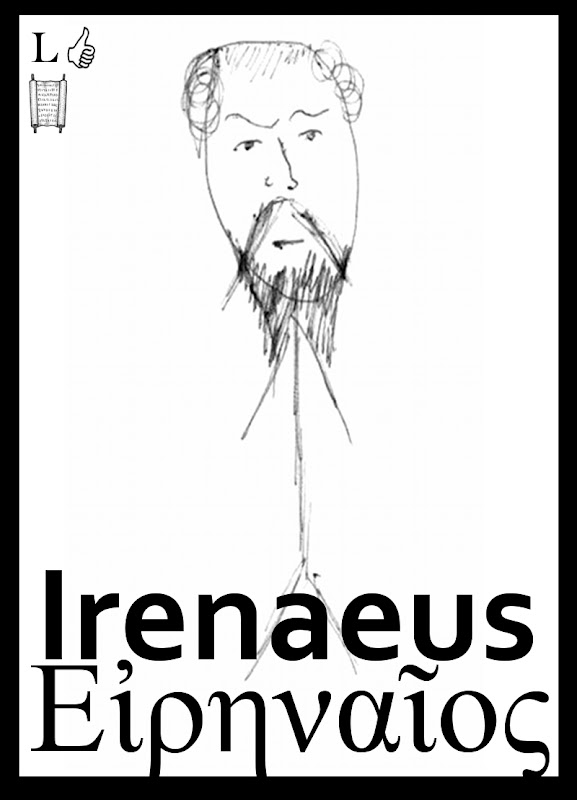
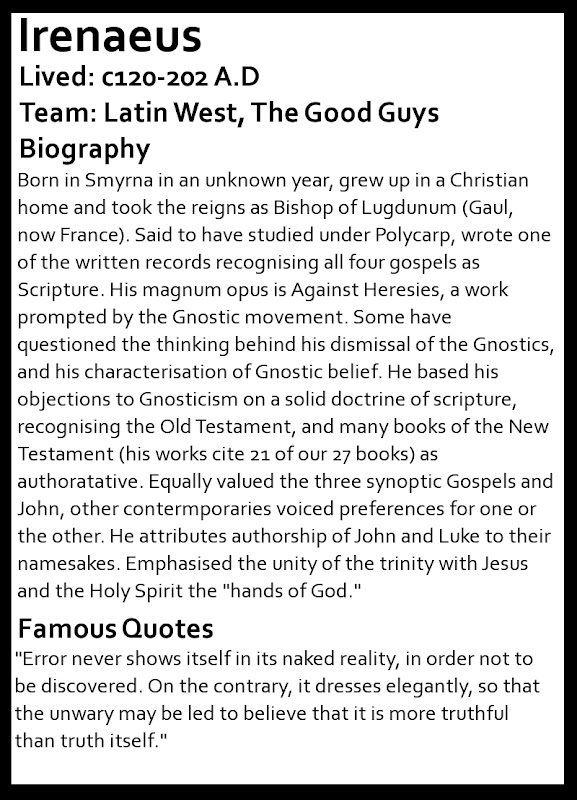
Church History Trading Cards: Irenaeus

Irenaeus studied under Polycarp, and then under Justin Martyr. A pretty enviable education. He rejected the latter’s fusion of philosophy and Christianity.

Despite serving in a church in the Latin West, Irenaeus was a Greek, born in Smyrna, his work was written in Greek, but the originals have been lost and the oldest copies are Latin translations.


His writings have been described as almost unintelligible to the modern reader. Here’s what someone wrote in the introduction to Book 1 of his most famous work, Against Heresies:

“Not a little of what is contained in the following pages will seem almost unintelligible to the English reader. And it is scarcely more comprehensible to those who have pondered long on the original. “

Irenaeus even makes an apology for his own writing in the introduction.

“Thou wilt not expect from me, who am resident among the Keltæ, and am accustomed for the most part to use a barbarous dialect, any display of rhetoric, which I have never learned, or any excellence of composition, which I have never practised, or any beauty and persuasiveness of style, to which I make no pretensions. But thou wilt accept in a kindly spirit what I in a like spirit write to thee simply, truthfully, and in my own homely way; whilst thou thyself (as being more capable than I am) wilt expand those ideas of which I send thee, as it were, only the seminal principles; and in the comprehensiveness of thy understanding, wilt develop to their full extent the points on which I briefly touch, so as to set with power before thy companions those things which I have uttered in weakness. “

He refuted the Gnostics on the basis that the Church had carried true beliefs from the time of Jesus through to his present time, here’s his summary of Christian belief:

“The Church, though dispersed through our the whole world, even to the ends of the earth, has received from the apostles and their disciples this faith: [She believes] in one God, the Father Almighty, Maker of heaven, and earth, and the sea, and all things that are in them; and in one Christ Jesus, the Son of God, who became incarnate for our salvation; and in the Holy Spirit, who proclaimed through the prophets the dispensations of God, and the advents, and the birth from a virgin, and the passion, and the resurrection from the dead, and the ascension into heaven in the flesh of the beloved Christ Jesus, our Lord, and His [future] manifestation from heaven in the glory of the Father “to gather all things in one,” and to raise up anew all flesh of the whole human race, in order that to Christ Jesus, our Lord, and God, and Saviour, and King, according to the will of the invisible Father, “every knee should bow, of things in heaven, and things in earth, and things under the earth, and that every tongue should confess” to Him, and that He should execute just judgment towards all; that He may send “spiritual wickednesses,” and the angels who transgressed and became apostates, together with the ungodly, and unrighteous, and wicked, and profane among men, into everlasting fire; but may, in the exercise of His grace, confer immortality on the righteous, and holy, and those who have kept His commandments, and have persevered in His love, some from the beginning [of their Christian course], and others from [the date of] their repentance, and may surround them with everlasting glory.

As I have already observed, the Church, having received this preaching and this faith, although scattered throughout the whole world, yet, as if occupying but one house, carefully preserves it.” – Against Heresies, Book One, Chapter X

Which stands the test of time.

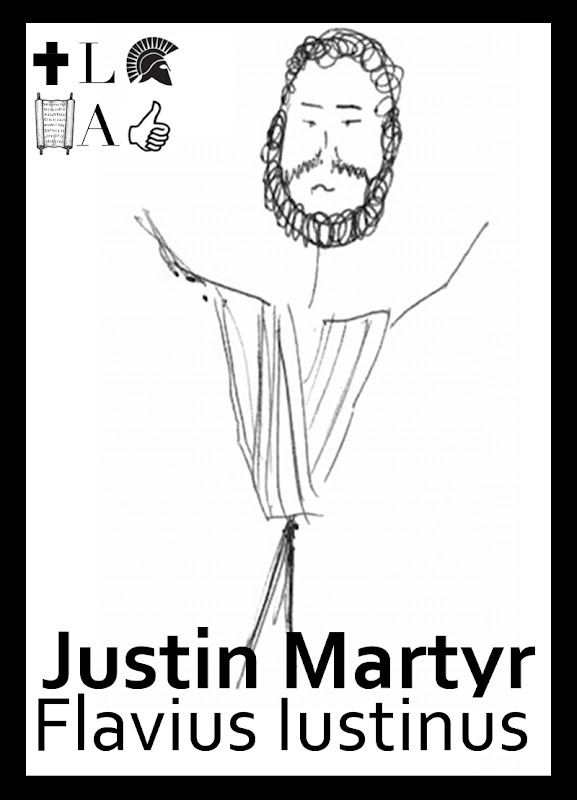
Church History Trading Cards: Justin Martyr

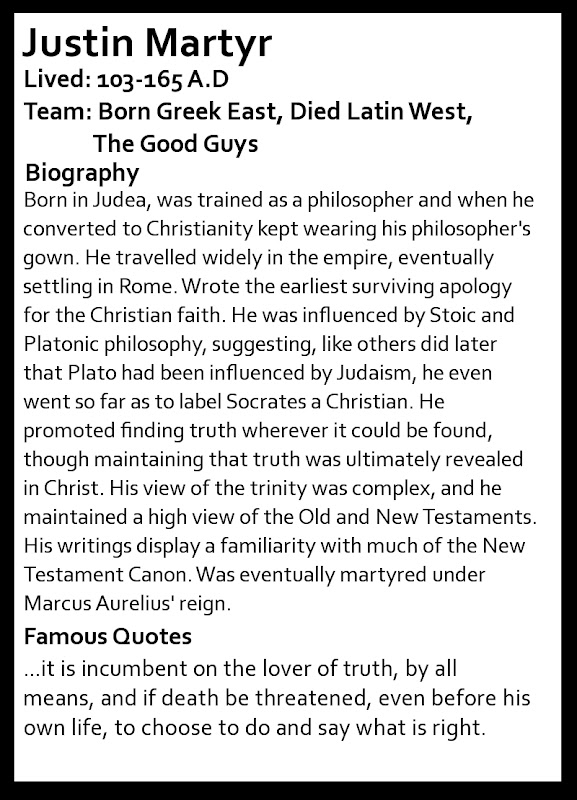
Justin Martyr was another one of those influential early Christian thinkers who came to Christianity from a background in Greek philosophy, and another guy who was deeply influenced by Platonism, but also had sympathy for Stoic philosophies, and went so far as to call Socrates a Christian because of the truths he recognised in Socratic thought. After his conversion he continued wearing his philosopher’s robe, and wandered around the empire teaching, before settling in Rome. He used his knowledge of philosophy as a string in his evangelistic bow, and wrote an apology for Christianity to the Roman Empire seeking to convince Rome to consider its position on the Christian faith more carefully.


From the Introduction to his Apology

Reason directs those who are truly pious and philosophical to honour and love only what is true, declining to follow traditional opinions, if these be worthless. For not only does sound reason direct us to refuse the guidance of those who did or taught anything wrong, but it is incumbent on the lover of truth, by all means, and if death be threatened, even before his own life, to choose to do and say what is right. Do you, then, since ye are called pious and philosophers, guardians of justice and lovers of learning, give good heed, and hearken to my address; and if ye are indeed such, it will be manifested. For we have come, not to flatter you by this writing, nor please you by our address, but to beg that you pass judgment, after an accurate and searching investigation, not flattered by prejudice or by a desire of pleasing superstitious men, nor induced by irrational impulse or evil rumours which have long been prevalent, to give a decision which will prove to be against yourselves. For as for us, we reckon that no evil can be done us, unless we be convicted as evil-doers or be proved to be wicked men; and you, you can kill, but not hurt us.

He was another famous martyr – beheaded in Rome during the reign of Marcus Aurelius. He was born in Judea, but it is likely that his father was a Greek or a Roman.

His writings recognise many of the books in our New Testament as scripture, and his reading of the Old Testament was influenced by the way the New Testament authors used it to point to Jesus as fulfillment, and by his Stoic predisposition for allegory.

There are some links to a few good articles about Justin Martyr here, and you can read his Apology and other writings here (though it’s in a slightly clunky form presented section by section on separate pages) unless you download this PDF of primary documents of the church fathers (including Justin Martyr) from the Christian Classics Ethereal Library.

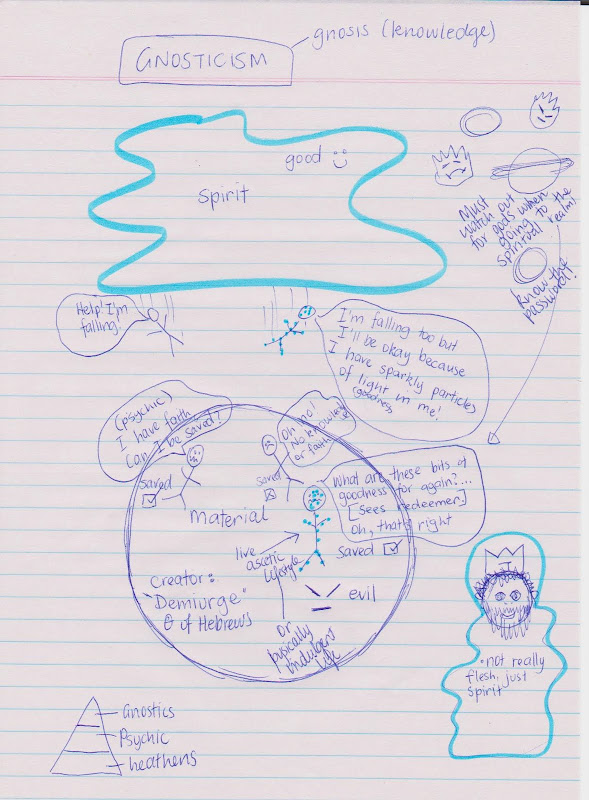
Church History 101: Robyn’s Guide To Gnosticism

I don’t want to present Robyn as an expert on heresy… but here’s her third guide to the heresies of the early church…

If you want a proper summary of Gnosticism I suggest you read this article from the online dictionary of philosophy, before reading the wikipedia entry, and then dismiss anything that isn’t also in the textbook.

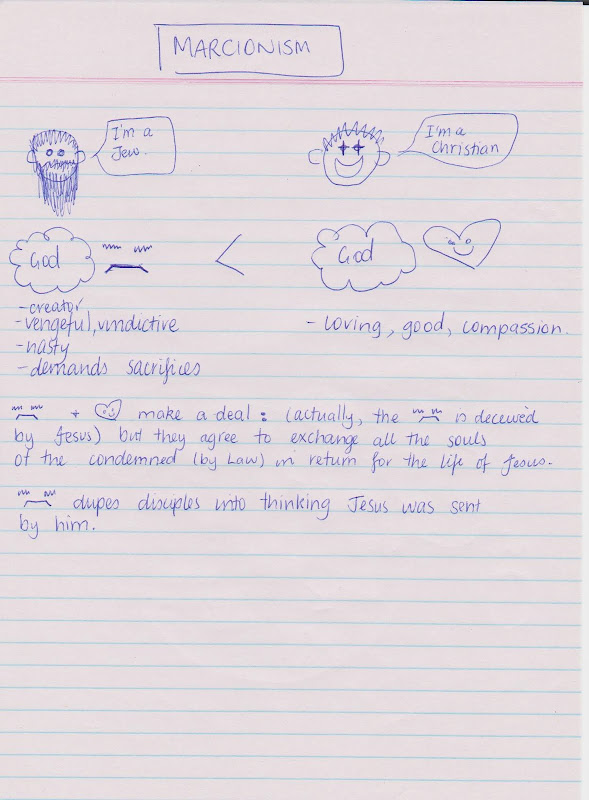
Church History 101: Robyn’s Guide to Marcionism

Marcionism, the heresy coined by Marcion, holds the dubious honour of being the first heresy identified as such by the church proper. Here’s Robyn’s guide to Marcionism:

Marcion also tossed out the Jewish Scriptures and most of the New. He went with ten chapters of Luke (that he’d edited) and ten of Paul’s epistles.

Some people think Marcionism is similar to Gnosticisim. It really wasn’t. The Gnostics were all about their “secret knowledge” while Marcionism based knowledge on Marcion’s canon. Which prompted the creation of the actual canon.

Marcionisms view of Christ was “docetic” – it denied the humanity of Jesus (and thus denied the Demiurge’s role in the make up of Jesus (the Demiurge was what Marcion called the God of the Old Testament – who he thought existed, but was evil). The Gnostics believed in this Demiurge, but also believed that Jesus was fully human.

In his favour, at least according to Origen, he ruled out the allegorical interpretations favoured by guys like Clement and Augustine, who essentially had the same issues with the Old Testament picture of God (before they allegorised their worries away). Tertullian reckons he was open to allegorical interpretations that suited him.

A guy named Robert Price reckons Marcion was the first to collect Paul’s epistles. This is because Robert Price is an idiot who thinks that Luke, Timothy and Onesimus are fictional characters. And doesn’t think most of the books of the New Testament were written until the second century (if that’s the case you’ve got to wonder why there’s no mention of the destruction of the Temple in AD 70. And why Acts ends where it does. And why John’s letters claim to be written by an eyewitness to Jesus ministry. Yeah. They must have been lying and ignoring some really compelling fulfillment of Jesus’ prophecy about the future of the temple, and forgetting that first century philosophical biographies (which Luke-Acts appears to be similar in genre to) normally ended with, or recounted, the death of the person they were writing about.

Blog Commenting Guidelines for Journalists

The Guardian Newspaper has posted its commenting guidelines for its own journalists.

I like them.

1. Participate in conversations about our content, and take responsibility for the conversations you start.

2. Focus on the constructive by recognising and rewarding intelligent contributions.

3. Don’t reward disruptive behaviour with attention, but report it when you find it.

4. Link to sources for facts or statements you reference, and encourage others to do likewise.

5. Declare personal interest when applicable. Be transparent about your affiliations, perspectives or previous coverage of a particular topic or individual.

6. Be careful about blurring fact and opinion and consider carefully how your words could be (mis)interpreted or (mis)represented.

7. Encourage readers to contribute perspective, additional knowledge and expertise. Acknowledge their additions.

8. Exemplify our community standards in your contributions above and below the line.

Church History Trading Cards: Clement of Alexandria

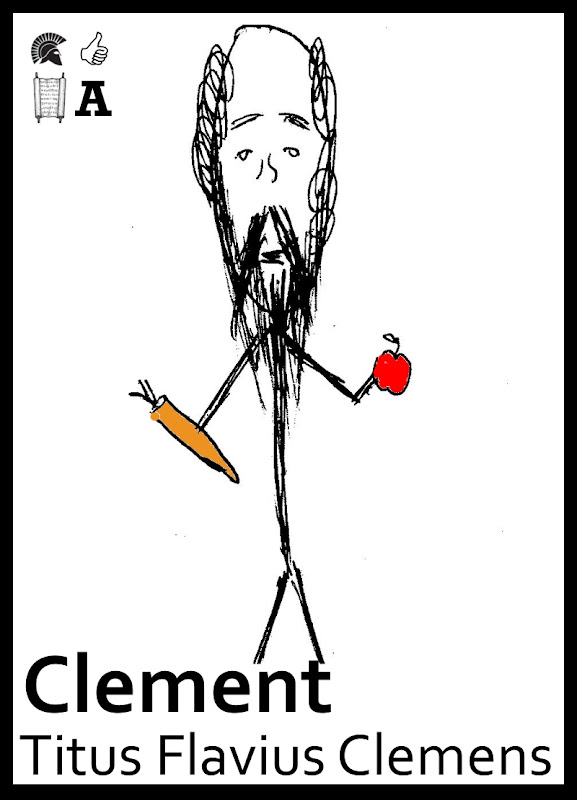
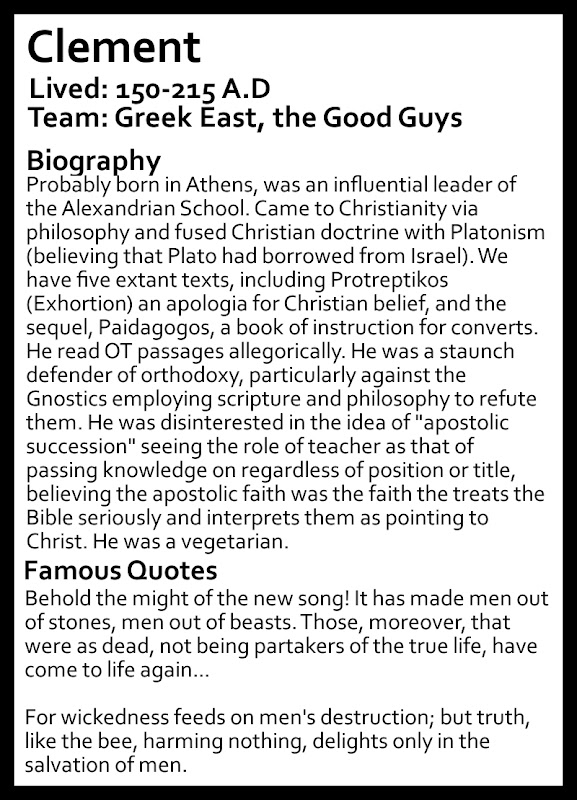
Clement was basically the proto-Augustine. Or, you could argue that he followed in Justin Martyr’s footsteps (and his omission from this series thus far will soon be rectified), and that Justin Martyr was the proto-Augustine. Basically his way of thinking and approaching the Greek school of philosophy was pretty similar to Augustine’s approach, and he, like Justin Martyr before him, and Augustine after him (and also like Philo before Justin) claimed that Plato had plagiarised Moses.

He knew Greek philosophy pretty well, and he sought to integrate it into his preaching of the gospel to a pretty educated audience in Alexandria. A city famous for being well educated and culturally sophisticated. Apollos (as in the Apollos of the Bible, as in “I follow Paul, I follow Apollos” also came from Alexandria).

Clement was a vegetarian, and like most vegetarians he had a moral superiority complex so he assumed that Jesus was a vegetarian too. I reckon Jesus hated vegetables, which is why he cursed the fig tree and hung out with fishermen.

Clement liked Plato, and he also liked Pythagoras. Who was the Pythagoras. The c2=a2 + b2 guy who figured out triangles and invented the self-draining siphon cup to play practical jokes on his greedy friends. Pythagoras was from Samos. The whole point of that paragraph was so that I could post this photo of a triangle in Samos.


From Samos

Clement wrote some pretty cool stuff too. Like everybody else who is famous from back then.

There are some good Clement resources here. And you can read his Exhortation here.

I like the motif he uses for the Gospel, that it’s a song that brings life to stone. He intertwines his systematic introduction to the gospel and appeal for conversion with the Bible in a fairly cohesive way – and he intersects that with Greek mythology and theology. He, like Augustine, was a little prone to allegory. Here are some highlights.

The silly are stocks and stones, and still more senseless than stones is a man who is steeped in ignorance. As our witness, let us adduce the voice of prophecy accordant with truth, and bewailing those who are crushed in ignorance and folly: “For God is able of these stones to raise up children to Abraham;” and He, commiserating their great ignorance and hardness of heart who are petrified against the truth, has raised up a seed of piety, sensitive to virtue, of those stones–of the nations, that is, who trusted in stones. Again, therefore, some venomous and false hypocrites, who plotted against righteousness, He once called “a brood of vipers.” But if one of those serpents even is willing to repent, and follows the Word, he becomes a man of God.

Others he figuratively calls wolves, clothed in sheep-skins, meaning thereby monsters of rapacity in human form. And so all such most savage beasts, and all such blocks of stone, the celestial song has transformed into tractable men. “For even we ourselves were sometime foolish, disobedient, deceived, serving divers lusts and pleasures, living in malice and envy, hateful, hating one another.” Thus speaks the apostolic Scripture: “But after that the kindness and love of God our saviour to man appeared, not by works of righteousness which we have done, but according to His mercy, He saved us.”

Wisdom, the celestial Word, is the all-harmonious, melodious, holy instrument of God. What, then, does this instrument–the Word of God, the Lord, the New Song–desire? To open the eyes of the blind, and unstop the ears of the deaf, and to lead the lame or the erring to righteousness, to exhibit God to the foolish, to put a stop to corruption, to conquer death, to reconcile disobedient children to their father. The instrument of God loves mankind. The Lord pities, instructs, exhorts, admonishes, saves, shields, and of His bounty promises us the kingdom of heaven as a reward for learning; and the only advantage He reaps is, that we are saved. For wickedness feeds on men’s destruction; but truth, like the bee, harming nothing, delights only in the salvation of men.

Behold the might of the new song! It has made men out of stones, men out of beasts. Those, moreover, that were as dead, not being partakers of the true life, have come to life again, simply by becoming listeners to this song. It also composed the universe into melodious order, and tuned the discord of the elements to harmonious arrangement, so that the whole world might become harmony. It let loose the fluid ocean, and yet has prevented it from encroaching on the land. The earth, again, which had been in a state of commotion, it has established, and fixed the sea as its boundary. The violence of fire it has softened by the atmosphere, as the Dorian is blended with the Lydian strain; and the harsh cold of the air it has moderated by the embrace of fire, harmoniously arranging these the extreme tones of the universe. And this deathless strain,the support of the whole and the harmony of all,–reaching from the centre to the circumference, and from the extremities to the central part, has harmonized this universal frame of things, not according to the Thracian music, which is like that invented by Jubal, but according to the paternal counsel of God, which fired the zeal of David.

This is the New Song, the manifestation of the Word that was in the beginning, and before the beginning. The Saviour, who existed before, has in recent days appeared. He, who is in Him that truly is, has appeared; for the Word, who “was with God,” and by whom all things were created, has appeared as our Teacher. The Word, who in the beginning bestowed on us life as Creator when He formed us, taught us to live well when He appeared as our Teacher; that as God He might afterwards conduct us to the life which never ends. He did not now for the first time pity us for our error; but He pitied us from the first, from the beginning. But now, at His appearance, lost as we already were, He accomplished our salvation. For that wicked reptile monster, by his enchantments, enslaves and plagues men even till now; inflicting, as seems to me, such barbarous vengeance on them as those who are said to bind the captives to corpses till they rot together. This wicked tyrant and serpent, accordingly, binding fast with the miserable chain of superstition whomsoever he can draw to his side from their birth, to stones, and stocks, and images, and such like idols, may with truth be said to have taken and buried living men with those dead idols, till both suffer corruption together.

I also like his exhortation to renounce pagan customs and turn to God…

“Let us then avoid custom as we would a dangerous headland, or the threatening Charybdis, or the mythic sirens. It chokes man, turns him away from truth, leads him away from life: custom is a snare, a gulf, a pit, a mischievous winnowing fan.”

Starting by presenting a call from Jesus:

This am I, this God wills, this is symphony, this the harmony of the Father, this is the Son, this is Christ, this the Word of God, the arm of the Lord, the power of the universe, the will of the Father; of which things there were images of old, but not all adequate. I desire to restore you according to the original model, that ye may become also like Me. I anoint you with the ungent of faith, by which you throw off corrup tion, and show you the naked form of righteousness by which you ascend to God. Come to Me, all ye that labour and are heavy laden, and I will give you rest. Take My yoke upon you, and learn of Me; for I am meek and lowly in heart: and ye shall find rest to your souls. For My yoke is easy, and My burden light.

And then his response:

Let us haste, let us run, my fellowmen–us, who are God-loving and God-like images of the Word. Let us haste, let us run, let us take His yoke, let us receive, to conduct us to immortality, the good charioteer of men. Let us love Christ. He led the colt with its parent; and having yoked the team of humanity to God, directs His chariot to immortality, hastening clearly to fulfil, by driving now into heaven, what He shadowed forth before by riding into Jerusalem. A spectacle most beautiful to the Father is the eternal Son crowned with victory. Let us aspire, then, after what is good; let us become God-loving men, and obtain the greatest of all things which are incapable of being harmed–God and life. Our helper is the Word; let us put confidence in Him; and never let us be visited with such a craving for silver and gold, and glory, as for the Word of truth Himself. For it will not, it will not be pleasing to God Himself if we value least those things which are worth most, and hold in the highest estimation the manifest enormities and the utter impiety of folly, and ignorance, and thoughtlessness, and idolatry. For not improperly the sons of the philosophers consider that the foolish are guilty of profanity and impiety in whatever they do; and describing ignorance itself as a species of madness, allege that the multitude are nothing but madmen. There is therefore no room to doubt, the Word will say, whether it is better to be sane or insane; but holding on to truth with our teeth, we must with all our might follow God, and in the exercise of wisdom regard all things to be, as they are, His; and besides, having learned that we are the most excellent of His possessions, let us commit ourselves to God, loving the Lord God, and regarding this as our business all our life long.

Saddle Up For Jesus

Got a friend who needs converting, or just to step out courageously for Jesus?. This will fix that.

Saddle Up And Ride from Family Christian Center on Vimeo.

Bringing people to God by the power of horses…

Because what the early church should have done was planted in the Hippodrome.

Missional v Attractional

This video made me laugh a little bit. Too much or too little of both of these extremes is a bit dumb. If you sound like one of these guys (and only one of these guys) then you’re creating false dichotomies.

Jesusville from Granger Community on Vimeo.

Via ChurchCrunch

Church History 101: Robyn’s Guide to Montanism

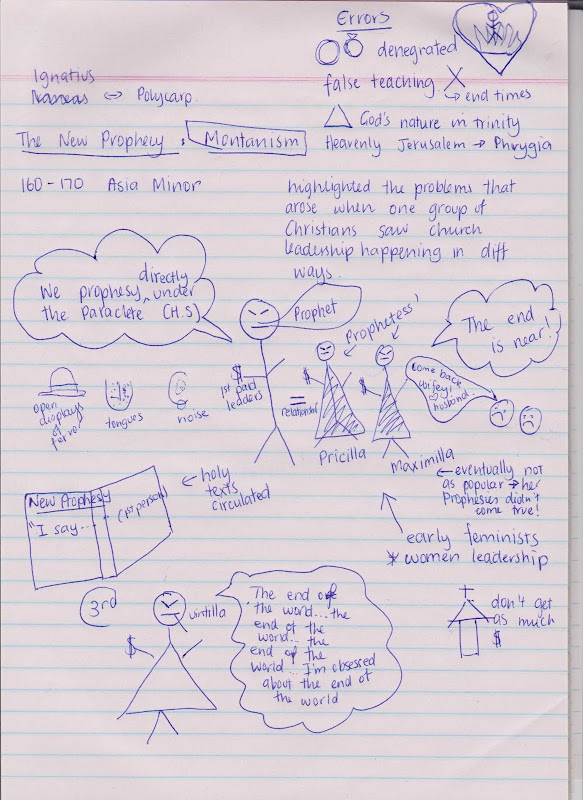
Montanism was a new prophecy. A movement that the church eventually decided was heretical. It arose in about 160 A.D in Asia Minor. Tertullian eventually became the most famous Montanist.

Here are some facts about Montanism included in the picture above. See if you can match them.

  1. Montanus was a “prophet”
  2. He was accompanied by two prophetesses named Pricilla and Maximilla.
  3. Pricilla and Maximilla abandoned their husbands to take up this role. The Montanists didn’t think much of marriage.
  4. They claimed to prophecy directly under the Holy Spirit.
  5. They were greatly interested in the end times, and kept proclaiming that it was near.
  6. Pricilla and Maximilla were early feminists, promoting women in leadership.
  7. They put on public displays featuring displays of fervour, tongues and lots of noise.
  8. They wrote holy texts, which were circulated and included prophecies written in the first person.
  9. They paid their church leadership which directed funds away from the church.
  10. Quintilla was one of the early converts  who became influential. She was obsessed about the end of the world.
  11. Some of their erroneous beliefs included the denigration of marriage, false teaching about the end times, misrepresentation of  God in the trinity, and that the heavenly Jerusalem would be in Phrygia.
  12. They strongly advocated church discipline and believed people couldn’t come back after leaving the church, and they loved martyrdom.

Church History Trading Cards: Tertullian

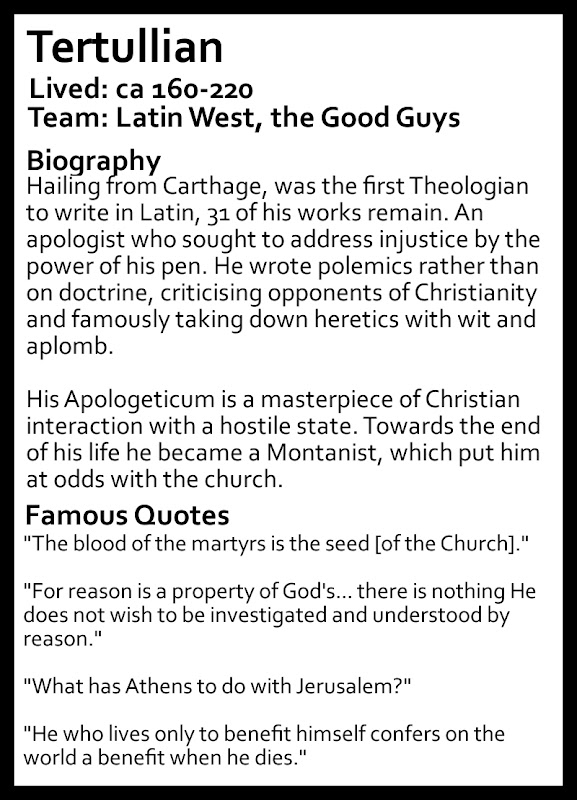
Tertullian is one of my favourite, if not my favourite writers from early church history. He writes acerbically with wit and biting sarcasm. There’s just something that resonates with me about the good guys from the Latin West (Augustine is cool too). Tertullian’s Apology is a must read. Check out the Tertullian Project for a batch of Tertullian flavoured resources.

Legend: L = Latin West, A = Apologist, Scroll = Author of primary documents you should read, Thumbs up = Theologically sound (mostly), Thumbs Down = Became a Montanist (which actually stopped him becoming a Catholic Saint, so it might have been worth it).

Here’s a sample from the Apology:

On the Legal Process for charges against Christians

“BUT if it is resolved we must be guilty, pray what is your reason for treating us differently from other criminals ? For it is a rule in law that where the case is the same, there the procedure of court ought to be the same also. But when we and heathens are impeached upon the same articles, the heathen shall be allowed the privilege of the council, and of pleading in person for setting off his innocence, it being against law to proceed to sentence before the defendant has put in his answer; but a Christian is permitted nothing, not to speak what is necessary, either to justify his cause, defend the truth, or prevent the injustice of his judges. On the contrary, nothing is attended to in his trial, but how to inflame the mob, and therefore the question is about his name only, and not the nature of his crime : whereas if you sit in judgment upon another criminal, and he pleads guilty to the indictment, suppose of homicide, sacrilege, incest, or rebellion (to instance the common
heads of your libels against us), upon such confession, I say, it is not your method forthwith to proceed to sentence, but you have patience to examine the nature of the fact in all its circumstances, viz.—the place, the time, the manner, and the accomplices of the action: but in the trial of a Christian, all these forms of justice are overruled.

On the foundation of Common Charges against Christians

…you ought on both sides to be equally severe in the examination of fact, and see to the bottom of those reports, so frequently and so falsely thrust upon us. For instance, to bring in a true list of how many infants every Christian has killed and eaten, what incests committed in the dark, what cooks we had for the dressing these children’s flesh, and what pimping dogs for putting out the candles.

On the response to changes wrought in people’s lives when they become Christians

Thus indeed they praise what they know, but vilify what they know not; they blot the fairest examples of virtue shining in their very eyes, because of a religion they are entirely in the dark about; whereas certainly, by all the rules of reason, we ought to judge of the nature of causes we see not, by the effects we see, and not pre-condemn apparent goodness for principles we understand not. Others, discoursing of some persons, whom they knew to be vagrants, and infamously lewd before they came over to our religion, drop their praises upon them in such a manner, that they stigmatize them with their very compliments; so darkened are they with prejudice that they blunder into the commendation of the thing they would condemn. For (say they) how wanton, and how witty was such a woman ! how amorous and frolicsome was such a young gentleman ! but now they are Christians : thus undesignedly they fix the amendment of their lives upon the alteration of their religion.

On the New Atheists (before they were even invented):

Some others are arrived to that pitch of aversion to the very name of Christian, that they seem to have entered into covenant with hatred, and bargained to gratify this passion at the expense of all the satisfactions of human life, acquiescing in the grossest of injuries rather than the hated thing of Christian should come within their doors.

On the Meaning of the word Christian

“But Christians is a Greek word, and means nothing more than a disciple of Christ, which by interpretation is the Anointed; and when you misname it Chrestian1 (for so far are you from understanding our religion, that as yet you know not our true name), even then it implies nothing worse than a benignity and sweetness of temper; thus outrageous are you at the sound of a name as inoffensive and harmless as those who bear it. But do men use to let loose their passions at this rate against any sect merely from the name of its founder ? Is it a new thing for scholars to be named from their masters? Is it not from hence that philosophers are called Platonists, Epicureans, Pythagoreans, etc.?”

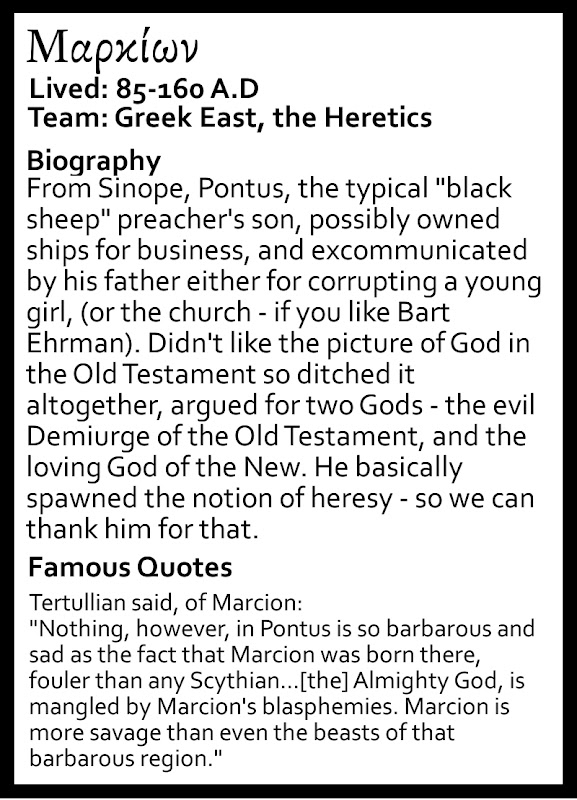
Church History Trading Cards: Marcion the Heretic

Marcion holds the honour of being the first person named and shamed by the church as a heretic. It was after Marcion that heresy hunting became a fun bloodsport for Christian writers and thinkers.

He couldn’t figure out how the Old Testament and New Testament could be reconciled (much like today’s atheists) so he decided to throw away the Old Testament, only accept Luke’s Gospel, and the writings of Paul, and believe in two Gods, the good one of the New Testament, and the Bad “Demiurge” of the old. This prompted a bit of an outcry (the guy was earlier excommunicated by his bishop, who happened to be his father), and Tertullian famously wrote a bunch of books addressing his heresies (you can read them online here). His description of Marcion’s home region, in volume I, and then his statement that as bad as it is, Marcion is the worst thing about it, is a beautiful piece of ad hominem polemic.

Marcion’s heretical understanding of Scripture also proved the catalyst for putting together a formal canon. So that’s another silver lining.

Key: The Spartan Helment – Marcion was from the Greek East, the Thumbs Down – Marcion was a heretic.

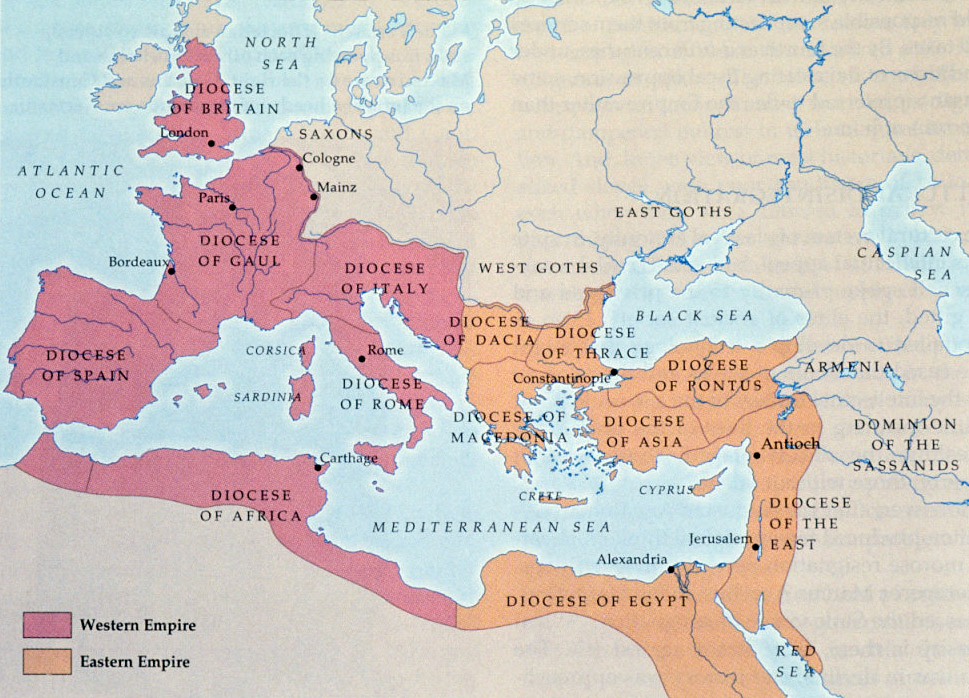
Church History 101: A map of the Roman Empire split into “Latin West” and “Greek East”

So, to make understanding Early Church History, and figures therefrom, we refer to them as being from the Greek East, or the Latin West. Here’s a map that clarifies what is what. It’s a bit clearer than the maps our wonderful, and very brilliant, lecturer Andrew Bain drew on the whiteboard.

MapEWRomanEmpire

Here, too, is a Wikipedia article on the distinction, useful for background. And another article on the schism that occurred between them, where there were eventually two emperors, one in the east, and one in the west, and then eventually just the western “empire” where there was a later schism and, for a while, two popes (irrelevant for this exam). The East became known as the Byzantine Empire.

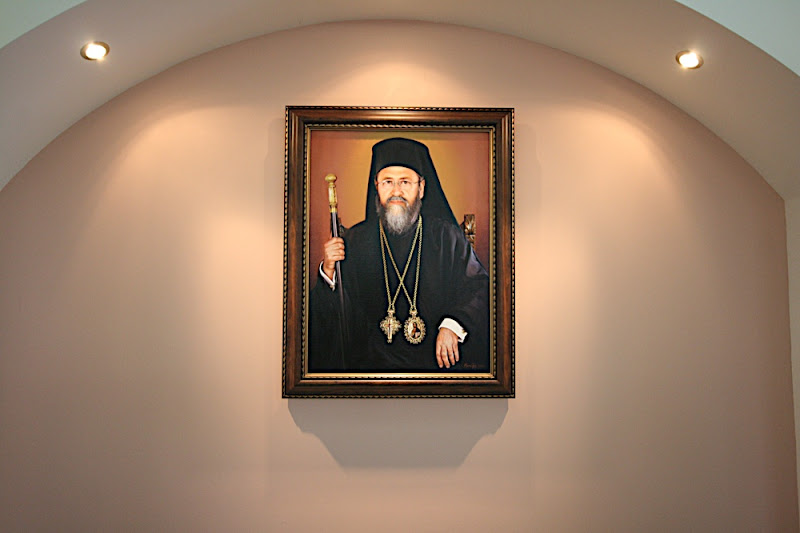
Of real interest is the interaction of different Christian views from the two sides of the empire, and how that interaction worked itself out in Christian belief… “Eastern Christianity” now describes “Orthodox” Christianity – as in the type practiced by Russian, and Greek Orthodox churches (they wear funny black robes, have beards, and hats). The current Greek Orthodox Bishop of Corinth looks like this:

Western Christianity now describes us, and the Catholics. The Latin speaking bit is carried over into Catholic liturgy. Here’s a little line diagram from Wikipedia:

When it comes to our subject, the East-West distinction helps place someone geographically, and has some bearing, but doesn’t necessarily define, somebody’s theology. It has some impact. But Augustine and Tertullian were from the west, and they were good, and Polycarp was from the East, and he was good too. Chronology has some bearing on how “good” or “bad” or “Biblical” or “heretical” somebody might be, when assessed geographically. All very confusing, no?